
World War Two
Published 6 Sep 2023Fight the Nazis or fight your countrymen? From Marshal Tito’s Partisans in Yugoslavia to the ELAS fighters in Greece, that is the animating question among the Balkans resistance movements. For many, the question is already answered. It is Mihailović and his Chetniks and EDES, EKKA, and the Greek royalist government who must be out-maneuvered first. British foreign policy has so far failed to change this state of affairs, can Churchill get his SOE officers to stop these civil wars?
(more…)
September 7, 2023
How Britain Helped the Communist Revolution – War Against Humanity 113
Comments Off on How Britain Helped the Communist Revolution – War Against Humanity 113
J.R.R. Tolkien was completely at odds with the literati of his day
In The Critic, Sebastian Milbank marks the 50th anniversary of the death of J.R.R. Tolkien:

J.R.R. Tolkien
A romantic Edwardian, steeped in Northern European folklore and Victorian literature, Tolkien was and is despised by large parts of the fashionable literary establishment. I have known very few neutral reactions to his work. People either love or loathe Lord of the Rings, which seems doomed to eternally inspire adoration or ire, and nothing much in between.
The often ferocious response of many critics perhaps stemmed from the apparent anachronism of the book, combined with its massive popularity. It was published in 1954, at a time when literary modernism was dominant and pervading the academy. Modernist writers were obsessed with interiority, broke with prior literary convention, and traded in irony, ambiguity and convoluted psychology. Literary critics of the time were taking up the “New Criticism”, which dispensed not only with the previous generation’s fascination with historical context in favour of close reading, but also with the traditionalist concerns for beauty and moral improvement, which were regarded as subjective and emotionally driven. Spare, complex prose, focused on the darker side of society, was in vogue. Into this context dropped 1,200 pages of dwarves, elves and hobbits in a grand battle of good and evil. They were greeted with the sort of enthusiasm one can imagine.
Edmund Wilson called the books “balderdash”, a battle between “Good people and Goblins”. The book’s morality was a sticking point even for the most sympathetic critics, with Edwin Muir lamenting that “his good people are consistently good, his evil figures immovably evil”. As his work travelled into the 60s, political problems cropped up, with one feminist critic writing a book-length attack on the series to denounce it as “irritatingly, blandly, traditionally masculine”.
The mystery of how a book can so sharply divide opinion is answered perhaps by how profoundly original and unusual The Lord of the Rings and Tolkien’s wider legendarium are. They are shamelessly moralistic, written on the basis of exhaustive literary theory, linguistics, geography and world-building, and quite devoid of social commentary or Empsonian irony. Yet they are as much a radical departure from prior literary forms as modernist literature itself is, making the book doubly at odds with prevailing style and doubly original.
The moralism of Tolkien’s work is not, as some critics seem to suppose, the product of schoolboy simplicity. It is far too rigorous for that. So morally charged and orchestrated is the novel, that it would be numbered amongst the small number of works that might have passed Plato’s test for literature. Not only is this in respect of its exacting honouring of good characters and depreciation of wicked ones within its narrative framework, but equally in Tolkien’s utter refusal of allegory, thus meeting Plato’s challenge that poets are dangerous imitators of the world.
Comments Off on J.R.R. Tolkien was completely at odds with the literati of his day
September 3, 2023
The War is Five Years Old – WW2 – Week 262 – September 2, 1944
World War Two
Published 2 Sep 2023Five years of war and no real end in sight, though the Allies sure seem to have the upper hand at the moment. Romania is coming under the Soviet thumb and Red Army troops are at Bulgaria’s borders, the Allies enter Belgium and also take ports in the south of France. A Slovak National Uprising begins against the Germans, and the Warsaw Uprising against them continues, but in China it is plans for defense being made against the advancing Japanese.
(more…)
Comments Off on The War is Five Years Old – WW2 – Week 262 – September 2, 1944
September 2, 2023
Trial Run for D-Day – Allied Invasion of Sicily 1943
Real Time History
Published 1 Sept 2023After defeating the Axis in North Africa, the stage was set for the first Allied landing in Europe. The target was Sicily and in summer 1943 Allied generals Patton and Montgomery set their sights on the island off the Italian peninsula.
(more…)
Comments Off on Trial Run for D-Day – Allied Invasion of Sicily 1943
September 1, 2023
Grassroots protests continue against London’s expanded ULEZ
London mayor Sadiq Khan’s “Ultra Low Emission Zone” expansion is not sitting well with the people who see it as an undemocratic imposition on the poorest Londoners:
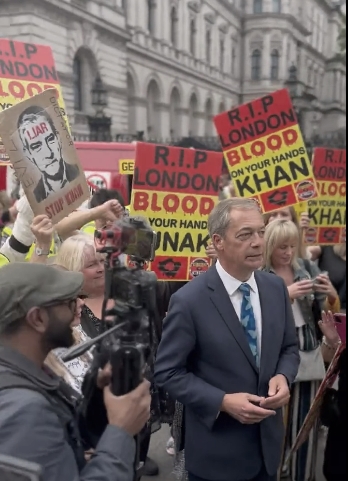
Nigel Farage at the ULEZ protests in London, 30 August 2023.
Image from JoNova.
This week many Londoners are waking up to the impact of living in an Ultra Low Emission Zone as the £12.50 daily charge for unfashionable cars begins in the outer poorer suburbs.
Normally “climate change” costs are secretly buried in bills, hidden in rising costs and blamed on “old unreliable coal plants”, inflation or foreign wars. Your electricity bill does not have a category for “subsidies for your neighbors’ solar panels”. But the immense pain of NetZero can’t be disguised.
For a pensioner on £186 a week it could be as much as an £87 a week penalty for driving their car — or £4,500 a year. The Daily Mail is full of stories of livid and dismayed people who served in the Navy or worked fifty years, who can’t afford to look after older frail Aunts or shop in their usual stores now, or who will have to give up their cars. People are talking about the “end of Democracy”. The cameras are expected to bring in £2.5 million a day in ULEZ charges to City Hall. But shops inside the zone may also lose customers, and everyone, with and without cars will have to pay more for tradespeople and deliveries to cover the cost of their new car or Ulez fee.
Protests have reached a new level of anger and hooded vigilantes in masks carry long gardening clippers, or spray cans and lasers to disable cameras that record number plates for Ulez. In one photo the whole metal camera pole has been sheared by an electric saw of some sort. There chaos.
Interactive maps have sprung up to report where the cameras are, and help people “plan their trips”. The vigilante group called Blade Runners have vowed to remove or disable every ULEZ camera in London. Nearly nine out of ten cameras have been vandalized in South-east London.
The Transport for London website was overwhelmed with searches from people wondering if their car was compliant and they would have to pay just to drive on the roads their taxes and fees built. Some people have bought old historic cars to get around the fee, but apparently a lot of people hadn’t thought much about what was coming. Sadiq Khan probably didn’t mention this in his election campaign. Presumably there are others in London who will get a nasty surprise bill in the mail.
As Nigel Farage says: “I’ve never seen people so angry about this new tax on working people. “And people are not just furious at Sadiq Khan, the Mayor of London, they’re angry at the Prime Minister and the Conservatives for not stopping the scheme.
Comments Off on Grassroots protests continue against London’s expanded ULEZ
August 31, 2023
The Double Agent Saving London From the V-1 – WW2 Documentary Special
World War Two
Published 30 Aug 2023The Germans are assaulting London with waves of V-1 flying bombs. But Eddie Chapman, a career criminal, serial womaniser, and masterful double agent working for MI5’s Double Cross is fighting a secret battle to beat the bombs. When he’s done with that, he pulls the wool over the Reich’s eyes to help Britain beat the Kriegsmarine. This is Agent Zigzag.
(more…)
Comments Off on The Double Agent Saving London From the V-1 – WW2 Documentary Special
The sciences have replication problems … historians face similar issues
In the latest Age of Invention newsletter, Anton Howes considers the history profession’s closest equivalent to the ongoing replication crisis in the sciences:
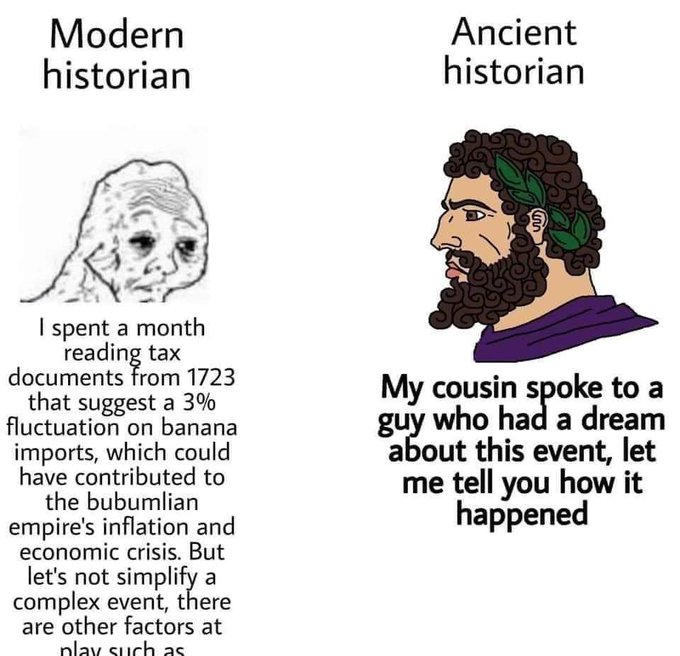
… I’ve become increasingly worried that science’s replication crises might pale in comparison to what happens all the time in history, which is not just a replication crisis but a reproducibility crisis. Replication is when you can repeat an experiment with new data or new materials and get the same result. Reproducibility is when you use exactly the same evidence as another person and still get the same result — so it has a much, much lower bar for success, which is what makes the lack of it in history all the more worrying.
Historical myths, often based on mere misunderstanding, but occasionally on bias or fraud, spread like wildfire. People just love to share unusual and interesting facts, and history is replete with things that are both unusual and true. So much that is surprising or shocking has happened, that it can take only years or decades of familiarity with a particular niche of history in order to smell a rat. Not only do myths spread rapidly, but they survive — far longer, I suspect, than in scientific fields.
Take the oft-repeated idea that more troops were sent to quash the Luddites in 1812 than to fight Napoleon in the Peninsular War in 1808. Utter nonsense, as I set out in 2017, though it has been cited again and again and again as fact ever since Eric Hobsbawm first misled everyone back in 1964. Before me, only a handful of niche military history experts seem to have noticed and were largely ignored. Despite being busted, it continues to spread. Terry Deary (of Horrible Histories fame), to give just one of many recent examples, repeated the myth in a 2020 book. Historical myths are especially zombie-like. Even when disproven, they just. won’t. die.
[…]
I don’t think this is just me being grumpy and pedantic. I come across examples of mistakes being made and then spreading almost daily. It is utterly pervasive. Last week when chatting to my friend Saloni Dattani, who has lately been writing a piece on the story of the malaria vaccine, I shared my
mounting paranoiahealthy scepticism of secondary sources and suggested she check up on a few of the references she’d cited just to see. A few days later and Saloni was horrified. When she actually looked closely, many of the neat little anecdotes she’d cited in her draft — like Louis Pasteur viewing some samples under a microscope and having his mind changed on the nature of malaria — turned out to have no actual underlying primary source from the time. It may as well have been fiction. And there was inaccuracy after inaccuracy, often inexplicable: one history of the World Health Organisation’s malaria eradication programme said it had been planned to take 5-7 years, but the sources actually said 10-15; a graph showed cholera pandemics as having killed a million people, with no citation, while the main sources on the topic actually suggest that in 1865-1947 it killed some 12 million people in British India alone.Now, it’s shockingly easy to make these mistakes — something I still do embarrassingly often, despite being constantly worried about it. When you write a lot, you’re bound to make some errors. You have to pray they’re small ones and try to correct them as swiftly as you can. I’m extremely grateful to the handful of subject-matter experts who will go out of their way to point them out to me. But the sheer pervasiveness of errors also allows unintentionally biased narratives to get repeated and become embedded as certainty, and even perhaps gives cover to people who purposefully make stuff up.
If the lack of replication or reproducibility is a problem in science, in history nobody even thinks about it in such terms. I don’t think I’ve ever heard of anyone systematically looking at the same sources as another historian and seeing if they’d reach the same conclusions. Nor can I think of a history paper ever being retracted or corrected, as they can be in science. At the most, a history journal might host a back-and-forth debate — sometimes delightfully acerbic — for the closely interested to follow. In the 1960s you could find an agricultural historian saying of another that he was “of course entitled to express his views, however bizarre.” But many journals will no longer print those kinds of exchanges, they’re hardly easy for the uninitiated to follow, and there is often a strong incentive to shut up and play nice (unless they happen to be a peer-reviewer, in which case some will feel empowered by the cover of anonymity to be extraordinarily rude).
August 29, 2023
The Souls of Black Folk by W.E.B. Du Bois “runs so fantastically counter to the entire ideology of ‘decolonise'”
In Spiked, Brendan O’Neill finds himself surprised at the inclusion of a very unusual book on a list demanded by those pushing for “decolonization” of university curricula:
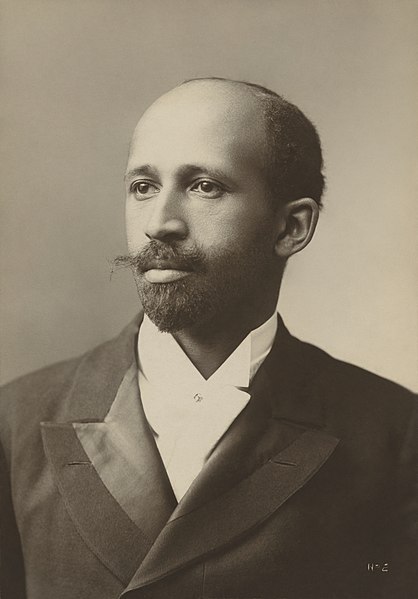
W.E.B. Du Bois by James E. Purdy, 1907, gelatin silver print, from the National Portrait Gallery which has explicitly released this digital image under the CC0 license.
Wikimedia Commons.
“Decolonise the curriculum” is a movement that wants university courses to focus less on dead white European males and more on writers of colour. Its argument is that black students need texts that speak directly to them. They need books by authors who look like them. They need books about experiences and ideas they can more readily relate to than they can the stuff written about in “high white culture”. Black students must be able to recognise themselves in what they study, we’re told, or else they’ll feel cheated and demeaned.
I was surprised to find that one of the leading decolonise movements, at the University of Edinburgh, was arguing for WEB Du Bois’ 1903 book, The Souls of Black Folk, to be included on the English curriculum. The activists said it was unreasonable to expect black students to engage with so many white authors. They also need to engage with people like Du Bois, in whose work they might “recognise themselves”. I was surprised, not because I think The Souls of Black Folk shouldn’t be on more university courses – absolutely it should. No, it’s because The Souls of Black Folk runs so fantastically counter to the entire ideology of “decolonise”. It made me wonder if these activists have even read it. Du Bois’ book contains some of the finest arguments you will ever read against the idea that high culture is a white thing that others cannot connect with.
One of my favourite passages in the book, from the chapter on what kind of education black men are fit for, touches on this very question. Here Du Bois makes his critique of those in his own time who were arguing that blacks only require basic education and industrial training. He describes his own experience of higher learning, writing:
I sit with Shakespeare and he winces not. Across the colour line I move arm in arm with Balzac and Dumas … From out the caves of evening that swing between the strong-limbed earth and the tracery of the stars, I summon Aristotle and Aurelius and they come all graciously with no scorn or condescension.
That passage, Du Bois’ moving belief that Shakespeare does not wince at him, captures a central thread of his writing: universalism. Du Bois agitates against accommodating to segregation or low expectations, and argues for the rights of “black folk” to assimilate into the spoils of civilisation; to become, as he puts it, “co-workers in the kingdom of culture”. To those in the late 1800s and early 1900s who argued that black people needed a targeted form of culture, one specific to their needs and capacities, Du Bois said: “We daily hear that an education that encourages aspiration, that sets the loftiest of ideals and seeks as an end culture and character rather than breadwinning, is the privilege of white men, and the danger and delusion of black men.”
Du Bois insisted that it is only through assimilation into the “kingdom of culture” that self-knowledge and self-improvement can truly occur. As he wrote: “Wed with Truth, I dwell above the veil.” The veil he’s referring to is the veil of colour, the one that separated blacks from whites in post-slavery America. For Du Bois, that veil was best lifted via assimilation into the American republic’s political universe and its realm of culture.
Du Bois’ critique of the notion that high culture was for white men, and would prove mystifying to black men, has sadly been superseded by an “anti-racism” with an entirely different outlook. Now, the supposedly radical stance is to believe that high culture is disorientating for black people, and possibly even damaging to their self-esteem, and therefore they require something more targeted. In short, they need release from the kingdom of culture. That, in essence, is what the decolonise movement desires: the “liberation” of non-white peoples from the cultural gains of Western civilisation. Behold the crisis of universalist belief.
Comments Off on The Souls of Black Folk by W.E.B. Du Bois “runs so fantastically counter to the entire ideology of ‘decolonise'”
August 28, 2023
Why Britain Advanced Before Other European Nations | Thomas Sowell
Thomas SowellTV
Published 17 Dec 2021
(more…)
Comments Off on Why Britain Advanced Before Other European Nations | Thomas Sowell
August 27, 2023
The Liberation of Paris – WW2 – Week 261 – August 26, 1944
World War Two
Published 26 Aug 2023Paris is liberated by the Allies, a symbolic act that causes the world to rejoice. Something far more important to the course of the war, though, happens this week in Romania. The Allies continue to advance in the south of France and begin a new offensive in Italy, though the Pacific War has quietened down once again.
(more…)
Comments Off on The Liberation of Paris – WW2 – Week 261 – August 26, 1944
6 Strange Facts About the Cold War
Decades
Published 27 Jul 2022Welcome to our history channel, run by those with a real passion for history & that’s about it. In today’s video, we will be exploring 6 odd Cold War facts.
(more…)
Comments Off on 6 Strange Facts About the Cold War
August 25, 2023
Fortress Britain with Alice Roberts S01E03
Fortress Britain with Alice Roberts
Published 16 Apr 2023
Comments Off on Fortress Britain with Alice Roberts S01E03
August 23, 2023
Slovenian SAR80: Sterling Out-Simplifies the AR-180
Forgotten Weapons
Published 15 May 2023The British Sterling firm designed the SAR-80 (specifically, their engineer Frank Waters) as a very simple rifle to sell to countries outside the main NATO/Warsaw Pact spheres of influence. Sterling ended up getting a license to produce the AR-18 though, and didn’t put Waters’ design into production.
When the newly formed Chartered Industries of Singapore came looking for a rifle to produce, the SAR-80 design was a chance for Sterling to sell a production license. CIS needed something to produce domestically to equip the Singaporean Army, and the SAR-80 met their needs. After selling the rifles to their own Army, the company went looking for export clients. They found a few, including Croatia, the Central African Republic, and Slovenia. A total of about 80,000 SAR-80 rifles were made, and this is one of the Slovenian-contract examples.
(more…)
Comments Off on Slovenian SAR80: Sterling Out-Simplifies the AR-180
August 22, 2023
“… the theatrics employed by Hitler and Mussolini just seemed too weird and downright ridiculous to the British”
In Spiked, Ralph Schoellhammer discusses some of the difficulties the Green Gestapo, er, I mean the likes of Extinction Rebellion and their mini-mes like Just Stop Oil have been encountering with the British public:

Roderick Spode, 7th Earl of Sidcup, leader of the “Saviours of Britain”, also known as the Black Shorts.
Still from Jeeves and Wooster (1990).
I have long been convinced that one of the reasons why fascism never had a chance in Britain was due to the predispositions of her people. If nothing else, the theatrics employed by Hitler and Mussolini just seemed too weird and downright ridiculous to the British.
PG Wodehouse captured this perfectly in an exchange between a British wannabe fascist, Roderick Spode, and Bertie Wooster: “The trouble with you, Spode, is that just because you have succeeded in inducing a handful of half-wits to disfigure the London scene by going about in black shorts, you think you’re someone.”
I don’t intend to liken fascists to environmentalists, but Brits have at least expressed a similar, visceral distaste for the theatrics of eco-activist groups in recent years. Marching in black “footer bags”, pretending to be the voice of the people, is just as ridiculous as holding up traffic in an orange “Just Stop Oil” t-shirt.
The environmental movement becomes more absurd by the day. The Guardian‘s George Monbiot, for instance, has just called for the reintroduction of deadly wolves and lynxes to Great Britain, in order to manage a surging deer population. One can only hope that this call to action will have about as much success as his campaign against meat, milk and eggs, which Monbiot is convinced are an “indulgence” humanity can no longer afford.
Sadly, the same is not true in Germany, where the elites are all too keen to humour even the most extreme climate fanatics. German discount supermarket Penny recently decided to increase the prices of its meat and dairy products, to include the environmental costs incurred in their production, as part of a week-long experiment. The price of frankfurter sausages rose from €3.19 to €6.01. The price of mozzarella rose by 74 per cent, to €1.55. And the price of fruit yoghurt rose by 31 per cent, from €1.19 to €1.56.
While the usual suspects in the establishment are clearly excited by this idea that in the future even shopping at a discount shop might become the preserve of the rich, average Germans are less pleased. Germany’s public broadcaster, WDR, asked Penny customers what they thought about the price-hike experiment. Due to a lack of enthusiasm from shoppers, WDR decided to have one of its employees cosplay as a happy shopper. That taxpayer-funded broadcasters now have to resort to outright fraud in order to drum up support for idiotic climate action tells you everything you need to know.
Comments Off on “… the theatrics employed by Hitler and Mussolini just seemed too weird and downright ridiculous to the British”
August 20, 2023
Hitler Has a Bad Day – WW2 – Week 260 – August 19 – 1944
World War Two
Published 19 Aug 2023This week the Allies invade Southern France, and do so very successfully. They’re also successful in the north, closing the Falaise gap and trapping huge numbers of Germans. In the East, however, the Germans manage to stop the Soviet drive on Riga with a counter attack, and in Warsaw they continue to brutally put down the Warsaw Uprising.
(more…)
Comments Off on Hitler Has a Bad Day – WW2 – Week 260 – August 19 – 1944


