In Reason, J.D. Tuccille discusses the hidden impact of “red tape” on the economy — just because the government isn’t getting a cheque doesn’t mean that compliance is free:
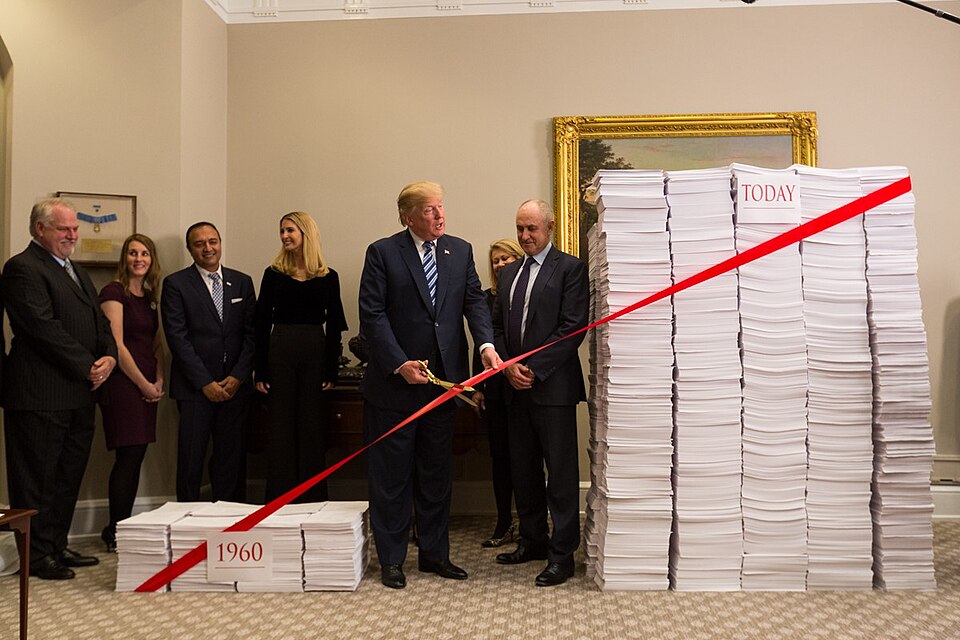
President Trump prepares to cut a “red tape” display of regulations representative of 1960 and compared to the current numbers of regulations, Thursday, December 14, 2017, in the Roosevelt Room at the White House, announcing how the administration is keeping its promise to remove regulations burdening job creators and American taxpayers.
White House photo via Wikimedia Commons.
Anybody who runs a business or engages in regulated activities knows that government red tape imposes a significant burden. Those burdens can be very high, deterring entrepreneurs from launching companies, restraining the growth of those that already exist, and driving some people to operate illegally rather than try to deal with an administrative state that specializes in obstructionism. But just how much do federal regulations cost us? A new report from the Competitive Enterprise Institute (CEI) tries to tally the price tag — and warns that Washington, D.C. needs major reform.
The Out-of-Control Regulatory State
That the regulatory state is out of control isn’t really a debatable point. The Federal Register lists 445 agencies with the legal authority to publish regulations. Forbes noted that “federal departments, agencies, and commissions issued 3,853 rules in 2016, while Congress passed and the president signed 214 bills into law”. In May of last year, the White House acknowledged that “the United States is drastically overregulated” and that “the Code of Federal Regulations contains over 48,000 sections, stretching over 175,000 pages … Worse, many carry potential criminal penalties for violations.”
[…]
Compliance Costs Strangle the Economy
“Just as consumers shoulder much of the corporate income tax and tariff burden, regulatory compliance costs and mandates borne by businesses percolate through the economy and materialize as higher prices, lost jobs, and lower output,” writes Crews. “Off-budget regulatory costs can drag down the economy, just as overspending can.”
If you balk at the idea that federal regulations impose costs of over $2 trillion on Americans, you should be aware that CEI is restrained in its assessment. As the report points out, other sources assign even higher price tags to regulatory burdens. Three years ago, the National Association of Manufacturers (NAM) estimated that “the total cost of federal regulations in 2022 is an estimated $3.079 trillion (in 2023 dollars), an amount equal to 12% of U.S. GDP”. That NAM report added that “the annual cost burden for an average U.S. firm is $277,000, the equivalent of 19% of the average firm’s payroll expenses”. For manufacturers with fewer than 50 employees, the NAM put regulatory compliance costs at $50,100 per employee per year.
Compliance costs aren’t expressed in only monetary terms, they also require time and effort. According to the Office of Management and Budget, for Americans supplying required information to federal agencies “in FY2022, the total paperwork burden … was 10.34 billion hours, compared to 9.97 billion hours in FY2021”.
Of course, not everyone is equally impacted by government regulations. Generally speaking, the smaller the company, the harder it is to comply with all the relevant rules, so big companies often end up supporting demands for more regulation because it handicaps smaller competitors to a much greater degree.