You’ve probably noticed that I don’t include a lot of content on Iran or Ukraine these days. That’s largely because the fog of war propaganda is too dense for much reliable information to come to us and be subject to any kind of fair analysis. Lorenzo Warby has a few rules to suggest to those of you trying to sift real information out of the noise — both specifically on the Iran conflict and also more generally for these kinds of low-signal/high-noise conflicts:
There is a lot of poor quality commentary about on the current Iran War — or, as the Chinese call it, the War in West Asia. Fortunately, there are two simple tests that winnows out much of the noise so you can focus on signal.
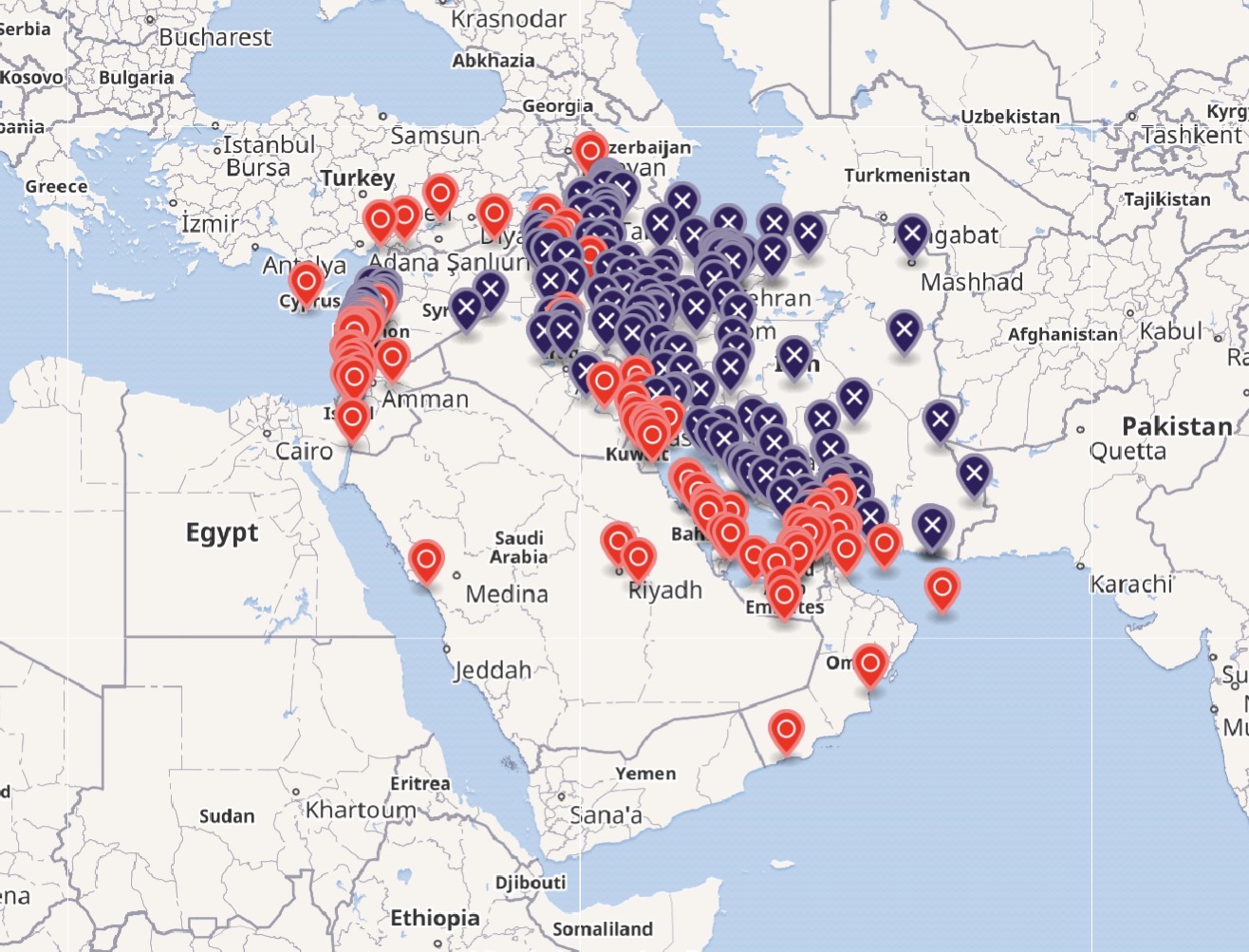
Locations struck by:
– United States and Israel (blue)
– Iran, Hezbollah, Houthis, and PMF (red)First Easy Test
Would this commentator ever admit that Trump had done something positive?
If the answer is no, ignore them. They are not commenting on the War, they are commenting on Trump. They are just providing anti-Trump talking points for this particular issue.
Second Easy Test
Does this commentator pay any attention to the record of the Islamic Regime? Its record of domestic repression, including various mass executions and mass killings of protesters? Its record in supporting and constructing proxies: in Lebanon, in Gaza, in Yemen, in Iraq, in Syria, in …? The record of those proxies and how they disrupt and degrade those countries? Its record in promoting terrorism across the globe? Its record in massive economic and environmental dysfunction …?
If the answer is no, ignore them. This is especially so if what they do comment on is Israel. They are not commenting on the War, they are commenting on Trump and on Israel. They are just providing anti-Trump, anti-Israel talking points for this particular issue.
The more of a regime of internal exploitation the Islamic Regime has become, the more it has built up its proxy forces. The more it built up its proxy forces, the more disruptive and destructive it has become.
[…]
Third, More Subtle, Test
The third test is about how wars work. Does the commentator understand that good strategy in war is a decision-tree? If you do X and Y happens, then follow up with Z. If you do X and A happens, follow up with B.
If they do not understand that, if they treat successful war strategy as being able to operate according to some plan so what the opponent does in response to it does not matter, then they do not understand war, and you can ignore them.
A classic way to fail in military affairs, is to not treat military action as a decision-tree, but to continue with the previous plan of action despite some crucial change in circumstances.