
World War Two
Published 10 Oct 2026The StuG III was built to support infantry. It became one of Germany’s most important tank killers. How did the Sturmgeschütz III go from mobile artillery to a mainstay of German armored warfare?
Built on the Panzer III chassis, the StuG traded a revolving turret for a low silhouette, strong frontal protection, and a fixed gun. Originally designed to destroy machine-gun nests and fortifications, it gained a long-barreled 75 mm gun as Germany confronted the T-34 and other Soviet tanks.
In “One Artillery Piece for the Road”, Spartacus Olsson follows the StuG III from Manstein’s assault-artillery concept through its development, production, and combat service. We examine its strengths, mechanical limitations, and the struggle between the artillery and Panzer branches over its expanding role.
Germany’s most numerous fully tracked armored fighting vehicle also exposes a larger contradiction: Nazi Germany could build practical, economical weapons, yet repeatedly burdened its war effort with costly complexity. What made the StuG different, and why could its battlefield successes never solve Germany’s strategic problems?
October 11, 2026
One Artillery Piece for the Road! – StuG III – Nazi Rearmament 09
October 4, 2026
From MG 34 to MG 42: Building Hitler’s Buzzsaw – Nazi Rearmament 08
World War Two
Published 3 Oct 2026The MG 34 pioneered the modern general-purpose machine gun. The MG 42 preserved that battlefield versatility while cutting manufacturing labor roughly in half and producing the terrifying sound remembered as “Hitler’s Buzzsaw”.
In this Nazi Rearmament episode, Spartacus traces the development of the MG 34 and MG 42 from clandestine German weapons programs during the 1930s through mass production and combat in World War II.
We examine how one basic weapon could accompany an infantry squad, deliver sustained long-range fire, engage low-flying aircraft, and serve inside tanks and fortifications. We also explore why the beautifully machined MG 34 became an industrial problem, and how stamped steel, roller locking, rapid barrel changes, and a cyclic rate reaching 1,500 rounds per minute transformed its successor.
But this is more than the story of two famous German machine guns. It is also a study of Nazi Germany’s war economy: technically ambitious and capable of remarkable innovation, yet ultimately unable to overcome the manpower and industrial resources of the coalition it chose to fight.
Finally, we follow the weapons beyond 1945, from the continued foreign service of the MG 34 to the MG 42’s postwar descendants, the MG 1, MG 2, and MG 3.
Which small arm should we cover next: the MP 40, FG 42, or StG 44?
September 30, 2026
What’s the Point of Armoured Cars?
The Tank Museum
Published 29 May 2026Even though we call ourselves The Tank Museum, at heart we are the museum of the Royal Armoured Corps. That means we don’t just have tanks — we have a wide range of armoured fighting vehicles that tell the story of the Corps. Within that collection sits the armoured car.
On the surface it can seem redundant: tanks are better armoured, have superior cross-country mobility and usually carry bigger guns. So why do armoured cars — a concept that predates the tank — remain in service today? After all, a Ferret doesn’t sound nearly as intimidating when up against the likes of the Chieftain.
00:00 | Introduction
01:25 | Starting Small
02:49 | Speed Demons
09:40 | Going Global
13:13 | Only the Enemy in Front
19:28 | Go Big or Go Home
(more…)
September 27, 2026
The 88 – Foe of Tanks and Planes Alike – Nazi Rearmament 07
World War Two
Published 26 Sep 2026The German 8.8-centimeter Flak began as a heavy anti-aircraft gun, but war repeatedly dragged it into new roles. It shot at bombers, destroyed tanks, smashed bunkers, supported infantry, and eventually defended the collapsing Reich from Allied armies advancing into Germany.
Its origins, however, predated the Nazis. Developed through clandestine cooperation between Krupp and the Swedish firm Bofors, the Flak 18 emerged from Weimar Germany’s efforts to evade the military restrictions imposed after the First World War. The Nazis inherited that expertise, expanded production enormously, and turned the “Eighty-Eight” into one of the most famous weapons of the Second World War.
From Spain and France to North Africa, the Eastern Front, and the air defense of German cities, the 88 earned a formidable reputation. But how much of that reputation was deserved? Was it really an unparalleled anti-tank weapon, or has later mythology exaggerated its contribution?
In this German rearmament special, we examine the development, production, deployment, capabilities, limitations, and strategic effect of the Flak 18, Flak 36, Flak 37, and the substantially redesigned Flak 41. This is the history behind the legend: an impressive piece of engineering employed in support of Nazi Germany’s war of conquest and genocide.
Harsher than Versailles: The Treaty of Brest-Litovsk 1918
The Great War
Published 24 Apr 2026On March 3, 1918 the Central Powers (Germany, Austria-Hungary, Bulgaria, and the Ottoman Empire) and Bolshevik Russia signed the Treaty of Brest-Litovsk, ending the First World War on the Eastern Front. The terms were harsher than those the Germans offered in December, and much harsher than the later Treaty of Versailles. The Treaty of Brest-Litovsk was only in force until November 1918, when the Central Powers’ defeat nullified it. But it had a major impact inside and outside Russia.
(more…)
September 23, 2026
Friedrich Merz’s rapidly fading political future
On Substack, eugyppius discusses the electoral chasm at Chancellor Friedrich Merz’s feet after terrible showings in recent state elections for his party and the continued rise of the extremely extreme extreme-right Alternative für Deutschland (AfD):


Within months of becoming Chancellor, Friedrich Merz promised an “Autumn of reforms”, which never materialised because the political will to fix Germany’s economic and fiscal problems does not exist within his coalition. Having failed to fix anything and driven support for the once-mighty CDU to historic lows, Merz has instead been served an Autumn of Reckoning. It is unclear whether he will survive it.
The state elections in Sachsen-Anhalt, Mecklenburg-Vorpommern and Berlin that for months have inspired fear and trembling within the German political establishment have come and gone. Each of them has realised our rulers’ worst fears in different ways.
1) In Sachsen-Anhalt, the CDU underperformed polls by more than 20%, while Alternative für Deutschland achieved the highest vote share any party has ever won in that state. The AfD are already in talks with the Bündnis Sahra Wagenknecht, and everyone expects an AfD government under Ulrich Siegmund to take power in the coming months.
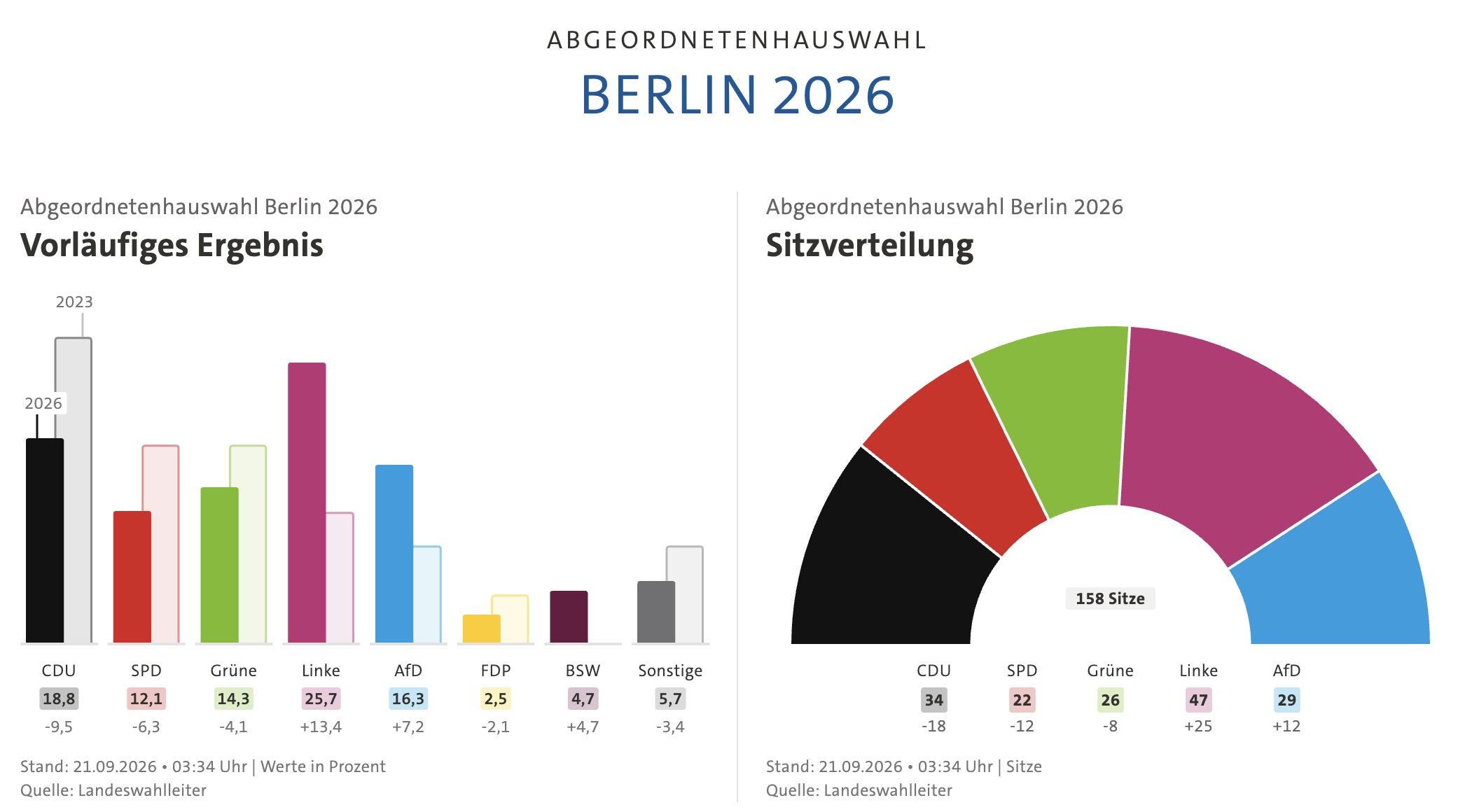
2) In Berlin, the CDU managed to squander the clear polling dominance it enjoyed throughout 2025 to finish in second place with just 18.8% of the vote – nearly seven points behind Die Linke. That is what a series of extremely stupid and unnecessary local scandals alongside association with the most unpopular Chancellor in the history of the Federal Republic can do to a party.
Zohran Mamdani’s advisers and campaign strategists assisted Die Linke in their left-populist Berlin campaign, which enjoyed particularly strong appeal among young voters. Assuming some late-breaking turbulence caused by the corruption and indiscipline that are typical of Die Linke do not derail things, they will form a government with the Greens and the Social Democrats.
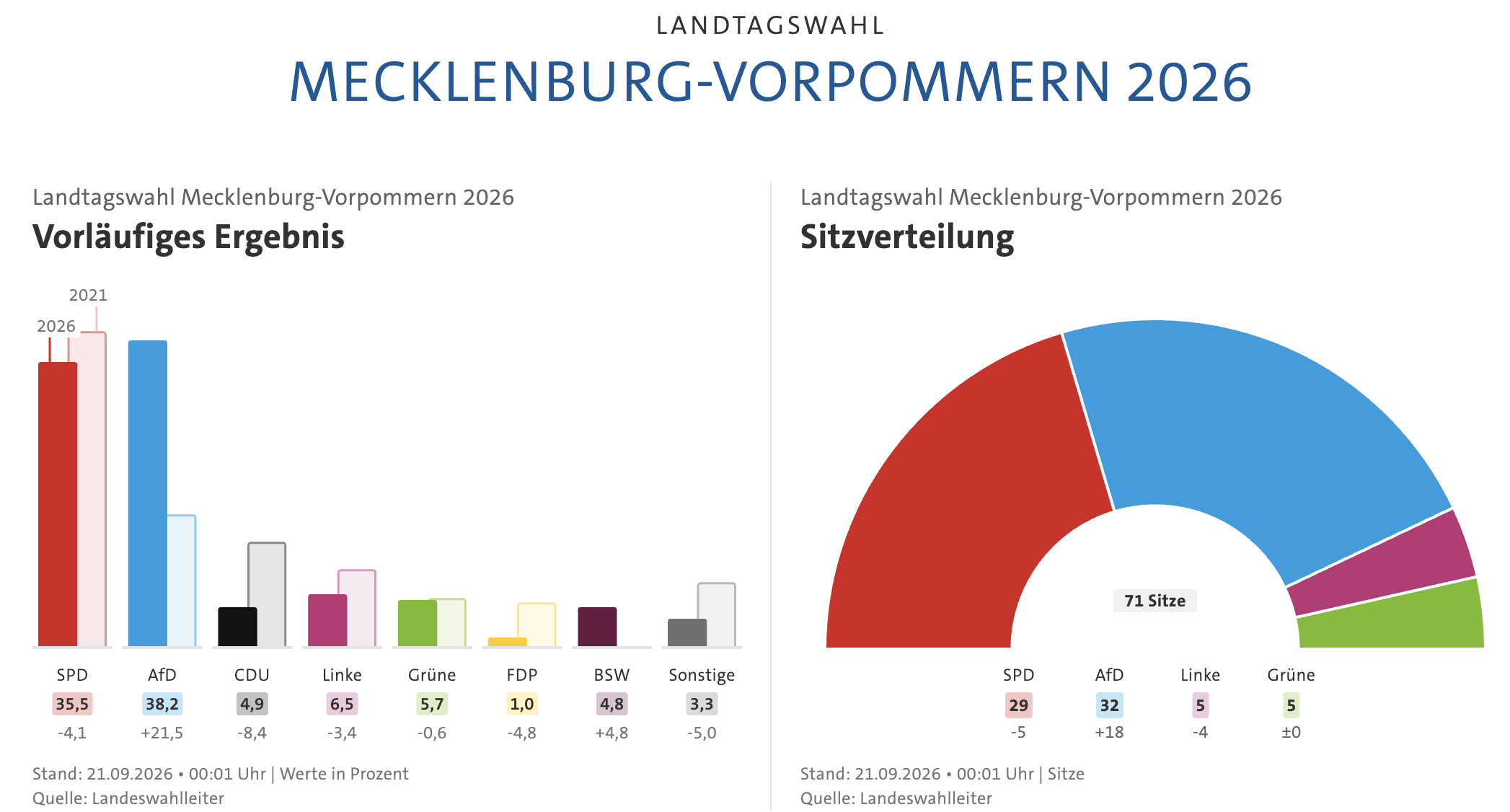
3) In Mecklenburg-Vorpommern, the CDU managed to underperform every last poll, logging their worst electoral result in all of history. With just 4.9% of the vote, they failed for the first time ever to scrape across the 5% hurdle for representation in the Landtag – an outcome I have predicted for weeks. Whereas in Sachsen-Anhalt voters overcame the firewall by making the AfD too powerful to wall off, in Mecklenburg-Vorpommern they abolished it entirely by kicking the party that invented and maintains the firewall straight out of parliament.
Alternative für Deutschland won the largest vote share, but the result will be another coalition of Social Democrats, Greens and Die Linke under the long-serving Minister President Manuela Schwesig. Schwesig enjoys especially strong popularity among women and pensioners, and she will be helped into power by a smattering of leftist students and climate-obsessed urbanites. The AfD will stand alone in opposition to the tepid foolishness of the coming legislature, and the citizens of Mecklenburg-Vorpommern will develop new ways of thinking about the Evil Fascist Nazi Hitler party, which probably cannot be all that evil or fascist or Nazi or Hitler, given that there is no longer any alternative to the left here in the northeast.
September 21, 2026
Custom-Order Walthers: Model HP and P38 in 7.65mm Parabellum
Forgotten Weapons
Published 8 May 2026When Walther first developed the P38, it was designated the Heerespistole — “Army Pistol”. Only after getting official Wehrmacht adoption did it get the designation P38. Walther offered models with both designations for commercial sale, albeit not to just anyone. Army officers, Party members, and other high-placed individuals could get pistols from Walther outside military orders. About 20,000 such guns were made during the war, and a tiny subset of them — just 225 — were made specifically in 7.65mm Parabellum instead of 9mm Parabellum. Today we are looking at two examples of those.
(more…)
September 20, 2026
September 15, 2026
The First Military Luger: Swiss Model 1900 s/n 01
Forgotten Weapons
Published 27 Apr 2026The first nation to adopt the Luger was Switzerland, which began testing in late 1898 and formally accepted the Luger in May 1900. Their guns were the first Lugers to be mass produced, as they were the first order received by DWM. The first batch of 600 arrived in Switzerland in May 1901, and today we are taking a look at the very first of that batch — serial number 01. It is the first production military Luger, and that’s a pretty cool landmark.
C&Rsenal Swiss Model 1900 video: • History of WWI Primer 145: Swiss Luger 19…
QotD: Auftragstaktik or “mission-type tactics”
Mission Command or Auftragstaktik (also “mission-type tactics”) is a style of command and control which stresses flexible decision-making by smaller units pursuing an objective (the “mission” of mission tactics) rather than imposing a single rigid top-down plan on the entire force. Under this framework, upper-level commanders assign objectives to their subordinates, who can then use their better local knowledge and quicker reaction times (being closer to the front) to craft a flexible plan to achieve those objectives; this process is then repeated down the command structure. Originally a German concept, US doctrine embraces mission command as its ideal style of command. Russian doctrine, by contrast, has generally been substantially more top-down in nature (with implications for force structure as well); this has proven a liability in Ukraine as the top-down plan did not go to plan and lower-level Russian commanders and NCOs are not generally trained to deviate from the plan “on the fly”.
Bret Devereaux, “Miscellanea: A Very Short Glossary of Military Terminology”, A Collection of Unmitigated Pedantry, 2022-03-25.
September 13, 2026
September 12, 2026
Berlin after 1918 … the decadence the Nazis fought
The period after the First World War in Weimar Germany was a huge break with the Wilhelmine past, especially in Berlin and some other large cities. Hitler wasn’t wrong about the moral decadence of the 1920s and the reaction helped build his movement. At The Grim Historian, Carlyn Beccia illustrates what life was like in Berlin for those who fully indulged in the excesses of the new liberalized society that so outraged Hitler and his supporters:
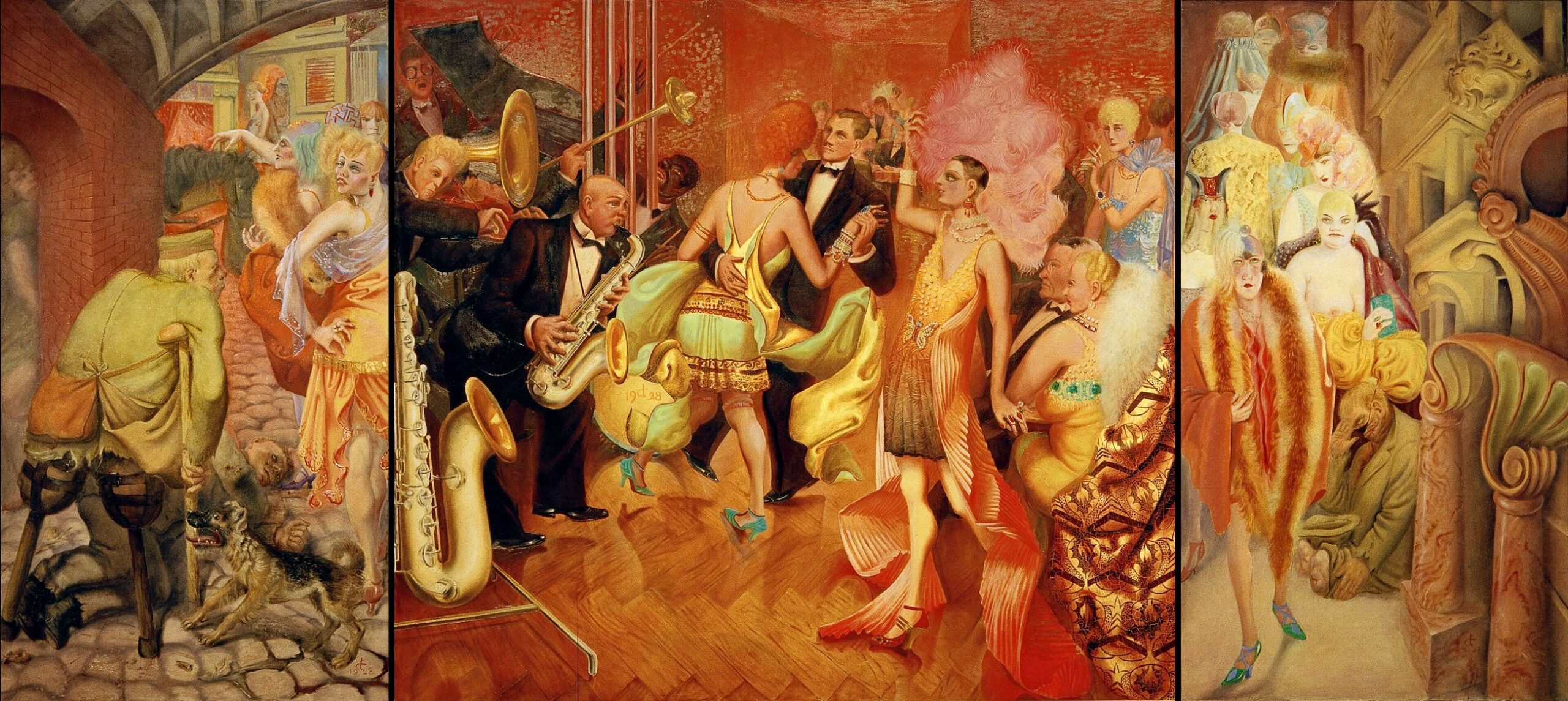
Metropolis by Otto Dix, 1927–1928,
Kunstmuseum Stuttgart
It’s 1929, and Berlin is having the kind of night respectable people will later insist never happened.
Neon bleeds across wet pavement. A taxi hisses past, throwing gutter water onto a woman whose dress has misplaced most of its back. Somewhere below street level, a trumpet murders a respectable German melody while a girl in a tuxedo leans in to kiss another girl.
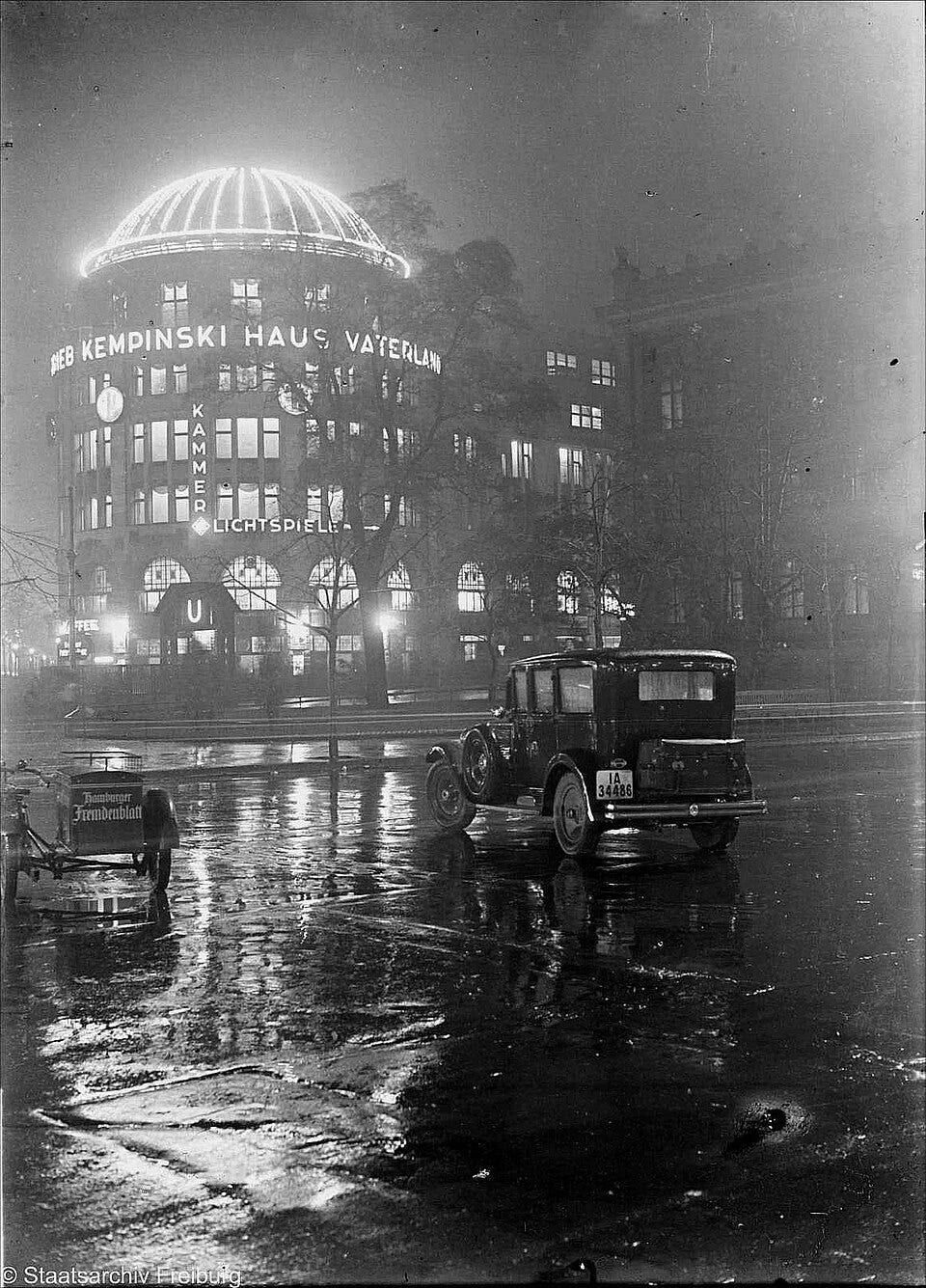
Berlin, 1929: Haus Vaterland, where Berliners could drink, dance, dine around the world, and enjoy an hourly fake thunderstorm over the Rhine because subtlety had apparently taken the night off. The pleasure palace could accommodate as many as 8,000 people.
CC BY 4.0She goes in. Another comes out laughing. The door swings.
They call these women the Neue Frau — “new woman”. Hair bobbed to the jawline as though she took a knife to the nineteenth century. Hemline at the knee, one stocking laddered at the ankle.
The new woman works behind a counter at a department store. When the doorman holds out his hand, she pays him with her own wages from her own bank account. Today, we would call these progressive women “girlbosses” while silently hating ourselves for not having a less cringy word.
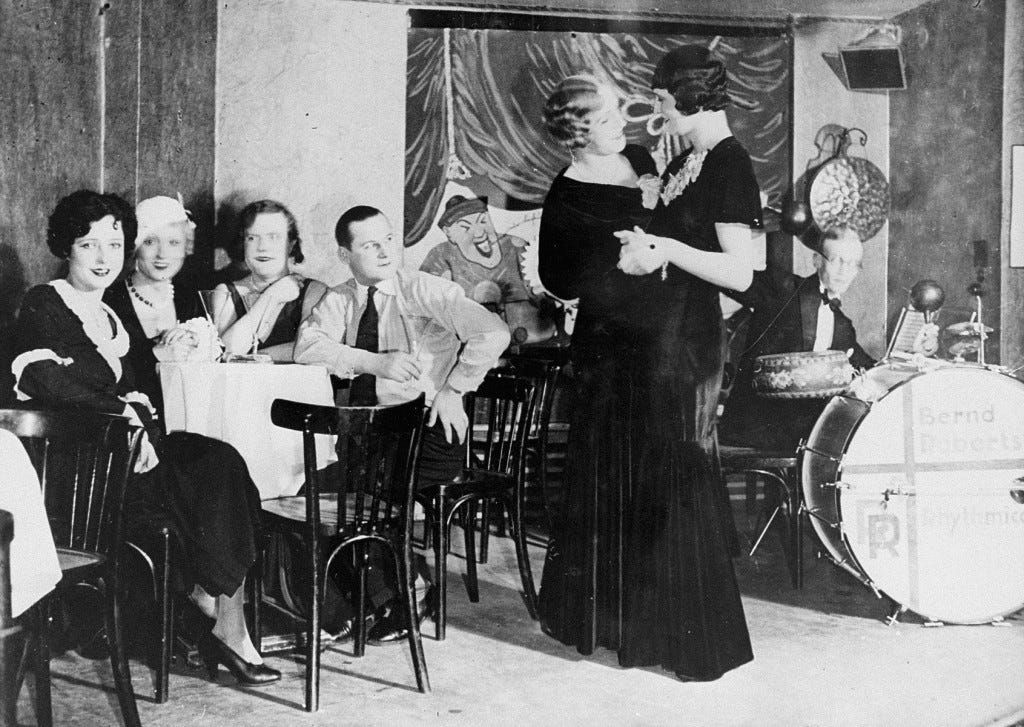
Berlin, 1929: Two women dance at the Eldorado, where lipstick, tuxedos, and heterosexual expectations were all optional. Four years later, the Nazis shut it down.
Bildarchiv Preussischer Kulturbesitz, via United States Holocaust Memorial Museum, Holocaust EncyclopediaOther young women belonged to a more slippery category Berliners called the Halbseidenen — the “half-silks”. Half-silk was fabric woven partly from real silk and partly from cheaper thread. The fabric was glossy enough to pass at a distance, suspect once you got close.
The nickname landed on women who were equally difficult to classify — shopgirls, dancers, sexually independent working women, occasional prostitutes, girls dressed just a little better than their wages should have allowed.
These women do not dance politely. Anita Berber, Berlin’s cocaine-addicted queen of nude dance, had made Dances of Vice, Horror and Ecstasy infamous. Grosz and Otto Dix paint Lustmord — sex murder — as a genre, and sell it.
Otto Dix – Portrait of the Dancer Anita Berber, 1925
Public DomainInside the club, smoke curls from red-stained lips like a genie escaping its lamp. Champagne sweats in silver buckets and sloshes in chipped glasses. A folded banknote, a razor’s quick flash, two white lines cut across a mirror while dancers stamp and spin inches away.
Women arrive as men, men arrive as women, and bankers disappear into back rooms with people their bankers’ wives would not have invited to luncheon.
This particular den of iniquity has competition. Weimar Berlin supports somewhere between 65 and 80 gay bars and another fifty lesbian ones.
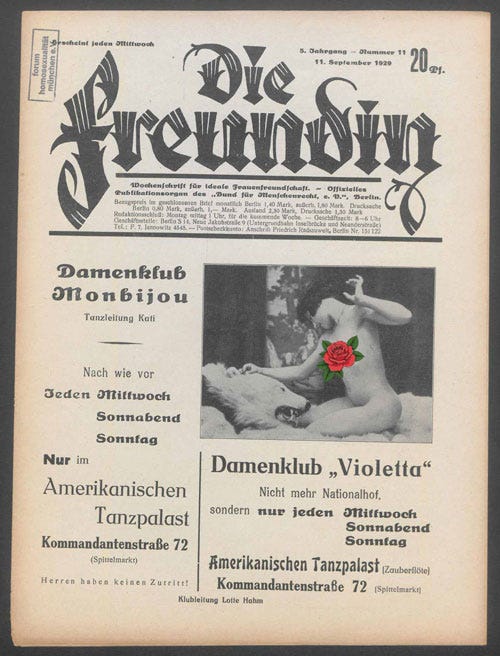
And the sexual revolution does not stop at closing time. It is sitting on the newsstands. By the end of the decade, more than twenty publications cater to gay, lesbian and gender-nonconforming readers — romance serials, political essays, personal ads, and club listings. A lonely girl in Leipzig can get Die Freundin without ever setting foot in a dancehall.
Berlin, 1929: Die Freundin, Germany’s lesbian weekly, advertises two women’s clubs at the Amerikanischer Tanzpalast. The fine print reads: “Men are not admitted.” I added the flowers. Weimar Berlin did not. | Forum Queeres Archiv München.
Across town, Magnus Hirschfeld has spent years trying to drag sex out of whispers and into science. The physicians in his Institute for Sexual Science would soon help pioneer some of the first gender-affirming surgeries. The institute also offers birth control and counseling, and works with Berlin police on “transvestite passes” — documents that let trans people walk the city without being arrested for their clothes.
Berlin has somehow managed to give gender nonconformity paperwork.
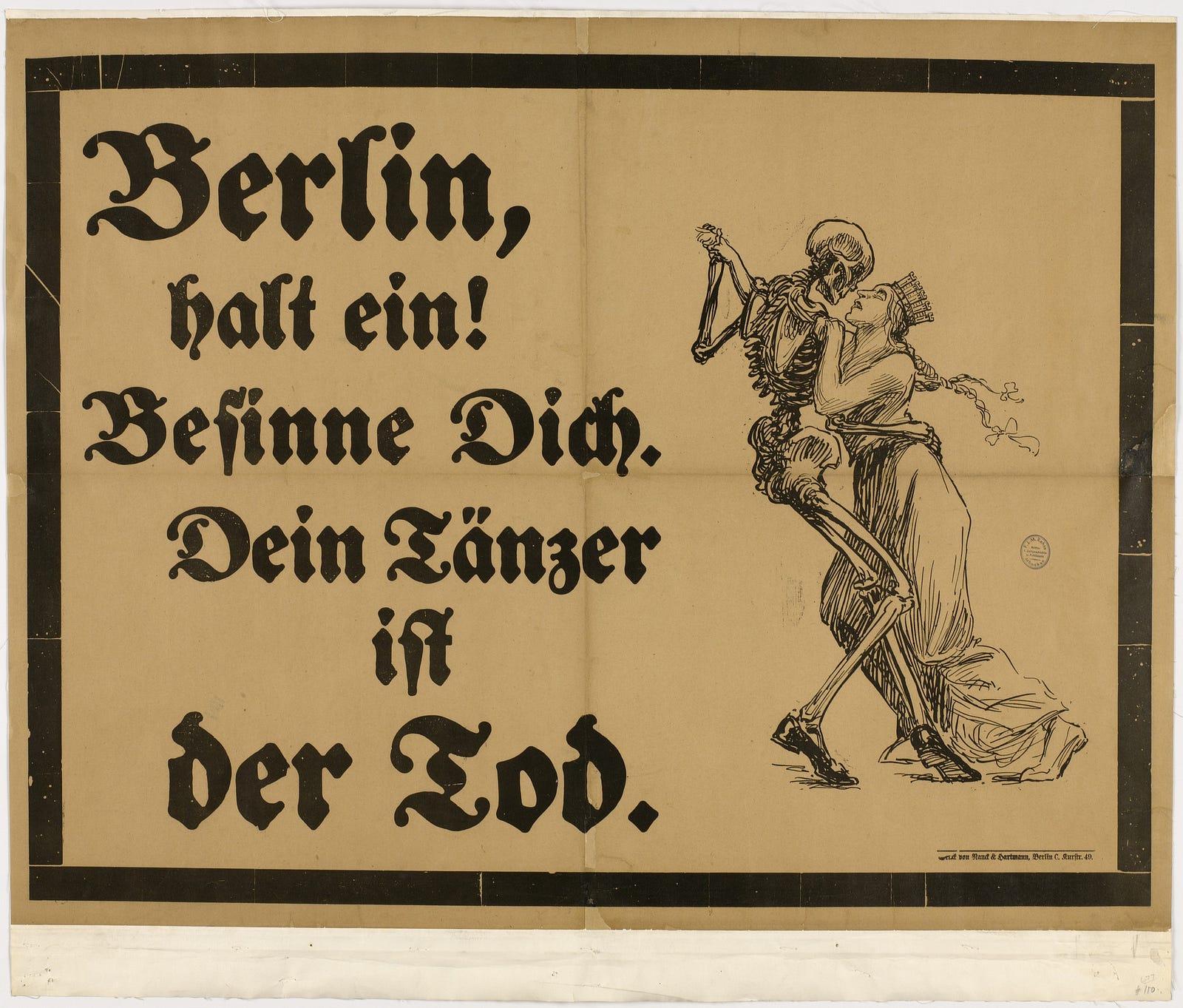
Not everybody finds this charming. Berlin has been hearing the opposite sermon since the republic was born. Ten years earlier, in the political convulsions after World War I, a poster showed a crowned Berlin locked in a waltz with a skeleton, “Berlin, halt ein! Besinne dich. Dein Tänzer ist der Tod” — Berlin, stop. Come to your senses. Your dance partner is Death.
The poster was not about lesbians in tuxedos. It came from the political chaos of 1919. But the accusation is already there.
Berlin is losing itself. It must return to the past and what once made it great.
Of course, by the late 1920s, the people making that nostalgic argument have begun pointing at sex. In 1927, Wilhelm Frick warns that homosexuality will lead to the “disintegration of the German people”. Large numbers of Germans describe Weimar’s new sexual visibility as decadent, immoral, and evidence of national degeneration. Right-leaning religious organizations and parties preach family, restraint, and traditional German culture.
Looking back on the inflation era, Austrian writer Stefan Zweig remembered the city transforming into “the Babel of the world”, with gay bars multiplying like mushrooms and transvestite balls so extravagant he thought ancient Rome had been outdone.
Berlin read the room. Berlin went on dancing, spending, and fucking.
Berlin, 1919: Ten years before Fritz stands outside our nightclub, Berlin is already being warned about its dance partner. “Stop! Come to your senses! Your dancer is Death.” | Van Santen, Berlin, Stop! 1919.
Lithograph. Library of Congress Prints and Photographs Division. Public DomainBerlin’s own tourist bureau was advertising Jeder einmal in Berlin! — everyone should visit Berlin at least once. In 1929, nearly 1.7 million guests did.
But not everyone enjoyed watching Berlin turn its private vice into a tourist attraction.
Because while people inside experienced liberation, and the moral right experienced decadence and national decline, young men experienced something else.
Exclusion.

September 7, 2026
The Backbone of the Nazi Panzer War – Panzer III
World War Two
Published 5 Sep 2026The Panzer III was intended to become the backbone of Nazi Germany’s panzer divisions. Emerging from clandestine Weimar-era experimentation and formally developed from 1934, it combined mobility, a five-man crew, a three-man turret, and comprehensive radio communication in one highly effective prewar design.
In this episode, Spartacus follows the Panzerkampfwagen III from secret German-Soviet tank trials at Kama through its production and deployment in Poland, France, North Africa, and Operation Barbarossa. We examine its evolution from the 3.7 cm gun to increasingly powerful 5 cm weapons, the advantages provided by crew specialization and radio-coordinated warfare, and why the Soviet T-34 and KV-1 exposed its diminishing margins in armor and firepower.
By 1943, the Panzer III had been displaced as Germany’s principal gun tank by the more adaptable Panzer IV. Its chassis, however, found an extraordinarily productive second life beneath the Sturmgeschütz III. The Panzer III was not a failed tank. It was an effective prewar design overtaken by an armored arms race it lacked the capacity to survive. Its fate also reflected Nazi Germany’s wider strategic failure: it had built weapons for short campaigns, then unleashed a coalition war whose demands exceeded Germany’s resources.
Watch our episode on the Sd.Kfz. 251: • The Halftrack That Made Blitzkrieg Possibl…
Watch Ten Days in Sedan: • Ten Days in Sedan
September 3, 2026
The Last Tiger
The Tank Museum
Published 24 Apr 2026The war has raged for more than 5 years.
In the Essel Forest, on the north German plain, a troop of British Comet cruiser tanks halts for a brew.
A shot rings out
It’s a Tiger!
Within seconds one of the Comets is hit.
The war is far from over …
This is the story of a fascinating and dangerous moment in time – one of the last duels between the brilliant Comet and the legendary Tiger.
00:00 | Introduction
00:42 | The Last Tiger
04:55 | The Rise and Fall of the Kampfgruppen
06:40 | The British Armour
07:52 | Tiger v Comet
13:08 | April 13th 1945This video features archive footage courtesy of British Pathé.
In this film, join Chris Copson as he tells the story of one of the last tank duels of the Second World War. On one side, the Tiger. With its 88mm gun and almost impenetrable armour, it had inspired fear in many Allied tank crews. But on the other side, the Brits were prepared with the latest in tank technology – the Comet. Both were imposing sights on the late WWII battlefield, but who would come out on top in the depths of the Essel Forest?
Want to learn more about the Tiger and Comet tanks? Here are some of the sources we used to make this film:
Battleground, Zaloga (Ed), Osprey, 2011.
Crouching Tiger, Hidden Comet, Fletcher, 2017
Encyclopaedia of British and American Tanks of WW II, Chamberlain and Ellis, Cassell 2014.
Encyclopaedia of German Tanks of WWII, Chamberlain and Doyle, Cassell 2011.
August 31, 2026
A Fighter to Make the European Skies Nazi – Nazi Rearmament 03 – Bf 109
World War Two
Published 30 Aug 2026The Messerschmitt Bf 109 was designed to solve one of the fundamental problems of modern warfare: how do you gain control of the air long enough for everything else to operate unhindered? Germany’s answer was a fast, heavily armed, highly advanced fighter that became the spearhead of the Luftwaffe‘s pursuit of air superiority.
In this German Rearmament special, we trace the Bf 109 from its origins in the clandestine development programs of the 1930s to its first combat missions over Spain and its emergence as one of the defining fighters of the Second World War. We examine its revolutionary design, its development and production, its role in the emerging doctrine of Bewegungskrieg, and its deployment from the opening campaigns in Poland and France to the Battle of Britain and the vast air war over the Eastern Front.
But the 109 also exposes the limits behind the image of an unstoppable German war machine. Its narrow-track landing gear made it notoriously unforgiving, its short range limited its effectiveness over Britain, and its ageing airframe became increasingly difficult to improve as the war progressed. By the later years of the war, Germany could still produce thousands of Bf 109s, but lacked the fuel, experienced pilots, industrial resources, and ultimately the air superiority needed to make those aircraft decisive.
The Bf 109 was an exceptionally advanced fighter for its time, and in the hands of an experienced pilot it remained lethal long after its first flight. But it also became a symbol of a deeper problem within the Nazi war economy: the growing inability to replace yesterday’s weapons with tomorrow’s.
This is the story of the fighter that made Blitzkrieg possible, and the machine that stayed in the sky long after Germany had lost control of it.
Never Forget.


