
Quotulatiousness

May 10, 2026

Quotulatiousness at year twenty-two

Filed under: Administrivia, Personal — Tags: — Nicholas @ 06:00

In 2004, my friend and co-worker Jon installed some blogging software on his site and asked if I’d like to set up my own blog there. (Hard though it may be to believe, blogs weren’t free to operate back in the dark ages of 22 years ago … free blogging sites started to pop up, but didn’t really take off for several years, and most of them were ad-supported.) I named my new blog by patterning it on Jon’s Blogulatiousness. Jon soon decided that blogging wasn’t for him, so it wasn’t long before he shuttered it, leaving mine the only active blog on the server. If I had any inkling I’d still be blogging in 2026, I assure you I’d have put a bit more thought into naming — and ease of pronunciation. But I didn’t, so we’re both stuck with my silly choice of name.

I’d been collecting online and offline quotations since the mid-80s, so I naturally thought it would make sense to focus my blogging efforts on sharing at least a few of those quotes. Some bloggers just naturally churn out brilliant and incisive essays on the issues of the day. Others post quick-hitting news or funny comments with links to other resources. I’m neither witty nor incisive, so I settled on the laziest way to fill the page: linking to a lot of those other sites run by far better writers, but including at least a few paragraphs from the linked article to entice my reader (or readers, on a good day) to click on the link and go read the entire original post.

Initially, the blog was kind of an adjunct to my quotation collection, but the blog soon ate the original quotes site … I’m ashamed to admit just how rarely I edit anything there these days.

Typical blog content is really an online incarnation of what used to be called “commonplace books” where a writer would collect information of interest that didn’t necessarily relate to the writer’s main interests or to anything else added to the book, as this summary explains:

Commonplace books (or commonplaces) are a way to compile knowledge, usually by writing information into books. They have been kept from antiquity, and were kept particularly during the Renaissance and in the nineteenth century. Such books are essentially scrapbooks filled with items of every kind: recipes, quotes, letters, poems, tables of weights and measures, proverbs, prayers, legal formulas. Commonplaces are used by readers, writers, students, and scholars as an aid for remembering useful concepts or facts. Each one is unique to its creator’s particular interests but they almost always include passages found in other texts, sometimes accompanied by the compiler’s responses. They became significant in Early Modern Europe.

“Commonplace” is a translation of the Latin term locus communis (from Greek tópos koinós) which means “a general or common topic”, such as a statement of proverbial wisdom. In this original sense, commonplace books were collections of such sayings, such as John Milton’s example. Scholars now understand them to include manuscripts in which an individual collects material which have a common theme, such as ethics, or exploring several themes in one volume. Commonplace books are private collections of information, but they are not diaries or travelogues.

I think that’s a pretty good description of most blogs, and certainly is true of Quotulatiousness.

Earlier anniversary postings:

Unfortunately, the first five years of postings — when I was merely a freeloading tenant on Jon’s site — aren’t accessible any more. With the move to my own site, I switched from MovableType to self-hosted WordPress (currently running version 6.9.4).
The state of Britain – “Where did it all go wrong?”

Filed under: Britain, Government, History — Tags: , , , , , — Nicholas @ 05:00

Reposted from Samizdata with Patrick Crozier’s kind permission. Parallels to the same period of history here in Canada or in Australia or New Zealand should be fully evident to my fellow former colonials:

The Britain of the mid-19th Century was the greatest civilisation that has ever existed. It had a mighty empire, a mighty navy, it had wiped out the slave trade and it was at the forefront of the Industrial Revolution, the greatest improvement in living standards in history. And now, as I write, it is hanging on by a thread: divided, debt-ridden and weak.

So, where did it all go wrong? Here – in reverse chronological order – is my list of the key dates:

2008. Reaction to the Financial Crisis.
Had the banks just been allowed to go bust and the banking regulation that reduced their numbers abolished we would not be looking at 20 lost years.

1997. Opening the borders.
Allowing the establishment of hostile communities in your country is not a good idea.

1987. Leaving the NHS untouched.
By 1987, the Thatcher government had privatised just about everything. Only the NHS and education were left. And they flunked it. Mind you it would probably have been electoral suicide.

1969. Failure to defeat the IRA.
If you reward terrorism you get more of it.
[NR: Canada did defeat the FLQ‘s campaign of terrorism and murder … and then basically conceded everything short of full independence that the FLQ had demanded. This is a classic example of winning the war but losing the peace.]

1965. Race Relations Act.
Keir Starmer is wrong. Britain does not have a “proud tradition of free speech”. But it did have some free speech. This act along with various successors outlawed some forms of speech. Those successors progressively outlawed freedom of association which might have gone a long way to taking the sting out of the Integration Crisis.
[NR: Enoch Powell’s “Rivers of Blood” speech seems ever more relevant to the daily lives of everyone in the west …]

1964. Abolition of the Death Penalty.
I appreciate libertarians tended to be divided on this issue. We may have a lot to say about what the law should be but very little about what should happen when it is broken. But if you are going to end a long-standing tradition it had better work. It didn’t.
[NR: I used to be fully against capital punishment. I’m much less doctrinaire about it now. Some people cannot be rehabilitated, and capital punishment is a better solution than life in prison.]

1963. Robbins Committee.
This led to the subsidisation of higher education and the subsidisation of student living costs. Where you get subsidy you get communism.
[NR: Universities have always been hotbeds of progressive thought. From the 1920s onward, they’ve been taken over by ideologues who want to utterly destroy western civilization … and we’ve been handing them ever more money to indoctrinate our young in their beliefs.]

c.1948. Ending of the right to defend oneself with a firearm.
I got this from the late Brian Micklethwait but I haven’t been able to confirm it. Brian’s point was that if you couldn’t use guns to defend yourself there was very little point in having one and so it became easy for the state to ban them.
[NR: Canada is in the middle of yet another spasm of anti-gun hysteria triggered (you saw what I did there) by events in the United States. There are hopeful signs that Canadian gun owners may yet indulge in peaceful civil disobedience over the the latest attempts to disarm us.]

1948. Nationalisation of rail.
Along with coal, steel and many others along the way. Losses, strikes, decline, waste, unemployment.
[NR: Patrick and I began communicating a few years ago when I asked him for additional information about both the 1920s forced consolidation of British railway companies into the “Big Four” and the subsequent full nationalization into British Railways. We clearly agree that this was, whatever its intentions, a bad move for both the railway companies and the nation at large.]

1947. Town & Country Planning Act.
Pretty much stopped building anywhere where people might want to live. A huge contributor to putting home ownership out of the reach of millions.
[NR: I heard much more about the zoning issue from American libertarians, but the Town and Country Planning Act was a major leap in bringing government regulation into everyday life in Britain.]

1931. Abandoning the Gold Standard.
Inflation and boom and bust became the order of the day.
[NR: In retrospect, this may have been Winston Churchill’s biggest blunder: putting Britain back on the Gold standard at the pre-WW1 rate of exchange.]

1920s. Abolition of the Poor Law.
I mean to write about this one day but TL;DR while the Poor Law had many shortcomings it did at least keep people alive while keeping the costs down.
[NR: Orwell’s eloquent writing about the plight of the poor between the wars illustrate a lot of the negatives for the jobless poor of the interwar era. Far be it from me to claim Orwell was wrong … but he didn’t show the entire picture.]

1922. Creation of the BBC.
A monopoly communist propaganda organisation using the most powerful media then in existence which non-communists were forced to pay for. What could go wrong?
[NR: The BBC was for a long time constrained in its advocacy for socialist ends, but they kicked off the traces at some point. Canadians will be more familiar with the power of state-sponsored media now that the Canadian government will be paying one-third of the salaries of all the mainstream print and broadcast media outlets … and the media have already transformed into sad parodies of Nazi German or North Korean state media.]

1920. Beginning of the War on Drugs.
Other than the crime and changes to the drugs themselves (making them more dangerous than ever), the persistent failure of the War on Drugs gave the state the excuse for ever greater assaults on civil liberties.

1918. Universal Adult Male Franchise.
This meant that people could vote themselves other people’s money. It very quickly led to the replacement of the (not very) Liberal Party by the (not-at-all liberal) Labour Party. Mind you, it should be pointed out that a lot of the damage was done well before.

1910. People’s Budget et al.
In introducing the state pension, a state GP service and unemployment benefit this laid the foundations of the Welfare State that is currently doing such a good job of bankrupting the country.

1910. Payment of MPs.
I put this one in tentatively. I would like to say it meant Members of Parliament no longer had to have made something of themselves but given that a large number of them came from rich families that is not quite true.

1906. Taff Vale Judgement.
This effectively put trade unions above the law leading to endless strikes, uncompetitiveness, industrial decline and unemployment.
[NR: This was an understandable concession when unions were all in the private sector. Now that the plurality, if not outright majority of union members are government workers …]

1890s. Death Duties.
Bit by bit this destroyed the aristocracy by forcing a fire sale every time the head of the household died. [And that did what exactly, Patrick? Summat! It did summat!]

1875. Trade Union Act.
This allowed picketting or the intimidation of non-striking workers by trade unionists. I have to thank Paul Marks for bringing this one to my attention.

1870. Forster Act.
This established state education along with all that went along with it such as indoctrination, poor quality education and the opportunity costs involved in children not being able to earn money or learn a trade.

1845. Banking Act.
This began the extension of the Bank of England’s monopoly to the whole of the country.

Anything I’ve missed?

How to Make Nazi Germany Look Normal – Death of Democracy 15 – Q4 1936

Filed under: Germany, History, Sports — Tags: , , , , , , — Nicholas @ 04:00

World War Two and Spartacus Olsson
Published 9 May 2026

How did Hitler use the 1936 Berlin Olympics to make Nazi Germany look peaceful — while preparing the country for war?

Berlin, September 30, 1936. Under the Olympic flame, Nazi Germany staged one of the most successful propaganda spectacles of the twentieth century. Foreign visitors saw order, ceremony, technology, pageantry, and athletic triumph. But behind the facade, the regime hid antisemitic persecution, rounded up Sinti and Roma, intensified police repression, intervened in the Spanish Civil War, and moved toward a massive new war economy.

In this episode, Spartacus Olsson looks back at the third quarter of 1936: the Berlin Olympics, Jesse Owens’ victories, Hitler’s secret war memorandum, the Four-Year Plan, Nazi propaganda, Germany’s growing involvement in Spain, and the dictatorship’s attempt to sell peace to the world while preparing for conquest.

The Olympics gave Hitler international validation. The Four-Year Plan revealed what he truly intended.

In this episode:
– How Nazi Germany sanitized Berlin before the Olympic Games
– How the regime temporarily hid antisemitic violence from foreign visitors
– How Sinti and Roma were forced out of sight before the Games
– How Jesse Owens challenged Nazi racial mythology on the track
– How Hitler moved Germany toward a war economy
– How the Four-Year Plan tied German recovery to rearmament
– How Germany’s intervention in Spain marked a new stage of escalation
– How propaganda, spectacle, and controlled media helped normalize dictatorship

This is not just a story about the 1936 Olympics. It is a story about how authoritarian regimes use spectacle, national pride, media control, and international complacency to hide what they are becoming.

Never Forget.

The “death of the reader” is how art stops being for people and becomes just for artists

Filed under: Books, Media, Quotations — Tags: , , , — Nicholas @ 03:00

When I first got interested in Jazz, I bought all sorts of music from multiple musicians and groups, liking some more and some less. But it seemed that at some point in the 1960s, I was finding less and less of the music to be interesting and entertaining. More and more from that point on, the music seemed to be deliberately less accessible, more intricate without being pleasant or compelling to hear, and (as I characterized it years ago on the old blog) more oriented to other musicians rather than the non-musician general listening audience. On the social media site formerly known as Twitter, Devon Eriksen shows that this happens in many artistic and creative pursuits and groups them all together in a phenomenon he calls “the death of the reader”:

This is what I call “The Death of the Reader”.

Authors write for readers, who aren’t authors. Artists paint for non-artists. Musicians play for non-musicians.

This keeps fiction, art, and music grounded.

But when any group stops creating for an external audience, and starts trying to impress only each other, they create a weird, self-reinforcing feedback loop.

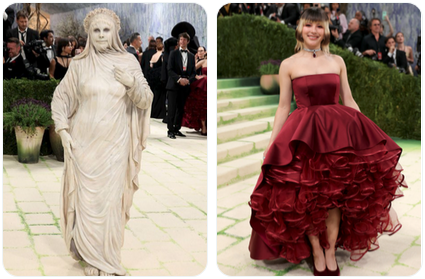
This isn’t clothing, or even fashion. It’s a costume party. They’re all trying one-up each other with something weirder and more eye-catching.

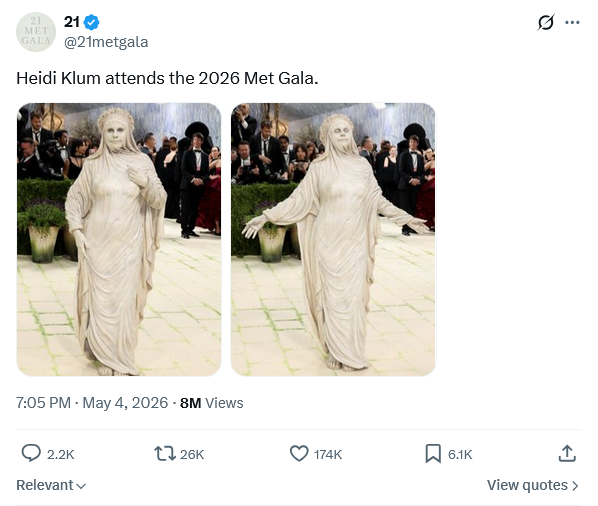
So when an athlete, of recent and topical celebrity, who isn’t a part of their Bored Billionaires’ Club, shows up in a dress that’s just a dress, of course they are going to mock her. She’s just revealed that she didn’t get the memo. That she’s not an insider.

How she looks to the world at large is not the point.

This is why 99.999…% of copies of Infinite Jest have never been read. This is why John Cage “wrote” four minutes of silence. This is why competitive bodybuilders from the 80s looked like Greek gods, and modern ones look like gargoyle freaks.

It’s all the Death of the Reader.

Hollywood doesn’t make movies for you now. They hate you. They make movies for each other.

And then cry about how you didn’t buy a ticket, because they think your only role is to pay for their onanistic circle of self indulgence.

This game isn’t going to stop. It’s just going to keep getting weirder until someone’s dress malfunctions and catches fire, and the rest of us all have a good laugh.

The Ancient Greeks: 01 – What Made Them Special? (b) Slavery, Violence, and the Reality of Greek Life

Filed under: Europe, History — Tags: , , , , , , , — Nicholas @ 02:00

seangabb
Published 31 Jan 2026

This section confronts the social realities of Greek civilisation that are often ignored or idealised.

It examines the position of women, the central role of slavery, ritualised violence against children, infant exposure, and what we would now describe as widespread paedophilia. Drawing on ancient sources such as Plutarch, Demosthenes, and Aristotle, it shows that these practices were not marginal, but embedded in Greek social norms and justified as rational policy.

Victorian and modern idealisations of Greece are critically dismantled in favour of historical evidence.

The aim is not moral condemnation, but historical clarity.

QotD: The cavalry

Filed under: Britain, Humour, Military, Quotations — Tags: , , , — Nicholas @ 01:00

These chaps, and very recently gals, used to be stylish troops on horses who charged into the infantry and hacked them to bits. Until the infantry all stood in squares, then they needed artillery to kill them. Once weaponry got advanced enough, they decided to give all our tanks to the cavalry. Now we have few tanks, the cavalry are in denial about being infanteers and cling to the old ways by driving around in trucks claiming to be recce or other jobs. They are just posh infantry. Better tattoos but spelt correctly and mostly not DIY ones, traditions dating back to the Tudors, officers wear lemon cords and soldiers still fight each other on Friday nights.

Combat Boot, “So, ‘capbadges’, what’s that all about then?”, combatboot.co.uk, 2020-11-13.

Powered by WordPress



