The Liberal party, both federally and provincially, have been massive fans of immigration for decades. Any kind of restriction on foreigners being allowed into the country was seen as tantamount to treason, in Liberal eyes. This resulted in a lot of votes for Liberal candidates in election after election, as most immigrants associated their welcome in Canada with the party most associated with pro-immigration policies. On the weekend, this happy little virtuous circle suddenly broke in the Toronto-area provincial riding of Scarborough Southwest, and the party is left wondering what is going on:
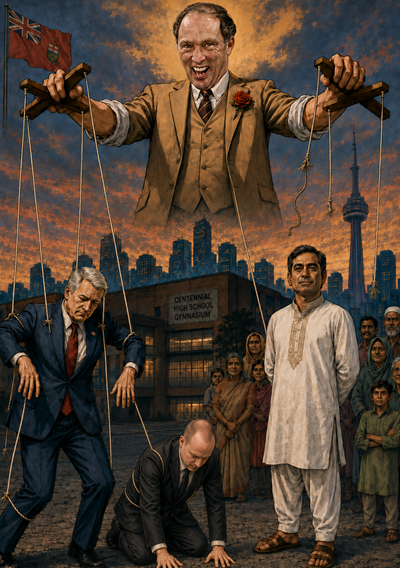
AI-generated image from Upper Canadian Cavalier
There is a particular flavour of humiliation reserved for the courtier who discovers, too late, that the rules he wrote for everyone else now apply to him. On Saturday afternoon in Scarborough Southwest, Nathaniel Erskine-Smith tasted it. The former federal Minister of Housing, the man Mark Carney himself had blessed to retain his Beaches–East York seat while parachuting into a provincial nomination as a launchpad for the Ontario Liberal leadership, lost. He lost to a man named Ahsanul Hafiz, a Bangladeshi immigrant who had arrived as an international student two decades ago, who had been forced during the campaign to answer for old social media posts of himself posing with firearms and calling for the death penalty of a Bangladeshi politician. Hafiz won not because he was a more accomplished man, not because he had a deeper grasp of public policy, not because he carried the gravitas of a former Crown minister of the Dominion. He won because he could deliver more bodies to a high school gymnasium on a Saturday afternoon than the Oxford-trained lawyer with the cabinet pedigree could.
This is the open secret of Liberal politics in Canada in the year 2026. The white Liberal cannot win his own nomination battles anymore. Not on the merits. Not on the organisation. Not on the strength of his name or the depth of his rolodex. He can only win when the party machinery he himself built bends the rules in his favour, locks the gate behind him, and quietly disqualifies the rivals who would otherwise eat him alive. When the machinery fails, as it failed in Scarborough Southwest, the result is what we saw on the weekend: the dauphin of the Carney court, the heir presumptive, sent home with a participation ribbon and a press release about how concerned he is of the democratic process.
The democratic process. We shall return to that phrase, because it has done a great deal of work for the Liberal Party of Canada these past sixty years, and it deserves the close inspection of an honest mind.
The Scarborough Lesson
Consider the bare arithmetic of what happened. Erskine-Smith is, by every measure the Laurentian establishment recognises, the kind of man the Liberal Party manufactures for leadership. Queen’s University, then Oxford for the BCL. A successful federal MP since 2015. A cabinet minister under both Trudeau and Carney. The blessing of the Prime Minister himself to remain a sitting federal MP while contesting a provincial nomination, an arrangement of breathtaking entitlement that would have been denied to anyone of lesser standing. He had every advantage the system can confer on a chosen son.
And yet the Bangladeshi grocer down the street had more votes.
Three thousand five hundred members were on the final voting list. The Bangladeshi community of Scarborough Southwest, organised through its mosques, its community associations, its weekly newspaper the Weekly Bangla Mail, its television station NRB TV, had decided some time ago that this riding belonged to them. Doly Begum, the former NDP MPP turned federal Liberal, had won the by-election three weeks earlier as the first Bangladeshi-Canadian elected to Parliament. The provincial nomination was the next obvious prize. Three of the four candidates running were of Bangladeshi origin. The fourth was Erskine-Smith.
You can imagine the scene at the high school. The folding tables, the volunteer scrutineers, families arriving in groups of six and eight, elderly grandmothers helped to their seats by grandsons. And against this, the dispersed and atomised liberal professionals of the riding, the kind of people who attend brunches in the Beaches and write earnest letters to the Toronto Star about housing policy. There was no contest. The grandmothers won. They will always win. They were always going to win. Anyone who has spent five minutes thinking honestly about what mass non-European immigration into a Westminster system actually means could have told you so.
This is not a scandal, it is not foreign interference. It is not even when properly understood, a failure of the Liberal Party. It is what democracy looks like when you transplant a foreign communal politics into a parliamentary system that was built for atomised individuals voting their conscience as Englishmen. The system the Liberals constructed across two generations, the system of mass importation without integration, of multiculturalism as official ideology, of the ethnic vote as the quiet hydraulic engine of every Liberal majority, has finally arrived at its terminal stage. The body has now grown larger than the head, and the head has noticed.
At Without Diminishment, Dakota Jeffery-Petts, who once worked as a volunteer on Erskine-Smith’s 2015 campaign, writes:
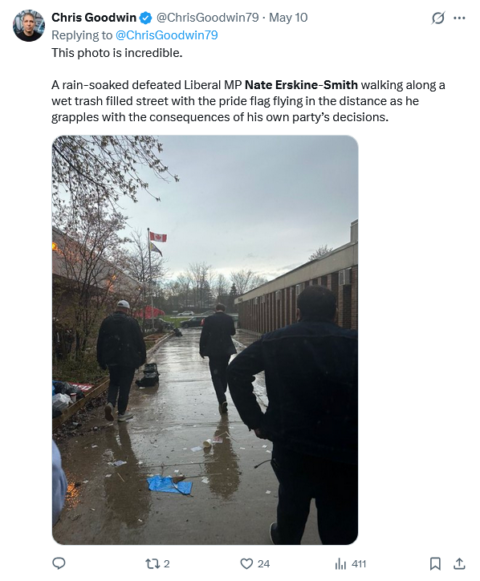
In Canada, the nomination process remains a glaring national security loophole. These contests are treated as private club matters rather than public democratic exercises. They lack the oversight of a neutral authority. This creates a low-cost, and at times entirely cost-free, environment providing a high-reward entry point for foreign interference.
All you need to do is speak sweet lies to members and constituents. In doing so, you create a motivated interest group that can effectively hand-pick a representative in a safe seat, bypassing the general electorate entirely.
When 3,580 memberships appear overnight in a single riding, we must ask: whose interests are being served? Are they Canadian interests, or diaspora interests?
The primary duty of an elected official, after all, is to the national and public interest. But when a candidate’s mandate is derived from a narrow, diaspora-specific recruitment drive, often centred on grievances or political movements from the old country, that candidate becomes a delegate for a foreign interest rather than a representative of Ontario and the Ontarians in that riding.
The result illustrates the danger of fragmented national and local loyalties.
Multiculturalism, when left without a strong framework of national identity, allows for the importation of foreign conflicts into our legislative halls. We are seeing the rise of a political class that views a seat in a Canadian legislature as a platform for foreign advocacy, rather than a tool for national or provincial governance.
This capture of our nomination process by diaspora activism is the ultimate sign of a hollowed-out democracy. If the gates to our legislatures are guarded by whoever can mobilise the largest bloc of unintegrated interests, then the concept of a Canadian mandate becomes meaningless.
We are effectively outsourcing our leadership selection to the highest bidder, or to the most aggressive foreign-aligned organiser. The decision by the Ontario Liberal Party to allow this surge, and the subsequent defeat of one of the more prominent politicians in the province, shows a party that has lost its way.
By prioritising raw numbers over the quality and loyalty of its candidates, the Ontario Liberals have signalled that they are comfortable being a vessel for proxies acting on behalf of foreign interests, despite the hardships facing so many Ontarians.