Quotulatiousness

May 12, 2026

First One Nation party MP elected in Australian by-election

Filed under: Australia, Media, Politics — Tags: , , , , — Nicholas @ 05:00

After the surge in support for populist Reform Party candidates in the British local elections, Australia’s populist One Nation party achieved their first member of the House of Representatives in a by-election in Farrer, with David Farley receiving 57% of the votes:

Australia’s One Nation party has won its first lower-house seat in a moment that’s been described as a political earthquake. As with Reform’s success in the council elections here, its significance is already being argued over.

The fact remains that One Nation candidate David Farley won over 57 per cent of the tally in Farrer, a vast regional constituency in New South Wales, a weathervane election that was triggered by the resignation of Sussan Ley after she was ousted as leader of the opposition conservative Liberal Party.

Saturday’s poll was the first federal test of One Nation’s support after the party recorded the second-highest number of votes out of any political party in the South Australian state election in March and, importantly, since the change of leadership of the Liberal Coalition opposition. With it, as I predicted a week or two ago, Pauline Hanson’s One Nation Party broke through Australia’s political glass ceiling.

Why and how? Well, for one significant reason. In response to her rise in the Australian polls, for the first time Ms Hanson and her party were endorsed by the opposition Liberal and Country (National) Party coalition. Blessed with two new leaders – two men prepared to defy the woke establishment and media – they “preferenced” the One Party candidate ensuring One Nation won the seat. Don’t forget Pauline Hanson has been far more of a persona non grata to the Australian establishment elite than Nigel Farage has to ours. I can’t see him having the chutzpah to turn up to Parliament wearing a full burqa!

Far better than anything I can write to capture the significance of the moment is David Flint’s account in Spectator Australia, titled “The Farrer earthquake: how the commentariat got it wrong“.

It is so good that I feel sure that Editor Rowan Dean will forgive me for quoting big chunks from it:

    The political establishment is in a state of shock … When Sky News Australia took the unprecedented step of calling the Farrer by-election for One Nation at an extraordinarily early hour, it wasn’t just calling a seat; it was announcing the end of an era. For the first time in Australian history, One Nation has captured a House of Representatives seat at an election, and if the current opinion polls are any indication, it is merely the first of many.

And that is the point. He goes on:

    The “commentariat” – that insulated class of pundits and pollsters – has spent years repeating the tired myth that One Nation is a party of complaint but not of policy …

    Farrer has proven that the commentariat’s “no-policies” narrative was a delusion. Australians are not merely “protesting”; they are voting for a platform of common sense, consistently put forward by Pauline Hanson and Senator Malcolm Roberts – one that the major parties have long since abandoned.

Flint argues that it presages the death of the major party monopoly: “The result reflects a deep-seated exhaustion with the status quo. Labor is no longer the party of the worker; it has become the party of the inner-city elite. The Greens, far from being environmentalists, seem content to see our landscape ruined by industrial ‘renewables’ to enrich foreign interests – propping up what Donald Trump rightly called the ‘world’s biggest fraud’. In contrast, voters have responded to a leader who tells the simple truth.”

May 7, 2026

Great success! Honda “postpones” their Ontario EV project

As part of their mindless fanboyism for anything remotely related to “Net Zero”, the federal government and the Ontario provincial government have been serving up subsidies for electric vehicles and hastening the “inevitable transition” away from internal combustion vehicles. Through legislation and regulation, they’ve been doing everything they can to close down the traditional car and truck manufacturing sector and replace them with zero emission vehicles. The various governments have handed out subsidies amounting to billions, and yet one after another after another the much ballyhoo’d EV factories, battery plants, and other futuristic projects fall by the wayside, leaving very little in exchange for those billions:

There was a time, not very long ago, when Liberal politicians treated EV battery announcements like moon landings.

Hard hats. Safety glasses. Giant ceremonial cheques. Breathless speeches about “the future”. Every battery plant was “historic”. Every subsidy package was “transformational”. Every corporate press conference looked like a motivational seminar for people who think buzzwords are infrastructure.

All we were missing was a fog machine and Bono.

Meanwhile ordinary Canadians were standing in grocery aisles doing mental math over bacon prices, delaying dental work, and wondering whether they could survive another winter utility bill without sacrificing whatever scraps remained of their savings.

But while Canadians were trying to keep their heads above water, Ottawa was busy launching one of the most expensive industrial subsidy experiments in modern Canadian history.

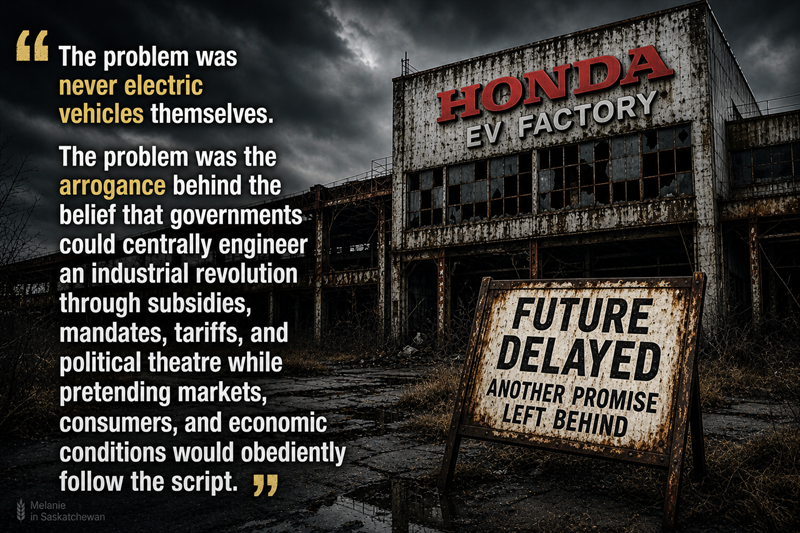
AI-generated image from Melanie in Saskatchewan

The Honda EV project in Ontario was supposed to be one of the crown jewels of this brave new green economy. Politicians lined up in hard hats and safety glasses like a traveling theatre troupe performing The Future Is Here. Canadians were assured this was proof the country was becoming an EV superpower.

Turns out it may have been more of a very expensive PowerPoint presentation with taxpayer financing attached.

[…]

In March 2020, Prime Minister Justin Trudeau appointed Mark Carney as an informal economic adviser during the COVID recovery period. Over the following years, Carney increasingly promoted “green transition” investment frameworks, climate-linked financial systems, ESG-focused economic planning, and massive public-private investment partnerships tied to decarbonization strategies.

Which is important context now, because the EV subsidy era did not emerge out of thin air. It grew out of a broader worldview that treated government-directed green investment as both economic policy and moral mission. The assumption underneath all of this was breathtakingly simple:

If government wants it badly enough, reality will cooperate.”

That is usually where things begin going sideways.

Canadians were told the EV transition was inevitable. Questions about affordability, charging infrastructure, winter range, electrical grid capacity, or consumer demand were often brushed aside like annoying little details raised by peasants who simply lacked sufficient enlightenment.

Then came the subsidy gold rush.

[…]

Corporations are not charities. They are not loyal patriots. They are not emotionally attached to government slogans.

They follow incentives. They chase profitability. They change direction when conditions change.

That is exactly what Honda did.

Meanwhile Canadians are left holding the bill for another “historic transformation” that produced:

  • endless announcements
  • glossy photo ops
  • consultant buzzwords
  • government self-congratulation
  • escalating subsidy exposure
  • and corporate renegotiations every time market conditions shifted
  • while producing no completed Honda EV manufacturing hub and no fleet of Canadian-built EVs rolling proudly off Ontario assembly lines.

What remains instead is a stalled megaproject, a confused tariff policy, a government spinning contradictory narratives depending on the week, and taxpayers once again discovering they were voluntold into becoming venture capitalists for political vanity projects.

Apparently this is what “economic leadership” looks like now.

Hard hats. Press releases. Fifty-plus billion dollars in EV-related exposure. And a factory plan slowly evaporating into the mist while Chinese EVs roll through the front gate anyway.

March 30, 2026

Net Zero or mass immigration, pick one (or better, pick neither)

Lorenzo Warby points out the blindingly obvious (to anyone with common sense) fact that the top two pet projects of western transnationalist elites — Net Zero and mass third-world immigration — are in direct conflict with one another. But rather than choosing one form of societal suicide over the other, the healthy alternative is to absolutely reject both:

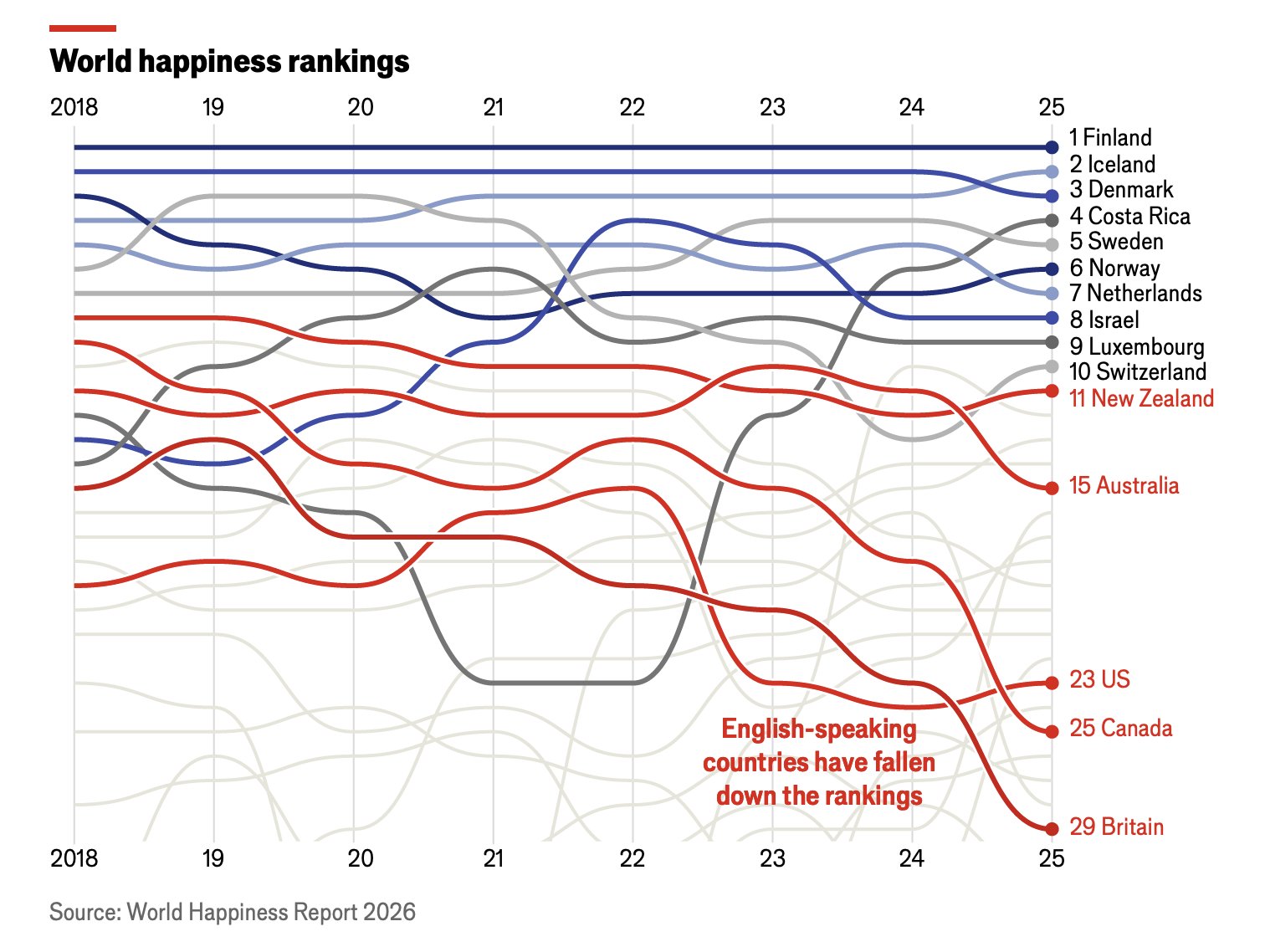
Culturally more homogeneous democracies are happier than more culturally diverse democracies. Also, in the Anglophone countries, where the centre-right won the most recent national election, happiness went up slightly. Where the centre-left won the most recent national election, happiness went down noticeably.

Australia is the latest developed democracy to experience conventional centre-right politics being threatened by a national populist surge. Just as country-club Republicans were Trumped, Gaullists were Le Penned, Forza Italia was Melonied, and the Tories are being Faraged, so the Liberal-National Party Coalition in Australia is getting Hansoned.

What Australia has in common with the pattern in the UK, and the rise of AfD (Alternative for Deutschland) in Germany, is the combination of Net Zero (or equivalent) with mass immigration leading to a national populist surge.

National populism well predates Net Zero. It does not predate the adoption of policies of elite display and elite benefit, particularly regarding immigration. The combination of Net Zero with mass immigration is, however, particularly conducive to surges electoral support for national populism, as we can see in the UK, Germany and now Australia.

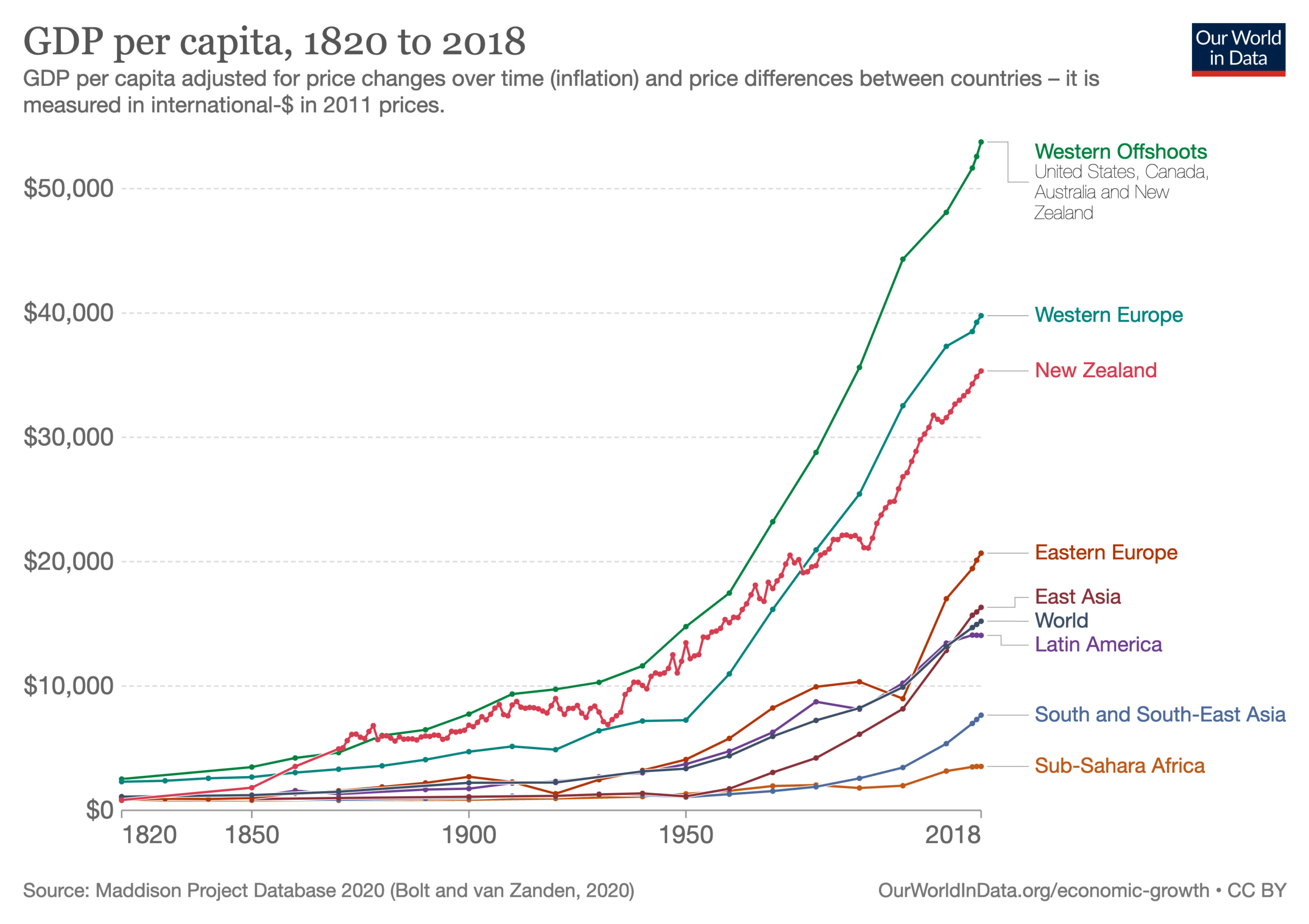
It is not hard to see why. Mass prosperity rests on cheap energy: that is much more important than, for instance, free trade. The Industrial Revolution is really the Mass Access To Cheap Energy Revolution. It is that access that is above all else responsible for The Great Enrichment.

As economic historian Jack Goldstone notes:

    by 1850 the average English person has at his or her disposal more than ten times the amount of moveable, deployable fuel energy per person used by the rest of the world’s population.

Net Zero means raising the price of energy, thereby narrowing access to it, and, in particular, narrowing the range of economic activity that is commercially sustainable. Even without increasing the population, that will increase contestation over resources.

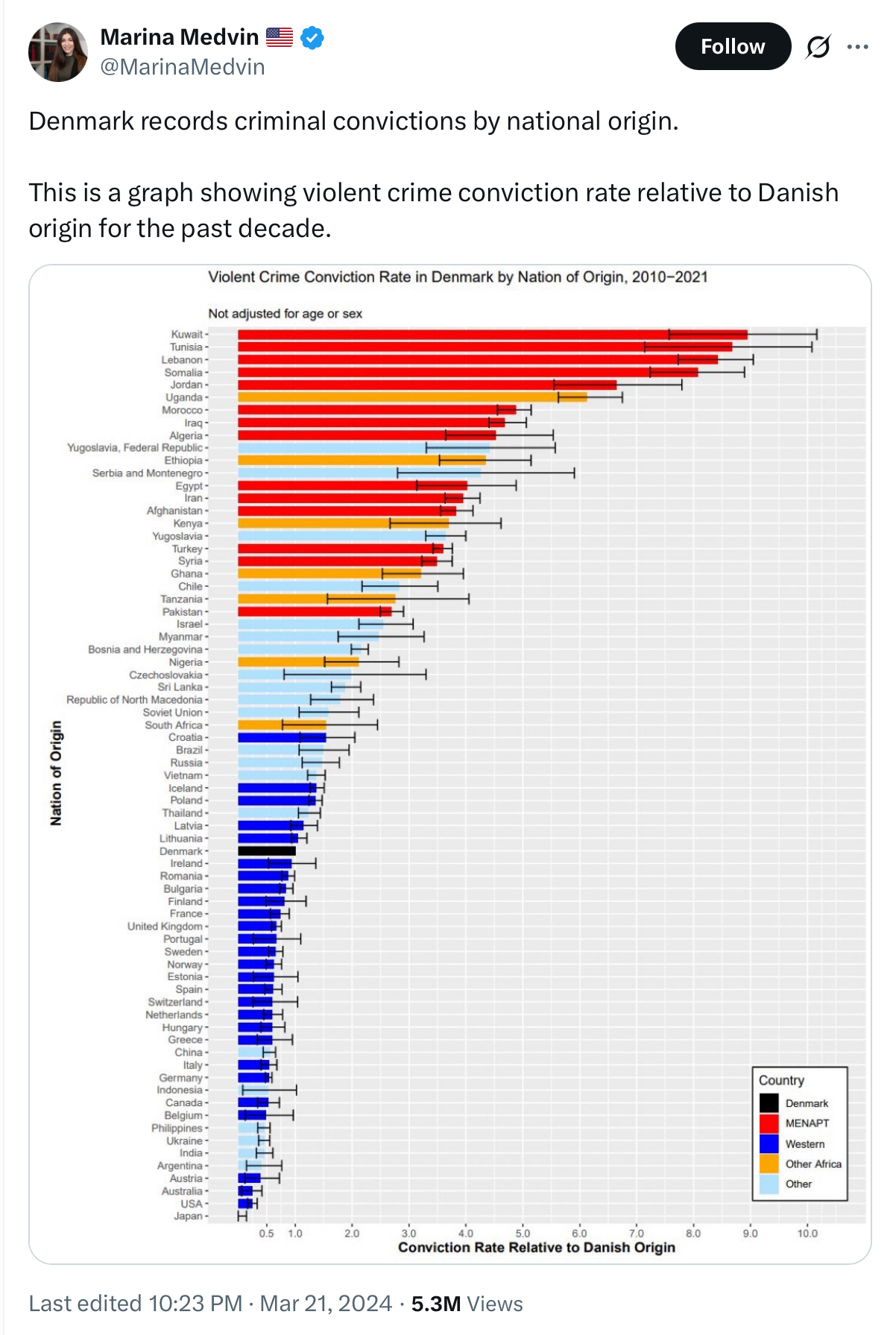
Add mass immigration to the mix, and that contestation becomes much worse. All the experienced costs of mass immigration — higher rents and house prices; increased congestion; downward pressure on wages and increased fiscal stress (if importing significant numbers of low-capital/skill immigrants); downward pressure on social trust and corrosive effects on the norms and rules that underpin institutions (if importing lots of people from very different cultures); increased crime (if importing significant numbers of people from higher crime cultures) — are then magnified.

January 4, 2026

“You will eat the bugs, peasant!”

Filed under: Food, Government, Media, Politics — Tags: , , , , , , — Nicholas @ 03:00

On the social media site formerly known as Twitter, ESR reacts to yet another “bugs are yummy, peons, you are going to eat them” post:

Contemplating this picture, I had a realization about the people who want you to eat bugs.

The fact that the bugs are disgusting to you is the whole point. Enlisting you as the principal enforcer of your oppression is the program. Fucking with your head is the actual goal, not just a tactic.

It doesn’t matter whether or not Western prejudice against eating insects is irrational. In an alternate world where we routinely eat insects, the people who want you to eat the bugs would find some other kind of disgusting garbage and play to make you eat it.

Because this isn’t sustainability or any of that bullshit. The degradation is the point.

However, even the powers-that-be can’t magically create economic conditions in which insect factories earn profits:

In the renewable frenzy of the early 2020s Ÿnsect raised €600 million to “Reinvent the food chain” and pioneer alternative foods that “respect the planet’s boundaries”. Some $200 million of their funding came from hapless taxpayers somewhere. But in record time, seemingly before it began, it has already gone. Bankrupted. And not because people don’t want to eat mealworms (which they don’t) but because there wasn’t much market in making animal feed either. It turns out that farm owners didn’t want to spend 2 to 10 times as much on “sustainable” cattle fodder. So the company shifted focus to high end pet food, where besotted owners have money to spare, but that crashed too.

h/t Tom Nelson

    How reality crushed Ÿnsect, the French startup that had raised over $600M for insect farming
    By Anna Heim, TechCrunch

    The company’s demise is hardly a surprise, as Ÿnsect had been embattled for months. Still, there is plenty to unpack about how a startup can go bankrupt despite raising over $600 million, including from Downey Jr.’s FootPrint Coalition, taxpayers, and many others.

    Ultimately, Ÿnsect failed to fulfill its ambition to “revolutionize the food chain” with insect-based protein. But don’t be too quick to attribute its failure to the “ick” factor that many Westerners feel about bugs. Human food was never its core focus.

It’s only money …

    And revenue was the problem. According to publicly available data, Ÿnsect’s revenue from its main entity peaked at €17.8 million in 2021 (approximately $21 million) — a figure reportedly inflated by internal transfers between subsidiaries. By 2023, the company had racked up a net loss of €79.7 million ($94 million).

The vainglorious heady days of climate communism meant some bureaucrats thought it made sense to spend $200 million dollars feeding bugs to cows to try to change rainfall in 2100 AD.

December 16, 2025

If your military embraces “Net Zero”, you’ve actually got a civil service in uniform, not a military

Filed under: Britain, Environment, Government, Military, Russia — Tags: , , , , , — Nicholas @ 05:00

In The Critic, Maurice Cousins points out the painful truth (painful that is to policians and career bureaucrats) that no serious military can prepare and carry out their prime duties if they also tout their allegiance to “Net Zero” bullshit:

Two developments explain the shift in tone. The first is the protracted US–Russia peace talks conducted largely over Europe’s head. The second is the publication of Donald Trump’s National Security Strategy, which makes explicit that Europeans must now assume far greater responsibility for their own defence. None of this should surprise anyone who has been paying attention. The Trump administration has been saying the same thing, bluntly and repeatedly, since its inauguration.

Speaking at the NATO Defence Ministers’ meeting in February 2025, the US War Secretary, Pete Hegseth, put it plainly: “To endure for the future, our partners must do far more for Europe’s defence. We must make NATO great again. It begins with defence spending, but must also include reviving the transatlantic defence industrial base, prioritising readiness and lethality, and establishing real deterrence.”

After nearly eighty years of relying on American power to underwrite their security, European leaders are being forced to relearn the fundamentals of hard power and grand strategy. It is difficult to overstate how profound a challenge this represents for both Europe and the UK. It demands a rethink across policy areas that, for decades, have been treated as marginal to national security.

Since the 1990s, Britain’s political and intellectual elite has operated within a fundamentally different paradigm. The “end of history” has become a cliché, but it is worth recalling just how deeply it shaped elite thinking. In the aftermath of the Soviet Union’s collapse, Anthony Giddens — one of the intellectual architects of New Labour — argued in The Third Way that the West no longer faced “clear-cut enemies”. Cosmopolitanism, he claimed, would be both the “cause and condition” of the disappearance of large-scale war between nation-states. The “strong state”, once defined by preparedness for war, “must mean something different today”. They believed that post-material and post-traditional values, including ecological modernisation, human rights and sexual freedom, would come to dominate politics.

For realists, this utopian worldview was always naïve. In her final book, Statecraft (2003), Margaret Thatcher warned that the post-Cold War world was far more likely to vindicate Samuel Huntington’s “clash of civilisations” than Francis Fukuyama’s progressive vision of an “end of history”, in which liberal democracy emerged as the inevitable global victor.

Clearly, the liberal internationalist illusion should finally have been shattered by Russia’s annexation of Crimea in 2014. Alas, it was not. Instead of prompting a fundamental strategic reset, Britain’s governing class doubled down on the same post-material, cosmopolitan assumptions that had shaped the 1990s and 2000s. In 2015, Europe and the UK embraced the Paris Climate Agreement. In 2019 — a year after the attempted murder of Sergei Skripal on British soil with a chemical weapon — ministers enshrined Net Zero in law and banned fracking. Each decision reflected the same belief: that geopolitics could remain subordinate to “climate leadership”, and that the material foundations of security could continue to be dismantled.

That worldview is now colliding with reality.

The US National Security Strategy contains a series of blunt truths about Europe’s condition. British commentary has focused on its remarks about culture, migration and defence spending. But one critical area has been largely overlooked: energy and industry.

The document begins from a hard material premise: that dominance in dense and reliable sources of energy — oil, gas, coal and nuclear — is essential to the ability of the United States, and its allies, to project power. From that foundation it draws a sharper conclusion, rejecting what it describes as the “disastrous ‘climate change’ and ‘Net Zero’ ideologies” that have hollowed out Europe’s industrial base while subsidising its adversaries. The result, it argues, is a defence problem that runs far deeper than military budgets. Alongside cultural weaknesses, myopic energy policy and de-industrialisation — exemplified by Germany’s recent offshoring of its chemical industry to China — are identified as anti-civilisational forces that directly erode Western hard power.

This makes Carns’s most important observation all the more sobering. While armies, navies and air forces respond to crises, he said, it is “societies, industries and economies [that] win wars”. He is unequivocally right.

On his Substack, Niccolo Soldo discusses the contents of the Trump administration’s new National Security Strategy:

Egyptian President Gamel Nassar had some choice lines to describe US foreign policy too:

    The genius of you Americans is that you never make clear-cut stupid moves, only complicated stupid moves which make the rest of us wonder at the possibility that we might be missing something.

    With the Soviet Union, you know where you stand today and where you will stand tomorrow. With the United States, you never know where you will stand tomorrow—and sometimes not even today.

    America is like a beautiful woman who changes her mind every night. You can love her, you can fear her, but you can never be sure what she will do in the morning.

And then there is this recent classic from Russia’s chief diplomat, Sergey Lavrov:

    The USA is agreement non-capable.

The point of sharing these quotes is to highlight the obvious fact that US foreign policy has long been unpredictable. This wouldn’t be too much of an issue if it were a middling power. When a superpower routinely upends the table, it makes life very, very difficult for those countries that have become “states of interest” for the Americans. Creating and pursuing foreign policy strategies require a lot of time and effort, meaning that they are very rarely predicated on short-term trends. When the predictability of foreign actors is removed from the strategic equation, the foundation of any plan becomes very weak.

Earlier this month, the White House issued its 2025 National Security Strategy vision in a 33 page .pdf document available for all to see and read here. This is an action that the US Executive Branch is mandated to do, ever since the Goldwater-Nichols Act of 1986. The point of this exercise is to articulate the vision of the President of the United States of America regarding foreign policy, so as to effectively communicate said vision to Congress and the American people. It does not mean that it is an official foreign policy strategy, since this area of governance is the responsibility of both the executive and legislative branches of the US Government.

Because this is the Trump Administration, and because of the fever pitch that has coloured both of his terms in office, a lot of attention is being given to this iteration of this mandatory document. This document is intentionally high-level (meaning that it purposely doesn’t drill down into specifics), keeping within the tradition of previous administrations. However, attention is warranted this time, because the vision outlined by President Trump per this document indicates a significant break in both the USA’s approach to and philosophical arguments regarding how and why it conducts its foreign policy. Despite the obvious Trumpist (think: transactional) touches interspersed throughout this document, what it does represent is a stated desire to break with certain idealist practices of recent administrations in favour of a more realist approach and worldview, one that stresses respect (if we accept the document at face value) for national sovereignty, and an admission that US global hegemony is simply not possible.

So what we are left with is a document that outlines a new vision for US foreign policy, one that has determined that taking on both Russia and China simultaneously is the wrong approach to securing American national interests. This makes it very worthy of closer inspection and analysis (something that I have been thinking about deeply since it was first made available to the public a fortnight ago). Before we begin to dive into it, I am asking you all to temporarily suspend your cynicism and take the strategy outline at face value for the sake of this analysis. I will once again repeat that this is not official policy, and there is a very strong chance that it will never be adopted as that.

December 8, 2025

If Britain’s political leadership were trying to destroy the country, what would they have done differently?

My Canadian readers — and possibly the occasional Aussie or Kiwi — can read Spaceman Spiff‘s essay and feel it applies almost 100% to our respective nations as well:

Image from Postcards from the Abyss

Britain is a disaster. The country seems to be in terminal decline.

Not only do we see a lack of ability to turn things around we witness leaders and prominent decision makers evidently clueless about normal life and the hardships many now face.

The political and media classes best reflect this phenomenon. Their views are insular, fictional and at odds with reality. They promote unorthodox ideas that are widely derided yet their enthusiasm is evident as are their hostile responses to being challenged.

Minor comments about immigration are treated as precursors to genocide. Criticism of a biased media unwilling to report events is dismissed as conspiracy. No discussion of climate policy and its unaffordable costs is tolerated. Deviation from the establishment view means excommunication and social exile.

Those in leadership positions drive Britain’s descent into authoritarian governance. Attempts to discuss changes to society leads to extreme overreactions, including jailing noticers, something they now boast about.

Britain has become a madhouse. Our leaders are unable to think like normal people. None of them are facing reality. They seem crazy.

Or, rather, they seem neurotic.

Neurosis is everywhere

Britain has degenerated into a technocratic regime that views the public as its enemy. Normal people disgust the country’s leaders and it shows. They no longer hide their contempt.

But there is a palpable sense of fear emanating from the powerful. Their reactions to normal events paint a troubling picture of who is leading the country, particularly the political and media classes.

If the British establishment were a person we would think them mentally unstable. The qualities we see most are those of a neurotic individual, a type that is well understood.

Here are some features visible in Britain’s ruling class.

Chronic anxiety and worry

A key attribute of neurosis is persistent fear or worry. Rumination is commonplace, circling around and around the same problems. There is also a tendency to overreact, with the response disproportionate to the issue at hand.

The current British regime is wracked with anxiety and worry. This defines them. They are vocal about their concerns.

We are reminded of an endless series of horrors we must attend to; systemic racism, lack of diversity, an imperial past and our cultural dominance along with our impact on the world.

One simple example illustrates the degree to which minds can become distorted by excessive worry.

James Watt perfected the steam engine in 1769 which kickstarted in the industrial revolution, changing the world forever. This would ultimately elevate most nations on earth and led eventually to the establishment of cheap abundant energy for almost everyone.

Until recently these events were viewed as an epoch-defining moment of engineering brilliance. Now this has been recast as a dark stain on Britain’s place in the world, with climate zealots keen to blame the British for all pollution caused by industrialization.

Instead of pride we now see embarrassment and even anxiety about the “damage” Britain has done to the world because it ushered in an era of cheap widespread energy for everyone.

Any rational person would understand this extreme view to be a distortion of reality and excessively negative, yet it permeates everything. Those who rule Britain are ashamed of our past. They worry about it. Only they do this, normal people are proud of our history.

[…]

Welcome to the madhouse

A system of governance driven by neurotics takes on their characteristics. Britain has become a neurotic bureaucracy; a neurocracy.

Neurotics overthink and live inside their heads. They lack the calm, detached strength needed to govern sensibly. Power structures inevitably take on these qualities.

The British government has become paranoid. Digital IDs, internet regulation, censorship. They jail normal people for social media posts. Dissenting views are increasingly punished with custodial sentences.

These are not the actions of the mentally strong. This is an embattled minority fighting reality and becoming desperate.

A gulf is opening between the rulers and the ruled. Increasingly no common ground is even conceivable as the fictions needed to maintain narratives grow. They become overtly false but are needed to feed the neurosis.

One of the things I like about the social media site formerly known as Twitter is how quickly authoritarian bullshit like this can get called out:

Update, 9 December: Welcome, Instapundit readers! Please do have a look around at some of my other posts you may find of interest. I send out a daily summary of posts here through my Substackhttps://substack.com/@nicholasrusson that you can subscribe to if you’d like to be informed of new posts in the future.

December 7, 2025

“Anglofuturism” – slogan or beacon of hope?

At Without Diminishment, Robert King argues for Anglofuturism as the most hopeful path forward from the morass all of the Anglosphere seems to be bogged down in:

(From the Ministry of Space, created by Warren Ellis, 2004.)

Born in the digital backwaters of podcasts and Substacks, Anglofuturism has climbed into public view like a rocket nearing the King Charles III Space Station, gathering both attention and indignation as it ascends.

The New Statesman mutters about it being rooted in “nostalgia“, while the far-left activist group Hope Not Hate insists it is something deeply sinister. Yet their agitation merely confirms a familiar sequence. First, they ignore you, then they laugh at you, then they fight you, and then you win.

At its essence, Anglofuturism is a project of civilisational renewal.

It begins with the conviction that Britain’s decline is not destiny but a decision, and the consequence of decades of political miscalculations that consider the national story to be over, Britain’s very own “end of history”.

Just turn on the news and you will see evidence for this everywhere. Strategic islands like the Chagos Islands surrendered to the vassals of hostile powers. A once-thriving energy sector crippled by the ritual self-flagellation of net zero policies, despite abundant North Sea oil resources.

The capital city of London, once envied for its composure, now deafened by the shrill chants of imported grievances, “From the river to the sea”. Britain was once a country whose streets were said to be paved with gold, according to the legend of Dick Whittington.

Today, they are paved with boarded banks, betting slips, and vape shops. The country’s future is already playing out in London, a place where the nation of Britain has faded into the idea of “the Yookay”. Britain is told that because it once colonised, it must now invite colonisation, that because it once conquered, it must now submit.

The result is a people bending ever lower in the hope of forgiveness from a self-appointed virtuous minority at home, and from the ever-growing numbers of strangers who now claim the country as their own.

Anglofuturism is the vanguard against this ideology. It insists that love of one’s civilisation is a duty, not a sin. It binds identity to optimism, and pride to ambition. It seeks to remind Britons that its best days may yet lie ahead, but only if it learns once more to have confidence in itself.

[…]

The policy of splendid isolation simply will not work for the twenty-first century.

Enter CANZUK, the proposed alliance of Canada, Australia, New Zealand, and the United Kingdom. Four constitutional monarchies, four democracies, and four maritime powers linked by law, language, and lineage. Together they would represent over 140 million people and a combined GDP exceeding $6 trillion. It would be a realm on which, once again, the sun would never set.

Our shared day of remembrance on November 11 is a reminder that we partake in traditions born of shared sacrifice.

Such a bloc would not be a re-creation of empire, but a confederation of equals who share the responsibilities of defence and trade, coordinating space and science, and projecting stability from north to south and east to west.

It could stand apart from American turbulence, Chinese authoritarianism, and European stagnation, and be a new civilisational pole rooted in innovation and freedom under common law. It could even be a new contender to lead the free world.

Britain is still a nation successful at exporting ideas like capitalism, liberalism, and, regrettably, Blairism. Anglofuturism could be its most powerful export to the Anglosphere yet.

For those of us at the edge of that world, in Cape Town, Perth, or Vancouver, the message of Anglofuturism is that our story is not over. Our civilisation may be weak, even fading, but it can be revived. Doing this will demand the same courage that built it, in the spirit of the pioneers and soldiers, the engineers and thinkers who shaped continents and defended freedom when it was under siege.

Like this, but better.

October 15, 2025

Hamburg votes to secede from industrial civilization

Despite my always plummetting hopes for Canada I have to admit that I do enjoy a little soupçon of schadenfreude with every new bit of evidence from eugyppius that Germany is determined to ostentatiously self-destruct even before the demented Dominion can:

Hamburg is German’s leading industrial city. Its companies add 20 billion Euros in gross value every year. Much of this economic output is related to Hamburg’s happy location on the Elbe and the fact that the city is home to Europe’s third-largest port. All of this has made Hamburg extremely prosperous, which prosperity has filled it with rafts of clueless virtue-signalling morons who have no idea how anything works, why they find Hamburg attractive in the first place or how their hip urban lifestyles are maintained.

In this photo, published by BILD, you can see some of these unmitigated retards having a happy because they’ve just scored cheap virtue points by voting in their own personal energy apocalypse.

Photo from BILD via eugyppius

Specifically, these dumbasses are celebrating because their completely insane popular referendum passed with 53.2% of the vote on Sunday. This referendum, the so-called Zukunftsentscheid (“future decision”), binds the Free and Hanseatic City to achieving total carbon neutrality by 2040, five years earlier than the 2045 goal set by the almost equally insane Germany-wide Climate Protection Law as emended in 2021, which is in turn five years earlier than the 2050 goal established by the selfsame law as it originally passed the Bundestag in the year of the child-saint Greta Thunberg 2019.

Turnout was pretty low in Hamburg last Sunday, with less than 44% of eligible voters bothering to cast a ballot, most of them by mail. Thus just 23% of the most deranged Hamburgians could take their city hostage and commit its government to destroying all of its industry and most of its economic activity inside the next decade and a half. The biggest joke is that when Hamburg has finally achieved the sacred Net Zero, it will make absolutely zero net difference to anything. Hamburg is responsible for something 0.022% percent of CO2 emissions globally. The city is not even a rounding error.

The referendum was an initiative of Fridays for Future, but it gathered the support of various social and environmental organisations, among them Greenpeace, the union Verdi and even FC St. Pauli. It will successively cap annual CO2 emissions sector-by-sector, imposing a slow and relentless strangulation in turn on transit, households, commerce and industry.

September 24, 2025

Zardoz: A Technocratic Parody

Filed under: Britain, Environment, Media — Tags: , , , , , , , — Nicholas @ 02:00

Feral Historian
Published 30 Jun 2023

After another viewing, I now think of Zardoz as an unintentional parody of the technocratic mindset that was congealing in the 1970s. It’s a strange film, a sometimes tedious film, but it’s worth a look if only because there’s nothing else quite like Zardoz.

I keep saying “Immortals” when I mean “Eternals” and I had to recut this one a bit due to some semi-random copyright issues so I apologize for any perceptible jank.

The tip jar at Ko-Fi helps keep Feral Historians in the woods and off the streets.
🔹 Ko-Fi | ko-fi.com/feralhistorian

September 12, 2025

Britain’s network of weather stations is becoming less and less reliable

Well-sited weather stations can provide useful raw data on temperature ranges, wind speed, precipitation, and other measurables, but that “well-sited” makes a huge difference. Older weather stations situated in areas of rapid urban expansion will often be less reliable as they become part of the urban heat island and report higher temperatures due to locally generated heat sources rather than the ambient temperature they were able to record before. This is what has apparently happened to far too many of the UK’s temperature measuring sites, according to Chris Morrison in The Daily Sceptic:

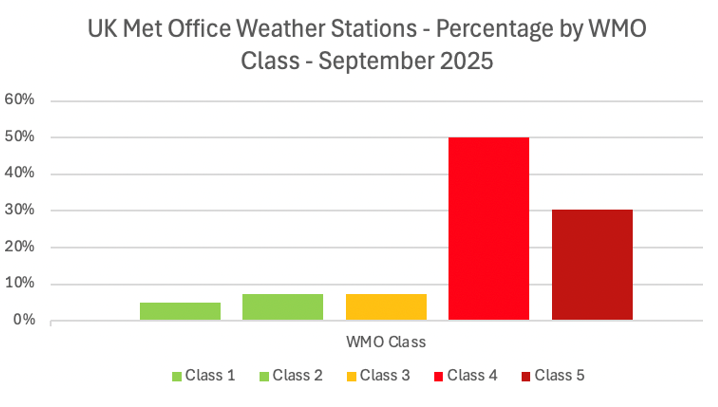
The latest WMO Class figures at the Met Office shown in block graph form. The higher the class number, the less reliable the station reports become.
Image from The Daily Sceptic

In March 2024 the Daily Sceptic shocked the science and political world by disclosing that nearly 80% of the UK Met Office’s temperature measuring sites were so poorly located that potential “uncertainties” could corrupt the readings by a numbers of degrees of centigrade. World Meteorological Organisation (WMO) Classes 4 and 5 in its CIMO scale come with “uncertainties” up to 2°C and 5°C respectively, and a Freedom of Information (FOI) request found that 77.9% of its sites were in these two “junk” categories. It should have been a wake-up call demanding immediate improvement of the nationwide network, not least because the Met Office frequently catastrophises its temperature figures in the interest of promoting the Net Zero fantasy. Alas, no. A new FOI has found that the Classes 4 and 5 junk sites have increased significantly over the last 18 months and now total an appalling 80.6% of the entire network. Pristine Class 1 sites – which measure a credible ambient air temperature with little chance of unnatural heat corruption – are just 4.9% of the total, having fallen in number in this short period from 24 to 19.

Hundreds of millions of pounds have flowed through this Government department over the last 18 months but little effort seems to have been made to improve its basic and important meteorological measuring function. What is worse is that the Met Office doesn’t seem to understand the scale of the problem. Over the 18 months, it appears that 20 new sites have been opened in its now 387-strong network. Seventeen of these have been given WMO classifications, of which a frankly ludicrous 64.7% are starting life in the Class 4/5 junk lane.

The WMO rates weather stations by the degree of possible temperature corruption caused by nearby unnatural or natural influences. Classes 1 and 2 are considered what we might call pristine, with no significant errors arising from artificial influences. The latest figures show that the Met Office has just 12.1% of its sites in these two unadulterated categories. Class 3 comes with an uncertainty of up to 1°C and accounts for 7.23% of the total. The real shocker is Class 4 where the percentage of the total has risen from 48.7% to over half at 50.1%. Class 5 has no defining conditions and could be located next to a blast furnace door. It has risen over the last 18 months from 29.2% to 30.5%. The WMO states that a Class 1 location can be considered a “reference site”. A Class 5 site is said to be a location “where nearby obstacles create an inappropriate environment for a meteorological measurement that is intended to be representative of a wide area”.

Despite this, Class 5 “extremes”, often caused by temporary but obvious heat spikes, litter the Met Office databases and record books. Of course such Class 5 data, unsuitable for providing an accurate temperature for a “wide area”, are loaded into databases producing “hottest evah” days, months, seasons and years. Their final destinations are the global datasets that exaggerate recent warming, again to promote Net Zero. Sprinkling the Class 4 and 5 fairy dust over the figures adds a bit more of the urgency required for elite political purposes.

September 4, 2025

Net Zero targets and Britain’s ever-declining car industry

Filed under: Britain, Business, China, Environment, Government, USA — Tags: , , , , , — Nicholas @ 03:00

At the Foundation for Economic Education, Jake Scott charts the decline of the British auto manufacturing centres and the government’s allegiance to its Net Zero programs:

Custom image by FEE

Britain was once a giant of car manufacturing. In the 1950s, we were the second-largest producer in the world and the biggest exporter. Coventry, Birmingham, and Oxford built not just cars, but the reputation of an industrial nation; to this day, it is a source of great pride that Jaguar–Land Rover, a global automotive icon, still stands between Coventry and Birmingham. By the 1970s, we were producing more than 1.6 million vehicles a year.

Today? We have fallen back to 1950s levels. Last year, Britain built fewer than half our peak output—800,000 cars, and the lowest outside the pandemic since 1954. Half a year later, by mid-2025, production has slumped a further 12%. The country that once led the automotive revolution is now struggling to stay afloat, and fighting to remain relevant.

This is why the news that BMW will end car production at Oxford’s Mini plant, shifting work to China, is so damning, bringing this decline into sharp focus. The Mini is not only a classic British car; Alec Issigonis’s original design made it an international icon. For decades, the Mini has been the bridge between British design flair and foreign investment. Its departure leaves 1,500 jobs at risk at a time when the government is desperate to fuel growth and convince a wavering consumer market that there is no tension between industrial production and Net Zero goals.

It’s a bitter reminder that we in Britain have been here before: letting an industrial crown jewel slip away.

The usual explanations will be offered: global competition, exchange rates, supply chains. All true, in the midst of a global trade war that is heating up and damaging major British exports. But such a diagnosis is incomplete. The truth is that Britain’s car industry is being squeezed by a mix of geopolitical realignment and government missteps.

The car industry has become the frontline of a new trade war. Washington has already moved aggressively to shield its own firms: the Inflation Reduction Act offers vast subsidies for US-made EVs and batteries, an unapologetic attempt to onshore production, and something that became a flashpoint of tension in Trump’s negotiation with the EU in the latest trade deal. On the production side, the Act has poured billions into US manufacturing: investment in EV and battery plants hit around $11 billion per quarter in 2024.

Ripples have been sent across the world in the US’s wake: Europe, faced with a flood of cheap Chinese EVs, has imposed tariffs of up to 35% after an anti-subsidy investigation. Talks have even turned to a system of minimum import prices instead of tariffs. Unsurprisingly, China has threatened retaliation against European luxury marques, while experts warn the tariffs may slow the EU’s green transition by raising prices.

This is no longer a free market: cars are treated as strategic assets, the 21st-century equivalent of shipbuilding or steel. Whoever controls the supply chains, particularly for EV batteries and the mining of lithium, controls not only the future of the industry but an important lever of national power.

The results are visible. In July 2025, Tesla’s UK sales collapsed nearly 60%, while Chinese giant BYD’s deliveries quadrupled. Europe responded by talking up new tariffs. Britain did nothing. In this asymmetric contest, our market risks becoming a showroom for foreign producers — subsidizing both sides of the trade war without defending our own.

August 6, 2025

Actual data demolishes the “climate catastrophe” narrative

Filed under: Environment, Government, Media, Politics, USA — Tags: , , , — Nicholas @ 05:00

At The Conservative Woman, Paul Homewood summarizes the findings of a new report for the US Department of Energy:

A report by five independent, eminent scientists has blown apart the myth of catastrophic climate change, destroying the case for Net Zero in the process.

Judith Curry, Roy Spencer, Ross McKitrick, John Christy and Steve Koonin are all highly respected leaders in their respective fields. Their report was commissioned by the US Department of Energy (DOE) but written with no editorial oversight by the DOE and with no political influence whatsoever. Although it specifically covers the US, its findings have worldwide ramifications.

The 151-page report, A Critical Review of Impacts of Greenhouse Gas Emissions on the US Climate, reviews scientific certainties and uncertainties in how anthropogenic carbon dioxide (CO2) and other greenhouse gas emissions have affected, or will affect, the nation’s climate, extreme weather events, and selected metrics of societal well-being.

Maybe the most relevant part concerns extreme weather. According to the report: ‘Most extreme weather events in the US do not show long-term trends. Claims of increased frequency or intensity of hurricanes, tornadoes, floods, and droughts are not supported by US historical data. Additionally, forest management practices are often overlooked in assessing changes in wildfire activity. Global sea level has risen approximately 8 inches since 1900, but there are significant regional variations driven primarily by local land subsidence; US tide gauge measurements in aggregate show no obvious acceleration in sea level rise beyond the historical average rate.

A few graphs from the report tell the story, and you can see them at the end of this article.

  1. US landfalling hurricanes show no long-term trends, either in frequency or intensity;
  2. Heatwaves were much worse than now before the 1960s;
  3. Temperature extremes are reducing, as a greater number of extremely hot days is more than offset by fewer extremely cold ones;
  4. There has been a marked decline in the number of the strongest tornadoes, EF3 to EF5, since the 1970s. The increased numbers of weaker tornadoes is the result of better observation methods, including Doppler radar, not an actual increase;
  5. US droughts were much more severe for most of the historical record going back to 1895;
  6. While wildfire activity has marginally increased since the 1980s, it was considerably worse up to the Second World War. Most of these long-term changes are caused by fire management practices, not climate changes;
  7. Tide gauges all around the US show the same story – a slow and steady sea level rise beginning in the mid 19thC. The rate of rise can vary considerably from station to station because of local factors. New York and the rest of the Atlantic Coast, for example, has been subsiding since the Ice Age; Galveston is sinking as a direct result of groundwater withdrawals.

The scientists pour scorn on weather attribution computer models, which have become the media’s go-to source for climate apocalypse stories. These attribution models routinely claim that extreme weather events have been made more likely because of global warming. They are dismissed in the report, which highlights the lack of high-quality data and reliance on deficient climate models. Other scientists have not been so kind!

April 30, 2025

Low-energy Europe

Filed under: Britain, Economics, Europe — Tags: , , , , , — Nicholas @ 03:00

Depending on who you read, it appears that the massive power outage in southwestern Europe nearly expanded across the continent, as Spain and Portugal went dark taking parts of other neighbouring countries’ networks down as well. James Price explains that this sort of thing is likely to be a recurring phenomenon as Europe leans ever more heavily on unreliable sources of electricity:

In his 2017 book The Strange Death of Europe, Douglas Murray accused Western European nations of Geschichtsmüde, being weary of history. President Trump might translate this by recycling a sobriquet he used against Jeb Bush — being low-energy.

This is now literally the case in both the United Kingdom and Germany, who have the most expensive energy costs in the developed world. The consequences have been catastrophic, in economic, political, environmental, and even geostrategic terms.

The true tragedy is that so much of the pain is self-inflicted, the result of bad, rushed policy designed to make people feel warm and fuzzy inside, rather than actually keeping people warm.

Net Zero

The commitment in Britain to “net zero emissions by 2050” was signed into law in the dying days of Theresa May’s premiership, as an attempt to give her a “legacy” after three painful years as Prime Minister. That legacy is likely to be lost, like the works of Ozymandias, as the world comes crashing back to economic reality.

The debate over the introduction of net zero was conducted during the Conservative Party’s leadership contest to succeed May, and therefore all attention was away from what would prove to be the most impactful economic decision of the year. The debate lasted all of 90 minutes.

The results have been completely devastating for Britain’s economy in all sorts of corrosive ways. For one, 169 years after Henry Bessemer worked out how to mass-produce steel in Sheffield, Yorkshire, Britain almost lost its ability to make the stuff here in Britain. Global factors like Chinese dumping play a part, but the extent of environmental regulation on British industry is making it impossible to sustain any kind of heavy industry. And now, British Steel has been nationalized once more, lumping the taxpayer with the losses and liabilities, but without doing anything to address the root causes.

But the government meddling does not stop there. In agriculture, a cruel, ideological attack on farmers (over whether farms can be charged inheritance tax) is going to spur more prime farmland to be turned into solar panel fields in a country where the sun often doesn’t shine.

There are now many statutory requirements to push environmental policies in all sorts of areas, to the complete detriment of other requirements, namely economic prosperity, that would otherwise be carefully balanced. So new homes in Britain have to have small windows, to increase insulation efficiency.

HS2, a much delayed and hideously over-budget high speed rail line between London and Birmingham, is building a one-kilometer-long tunnel to prevent bats being harmed by high-speed trains. The tunnel will cost over £100 million to build. Not only is there no evidence that the trains would interfere with bats, but there is also some evidence that the bat tunnel may actually be a bat-killing tunnel.

Hinkley Point C, the only nuclear power station being constructed at the moment in Britain, is having to construct a “fish disco” at huge costs to push fish away from being sucked into the cooling system.

This kind of environmental “everythingism” is not just holding back progress, not just costing huge amounts; it is corrosive of every attempt by people who just want to get on with building and growing — even “green” enterprises. Orsted, an offshore wind company, had to fill in forms five times longer than Tolstoy’s War and Peace, and had to wait nearly three years for a decision to build one farm.

And specifically about the Spanish situation that nearly triggered a Europe-wide blackout, from the social media network formerly known as Twitter:

SPAIN BLACKOUTS: AN ANONYMOUS EXPERT VIEW

From a deep groupchat, last night, translated from Spanish, written by an expert in transmission and distribution of power. Not my words.

“What has happened on April 28 has a well-located origin: the Aragón-Catalonia corridor, which is one of the most important electric highways in Spain. There is not only the electricity produced by our solar and wind farms in the northeast, but also the electricity that we import from France. This international interconnection, although weak (it can only contribute 3% of our demand, well below the minimum of 10% that marks the EU), in times of stress is essential to balance the network.

“At 12:32 p.m., in that Aragón-Catalonia corridor there was an electric [shake]. What exactly does “shake” mean? It means that suddenly and abnormally, the power that flowed through those lines began to vary violently, rising and falling in a very short time. Such abrupt variability can be due to three main causes:

“1. That a relay or transformer on that electric highway detects an abnormal flow of current or voltage (higher or lower than expected) and automatically disconnected to avoid burning or [being] destroyed. This is called that “opens” a relay or switch: it jumps and cuts the passage of electricity to protect itself.

“2. That the enormous concentration of renewable energy in that area (mainly solar and wind) has created an electrical resonance: electronic inverters, which synchronize current, can sometimes be amplified between them if a small voltage alteration (for example, due to clouds, strong wind or a slight failure) extends like an echo to all devices, causing widespread oscillations.

“3. That a wrong control order has been sent (by mistake or attack) from the SCADA systems, disconnecting or reducing the generation of multiple hit plants. There is no confirmation of this possibility yet, but it is being investigated.

“What is known is that as a consequence of that shake, the interconnection with France jumped: we were isolated just at the worst time, when the peninsula needed external support to stabilize.

“Without that French help, the frequency of the peninsular network (which should always be 50 Hz exact) began to drop quickly. The frequency is like the heartbeat of the network: if it falls too much, the systems understand that the patient (the network) is collapsing and automatically disconnected so as not to self-destruct. Thus, in just five seconds, the solar and wind farms were turned off — [they are] very sensitive to frequency variations — 15 GW of power was lost suddenly (60% of all the electricity generated at that time), and the network could not take it anymore: it collapsed completely, showing the Redeia Platform (REE) a “0 MW” nationwide. That does not mean that all the turbines were physically turned off, but there was no generator synchronized at the common frequency of 50 Hz. It was, for practical purposes, a country [turned] off.

“To [restart] a completely dead network, one essential thing is needed: plants that can start in black, that is, without receiving energy from anywhere else. Spain has identified five large hydroelectric jumps capable of doing this. However, and here is one of the great negligences that are coming to light, three of those five groups were stopped in scheduled maintenance, by business decision supervised by the administration. Only two were operational. That made the recovery much slower and weaker than it should be in a normal contingency plan.

“The result is that, after almost 10 hours, only 35% to 40% of the national supply has been recovered, and there are still large areas in the dark or under scheduled cuts.

“The situation reveals a very serious underlying problem:

“Spain is still an energy island: it only has 3% foreign exchange capacity compared to its total demand.”

Part 2:

“The network depends a lot on variable renewables, which are disconnected quickly in the face of any instability.

“The lack of physical inertia reserves (i.e. large rotating masses such as thermal power plants or classic hydraulics) prevents the disturbances from damping.

“And poor maintenance planning left without enough hydraulic muscle to respond to a crisis.

“The most likely causes, with current data, are:

“A combination of technical failure in protection or in synchronization, added to a serious lack of operational forecast and maintenance (probability ≈ 40%).

“The possibility of an intentional cyber-physical attack remains in analysis (≈ 25% estimated probability).

“Other factors such as human error, punctual atmospheric phenomenon or mixed causes complete the rest.

“In short: an initial shake at the most sensitive point of the Spanish network — the Aragón-Catalonia corridor, door to Europe — left the peninsula isolated and vulnerable. The network could not sustain its own demand because it did not have sufficient assistance, nor stable physical reserve, nor enough bootable plants in black. Three of five hydroelectric jumps were out of service when they were most needed.

“For this reason, Spain went out in five seconds, and that is why it still continues to light little by little, fragile, slow and exposed.”

April 8, 2025

Mark Carney explained how he viewed the world in his book Values

It’s worth considering what Mark Carney wrote about his beliefs before becoming prime minister and how he’s campaigning right now:

For those who haven’t had the misfortune of parsing through Mark Carney’s Values, it reads like a sermon from a high priest of globalism — polished, preachy, and packed with ideas that should send shivers down the spine of anyone who cares about Canada’s economy, especially Western energy producers.

Writing as the former Bank of Canada governor and a darling of the Liberal elite, Carney pitches a vision of “sustainable finance”, net-zero absolutism, and heavy-handed regulation. To the National Citizens Coalition, it’s clear: this isn’t a roadmap to prosperity, it’s a wrecking ball aimed at the heart of Canada’s resource sector and the West’s economic lifeline.

Start with Carney’s obsession with “revaluing value”. In Values, he argues markets should prioritize climate goals over profit, pushing financial institutions to choke funding for oil and gas.

For Alberta and Saskatchewan, where energy employs tens of thousands and pumps billions into the economy, this is a death knell dressed up as virtue.

Western producers aren’t just businesses; they’re the backbone of communities, powering schools, hospitals, and homes. Carney’s disdain for fossil fuels ignores their role in keeping Canada competitive while our allies and adversaries keep drilling. His plan? Starve the sector, stranding assets and jobs, all to appease international green lobbyists in European nations with nationalized economies on the road to being as disastrous as Canada’s.

Then there’s his love affair with regulation. Values champions policies just like Bill C-69 — the “No More Pipelines Bill” — which Carney has refused to repeal. He sees it as a tool to enforce his net-zero utopia, but for the West, it’s a padlock on progress. Pipelines that could carry Canadian oil to global markets sit stalled, leaving producers at the mercy of low prices, foreign competitors, and now, tariff threats.

Carney’s mental framework both then and now doesn’t just stop projects, it signals to investors that Canada’s energy sector is a no-go zone. The result? Capital flees, jobs vanish, and the West pays the price for the lofty ideals of a London and Manhattan banker, who spends only part of his time in Canada — specifically, Ontario and Quebec.

Dan Knight on Carney’s swing through some British Columbia ridings this week:

A mock campaign sign for the Liberals spotted on social media.

Mark Carney rolled into Victoria this week with the swagger of a man who’s never missed a wine-and-cheese reception in his life and delivered what the Liberal brain trust likely considers a “bold vision” for Canada. But peel back the banker buzzwords and Churchill cosplay, and what you really got was a cringeworthy display of delusion, detachment, and recycled globalist dogma.

He opened his mouth and immediately signaled his marching orders: “clean energy”. Not once. Not twice. It was practically every other sentence. Because when you’re out of ideas, just say “green transition” on repeat and hope nobody checks the receipts.

He’s not just pushing the same failed Liberal climate ideology — he’s doubling down on it.

Carney promised to turn Canada into a “clean energy superpower” — without explaining how, exactly, we get there when his party has spent years shutting down oil and gas, blocking pipelines, and handing our resource wealth to the Americans.

This wasn’t new policy. It was the same Liberal fantasy that has already gutted Alberta, choked investment, and driven electricity prices through the roof — just ask Europe how that’s going. And when it comes to reopening auto plants or restoring manufacturing jobs? Nothing. Not a plan, not a word, not a clue.

And don’t worry — when Trump’s tariffs hit our industries, Carney says we’ll respond with “retaliatory tariffs”. Sounds tough, until you remember who actually pays those. Working Canadians. Line workers. Parts manufacturers. People trying to keep the lights on while Ottawa plays global economic chicken.

Carney’s big idea for recovery? Just keep handing money to the Liberal-connected elite.

He promised to “give back” — and by that, he means pouring another $180 million into the CBC, the same taxpayer-funded mouthpiece that’s been running interference for the Liberals for nearly a decade. This comes after ArriveCAN, the $60 million QR code boondoggle funneled through Liberal contractors, and countless other slush funds masquerading as “public service”.

While the working class is bracing for a made-in-Ottawa recession, Carney’s pledging more green slogans, more centralized control, and more taxpayer money to keep the illusion alive.

March 30, 2025

Recycling an old slogan – [Mark Carney] “didn’t come back for you”

Filed under: Cancon, Media, Politics — Tags: , , , , , , — Nicholas @ 04:00

I guess you could say that Elizabeth Nickson isn’t a Carney fan:

Doesn’t he look half-dead? Like a shroud covers his saggy emaciated face and spindly body. Indicative of lifelessness of his ideas. NOT his actual ideas because what he is currently selling are the ideas he stole from Canada’s Conservative Party. Those ideas are grass roots, labored over for decades in underfunded think tanks, all roundly mocked and slandered in our repellent media which never tells the truth when an easy lie is within reach. But now, in the hands of a “leader” who will not stop the Liberal Party and its Laurentian elite clients looting of the Canadian people, well now they are AOK. And genius. And a lie, because he will only perform the minimum to gratify the stupid, “educated” women who will elect him.

Because above everything Liberal Party looting must continue. And with Net Zero and all that elite clap trap there will be another three generations of Canadians to ruin, to steal from, to harvest their life’s energy to feed the Party’s enormous ego and the plush lifestyles in the posh suburbs of Canada. Scratch such a resident and whatever he does, his salary is boosted by government, in some form or other, via contracts which do not perform, ghost contracts, just money to play with for supporting the Liberal Party.

If Carney is elected, the country will break up.

First Alberta will go. Danielle Smith emerged grim from her last meeting with Carnage. Have you heard of stranded assets? That’s his goal for Alberta’s oil and gas. Albertas energy is responsible for one third of Canadas private sector economy and no matter what he says, he has worked for two decades for Climate Change sequestration nonsense. For solar and wind, for de-development, sliming his way around the world twisting arms. He was the grim reaper behind Justin’s authoritarianism. As a result our current economy is built on government and debt and refinancing loans and housing.

Oh he will lie and lie and lie and promise new industrial infrastructure. Sure he will. You know who will own that infrastructure? BIS, the Bank of International Settlements or some international banking outfit. They will own it because carbon credits and future use. They will retire some of our debt, not enough for us to actually grow, just to keep body and soul together. And we will grind forward another twenty years, piling up yet more debt, at which time the Liberal Party will broker off another hunk of our heritage.

Then Saskatchewan. BC and Manitoba will look at the powerhouse economy that the U.S. is building, and petition to strand the Eloi, with their banal life of ease on B.C. Coast, all as equally dumb and destructive as California’s ruinous elites. And join the U.S.

Canada has so much banked energy, so much thwarted ambition, so many lives wasted. So much potential lost. We are like a screaming adolescent banging ourselves against the wall, wanting nothing more than to get a job and get on with it. (Oh, wait, that was me)

Kaizen’s video is linked [here]. I STRONGLY recommend you listen to his powerful brief encapsulation of how fast the American economy is going to grow.

We tariff because we are broke. We are broke because we have regulated ourselves into stasis. This below represents what it is to do business in Canada. I have heard this from thousands of entrepreneurs.

Older Posts »

Powered by WordPress