The Rest Is History
Published 5 May 2026What does The Odyssey teach us about the history of wine in the ancient world? How did Julius Caesar use wine to conquer the world? And why was The Judgement of Paris – when America took on France – the most controversial incident in the history of wine?
Join Dominic and Tom as they discuss the long history of wine; from ancient Jordan, to Bronze Age Greece, to the Vikings, and beyond …
00:00 The complete history of wine in 8,000 years
00:41 Lloyds
02:14 Pliny the Elder and the first wine snob
06:02 Why wine is such a rich subject for history
09:27 Noah, Mount Ararat and the biblical origins of wine
11:31 Georgia, Armenia and the world’s first wineries
13:15 The Canaanites and the invention of the wine trade
16:19 The Phoenicians, Greeks and wine culture across the Mediterranean
18:32 How Rome created the first international wine culture
20:32 Wine, slavery and the Roman conquest of Gaul
23:12 Italy becomes the heartland of Roman wine
24:40 How Christianity preserved wine after Rome’s fall
27:22 Why Islam transformed the history of wine
30:09 Wine drinking, loopholes and the caliphs
33:41 Rumi, Sufism and wine as a metaphor for divine love
37:29 England and the invention of the modern wine bottle
40:08 Kenelm Digby and the rise of English bottles
43:22 Cork, port and the Methuen Treaty
45:12 The English invention of the corkscrew
47:10 How French became the language of wine
50:07 Samuel Pepys discovers Haut-Brion
52:33 First growths, Bordeaux and the hierarchy of wine
56:09 Why wine was once an elite English obsession
57:49 Terroir and the spiritual language of French wine
1:00:59 The Judgment of Paris
1:03:57 Prohibition and the collapse of Californian wine
1:06:19 The blind tasting that humiliated France
1:08:08 Stag’s Leap and California’s victory
1:09:11 How New World wine changed the industry
1:10:44 Wine, competition and partnership
1:11:46 Henry Jeff, the bonus episode and the Mona LisaVideo Editor: Jack Meek, Adam Thornton & Harry Swan
Social Producer: Harry Balden
Producers: Aaliyah Akude & Tabby Syrett
Senior Producer: Callum Hill
Executive Producer: Dom Johnson
Head of Digital & Social: Sam Oakley
October 5, 2026
Tom Holland Explains the Entire History of Wine in 72 Minutes
April 6, 2026
Cross-country booze woes
On his Substack, Brian Lilley discussed the frustrations of Canadian drinkers thanks to our odd and often illogical regulations around the sale of alcohol:
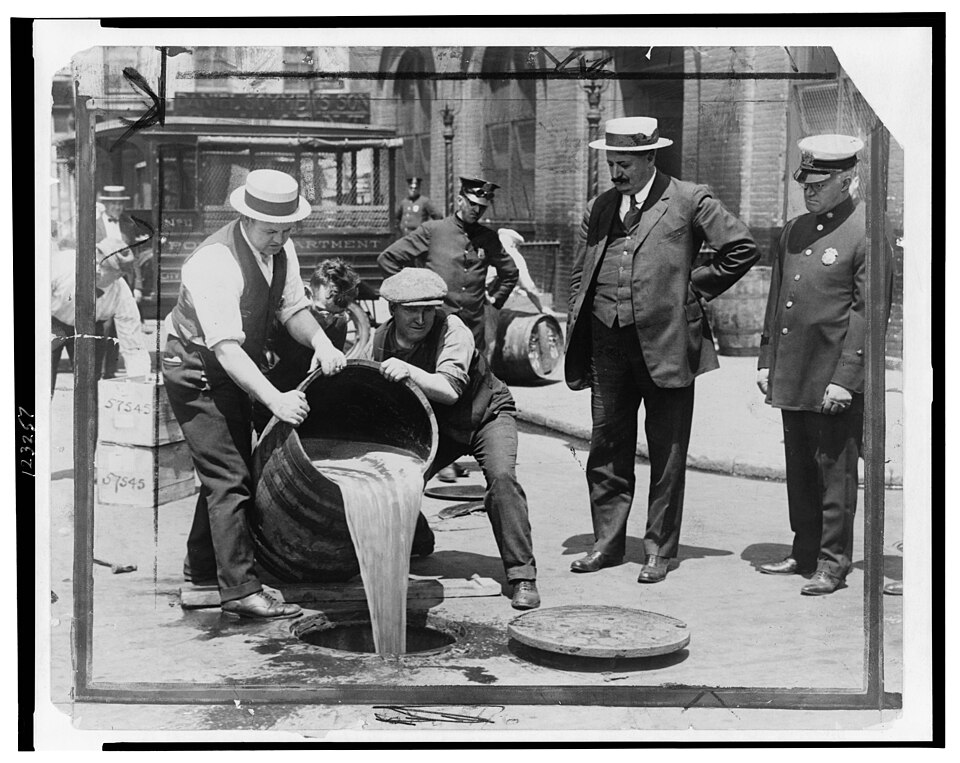
How Canadian Premiers think they’d have to operate if they let private enterprise into the alcohol trade.
New York City Deputy Police Commissioner John A. Leach, right, watching agents pour liquor into sewer following a raid, 1921.
Wikimedia Commons.
I landed in Saskatoon after a late in the evening flight from Toronto on Thursday. As we headed to a family gathering south of the city, we stopped to pick up some refreshments to add to the festivities.
First off, I’ll say private liquor stores in Sask, like the ones run by Sobey’s or Co-Op are generally quite nice. It’s proof that you can have private liquor stores, the province won’t fall apart and consumers can get their products in a nice, clean, friendly environment.
This is in reference to the silly Canadian abhorrence of private liquor sales … most of our provincial governments are deeply involved in the booze trade, and regularly imply that letting any more of that business go into private hands will instantly create a maple-flavoured version of Al Capone’s empire during Prohibition.
You can also buy booze here that is forbidden in Ontario.
But holy crap is beer expensive here!
[…]
The combined federal and provincial tax rate for Quebec is about 31.5%, Ontario’s is 43% and Sakatchewan’s are the highest in the country at 49.4%.
While beer is more expensive in Sask, Ontario made liquor is cheaper here…
Why is it that in Saskatoon I can buy a bottle of Wiser’s whiskey, made in Windsor, Ontario, for about $10 cheaper than I can at the LCBO, Ontario’s government run liquor stores?[…]
In Saskatchewan, consumers can choose what to buy…
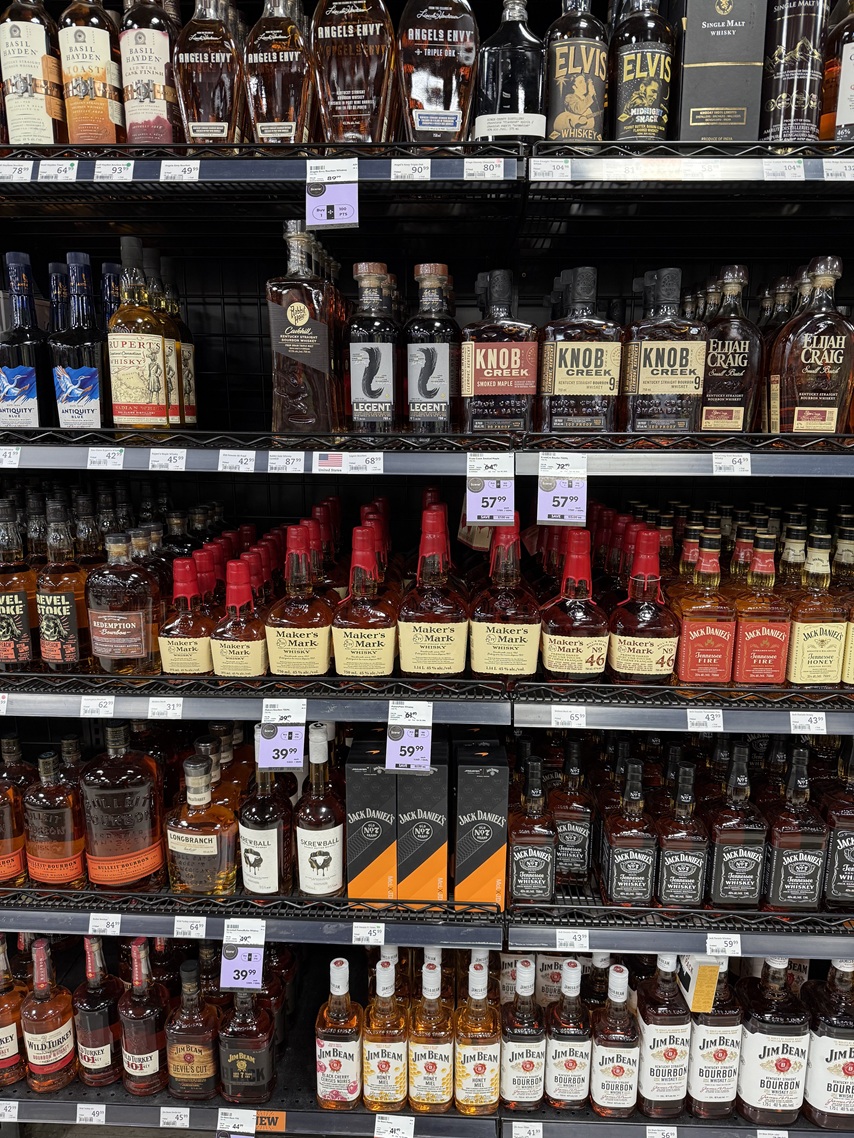
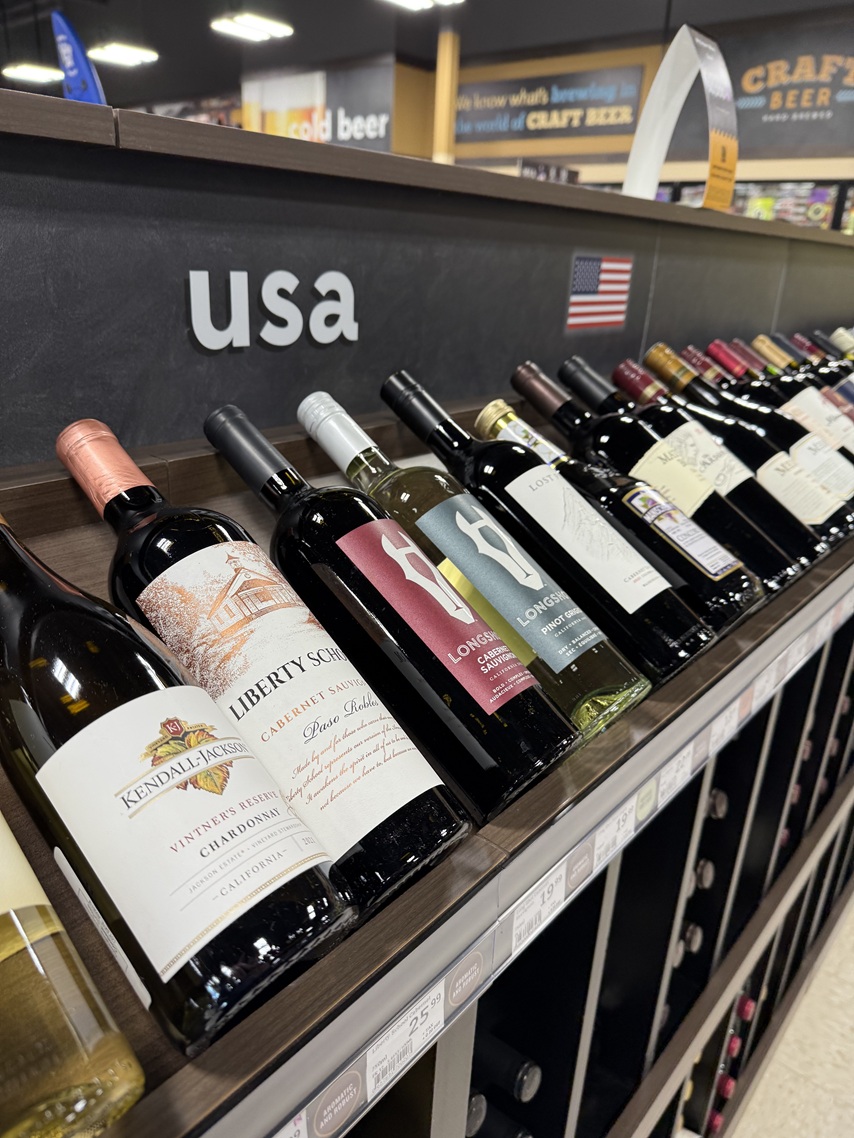
Ontario has had a ban on the sale of American alcohol products via the LCBO since March 2025. In Saskatchewan, as in Alberta, you can choose whether to buy your Kentucky bourbon or California wine.
That’s a lot of sweet, sweet bourbon for sale at a Sobey’s store in Saskatoon.
If you want to buy some California wine in Saskatoon, you can.
So far, Alberta and Saskatchewan are alone in allowing the regular sale of American alcohol. Consumers who want to boycott here can and I’m sure many do. I hear plenty of anti-Trump/anti-American attittudes here so sales are likely lower than they were pre-tariff.That said, you are an adult and can buy Yankee hooch if you want to.
That won’t be happening in Ontario anytime soon.
February 14, 2026
The EU’s plans to drain the “wine lake” … again
Canada isn’t the only place with rigidly governed agricultural cartels … the European Union has always been a big fan of governing agricultural markets by fiat rather than allowing the markets to sort out how much of which product should be produced. One of the biggest markets actively distorted by EU regulation is the wine industry, where faulty regulations ended up paying for a vast over-supply of wine in the 1980s and 90s. Rather than eliminating the regulatory structures, the EU continues to prefer letting bureaucrats dictate to producers:
When the Common Agricultural Policy was established, it was quickly determined that one of its core objectives would be the protection of farmers, ensuring stable incomes and food security. In the wine sector, this logic translated into strong interventionism aimed at expanding and stabilizing production.
For decades, Brussels subsidized vineyard planting, protected minimum prices, and absorbed producers’ economic risk, disconnecting production decisions from signals of demand. Producing more ceased to be an economic choice and became a politically safe decision.
This approach created a structural market distortion. As wine consumption began to decline across Europe for demographic, cultural, and economic reasons, the artificially incentivized productive structure remained intact and unable to adjust.
It was in this context that, during the 1980s and 1990s, the first major shock occurred, known as the wine lake: massive wine surpluses with no outlet. Even then, Brussels treated this episode as an isolated and temporary phenomenon, ignoring the fact that it was the direct consequence of existing policies. By persisting with the same strategies, the problem ceased to be episodic and became structural.
In the early 2000s, the European Union was finally forced to recognize that the wine crisis was not temporary. However, instead of removing production incentives and restoring the market’s adjustment function, it opted for a new form of intervention: subsidizing the voluntary uprooting of vineyards. The decision to destroy productive capacity ceased to be economic and became administrative, decreed from the European political center, with profound effects across several countries.
This model, presented as temporary, set a dangerous precedent. Rather than allowing less viable producers to exit the market through prices and economic choice, the state began paying for withdrawal, subsidizing the costs of adjustment and normalizing the idea that the correction of public policy errors should be financed with more public money.
This policy did not solve the underlying problem. It merely reduced cultivated area temporarily, while leaving intact the regulatory architecture which had created the initial distortion. The sector became trapped in a cycle of incentivized expansion, predictable crisis, and administrative correction.
It is within this framework that the Wine Package emerges as the European Union’s latest set of measures for the wine sector. The package relies on an administratively planned reduction of supply through financial incentives for vineyard uprooting, complemented by regulatory adjustments, temporary support measures, and crisis management instruments. Instead of allowing the market to adjust to declining consumption, Brussels once again opts for the destruction of productive capacity as a policy tool. Although the package includes support measures and environmental framing, its central axis remains the administrative reduction of supply.
The impact of these decisions is not marginal. The European wine sector represents a significant share of the European Union’s economy, sustaining approximately 2.9 million direct and indirect jobs and contributing more than €130 billion to EU GDP.
January 20, 2026
Feeding the Great Mongol Khan
Tasting History with Max Miller
Published 29 Jul 2025Mastic stew with black rice, spices, and lamb, garnished with cilantro
City/Region: Mongol Empire | China
Time Period: 1330The grandson of Genghis Khan, Kublai Khan doubled the size of the largest land empire the world had ever known by conquering China. We actually know quite a bit about the foods that fueled his empire-expanding efforts. Shortly after his death, Yinshàn zhèngyào, or The Proper and Necessary Things for the Emperor’s Food and Drink, was written, and its recipes include ingredients from across Kublai Khan’s vast empire.
The mastic in this stew is a resin from the mastic tree in the Mediterranean, and it has a bitterness along with cedar or pine notes. I really like it in sweet things, but there is no sugar in this dish. The stew is aromatic and smells of cardamom and cinnamon, but they don’t come through in the flavor. The bitterness of the mastic and the lamb dominate the dish, but Kublai Khan was eating this dish to invigorate his chi, so maybe the flavor didn’t matter as much.
I used black rice, or forbidden rice, so named because supposedly it was only eaten by the emperor and his court for much of Chinese history, and it makes the stew a deep purple. You can use long grain white or brown rice, which will make for a lighter colored dish.
Nourishes, warms the middle and grants chi. Leg of mutton, five tsaoko cardamoms, 2 ch’ien cinnamon, one half sheng chickpeas, mash and remove the skins. Boil the ingredients together to make a soup, strain it. Cut up the meat and set aside. Add 2 ho of cooked chickpeas, 1 sheng of aromatic rice, 1 ch’ien of mastic. Mix well with a little salt. Add chopped meat and cilantro.
— Yinshàn zhèngyào by Hu Sihui, 1330
December 24, 2025
QotD: Moderation for the inveterate port fan at Christmas
The problem with wine is that it’s all so strong these days. I had a Saint-Estèphe last year that was 15 per cent. 15 percent Bordeaux! I used to enjoy having Châteauneuf-du-Pape on Christmas day, but that can touch 16 per cent. So once again Germany is your friend here.
A nice spätburgunder, the delightful German word for pinot noir, would be a good alternative. Or perhaps an English red. They’re not easy to find or cheap but I can thoroughly recommend the 2020 pinot noirs from Gusbourne in Kent and Danbury Ridge in Essex.
With the turkey, keep the pork accessories to a minimum. Don’t sneak into the kitchen to polish off the pigs in blankets. Instead have lots of vegetables, but do not have seconds, no matter how tempting that might be. As for Christmas pudding, avoid, avoid, avoid. Maybe a crumb for appearances’ sake. But you must resist the sweet wine. I’m a sucker for a nice monbazillac but I’ve decided you don’t need port and sweet wine, and I’m going for the port. Eyes on the prize and all that.
The strategy is to reach the port and stilton course having consumed no more than the equivalent of one bottle of wine. Ideally less. If you’ve had two, that’s too much. Go for a walk.
Assuming you’ve reached this stage soberish and with a stomach that’s not rebelling, that doesn’t mean that you can suddenly channel your inner Georgian squire when the decanter comes round. Don’t be like John Mytton, one time MP for Shrewsbury, who arrived at Cambridge University with 2,000 bottles of port: unsurprisingly he didn’t graduate. He was notorious for drunken antics such as setting fire to his nightshirt in a bid to cure hiccups and once rode a bear into a dinner party for a jape. We’ve all had that urge after too much port.
It might seem heretical, but you don’t need to finish off the decanter at the table. A vintage port should be good for four or five days, whereas tawny lasts for weeks, so you can keep coming back to it. If there are only a few port fans in the family, it’s worth opening a bottle on Christmas Eve and having a glass or two. Then if you do decide to polish it off while outlining your plan for getting the British economy back on track, there won’t be quite so much in the bottle. Oh, and tiny glasses, please. Think Russell Crowe and Paul Bettany in Master and Commander.
When lunch is over, say no to coffee and find somewhere to have a nap until it’s time for a cup of tea. Try to avoid eating or drinking alcohol again for the rest of the day. But who am I kidding, I’ll probably open a bottle of Beaujolais to go with my turkey sandwich. And maybe a little port and Stilton. But nothing after nine o’clock. That is very important.
And so to bed for a good night’s sleep and awake rested, if not quite refreshed, and without an angry wife glaring at me. That’s the plan anyway.
Henry Jeffreys, “How to drink port without the storm”, The Critic, 2022-12-09.
December 22, 2025
QotD: Wine and vegetarianism
Jay McInerney, Bacchus & Me: Adventures in the Wine Cellar.
December 4, 2025
QotD: Champagne
Winston Churchill
April 2, 2025
QotD: Restaurant wine etiquette
For extra points: if it’s a dark red like a cabernet or burgundy, wince slightly, then tell the sommelier to let it breathe for ten or so minutes before he serves it to the table. (That’s a cheat, by the way; all reds need to breathe a little after uncorking.)
The wine world is full of phonies who like to show off. The way to make people think you know what you’re talking about is to say less, not more. What you do (see above) is more impressive than what you say.
Kim du Toit, “Busted”, Splendid Isolation, 2019-11-25.
March 2, 2025
QotD: Chardonnay
Jay McInerney, Bacchus & Me: Adventures in the Wine Cellar, 2002.
February 9, 2025
QotD: Rosé Wine
Jay McInerney, Bacchus & Me: Adventures in the Wine Cellar, 2002.
January 18, 2025
Incentives matter even to “objective” scientists
A 2019 Canadian “study” ideally illustrates that scientists are just as human as anyone else where they are incentivized to provide “desired” outcomes:
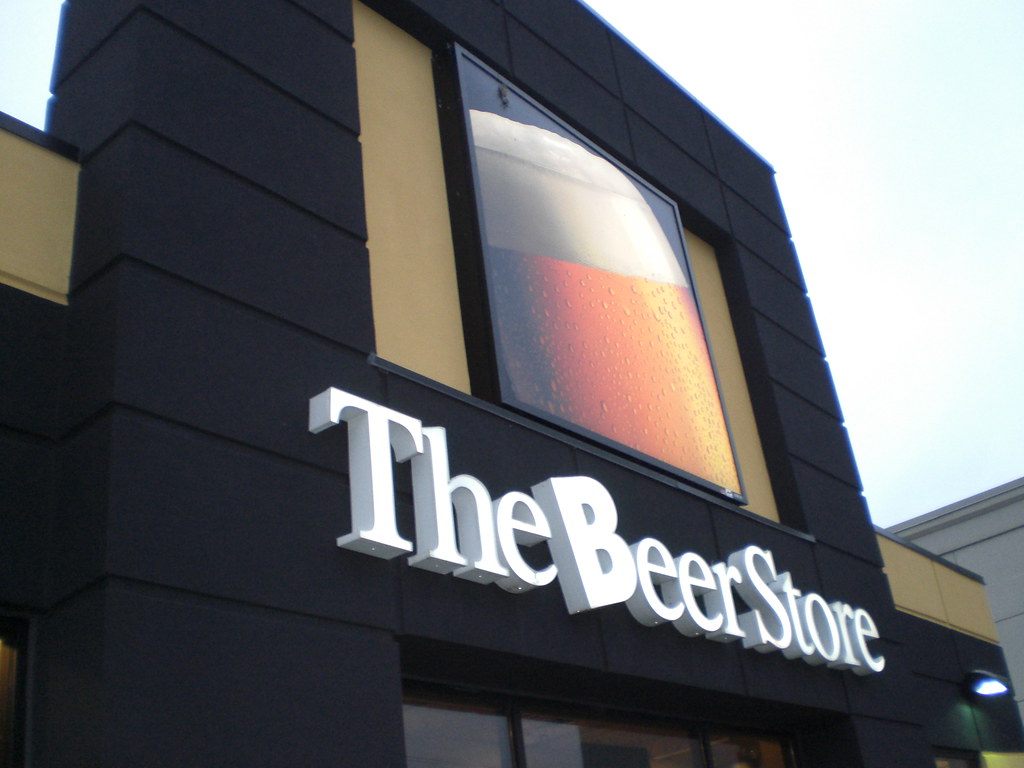
“The Beer Store” by Like_the_Grand_Canyon is licensed under CC BY-NC 2.0


Earlier this year, a major Canadian study on alcohol policy provided an excellent illustration of this. As news headlines across the country reported, 16 scientists and researchers at various universities and institutions had, through their Canadian Alcohol Policy Evaluation, shown that provincial governments are “failing to address alcohol problems”.
The scientists evaluated provincial government policies and assigned a grade in the “D” range to seven of Canada’s 13 provinces or territories, while five received an “F”. The policy evaluation, however, was a curious one. Strangely, the policy evaluation did not evaluate whether government policies were beneficial to those who want to buy or sell alcohol.
Instead, provincial governments were evaluated more favorably if they devoted greater efforts toward afflicting buyers and sellers of alcohol through punitive taxes, price controls, heavy restrictions on the sale and marketing of alcoholic beverages, higher minimum legal drinking ages, and so on.
Even in the most restrictive markets, the researchers found that alcohol was too cheap, or that its purchase was too convenient, or that governments did not do enough to discourage or restrict its sale and consumption.
Predictably, and perhaps exemplifying Berlinski’s point on scientists grasping for government funds, the report authored by 16 scientists whose livelihoods involve raising public alarm about alcohol consumption concluded that there ought to be more government funding for public education on the dangers of alcohol consumption.
The report also advocated more government funding for bureaucracies to discourage drinking, more government funding for a lead organization to implement restrictive alcohol policies, more government funding for independent monitoring of such implementation, and more government funding to track and report the harm caused by alcohol consumption.
Like the CEO of a domestic automobile company insisting that tariffs against car imports — which would cause a massive wealth redistribution from consumers’ wallets into his own and those of the company’s shareholders — are in the national interest, the anti-drinking scientists insisted in the name of public health and wellness upon income redistribution from taxpayers and consumers to their own industry.
November 12, 2024
QotD: Roger Scruton, terroiriste
>Good wine is a “somewhere”, not an “anywhere”. It is stamped with a place and a year. Rooted, literally. The fancy French word for this is terroir, referring to the way in which environment — soil, geology, even the history of a place — is all responsible for a wine’s character. Terroir is a sense of place in a glass. Roger Scruton often referred to himself as a “terroiriste“. And this could describe his political philosophy as much as his philosophy of wine. From 2001 to 2009, Scruton wrote a wine column in the New Statesman, enabling him to smuggle into that otherwise exclusively Left-wing journal, all sorts of reactionary political ideas: about God, about fox-hunting, about beauty, about his love of the countryside.
Wine, for Scruton, was never just about the taste, never a merely aesthetic sensation. Indeed, he was extremely sniffy about all those “blind tastings” — the ones where we delight when an expert fails to spot the difference between plonk and Premiere Cru. They miss the point, says Scruton. Blind tasting, he explained, is like blind kissing — not a good way to distinguish, for example, between someone who is sexy and someone who is not. Indeed, if the experiment on Love Island is anything to go by, it’s not even a good way to distinguish who your own girlfriend is.
That’s because sexual chemistry, like wine, is a great deal more than some momentary sensation on the lips. It’s a great deal more than a message sent by taste receptors to the brain. It is all about the terroir. And this is not just a comment about wine but about aesthetic experience in general. When we encounter a work of art, we bring a whole hinterland of knowledge that makes sense of that specific experience and gives it its character as art. Music is more than a vibration of the air and its reception by the ear and the brain. So too with wine and taste.
Giles Fraser, “Raise your glass to Roger Scruton, the terroiriste“, UnHerd, 2020-01-15.
October 18, 2024
QotD: Californian wine
Lawrence Osborne, The Accidental Connoisseur: An Irreverent Journey Through the Wine World, 2004.
October 8, 2024
Making the Black Mead of Medieval France – Bochet
Tasting History with Max Miller
Published Jun 25, 2024Black mead, or bochet, made with spices and wood chips
City/Region: Paris
Time Period: 1393Mead was very popular from Russia to England, but started to lose favor in part due to the rise of cheaper brews like vodka and hopped ales. Mead was often still drunk for its medicinal properties, especially when it was infused with herbs and spices.
This mead has some of those wonderfully warming spices, and I added wood chips from the local brewing store to mimic the wood barrels that it would have been fermented in. The burnt caramel scent softens and mellows out during fermentation, and the resulting mead is not sweet at all and is more complex than many meads I’ve had.
To make six sextier of bochet, take six pints of very sweet honey, and put it in a cauldron on the fire and boil it, and stir for so long that it starts to grow, and you see that it also boils with bubbles like small blisters which will burst, releasing a little bit of dark smoke. Then add seven sextier of water and boil so much that it reduces to six sextiers, and keep stirring. And then put it in a vat to cool until it is lukewarm; then strain it through a cloth, and put it in a barrel and add a pint of yeast from ale, because that is what makes it piquant, (though if you use bread yeast, it makes as good a flavor, but the color will be duller), and cover well and warmly so it ferments.
If you want to make it very good, add an ounce of ginger, long pepper, grains of paradise and cloves in equal amounts, except for the cloves of which there should be the least, and put them in a cloth bag and toss it in. And when it has been two or three days and the bochet smells of spices and is strong enough, take out the bag and wring it out and put it in the next barrel that you make. And so this powder will serve you well up to three or four times.
— Le Ménagier de Paris, 1393.
September 8, 2024
The last dispatch from Toronto before the catastrophe began
Toronto, in fact all of Ontario, may no longer be there when you get up tomorrow morning. As Chris Selley explained in his brave, final communiqué from the doomed province:
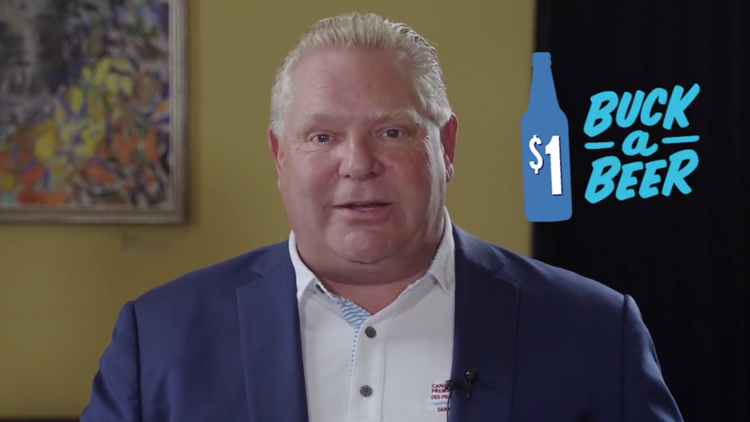
Doug Ford, the form of the destructor Ontario chose.
Dear non-Toronto friends,
This city is in crisis. This may be my last communiqué before the telex goes down for good, and I feel honour-bound to tell the world of my city’s plight. If the worst should occur, which it almost certainly will, please tell our story.
The unthinkable has occurred: Doug Ford’s madmen and women at Queen’s Park have licensed hundreds upon hundreds of new locations — called “convenience stores”, in local parlance — to sell beer, wine, cider and pre-mixed cocktails.
They did this instead of fixing health care, if you can believe that. And, outrage upon outrage, the government even made a map of such locations — as if delivering fallen Ontarians one by one to Mr. Booze himself.
Why, within just a few hundred metres of where I write, through my tears, I can discern on the map more than five such new locations. There’s Mei Convenience, Mimi Variety, Lucy Grocery and Meat, Queen & Jarvis Convenience … the list goes on, and on, my God. Church attendance is reportedly soaring as Torontonians steel themselves for the forthcoming.
Ford’s government did this entirely to solicit corporate donations to his party (some say that’s actually illegal, but whatever) from his buddies at convenience-store empires 7-Eleven and Couche-Tard … and presumably from Mimi and Lucy, whoever they are. Very rich women, clearly.
Instead of fixing health care!
Until recently, some semblance of sanity prevailed: The nearest government-run liquor store to where I sit now is a 15-minute walk away; the nearest Beer Store, the privately owned former quasi-monopoly where you’re still supposed to return your bottles and cans, is nearer to 20 minutes.
And now, suddenly, a bottle or can is shockingly near to hand. And this will lead to more alcohol-related harms. Of this there is no doubt, as one expert recently told the Toronto Methodist Star: “Harm will increase in Ontario. That is straightforward.”
It is true that many jurisdictions around the world report similar or lower levels of alcohol consumption and related harms than Ontario despite having much greater access to retail alcohol — Italy, Greece, the United States — but that is not germane to this discussion. Ontarians are not like other people. Ontario is not like other places. We are worse. Or maybe better. Or some combination of the two.
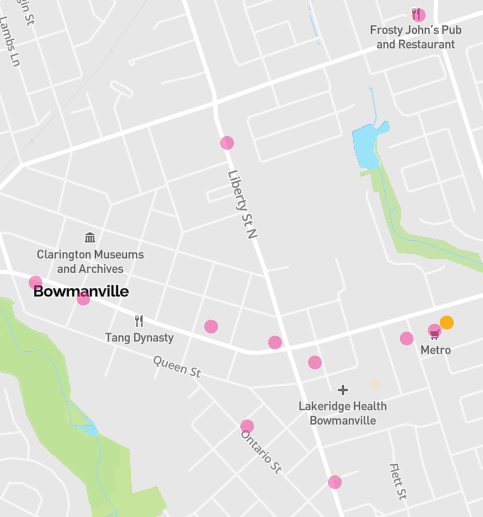
It’s true! Even saintly Bowmanville has been sullied with the demon liquor thanks to Premier Ford’s diabolical plan: