Quotulatiousness

May 14, 2026

“Trust is the most scarce thing in the media landscape right now”

Filed under: Media, USA — Tags: , , , — Nicholas @ 05:00

As with a lot of cultural upheavals, I’m a bit behind the curve on this one, so let Ted Gioia give you the state of play in “Rick Beato Versus the NY Times“:

Fifteen days ago, the New York Times published its list of the 30 greatest living American songwriters. Since then, all hell has broken loose in the music world. And in the last 48 hours, that Hades just got a lot hotter.

I’d been one of the 250 “music insiders” surveyed by the Times for the article — so the day after the list was published I shared my ballot here.

I was unhappy with the results, as were many other music fans. But that might have been the end of the story. Surveys are always a bit dodgy — but what can you do about it?

Then I took time to learn about the Times methodology and was even more dismayed. In fact, I was miffed.

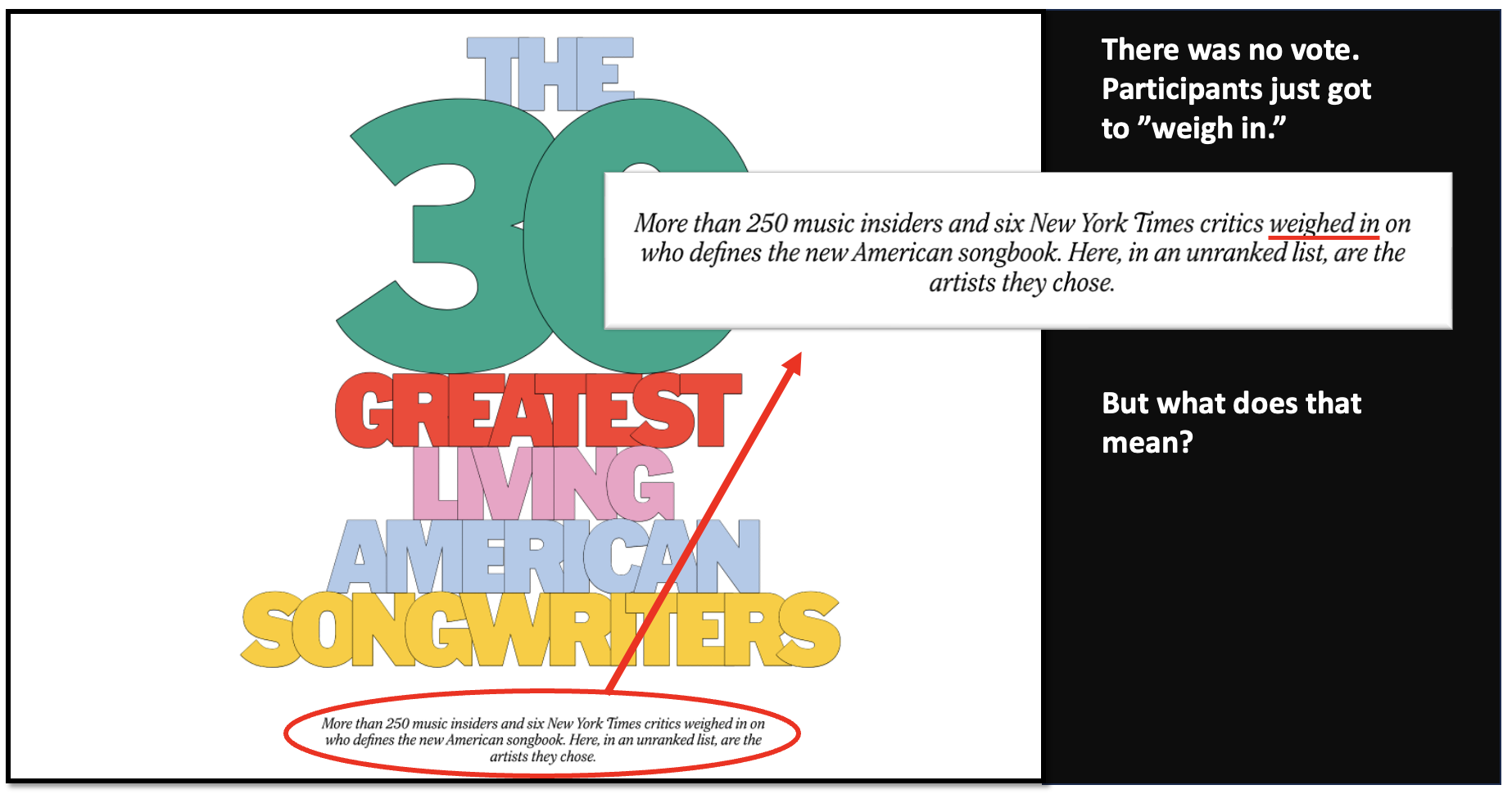
I assumed that I was voting for the songwriters who would be included in the list. But I now see that the experts consulted by the Times only got to make nominations. The final 30 names were chosen by six New York Times music critics.

There never was a real vote. The Times got the results it wanted internally — the insiders made the final call. But the way they explained it to their readers was intentionally vague.

In small print, readers were told that industry experts “weighed in” — whatever that means.

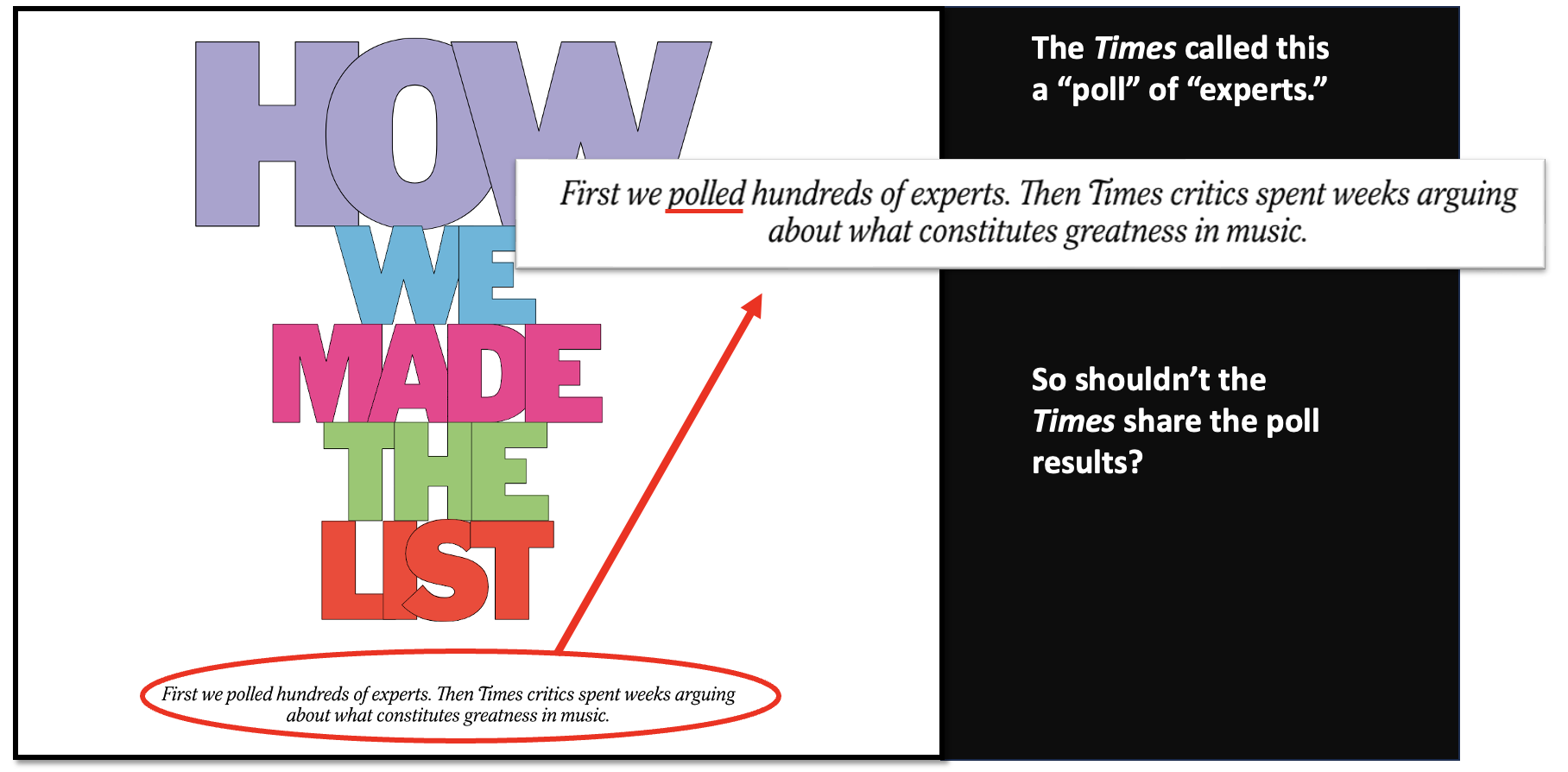
Readers were invited to click on a link to learn “how we made the list”. But even here, the Times served up fuzzy language.

If you kept on reading, you eventually learned the truth. The Times took the verdict of the “experts” and then “ran it through a filter”. The survey was just a “starting point”. The actual top thirty was decided via a “conversation” among its internal team.

Huh?

The Times did share a few ballots, and even this small sample made clear how different the final list was from the survey of experts. That would be embarrassing for the Times under the best of circumstances, but especially so in the current environment — when that same newspaper has repeatedly expressed outrage about voter suppression and attempts to subvert democracy.

If the Times really believes in the importance of voting and standing by results, why doesn’t it just share the actual ballot count?

Even so, this all might have been forgotten. But last Friday, the Times made the mistake of releasing a video entitled “In Defense of the NYT ‘Greatest Songwriters’ List“.

Here members of the inside team came across as smug, maybe even contemptuous, in responding to music fans who reached out to them. At one juncture, a Times critic laughs at a comment from a reader — simply for saying that he went to the Berklee College of Music. Then he continues to chuckle and smirk as he reads the rest of the reader’s comment, before finally throwing it on the floor.

This music lover had made the mistake of defending Billy Joel. For a serious critic at the Times, that is apparently very funny.
The Humble Wood that Built Great Furniture

Filed under: History, Tools, Woodworking — Tags: , , — Nicholas @ 04:00

Rex Krueger
Published 13 May 2026

Lynching

Filed under: History, Law, USA — Tags: , , , — Nicholas @ 03:00

On the social media site formerly known as Twitter, Tom Kratman shares some thoughts on lynching:

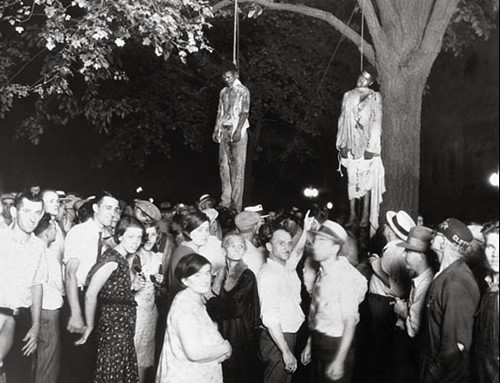
“1930 Lynching” by e-strategyblog.com is licensed under CC BY 2.0 .

So, in honor of the white liberal idiots (Lord, forgive us our redundancies) and black race grifters, who seem to infest X, some old thoughts on lynching:

So I was musing on lynching. It occurred to me that merely because someone was lynched it does not necessarily follow that they were either innocent, nor that the lynching was improper or wrong. Of course, we think of it, or most of us do, today, as being a purely racist phenom, applied entirely to innocent black folks. Neither of those is true.

I think we can divide lynching into several different levels and levels of legitimacy.

1. In a place of high crime where the law does not exist. In this case, yes, of course, do what you must to preserve life, liberty, and property, to protect your friends, neighbors, and family.

2. In a place of high crime where the law exists but has become purely notional, where criminals are not generally pursued, tried, convicted, or punished, and where this is no real hope for improvement. In this case, too, lynching is likely legitimate, for two reasons, the ones set out above and, further, to humiliate the arms of the law and the political branches into doing their jobs.

3. In a place where the law exists, where criminals are pursued, tried, and convicted, things become murkier. Note that I left off “punished”. In this case, I would argue, the law has become as ineffective as #2, above. Parts of California under Soros-supported prosecutors, I am looking at you. On the whole, in these places, I would suggest that lynching has at least some legitimacy.

4. Illegitimate lynching starts where the law is operative, and largely works, but where people — and this is where black folks tend to come in — are both impatient and want to terrorize some folks into general acquiescence. I am thinking here of people dragged from jail, after conviction, and put to death. It’s been done to both whites and blacks, but more to blacks.

This is wrong both because of the terrorizing aspect AND because you have just, from the perspective of those same black folks, changed matters into something highly analogous to #1, above, the law doesn’t apply to or defend them, so of course they can legitimately engage in self-help.

5. The least legitimate form, indeed, it is totally illegitimate, is when the law works, but people just want to engage in self-help, largely for the reasons in #4, and without there ever being an indictment, presentation of evidence, conviction, or anything but a mob operating with a mob’s IQ, which is roughly that of a none-too-bright earthworm.

There are some odd nuances here. For example, take someone with diplomatic immunity who kills your child. I have no answer, yet, for this, but, as a practical and personal matter, have to say that I would personally hunt the son of a bitch down and have lumber and nails handy.

Why did the Romans defeat the Macedonians and Seleucids so easily?

Adrian Goldsworthy. Historian and Novelist
Published 19 Nov 2025

Today I try to answer several questions about the confrontation between Rome and the Hellenistic Kingdoms of the Eastern Mediterranean — espcially the Macedonians and Seleucids. In contrast to the monumental struggle between Rome and Carthage, where Hannibal in particular inflicted very costly defeats on the Romans, the wars with the “sophisticated” military powers of the east seem much more one sided — brief and decided by a single pitched battle. How fair is the sense that these conflicts were “easier” for the Romans to win, and if they were — why was this?

QotD: Marx was right about “alienation”

Filed under: Media, Quotations, Technology — Tags: , , , , — Nicholas @ 01:00

So, too, with alienation. Marx was talking about physical commodities — the guys who work in the widget factories can’t afford the widgets they make. Indeed, they never even see the finished widget as it rolls off the line — they are just a small cog in a big machine. But alienation is so much more profound than that, and more pervasive. Again, consider the laptop class. What are they connected to, other than their tiny social media bubbles? They have no real relationship even to their own physical body — just look at them, for pete’s sake. They’ve never done anything with their hands but type. And as for social relations, they’re so disconnected from other people that they will text people who are in the same room.

No shit, I’ve seen it happen. And it’s even worse than that, because they think they’re being socially savvy. “Oh, Jayden is in the middle of a conversation with Brayden; I’ll just text him, so as not to interrupt.” But since people under forty are physically incapable of not checking their phone the minute it beeps at them, it’s not just an interruption, it’s an especially obnoxious one … and they have no idea. What we used to call the “soft skills” — the ability to come up to Jayden and Brayden, assess where the conversation’s going, and steer it in such a way as to get Jayden the info he needs organically — are totally gone.

You can test this for yourself. Just don’t answer the phone. Or a text. Seriously, try it. It’s tough, isn’t it? No matter where you are, the fucking thing dings, and you immediately grab for it. It takes real physical effort not to. It’s much, much easier to simply turn it off, and while I’m all for that — indeed, I’m for dropping it overboard in the Marianas Trench, or shooting it into deep space — try leaving it on, and only checking your text messages at a set time. It’ll keep until 3pm (your designated “check message” time), I promise. Or if it won’t — if it’s the wife asking you to pick up a gallon of milk on the way home — then you’ll learn a different lesson, the one about how we use crutches for some reason when we’ve got perfectly good legs.

That’s alienation, in the broadest and most significant sense. Since you are constantly available — since your time is now a commodity, that you’re constantly selling to the lowest bidder — your personal worth is zilch. You’re a message-answerer and milk-fetcher and all-purpose Guy Friday, to everyone, all the time. Even to — make that especially to — the people who supposedly love you, and respect you. Because who cares what you’re doing right now? The important thing is that milk, no?

Severian, “On Losing the Cold War”, Founding Questions, 2022-07-02.

Powered by WordPress