Quotulatiousness

May 28, 2026

“Seamen tend to be wary of authority, unless it is wisely exercised”

Filed under: Britain, History, Military — Tags: , , , — Nicholas @ 05:00

In UnHerd, Peter Hitchens considers the plight of the Royal Navy, much diminished from its years (centuries, actually) of greatness:

Our own Royal Navy is famous for its mutinies, in HMS Bounty in 1789, at Spithead and the Nore in 1797, and most recently at Invergordon in 1931. It is a curious organisation, its hammocks once filled by the cruel Press Gangs kidnapping innocent men and forcing them to sea and possible death, its discipline for many years enforced by the cruel cat o’ nine tails and the occasional shooting of an admiral to encourage the others. But it stood between us and the world, without trying to take over the state, and it was very beautiful, and many of us loved it. In London and the big seaport cities, bluejackets in their Edwardian uniforms were still a common sight in my childhood. They were reassuring, not overbearing. Since 1901, when horses failed at the task, Navy men have pulled the gun carriage on which Royal coffins (and Churchill’s) have rested at state funerals, an extraordinarily moving sight. These were our defenders, upon whom, as Charles II’s Articles of War first proclaimed, “under the Good Providence of God, the safety, honour and welfare of this realm do chiefly depend”.

In an era when soldiers were often despised, or even feared, sailors were not. Think of Kipling’s 1890 poem “Tommy”, intended to change the drunken delinquent reputation of Queen Victoria’s redcoats:

    For it’s “Tommy this, an’ Tommy that, an’ Chuck him out, the brute!”
    But it’s “Saviour of ‘is country” when the guns begin to shoot.

In George Orwell’s perfect novel Coming Up for Air, Edwardian civilians are appalled when a young man signs up for the Army: “‘Well now! Listed for a soldier! Just think of it! A fine young fellow like that!’ It just shocked them. Listing for a soldier, in their eyes, was the exact equivalent of a girl’s going on the streets.”

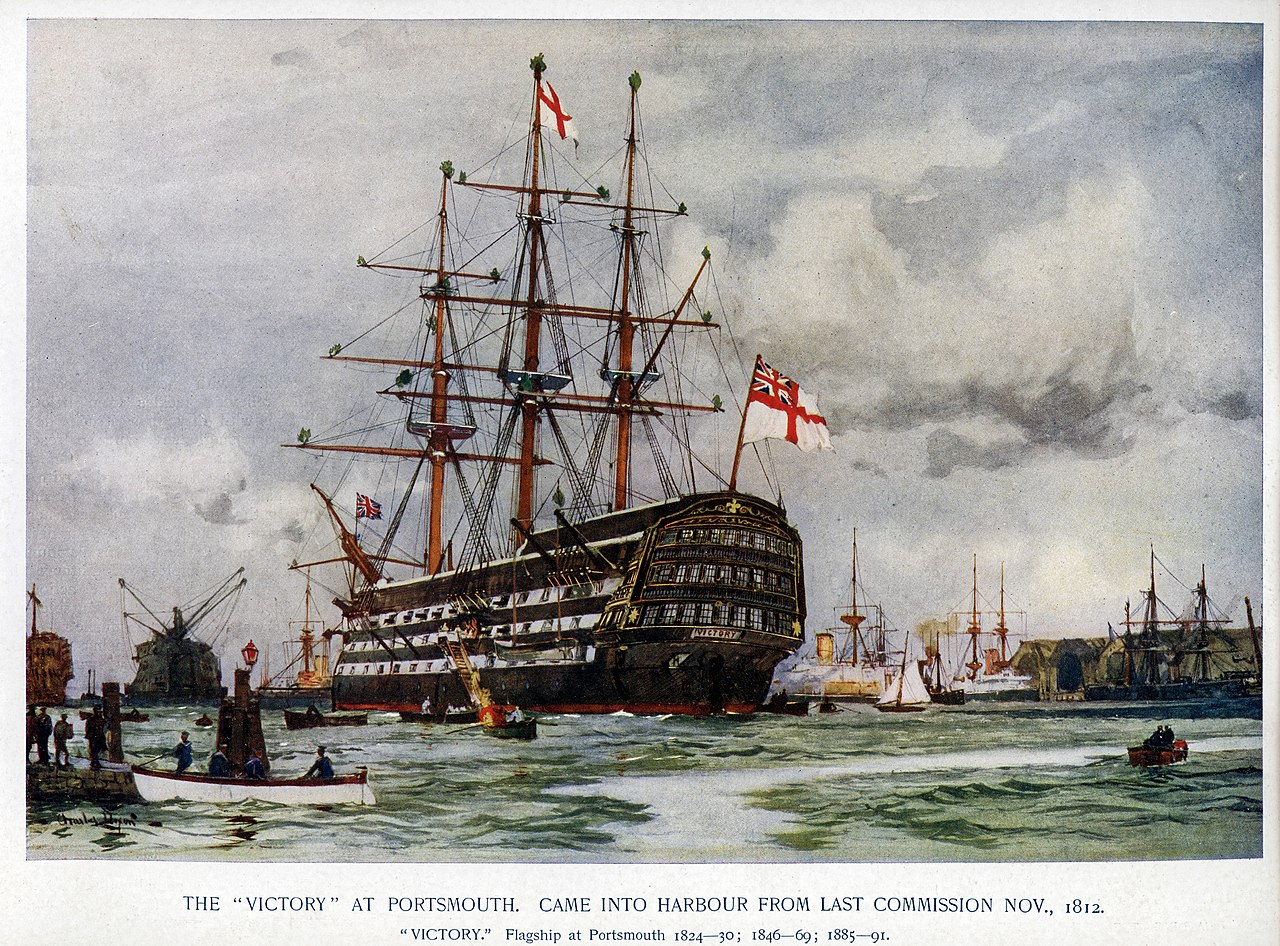
HMS Victory in Portsmouth Harbour”
Painting by Charles Edward Dixon (1872-1934) via Wikimedia Commons.

But sailors, possibly because they were at sea so much, were idealised as “hearts of oak” manning the wooden walls (and later the steel walls) of England. And the same was true for officers, credited above all with the great victory at Trafalgar in 1805, which secured national safety and prosperity for the rest of that century. They had a reputation for taciturnity and bluffness, which never does anyone any harm, and they often lived up to it. The fictional Jack Aubrey, in Patrick O’Brian’s witty and clever books about the Napoleonic wars, is a perfect rendering of this type. They tell terrible jokes. They don’t say much, just “Kiss me, Hardy” (Nelson as he died); “There seems to be something wrong with our bloody ships today, Chatfield” (Beatty at Jutland, as British warships repeatedly blew up under German fire); and “Continue to engage the enemy” (Warburton-Lee at Narvik, dying on his bridge after smashing up Hitler’s destroyer fleet and so making a cross-Channel invasion impossible).

And so the word “Navy” had, for many years, a useful commercial magic if you were selling something a bit manly and bluff, such as Navy Cut tobacco and Navy Rum, or even Senior Service cigarettes. But it did not have the yelling, martinet character of the Army. I have never yet seen a naval officer’s uniform that fits properly, and when sailors are marched aboard their ships (does this still happen?), the drill is far from pernickety. Close contact with the Navy — both my parents were in it, and so were most of their friends, some of my schoolteachers and many of the parents of my schoolfellows — revealed a dry, faintly sarcastic view of the outside world which had never been to sea. Even my mother, an ocean-going snob who would die of shame if she heard me use the word “toilet”, had mastered the sarcasm of the fleet. More than once I jumped with surprise when I heard her icily remarking about some inadequate if feeble attempt at recompense. “Well, that’s damned nice of him”, she’d say, which, for a Fifties married middle-class woman in a respectable suburb, was going it a bit.

“Any corporate or Amazon CFO could find 3% (to cut) in Federal budget on a Tuesday afternoon”

Filed under: Bureaucracy, Business, Government, Media, Politics, USA — Tags: , , , — Nicholas @ 04:00

Tim Worstall points out the difference between what Jeff Bezos said about cutting government spending and what Elon’s hired guns were able to achieve with DOGE:

“Jeff Bezos' iconic laugh” by Steve Jurvetson is licensed under CC BY 2.0 .

So online we find:

    Jeff Bezos: “Any corporate or Amazon CFO could find 3% (to cut) in Federal budget on a Tuesday afternoon” to fund zero taxes for bottom half/poor.

And we also find the obvious rebuttal from Derek Thompson:

    cmon man, this is not sophisticated stuff from bezos

    Elon sent all the 22yo genius into the govt for several months and they only cut federal spending by 0.01%

    this idea that it’s trivially easy to cut govt spending is one of the oldest tropes in the genre of ‘business guy talks about washington without having any knowledge of the budget’

Clearly, there’s a certain difference in those two views.

The difference explained by the fact that they’re talking about two different things. Thompson is talking about “If we assume that govt continues to do what govt does, in largely the same way, then how much is actual waste?” While Bezos is talking about “What is it we shouldn’t be doing and so cut that shit?”. If you ask a different question then of course you’re going to get a different answer.

Now, I am emotionally attached to that second set of question and answer because that’s me. But I do acknowledge that politics doesn’t, in fact, work that way. A corporate CEO does have the power to just go “Nope. G’bye” in a way that someone in a politial system does not. Which is what largely describes the difference in both Q and A.

The full interview is here at CNBC:

    And so really it’s a skills issue. You want to say any corporate CEO, CFO worth their salt, an Amazon CFO could find 3 percent in the federal budget on a Tuesday afternoon. This is, there is, there is so much waste in government spending.

I take this to be obviously true. Not, perhaps, in the way Elon was trying to do it — seek the inefficiency in the current structures. But in what is being done and how. For example, from Bezos:

    They spend $44,000 per student, $44,000. That’s 30 percent more per student than other big cities like Chicago, L.A., and Boston. And it’s three times more than Miami and Houston. And by the way, New York City doesn’t get better outcomes.

    SORKIN: But there’s also a question about, you know, there’s teachers unions in New York, for example.

    BEZOS: None of this money is getting to the teachers. I promise you, if you’re, if you’re charging $44,000 per student, how much is that money you think is trickling down to teachers? Not much.

In a private sector corporation the CEO can indeed just say fuck that shit — fire the power skirts and Hang the Lanyards. This is something a political system finds very difficult indeed. Thus the different Q and A.

“Van Langenhove is not charged with spreading false information. He is charged with presenting facts in a way that incites hatred”

Filed under: Europe, Law, Liberty, Politics — Tags: , , , , , — Nicholas @ 03:00

This is the natural end result of “hate speech” laws, as a court in Belgium clearly states in the finding quoted here:

These two paragraphs of my verdict are crucial for everyone to read and understand.

“Even if all of the statements made by Van Langenhove are based on scientific evidence and statistics, it makes no difference to the criminal intent. Van Langenhove is not charged with spreading false information. He is charged with presenting facts in a way that incites hatred against persons on the grounds of one or more of the protected criteria in the Anti-Racism Law.” 1⃣

“For Van Langenhove to have committed a crime, it is not necessary for him to have incited concrete acts of hate or violence. It suffices that others are incited to take on a general attitude of intolerance or disapproval regarding a group protected under the criteria of the Anti-Racism Law.” 2⃣

This means you can go to jail for “inciting hatred” even if your statements were 100% factual (see 1⃣) and even if you did NOT incite concrete acts of hate (see 2⃣).

The benchmark of “inciting hatred” , a crime punishable by prison, is thus “saying something that has the potential of inciting someone to have a general attitude of disapproval regarding a protected group“. This means literally any criticism of mass migration is now a punishable offence. If you cite a statistic, and someone could potentially think less of a protected group (like migrants) because of it, you can be jailed.

The craziest part is that there is no defence possible against this. I brought the scientific studies that I cited to court, but the judge didn’t care 1⃣. I also proved that the hundreds of students present at the lecture included students of all different political affiliations, and everyone was able to voice their opinion or ask questions. The lecture went very calmly, so obviously nobody was incited to hatred. But this too did not matter 2⃣, because if the judge says he believes there is the possibility that someone COULD be incited to “a general attitude of disapproval“, this is enough for the judge to send me to jail, even without any evidence.

I’m telling you this to warn you that by the time these hate speech laws have come into place, it’s already too late. You will NEVER be able to beat these laws in court. You have to stop them before they are implemented. Let my fate be your warning.

The Day The Earth Stood Still: a Post-WWII War of the Worlds

Filed under: Books, Media — Tags: , , , — Nicholas @ 02:00

Feral Historian
Published Jan 9, 2026

The Day The Earth Stood Still (1951) is in some ways the most successful translation of the alien invasion story from 19th Century colonial assumptions to those of the post-WWII world. They no longer come to take our land and plunder our resources, but to keep us from threatening their “Rules Based Order” and turn us into a low-fidelity copy of themselves.

00:00 Intro
02:46 Nukes and Norms
06:48 Ultimatum
09:00 Farewell to the Master
11:08 Hello Remake
(more…)

QotD: Re-defining economic liberalism

Filed under: Economics, History, Liberty, Quotations — Tags: , , , — Nicholas @ 01:00

The L-word is not taken to mean American “liberalism”, the distressingly anti-liberal, lawyer-driven politics of increasing governmental planning and regulation and physical coercion. It is instead the rest of the world’s “liberalism”, economist driven, “the liberal plan”, as old Adam Smith wrote in 1776, “of [social] equality, [economic] liberty and [legal] justice”, with a modest, restrained government giving real help to the poor. True modern liberalism.

A liberal “rhetoric” explains the good features of the modern world compared with earlier and later illiberal régimes — the economic success of the modern world, its arts and sciences, its kindness, its toleration, its inclusiveness, and especially its massive liberation of more and more people from violent hierarchies ancient and modern. Its enemies claim that it also explains alleged evils, such as the reduction of everything to money or the loss of community or the calamity of immigration by non-Christians. But they are mistaken.

Dierdre McCloskey, “The power of liberalism can combat oppression in all its forms”, The Economist, 2020-01-08.

Powered by WordPress