Quotulatiousness

May 11, 2026

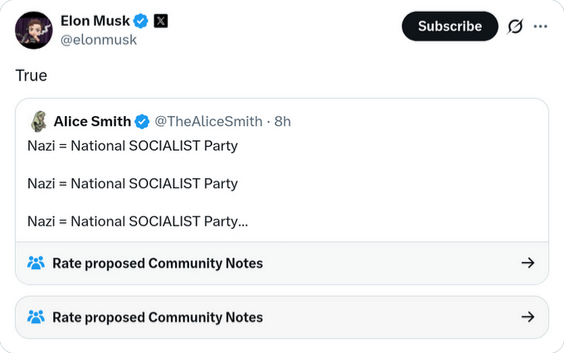
Were the Nazis socialists?

Filed under: Germany, History, Politics — Tags: , , , , — Nicholas @ 05:00

If you’re ever bored and want to kick off an argument online, you can take either side of this statement and watch the signal-to-noise ratio drop precipitously. The NSDAP, the Nazis, began as one of the many, many groups of angry young Germans in the days after the end of the First World War. The full name of the party — the National Socialist German Worker’s Party — indicates who the original party founders thought would be the engine of their political rise. They were explicitly anti-communist, as the spectre of the Russian Revolution terrified many Germans, but German socialism was still within the Overton Window of political debate.

Lots of arguments about this one.

Many people assume Nazis could not have been socialists, despite all the time and energy they devoted to jumping up and down screaming “We are socialists!”, because they were “right-wing” and socialism is supposed to be “left-wing”.

Except “right-wing” and “left-wing” don’t have rigid definitions outside the context of the French revolution. In any other context, they’re just a metaphor.

So why did the NATIONAL Socialist German Workers’ Party and the INTERNATIONAL Marxist-Leninist Socialist Workers’ Movement hate each other so much?

It’s pretty obvious when you look at the names.

National.

International.

To Nazis, the race and culture of a people are everything. They are what the state is supposed to represent. Ein Volk, as they would say. The purpose of Nazi socialism is to control capital assets, subordinating them to the will and welfare of the ethnostate.

But Marxist-Leninists seek to abolish all ethnostates. They are a globalist movement, seeking to place all capital assets under the control of a universal proletariat in theory, which is in practice represented by one world government.

Thus, Nazis sought to use socialist policies for the welfare of the German people and Marxist-Leninists seek to abolish “German” as a meaningful distinction, along with all other cultures.

The antipathy between Nazis and communists was a sectarian struggle within socialism. Same methods, but different sacred groups.

Since the defeat of National Socialism by International Socialism in WW2, all modern socialism is pretty much of the international variety.

This does, however, suggest that there is a contrast between National Capitalism and International Capitalism as well.

Which is the source of the current sectarian struggle between elements of the American right wing.

Update, 12 May: Welcome, Instapundit readers! Have a look around at some of my other posts you may find of interest. I send out a daily summary of posts here through my Substackhttps://substack.com/@nicholasrusson that you can subscribe to if you’d like to be informed of new posts in the future.

“We’ve entered the pre-violence rhetorical phase of the classic communist cycle”

Filed under: China, History, Politics, Russia, USA — Tags: , , , , , — Nicholas @ 04:00

You have to have noticed that progressives all seem to have recently decide en masse that we need to liquidate eliminate expropriate the billionaire class. It’s been done in the past, and modern progressives seem to be unable to spot the pattern, even as they work hard to bring it back to life by constantly scapegoating the wealthy (machine translated from Brivael Le Pogam’s original French post):
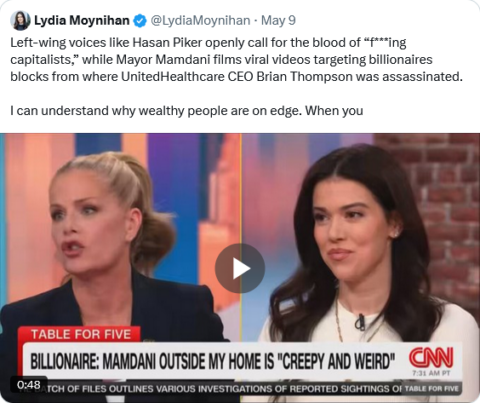
Lydia is putting her finger on something that no one wants to name clearly: we’ve entered the pre-violence rhetorical phase of the classic communist cycle.

The script is documented, archived, and it repeats itself identically for a century. Before every mass massacre carried out in the name of Marxism, there are always 5 to 15 years of public designation of a category of people as “the enemy to be taken down”. Not a debate on public policies. Not a critique of inequalities. A methodical dehumanization of an entire class.

In the USSR in the 1920s, it was the kulaks. Lenin wrote as early as 1918 that it was necessary to “exterminate the kulaks as a class”, an expression repeated word for word by Stalin ten years later. Result: 4 million peasants deported, several million dead in the Holodomor.

In Maoist China, it was the landlords and “class enemies”. Mao orchestrates public “struggle sessions” where neighbors, children, former employees are forced to denounce, humiliate, and beat. Tally from the land reform alone: 1 to 2 million executions, not counting what follows.

In Cambodia, it was the “new people”: city dwellers, intellectuals, people wearing glasses. Khmer Rouge propaganda designated them for years as parasites before massacring them. 1.7 million dead in 4 years.

Now look at what’s happening in the United States in 2026.

Hasan Piker, who reaches millions of young men on Twitch, speaks openly of the “blood of f***ing capitalists”. Not in 1968 in a Trotskyist cell, in 2026 on the platform most watched by 18-25 year olds.

Zohran Mamdani, elected mayor of New York, films viral videos in front of billionaires’ buildings, exactly where Brian Thompson, CEO of UnitedHealthcare, was assassinated last year by Luigi Mangione. The latter was turned into a pop icon by a part of the American left in less than 48 hours. T-shirts, fan art, romanticization of the murderer.

This isn’t “political passion”. It’s phase 1 of the protocol. The public designation of a category of humans as legitimately hateable, followed by the valorization of those who take action.

The “normal” reaction of a healthy democracy should be the immediate social and professional isolation of these voices. What’s happening: they top podcast charts, they’re elected officials, and they get favorable media coverage.

History doesn’t stutter. It copy-pastes. And the first victims are always surprised to discover, too late, that the speech they found “a bit excessive but oh well” was actually the clear warning that a pit was being dug for them.

Lydia is right to say it. And she’ll be even more right in five years when we reread these tweets.

And more:

And if you’re reading this thinking, “This doesn’t concern me, I’m not a billionaire”, stop for two seconds and really think about it.

Because that’s exactly what the Russian peasants told themselves in 1918 when people started talking about the “bourgeois”. They applauded, or they looked the other way. It wasn’t their problem. They weren’t rich.

Ten years later, they were called kulaks. And “kulak“, in Stalinist practice, meant any peasant who owned one more cow than his neighbor, who had dared to hire a seasonal worker, who had a slightly better-kept barn. 4 million deported. Several million dead.

That’s exactly what the small Chinese shopkeepers told themselves in 1949, when Mao went after the “great landowners”. Not their problem. They just ran a little store. Five years later, they too were classified as “class enemies”, stripped of everything, publicly humiliated, sometimes beaten to death by their own neighbors.

That’s exactly what the Cambodian schoolteachers told themselves in 1970, when the Khmer Rouge talked about “urban exploiters”. Not their problem. They barely earned enough to live on. In 1975, knowing how to read was enough to sign your death warrant.

The communist mechanism NEVER stops at the ultra-rich. Never. It’s a historical law as solid as gravity.

Why? Because fundamentally, the communist doesn’t hate wealth. He hates individual emancipation. He hates the very idea that a man can build something that belongs to him, decide his own life, refuse the collective. Private property isn’t an economic detail to him — it’s the metaphysical enemy. Because someone who owns something is someone who can say no.

So if you have an apartment you spent 15 years paying off, you’re concerned. If you have a small business, a shop, a sole proprietorship, you’re concerned. If you have a savings plan, a bank book, stocks, you’re concerned. If you have a family home in the provinces, you’re concerned. If you work hard to pass something on to your kids, you’re at the top of the next lists.

Billionaires are just the first course. Always. Because there are few of them and they’re easy to point out. They’re the appetizers for the machine. The main course, historically, is you.

And meanwhile, a lot of people read threads like this, nod their heads, and don’t share. Don’t comment. Don’t take a stand. Out of fear of being labeled “right-wing”, “reactionary”, “too political on LinkedIn”. Out of comfort. Out of social cowardice.

Know that this silence has a precise historical cost. Every time a society has tipped into this madness, it did so because the reasonable majority stayed silent too long, thinking it would all blow over on its own.

It never blows over on its own.

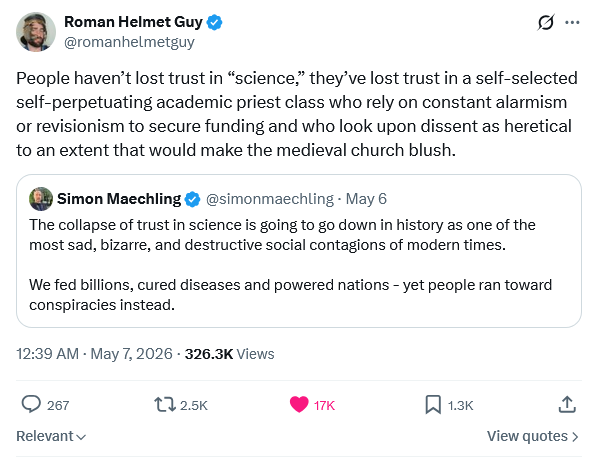
A tale of how the people lost faith in the Oracle

Filed under: History, Media, Quotations, Science — Tags: , — Nicholas @ 03:00

On the social media site formerly known as Twitter, Eve Keneinan tells a story about a people who once depended on the words of the Oracle and why they eventually stopped listening:

Once upon a time, the people of a certain land were blessed with an oracle of uncanny precision and depth in its predictions and information.

The people rose to prominence and prosperity thanks to consulting the oracle.

However, the people were never allowed to consult the oracle directly, but only through the priests that carried their questions to it, and brought the oracle’s responses back to them.

Eventually, the priests began to confuse the virtues and gifts of the oracle as their own, and began no longer to bother asking the oracle questions before deciding on what “its” answers would be.

Thus it transpired that, while the oracles was a reliable and beneficial as it ever was, since its true answers no longer reached the people, but merely the false and self-serving answers of the priests, the act of “consulting the oracle” became no longer beneficial.

So people stopped consulting the oracle.

The priests were mystified by this.

“The oracle is as reliable as ever,” they said amongst themselves. “Why do the people then no longer trust it?”

And yet they had done it themselves.

The History of SPI: Part 1 / Simulations Publications Inc. / Wargaming History

Filed under: Business, Gaming, History, Military, USA — Tags: , , , , , — Nicholas @ 02:00

Legendary Tactics
Published 18 Dec 2025

Remember the golden age of wargaming? This is THE definitive history of SPI (Simulations Publications, Inc.), one of the most influential publishers in tabletop gaming. From its groundbreaking magazine Strategy & Tactics to iconic titles like War in the East, StarForce, and Terrible Swift Sword, SPI reshaped what board wargames could be — and built a passionate community along the way.

This is Part 1, where we delve into the origins of SPI and Strategy & Tactics Magazine, and the people and games that were part of it.
(more…)

QotD: The cultural importance of the church in early Medieval Europe

We should start by charting the broad outlines of the place of the medieval church in Western Europe. I should start off by noting that this is a huge topic – as will swiftly become clear, there was almost no part of society in which the Church did not play a significant role – and I will only be offering a broad-strokes overview here, sufficient to provide a basis of comparison for [Game of Thrones]. Most of this discussion will principally concern the Latin Church (what today is the Catholic Church) in the West. Since this discussion is – importantly! – about the state of affairs before the reformation, I will tend to refer to the Latin Church simply as “the Church” for brevity’s sake.

The very first thing to note is that the Church (in this case, both the Latin West and the Greek East) pre-dated the Middle Ages themselves. The Church arrived in the Middle Ages as relic of the Roman Imperial past. It inherited Roman Imperial organization – the diocese, for instance, derived from the boundaries of Roman super-provinces called dioceses (Greek: διοίκησις). Unlike the new medieval aristocracy, which tended to rule from fortified estates in the countryside, the Church remained centered in towns and cities, many of which had been major centers under the Romans. As the Roman provincial administration collapsed, it largely fell to the Church – as one of the few surviving literate institutions – to replace some of the core functions, like record keeping and the preservation of literature and learning. This was less true [in] Scandinavia and Eastern Europe, places where the Church was a relative late-comer, but for most of Western Europe, the Church was not some new institution grafted on to a pre-existing society (as it had been under the Romans), but rather part of the bedrock cultural foundation upon which that new society was constructed (fellow pedants! – please note carefully the phrase part of in the previous sentence; I am aware there were other things).

That said, the institutional power of the Church (and here we really do mean what would be the Roman Catholic Church) begins to change dramatically in the 11th century, right as we enter the High Middle Ages, and continues for the next several centuries (keeping in mind that Game of Thrones and A Song of Ice and Fire really evoke the High and Late Middle Ages, rather than the Early period). In short, the institutional heft of the Church grows dramatically. Quite a few things begin happening which are linked together: the Popes begin trying to wrest control over the Church’s hierarchy (specifically, the investiture of bishops) from secular rulers. Clerical celibacy was more stringently enforced. The Church intruded into warfare (as we’ve discussed with the Peace of God / Truce of God movements). It began to more directly attempt to regulate marriage, especially among the powerful (marriage was a made a sacrament in 1184). By the 1300s, this included keeping detailed records in many parts of France about births, deaths and marriages, in part to ensure no one married a close relative.

(And, of course, for those of you thinking, “wait, isn’t this also the period of the Crusades – military expeditions called by and at least nominally (but not in practice) under the auspices of the Pope?” Yes, it is, and that’s not an accident either).

In my experience teaching this, it is the next step that baffles my students the most. This vast increase in the institutional power of the Church was made possible, not by armies or shrewd real-politic (though both were involved), but by belief. The primary weapon wielded by Popes in this effort was the threat of excommunication, which (under Catholic doctrine) cut off the excommunicated individual or community from salvation, potentially damning them for all eternity. But of course that threat is only real if you believe the Pope has that power. And therein is the key point: most of Europe did believe. As I tell my students, it is safe to assume, as a general matter, that people in the past believed their own religion. Of course there are exceptions, but the general rule remains.

In the conflicts that arose – because, as you might imagine, secular rulers were unwilling to give up their prerogatives – it did not actually much matter if the king or emperor believed in the power of excommunication, because no one rules alone. Thus when the Holy Roman Emperor Henry IV was excommunicated by Pope Gregory VII in 1076, the audience for this act wasn’t Henry himself (who had already declared Gregory illegitimate anyway). It was directed at all of Henry’s vassals and supporters, releasing them from their oaths of allegiance and essentially saying, “stick with this guy, and he’ll take you to hell with him”. It worked, sparking a major rebellion and forcing Henry to humiliatingly apologize the following year.

(History note: this would be “round 1” in a multi-round fight that wasn’t settled until 1122 with the Concordat of Worms; in the end the Papacy mostly won, sharply limiting the Holy Roman Emperors’ power over their bishops).

Bret Devereaux, “New Acquisitions: How It Wasn’t: Game of Thrones and the Middle Ages, Part II”, A Collection of Unmitigated Pedantry, 2019-06-04.

Powered by WordPress