Quotulatiousness

May 11, 2026

“We’ve entered the pre-violence rhetorical phase of the classic communist cycle”

Filed under: China, History, Politics, Russia, USA — Tags: , , , , , — Nicholas @ 04:00

You have to have noticed that progressives all seem to have recently decide en masse that we need to liquidate eliminate expropriate the billionaire class. It’s been done in the past, and modern progressives seem to be unable to spot the pattern, even as they work hard to bring it back to life by constantly scapegoating the wealthy (machine translated from Brivael Le Pogam’s original French post):

Lydia is putting her finger on something that no one wants to name clearly: we’ve entered the pre-violence rhetorical phase of the classic communist cycle.

The script is documented, archived, and it repeats itself identically for a century. Before every mass massacre carried out in the name of Marxism, there are always 5 to 15 years of public designation of a category of people as “the enemy to be taken down”. Not a debate on public policies. Not a critique of inequalities. A methodical dehumanization of an entire class.

In the USSR in the 1920s, it was the kulaks. Lenin wrote as early as 1918 that it was necessary to “exterminate the kulaks as a class”, an expression repeated word for word by Stalin ten years later. Result: 4 million peasants deported, several million dead in the Holodomor.

In Maoist China, it was the landlords and “class enemies”. Mao orchestrates public “struggle sessions” where neighbors, children, former employees are forced to denounce, humiliate, and beat. Tally from the land reform alone: 1 to 2 million executions, not counting what follows.

In Cambodia, it was the “new people”: city dwellers, intellectuals, people wearing glasses. Khmer Rouge propaganda designated them for years as parasites before massacring them. 1.7 million dead in 4 years.

Now look at what’s happening in the United States in 2026.

Hasan Piker, who reaches millions of young men on Twitch, speaks openly of the “blood of f***ing capitalists”. Not in 1968 in a Trotskyist cell, in 2026 on the platform most watched by 18-25 year olds.

Zohran Mamdani, elected mayor of New York, films viral videos in front of billionaires’ buildings, exactly where Brian Thompson, CEO of UnitedHealthcare, was assassinated last year by Luigi Mangione. The latter was turned into a pop icon by a part of the American left in less than 48 hours. T-shirts, fan art, romanticization of the murderer.

This isn’t “political passion”. It’s phase 1 of the protocol. The public designation of a category of humans as legitimately hateable, followed by the valorization of those who take action.

The “normal” reaction of a healthy democracy should be the immediate social and professional isolation of these voices. What’s happening: they top podcast charts, they’re elected officials, and they get favorable media coverage.

History doesn’t stutter. It copy-pastes. And the first victims are always surprised to discover, too late, that the speech they found “a bit excessive but oh well” was actually the clear warning that a pit was being dug for them.

Lydia is right to say it. And she’ll be even more right in five years when we reread these tweets.

And more:

And if you’re reading this thinking, “This doesn’t concern me, I’m not a billionaire”, stop for two seconds and really think about it.

Because that’s exactly what the Russian peasants told themselves in 1918 when people started talking about the “bourgeois”. They applauded, or they looked the other way. It wasn’t their problem. They weren’t rich.

Ten years later, they were called kulaks. And “kulak“, in Stalinist practice, meant any peasant who owned one more cow than his neighbor, who had dared to hire a seasonal worker, who had a slightly better-kept barn. 4 million deported. Several million dead.

That’s exactly what the small Chinese shopkeepers told themselves in 1949, when Mao went after the “great landowners”. Not their problem. They just ran a little store. Five years later, they too were classified as “class enemies”, stripped of everything, publicly humiliated, sometimes beaten to death by their own neighbors.

That’s exactly what the Cambodian schoolteachers told themselves in 1970, when the Khmer Rouge talked about “urban exploiters”. Not their problem. They barely earned enough to live on. In 1975, knowing how to read was enough to sign your death warrant.

The communist mechanism NEVER stops at the ultra-rich. Never. It’s a historical law as solid as gravity.

Why? Because fundamentally, the communist doesn’t hate wealth. He hates individual emancipation. He hates the very idea that a man can build something that belongs to him, decide his own life, refuse the collective. Private property isn’t an economic detail to him — it’s the metaphysical enemy. Because someone who owns something is someone who can say no.

So if you have an apartment you spent 15 years paying off, you’re concerned. If you have a small business, a shop, a sole proprietorship, you’re concerned. If you have a savings plan, a bank book, stocks, you’re concerned. If you have a family home in the provinces, you’re concerned. If you work hard to pass something on to your kids, you’re at the top of the next lists.

Billionaires are just the first course. Always. Because there are few of them and they’re easy to point out. They’re the appetizers for the machine. The main course, historically, is you.

And meanwhile, a lot of people read threads like this, nod their heads, and don’t share. Don’t comment. Don’t take a stand. Out of fear of being labeled “right-wing”, “reactionary”, “too political on LinkedIn”. Out of comfort. Out of social cowardice.

Know that this silence has a precise historical cost. Every time a society has tipped into this madness, it did so because the reasonable majority stayed silent too long, thinking it would all blow over on its own.

It never blows over on its own.
May 3, 2026

Useful intellectual idiot case study: Malcolm Caldwell

Filed under: Asia, Britain, History, Politics, Quotations — Tags: , , , , — Nicholas @ 03:00

Occasionally, Substack suggests a writer or a particular post that its algorithm deems likely to be of interest to me. This post from a few weeks ago by Mark Manson definitely fit the bill. He ranges over a variety of cases starring intellectuals suddenly discovering reality, starting with a particular British useful idiot’s collision with reality:

On December 19th, 1978, Malcolm Caldwell, a professor at the University of London boarded a plane to Cambodia for a historic trip. It was an opportunity so rare, so special, that Caldwell genuinely believed it could potentially change the world.

Three days later, Caldwell would die in one of the dumbest ways imaginable.

Malcolm Caldwell was the consummate intellectual. He had spent his entire life studying Southeast Asian history and economic development. He had written hundreds of articles and over a dozen books on the subject. He was a professor and researcher at one of the most prestigious universities in the world and was celebrated and supported for his views.

Much of his work dealt with English colonialism in Asia and its dire political consequences. As a result, Caldwell evolved into a staunch Marxist, far to the left of the leftiest leftist who ever lefted.

Just to give you an idea how far left we’re talking, Caldwell visited North Korea in the 1960s and came away saying good things about it. When the Vietnam War started, Caldwell tried to host a fundraiser in London … for the Vietcong.

So when communist revolutionaries took control of Cambodia, Caldwell showed enthusiastic support. The new communist leader of Cambodia was a man by the name of Pol Pot and he had radical new ideas of how to achieve a communist utopia — ideas that had existed in Marxist thought but had yet to actually be attempted in any communist country. Caldwell had been waiting for decades for a communist revolutionary who fully implemented his Marxist dreams. Caldwell came to believe Pol Pot was his man.

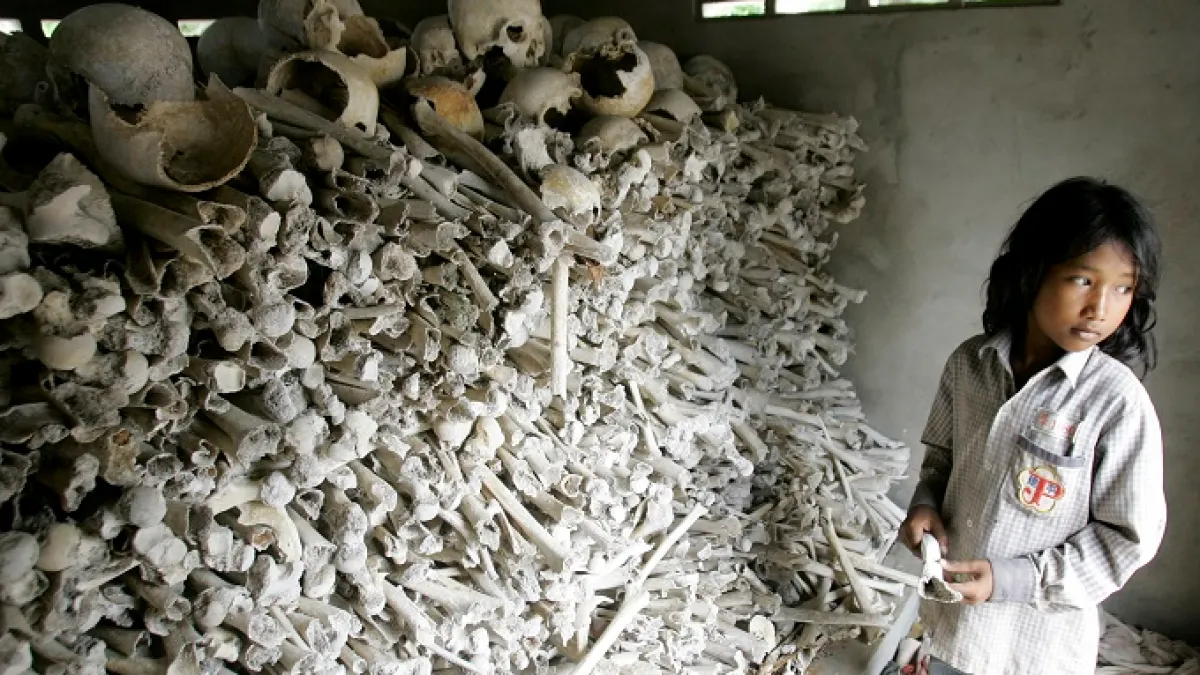
Bones recovered from the Killing Fields in Cambodia. Pol Pot’s regime killed nearly 2 million people in less than five years.
Image from Mark Manson.

But the truth was that Pol Pot was as insane as he was cruel. And it was pretty obvious to anyone paying attention. Upon taking power, Pol Pot nationalized the all land, kicked out or killed all foreigners, and began a sweeping genocide against the educated class. In the four years Pol Pot was in power, it’s estimated that he was responsible for the death of more than 20% of the country’s population.

But when news of the genocide and atrocities began to leak out of Cambodia, Caldwell refused to believe it. He defended Pol Pot’s regime and wrote off the atrocities as simply more western capitalist propaganda. His unwavering support eventually earned him an exclusive invitation to visit Cambodia by Pol Pot’s government. Caldwell accepted. And in December of 1978, he boarded that fateful flight to Asia.

Once there, Caldwell toured the country. He met the leadership and learned about their policies firsthand. But the climax of his trip was the last evening — a private audience with Pol Pot himself. Reportedly, Caldwell was “euphoric” with excitement and anticipation. Once in private, Caldwell and Pol Pot had a long intellectual conversation. In his enthusiasm, Caldwell began sharing some of his ideas for the Cambodian regime. He began to offer feedback and dare I say, potentially even a little criticism. Pol Pot, not used to being lectured to by a professor, promptly had Caldwell killed that night.

Malcolm Caldwell is what I like to refer to as an intelligent idiot. A man with an encyclopedic breadth of knowledge and understanding, a world-class mind with powerful thoughts, and yet absolutely no idea how to apply any of it.

October 24, 2024

Did the Media Lose the Vietnam War?

Filed under: Asia, History, Media, Military, USA — Tags: , , , , , , , , , , , — Nicholas @ 02:00

Real Time History
Published Jun 21, 2024

In late April 1975, dramatic images from Saigon are beamed across the world. North Vietnamese troops proclaimed final victory. Just how did the US lose the Vietnam War?
(more…)

November 1, 2021

Indochina and The Battle of Dien Bien Phu

The History Guy: History Deserves to Be Remembered
Published 29 Sep 2017

The History Guy remembers how decolonization led to proxy war and the Battle of Dien Bien Phu in what is now known as Vietnam.

The episode discusses and presents historical photographs and film footage depicting events during a period of war, which some viewers may find disturbing. All events are described for educational purposes and are presented in historical context.

The History Guy uses images that are in the Public Domain. As photographs of actual events are often not available, I will sometimes use photographs of similar events or objects for illustration.

Patreon: https://www.patreon.com/TheHistoryGuy

The History Guy: Five Minutes of History is the place to find short snippets of forgotten history from five to fifteen minutes long. If you like history too, this is the channel for you.

Awesome The History Guy merchandise is available at:
https://teespring.com/stores/the-hist…

The episode is intended for educational purposes. All events are presented in historical context.

#DienBienPhu #militaryhistory #thehistoryguy

January 22, 2021

Japan’s Only Pacific “Ally” – Phibun’s Thailand – WW2 Biography Special

Filed under: History, Japan, Military, Pacific, WW2 — Tags: , , , , , , — Nicholas @ 04:00

World War Two
Published 21 Jan 2021

Thailand’s prime minister and de-facto dictator Plaek Phibunsongkhram imported European fascism, nationalism and militarism to his country. But when Japan’s threat to South-East Asia became imminent, Phibun didn’t know what to do. His story is one of utter indecisiveness and opportunism.

Join us on Patreon: https://www.patreon.com/TimeGhostHistory
Or join The TimeGhost Army directly at: https://timeghost.tv

Follow WW2 day by day on Instagram @ww2_day_by_day – https://www.instagram.com/ww2_day_by_day
Between 2 Wars: https://www.youtube.com/playlist?list…
Source list: http://bit.ly/WW2sources

Hosted by: Indy Neidell
Written by: Joram Appel
Director: Astrid Deinhard
Producers: Astrid Deinhard and Spartacus Olsson
Executive Producers: Astrid Deinhard, Indy Neidell, Spartacus Olsson, Bodo Rittenauer
Creative Producer: Maria Kyhle
Post-Production Director: Wieke Kapteijns
Research by: Joram Appel
Edited by: Miki Cackowski
Sound design: Marek Kamiński
Map animations: Eastory (https://www.youtube.com/c/eastory)

Sources:
IWM HU 675
Portrait of Plaek Phibunsongkhram, courtesy of 冯銮披汶 https://commons.wikimedia.org/wiki/Fi…
From the Noun Project: people by ProSymbols, tick by akash k

Soundtracks from the Epidemic Sound:
Johannes Bornlof – “Deviation In Time”
Philip Ayers – “Trapped in a Maze”
Rannar Sillard – “March Of The Brave 4”
Fabien Tell – “Last Point of Safe Return”
Johannes Bornlof – “The Inspector 4”
Farrell Wooten – “Blunt Object”

Archive by Screenocean/Reuters https://www.screenocean.com.

A TimeGhost chronological documentary produced by OnLion Entertainment GmbH.

June 17, 2020

Alcibiades, the first recorded iconoclast, but far from the last

James Heartfield on the modern day resurgence of iconoclasm:

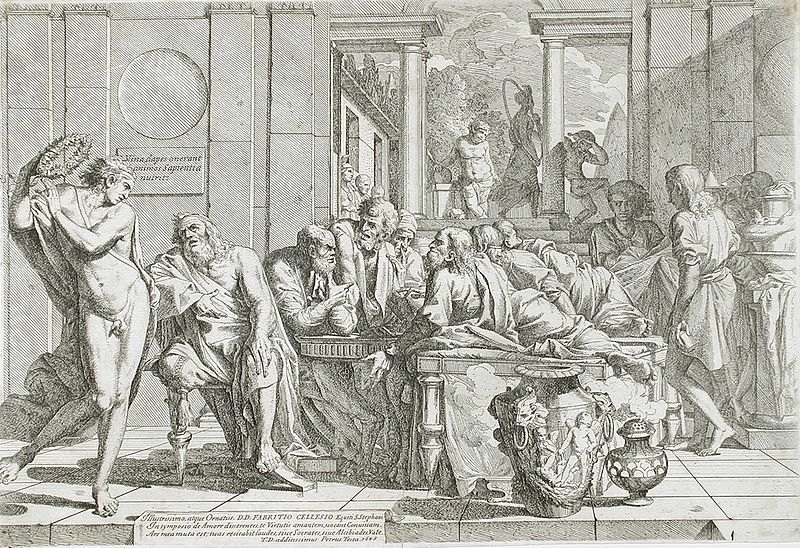
“Drunken Alcibiades interrupting the Symposium”, an engraving from 1648 by Pietro Testa (1611-1650)
Via Wikimedia Commons.

… far more often, the attacks on public symbols are indicative of a breakdown in social solidarity — often with alarming consequences. For activists seeking to win popular support, knocking down statues is a high-risk strategy that can provoke the opposite sentiments to those hoped for. The futurist Marinetti’s proposal to fill in the canals of Venice with concrete to make modern roads is a witty way to make a point, but not a sound policy.

Alcibiades was perhaps the first recorded statue vandal. One night in 415 BC he knocked all the stone cocks off the statues of Hermes in Athens. In 1497, the friar Girolamo Savonarola launched a Bonfire of the Vanities in which artworks, books and statues were destroyed out of a fear they would tempt people away from God. As any lover of old English churches knows, the furies of the Puritan revolution led to the destruction and defacing of Catholic saints’ statues and paintings.

In the modern era, the temptation to destroy monuments has been strong. In the First World War, Britain’s local authorities changed German-sounding names of streets like Bismarck Road — now Waterlow Road — while bully boys attacked German-owned shops. In 1933, Nazi students in Germany organised bonfires of subversive books, while the Reich organised an exhibition of “degenerate” modernist art. The burning of books only served as a trial run for the extermination of people, as the symbolic slaughter failed to yield the results of a “cleansed” Germany.

People often make the point that there are no statues of Hitler in Germany — though those were not taken down by Germans, but by the Allied occupiers. You can still see Albert Speer’s Zeppelinfeld and grandstand in Nuremberg, where many of Hitler’s rallies took place, though not much else of his Nazi architecture survives. Mussolini’s architects, Giuseppe Terragni and Marcello Piacentini, did better — much of their absurdly grandiose work survives. The model of an Allied-led “denazification” was in the minds of the US-led forces that overthrew Saddam Hussein in 2003. The destruction of his statue in Baghdad was largely staged by the allies.

Under the Maoist regimes in China and the Khmer Rouge in Cambodia, some of the worst atrocities after the Nazis were carried out. Mao’s “Cultural Revolution” against the “four olds” led to the destruction of books and artworks. Later, there were showtrials and the politically incorrect were battered by the mob. In the wreckage of Cambodia, Pol Pot led a terrifying war on alleged capitalist-roaders and even intellectuals — who could be handily identified by the fact they wore glasses — that led to millions being killed. Pol Pot declared a “year zero” — that all civilisation before the Khmer Rouge took power would be cancelled. Tragically, the wholesale wiping out of Cambodian culture was only a prelude to the extermination of much of its population. The sentiment of wiping out the wrong history was repeated in the war that al-Qaeda-inspired regimes in Afghanistan and Mali conducted against books and statues that did not match their own Islamist views.

In Soviet Russia, when the communist-allied artists of the Proletkult organisation argued that all Tsarist culture should be expunged, the Bolshevik leader Lenin took them to task for “rejecting the most valuable achievements of the bourgeois epoch”. Instead, he said, they should assimilate and re-work “everything of value in the more than 2,000 years of the development of human thought and culture”. Sadly, Lenin’s wise advice was lost on the Stalinist regimes that followed, during which the policy oscillated between futurist iconoclasm and maudlin Russian sentimentality. History got its revenge in eastern Europe when most of the ubiquitous Lenin and Marx statues came down in the 1990s.

November 12, 2019

Building Angkor – The “Lost” City – Extra History – #5

Filed under: Asia, Environment, France, History, Religion — Tags: , , , , — Nicholas @ 04:00

Extra Credits
Published 8 Nov 2019

Join us on Patreon! http://bit.ly/EHPatreon

After its decline, Angkor had become the Ancient, Lost City so prominent in our pop culture. Just one problem: Angkor was neither ancient (having declined around the same time as Hundred Years War) nor lost (people still lived there!). That didn’t stop the European visitors from trying to invent all kinds of stories for how this city could possibly exist, and stealing parts of the temple to bring back home. But despite all the hardships Angkor faced, it managed to become a national symbol for Cambodia and still remains to this day.

November 3, 2019

Building Angkor – A Drowning City – Extra History – #4

Filed under: Architecture, Asia, History, Religion — Tags: , , , , , — Nicholas @ 06:00

Extra Credits
Published 2 Nov 2019

Join us on Patreon! http://bit.ly/EHPatreon

We’ve talked about the magnificence of Angkor at its peak, but how did this sprawling metropolis become a city of ruins? The city of Angkor depended on the reliability of the seasonal monsoon. Several decades of drought left them with little choice than to modify the whole water system. But when the waters returned, they returned in force. As did enemy forces. Thus begins the death spiral of the city of Angkor.

From the comments:

Extra Credits
1 day ago
Always 👏 maintain 👏 your 👏 water 👏 infrastructure !!!

October 29, 2019

Building Angkor – A Clash of Gods – Extra History – #3

Filed under: Architecture, Asia, History, Religion — Tags: , , , — Nicholas @ 04:00

Extra Credits
Published 26 Oct 2019

Join us on Patreon! http://bit.ly/EHPatreon

Jayavarman VII, a Buddhist pacifist, was forced to give up his pacifism and rise to the throne at the age of 60. But once seated on the throne, he built Angkor Thom. The architecture was a fusion of buddhist and hindu stylings and included a comprehensive medical system. But will Angkor be able to stand after Jayavarman VII has passed?

Jayavarman VII the Great may be known as the greatest ruler of the Khmer, but he also wins the award for history’s best son. Making your mom the face for the goddess of wisdom is quite the Mother’s Day gift.

(Since folks have been asking for the metric conversions on our videos, 9 miles = 14.5 km at 4:52)

October 21, 2019

Building Angkor – Temple City – Extra History – #2

Filed under: Architecture, Asia, History, Religion — Tags: , , , , — Nicholas @ 04:00

Extra Credits
Published 19 Oct 2019

Join us on Patreon! http://bit.ly/EHPatreon

Let’s take a little tour around Suryavarman II crowning achievement, the temple that took only 33 years to complete, while Europeans were taking centuries to build their cathedrals. With a two mile long wall, gates large enough to allow elephants to pass and steps so steep that the average person needed to climb them like a ladder, Angkor Wat’s every feature was made to be impressive. But what lies at the heart might be surprising…

October 13, 2019

Building Angkor – Monsoon Metropolis – Extra History – #1

Filed under: Architecture, Asia, History, Religion — Tags: , , — Nicholas @ 06:00

Extra Credits
Published 12 Oct 2019

Join us on Patreon! http://bit.ly/EHPatreon

Let’s lay down the foundations for one of the architectural marvels of the ancient world: At its height, the city of Angkor was, by several measures, the largest city of the medieval era. With a million people and a footprint larger than modern-day New York, it was arguably the world’s largest pre-industrial city. And at its center lay the magnificent Angkor Wat.

April 18, 2018

QotD: The United Nations

Filed under: Africa, Asia, Bureaucracy, Quotations — Tags: , , , — Nicholas @ 01:00

It’s a good basic axiom that if you take a quart of ice-cream and a quart of dog faeces and mix ’em together the result will taste more like the latter than the former. That’s the problem with the UN. If you make the free nations and the thug states members of the same club, the danger isn’t that they’ll meet each other half-way but that the free world winds up going three-quarters, seven-eighths of the way. Thus the Oil-for-Fraud scandal: in the end, Saddam Hussein had a much shrewder understanding of the way the UN works than Bush and Blair did.

And, of course, corrupt organisations rarely stop at just one kind. If you don’t want to bulk up your pension by skimming the Oil-for-Food programme, don’t worry, whatever your bag, the UN can find somewhere that suits — in West Africa, it’s Sex-for-Food, with aid workers demanding sexual services from locals as young as four; in Cambodia, it’s drug dealing; in Kenya, it’s the refugee extortion racket; in the Balkans, sex slaves.

Mark Steyn, “UN forces — just a bunch of thugs?”, Telegraph Online 2005-02-15

August 20, 2016

QotD: Violence in wartime – the great exception

Filed under: Germany, History, Quotations — Tags: , , , , , — Nicholas @ 01:00

War is the great exception, the great legitimizer of murder, the one arena in which ordinary humans routinely become killers. The special prevalence of the killer-ape myth in our time doubtless owes something to the horror and visibility of 20th-century war.

Campaigns of genocide and repressions such as the Nazi Holocaust, Stalin’s engineered famines, the Ankha massacres in Cambodia, and “ethnic cleansing” in Yugoslavia loom even larger in the popular mind than war as support for the myth of man the killer. But they should not; such atrocities are invariably conceived and planned by selected, tiny minorities far fewer than 0.5% of the population.

We have seen that in normal circumstances, human beings are not killers; and, in fact, most have instincts which make it extremely difficult for them to engage in lethal violence. How do we reconcile this with the continuing pattern of human violence in war? And, to restate to one of our original questions, what is belief in the myth of man the killer doing to us?

We shall soon see that the answers to these two questions are intimately related — because there is a crucial commonality between war and genocide, one not shared with the comparatively negligible lethalities of criminals and the individually insane. Both war and genocide depend, critically, on the habit of killing on orders. Pierson observes, tellingly, that atrocities “are generally initiated by overcontrolled personality types in second-in-command positions, not by undercontrolled personality types.” Terrorism, too, depends on the habit of obedience; it is not Osama bin Laden who died in the 9/11 attack but his minions.

This is part of what Hannah Arendt was describing when, after the Nuremberg trials, she penned her unforgettable phrase “the banality of evil”. The instinct that facilitated the atrocities at Belsen-Bergen and Treblinka and Dachau was not a red-handed delight in murder, but rather uncritical submission to the orders of alpha males — even when those orders were for horror and death.

Human beings are social primates with social instincts. One of those instincts is docility, a predisposition to obey the tribe leader and other dominant males. This was originally adaptive; fewer status fights meant more able bodies in the tribe or hunting band. It was especially important that bachelor males, unmarried 15-to-25 year-old men, obey orders even when those orders involved risk and killing. These bachelors were the tribe’s hunters, warriors, scouts, and risk-takers; a band would flourish best if they were both aggressive towards outsiders and amenable to social control.

Over most of human evolutionary history, the multiplier effect of docility was limited by the small size (250 or less, usually much less) of human social units. But when a single alpha male or cooperating group of alpha males could command the aggressive bachelor males of a large city or entire nation, the rules changed. Warfare and genocide became possible.

Actually, neither war nor genocide needs more than a comparative handful of murderers — not much larger a cohort than the half-percent to percent that commits lethal violence in peacetime. Both, however, require the obedience of a large supporting population. Factories must work overtime. Ammunition trucks must be driven where the bullets are needed. People must agree not to see, not to hear, not to notice certain things. Orders must be obeyed.

Eric S. Raymond, “The Myth of Man the Killer”, Armed and Dangerous, 2003-07-15.

June 17, 2014

Somaly Mam’s Icarus turn

Filed under: Asia, Media — Tags: , , , , — Nicholas @ 07:31

In Taki’s Magazine, Kathy Shaidle describes the rise and fall of Somaly Mam, who is the most recent fantasist to dupe Westerners about conditions in her home country:

One of the last thrills still permitted us normal folks (for now) is getting to watch one of these self-appointed activists and advocates endure an Icarian tumble. Take that recent Newsweek exposé of secular saint and “sex work” abolitionist Somaly Mam.

No, I’d never heard of her before, either. I didn’t realize how far removed I was from what the authorities have deemed reality until I read that, among other things, this woman had been feted by the White House and the State Department, appeared on The Oprah Winfrey Show, made the “TIME 100” list, and declared one of Glamour’s “Women of the Year.” Plus she’d been named one of the “Women Who Shake the World” by, er, Newsweek.

Cambodian-born Somaly Mam began making claims she’d been sold into sexual slavery as a youngster. After a daring escape, she dedicated her life to rescuing other girls from the same fate, leading armed raids on brothels, then providing shelter, education, and vocational training to the former captives—with the help of Western donors, many of them celebrities.

Aaaaaaannnnnddddd … ? Oh, come on. Guess.

Simon Marks has been investigating Mam for The Cambodia Daily (“All the News Without Fear or Favor”) for years. When Newsweek ran his findings in that cover story last month, the rest of the world found out what actual Cambodians and NGO-types have been trying to tell us all this time:

Mam’s “origin story” is mostly bollocks on stilts.

Her “rescues” are more like kidnappings, and her statistics about Cambodia’s trafficking rates, exaggerated. She coached non-ex-prostitutes to tell hair-raising tales of rape, torture, and even eye-gouging when pale-faced documentarians came calling. “[I]nstead of a brothel or a massage parlour,” Mam’s “rescued slaves” ended up “working for poverty-level wages in unsafe and exploitative conditions in sweatshops.”

Powered by WordPress