If you’ve been following for a while, you’ll know that I’m a big fan of Field Marshal Bill Slim, the best but also least well known British general of the Second World War. His achievements in Burma and India are overshadowed in popular memory by the struggle against the Nazis in Europe and the vast Pacific campaigns against the Japanese by primarily American forces. In recent years, there’s been a bit more attention paid to the XIV Army’s long and bitter fight, but there’s always more to discover about that incredible struggle:
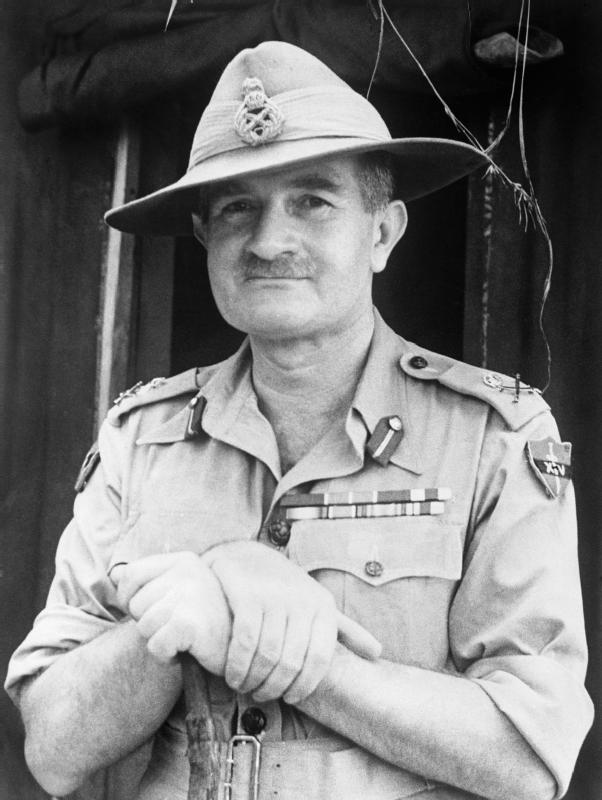
Field Marshal Sir William Slim (1891-1970), during his time as GOC XIVth Army.
Portrait by No. 9 Army Film & Photographic Unit via Wikimedia Commons.
But I see him clear, with that robber-baron face under the Gurkha hat … looking like a rather scruffy private with a general’s tab — which of course is what he was.
– one of General Slim’s soldiers remembers
A search on Amazon using the term “military memoir” yields more than forty thousand results. With so many choices, why read Field Marshal William Slim’s World War II memoir entitled Defeat into Victory? Interestingly enough, there are two answers. The short answer was revealed in 2011 when the National Army Museum in London held a debate and a public poll to answer the question — Who is Britain’s greatest general? Great Britain, of course, has a long and distinguished military history with a great many famous military commanders who could all vie for this honor. In what turned out to be a surprise to many, Field Marshal Slim tied with the Duke of Wellington as the winner. So, if you are considering whether to read Slim’s memoir, ask yourself — how much do you know about someone who might be one of the greatest generals in history?
Before continuing this essay with a longer, more structured answer about the value of Slim’s memoir, a few words about William Slim himself. He began his military career as a temporary lieutenant at the beginning of World War I, without the benefit of a university education or Sandhurst training. By the end of World War I, he had achieved a sterling military record — wounded twice, awarded the Military Cross and temporarily promoted to major. He spent the inter-war years assigned to the Indian Army and was notably associated with the 6th and 7th Gurkha Rifles. At the beginning of World War II, he was given brigade command in East Africa and then command of the 10th Indian Division in the Middle East. His memoir begins in early 1942 when Slim is suddenly and unexpectedly told to leave his command and report immediately to Army Headquarters in India. The summons was so abrupt that Slim thought he was being relieved of command. He didn’t know it at the time but he was about to spend the rest of the war in India and Burma.
A distinct three-act narrative arc forms the structure of his book. In Act I (1942), Slim takes command of Burma Corps. This was an ad hoc two-division force that was in the middle of conducting a fighting retreat while being overwhelmed by the surging Japanese Army. Slim and his men end up suffering through a one hundred day, nine-hundred-mile retreat back to India in what historians have called the longest retreat ever conducted by a British army. By May 1942, the remnants of his Corps finally reached safe haven in India.
In Act II (1943), Slim regroups, retrains and resupplies his forces in preparation for his reconquest of Burma. This was not as straightforward a task as it sounds. Slim now commands the Fourteenth Army which, at its height, consisted of nearly one million soldiers and was one of the largest armies in the world. But the size of the Fourteenth Army was not as striking as the diversity of its composition. Slim had to make a disciplined, cohesive and effective fighting force using regiments from England, Scotland, South Africa, Nigeria, Kenya and a vast array of Indian units including Sikhs, Rajputs, Pathans and Gurkhas from Nepal. Later in the war, Slim described a routine tactical operation: “The Japanese had for some time been harassing 28 East African Brigade Group … and a Punjabi battalion had been sent in to stiffen it”. The Japanese counterattacked “and a British battalion was hurriedly transferred from the east bank and joined them”. One routine tactical operation — involving allied soldiers from three continents.
In Act III, (1944-45), Slim and his army return to Burma and achieve triumph after triumph. The first triumph is the battle of Imphal (March-July 1944). The famed novelist George MacDonald Fraser was a young Scottish soldier in Slim’s Fourteenth Army and he later wrote; “I imagine that every teenager today has heard of Stalingrad and Alamein and D-Day but I wonder how many know the name of Imphal … where Japan suffered the greatest catastrophe in its military history”. The subsequent battle of Meiktila (February- March 1945) was equally significant and has been characterized by British military historian Corelli Barnett as, “the cleverest, boldest and most brilliant single British victory in World War II”. By mid-1945, Slim’s victorious Fourteenth Army had retaken Rangoon and destroyed the Japanese army in Burma.
There are three dimensions to Slim’s memoir that make it so memorable. It is a tale well-written, it is a tale of wonder and it is a tale filled with wisdom.