Quotulatiousness

August 31, 2026

David Friedman on the racial IQ controversy

Filed under: Health, History, Politics — Tags: , , , , , , — Nicholas @ 05:00

David Friedman responds to a question from one of his readers:

Lynn’s national IQ estimates (source)

    It is never too much to remember how much ethnic cleansing was made in the past based on “scientific evidence” that some races were “not as intelligent as ours” … (Comment on my blog)

Claims of this sort, about genocide, slavery, or ethnic cleansing, are offered as a reason not to talk about group differences. The implicit argument is that even if the average IQ of Africans is lower than that of Europeans or fewer women than men are talented at mathematics it is better not to say so, better to pretend it isn’t true. People making the argument rarely put it that way but it is pretty clearly what they believe.

This raises three questions. One is whether group differences exist. My view is that they almost certainly do. Darwinian evolution implies that humans are “as if designed” for reproductive success. Male and female differ in their role in reproduction so it would be surprising if the same distribution of talents were optimal for both. Africans are optimized against different environments than Europeans; that is the reason for the differences in appearance by which we distinguish them. It would again be surprising if the same distribution of abilities were optimal for both. That does not tell us what the differences are but it makes me skeptical of claims that they do not exist.

That is not, however, the subject of this post.

A second question is whether, if the claim is true, it is a valid argument for concealing true facts about group differences. It might be. If something is true and the consequences of it being known are sufficiently bad that is a reason to conceal it. Consider, for example, accurate instructions for creating a plague virus.

Whether that is the case for the existence of group differences depends on the consequences of concealing or not concealing it; my guess is that if significant group differences exist the consequences of pretending they don’t are worse than of admitting that they do1 but that is also not the subject of this post.

The third question is whether the claim is true, whether the belief that some groups were less intelligent was the cause of terrible things in the past. As far as I can tell it was not. There were terrible things done in the past and the perpetrators often expressed a low opinion of the victims but I have found no case in which supposedly scientific evidence of their inferior intelligence was the cause. In the most plausible cases, mass killing of Jews, Slavs and Romani by the Nazis, prejudice and conflict long predated the purported scientific evidence.

Consider some examples of terrible things.

Ethnic cleansing in Yugoslavia, so far as I can tell, had nothing to do with scientific evidence, real or bogus, about the relative intelligence of races. In some cases the cleansers and their victims differed only in whether their ancestors had or had not converted to Islam in the distant past. In others, the justification offered for the cleansing was “it’s historically our land, and they have taken it over by immigrating and having more babies than we did”.

The largest race killing in the post-war period may have been the Hutu/Tutsi conflicts in southern Africa.2 The victims were mostly Tutsi, an ethnic minority that before independence been the dominant group.3 It is hard to believe that any significant amount of it was motivated by evidence of their inferior IQ.

What about the Holocaust? Some Nazis made claims about Jewish inferiority of one sort or another but the basis for their antisemitism was the idea that Jews were race enemies, in which case the more intelligent they were, the more dangerous. One can see that pretty clearly in Henry Ford’s less malevolent version of antisemitism. The Nazis claimed that Slavs were an inferior race but their motive for killing or deporting them was to seize their land, a conflict that had been running, off and on, since medieval times. The Romani, the other major target of racial killing, were viewed as inferior but principally as criminals and vagabonds, again an issue that long predated the Nazis.


  1. Nathan Cofnas argues that the confident denial of group differences is responsible for the popularity of woke beliefs. If you know for certain that Africans and Europeans, men and women, have the same distribution of abilities it follows that any difference in group outcomes must be due to one group having a less favorable environment; if you cannot find evidence of racism, sexism, or something similar you must not be looking hard enough.
  2. The Nigerian Civil War may have killed more people but although the sides were racially different the conflict was over the attempt of the Ibo minority to secede from Nigeria.
  3. I somewhat oversimplify.

July 20, 2026

Eight Great Powers Invade China: the Boxer Uprising 1900-1901

Real Time History
Published 20 Feb 2026

After the defeat in the 1st Sino-Japanese War, the Qing Dynasty is under pressure: Some are calling for domestic reforms and ousting Western influence, while the Great Powers want to further open up China for their businesses. Violence erupts when the so called Boxer movement kills several Westerners.
(more…)

July 7, 2026

QotD: “I was just following orders” — the Nuremberg Defence

Filed under: Germany, History, Law, Military, Quotations, USA, WW2 — Tags: , , , — Nicholas @ 01:00

    JerryRigEverything @ZacksJerryRig
    It is illegal to obey illegal orders.
    It is illegal to obey illegal orders.
    It is illegal to obey illegal orders.
    It is illegal to obey illegal orders.
    It is illegal to obey illegal orders.
    It is illegal to obey illegal orders.
    Congress has not declared War.
    Pass it on.

Hot Take: The “Nuremberg Defense” should be completely legally valid because it was for the entirety of human history until the Nuremberg Trials.

The idea that the average GI Joe has the knowledge and capability to parse the legality of orders in life-and-death situations is one of the best examples of how Liberalism simply does not comport with reality.

Every lawyer knows this to be true, too. Ask any number of attorneys a question on a matter of law and if the question is worth a damn you’ll get as many answers as participants. All good legal questions start with the same answer: “It depends.”

If you can’t even get a team of attorneys to always agree on whether something is legal, with hours to days to weeks of research put into the question, why/how do you expect a normal joe to figure that out?

You don’t. He can’t. You know that.

You just want to inspire doubt, raise mutiny, and have a way to punish people who did things you don’t like on the orders of someone out of your reach.

J.T. Alexander, The social media site formerly known as Twitter, 2026-04-06.

February 18, 2026

Battle of Manila, 1945

Filed under: History, Japan, Military, USA, WW2 — Tags: , , , , — Nicholas @ 02:00

Real Time History
Published 3 Oct 2025

The Battle of Manila 1945 was the only urban battle in the American Pacific War comparable with Stalingrad, Berlin or other European battles. In gruelling weeks of fighting the 6th Army fought in house-to-house combat against entrenched Japanese.
(more…)

February 8, 2026

WW1: The Eastern Front in 1914 | EP 5

Filed under: Germany, History, Military, Russia, WW1 — Tags: , , , , — Nicholas @ 10:45

The Rest Is History
Published 8 Sept 2025

While the Western front was raging following the outbreak of the First World War in 1914, what was unfolding on the Eastern Front? Why was it an even bloodier and more brutal arena than the West? As Austria took on its great antagonist — the spark of the entire war — Serbia, why were its early campaigns constantly blighted by disaster? What terrible mistake did Russia, with its behemoth of an army, make? How would its dramatic war with Germany unfold? And, would this be the beginning of the end of the Habsburg Empire?

Join Dominic and Tom as they discuss the outbreak of the First World War on the Eastern Front, and its early clashes.

—————————————————

0:00 Adobe AD
0:50 Intro
3:27 The Eastern Front explained
5:15 The Serbian Front
33:23 Uber AD
34:02 Folio Society AD
35:33 Russia invades Germany
(more…)

January 8, 2026

WW1: The War Begins… | EP 1

The Rest Is History
Published 25 Aug 2025

Following the declaration of war in 1914, how did the outbreak of the First World War unfold? What were the earliest military engagements of this terrible, totemic event? Who were its key political players and how did they respond? What was the attitude to the war in Germany? Were the allies unified from this early stage, or were they suspicious and frozen by indecision? And, how did the Germans, with the mightiest army in all the world, make its move on “plucky little” Belgium?

Join Dominic and Tom as they launch into one of the most consequential events of all time: the outbreak of the First World War.

00:00 – Germany: from peaceful nation to war machine
02:30 – Introduction to WWI series: scope and importance
04:16 – Was Germany uniquely responsible for the war? Historians’ debate
06:12 – Fear versus aggression: German motivations
06:46 – The July Crisis: Sarajevo, blank cheque, Kaiser’s holiday, Austrian ultimatum
08:08 – Helmuth von Moltke the Younger: personality, melancholy, moustaches
12:01 – Germany’s strategic weakness: encirclement fears, manpower and GDP
13:45 – The Schlieffen Plan explained
18:06 – Von Moltke panics
19:00 – Kaiser signs mobilization order; emotional scene in Berlin
22:53 – The problem of Belgian neutrality and Britain’s obligations
23:47 – British cabinet debates: how far into Belgium would justify war?
25:04 – German ultimatum to Belgium: demands for railways and fortresses
26:14 – Belgium rejects ultimatum; King Albert’s defiance
27:59 – “A scrap of paper”: German gaffe fuels British propaganda
28:35 – King Albert’s speech to parliament: “Determined at any cost”
29:52 – Total War Rome (Creative Assembly)
30:37 – German invasion begins
36:18 – German reprisals in Belgium
50:00 – Comparisons with Allied conduct in Ireland, colonies, and elsewhere
50:47 – The Leuven library fire: destruction of manuscripts, global outrage
52:12 – Germany’s reputation collapses: admired culture turned to “barbarism”
53:28 – Fall of Brussels: German army enters the capital
(more…)

December 16, 2025

The Battle of Algiers: France’s “Victory” That Lost the War – W2W 057

Filed under: Africa, France, History, Military — Tags: , , , , , , , — Nicholas @ 04:00

TimeGhost History
Published 14 Dec 2025

In the mid-1950s, what Paris insists on calling a “police operation” in Algeria, steadily sparks into a full-scale war that exposes the fragility of the French Republic itself. As the FLN launches coordinated attacks, the army responds with mass arrests, torture, and collective punishment, drawing the military deeper into politics. The Battle of Algiers becomes a laboratory of counterinsurgency, even as public opinion fractures at home and successive governments collapse under the strain. By the decade’s end, the conflict has eroded faith in France’s imperial mission and helped trigger the fall of the Fourth Republic, proving that Algeria was not just a colonial war, but a crisis of the French state.
(more…)

August 12, 2025

German-Soviet Invasion of Poland 1939

Real Time History
Published 8 Aug 2025

Germany and the Soviet Union both regarded the Polish state as a creation of the post-WW1 system, and both had claims on Polish territory. In the summer of 1939, Adolf Hitler decided to invade Poland in a fait acompli against the Allies. In a secret agreement between Germany and the Soviet Union they agreed on dividing up the Polish state and Eastern Europe.
(more…)

July 25, 2025

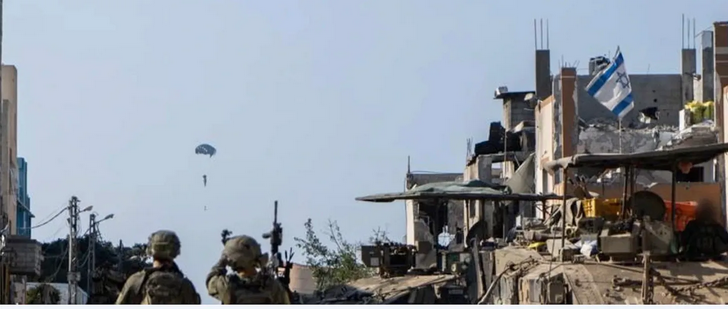
The ongoing conflict in Gaza

Filed under: Media, Middle East, Politics — Tags: , , , , , , , — Nicholas @ 03:00

On his Substack, John Spencer responds to a New York Times op-ed that claims Israeli forces in Gaza are engaged in genocide:

In his New York Times op-ed titled “I’m a Genocide Scholar. I Know It When I See It“, Omer Bartov accused Israel of committing genocide in Gaza. As a professor of genocide studies, he should know better. Genocide is not defined by a few comments taken out of context, by estimates of casualties or destruction, or by how war looks in headlines or on social media. It is defined by specific intent to destroy a national, ethnic, racial, or religious group in whole or in part. That is a high legal bar. Bartov did not meet it. He did not even try.

I am not a lawyer or a political activist. I am a war expert. I have led soldiers in combat. I have trained military units in urban warfare for decades and studied and taught military history, strategy, and the laws of war for years. Since October 7, I have been to Gaza four times embedded with the Israel Defense Forces. I have interviewed the Prime Minister of Israel, the Defense Minister, the IDF Chief of Staff, Southern Command leadership, and dozens of commanders and soldiers on the front lines. I have reviewed their orders, watched their targeting process, and seen soldiers take real risks to avoid harming civilians. Nothing I have seen or studied resembles genocide or genocidal intent.

Bartov claims that five statements by Israeli leaders prove genocidal intent. He begins with Prime Minister Netanyahu’s comment on October 7 that Hamas would “pay a huge price”. That is not a call for genocide. It is what any leader would say after the worst terrorist attack in the nation’s history. He also cites Netanyahu’s statements that Hamas would be destroyed and that civilians should evacuate combat zones. That is not evidence of a desire to destroy a people. It is what professional militaries do when fighting an enemy that hides among civilians.

Bartov presents Netanyahu’s reference to “remember Amalek” as a smoking gun. But this is a phrase from Jewish history and tradition. It is engraved at Israel’s Holocaust memorial, Yad Vashem, and also appears on the Holocaust memorial in The Hague. In both places, it serves as a warning to remain vigilant against threats, not as a call for mass killing.

He also highlights Defense Minister Gallant’s use of the term “human animals” to describe Hamas fighters. That is not a war crime. After the slaughter, rape, and kidnapping of civilians on October 7, many would understand or even share that reaction.

Unable to find intent among those actually directing the war, Bartov turns to far-right politicians like Bezalel Smotrich and Nissim Vaturi. These individuals do not command troops, issue orders, or shape battlefield decisions. I have studied the actual orders. They focus on destroying Hamas, rescuing hostages, and protecting civilians whenever possible. Their rhetoric is irrelevant to the legal case.

Israel has taken extraordinary steps to limit civilian harm. It warns before attacks using text messages, phone calls, leaflets, and broadcasts. It opens safe corridors and pauses operations so civilians can leave combat areas. It tracks civilian presence down to the building level. I have seen missions delayed or canceled because children were nearby. I have seen Israeli troops come under fire and still be ordered not to shoot back because civilians might be harmed.

Israel has delivered more humanitarian aid to Gaza than any military in history has provided to an enemy population during wartime. More than 94,000 trucks carrying over 1.8 million tons of aid have entered the territory. Israel has supported hospitals, repaired water pipelines, increased access to clean water, and enabled over 36,000 patients to leave Gaza for treatment abroad.

June 25, 2025

The Korean War Week 53 – Moscow Says ‘End the War!’ – June 24, 1951

The Korean War by Indy Neidell
Published 24 Jun 2025

Soviet Ambassador Jacob Malik speaks to the world on UN radio, saying that the Soviet position on Korea is that ceasefire talks should begin among the belligerents. The Americans are thinking of how they can bring in more non-American UN units, even as South Korean President Syngman Rhee denounces the British and Commonwealth forces and says they should go home.

00:00 Intro
00:41 Recap
01:07 Jacob Malik Speaks
02:02 Chinese Change Plans
03:19 10th Corps Advances
05:37 More Non-American UN Units
07:52 Rhee Denounces his Allies
12:17 Summary
12:40 Conclusion
14:15 Call to action
(more…)

June 7, 2025

The 12th SS Massacre of the Canadians in Normandy | History Traveler Episode 195

Filed under: Cancon, France, Germany, History, Military, WW2 — Tags: , , , , , — Nicholas @ 02:00

The History Underground
Published 9 Feb 2022

In the days after D-Day, the Canadians of the 3rd Infantry Division found themselves up against the German 12th SS Panzer Division as they were making their way south through Normandy. Tragically, some of these men would find themselves as the victims of one the battle’s worst atrocities at a place called Abbey Ardenne. In this episode, we’re joining Paul Woodadge of ‪@WW2TV‬ as we retrace the final steps of these men as they made their way to a tragic fate at the hands of Kurt Meyer and a division of the most fanatical fighters that Germany threw into the Battle of Normandy.
(more…)

May 23, 2025

Yasukuni-jinja, Japan’s most controversial historical site

Filed under: Asia, China, History, Japan, Military, Railways, Religion, WW2 — Tags: , , , , , — Nicholas @ 05:00

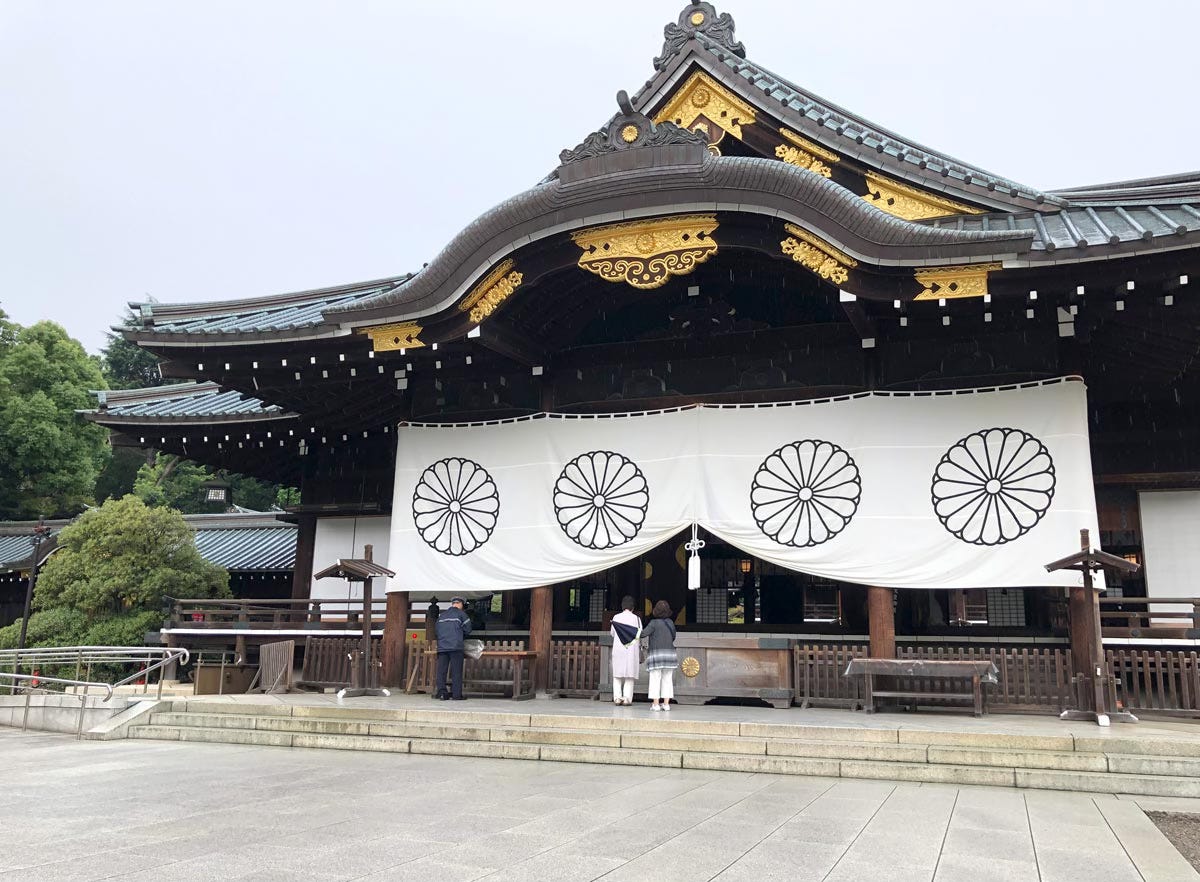
Nigel Biggar on the Yasukuni-jinja in the Imperial Gardens in Toyko, where the Japanese shrine to their war dead also celebrates fourteen convicted WW2 war criminals:

The Yasukuni Shrine in the Imperial Gardens, Tokyo.
Photo by Pierre Hazan

If ever you find yourself in the centre of Tokyo, make your way to the north-west corner of the Imperial Gardens, and turn left. A few minutes will bring you to the Yasukuni-jinja, Japan’s most controversial site. This is the national shrine to the war-dead, whose two and half million resident “glorious souls” include fourteen Class A war criminals.

A hundred yards to the right of the main shrine stands a museum, the Yushukan. Upon entering it, a visitor finds himself immediately face to face with a locomotive.

Now, when an Anglo-Saxon puts together Japan, Second World War, and locomotive, he arrives at one thing only: the “Burma Railway”. This is the railway that was hacked through the Burmese jungle partly by Allied prisoners-of-war, who were treated as slave labour and perished in their thousands. Over 12,000 Westerners died — about one in five — alongside perhaps 90,000 Asians.

So our Anglo-Saxon visitor beholds the locomotive with a mixture of disbelief, rising horror, and curiosity. He approaches the machine, looking for an explanatory text. Finding it, he learns that this locomotive is one of ninety that ran along the Burma Railway. He also learns the name of the military unit responsible for the railway’s construction. But of the Allied prisoners, the slave-labour, and the number of their deaths he learns nothing at all.

The Burma Railway wasn’t Auschwitz, either in genocidal intent or in murderous scale. But it was similar in its cruel contempt for human life. So the experience of confronting this Tokyo locomotive is analogous to stepping into a museum in Berlin and being confronted by one of the trains that shipped Jews to Auschwitz, and then reading an explanation that omits any mention of its cargo or the nature of its destination. If there were such a museum in Berlin, I’d have found it.

When our Anglo-Saxon ventures deeper into the Yushukan, he eventually discovers the exhibition on the 1930s and World War Two in the Far East. And here he learns that Japan’s imperial expansion was in fact a war of liberation, waged on behalf of subjugated Asian peoples, against Western colonial domination. And he learns that, even though Japan lost the war militarily, she won it politically, since the example of her early victories over the French in Vietnam, the Americans at Pearl Harbor, and the British at Singapore helped to inspire anti-colonial movements worldwide and so succeeded in ridding the world of European empires.

He also learns that what is known outside Japan as “the Rape of Nanking” (1937-8) is referred to demurely in the museum as “the Chinese incident”. And that whereas the “Rape of Nanking” is reckoned to have involved the indiscriminate massacre by Japanese troops of about 300,000 Chinese civilians, “the Chinese incident” only involved the severe treatment of Chinese troops who had violated the laws of war by disguising themselves in civilian clothes.

May 18, 2025

Why it Sucked to be an Italian Prisoner in North Africa – WW2 Fireside Chat

Filed under: Africa, Britain, Germany, Greece, History, Italy, Military, WW2 — Tags: , , , , , — Nicholas @ 04:00

World War Two
Published 17 May 2025

Today, Indy and Sparty tackle some questions on the North African theatre. Why did the Italians think invading was a good idea in the first place? Was Allied treatment of Axis POWs a war crime? How did Italian and Allied tanks stack up?
(more…)

May 4, 2025

The Clean German Myth, Doomed B-17 Pilots, and Japan’s Rapid Victories – Out of the Foxholes Live

Filed under: Germany, History, Japan, Military, Pacific, USA, WW2 — Tags: , , , , , — Nicholas @ 04:00

World War Two
Published 3 May, 20205

Indy and Sparty tackle some more of your interesting questions in another live Out of the Foxholes. Today they look at loss rates of B-17 crews, the myth of the clean Wehrmacht, and ask why the West was apparently so unprepared for Japan’s attack.
(more…)

April 19, 2025

Downfall: The Battle of Berlin 1945

Filed under: Germany, History, Military, Russia, WW2 — Tags: , , , , , , — Nicholas @ 02:00

Real Time History
Published 6 Dec 2024

April 1945. After nearly six years of war, the Red Army stands massed on the banks of the Oder River in eastern Germany. The Nazi capital and Hitler’s bunker are just 60km away, but the Nazi Party and the Wehrmacht are preparing to fight to the bitter end in the final struggle of WW2 in Europe – the Battle for Berlin.
(more…)

Older Posts »

Powered by WordPress