Quotulatiousness

November 7, 2026

A different kind of neo-colonialism

Filed under: Britain, Bureaucracy, Government, History — Tags: , , , — Nicholas @ 05:00

In The Daily Sceptic, David Betz and Michael Rainsborough point out that the British government, in its dealings with the British public, seems to have fallen back on habits developed in the days of the world-spanning British Empire:
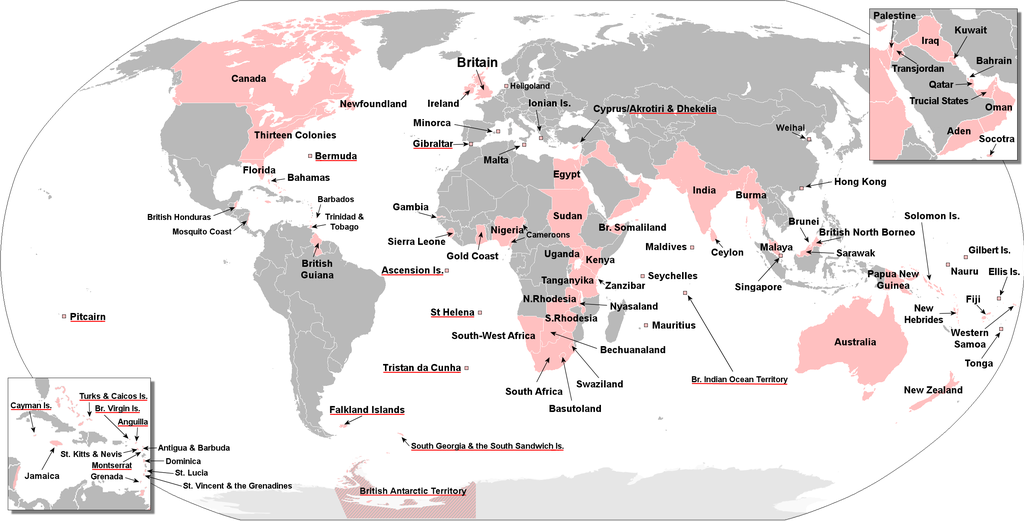
The territories that were at one time or another part of the British Empire. The United Kingdom and its accompanying British Overseas Territories are underlined in red.
Composed by “The Red Hat of Pat Ferrick” via Wikimedia Commons.

Despite spending much of the past half-century apologising for the Empire, the British establishment is rediscovering its favourite method of rule. The old colonial district officer, accustomed to keeping the peace between rival communities, cultivating local notables and reporting troublesome political sentiments to his superiors, would find much to recognise in contemporary Britain. He might struggle with the current terminology, but once someone explained what a Cohesion Support and Interventions Function actually did, he would probably feel quite at home.

In an essay we wrote six years ago called “Empires of Progress“, we argued that Western governing elites were increasingly abandoning the assumptions of the nation-state in favour of an imperial conception of political authority. A nation-state presumes a people sufficiently conscious of belonging together to accept common institutions and obligations. An empire governs different peoples, often possessing competing interests and loyalties, through a combination of accommodation, patronage, arbitration and coercion. Nations require citizens; empires administer subjects.

What we then identified as an emerging tendency has since acquired a more distinct institutional and political character in Britain. Successive governments, having encouraged mass immigration and multiculturalism, increasingly employ methods familiar from imperial administration to manage the communal divisions arising from those policies.

More significantly, these arrangements threaten to transform the relationship between the governing establishment and the historic British population, whose national attachments and political preferences increasingly conflict with the assumptions of those exercising power. Here, we examine how communal brokerage, differentiated accommodation and preventive security contribute to this estrangement, weakening the common national allegiance upon which the legitimacy of the state depends.

The imperial reflex, imported into the British domestic realm, we suggest, will prove considerably more destabilising than its practitioners anticipate.

Divide, rule, cultivate allies

British imperial administration depended upon an intimate knowledge of the populations it governed. Officials classified communities by ethnicity, religion and customary authority, cultivated influential intermediaries and distributed recognition, privileges and patronage to secure cooperation.

Such arrangements reduced the costs of government while giving selected local leaders a stake in the preservation of imperial authority. The British also secured the allegiance of particular populations whose interests became closely associated with the existing political order.

Governing through intermediaries and building dependent constituencies were complementary techniques, although the interests of the two were not always identical. By recognising communal leaders as representatives of distinct populations, imperial administrations could also reinforce the divisions that sustained their authority.

In British Malaya, for example, colonial economic development encouraged large-scale Chinese and Indian immigration, transforming the demographic composition of the peninsula and creating competing communal interests. The colonial economy developed along pronounced ethnic lines, with Malays concentrated in agriculture, Chinese communities prominent in commerce and mining, and Indian labour recruited extensively for plantation work. While not absolute, these divisions established a political landscape in which economic interests and communal identities became closely associated. British administrators also relied upon recognised communal intermediaries, including Chinese leaders known as Kapitan Cina, who mediated relations with Chinese communities and whose commercial privileges and political influence could become closely connected with the colonial power.

After the Second World War, the proposed Malayan Union of 1946 sought to extend citizenship to much of the immigrant-origin population while reducing the authority of the Malay rulers. Malay opposition forced the British to abandon the scheme in favour of the Federation of Malaya in 1948, with more restrictive citizenship provisions. The subsequent establishment of the Communities Liaison Committee in 1949 brought leading Malay, Chinese and Indian representatives together to negotiate questions of citizenship, economic interests and national identity. Political authority rested upon negotiations among recognised communal organisations, culminating in the Alliance between Malay, Chinese and Indian parties that helped secure independence in 1957. The British authorities, in effect, created the demographic and economic circumstances that made communal bargaining an indispensable feature of the constitutional settlement that followed.

At home, the contemporary British state confronts comparable divisions arising from a demographic transformation shaped decisively by the policies of governments of both major parties.

The lasting power of Nazi propaganda

Filed under: Germany, History, Media, WW2 — Tags: , , , — Nicholas @ 04:00

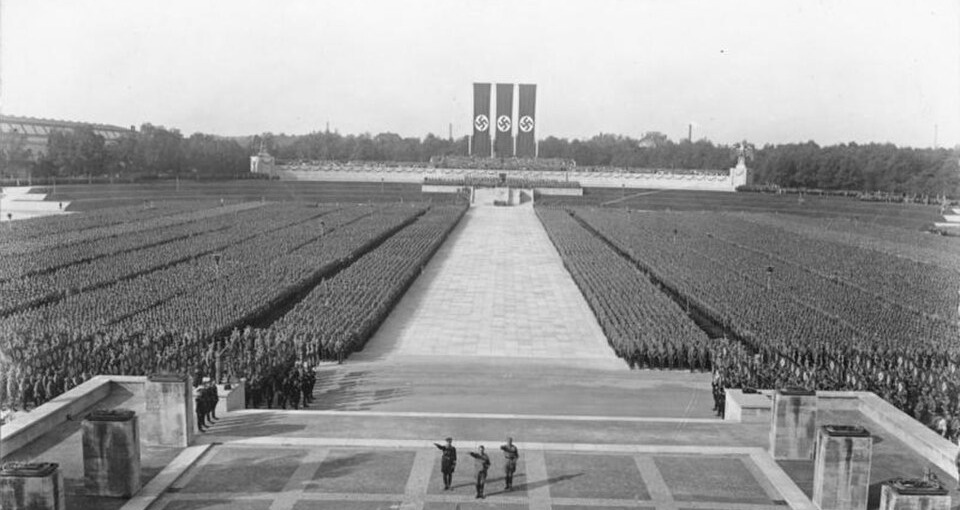
After the Canadian government started subsidizing most of the TV and radio stations along with the newspapers and magazines, it helped me to understand how the concentration of messaging had been key to maintaining and reinforcing Hitler’s grip on power in Germany in the 1930s. Before that time, there were still independent and opposed viewpoints available to ordinary Germans, but after Hitler became Chancellor, most of them were shut down or taken over by the Nazis. The message delivered to Germans from that point on was closely directed by the propaganda ministry under Goebbels, and it was very effective in harnessing German public opinion. Modern communication channels that we enjoy today would not be as easily controlled as the printing presses and radio towers of Hitler’s day … but we’ll see in real time how much various governments are willing to try to extend their control to the internet.

On Substack, Katja Hoyer looks at how the carefully curated images of the Nazi propaganda machine still worked to shape opinions long after the Reich was defeated, as western media kept re-using Nazi images to illustrate stories about that regime:

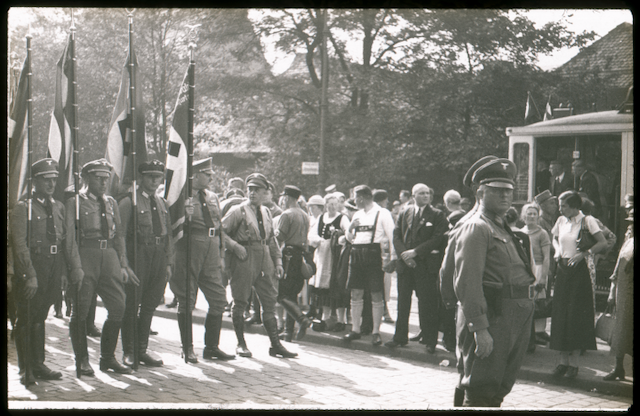
Image taken at the 1934 Nuremberg Rally. Img: Bundesarchiv, Bild 102-16196 / CC-BY-SA 3.0

The result was that many of us grew up with an image of the Nazi era not a million miles away from the one the regime itself had wanted to project. Long columns of soldiers marching in rigid formation. Perfect young boys and girls in uniforms, ecstatically following their Führer into his future. Order. Discipline. Design.

The reality of the Nazi regime was of course very different. So by looking at the Nazi regime through its own lens, are we perpetuating its propaganda?

That’s the question the American art historian Madeleine Johnson asks in her book At Hitler’s Picnic: Discovering the 1934 Nuremberg Rally. She has kindly agreed to give us here at ZEITGEIST a taster of her work and some of the very different images she has found.


    Have you ever noticed how you can almost bet which photos will accompany any book or video about Nazi Germany? You can almost guarantee there will be sepia images of armed SA men on trucks, footage from Leni Riefenstahl’s Triumph of the Will, clips from Eva Braun’s home movies or newsreels of the Wehrmacht in combat.

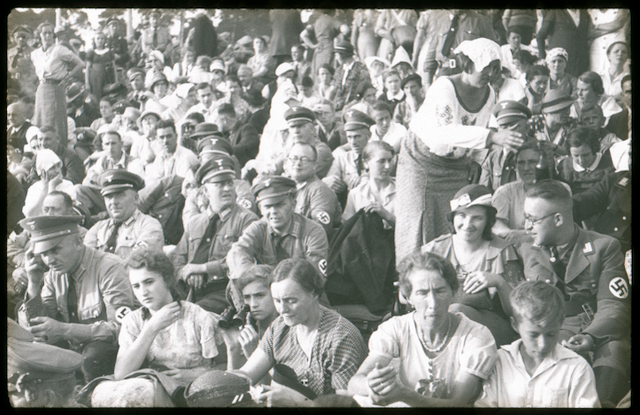
    I had never really thought about this until 112 old glass slides turned up when we cleared out my childhood home. As I eventually learned, my uncle, a U.S. G.I., had found them scattered on the floor of a local Nazi headquarters in March 1945 and sent them home as a souvenir.

    When I first saw them, it took a moment to recognise that these slides of portly men and their families snacking in the stands, children in mini Nazi uniforms and litter in the famous Luitpold Arena were taken at the 1934 Nuremberg rally. They were completely unlike the perfectly aligned ranks of the SS and SA and glowing Hitler youth familiar from Heinrich Hoffmann’s photos and Riefenstahl’s film.

    Image from Madeleine Johnson’s collection

    The contrast between these amateur snapshots and the images we “know” got me thinking about how and why such a predictable, and limited, group of images still dominate the narrative of Nazi Germany today.

    Some of the reasons we keep seeing the same photographs are structural. It may have been the country of Leitz and Zeiss, but cameras were expensive and not widely owned in 1930s Germany. The regime limited photography too. Only three official photographers were permitted to take photos at rally venues. Those combat films would have required propaganda ministry permission. Heinrich Hoffmann had the exclusive on Hitler photos, and he and Eva Braun were the only ones with access to Hitler’s private life.

    There is the survival factor. Personal photos that weren’t destroyed by war may not have survived de-Nazification or family shame. Another reason for the constant employment of the same images is that they are familiar. They are a kind of shorthand that does not need explaining. They offend no one, and their authenticity is not in doubt (except for that famous one of Hitler in the 1914 crowd, probably made by Hoffmann’s studio).

    Image from Madeleine Johnson’s collection

I’d noticed many years ago that the mental image most people had of the Wehrmacht was directly from Nazi propaganda films and photos, which emphasized the “mechanized might” of the modern German military machine … despite the fact that the Germans used many more horse-drawn carts than motorized vehicles all the way through the war. The images were striking — nobody said the Nazi propagandists were incompetent — and they also helped hide the fact that the French and British had been thoroughly trounced in 1940 despite their more heavily armed tanks outnumbering the lighter German panzers.

Ludwig Erhard’s shock treatment of the postwar German economy

Filed under: Economics, Germany, History — Tags: , , , , — Nicholas @ 03:00

On the social media site formerly known as Twitter, Handre points to the state of the German economy after World War 2 and what it took to shock it back to life:

Germany did it before. The question worth asking now, with Europe’s largest economy grinding through its third consecutive year of stagnation, is whether Germany can summon the nerve to do it again.

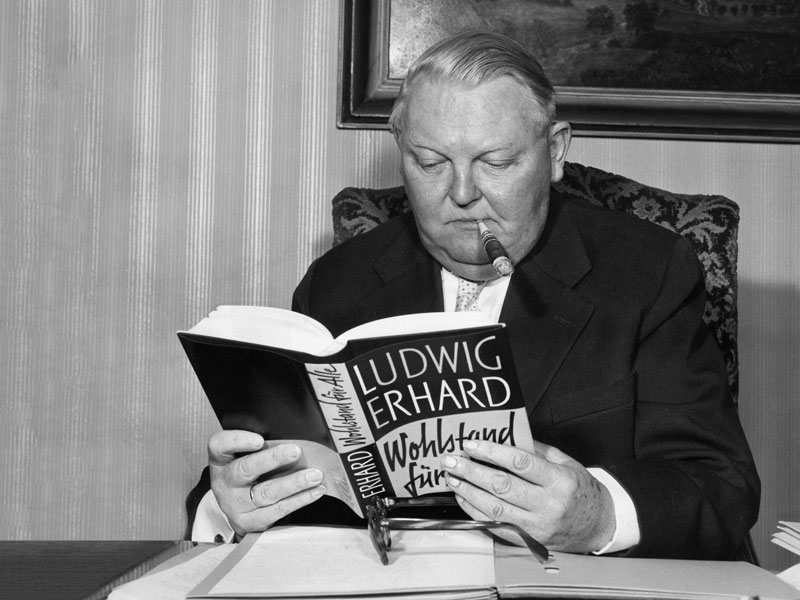
In 1948, Ludwig Erhard did something that struck most of his contemporaries as insane. He abolished price controls overnight, slashed rationing, and replaced the worthless Reichsmark with the Deutschmark at a brutal conversion rate. The occupying Allied authorities were furious. Labor unions called a general strike. Erhard told the critics to wait two weeks.

They waited. Industrial output jumped 50 percent within months. By 1950, real wages were rising and the black market, which had functioned as the actual German economy under Allied price controls, simply evaporated. Prices fell as production caught up with demand. Consumer goods reappeared on shelves for the first time in a decade.

In a sound monetary environment, rising productivity drops prices and you get richer in real terms without a central bank engineering 2 percent annual inflation to pick your pocket. The Deutschmark held its value. Savings meant something. Capital formation exploded because businessmen could actually calculate future costs without guessing what the currency would be worth next year.

Germany’s neighbors ran the opposite experiment, keeping controls and soft money, and watched their recoveries crawl.

The 2026 German government faces energy costs triple their 2019 levels, a manufacturing sector hollowing out, and a central bank it no longer controls. Erhard’s playbook sits on the shelf. Cut the regulatory burden, restore price signals, stop the spending. This is not complicated; the political will is the only scarce resource.

Trajan and Hadrian – 20: The Conquered and the Proud

Filed under: Europe, Government, History — Tags: , , , , , — Nicholas @ 02:00

Adrian Goldsworthy. Historian and Novelist
Published 29 Apr 2026

Today we think about the careers of the emperors Trajan and Hadrian, Roman aristocrats from Spain. Gibbon included them among the five good emperors who presided over the height of the Roman empire. Trajan was remembered fondly by the Roman elite, but is less well known today. Hadrian is more famous, generally remembered as good, but was bitterly unpopular with the Senate.

QotD: “Capital allocators” and “operators”

Filed under: Business, Quotations, USA — Tags: , — Nicholas @ 01:00

If you hang out much with finance bros (or “capital allocators” as they now call themselves),1 you may chance to hear somebody described as an “operator”. What is this strange species? What is this unusual job with an unusual title? Near as I can tell, an “operator” is somebody who actually runs a real business in the real world. But atop the commanding heights of 21st century America, that makes you an anomaly. You have no podcast. You have no portfolio of bets. You have no LPs, no byzantine leverage structure, and no IRR calculations. You don’t flit from deal to deal, hovering on a castle of financialized abstractions so ethereal the lack of air pressure at that altitude gives you a nosebleed. You aren’t even an intellectual or a scribbler who writes about real things at a layer of remove. No, instead you toil in the muck, doing basically the same thing every day, trying to make an actual business actually succeed. What a weirdo.

John Psmith, “REVIEW: Anabasis, by Xenophon”, Mr. and Mrs. Psmith’s Bookshelf, 2026-06-01.


  1. This neologism is actually incredible It’s like something out of early 20th century Marxist propaganda, but they did it to themselves! This is not helping us beat the accusation that we live in a cleverly-disguised planned economy.

Powered by WordPress