History Rage Podcast and HardThrasher
Published 26 Jul 2026Was the legendary B-17 really brilliant — or dangerously overrated wartime myth?
The B-17 Flying Fortress is one of the most iconic aircraft of the Second World War — but what if its reputation doesn’t match reality?
In this explosive episode of History Rage, host Paul Bavill welcomes aviation historian and YouTube creator Will Carver aka @hardthrasher to challenge one of the biggest myths of Allied air power. Known for his sharp analysis and uncompromising views, Will argues that the B-17’s legendary status owes more to storytelling, culture, and Hollywood than battlefield performance.
From its origins in 1930s military theory to the brutal realities of daylight bombing over Germany, this episode digs into why the aircraft that symbolised American courage may not have delivered the technical superiority it promised.
What You’ll Learn in This Episode:
• Why the B-17 Flying Fortress became such a powerful cultural icon
• The real limitations of its bomb load, range, and survivability
• How daylight precision bombing proved far harder than planners expected
• The truth about the Norden bombsight and its controversial testing history
• Why raids like Schweinfurt exposed devastating weaknesses
• How aircraft design decisions limited bomb capacity and effectiveness
• Why the courage of crews matters even more when the technology strugglesDespite its fearsome reputation, the B-17 often carried smaller bomb loads than British heavy bombers and struggled to defend itself against increasingly capable German fighters. Its reliance on formation flying reduced speed, altitude flexibility, and survivability — sometimes with catastrophic results.
Why This Episode Matters
This episode isn’t about mocking history — it’s about understanding it properly.Will makes a powerful point: praising equipment as flawless risks overshadowing the extraordinary bravery of the crews who flew it. Many airmen climbed aboard knowing the risks were immense, flying into intense flak and fighter opposition regardless. Their courage deserves recognition grounded in truth, not mythology.
November 21, 2026
The B-17 Was Crap with Will Carver (aka Lord Hardthrasher)
QotD: The Late Bronze Age Collapse
We need to be clear, to begin with, that while we have scattered fragments of epigraphic evidence (that is, inscriptions), almost all of our evidence for the Late Bronze Age Collapse is archaeological. Without archaeology, we would remain largely in the dark about this event. But archaeological evidence also brings with it challenges: it can tell you what is happening (sometimes) but often not why and dating with precision can be challenging. Most of what we’re tracking in understanding LBAC is site destruction, identified by the demolition of key buildings or “destruction layers” (often a thin layer of ash or rubble indicating the site was burned or demolished), but dating these precisely can be difficult and there are always challenges of interpretation.
With that said, the Late Bronze Age Collapse is a sequence of site destructions visible archaeologically from c. 1220 BC to c. 1170 BC, which are associated with the collapse or severe decline of the major states of the region (the Eastern Mediterranean and Middle East). We generally conceptualize these destructions as a “wave” moving in sequence beginning in the Aegean, moving over Anatolia, sweeping down the Levant and arriving in Egypt but in many cases my sense is the chronology is more complex than that. Many sites in the path of this “wave” were not destroyed, with some declining slowly and others declining not much at all; other sites (I have in mind Tiryns) see the destruction of their political center but the decline of the urban settlement around it happens slowly or later.
First, we ought to set the stage of the Late Bronze Age. What really marks out the Late Bronze Age (c. 1500 BC to c. 1200 BC) from earlier periods is that the emerging state systems in Mesopotamia, Syria, Anatolia and Egypt had expanded to the point of coming quite fully into contact with each other, with a significant degree of diplomatic, economic and cultural interconnectedness, to the point that we sometimes refer to the “Late Bronze Age Concert of Powers” (evoking 19th century European balance of power politics) when talking informally about them.
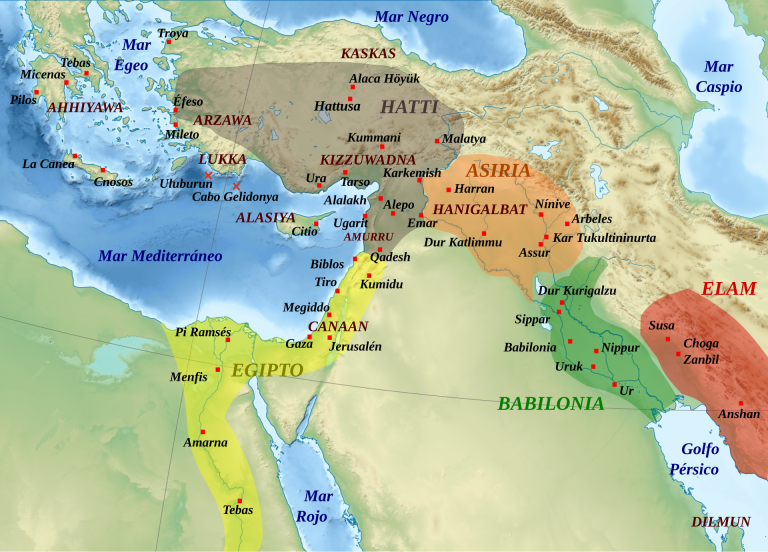
Wikimedia Commons map (in Spanish, there wasn’t an English version, but it will do) of the rough political situation in the 1200s BCE. The Hittite Empire (labeled as the “Hatti“, another name it went by, after another major ethnic group within it) in Anatolia, the Assyrian (Asiria) Empire in N. Mesopotamia, Kassite Babylon (Babilonia) in S. Mesopotamia and (New Kingdom) Egypt.
Now I should caution, we often provide these nice neat maps of the Late Bronze Age powers (and they’re useful to a degree) but the borders of these states were quite fuzzy – their outer “possessions” were often tributaries under the rule of local kings which might be weakly attached to the imperial center. Nevertheless, going from East to West: southern Mesopotamia was dominated by the “Middle Babylonian” Empire, ruled by the Kassite dynasty (the Kassites being an ethnic group who had taken power around 1530 BC) while northern Mesopotamia was dominated by the Middle Assyrian Empire (from about c. 1350 BC). Anatolia and the Northern Levant was controlled by the multi-ethnic Hittite Empire, which seems to have sparred regularly with the New Kingdom of Egypt which controlled Egypt and the southern Levant. Basically all of these powers had less settled, often pastoral peoples in their hinterlands which presented on-going security challenges for them.
These larger imperial states were more economically complex as well. In particular, their large armies required significant amount of bronze which – because its core ingredients of tin and copper effectively never occur in the same place – demanded substantial long-distance trade, though trade was hardly only in copper and tin, but also included other high value goods and even (where feasible) bulk staples. So while these powers clashed regularly, at the elite level (if not at the level of the subsistence economy) they were also reliant on each other to some degree.
Finally, at the edge of this state system is the Mediterranean and especially the Aegean. In the Aegean – in Greece and Crete especially – we see effectively miniature versions of these state structures, complete with (by Near Eastern Standards) itty-bitty palaces (the Minoan urban centers on Crete had come under Mycenean (=Greek) rule in c. 1450, the palaces there largely abandoned). Cyprus shifted between being nominally subordinate to either the Hittites or the Egyptians but seems to have mostly run its own affairs and was integrated through trade into the state system.
As noted above, LBAC starts perhaps as early as 1220 or so, and what we see in very rough sequence is as follows.
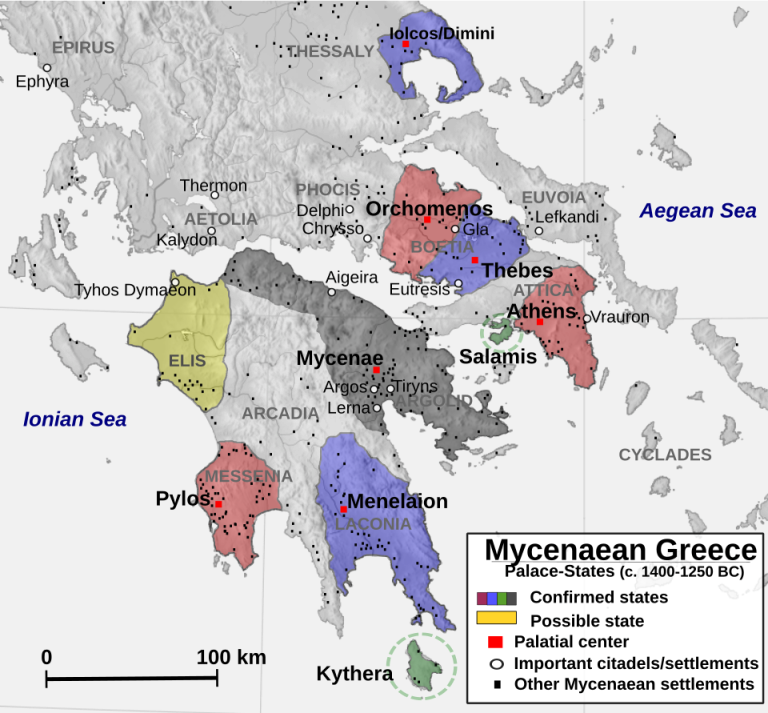
As far as I know, we still generally think the earliest rumblings are instability in the Mycenean Greek palace states. Things had been unstable in this area for a few decades and we have some scattered destructions (Thebes) and intensified fortifications around 1250, suggesting things were not going great in Greece. Then from c. 1200 to c. 1180 we see the destruction or collapse of basically all of the palace centers in Greece. In some cases the urban core continues for a while, in other cases it doesn’t – in a number of cases, once the site is abandoned, it is not reinhabited (e.g. Mycenae itself, the largest of the palace centers).
Via Wikipedia, a map of major Mycenaean palace centers and proposed palace states.
As we’ll see below, the impact in Greece is greater than basically anywhere else because the collapse of the LBAC is more severe in Greece than basically anywhere else.
Meanwhile, the Hittite Empire was itself not in good shape when this started. As far as we know, the Hittites were very much on the “back foot” in the late 1200s, pressured by the Assyrians and Egypt and so potentially already short on resources when their neighbors to the West began imploding. As far as I know, precise dates are hard to nail down for this, but the Hittite Empire in the early 1100s comes apart under pressure and by 1170 or so it is gone. That collapse of imperial power is matched by a significant number of site destructions across Anatolia, including the Hittite capital at Hattusas and the large settlement at modern Hisarlik, now fairly securely identified as ancient Troy. Some (like Troy) were rebuilt, others (like Hattusas) were not, but centralized Hittite power was gone and there’s a marked reduction in urbanization and probably population.
Moving into the Northern Levant, Syria and Northern Mesopotamia, we see Assyrian power – which had been advancing before, you’ll recall – contract sharply alongside more site destructions, though again chronology is tricky. One of the key sites here is Ugarit, a major Bronze Age Levantine coastal city which was destroyed c. 1190 – before the last of the Mycenean palaces (but after the first of them). The city’s destruction in fire preserved clay tablets with diplomatic messages from the local king of Ugarit (a Hittite vassal) frantically writing to his Hittite superiors for reinforcements in the face of significant (but frustratingly unnamed) threats prior to the destruction of the city.
That said, destruction in the Fertile Crescent is very uneven. The Middle Assyrian Empire contracts, but does not collapse, while the Kassite Dynasty in Babylon clearly suffers some decline, but largely stabilizes by the 1160s before being run over by the Elamites in the 1150s. Site destructions in the Levant are uneven and some key Bronze Age centers like Sidon and Byblos were not destroyed and remained major centers into the Iron Age.1 My understanding is that while there was significant decline in the southern Levant, it is hard to pin any specific large-scale site destruction to the 1220-1170 period.
Finally we reach Egypt in a period we refer to as the “New Kingdom” (1570-1069); we can trace politics more clearly here due to surviving Egyptian inscriptions. Egypt was also in a weakened position going into this crisis, facing pressure from Libyan raiders coming overland from the West and also some internal instability. In c. 1188, civil war broke out as the last queen of the reigning 19th dynasty was unable to retain control, leading to revolt and the seizure of power by Setnakhte and the 20th dynasty; his son Ramesses III took power in c. 1185. Things didn’t get easier from there as we hear reports of renewed Libyan incursions in c. 1180 (coming from the west) followed almost immediately by an invasion by the “sea peoples” (see below) who were evidently fended off in at least two major battles, the Battle of the Delta (c. 1179ish?) and the Battle of Djahy (c. 1178ish?).
Egypt holds together, but there’s a fair bit of evident economic strain (likely climate based, see below) and the ability of Egypt to project power outside of Egypt seems largely spent by the end of the reign of Ramesses III; his successors do not appear to have been able to right the ship and Egyptian power continued to fragment and decline, with the dynasty stumbling on until it collapsed in 1077 leading to the Third Intermediate Period (“Intermediate Periods” are the term for periods of fragmentation within Egypt).
I should note in this overview that our understanding of this sequence of collapses and declines has changed significantly. The idea of the Late Bronze Age Collapse has been around since the early 1800s when historians first noticed that the end of the Greek “Age of Heroes” (linked by them to the Fall of Troy, which the (Classical) Greeks believed happened in 1184) seemed to map neatly on to the failure of the Egyptian 19th Dynasty. As archaeologists in the later 1800s and early 1900s started actually excavating the Greek “Age of Heroes” (thus discovering the (Mycenaean) Greek Late Bronze Age, which we term the “Late Helladic” period (c. 1700-c. 1040 BC)) and then finding site destructions dateable within a band of perhaps 1250 to 1150 BC in Greece, Anatolia, Syria and the Levant the idea of a general collapse around the legendary date for the Fall of Troy picked up a lot of steam.
My sense of the scholarship is that this “civilizational collapse” narrative has been drawn back a bit as it becomes clear that some sites were not destroyed and also that some site destructions or abandonments happened significantly later or earlier than the relatively tight 1220-1170 BC time frame that emerged for the core of the collapse. No one (that I know of) is arguing there was no LBAC – there was clearly an LBAC – but the scale of the collapse remains something of a moving target as we excavate more sites, adding them to lists of sites that were destroyed, declined or (sometimes seemingly randomly) were spared.
And the list of sites that were not destroyed is significant. Of note, Athens very clearly has a Mycenaean citadel on the Acropolis (which can’t be excavated because the Acropolis is in the way, but it is very obviously there) but there’s no break in settlement in Athens. Already mentioned, Byblos and Sidon remained very prominent centers before and after, while Jerusalem and Tyre, both apparently minor settlements before LBAC (and not destroyed) will become increasingly prominent in the Iron Age Levant. Likewise the great cities of Egypt and Mesopotamia remain, few to no site destructions in either regions. At the same time, many settlements that escape destruction do not escape decline: in many cases these cities continue to shrink (and some places that escape destruction, like Tiryns, shrink slowly rather than vanishing all at once) or grow visibly poorer in a longer process. So the moment of destruction comes with a long “tail” of decline stretching out decades.
So to summarize, the Late Bronze Age Collapse is a series of site destructions, abandonments and declines running from roughly 1220 to roughly 1170 (though decline continues after this point) distributed quite unevenly through the interconnected Late Bronze Age Mesopotamian-and-Eastern-Mediterranean world. Greece and Anatolia are severely impacted, the Levant somewhat less but still fairly strongly, while the states of Egypt and Mesopotamia do not collapse but enter long periods of decline.
What that description leaves out, of course, are causes and effects.
Bret Devereaux, “Collections: The Late Bronze Age Collapse, A Very Brief Introduction”, A Collection of Unmitigated Pedantry, 2026-01-30.
- Sidon and Byblos, alongside Tyre (settled in the Bronze Age, but only prominent in the Iron Age) would be the most powerful and prominent Phoenician cities in the early Iron Age.