
Quotulatiousness

November 1, 2026

“Welcome to the wonderful world of carbon accounting”

One of the biggest blind spots for climate warriors is the proportion of hand-waving and wishful thinking required to make their grand unified visions of a Net Zero world, as revealed by John Robson as he conducts the search for the fabled “Scope 3”:

Net Zero image from Jo Nova

We recently got an email from Heatmap saying “Half of companies with net-zero commitments call scope 3 their biggest barrier.” And we thought duh what? And then “Probably the other half said ‘What’s scope 3?'” It turns out to be the carbon emissions you don’t emit but get blamed for anyway. More fun from the wacky world of climate economics. Which has this regrettable feature in common with interventionist economics generally: They don’t know enough to know what they don’t know. The email also said “Most are stuck on spend-based estimates too rough to prove whether their reduction programs are working”. As in the old Soviet Union the planners basically planned to spend because unless you let consumer preferences form prices in competitive markets, you can’t tell whether you’re making something useful or just sawdust sausages and ill-fitting size 12 shoes all for left feet.

In a striking departure from modern journalistic practice, we responded by Googling “Scope 3”. And it turns out to be something very revealing in its unrevealingness. For instance, from the “Carbon Trust“:

    The Greenhouse Gas Protocol – which provides the most widely recognised accounting standards for greenhouse gas emissions – categorises GHG emissions into three ‘scopes’. Scope 1 covers direct emissions from owned or controlled sources. Scope 2 covers indirect emissions from the purchase and use of electricity, steam, heating and cooling. By using the energy, an organisation is indirectly responsible for the release of these GHG emissions. Scope 3 includes all other indirect emissions that occur in the upstream and downstream activities of an organisation.

So here’s the problem. Scope 1 is reasonably easy to measure, at least in principle. It’s the GHGs you emit directly by doing whatever you’re doing, minus presumably staff breathing out CO2 while at work. Scope 2 isn’t too bad: it’s the same as Scope 1 except it’s from your power suppliers for whatever share of their output you acquire. But Scope 3 is a very different beast. It’s all the emissions from all the people you bought stuff from, plus all the emissions from all the people who bought your products. All of them. Every single one. Even your kid’s lemonade stand. And all based on pseudo-scientific “accounting and reporting standards” that sound good, make work, generate money and are no use in the real world.

Here we must again cite Leonard Read’s 1958 classic “I, Pencil“, a demonstration even from a simpler era when people used pencils not AI that tracing out all the steps involved in making things, was inherently a transcomputable and never-ending quest. Thus, the pencil tells the reader, “not a single person on the face of this earth knows how to make me”. Take any part of it: the wood, the paint, the eraser, the graphite, and you touch a global supply chain of near infinite complexity. Among a great many other things, that:

    My bit of metal – the ferrule – is brass. Think of all the persons who mine zinc and copper and those who have the skills to make shiny sheet brass from these products of nature. Those black rings on my ferrule are black nickel. What is black nickel and how is it applied? The complete story of why the center of my ferrule has no black nickel on it would take pages to explain.

And to explain who made the coffee and shoes and razor blades for the miners, and who produced the fuel for the ships that carried these goods about, and who made the machine tools to create sheet brass, and on and on, would defy any central planner even before they got to the problem that all these people in turn used pencils (we said it was 1958). Which is why after an initial burst of idealism Soviet Five-Year Plans were essentially reduced to replicating last year’s plan and adding a few percent.

Now imagine trying to track all the carbon emissions. Because it’s what Scope 3 aims to do as if it were a mere detail.

Incidentally Soviet planners from the 1960s on into the 1980s actually thought that more powerful computers would overcome this problem, being unclear on the concept of “transcomputable” particularly as it applied to systems with feedback loops. Then the USSR done died. But not this hope.

Thus Heatmap insists that it can be done with their handy guide, which “lays out a four-step playbook for closing the gap between scope 3 commitments and measurable supply chain progress, using domain-specialized sustainability AI” and from whose three “What you’ll learn” gems the first is:

    How to move from spend-based estimates to product-level emissions data in hours – with AI-powered material mapping and multi-agent validation

Oooh. AI-powered. Domain-specialized no less. And multi-agent validation. We suppose it beats getting it all from Agent 86. But not by much because the fantasy of measuring all the carbon outputs from all your inputs relies on the fantasy of measuring all your inputs and you can’t.

In a market economy, a real one, you don’t have to. As Read also said, as long as you know the price you must pay for the immediate inputs, how to assemble them into outputs, and the price you can get for those outputs, you can tell whether a purchase is rational. But if you have to know more than you can, you’re sunk. Especially if you don’t know you can’t.

Welcome to the wonderful world of carbon accounting. Do not mistake it for the real kind of accounting though.

How Hitler Stole an Armored Arsenal – Panzer 35(t) & 38(t) – Rearmament 12

Filed under: Europe, Germany, History, Military, Weapons, WW2 — Tags: , , , — Nicholas @ 04:00

World War Two
Published 31 Oct 2026

The Panzer 35(t) and Panzer 38(t) were designed to defend Czechoslovakia. How did they end up helping Hitler invade Poland, France, and the Soviet Union?

When Germany occupied the Czech lands in March 1939, it seized far more than an inventory of weapons. It gained established factories, skilled workers, and tank designs that could help fill serious gaps in German rearmament. Captured LT vz. 35s entered Wehrmacht service, while production of the LT vz. 38 was redirected to equip Germany’s expanding Panzer divisions.

In this episode of Nazi Rearmament, Spartacus Olsson examines the development, production, and battlefield performance of these Czechoslovak-designed tanks. From Škoda and ČKD to German-controlled BMM, we follow the weapons and industries appropriated to serve Hitler’s wars of aggression.

We compare the 35(t)’s troublesome pneumatic controls with the 38(t)’s dependable mechanical design, examine their armament and armor, and trace their combat service as increasingly powerful opponents exposed their limitations. We also explore the continuing contribution of Czech engineering through vehicles including the Marder III, Grille, and Jagdpanzer 38.

Their story reveals a bitter consequence of appeasement. The Munich Agreement sacrificed Czechoslovak territory in the hope of preserving peace. The subsequent German occupation placed weapons and industrial resources in the hands of the aggressor, strengthening his capacity to wage further war.

Optimism about the west, despite current events

Filed under: Europe, Government, Liberty, Politics — Tags: , , , , — Nicholas @ 03:00

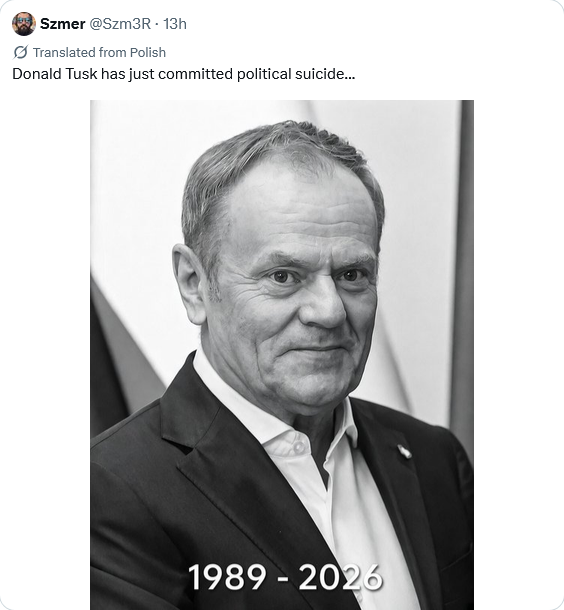
On the social media site formerly known as Twitter, Brivael Le Pogam explains why it’s still possible to be optimistic about western culture, even in the face of things like the coup in Poland this weekend:

People always ask me why I’m so optimistic about the West.

A few weeks ago, I told a friend I’d never been more bullish on our future. He looked at me like I’d lost my mind. So I gave him two predictions.

First: the EU, as it exists today, is going to collapse.

Second: we are going to hold a Nuremberg trial for communism. Not for people. For ideas. Because those ideas are still the ones killing us today.

Then I explained why.

There’s one law I’ve watched play out everywhere, in startups, in family fortunes, in empires:

The more a system is full of money and empty of intelligence, the faster it decays.

Take the simplest example. The son or daughter of a billionaire who inherited the money but not the education that came with it. They become parasites on what their parents built. They don’t understand what they’re running. But they’re surrounded by courtiers telling them they’re brilliant, so they feel invincible. And they start breaking things, one confident decision at a time.

That’s the West’s ruling class right now. And here’s the part people miss: a decadent system with no intelligence left doesn’t slowly drift. It collapses. Because it can’t stop making mistakes, and every mistake is bigger than the last.

Here’s what that looks like in practice.

In 2024, Marc Andreessen sat down with officials from the Biden administration. By his account, they told him not to bother funding AI startups. AI would be a game for two or three giant companies, working hand in hand with the government. When he pointed out that AI is just math, they told him that during the Cold War they classified entire branches of physics, and they could do the same with the math behind AI.

Think about who they said that to. The man who wrote “Software is eating the world.” The man who understood decades ago that whatever the state gets its hands on, it ruins. Nobody with a functioning brain walks into a room with Marc Andreessen and says that. Those people did. With total confidence.

And now, this week: Donald Tusk.

Police surrounding Poland’s Constitutional Tribunal. Government-backed judges declaring the chief justice suspended. All of it on a Friday evening, while the elected president was on a plane to Senegal, forced to turn around and fly back to Warsaw.

When you’re winning the argument, you don’t send the police to the courthouse.

This is what decadence looks like up close. Endless money. Zero feedback from reality. High on their own supply. Surrounded by people who will never tell them no.

Systems like that don’t reform. They break.

So yes, people find me optimistic. This is why. I’m not betting on these people fixing anything. I’m betting on what gets built after they’ve finished breaking it.

Why Do Shortline Railroads Exist? | Railroad Economics 19

Filed under: Business, Economics, Railways, USA — Tags: — Nicholas @ 02:00

Railroad Economics
Published 14 Jul 2026

Every day, thousands of freight cars are delivered by railroads you’ve probably never heard of. These smaller companies, known as shortline railroads, play a critical role in the North American freight network by serving customers that the major Class I railroads often can’t do efficiently.

In this episode of Railroad Economics, we explore why shortline railroads exist, how they make money, what they haul, and why the largest railroads depend on them to complete the “last mile” of freight service. From industrial switching to local customer service, these small railroads are an essential part of the railroad business.

If you’ve ever wondered why there are so many different railroad names on freight trains, this video explains the economics behind it.

QotD: The soul in Greco-Roman beliefs

In the Hellenic tradition, the soul is immortal and eternal. It pre-exists the body and descends into generation as a trial, a learning, and a purification. The soul’s goal is to return to its divine source through a process of purification, ascent, and union. This belief was held widely across Greek religion, from Homeric poetry and Orphic mystery rites to the highest philosophical schools.

According to the Orphic Hymns, the soul is a divine spark that has fallen into the world of becoming and must return to the world of being. The hymns speak of Dionysus, Zagreus, and Persephone as central figures in this mystery: the soul is torn apart, scattered in matter, and later reassembled through divine rites. The initiate, by imitating this divine cycle through ritual purification, hymn, and sacrifice, undergoes rebirth.

In Hesiod’s Theogony, we see the mythic structure that undergirds this cosmology: the descent from primordial Chaos, the generation of Gaia, Uranus, and Kronos, and the eventual rise of Zeus. This procession is echoed philosophically in the chain of being. The gods in Theogony do not exist in contradiction to the metaphysical One, but as its manifest intelligences within the mythic and cosmic order. As Proclus understood, myth expresses eternal truths in symbolic form. The battles between gods, the descent of Persephone, the castration of Uranus, all become symbols of metaphysical processes: separation, individuation, and return.

The Iliad presents a world filled with divine agency. Gods walk among men, intervene in fate, and dwell in both the heights of Olympus and the underworld. In this epic, the soul of a hero does not vanish into nothingness but continues to exist in Hades. Achilles’ encounter with Patroclus in Book 23, and his conversation with the shade of Agamemnon in The Odyssey, show a world where the dead still think, speak, and interact. These passages lay the groundwork for later philosophical interpretations of soul continuity and destiny.

According to Plato’s Phaedo, the soul that pursues wisdom and virtue through its life is not bound to the cycles of reincarnation but is released to dwell in the realm of the Forms. The Phaedrus describes the soul as a winged charioteer drawn by two horses — one noble, the other base — and presents the upward path as a struggle toward divine vision and eternal beauty. These teachings were taken up and deepened by Plotinus and Proclus, who saw philosophy, purification, and theurgy as the means of ascent.

When the soul departs the body, it is judged not by a personified deity alone, but by the measure of its own harmony with the divine order. As taught in the Chaldean Oracles, and echoed in Iamblichus and Proclus, souls that have lived with virtue and piety are able to ascend through the planetary spheres, shedding the influences of fate and materiality. They are guided by gods and daimons, until they reach the realm of pure intelligibility. If the soul is unpurified, it returns through cycles of rebirth, often into new human lives, or sometimes into the bodies of animals. This reincarnation is not random, but governed by cosmic justice, in accordance with the soul’s prior deeds and inclinations.

Some souls, according to Orphic and Platonic teaching, dwell for a time in the Elysian fields — a region of light, memory, and joy — before continuing their ascent. Others remain longer in Hades, in realms of forgetfulness and shadow, undergoing correction. Yet even here, the gods provide guidance and possibility. Hecate, Hermes, and Persephone are all guardians of the dead. Offerings to the chthonic gods, libations at tombs, and remembrance of ancestors all serve to support the dead in their journey and maintain harmony between the worlds.

The afterlife is not a binary judgment, as in later Christian thought, but a complex and graduated realm where the soul’s condition matches its spiritual state. Justice is exact and unyielding, but not vindictive. Divine mercy exists in the opportunity for return, remembrance, and the path of theurgy. The ultimate goal is henosis, the reunification of the soul with the divine source, the One, beyond multiplicity, where all things become one again.

Fortissax, “A Pagan Confession”, Fortissax is Typing, 2025-08-16.

Powered by WordPress


