Quotulatiousness

November 4, 2026

More Polish news

Filed under: Europe, Government, Media, Military, Politics, Russia — Tags: , , , , , — Nicholas @ 06:00

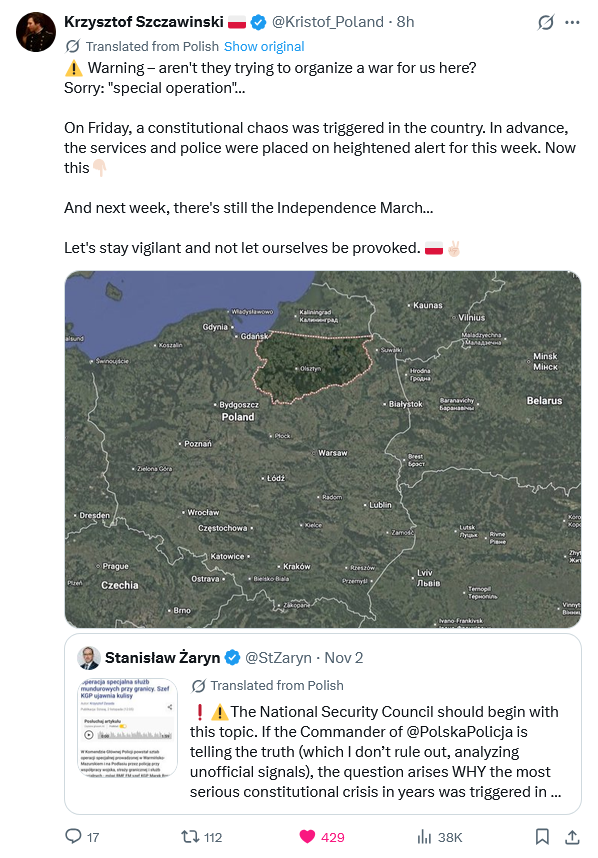
On the social media site formerly known as Twitter, Krzysztof Szczawinski posted about concerns that the Tusk government may be trying to provoke a military confrontation with the Russians over the Kaliningrad exclave on the northeast border of Poland:
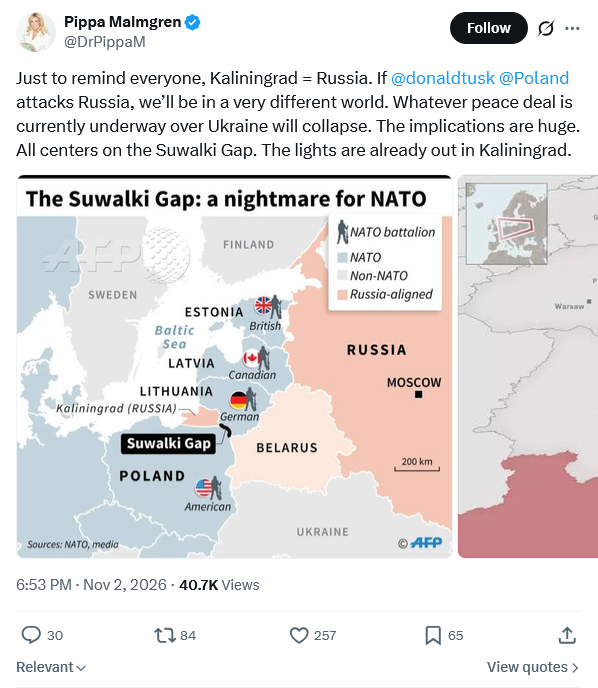
He also shared a post from Pippa Malmgren, a former US presidential advisor:
In the New English Review, Bruce Bawer discusses the overall situation in Poland after the attempted coup over the weekend:

And now a would-be coup, which Tusk defended by saying: “I will not allow the right wing to take us out of the European Union. That’s what the game is about today.” Upon learning of Tusk’s perfidy, President Karol Nawrocki, who is not a fan of the EU and who at the time was in an airplane over Spain on his way to Senegal on an official trip, turned the plane around as soon as news of the attempted coup reached him. “At such a moment”, Nawrocki posted on X, “the President must be in Poland. I’m interrupting my flight to Senegal. I’m returning.” In a subsequent post, he explained that the traitors’ “ultimate objective … is to impose EU law over Polish law, force through the EU Migration Pact [which, adopted in 2024 and already rejected by Poland, empowers Brussels to orchestrate the resettlement of migrants throughout the EU], and open Poland’s borders to tens of thousands, potentially hundreds of thousands, of illegal migrants.” When Nawrocki’s plane reached Warsaw, the control tower, under orders from Tusk – which could hardly be interpreted as anything other than an assassination attempt – denied his plane permission to land; but as one writer on X put it, “the Polish military immediately took control of the airport’s military zone, arranged for the president’s plane to land safely in the capital, and provided security escort for President Nawrocki, with special forces personnel accompanying him throughout”.

Nawrocki then made his way to the Constitutional Tribunal, where the police had been commanded to keep him out, but, depending on which story you believe, either let him pass without incident or at first tried to deny him entry. (According to the Economist, which proffered a reliably pro-EU version of events, Nawrocki and his entourage “forced their way into the building, pushing Ms Korwin-Piotrowska out of the way”. After entering the building, Nawrocki removed Tusk’s five judges and reinstated the Tribunal president whom Korwin-Piotrowska had dismissed. And as word of all these developments spread to the Polish people, the streets around the Court began to fill with protesters – because the overwhelming majority of Poles share Nawrocki’s nationalism, not Tusk’s EU-toadyism. In 2025 they elected Nawrocki by a large margin; Tusk entered office not because the people voted him in but because there was no clear winner of the 2024 parliamentary elections, whereupon his party (which had come in second), in coalition with two other parties, appointed him to the position. In short, Nawrocki is the choice of the people; Tusk is a party animal, a coalition creature, an EU puppet. As with so many champions of globalism in the Western world, he has relentlessly presented his aggressively anti-democratic posture as a valiant defense of democracy.

The Polish people know better. That’s why they’ve gathered – peacefully, singing their national anthem – around the Constitutional Tribunal. Although various sources, including Lara Logan, described the coup attempt on late Sunday evening as having failed, Filip Styczynski, a Nawrocki partisan, posted a video outside the court on Monday evening stating that things remained at an impasse. One thing, however, is clear: the established media in Western Europe, which take it as their sacred task to squelch or misrepresent stories that make globalism look bad, have done a bang-up job with the developments in Poland; as more than one observer has pointed out, the facts about Tusk’s attempted coup would hardly have gotten out of Poland if not for X and other social media. It will be more than interesting to observe the fallout of this conflict. At stake is the profound desire of most Poles to keep Poland defiantly Polish – safe, clean, proud, free, and unapologetically devoted to its history and culture and traditions – rather than to allow it to become another increasingly Islamized hellscape like its EU-compliant neighbors to the West. If Nawrocki prevails, is it possible, or even likely, that Poland will quit the EU with all due dispatch – thereby weakening the authority of the unelected van der Leyen over other EU member states and hence, dare one hope, encouraging the citizens of those member states, too, to step out from under that well-coiffed, vainglorious dictator’s boot? Over the weekend Hungary joined Poland in kicking the Migration Pact to the curb. What’s next?

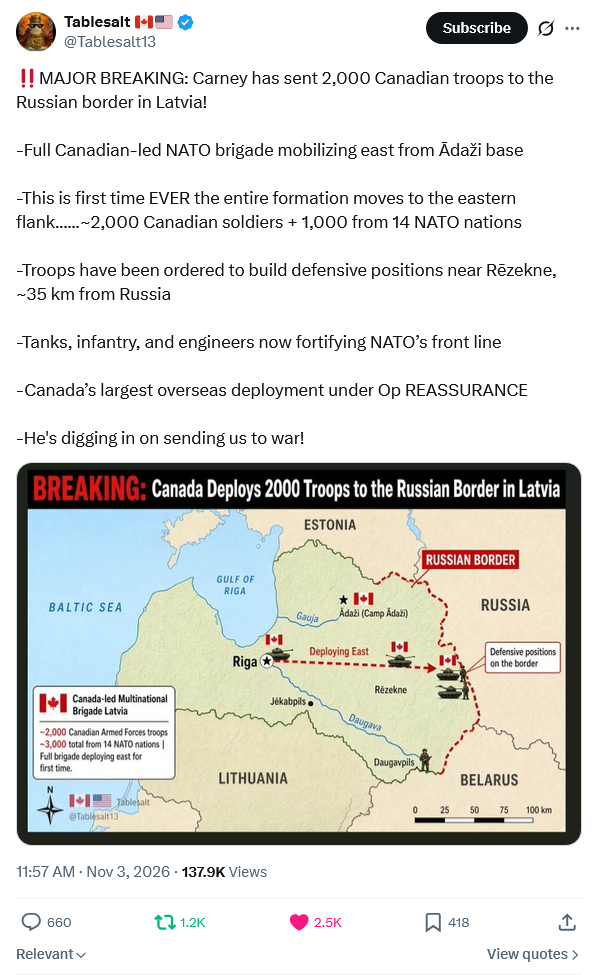
Also in that suddenly fascinating part of the world:
The Commonwealth, in theory and practice

Filed under: Britain, Cancon, History, USA, WW2 — Tags: , , , , , , — Nicholas @ 05:00

The British Commonwealth of Nations is back in the news, thanks to decolonialist activists and slavery reparations demands from former British colonies. But what is the Commonwealth and how did it come to be? In UnHerd, Mary Harrington explains its origins after the First World War:

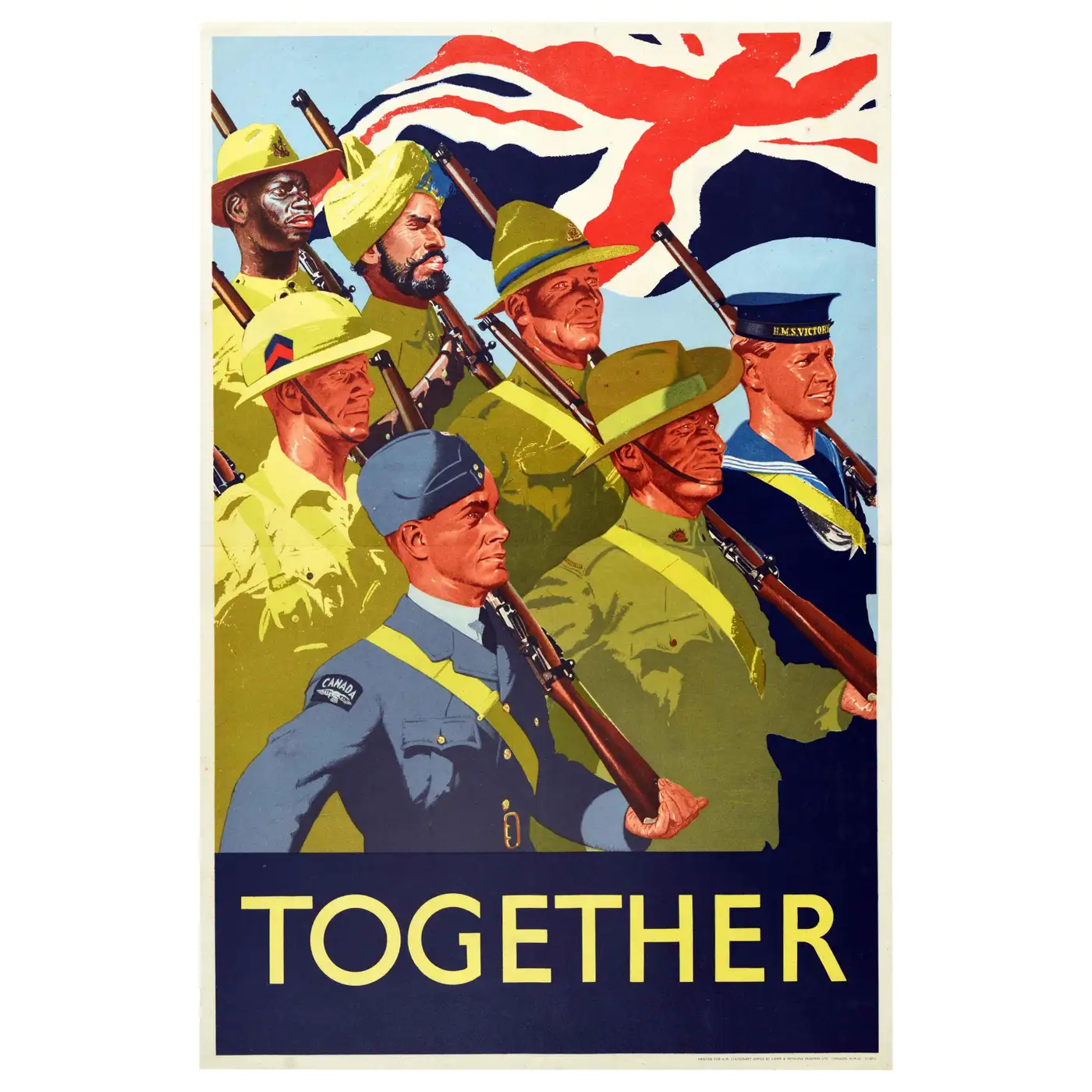
The patriotic view of the Commonwealth during WW2.

But what is this Commonwealth for? In one corner of my sitting room stands a tea-trolley that used to belong to my grandmother. It’s a beautiful piece of furniture, which you can convert from a two-storey conveyance into a handy fireside table by activating a hidden mechanism. But though it’s ingeniously made, it doesn’t have a role in our house, except storage. The floors are too uneven for it to be useful transporting things, and afternoon tea doesn’t happen.

The Commonwealth feels like that tea-trolley: evidence of something clearly once of social significance, whose context has disappeared. Along with that context, so too has much of the detail of how we got from there to here. And there’s a link between this fact and the ever more insistent demands that Britain atone for slavery: namely our loss of any account of British history that hasn’t been pre-filtered through a post-war internationalist perspective (which is to say, at least until recently, an American perspective).

[…]

This entity began as a realist adaptation to changing geopolitical forces. It was conceived of in 1926 as a response to a shift in relations between Britain and important imperial holdings as a consequence of the First World War. The exigencies of imperial worldwide coordination in that conflict had forced a new degree of independence across dominions including Canada, South Africa, and New Zealand. Then, following the war, these states were understandably reluctant to relinquish this new autonomy.

Matters came to a head in 1926, when the Canadian Prime Minister demanded that the British Governor-General, Julian Byng, dissolve the government and call an election. Byng refused, triggering a dispute over who was in charge. The row prompted a conference, led by former Prime Minister Lord Arthur Balfour, which aimed to align existing imperial law with reality. The end of these discussions was the Balfour Report, which explicitly described the various British imperial dominions as not dominions at all. Rather, they were “autonomous Communities within the British Empire, equal in status, in no way subordinate one to another in any aspect of their domestic or external affairs, though united by a common allegiance to the Crown, and freely associated as members of the British Commonwealth of Nations”. This definition was formalised in 1931, along with an “imperial preference” policy which set advantageous trading terms among Commonwealth nations.

This settlement didn’t last long, though — and as it evolved, it grew gradually less pragmatic, and less concrete. This was with no small thanks to the American statesman Wendell Willkie, a close advisor of Roosevelt, who was a vocal critic of British imperialism. Willkie called for leadership of the world to pass instead to America. In time, and with Willkie’s encouragement, dismantling the European empires (and their trade clubs, such as the Commonwealth’s “imperial preference”) would become an explicit aim of American foreign policy.

When the Second World War broke out, the US made it a condition of the 1941 “lend lease” agreements, by which America supplied aid to Britain, that the latter would agree to work toward ending these preferential trade arrangements. Then, after the war, US loans to an effectively bankrupt Britain were again explicitly tied to economic liberalisation, culminating in the General Agreement on Tariffs and Trade in 1949. This ended any meaningful economic role for the Commonwealth, leaving behind little save a ceremonial role, a vague do-gooding remit, and some ambivalent memories.

To be clear: it’s not exactly that the British Empire was alive and well until America dismantled it. The phrasing of the Balfour Report, all the way back in 1926, suggests that in some respects Britain had by then already begun decolonising herself in favour of a pretence of being first among equals. But decolonisation was certainly accelerated by other geopolitical factors and actors.

What emerged, then, was a self-effacing post-war Commonwealth of values and vibes, in which “British” was deliberately discarded. It always had its critics. Enoch Powell challenged it through the post-war decades, as a geopolitically incoherent bit of “make-believe”, comprising states without meaningful, real-world commonalities or obligations to one another, whose artificial agglomeration encouraged Britain to act against her own national interest while smuggling damaging alterations into Britain’s historic constitution.

But in the Commonwealth’s defence, it succeeded in one respect: it sustained some kind of continuity between the historic empire of Great Britain and the post-war state that succeeded it. Importantly, by not actually doing very much, it achieved this without challenging the anti-imperial internationalism that came to define the post-war “West”.

The Korean War Week 124 – Bugging Out at Jackson Heights! – November 3, 1952

Filed under: China, History, Military, USA — Tags: , , , , , , , , — Nicholas @ 04:00

The Korean War by Indy Neidell
Published 3 Nov 2026

The Battle of Jackson Heights continues, but this week some of the American troops refuse to fight, disobeying orders and abandoning their posts on the hill. This may well be because many are new recruits and the hill is covered with dead bodies from both sides, but whatever the case, it will have future repercussions for those men. There’s other fighting in the field as Operation Showdown, but the question on the world’s lips as the week ends is “who will win tomorrow’s American Presidential election?”

00:00 Hook
00:48 Recap
01:08 Jackson Heights
04:39 Other Fighting
06:35 Air Support
07:39 Artillery
12:19 The Checkers Speech
17:34 Summary
17:48 Conclusion
18:24 Call to Action

High-trust societies

Filed under: Cancon, Government, Law, Media, Politics — Tags: , , , — Nicholas @ 03:00

On the social media site formerly known as Twitter, Eva Chipiuk points out that high-trust societies can only absorb a small proportion of immigrants from low-trust cultures before the society begins losing some of the advantages of being a high-trust culture:

An asylum seeker, crossing the US-Canadian border illegally from the end of Roxham Road in Champlain, NY, is directed to the nearby processing centre by a Mountie on 14 August, 2017.
Photo by Daniel Case via Wikimedia Commons.

A high-trust society cannot survive when the rules apply to some people and not to others.

Canada was known and loved as a place where you could trust your neighbours, expect fair treatment and build a life with confidence that the rules meant something. That trust was part of what made this country feel like home. It is worth protecting.

The rule of law is foundational to that trust. Everyone is subject to the law, including the people who write it, enforce it and exercise power in our name.

You cannot expect citizens to respect the law while allowing those in power to disregard its limits. You cannot demand honesty while rewarding corruption. And you cannot keep asking people to trust institutions that refuse to hold themselves accountable.

People see the double standard. They see who gets investigated, who gets protected, whose conduct is excused and whose life is turned upside down.

A high-trust society depends on people knowing that the same legal standards apply to everyone. That their rights will be respected. That public power has limits. That wrongdoing will have consequences, regardless of who is responsible.

A low-trust society takes hold when people conclude that the rules are merely tools used by those with power against those without it.

Those two systems cannot coexist. Either we uphold equal accountability, or we normalize selective enforcement and watch trust disappear.

And no, demanding accountability is not what undermines public confidence. The misconduct does that. The cover-ups do that. The refusal to apply the law equally does that.

Institutions are not entitled to our trust because of the power they hold. They earn it through how they exercise that power — and whether they hold their own accountable when it is abused.

Apply the law equally. Respect its limits. Hold people accountable, regardless of their title, position or political allegiance.

The rule of law means nothing if the people entrusted to uphold it are protected when they violate it.

The question for Canadians is: What kind of country do you want? One where you can trust your neighbours, rely on your institutions and know the law applies equally to everyone? Or one where who you know and how much power you hold determine which rules apply to you?

The Dorchester Armoured Command Vehicle

Filed under: Africa, Britain, History, Military, WW2 — Tags: , , , — Nicholas @ 02:00

David Willey
Published 15 Jul 2026

AI-generated video summary: David Willey explores the history of these vital World War II command posts, known as Dorchesters. Originally built on reliable Matador truck chassis, these armored vehicles provided mobile offices for high-ranking officers. Discover how their rugged design and unique role in North African campaigns made them highly coveted assets throughout the conflict.
(more…)

QotD: Conservatism and Canadian nationalism

Filed under: Books, Cancon, Politics, Quotations, USA — Tags: , , , — Nicholas @ 01:00

… as much as Canadian nationalism is a muddled and confused nationalism and at times incoherent identity, it’s still a powerful political force. Canadians may be unsure of who they are, but they know that they aren’t American. Yes we share similarities with America, but most Canadians absolutely do not want to just become, or be seen as Americans. Canadian patriotism and nationalism may just be largely about what we are not, but it’s still an extremely potent and active political force and shows no signs of waning.

And herein is the challenge that I think lies at the heart of what holds conservatism back nationally in Canada. Even as regional alienation and divides grow stronger, I don’t believe this alternative North American identity is (or could be) an alternative for anything beyond a tiny number of Canadians. Anti-Americanism in Canada is often crass and vulgar, but it’s powerful. A conservatism that sounds like it’s rejecting Canada and imports American-style conservatism is always going to sound foreign and unappealing to most Canadians.

I happen to think that Harper, perhaps the shrewdest political mind of his generation, realized this. The influence of The Patriot Game on Harper is well documented, but if you pay close attention to Harper’s own development, you can see how Harper actively attempts to become a national leader and embraces a certain idea of Canada. Harper gained a reputation for dressing in Canada garb, he’d end speeches with “God Bless Canada”, and the 2010 Winter Olympics in Vancouver represented a kind of crowning moment for Harper’s confident patriotism. In a speech given to the BC legislature on the eve of the Winter Olympics the Globe and Mail claimed that “the subtext of his speech was that Canada is a confident country now, and ready to ‘stand on guard for itself'”.

This wasn’t just rhetorical, Harper’s conservatism made a serious effort to begin reclaiming our national identity. This was about actively championing a different version and story of Canada, one that went beyond the mythologizing of the Liberal national project. Harper wasn’t the only mind behind this, two of the most important champions of this in the Harper government were Jason Kenney and senior adviser Chris Champion.

The Conservatives emphasized our historic symbols and institutions like the monarchy, take a look for example at the changes they made to the citizenship guide. They restored the “Royal” prefix to the Navy and Air Force. They put serious effort and resources into celebrating Canadian history such as during the 200th anniversary of the war of 1812. This was a conscious effort to challenge the monopolistic control the Liberals have had over our national identity. More importantly, it was an active effort to not just to reject this narrative but to offer a distinctly Canadian alternative as well. I think this gets at why Canada’s Laurentian class hates Harper so much.

Ben Woodfinden, “True North Patriotism and a Distinctly Canadian Conservatism”, The Dominion, 2020-10-20.

Powered by WordPress