A rejection of the new Canada, especially the largesse and overreach of the federal government into economic matters, was the perfect match for importing the new kind of libertarian-infused conservatism that became dominant in the 1980s with figures like Reagan and Thatcher. “Small government” conservatism provided a solid ideological foundation on which to build a new kind of conservatism to oppose aspects of the new regime, and it was also one that didn’t require nostalgizing for the old Dominion.
This small government conservatism wasn’t a homegrown ideology, it was adopted and imported from elsewhere. America especially. The dominant paradigm in postwar American conservatism became the fusionism that was associated with publications like National Review, and eventually became a dominant political force in Ronald Reagan. The success of this fusionism also made it appealing, and ready-made, to be imported to Canada and fused with this rejection of big government Liberal nationalism. In the process, Canadian conservatism begins to sound more American.
I’m not using this pejoratively and I don’t see this so much as a form of cultural imperialism. The adoption of this kind of conservatism made sense in response to the new Liberal nationalism. But it does present some serious problems for Canadian conservatism. This anti-nationalism and small government conservatism will appeal to some, especially in the West, but it’s not something that a national movement could be forged around.
This is what I mean when I say lots of conservatives don’t like Canada all that much. In adopting small government American conservatism, this kind of conservatism sounds like an American critique of Canada. Canadian healthcare looks “socialist” to American conservatives, and small government ideologues in America look at Canada and see big government “Soviet Canuckistan.” This is what Canadian conservatives adopting this kind of ideology sometimes sound like, and you can see why this has limited electoral appeal.
Ben Woodfinden, “True North Patriotism and a Distinctly Canadian Conservatism”, The Dominion, 2020-10-20.
October 14, 2026
QotD: The rise of the Reform Party of Canada
September 30, 2026
Undermining any attempt to discover truth and achieve any reconciliation
The urge to uncover past wrongs in the Canadian government’s dealings with First Nations groups isn’t a bad thing … but the government’s unwillingness to require factual evidence in support of claims of past wrongs will do exactly the opposite of working toward cultural reconciliation:

Photo from Woke Watch Canada
Why is the federal government trying to prevent Canadians from learning the truth about Indian residential schools?
On 24 September 2026, six days before Canada’s National Day for Truth and Reconciliation, Minister of Crown-Indigenous Relations Rebecca Alty issued a statement about so-called ‘Residential Schools denialism’.
Alty claims so-called ‘Residential Schools denialism’ “spreads false information by denying or casting doubt on the history of Residential Schools and the lasting harm they caused”. She offers no examples, which strongly suggests she could not provide examples if pressed to do so. The federal government is thus using Canadian taxpayer funds to attack a straw man of its own creation.
In fact, the federal government has gone far beyond using Canadian taxpayer funds to attack the straw man it calls ‘Residential Schools denialism’. It has even entertained bills which would criminalize it.
The federal government refuses to release residential school attendance records to the public which would disprove claims of missing children
In addition to using Canadian taxpayer money to attack so-called ‘Residential Schools denialism’ — a straw man of its own creation — and entertaining bills which would criminalize it, the federal government has actively prevented the truth about Canada’s Indian residential schools from coming out.
For years there have been tales of thousands of missing Indian residential school students. The federal government has allowed these baseless rumours to proliferate, despite the fact that not a single name of a missing Indian residential school student has ever been produced by anyone, including the federal government.
Moreover the federal government has allowed these baseless tales of missing Indian residential school students to proliferate while actively concealing from the Canadian public the attendance records in its possession which disprove them.
An example is the attendance records for the Kamloops Indian Residential School. A close examination of the quarterly returns for the Kamloops Indian Residential School from 1943-1952, which are available online, establishes that every student is accounted for during that decade.
The government also has quarterly returns and other attendance records for the remaining years of the existence of the Kamloops Indian Residential School, 1952-1977, which it has not released to the public. Their existence is attested to by the federal government itself in the school narrative it prepared for use in the Independent Assessment Process.
Quarterly returns were the basis on which the Department of Indian Affairs calculated the per capita grant which covered the operating costs of the school. School officials ensured they were meticulously accurate in order to obtain as large a grant as possible based on current student enrolment, and the Department of Indian Affairs likewise demanded that they be meticulously accurate to avoid the federal government overpaying the school.
It is thus of the greatest significance that on pp. 7-8 of the attached school narrative, the federal government provides a table of total attendance figures for the years of the Kamloops Indian Residential School’s existence. The figures given by the federal government for the years from 1952-1977 are not estimates. They are very precise numbers — 402, 424, 381, 390, for example — indicating that they are derived from attendance records in the federal government’s possession, and in fact the federal government’s heading on the table reads “most are September figures for each year and based on Quarterly Returns where possible“.
It is thus clear that if released by the federal government, the quarterly returns underlying the figures in this table would establish conclusively that not a single student from the Kamloops Indian Residential School went missing between the years 1952-1977, yet the federal government refuses to release these attendance records so that the Canadian public can learn the truth. Instead, the federal government allows the damaging and completely unfounded myth of thousands of missing Indian residential school students to proliferate, and even to be promulgated beyond Canada’s borders (as, for example, in the recent hearings of the Rome-based Permanent Peoples’ Tribunal).
The federal government needs to release these attendance records, not just for the Kamloops Indian Residential School, but for all Indian residential schools in Canada, so that the Canadian public can learn the truth, i.e., that federal government records establish that not a single student is missing from an Indian residential school.
On X, Mr Bench points out that First Nations’ political representatives see literally no end to the need for reconciliation for generations yet to come:
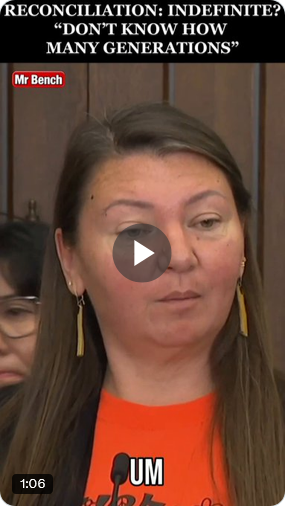
Will reconciliation ever end?
According to Candice … NO.
Plan for this to continue for generations.
She says some people haven’t even started healing yet.
Her son will need healing.
Her future grandchildren will need healing.
And she admits:
“Don’t know how many generations it’s gonna take for us to heal, and healing is forever.”
So when does reconciliation end?
It doesn’t. So keep the funds flowing
If “healing is forever”, apparently there is no finish line.
L. Wayne Mathison speaks for an increasing number of Canadians here:
I’m sick and tired of being told that people generations from now will still need to “heal” from events they never personally experienced. My ancestors went through terrible things too. History is full of conquest, poverty, discrimination, war and displacement.
Remember the past. Teach it accurately. Deal with specific injustices that still exist. But at some point adults also have to build a life in the present.
I do not believe anyone should inherit permanent victimhood, and I do not believe anyone alive today should inherit permanent guilt.
Reconciliation without measurable goals, accountability or any conceivable end point stops looking like reconciliation to me, period.
Keep this up, and I am totally done with this.
September 23, 2026
Without massive contradictions, would Canada even have a federal government?
As John Carter notes, the current federal government is committed whole-heartedly to a wide range of initiatives and programs, many of which are directly in contradiction of other initiatives and programs that the goverment is also whole-heartedly committed to:
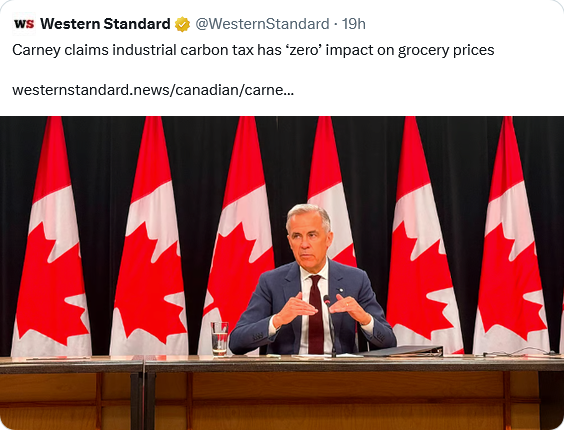
Setting aside the absurd spectacle of this sheer economic illiteracy spilling forth from the mouth of a man who is supposedly some kind of economic prodigy (please do not look at the state of the British economy btw), pause to savour the conspicuous irony of a government trying to revitalize the Canadian economy while crippling its access to energy (in the middle of a war-driven oil shock no less) in the name of hallucinated climate nonsense no one even believes in anymore.
This is the same government that wants to turn Canada into a research superpower while miring the universities in DEI.
It’s the same government that’s trying to rebuild the military for “warfighting” (it has another purpose?) while going full speed ahead on vaginal maximalism in uniform.
It’s the same government announcing itself as an AI superpower, without a single frontier lab within its borders, while its brains drain south in search of the money, opportunity, and regulatory freedom the government itself ensures that Canada cannot provide.
None of this is real. It’s all press releases and press conferences meant to create the illusion of forward motion towards the achievement of contradictory aims, when no such reconciliation is possible, and no actual movement is taking place.
September 22, 2026
The future of online free speech for Canadians
The Liberals in Ottawa prefer not to hear uppity citizens yapping about Liberal policies, and having a majority in the House of Commons means that there’s very little chance that they won’t be able to ram through a bill to curtail the ability of Canadians to speak freely online — that’s why I put a “warrant canary” in my daily Substack summary of blog posts. On X, John Carter has some advice that may be helpful to Canadians who don’t agree with the government:
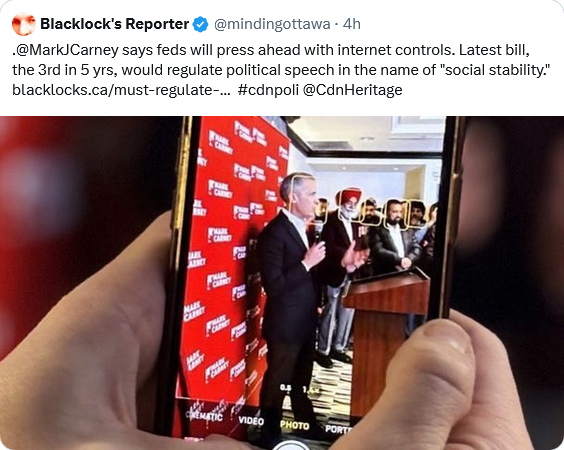
Carney is essentially trying to implement Yookay style online speech controls. With his stolen majority government, there’s no way to stop him, and so no reason to expect that he won’t succeed.
Canadian nationalists therefore need to start being smart. Use coded language. Avoid overt “hate speech”. Don’t advocate violence. Use positive messaging, love of country rather than hatred of other. Make their job as difficult as possible.
This is nothing the right hasn’t seen before. The bad old days of Twitter censorship are not so far behind us. Britain and Europe already have very similar laws. That hasn’t stopped their nationalist communities. Censorship doesn’t change the underlying social conditions. At worst it prevents people from being too direct. Furthermore, by forcing dissidents to be clever, it exerts a selective pressure that raises the intellectual level of dissidents, while making the censors themselves increasingly ridiculous.
Censors themselves are usually very stupid people. Coded language tends to go right over their tiny heads. They don’t handle satire well. It’s also very easy to mock a regime like this by parroting its own vocabulary. Elbows up, everyone. Diversity is our greatest strength.
State capacity is another factor. How many censors do they actually have? How competent are they? (diversity is our greatest strength!) How many people can they actually enforce these laws on? Every time someone gets dragged into court the state is burning a significant quantity of time, energy, and attention. The cost-benefit of tasking bureaucrats, police officers, lawyers, and judges to punish random shitposts is math that doesn’t math very well. The entire strategy relies on making an example of a few to cow the many. If the many aren’t cowed, because for instance despite the censorship they can see with their own eyes what’s actually happening to their country on the street, all censorship does is piss people off and further undermine the legitimacy of a regime that would not be resorting to censorship in the first place if its legitimacy was beyond reproach.
This is bad. I’m not looking forward to it. But panic won’t help. Keep your wits about you, stay calm, be smart.
September 15, 2026
A Fall election seems quite likely
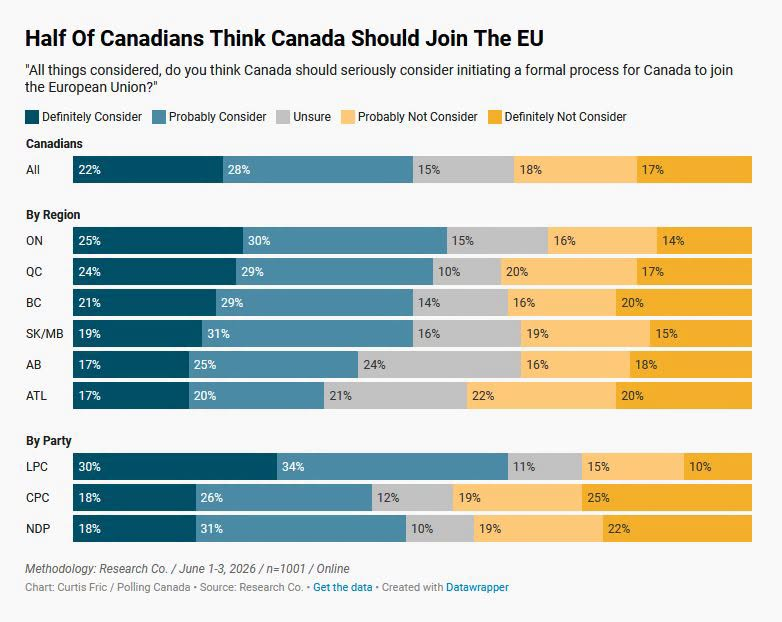
One of the advantages of a Westminster-style parliamentary system is that election dates are not fixed, so that the Prime Minister can take advantage of perceived opportunities to win majorities when they arise. It must be very tempting to Mark Carney to call an election as soon as he can, as the Elbozos are still waving their arms and chanting his praises for “standing up to the Bad Orange Man”. His latest notion of trying to add Canada to the European Union as some sort of “associate member” is also popular among people who think that Canada should be more like Europe (the Venn diagram of Elbozos and Europhiles is almost a perfect circle). On X, Jay Currie stares into the abyss of yet another Liberal majority government with a renewed electoral mandate:

The Prime Minister of all the Canadas is prepping for his Davos 2.0 speech to the European Parliament on the 17th when, apparently, he is going to propose that Canada become some sort of associate member of the EU. God help us.
The developed world can be thought of as two camps: the progressives and, for want of a better term the nationalists (could be traditionalists but that is only one strain within the nationalist camp). The supra nationalist institutions, EU, UN etc are progressive to their core.
Progressives see borders as barriers to progress, believe diversity is strength, see international action as the only way to defeat the horror of “climate change”, want international controls on speech, technology and public health.
For progressives individual rights, the rule of law, property are all barriers to the greatest good for the greatest number. Citizenship is an antique concept best left in the 20th century.
Most importantly progressives see the state, rules and regulations, a constantly refreshed “New World Order” and managed decline as both beneficial and inevitable. Arc of History and all.
Nationalists begin with the tiniest unit in society, the individual, and take that unit seriously. What rights does an individual have? If you start there you automatically circumscribe the power of the state. You also set the state’s direction.
Taking individual rights seriously creates a state in which individuals matter, there their voluntary associations beginning with families, matter. “The greater good” is no more than a suggestion when it comes to protecting individual rights.
The Europe of the EU came out of the ashes of a world in which individuals were subjects rather than citizens (with the notable and sporadic exception of post Revolutionary France) and the concept of individual rights was fragile at best.
The progressive intent of the EU was to treat “Europeans” as interchangeable economic units whose value was locked to group identity and which must be prepared to share the burdens imposed for the greater good.
Nationalism was seen as regressive as was patriotism and the insistence that individuals had rights which over rode the “common good”. After all, the horrors of WWI and II were the products of patriotic nationalism.
The progressive European project worked quite well for the first twenty or so years when Marshall plan aid funded the rebuilding of Europe and membership in the EU was relatively restricted. Expansion and mass immigration strained the Community.
Part of the reason the EU worked quite well in the early years was that its goals were relatively modest, a trading bloc with harmonized economic regulation left individual countries to work out their social, legal and rights structures.
As with any progressive institution the modest goals of the early years were gradually replaced with “ambition”. The 1985 Schengen Agreement eliminated hard borders within the EU. The European Convention on Human Rights harmonized the rights of Europeans.
Part of the progressive ambition was the creation of a hitherto unknown entity known as “the European” superficially similar in concept to “the American”. Questions of nationality could be submerged as this new entity stepped into the world.
For the progressive camp the “European” was a giant step forward into a post national future. As indeed it was for a tiny minority of bureaucrats, academics, journalists, financiers and other members of a self appointed cognitive elite.
People who objected to this grand homogenization of the nations of Europe were obviously frightened of the inevitable future because, well, they were not well educated and, entre nous, not too bright.
For the “Europeans” the great cause of the 21st century was laid out in Rio in 1993 when a conference convened by Canadian Maurice Strong sounded the alarm about “global warming” currently rebranded “climate change”.
Now there was a global threat demanding a supra-national response where the “Europeans” could assume a leadership role by…well, by shipping all of their heavy industry offshore and building very expensive windmills and mandating electric cars.
To no one’s very great surprise the Europeans have managed to de-industrialize and regulate themselves to the point of actual poverty. Fortunately, it was all for the global greater good so the Europeans could congratulate themselves.
Not content with climate virtue, the Europeans (though not the regressive nationalist yobs) took it upon themselves to welcome millions of migrants. An act of humanity and also shrewd as the Europeans had given up having children.
Of course, the idea had been trial-ballooned recently to get Carney-friendly headlines ready in advance:
September 7, 2026
An “exit tax”? What next, internal passports?
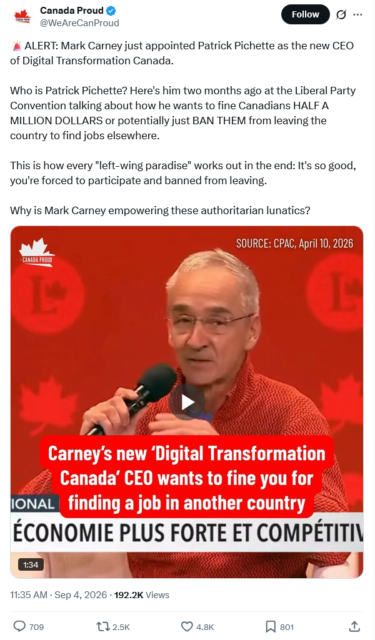
A few months back, there was a brief online reaction to the Liberal Party idea of imposing a ridiculously high “exit tax” on young Canadians taking jobs in other countries — and by “other countries” they really only meant the United States. I dismissed it at the time as just someone letting their Liberal freak flag fly … but:
Jesus Christ. These boomer leaflibs, man.
It doesn’t occur to him to ask why highly trained Canadian engineers would rather work in the US. Actually no, he tacitly admits this: they get paid more. Why is that? Why can’t they get paid well in Canada, putting their skills to work here, developing innovative, world-leading technologies right at home in Canada?
The answer is obvious. Because there is no opportunity in Canada. It’s all but impossible to develop high tech industry here. The regulations are too thick, and all the available investment capital gets sucked up into real estate development.
Maybe Canada should try and fix that, so that Canada is actually an attractive country for talented young Canadians?
But nah fuck those kids, we should just charge them a half million dollar exit tax so if they can’t pay that they can just let their dreams die and get a job at BMO.
Oh and at the same time we should flood Canada with “world leading talent” (from Calcutta), in order to make it that much more impossible for Canadian engineers to find employment in their fields at home.
September 4, 2026
Loyalist Canada to Liberal Canada, a political devolution
On Substack Notes, John Carter discusses the old, stable Canada that the Liberals have spent sixty years trying to destroy, with great success, sadly.
For all intents and purposes, post-1965 Liberal Canada is a completely different country from the Loyalist Canada that it erased. Different flag, different basis for moral legitimacy, different constitution even.
Liberal Canada loves to wear poppies on Remembrance Day, but this is stolen valour. Liberal Canada has never won a single war. Loyalist Canada won every war it fought in.
Liberal Canada built no great works. Most of the infrastructure of Canada was constructed before Liberal Canada. The Trans Canada Highway, the Trans Canada Railroad, the Pickering Nuclear Power Plant, the Toronto subway, the Montreal Metro — all were built or initiated by Loyalist Canada. Liberal Canada completed the projects that began under Loyalist Canada, but initiated none of its own, and at best can be said to maintain the infrastructure it inherited … badly. Liberal Canada cannot even build a pipeline to bring its oil to market. Liberal Canada cannot even refine its own oil.
Loyalist Canada built out an organizational infrastructure of Crown Corporations which were once the envy of the world. Liberal Canada dismantled them, giving us toll roads owned by foreigners.
Loyalist Canada built all of this infrastructure, and won all of those wars, without incurring a national debt. The national debt was accrued entirely by Liberal Canada, and is entirely a function of social welfare programs it uses to turn Canadians into domesticated clients of Liberal Party patronage, and indentured servants of the banks.
Then of course there are the demographics. Loyalist Canada was a white Canada, a British and French Canada, and a fecund Canada, with one of the world’s highest birth rates. Liberal Canada is a barren Canada, with one of the world’s lowest birth rates, and it has presided over the systematic replacement of the Canadian people with Indians, Chinese, Africans, and Muslims, to whom it moreover extends preference for social services, university admissions, and employment. Liberal Canada makes Canadians second class citizens in the land their ancestors built.
Liberal Canada is a parasitic entity that is rapidly killing its host. It is an exhausted Brezhnevian sclerocracy that destroys ambition because even the most modest of ambitions are a threat to the soft men, the mild bureaucrats and glassy-eyed ideologues who subsist on the arbitrage of national decline. Liberal Canada is weak, and so it demands that its subjects be even weaker, as this is the only way for weak men to rule.
Liberal Canada is not the real Canada, and Canadians are beginning to wake up from this long nightmare of mismanagement and institutionalized treason, and to remember who they are.
July 30, 2026
Canadian conservatives need different leaders, say Liberal media
Unlike the Liberals and NDP, whose leaders get a media honeymoon that sometimes lasts for years, Conservative leaders are never given the slightest break by presstitutes paid by the Liberals. (Anyone further to the right than the centrist Conservatives get almost no media attention at all, as Maxime Bernier can attest.) L. Wayne Mathison responds to “helpful” suggestions for how the Conservatives can get rid of their current unpopular-with-the-state-media leader and replace him with someone more “acceptable”:

The pattern is obvious.
Scheer was supposedly too awkward. O’Toole was too inconsistent. Pierre is now too aggressive, too divisive, too nasty. Change the leader and the criticism changes with him. The objective stays the same: keep Conservatives apologizing, retreating and replacing leaders while the Liberals remain the default governing party.
The elite Red Tories never wanted Pierre Poilievre as leader because he threatens the arrangement they are comfortable with. They prefer a Conservative Party that manages Liberal policies a little more efficiently, attends the right receptions and never seriously challenges Ottawa’s permanent political class.
Put on the economics hat and the incentives become clear. The people closest to government often do very well under bigger government. Consultants get contracts. Lobbyists gain influence. Bureaucracies expand. Well-connected corporations receive subsidies and protection. Housing owners watch scarcity drive up their assets. Ordinary workers get higher taxes, weaker wages, expensive housing and declining public services.
Pierre’s real offence is that he speaks directly to the people paying the bill.
Canada has nearly every advantage a country could ask for: energy, minerals, farmland, fresh water, educated people, stable institutions and access to the largest market on Earth. We should be one of the wealthiest and strongest countries in the world. Instead, our political class keeps managing scarcity, blocking investment and teaching Canadians to expect less.
Conservatives should stop chasing approval from commentators and insiders who will never support them. Back Pierre. Defend the principles. Make the economic case clearly.
Prosperity should not be reserved for the people who already know how to work the system.
The best investment the Liberals ever made was buying the loyalty of the relic media with a dollop of cash from the government’s coffers. They already were mostly onboard with the Liberals — those that didn’t think the NDP was too far right — but the financial leash made even the mavericks think twice about substantive criticism of the man who co-signed their pay cheques.
Update: Fixed missing URL.
July 29, 2026
The American Deep State’s biggest experimental laboratory
On Substack, John Carter links to the latest of kulak’s fascinating-and-unsettling Anarchonomicon posts with this introduction:

Kulak’s thesis here is that English Canada generally, and Toronto specifically, is ground zero for a lot of the more insane gay race communism trends because America has been using Canada as a testing ground for psychological operations since the 1950s.
That sounds kind of nuts but he makes a plausible case. Since Canada is technically a foreign country, intelligence agencies don’t face the same limitations they do at home. Since Canada is almost culturally identical to the US, what works in Canada will generally work domestically (and all the GAE psyops are ultimately aimed at America’s domestic tax cattle).
Kulak also brings the receipts here, showing how things like MeToo and GamerGate seem to have been prefigured by similar movements in Canada a couple years before.
One thing he misses is land acknowledgements, which began spreading in Canada in 2013 or so, and have since started appearing at American and Australian universities. I don’t know for sure that they started in Canada, all I can say is that it was Canada where I first noticed them, and where they have become ubiquitous.
Multiculturalism is another Canadian export, developed here in the 60s and rapidly introduced all over the Western world. The prime ministers who introduced it were American puppets, and the ideology itself has a very broadly American “nation of immigrants” feel to it.
Anyhow, you motherfuckers, two can play this game.
On the land acknowledgements, the first time I encountered it was at my son’s university graduation ceremony, but his university had a big First Nations specialization so it didn’t seem too outlandish at the time. Since then, of course, pretty much every event in urban Canada seems to feature a land acknowledgement and they don’t appear to be optional any more.
Anyway, on to kulak’s post on “The Battle for the Mind of North America”:
The Land of Mind-Rape and Honey
Canada is/was a nice enough place to visit or grow up … several large nice cities surrounded by tons and tons of quaint and cute functional “Mainstreet USA” style quirky little towns.
The “Rape” refers to Rapeseed, the primary ingredient in Canola Oil, the unhealthy seed-oil. (they named it “Canada Oil” because “Rape Oil” might make people hesitate)
But when you scratch at the surface there’s something profoundly deeply wrong with Canada. You can feel it. You can see it when you look out your window or when you turn on your television. You can feel it when you go to work … when you go to church … when you pay your taxes.
and the Canadians are quite pleased to tell you just what that thing is:
America.
Funnily though, when you ask what Americans have done to them or what is wrong with America, they’ll tell you things about moral degeneracy and perfidy of Americans … no different than what the American elite and the US Government expresses about its own populace.
For reference: Canada is a vassal of the US.
It has been since the 1960s when the British lost the Suez Crisis and the American Deep State backed “Multiculturalism”, an end to “God Save the Queen”, legalized sodomy, ended prayer in public schools, demilitarized Canadian education (which til the 60s included rifle practice, marching, and survival training) … and oh ya a new flag.
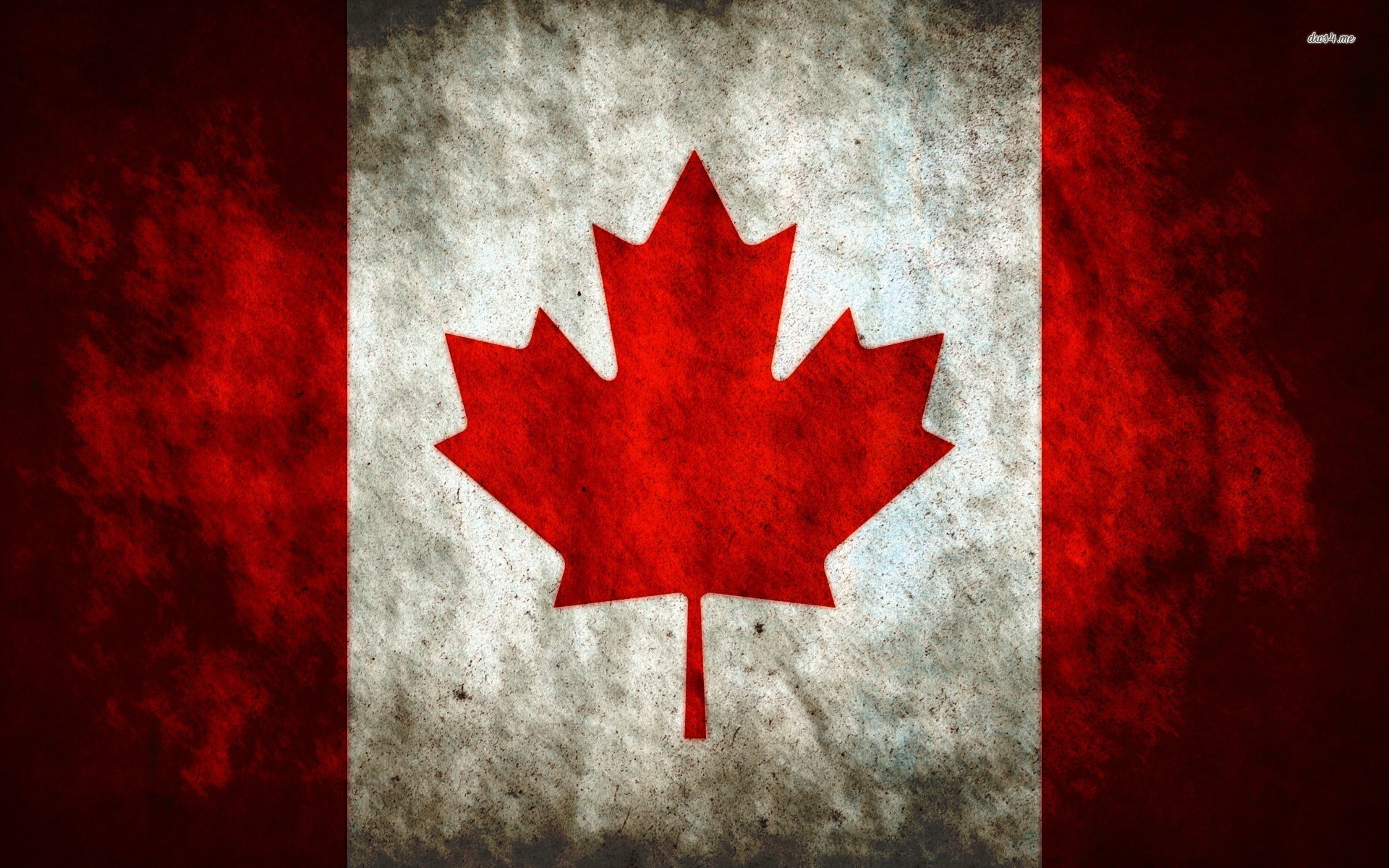
The Canadian flag, adopted in 1964 … which the very year should be a “red flag”. Is in fact, an American flag. It is the symbol of America’s diplomatic and espionage victories over the British Empire and its final conquest of Canada.
Canada’s entire culture, defined by being British, Imperial, warlike, frontier militiamen (Indeed Canada’s 1950s culture in many ways resembled Washington’s and Jefferson’s colonial American culture more than America did) … was ripped out in the course of a decade … quite intentionally and by design.
Indeed Canada was the testing ground for the Global American Empire’s psychological cultural program.
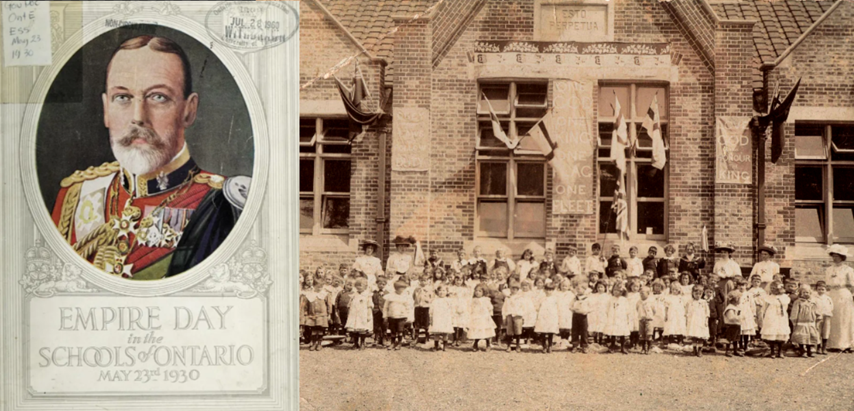
To get a feel for just HOW aggressively Canadian culture was purposefully ripped apart … I encourage you to flip through the various programs for “Empire day in the Schools of Ontario” up on archive to see English Canada’s actual natural culture. (I will be writing about this in more detail in another piece.)
And Please Note: The British did nothing comparable … the “Narnia” age of Canada coexisted with The Fabians, George Bernard Shaw, and the basically open communist treason of the actual British Aristocracy.
The mottoes on the posters: “Obey/ the Law/ Follow/ Duty”, “One God/ One King/ One Flag/ One Fleet”, “Love God and Honour the King”
This was immediately ripped out by State Department’s assets like Pearson and Trudeau in the 60s and 70s in favour of “Multiculturalism”.
How does the one Canada: Royalist, Militaristic, Patriotic as Can Be, defined by the three institutions of Church, Militia Armoury, and the old-style High School ruthlessly enforcing standards … More akin to Cadia from 40k than a 21st century country … How did it transform into the modern Canada within living memory?
How do you destroy the entire culture of a country and replace it with an entirely new culture in front of its population’s very eyes … without resistance and without protest?
Well that’s the problem that was solved here.
Canada was the testing ground for all of the American Government’s cultural occupational weapons it would go on to use on Europe and on its own people.
Terms like “melting pot”, “racism”, “tolerance”, “the open society” … These of course has all been coined by American Jewish and Communist activists (“Racism” specifically is a Trotskyist doctrinal term of art propagated by Trotsky’s personal pamphlets, and you should call any “Conservative” who ever uses the term a Communist traitor).
However it was in Canada that top down US foreign policy institutions first applied the current model to a country which they had conquered without a war.
Indeed when one looks into “Denazification” in Germany or the US occupations of France, Italy, or Japan you find little to no overlap between the language, structure, and even values of the “Democratic”, “antifascist”, and “Peaceful” occupational ideology and modern Globohomo.
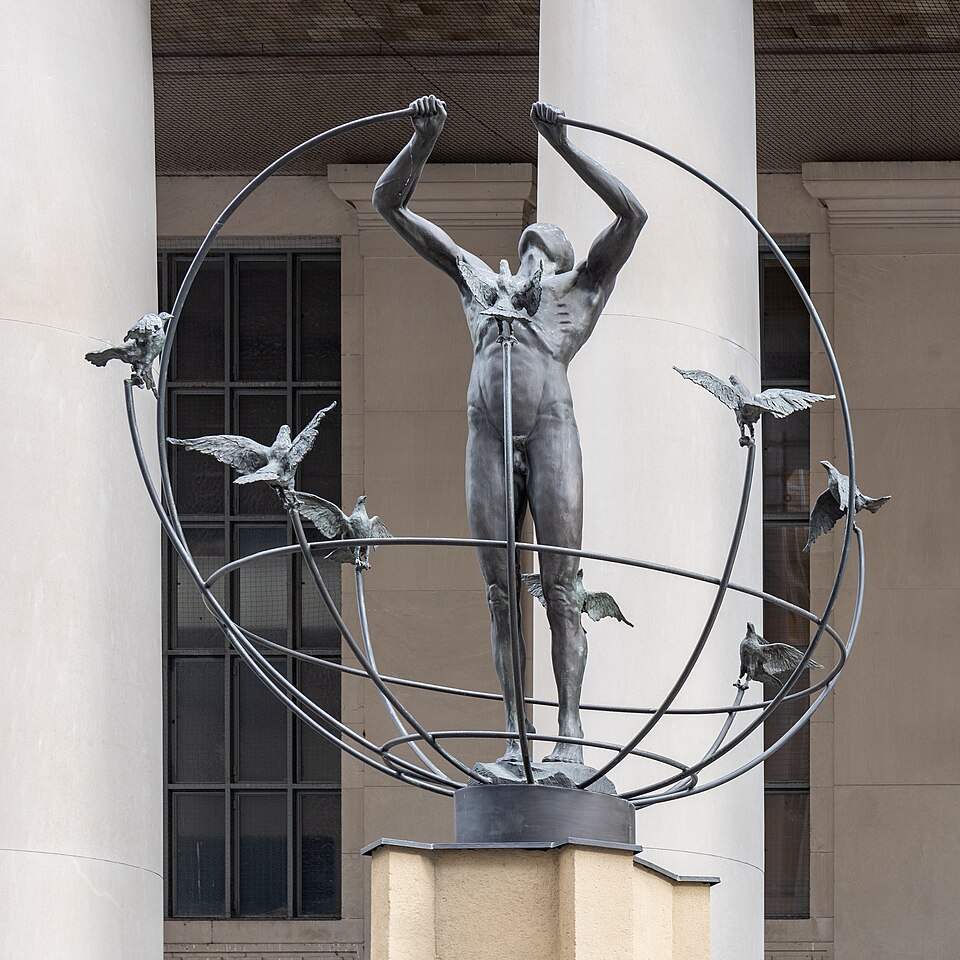
“Monument to Multiculturalism”. Toronto. Erected 1985. (The “Monument” can be interpreted two ways … the man and doves working together to build a unified world … or the man is unwittingly cooperating in his own caging and enslavement)
Whereas in Canada the US occupational ideology EXACTLY resembles modern globohomo. From the outset.
Pierre Trudeau’s first major political moment was the 1967 decriminalization of homosexuality.

The changing nature of Canadian patriotism
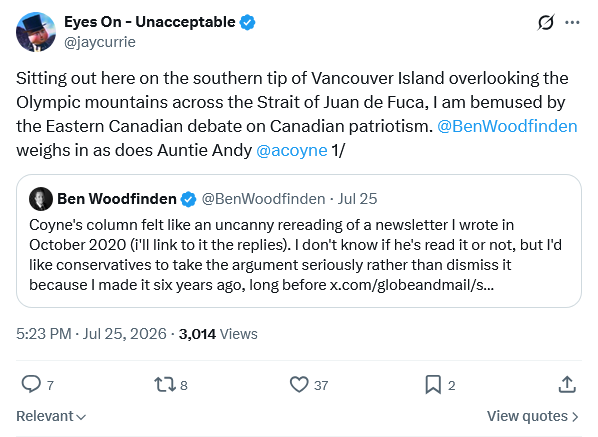
On the social media site formerly known as Twitter, Jay Currie contrasts the kind of patriotism most Canadians grew up with against the politicized version hijacked by the Liberals as a tool in their never-ending quest to re-shape Canadians in their preferred image:
Sitting out here on the southern tip of Vancouver Island overlooking the Olympic mountains across the Strait of Juan de Fuca, I am bemused by the Eastern Canadian debate on Canadian patriotism. @BenWoodfinden weighs in as does Auntie Andy @acoyne
The current version of the debate is focused on whether the Conservative Party is “patriotic enough”. In less fraught times that would translate to “love of Canada” but now it comes down to anti-American and, more importantly, anti-Trump enough.
Probably because, after twelve years of Trudeau/Carney there is very little “Canada” left to love. We’re a post-national, genocidal, nearly European entity ruled from an embattled Ottawa beset by Americans, Chinese and our own separatists.
From the Ottawa/Toronto point of view Canada’s singular attribute is our willingness to punch Trump right in the nose. And woe betide the traitors like Smith, Moe and Frechette who are not willing to get behind Captain Canada as he takes his roundhouse swings.
And the Conservative Party is failing on the patriotism front precisely because a significant part of it thinks punching the Yanks in the nose is possibly the dumbest thing they have ever heard. Why the Hell would we do that?
On the Auntie Andy/Woodfinden scale of patriotism this disqualifies the CPC from ever winning a federal election because only Canadian Patriots should be allowed to command the Ottawa ramparts eyes firmly fixed on the perfidious Yanks.
As a thought experiment try to define Canadian patriotism without reference to the US or Donald Trump. I assure you it can be done. The way you do it is begin with the ground you are on. Where is it? What is it? What can you see?
Now, think about your neighbours, the stores you go to, the pub you like, the golf course or soccer field or swimming pool you prefer, the schools you went to, the teams you played on, yes, your favourite NHL team, vacation spot, drive.
Essentially these and hundreds of other details are the ground truths of your Canada and it is that Canada where your patriotism begins. The Canadian flag, the Peace tower, your favourite version of “Oh, Canada” are all abstractions of this ground truth.
People don’t fight for “King and Country”, they fight for their children, their spouse, their parents, their neighbours. That is where the real loyalty lies. It’s acutely local and it accretes across time, across generations.
The Liberal Party project of the last half century has been to replace this hyper-localized patriotism with an synthetic, denatured, atomized Patriotism which defines itself by what it is against, not what it is for. It is a deeply unsatisfying project.
The fact the CPC is wary of this synthetic patriotism is to its credit. Looking at its messaging in the last election at least a part of the CPC understands that Canada is the ground you stand on, not an invention of Ottawa. It’s the right message.
At Without Diminishment, Carl Vallée identifies one of the structural strengths of the left that allow them to concentrate on achieving and maintaining power: unity of vision across all progressive parties.
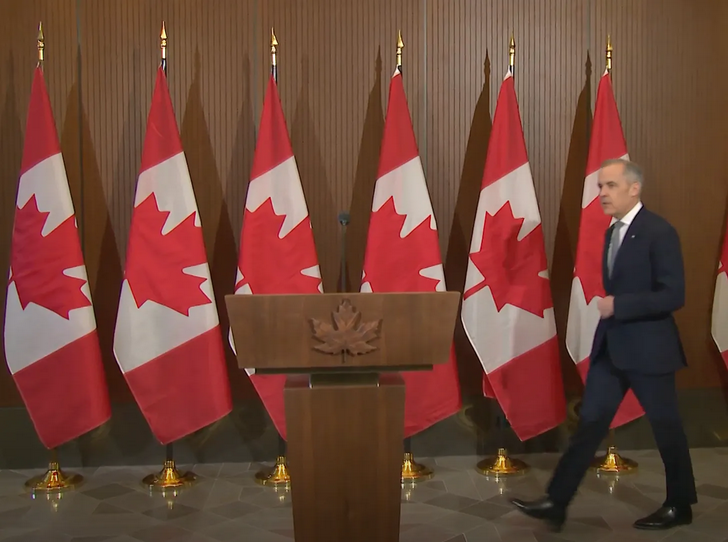
Exit Trudeau, enter Carney.
It must be admitted that the Liberals have dominated the political landscape for much of the past century, enabling them to weave their own partisan symbols and values into the fabric of Canadian institutions.
The federal state as it exists today is a legacy of Liberal Party rule. Pierre Trudeau’s Charter of Rights and Freedoms fundamentally changed the trajectory of this country, but the ideology underpinning it had begun to take shape even before his time. Whether one considers multiculturalism, mass immigration or the red maple leaf flag, Canada is a country whose institutions naturally lean, if not lurch, to the left.
Therefore, conservatives must swim against the current, almost perpetually. Why is this? I submit that it stems from the fact that Liberals in both English Canada and Quebec are ideologically closely aligned and share a common vision of Canada. The left often looks much the same everywhere. Certainly, its values, methods and codes of communication are identical across the Western world.
In Canada, Liberals will not hesitate to weaponise the state to ensure their values endure. The alignment between Liberals in Quebec and English Canada has been critical to their electoral success.
Conversely, the right are more locally rooted and provincial, and are therefore less inclined to share a broad common vision with their compatriots across the country. This poses a challenge to both the coherence of Canadian conservatism and its electoral arithmetic.
Conservatism in Quebec is not libertarian, and here we envisage using the state to advance nationalist and conservative ends. What we conserve in Quebec is not what our friends in Western Canada or Ontario seek to conserve.
Arrayed against our alliance of local political traditions are the Liberals, who share and promote a single, pan-Canadian narrative. The inability of the right to offer a catch-all vision capable of rallying the anti-Liberal vote partially explains the electoral success of the Liberal Party over the past few decades.
Structurally, the 1982 rupture over the imposition of the Charter has made this phenomenon almost permanent, despite the efforts of prime ministers Brian Mulroney and Stephen Harper to rally coalitions against the Liberals. Neither was able to prevent the Charter from entrenching itself as Canada’s new national narrative, despite the explicit opposition of Francophones, one of the country’s founding peoples.
If there is a fault, it does not lie solely with the pan-Canadian conservative movement, but also with Quebec’s bleus, who failed to invest in the Conservative Party of Canada, the only political party capable of rivalling the Liberals. As a result, the Quebec vote is split between the Conservatives and the Bloc Québécois, whose voters are much less left-wing than the party’s current leadership. In the 2025 federal election, the combined Conservative and Bloc vote in Quebec actually exceeded the Liberal vote.
July 16, 2026
QotD: The nostalgic British elements of Canadian nationalism
Britishness survives as civic nationalism. Old British Canada may be gone, but aspects of that Britishness live on. We should celebrate our history and our historic symbols, but this alternative shouldn’t set about restoring it all. A future oriented embrace of our history needs to be built around the active parts of this Britishness that have now become truly Canadian. For example, the Crown in Canada is not now just a British institution, it’s a Canadian institution. Same with our democratic institutions and parliamentary traditions, which we must work to strengthen and renew.
Embracing this enables us to thread the needle on our relationship with America. Part of what makes us different historically, culturally, ideationally, and in disposition from America, is this history. Just as Canadian Britishness has survived to the present day in unique ways, our desire not to become Americans is alive and well. A homegrown Canadian Britishness enables us to continue this without falling into crass anti-Americanism, and without requiring us to embrace the new Liberal nationalism to reject America. We should see America as an amicable cousin, but one that we are distinct and different from.
But most importantly, what this new kind of national identity needs to build around needs to be an evolution of the liberal nationalism that emphasizes and consciously builds around our regional pluralism. […] but the kind of rationalistic liberalism that our modern national identity is built around, while sold as a way of dealing with diversity, suffers from some serious internal tensions. Liberalism, especially the Canadian variant of it, implicitly depends upon and encourages a degree of homogenization that flattens hard cultural differences. We need to become more pluralistic, and less liberal.
Ben Woodfinden, “True North Patriotism and a Distinctly Canadian Conservatism”, The Dominion, 2020-10-20.
July 10, 2026
Defensive driving is more important today than ever before
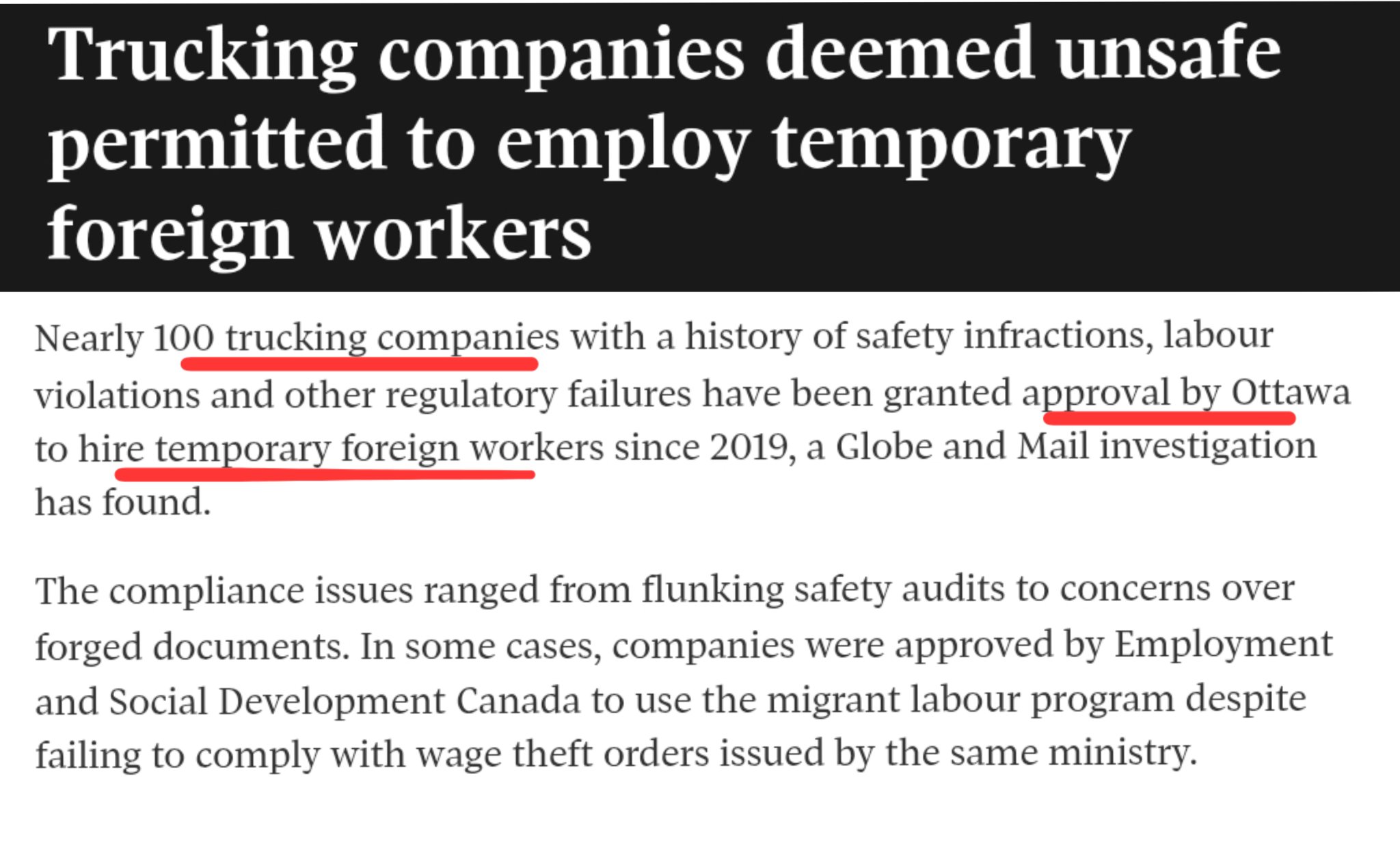
At some point, the Canadian and provincial governments decided that the safety of their citizens was a lower priority than ensuring that temporary foreign workers — many of whom apparently understand little or no English or French — had to be given commercial trucking licenses and set loose on the King’s Highways:
Absolutely insane‼️
But this is something I’ve been raising the alarm on for years.
The Canadian trucking industry, which almost a third of it is gray/black market now, have been captured by foreigners and empowered by Ottawa.
100 trucking companies with a history of safety infractions, labour violations and regulatory failures were approved by the Liberals to mass immigrate temporary foreign workers.
Canadians are losing their lives on our roads every day by foreigners who shouldn’t be in Canada that the Liberals allowed scam organizations to bring in and who shouldn’t be behind the steering wheel to begin with. Then the Liberals and activists judges won’t even deport these people.
Many trucking companies that lose license to operate or get hit with infractions would just change provinces of operations and name – sometimes not even the name, and would just keep operating because there is no proper systems raising red flags and no one investigates. Complete incompetence.
Many operate in Alberta, Saskatchewan and Ontario and move around these provinces.
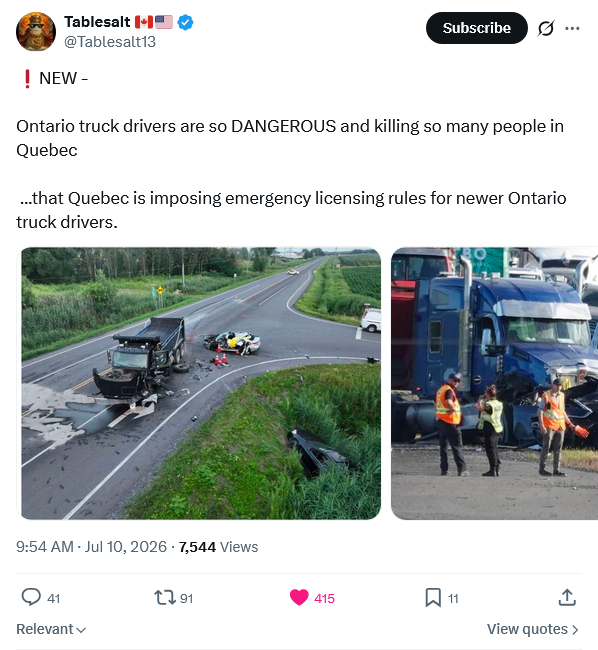
Update: Quebec has taken official notice of the situation.
June 19, 2026
Nobody voted for this kind of dystopian nightmare, Mr. Carney!
The Liberal Party, having engineered themselves a majority in the House of Commons, are on a speed-run to the kind of dystopian police state we used to read about in science fiction novels:
Millions of Canadians are beginning to see the similarities between communist regimes and the direction of current government policy.
The pattern is always the same.
It begins with noble promises: safety, equality, compassion, protection, the greater good.
It ends with censorship, coercion, surveillance, prisons, ruined lives, and a police state.
Always.
It comes wrapped in slogans, experts, committees, emergency powers, censorship, enemies of the people, and the belief that the state has the right to crush the individual for the greater good.
Consider…
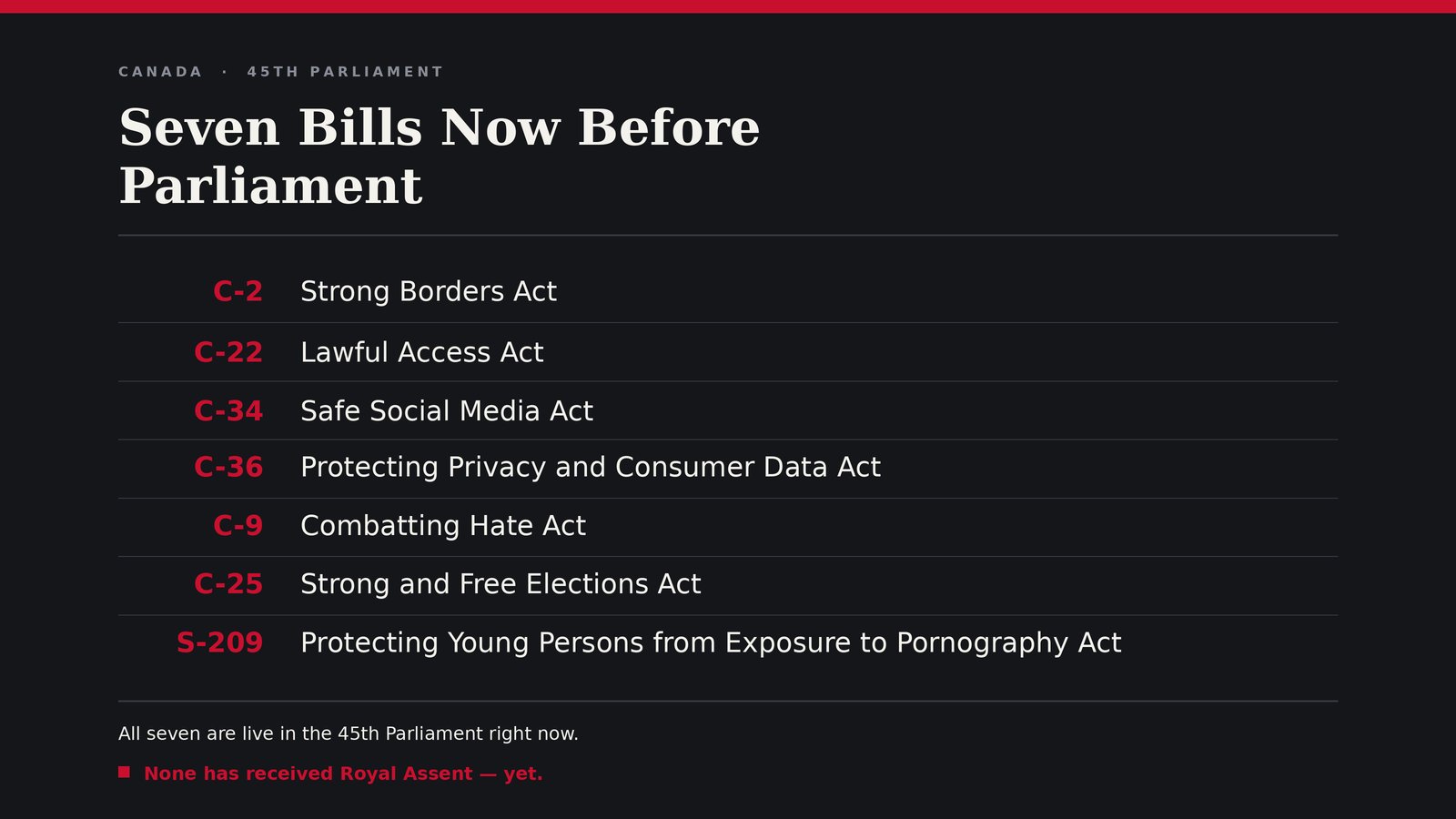
C-2 – Strong Borders Act
C-22 – Lawful Access Act
C-34 – Safe Social Media Act
C-36 – Protecting Privacy and Consumer Data Act
C-9 – Combatting Hate Act
C-25 – Strong and Free Elections Act
S-209 – Protecting Young Persons from Exposure to Pornography ActAll seven are live in the 45th Parliament right now. None has received royal assent yet.
Consider that good, law-abiding Canadians are being gradually and systematically disarmed.
This is not a warning about some distant future.
In 2022 the federal government invoked emergency powers it did not have, froze the bank accounts of citizens over their political views, and banned Canadians from funding a protest. Two levels of court have since ruled it unconstitutional — a violation of the very Charter rights every one of these bills now circles.
That was the trial run. It needed an emergency as the excuse.
The seven bills above are the permanent version — the same reach, made routine — so that next time, no emergency need be declared at all.
A free country is not lost in a single day. It is legislated away in pieces, each one introduced with a reassuring name and defended as necessary, while good people keep assuring themselves it could never happen here.
It already did. The only question is whether enough Canadians notice before it becomes permanent.
Read every bill. Watch every one of them. Because this is the stage where it can still be stopped … and perhaps our last chance.
The Justice Centre for Constitutional Freedoms is trying to get Canadians to pay attention to what just one of these bills will do:
Bill C-34 will affect every Canadian. Age verification. AI regulation. A new Digital Safety Commission. Most Canadians have never heard of it. Here’s what it will do.

Michael Geist posts a Substack Note about bill C-22:
Bill C-22, the lawful access bill, has been reported back from committee and is headed toward passage. There are some amendments, but many concerns remain. The updated bill with changes is at
There are two changes to metadata retention. First, the maximum retention period the government can impose drops from 1 year to 6 months. Second, it can now mandate a category of metadata only if satisfied the category and all its elements are essential to investigations.
The committee rewrote the definition of systemic vulnerability. A “substantial risk” becomes a “credible risk, based on recognized international technical standards”. But it also added a carve-out: a flaw exposing only a target’s data is not “systemic”.
Added a new section on decryption that says nothing in the Act can be read to compel a provider to decrypt user-encrypted data, unless the provider supplied the encryption and holds the key. Borrowed from US law, but doesn’t fit the same way.
Compliance with ministerial orders is now expressly subject to the systemic vulnerability exception. That addresses a contradiction in the original text, where the duty to comply appeared to be unconditional.
The original bill set no maximum duration on these ministerial orders. This now changes to a two-year cap without the open-ended review-and-extend mechanism.
The amendments will rightly leave many still concerned. Companies considering exiting Canada due to Bill C-22 are unlikely to conclude that it fully addresses their issues. Yet the government is likely to push it through the House today.
June 13, 2026
The Laurentian Elite
The people who actually rule Canada — including but not limited to Liberal Party members — don’t mind “populists” who want to “spread awareness”, because it’s about as ineffective as can be and dissipates some of the energy that might otherwise be used to oppose the Laurentian Elite’s preferred outcomes:

Homesteaders, agrarians, and populists relying on “spreading awareness”, protesting, or Americanisms like “we the people” and “the silent majority” aren’t nearly as effective or influential as people think they are.
A deeply unpopular Laurentian liberal elite minority, one that increasingly LARPs as blue-state Americans and takes its cues from them, managed to transform the country against the popular will.
Over a roughly twenty-year period between the 1940s and 1960s, they spent decades scheming behind the scenes. They changed the flag, lured French Canadians into supporting them through the Royal Commission on Biculturalism and Bilingualism by promising greater national recognition of Canada’s French heritage, then dropped the whole thing almost immediately. They pulled the rug out from under them and basically said, “SYKE, you thought. Here’s infinite immigrants instead.”
In 1971 they pushed multiculturalism and the cultural mosaic, abolished assimilation while polling showed around 80% of Canadians opposed increased immigration. They later entrenched their ideology through the Charter of Rights and Freedoms, stacked and empowered a judiciary that would future-proof it, formalized the project through the 1988 Multiculturalism Act, and gradually consolidated influence over the media, education system, and cultural institutions.
The result was a decades-long effort to indoctrinate Canadians into viewing their country as a post-national economic zone built on stolen land called Turtle Island, where Canadians don’t exist, but foreigners are just as Canadian as you and me, borders are morally questionable, and none is illegal on stolen land.
This isn’t going to be reversed through awareness campaigns, symbolic protests, or endlessly posting facts online. Political systems are ultimately shaped by elites and counter-elites. The only way this order gets replaced is if a rival elite, or a political force capable of becoming one, displaces the existing ruling class and takes its place.
That process will almost certainly involve some degree of populism, but populism by itself is not enough. You need people who can actually build institutions, wield power, and replace the current establishment rather than just complain about it or bug off into the woods, or try to balkanize the country.
May 31, 2026
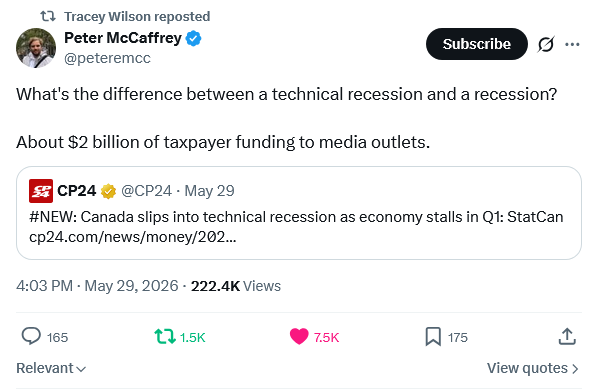
Canada slips into recession: state media rally to attack official opposition
Even before they became explicitly subsidized presstitutes for the Liberal Party, the Canadian mainstream media have always been far more critical of conservatives, so this pivot to defend the government after official statistics show the country is in a technical recession is very much on brand:
Stuart, this is exactly the problem.
You’re acting like annualized quarter-by-quarter numbers are some exotic partisan invention. They aren’t. That is one of the standard ways GDP is reported and understood.
And the “reporter’s narrative” point is weak. The reporter framed the question as if calling it a recession was irresponsible, even though the numbers show real weakness: contraction, stalled growth, falling investment, weak productivity, and Canadians losing ground.
Pierre did what more politicians should do: he challenged the frame.
Because the frame matters.
When Conservatives warn about decline, it’s “doom”.
When Liberals preside over decline, it’s “complex global headwinds”.
When Canadians get poorer, it’s “resilience”.
When GDP shrinks, it’s “not quite the word we’d prefer today”.
Give me a break.
Canadians do not live inside a Statistics Canada footnote. They live inside rent, mortgage renewals, grocery bills, job insecurity, and taxes. Pierre is speaking to that reality.
The press gallery can massage the vocabulary all it wants. The country is weaker, poorer, less productive, and more expensive.
That is not a narrative.
That is the room.

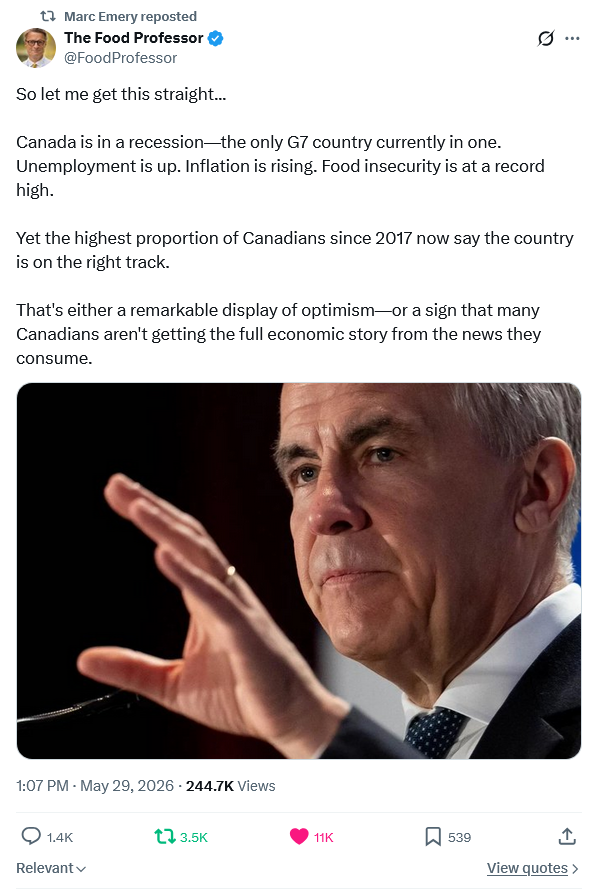
The Liberals are getting great value for their money — well, our money — as even though the economy is tottering, media-massaged messaging is reflected in polls (feel free to doubt the accuracy of polls like this if you like):