
Quotulatiousness

March 14, 2026

Quid pro quo – something that is given in return for something else

Filed under: Cancon, China, Media, Politics — Tags: , , , , , — Nicholas @ 03:00

In the National Post, Tristin Hopper considers what the Parliamentary floor-crossers got in exchange for their loyalty:
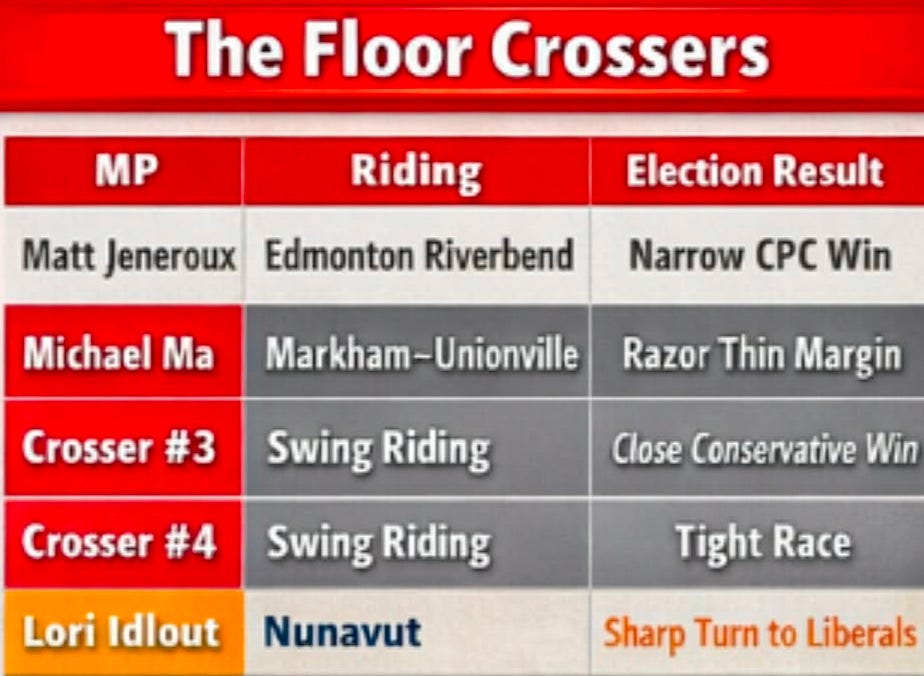
Image from Melanie in Saskatchewan

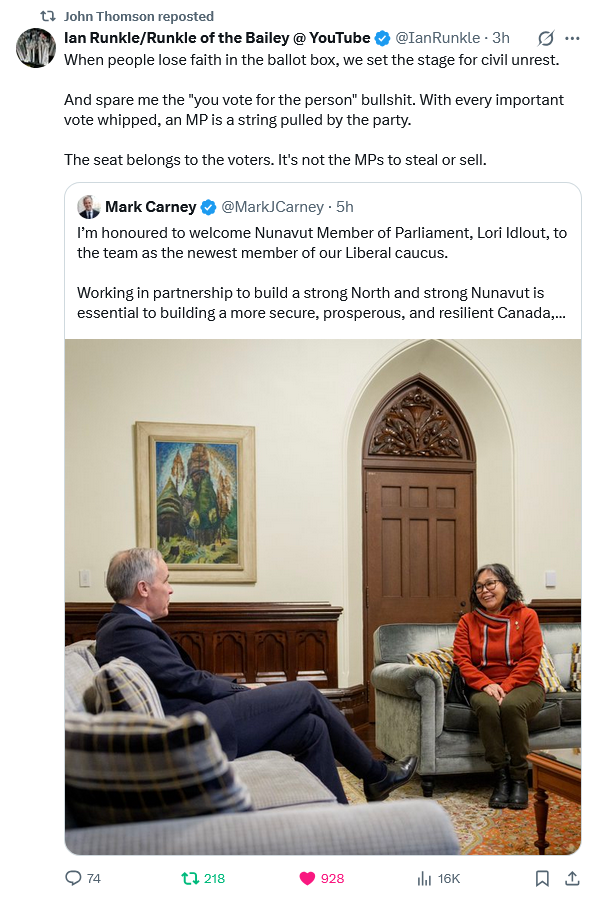
Nunavut MP Lori Idlout has now become the fourth opposition member to join the Liberals in just the last five months, joining three Conservative MPs.

While there have been more than 100 MP floor-crossings since Canada’s 1867 founding, the circumstances have never looked quite like this. In any prior instance where multiple MPs shifted party loyalties in a short period of time, it was almost always because of a seismic political issue such as First World War conscription or Quebec separatism.

But in this case, all four floor-crossers gave vague reasons for the move, if they even tried to explain it at all. Idlout’s statement, issued by the Liberal Party, explained her switch as endorsing “strong and ambitious government that makes decisions with Nunavut — not only about Nunavut”.

Unmentioned is that the four also saw personal benefits for their defection to the government benches. A cursory summary is below.

Thus far, there are no tangible goodies to d’Entremont’s surprise November floor-crossing. He hasn’t received a position in cabinet, a pay raise or any special titles. What he did seem to secure, however, was his job.

When rumours first began to leak out that the Liberals were actively seeking floor-crossers among the Conservatives, one commonality emerged among the MPs being solicited: They all represented tightly contested ridings that were now polling for the Liberals.

This was particularly true of d’Entremont’s Acadie-Annapolis riding in Nova Scotia. He won it for the Conservatives by just 536 votes in 2025. And given a surge in Liberal popularity across the Maritimes in interim months, it now seemed likely to swap back to the Liberals; which it had done as recently as 2015.

D’Entremont’s former Conservative colleagues would allege quite directly that the defection had been done purely to remain as the MP for Acadie-Annapolis.

After the floor-crossing, Conservative MP Rick Perkins would allege that d’Entremont had told him the weekend prior, “If an election is held now, I will lose my seat. I might as well not run.”

“There is nothing in his floor crossing about principles. It was about keeping his job,” Perkins wrote in a Facebook post.

Ma also represents a tightly contested riding. Markham-Unionville had gone Liberal as recently as 2021, and he won in 2025 with just 50.65 per cent of the vote as compared to 47.05 per cent for his Liberal opponent.

But it only took a few days after the floor-crossing before Ma was conspicuously added to Prime Minister Mark Carney’s delegation headed to the People’s Republic of China and Qatar.

As noted by National Post‘s Chris Nardi at the time, Ma was the only member of the delegation who wasn’t a minister or a parliamentary secretary. His highest applicable rank was that he was vice-chair of the Canada-China Legislative Committee, a group comprising 11 other MPs and senators who didn’t similarly receive a seat on the plane.
March 12, 2026

Carney’s Liberals buy gain another seat in Parliament

Filed under: Cancon, Government, Media, Politics — Tags: , , , — Nicholas @ 04:00

What couldn’t be obtained at the ballot box can apparently be constructed through non-electoral methods. After the Liberals fell short of a majority in the 2025 federal election, they’ve now gained four more seats through attracting opposition MPs to join their caucus:

Image from Melanie in Saskatchewan

Consider several ridings from the last election where Conservatives defeated Liberals by extremely small margins. Terra Nova–The Peninsulas was decided by only a handful of votes. Milton East–Halton Hills South by just a few dozen. Windsor–Tecumseh–Lakeshore by fewer than a hundred. In Markham–Unionville and Edmonton Riverbend the margins were still narrow by federal election standards, measured in the low hundreds.

In ridings with tens of thousands of ballots cast, those margins are not ideological fortresses.
They are statistical coin flips.

Now imagine you are a strategist trying to change the parliamentary math without calling another election. Would you target MPs who defeated your party by twenty thousand votes? Or would you look at ridings where the electorate was already split nearly fifty fifty? Where persuading one individual changes everything!?

That is where the Moneyball logic appears.

Instead of persuading fifty thousand voters, you persuade one MP. The scoreboard shifts instantly. No campaign. No election. No voters trudging through snow to mark an X. Just a quiet change of jersey on the House of Commons floor.

Now consider the MPs who have crossed the floor or whose ridings are currently the focus of speculation. Seats like Edmonton Riverbend held by Matt Jeneroux and Markham–Unionville represented by Michael Ma sit squarely in that category of competitive swing ridings. Even Nunavut, represented by Lori Idlout, illustrates how single seats in geographically unique ridings can dramatically affect parliamentary arithmetic.

Notice the pattern.
Not massive strongholds.
Swing ridings.
Seats where the Liberal candidate already came within striking distance.

Which raises an uncomfortable question.

Is this coincidence?
Or strategy?

Because if a riding was decided by one hundred votes, persuading the MP to change parties is dramatically easier than persuading fifty thousand voters to change their minds. The parliamentary math changes instantly.

The voters never get another say.

    Just like Canadians did not get a say when 131,674 votes from Liberal Party members at Mark Carney’s leadership race installed Mark Carney as defacto Prime Minister. He effectively became the Prime Minister of Canada through installation, not election.
    That is 0.33 percent of Canadians.
    Or, put another way, roughly one third of one percent of the country’s population participated in choosing the Liberal leader who then became Prime Minister through the parliamentary system without being elected by the people of the country.
    • 131,674 people chose the leader
    • out of about 41 million Canadians

Of course nobody in Ottawa will describe it this way. Politics prefers softer language. You will hear phrases like cooperation, evolving priorities, responsible leadership, and national unity.

Politics prefers poetry.
Arithmetic prefers patterns.

Individually every floor crossing can be explained. Each one comes with its own “so-called” story, its own “so-called” reasoning, its own “so-called” justification.

But collectively something else begins to emerge.
A seat here.
Another seat there.
Nothing dramatic.
Until one day the standings look different.

Exactly the way Moneyball worked. No blockbuster moves. Just quiet arithmetic accumulating advantage until the outcome changed.

In the past I’ve been comfortable with the Parliamentary tradition that voters elect individuals as their representatives so if that MP leaves the party they were elected for, it doesn’t change the representation of the constituents. Historically, when most MPs were free to vote their conscience except for a minority of “whipped” votes, where they were obligated to vote on party lines, this made sense. I’m becoming less comfortable as this pattern of “recently elected opposition MPs suddenly discovering they’d run for the wrong party” repeats, indicating that it’s not just ordinary politics, but a deliberate strategy on the part of the Liberals.

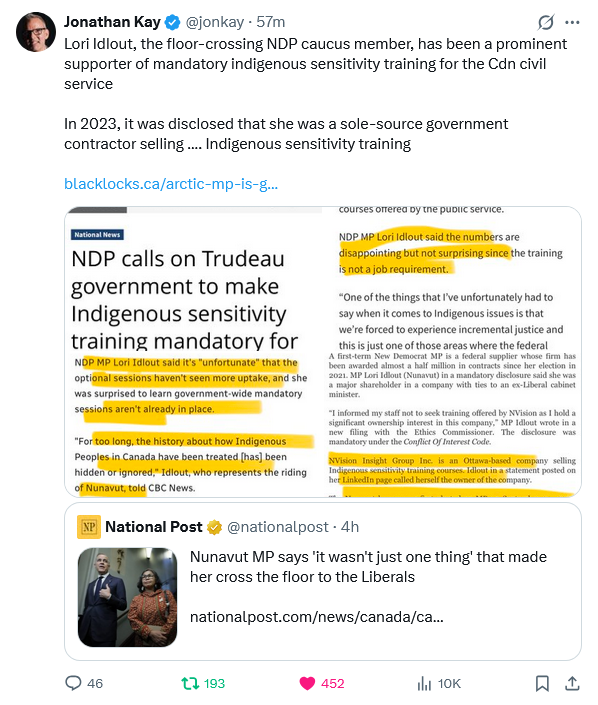
Some have speculated that a major factor in the latest defection was a recent federal financial benefit to the territory, but it might perhaps have been something more concrete:

May 17, 2012

Official response to UN’s Special Rapporteur on the right to food

Filed under: Cancon, Food, Government, Health, Politics — Tags: , , , , — Nicholas @ 00:09

As you’ll know if you’ve been visiting the blog for a while, I’m not a cheerleader for the federal government and I often disagree with their policies and statements. However, I can’t find much to disagree with in this:

May 16, 2012 (OTTAWA, ON) — The Honourable Leona Aglukkaq, Minister of Health, and Minister of the Canadian Northern Economic Development Agency, today issued the following statement:

Today I met with Olivier De Schutter, the UN’s Special Rapporteur on the right to food.

As an aboriginal person from the North, I was insulted that Mr. Schutter chose to “study” us, but chose not to “visit” us.

In fact, Mr. De Schutter confirmed to me that he did not visit a single Arctic community in Canada during nearly two weeks of travel within Canada.

I asked him what stance he would take in his report on uninformed, international attacks on the seal and polar bear hunt that make it harder for aboriginal hunters to earn a livelihood. I told him that I would be reviewing his final report closely, to see if he makes any recommendations to activist groups to stop interfering in the hunting and gathering of traditional foods.

I was concerned that he had not been fully informed of the problems with the discontinued Food Mail program that subsidized the shipping of tires and skidoo parts, as opposed to Nutrition North, which improves access to nutritious and perishable foods.

He made several suggestions that would require the federal government to interfere in the jurisdiction of other levels of government. It was clear that he had little understanding of Canada’s division of powers between the federal, provincial and municipal levels of government despite his extensive briefings with technical officials from the Government of Canada.

Our government is surprised that this organization is focused on what appears to be a political agenda rather than on addressing food shortages in the developing world. By the United Nations’ own measure, Canada ranks sixth best of all the world’s countries on their human development index. Canadians donate significant funding to address poverty and hunger around the world, and we find it unacceptable that these resources are not being used to address food shortages in the countries that need the most help.

-30-

December 27, 2011

RCAF reportedly considering expansion of northern base

Filed under: Cancon, Military — Tags: , , , — Nicholas @ 11:51

David Pugliese on the possible upgrade of air force facilities in the far north:

The Royal Canadian Air Force has looked at a major expansion at Resolute Bay, Nunavut, as it considers transforming it into a key base for Arctic operations, according to documents obtained by the Ottawa Citizen.

The construction of a 3,000-metre paved runway, hangars, fuel installations and other infrastructure has been proposed for the future as part of an effort to support government and military operations in the North.

Resolute Bay in Nunavut would be able to provide a logistics site for search-and-rescue operations as well as a base for strategic refuelling aircraft, according to the briefing from the Arctic Management Office at 1 Canadian Air Division, the air force’s Winnipeg-based command and control division. The briefing was presented in June 2010 and recently released by the Defence Department under the Access to Information law.

[. . .]

The RCAF briefing also examined establishing a forward operating base on central Ellesmere Island by expanding the current facilities at Eureka, Nunavut. That initiative proposed adding new facilities and turning the location into a regional asset for government departments. Also included in the “FOB Eureka” concept is the proposal that the existing airfield be expanded.

Creating a Forward Operating Base Eureka could allow the military to downsize or rebuild the existing Canadian Forces Station Alert, according to the presentation.

CFS Alert is on the northeastern tip of Ellesmere Island and is used for the interception of communications.

The presentation noted that Eureka would be easier to sustain as it could be resupplied by sea while Alert has to be resupplied by air. Making Eureka the main Canadian Forces “very high” Arctic station would also allow the military to separate the missions of sovereignty enforcement and the role of communications intercepts, it added.

August 14, 2010

QotD: Canadians and booze smuggling

Filed under: Cancon, Economics, Law, Quotations — Tags: , , , , , — Nicholas @ 01:28

Colourful, aggressively marketed and bad for you unless consumed in moderation, spirits have a lot in common with breakfast cereal. And just as Trix are for American kids only, Canadian adults are denied quite a number of wonderful products, many of them taken for granted abroad. It’s the fault of our provincial booze monopolies, of course. The only remedy for now is to cross the border and spend those 96¢ loonies. Rather than filling the trunk with discount Smirnoff on your next trip to the States, I would suggest bringing home some of the alcoholic flavours you cannot buy here, as listed below.

Review the rules on alcohol importing on the Canada Border Services Agency’s website at beaware.gc.ca. The best policy is honestly declaring what you have; if you’re over the limit you’ll just have to pay taxes and duty (unless you live in Nunavut or the Northwest Territories, which restrict the amount of booze you bring into the country).

Also note: Alberta residents are advised to use the search function at alberta-liquor-guide.com before making any suitcase-stuffing plans. There’s a chance the products below are available at home. Surprise, surprise: The lone province that doesn’t put shelf-stocking decisions in the hands of bureaucrats offers a superior selection.

Adam McDowell, “Happy Hour: Making the most of cross-border booze shopping”, National Post, 2010-08-13

Powered by WordPress


