Quotulatiousness

August 31, 2026

QotD: India, “coasting on inertia”?

Filed under: Bureaucracy, Government, India, Quotations — Tags: , , , , , — Nicholas @ 01:00

There are lots of examples of “nations” that don’t have any real reason to exist as coherent political entities. All of Africa, for instance, but also India, and they’re a pretty good test case for how far coasting on inertia can take you. I didn’t get into any trouble when I was there – I’m the law-abiding sort, and besides, I was a guest in their country — but I knew that, should trouble find me, the first thing I was going to do was hand Officer Friendly-ji my passport … in which he would find two nice crisp Tubmans. And if that didn’t solve the problem, I’d invite him to come down to the ATM with me and figure it out from there.

Moreover, if I happened to witness a crime … well, that wasn’t going to happen. I’d make sure of it. Pro wrestling referees got nothing on me. But if somehow I did get roped into an investigation, I was going to flee to the nearest Western embassy and hole up like Julian Assange. As with the Tubmans-in-the-passport thing, this is not because I condone or encourage crime. I really hope they find the guy whodunit, and nail his balls to the wall … in the abstract. But in the concrete, my main concern is that Officer Friendly-ji will have much less paperwork, and far more business opportunities, by pinning it on the burra sahib, so sahib — that would be me — is making his pasty pale ass scarce.

This is not a blanket condemnation of the Indian police. Rather, it’s an acknowledgement of reality. India is a huge country of over a billion people, in which there are at least 30 major languages (= “spoken by over a million people”) and a thousand minor ones. There are at least six major religions, the adherents of which are always bickering with each other. Even granting that every single national official in India has the wisdom of Solon, how the hell are they supposed to pass laws that mean anything under those conditions?

The administration of “justice”, then, devolves to the lowest common denominator in the localities. About which I know nothing, which makes me a nice fat target, so … yeah. How many dolla dolla bills to make this go away, Inspector?

Severian, “Friday Mailbag”, Founding Questions, 2022-07-22.

August 27, 2026

Women and power

Filed under: Media, Politics, USA — Tags: , , , , , , , — Nicholas @ 05:00

Sara the Editor (that is, not Sarah Hoyt the SF author and Instapundit co-blogger) posted this on Substack Notes a couple of weeks ago before the Lindsay Clancy trial began, but it discusses some of the things that have become common topics of interest since then:

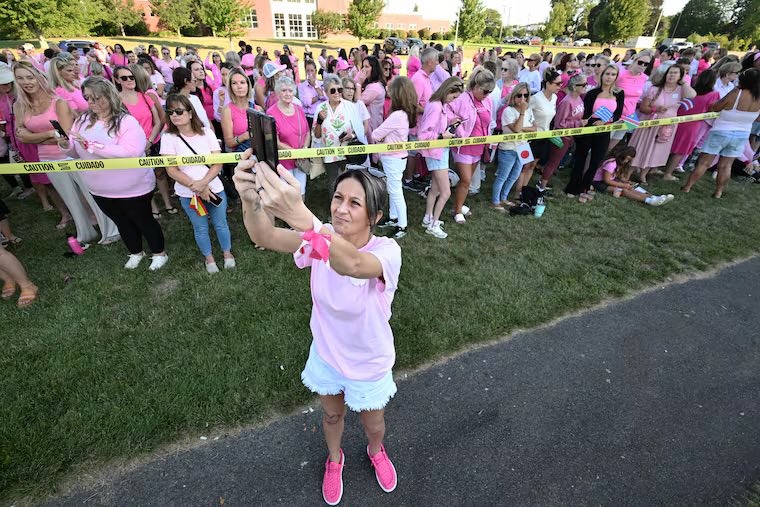
Pink-clad supporters of Lindsay Clancy
Photo from Aged Well

Women are weak, and that’s why they’re evil.

Women are never taught how to restrain their own power. This wasn’t bred into them, either. A woman never had to grapple with what every man faces at some time in his life: the realization that he can easily overpower and hurt a significant portion of the population, including women, children, and the elderly.

Men are taught not to do this wantonly, and if they do, we used to execute them. So we’ve been actively breeding it out of men.

Women are more valuable in terms of childbearing and bore little risk to society as long as men had the right to raise his own hand against a violent woman.

Women can only abuse children, old women, and crippled men. And they do, frequently, unless they fear repercussions for it.

Now women have political power. Now they have access to weapons that are small, light, and easy for a weakling to wield. They can now easily abuse men, and the men will sit there and take it, because they dare not defend themselves and are terrified of the woman-worshipping state police force, a mercenary army of cucks and degraded white knights.

Why would you expect a creature who never had to grapple with power to suddenly wield it with virtue?

You wouldn’t.

Every believable story where random people get superpowers gets one core thing right: the former weaklings are the most vengeful. They can’t wait to make the strong whimper at their feet.

This is literally every feminist ever. They say it out loud. They are razing the world with their newfound powers. Because women were never virtuous, just incapable of evil at scale.

Just look what they did when mass murder was put within female reach.

The oceans of infant blood that women have spilled in the last hundred years dwarfs every death caused by men in every war throughout all of recorded history. And yet feminists, they sit on that pile of tiny skulls lecturing men about how evil they are because they have more innate physical strength.

Do not fear the strong. Fear the ones who have become strong overnight.

They have all the spite and the will to spread their own misery.

More specifically dealing with the phenomena of women publicly proclaiming their support for a woman who deliberately murdered her own children:

This week was a pretty extreme wake-up call on the state of women online.

We learned that there are a shockingly large number of women who not only identify with a child murderer, but are ostentatiously, publicly performing that identification: posting videos of themselves sobbing while clutching infants, captioned “Same, Lindsay”.

They’re posting AI videos of Lindsay Clancy — a woman who sent her husband on an errand so that she could strangle their three children to death — receiving the warm embrace of the Sisterhood. Some are even running the “no uterus, no opinion” playbook but for actual infanticide. (I will not post examples, they’re easy to find.)

Clearly, this is not a feeling about which they are furtive or ashamed. It is baffling to imagine them setting up their camera so that they can publicly “break down”, Just Like Lindsay, to an audience of millions.

[…]

What these women are thinking is: “being a mom is Seriously Super Hard, and I am being Super Brave, look how Brave I’m being.”

That’s really all it is. The best defense you can make of this behavior is that it is sincerely, completely superficial and self-involved.

A social media hysteria has given them moral and social permission to complain in maximally dramatic terms, and to participate in a chorus of mutual validation.

There’s an echo in the “I choose the bear” discourse from a few months back.

Millions of women claimed that they would rather be alone in a room with a bear than alone with a man — and men responded with shock, in the mistaken belief that women were saying that they would actually literally rather be alone in a room with a bear.

This was not helped by the fact that many women, in the interest of making their point more vividly, said, “You’re not hearing me — I literally actually would rather be alone in a room with a literal bear and I’m not kidding”.

These women mean what they say, but not in the way that you mean things when you say them.

One of the emotional engines of this controversy is the perception that Lindsay Clancy was “crying out for help” and was “failed by the system” — that she wasn’t Heard or Taken Seriously.

But of course, her situation was being taken as seriously as such a situation could possibly be taken. There was a small army of doctors and therapists (and her husband, and a nanny) actively monitoring her.

If she had expressed a desire or plan to kill her children, they would have been immediately removed from her custody — but she didn’t.

The reason psychiatrists don’t institutionalize people or snatch their children when they report feeling depressed — or even when they report having certain categories of scary thoughts — is that they want people to speak up when they’re having trouble.

The only intervention that would have stopped this is for someone to suspend her parental rights or institutionalize her, with no judicable evidence (across a battery of clinical encounters) that she intended to harm her kids.

Obviously, these thousands of women are not actually suggesting that they are literally, actively experiencing what Lindsay Clancy experienced, or actually demanding the only intervention that would have made any sense (to have their children confiscated by the state.)

Maybe it’s waste of time to spell out that these demands have no practical content, but whatever: they have no practical content. Women are Using Language Differently. They want to Feel Heard. It’s Not About the Nail.

On her Substack, Janice Fiamengo helpfully points out that western cultures have always had a more lenient view of female murderers of their own children:

Do any of these advocates care about the principles of justice? Do they believe in equality before the law? Are they concerned with the possibility that a not guilty verdict in Clancy’s trial will encourage other unhappy mothers to kill their children? (Mothers are already, according to U.S. government data, the most frequent perpetrators of child homicide, see p. 65).

It seems not. The primary impulse is to see Lindsay Clancy and, by extension, all unhappy mothers as the true victims now and forever, never to be held responsible for any bad act, deserving of boundless sympathy.

Perhaps there has never been a case that illustrated women’s incoherent morality so clearly.

But it is not, alas, a new thing, and men in the west have tolerated and furthered it for centuries. In his 1913 book The Fraud of Feminism, British barrister Ernest Belfort Bax described, with his characteristic wit, how the female criminal is “surrounded by a halo of injured innocence”, “convinced of the maliciousness of her accusers” and of her own lack of responsibility (89-90).

Bax showed that nineteenth-century criminal law had great difficulty conceiving of and punishing female violence. Where there was any doubt as to a woman’s guilt, juries were reluctant to convict; and even where there was no reasonable doubt, they were eager to find mitigating circumstances such as temporary insanity, victimhood, or male coercion to justify leniency.
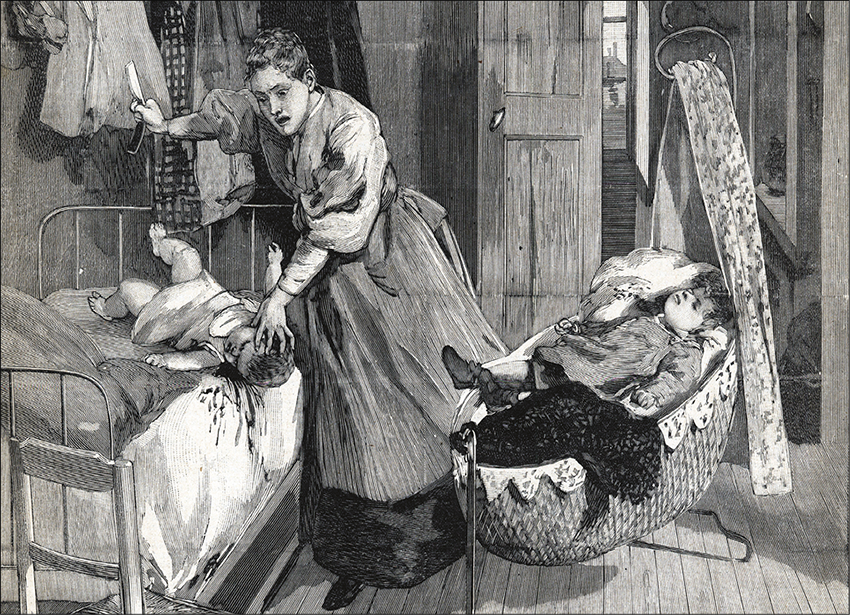
A now-famous Philadelphia case involved a mother, Harriet Vaughn (variously spelled Vaughan), who had murdered her newborn baby within hours of its birth in 1868, and was championed by her feminist supporters as a wronged innocent. The severely beaten dead baby, which Vaughn had attempted to conceal under her bed after crushing its skull with a blunt instrument, was hardly mourned at all (for a full account, see Sarah Barringer Gordon, “Law and Everyday Death: Infanticide and the Backlash against Woman’s Rights after the Civil War” in Lives in the Law).

Although Vaughn was convicted of murder and sentenced to death by hanging — a highly unusual sentence in that no woman had been hanged in Philadelphia since 1737 — her plight almost immediately became a cause célèbre, with advocates rallying to her defence. Elizabeth Cady Stanton, leader of the American feminist movement, spent months agitating on Vaughn’s behalf. In the pages of The Revolution, the feminist newspaper she ran with her associate Susan B. Anthony, Stanton portrayed Vaughn as a sexually-abused maiden, and a loving but desperate mother forced to kill her child because she had no other options. She described her as “a poor, ignorant, friendless and forlorn girl who had killed her new-born child because she knew not what else to do with it” (Stanton, “Infanticide”, The Selected Papers of Elizabeth Cady Stanton and Susan B. Anthony, p. 158).

None of this was founded in fact — Vaughn herself did not claim she had been raped and there were many institutions for foundlings in Philadelphia where she might have left her baby — but it was a familiar sentimental narrative guaranteed to stir indignation against the sentence.

Members of the Working Women’s Association of Philadelphia held a mass rally on Vaughn’s behalf, visited Vaughn in prison, and petitioned the Pennsylvania Governor for her pardon, which was granted in May of 1869. Released from prison, Vaughn left Philadelphia for her birthplace of England and was heard from only once more, when she wrote some months later to request the $300 that she had heard feminists had raised for her.

Sympathy for infanticidal, especially unwed, mothers was widespread in nineteenth-century English-speaking countries, where the killing of babies was “an unsavoury but surprisingly common feature of life” (Constance Backhouse, Petticoats and Prejudice, p. 113). Law Professor Sarah Gordon reports that “In 19th century Philadelphia, thousands of dead newborns were found in alleys, ash heaps, privies, rivers, and so on”. Professor of History Ann R. Higginbotham gives examples from 19th century London to show that “juries were extraordinarily reluctant to convict women accused of murdering their illegitimate infants”, often out of sympathy for the women’s difficult circumstances (Sin of the Age: Infanticide and Illegitimacy in Victorian London, p. 329).

August 26, 2026

“Women who see in Clancy something not just sympathetic, but martyr-esque”

Filed under: Law, Media, USA — Tags: , , , — Nicholas @ 05:00

David Dennison clearly views-with-alarmhorror the phenomenon of women publicly demonstrating their support and claiming understanding for a woman who murdered her three children:

Pink-clad supporters of Lindsay Clancy
Photo from Aged Well

A disclaimer first: NOT ALL.

The Lindsay Clancy verdict could come as early as this week. If you have no idea what that sentence meant, honestly, just stop reading and go do something else. This case is not one you want in your head if it isn’t already. Trust me.

There really aren’t many things that are more distressing than what actually happened here. My complaining about other aspects of the Clancy saga is a bit like if somebody you loved died in a terrible car wreck and I said, “It’s a shame there was so much damage to the paint”. Still, that’s what I’m going to do.

The Lindsay Clancy trial has sparked an on and offline movement of women who see in Clancy something not just sympathetic, but martyr-esque. These women get her. They see themselves in her. They feel what they know she felt, and regard her as an avatar of the unsung stress of motherhood, and the woeful lack of attention paid to women’s struggles.

You may–especially if you are among the penis-havers – be asking yourself several things about now. Perhaps things like:

  • The stress of motherhood is unsung?
  • Women’s struggles receive insufficient attention?
  • Other moms see themselves in a woman who shooed her husband out of the house so she could wrap exercise bands around the necks of her three children and slowly choke the life out of them one by one while they stared into the deranged eyes of the person who brought them into this world in the first place? Really? That’s relatable?

Yes to all three, apparently.

These women are organized too. They are showing up. Clancy has pleaded not guilty by reason of lack of criminal responsibility – or in layman’s terms, not guilty by reason of insanity. Clancy was suffering from severe postpartum psychosis, was on enough meds to stock a pharmacy, and was, per her own reports, hearing voices.

[…]

Wrong Side

What is wrong with these women defending Lindsay Clancy? I can understand a sincere belief that postpartum depression and psychosis aren’t taken seriously enough (I don’t actually think that’s true, but I can understand somebody thinking it is). But I actually cannot understand somebody looking at Clancy’s actions and thinking, “Same, girl.”

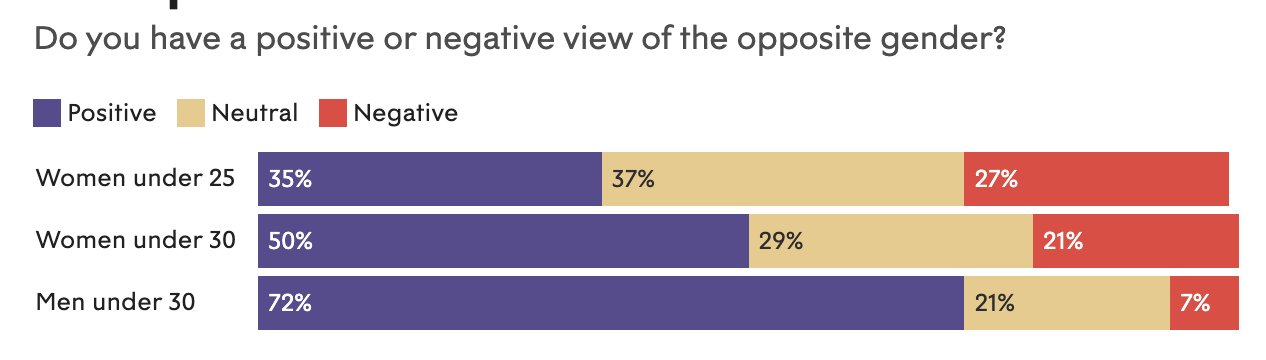
I’m not alone. We may be seeing the beginnings of a backlash to a backlash. The first backlash is the intense, unreturned dislike young women are experiencing these days for the coarser sex. A manifestation of that, I submit, is blaming the supposed inattentiveness of a man for his wife throttling his children to death.

Survey of British women done for The New Statesman.

This backlash though is one of men asking themselves, just as I did, what the fuck? Where is this tribalism coming from? What causes a person to look at Patrick Clancy, who returned home from a drug store after picking up his wife’s meds to find her sprawled on the yard, his three children strangled inside, and think, “I don’t like the look of him …?”

August 24, 2026

It’s no wonder that people have lost trust in formerly prestigious institutions

Filed under: Britain, Education, Media, Politics, USA — Tags: , , , , , , — Nicholas @ 05:00

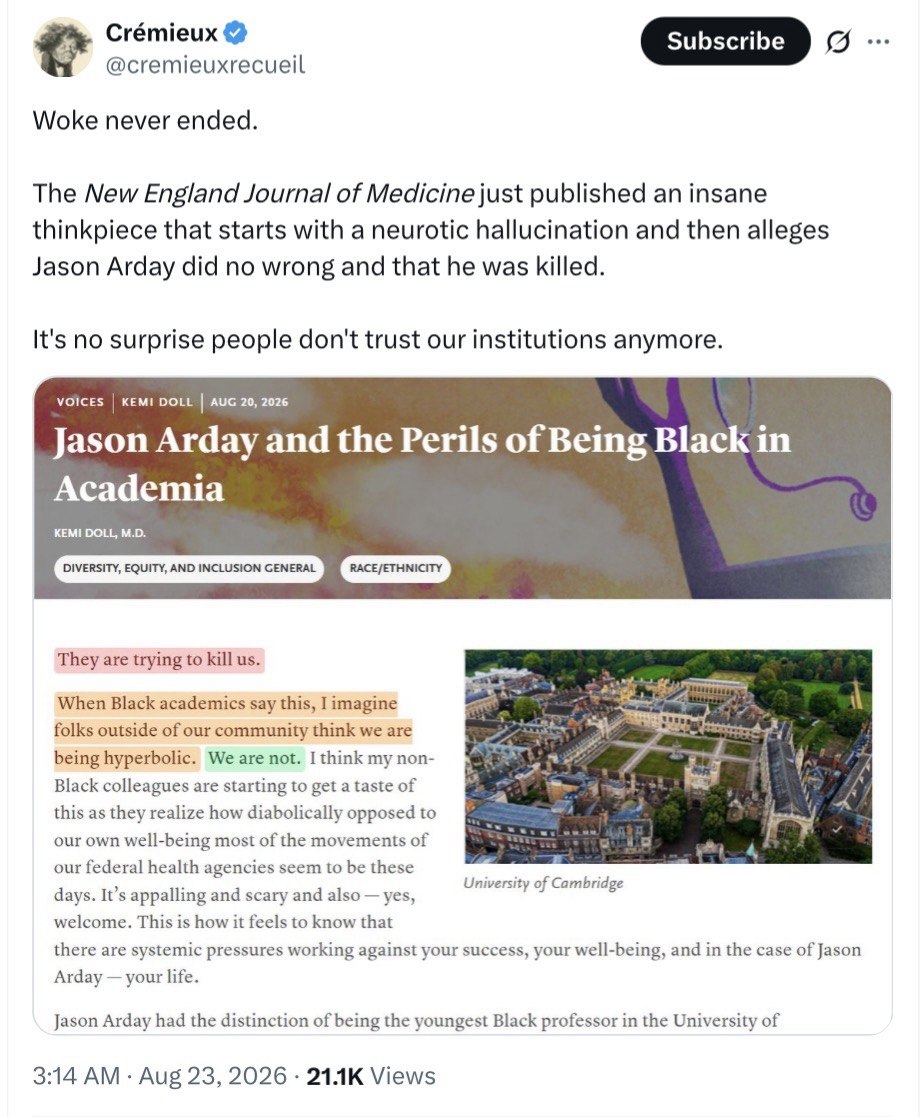
Lorenzo Warby on the two cases that are currently front-and-centre with the terminally online left, one a recently deceased academic grifter and another a confessed multiple murderer (of her own children):

We are currently observing attempts to turn the late Jason Arday — a fabulist who produced nothing of intellectual merit — and Lindsay Clancy, a woman who murdered her three children, into moral heroes. The former is allegedly a martyr for the cause of anti-racism and care for the neurodivergent/autistic, the latter for motherhood — or at least postpartum depression and psychosis. Both are construed as victims.

There is a real push to put the truly awful into Affluent White Female Urban Liberal. It’s almost as if there are some issues with feminisation. On the other hand, a woman being an open supporter of Lindsay Clancy is an excellent negative signal for men.

Just when you think progressivist purity spirals can’t get any worse, they do. Thus, we not only get the above hagiographical elevations of the grotesquely unworthy, we also see the physical mutilations of trans-surgery used to rehabilitate female genital mutilation.

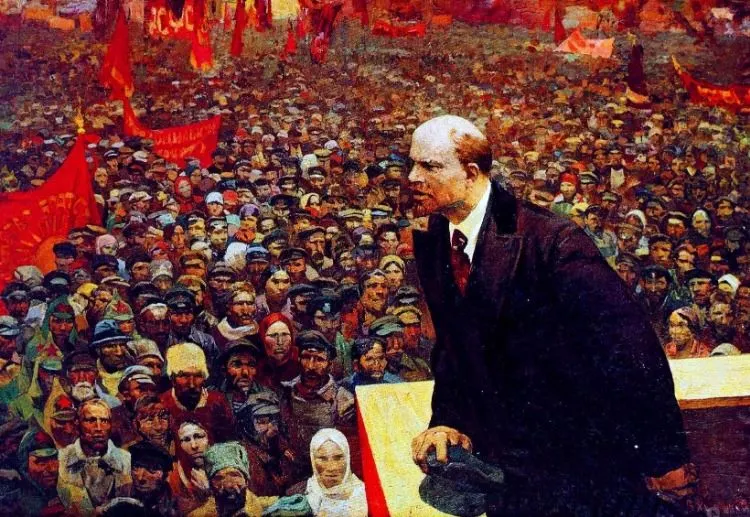
But, of course, any such surprise is having far too contemporary a focus. Left-progressivism has a long history of elevating some of history’s most appalling monsters, most tyrannical mass murderers — Lenin, Stalin, Mao — as heroes of world-history and human liberation.

The use and abuse of moral mascots

The worse a group or individual behaves, the more progressives like them. If a group is noted for high levels of violence or various social dysfunctions, left-progressives adopt them as moral mascots.

The concept of such mascots comes from economist Thomas Sowell. Mascots are people or individuals that “the Anointed” — those who see themselves as at forefront of human liberation — adopt to be extolled and defended. This is connected to Thomas Sowell’s analysis of Constrained and Unconstrained political visions.

The Constrained Vision says there are no complete solutions, there are just trade-offs, all the way down. Human nature is one of those constraints. Biologist E.O. Wilson‘s famous observation about Communism — great idea, wrong species — is a pithy expression of the Constrained Vision.

In the Constrained Vision, history is an enormous memory well where we learn about ourselves. This is because the humans who made history are just like us. Their experience, their triumphs and failures, even their mundanities, are lessons for us.

History is contingent, it has no particular direction. The Constrained Vision finds it easy to take people’s choices as having authority because there is no direction of historical travel to which they must conform.

The Unconstrained Vision denies that human nature is a constraint in that way, so it’s possible to create a society of transformative human liberation. History is not a source of lessons, but a record of failures to achieve that liberation — a record of corruption and sin.

Moreover, history has a proper direction — towards transformative human liberation or another, related telos. Hence, choices that support that direction are legitimate, those that go against it are not. The politics of the Unconstrained Vision turns elections into legitimating rituals: citizens’ votes are blocked from overturning any of the policies the Anointed have decided represent history’s proper direction.

The Anointed evince what writer Wesley Yang labels the non-electoral politics of institutional capture. If you want to see that in its most complete form among the Western democracies, PM Tony Blair’s debauching of Britain’s constitutional order through quangoes, human rights legislation that empowered judges over elected ministers, and devolving decision-making to the EU — thereby massively increasing the degree to which elections became legitimating rituals that change remarkably little — is the current gold standard case. However, all Western democracies face similar pressures, albeit to considerably differing degrees.

The commitment of The Anointed to this vision of human liberation gives them such a sense of trumping moral authority that they see themselves as owning morality. They have the right-to-decide what is moral and then to impose their decisions on everyone else.

“Communism is an ideology designed to liquidate nations”

I nearly skipped this post by Celina, as it started off appearing to be pretty much of interest only to Australians, but that was just the opening sections:

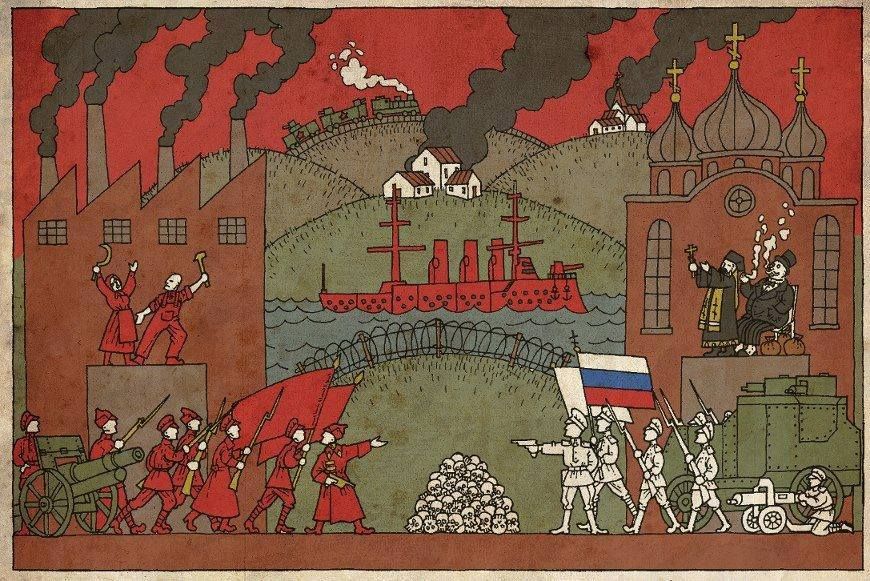
The Bolsheviks were the first governing power of the modern era to write the suppression of “national enmity” into a systematic criminal code. The RSFSR Criminal Code of 1922 penalised agitation and propaganda arousing national enmity or dissension, its successor, the 1926 Code, carried the provision forward as Article 59-7, under the chapter dealing with especially dangerous crimes against the order of administration, punishing “propaganda or agitation directed towards arousing national or religious enmity or discord”, with sharply escalated penalties, up to and including death, where the offence occurred in wartime or amid mass disturbances. From the earliest years of the Soviet state, in other words, speech about nationality was not a civil-society problem to be argued out, but a category of state crime sometimes punishable by death.

To understand why, it is necessary to understand something about communism that conservatives and libertarians have largely obscured. If you ask the average conservative what communism is, he will most likely start discussing government ownership, five-year plans, bread queues etc.

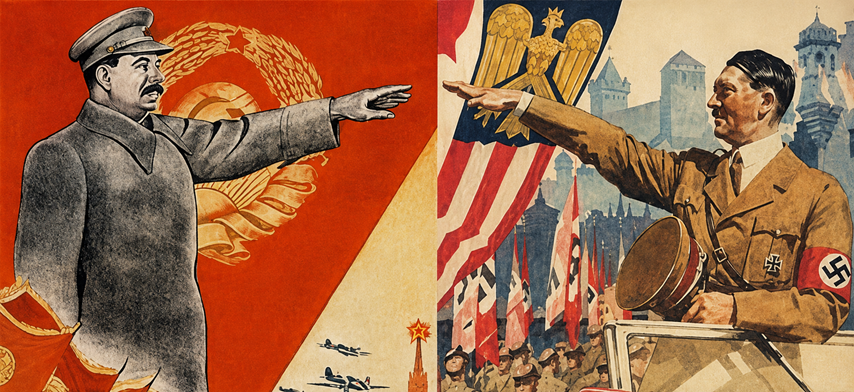
Communism, from this point of view, is essentially capitalism with the economic settings reversed. The government “does and owns everything“. This is why so much conservative analysis eventually degenerates into horseshoe theory: fascists liked government intervention and communists liked government intervention, therefore fascism and communism were basically versions of the same thing.

But that completely misses the ideological conflict which defined twentieth-century Europe. Communism was not just some economic theory about who should own what. It was an internationalist theory about who you are.

Communism is an ideology designed to liquidate nations. Literally.

Marxism insisted that the fundamental political division of mankind was class. The worker was not ultimately supposed to understand himself principally as English, German, Italian, French or Russian. He belonged to the proletariat. His historical interests were shared with workers beyond the borders of his own country, while his supposed national solidarity with his own bourgeoisie concealed the class relationship upon which capitalism depended. Hence the language that runs through the entire communist tradition: Workers of the world, unite; The proletariat has no fatherland; No war but class war. You’re not Italian, you’re not German, you’re the proletariat, and all you have to lose is your chains.

The political logic here is blatantly obvious. Nationality competes with class consciousness, patriotism competes with proletarian internationalism. The nation tells a German worker that he shares something profound with another German who happens to own a factory. Marxism tells him that this solidarity is false and his real political brother is the French, Russian or Italian worker standing on the other side of the border.

That is why the nation became one of the great obstacles confronting revolutionary socialism. The theory said workers possessed common international class interests. Yet, history repeatedly demonstrated that workers continued to behave like members of nations.

In 1914, the workers of Europe did not unite against their governments and refuse the coming war. They rallied overwhelmingly to their respective countries. Socialist parties fractured along national lines. Men who Marxists expected to understand themselves as an international proletariat marched into battle as Germans, Frenchmen, Russians, Austrians and Britons. And the same problem returned after the Bolshevik Revolution.

That is why the great twentieth-century conflict between communism and nationalism was not accidental. It was ideological. Communism was internationalist not in the banal sense that communists in different countries cooperated with one another, but in its conception of history itself. The nation was something history would ultimately transcend. Lenin said this openly: socialism aimed not simply to bring nations closer together, but eventually to “merge them“. Elsewhere he described the centralised state as a historical step towards the future “socialist unity of the whole world“.

Stalin, grasping this principle, forged civic nationalism as the indispensable stepping-stone toward that communist universalism. Inside the borders of the revolutionary state the old nationalities were to be liquidated into a single Soviet identity: you are not Ukrainian, you are not Russian, you are not Jewish, you are not Georgian, you are a Soviet patriot, loyal only to the revolution. That state, once purged of national loyalties, would then project its universalist ideology outward, seeking global hegemony by liquidating, in turn, every nation that still dared to resist it.

Update, 25 August: Welcome, Instapundit readers! Have a look around at some of my other posts you may find of interest. I send out a daily summary of posts here through my Substackhttps://substack.com/@nicholasrusson that you can subscribe to if you’d like to be informed of new posts in the future.

August 16, 2026

In Ontario, bike lanes are not a “human right”, thank goodness

Filed under: Cancon, Government, Law, Media, Politics — Tags: , , , , , — Nicholas @ 05:00

On his Substack, Brian Lilley celebrates two recent developments in Ontario that — unlike so many others in the last several years — align with common sense:

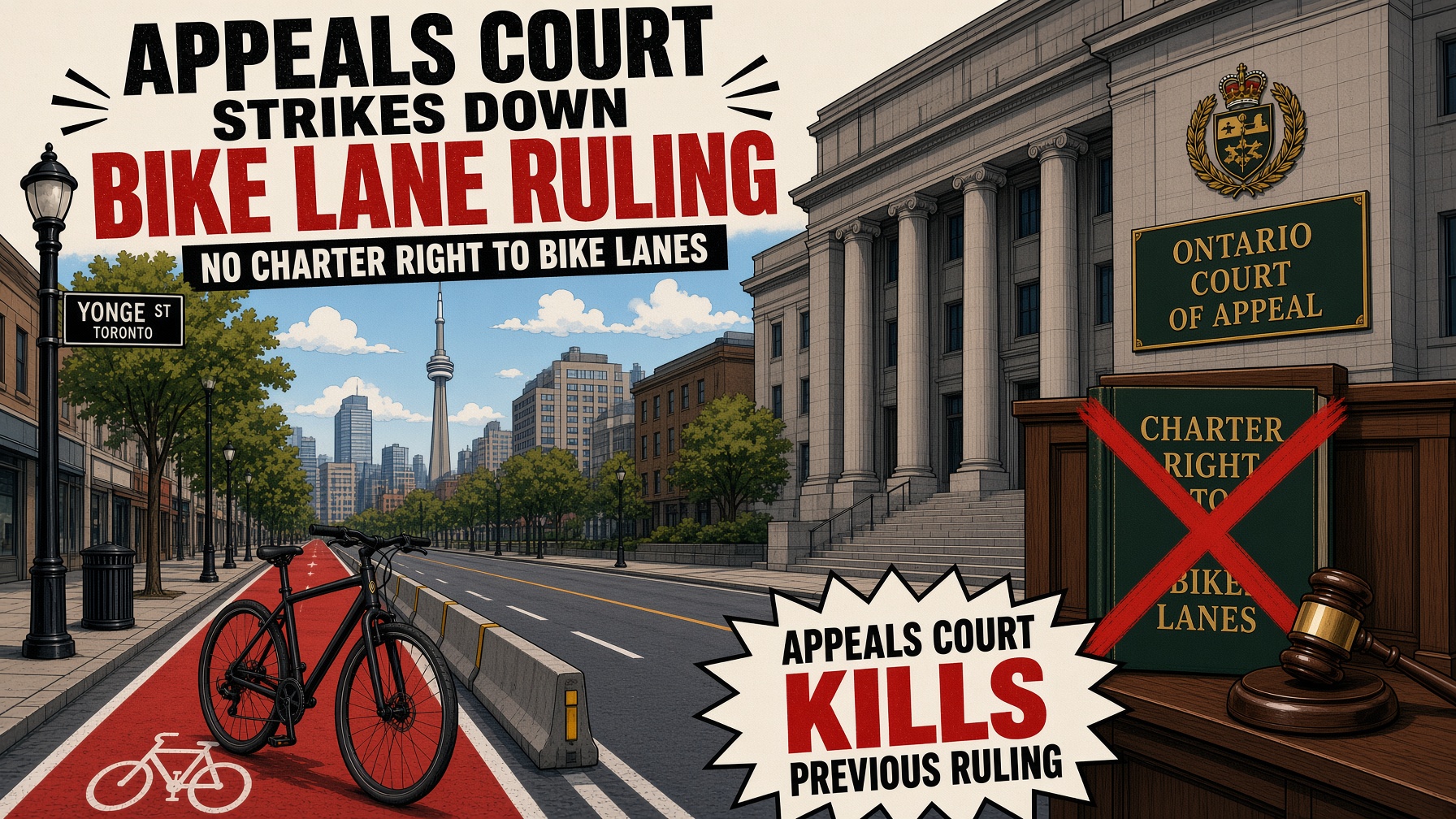
Last year I wrote about the horrible court decision put out by “Justice” Paul Schabas on bike lanes being a Charter right. I put “Justice” in quotations because as I described at the time, the decision was so horrible and so political that it wasn’t worthy of an Ontario court.

Today, the Court of Appeal of Ontario agreed with me. As I wrote in my Toronto Sun column, they didn’t just overturn the ridiculous decision by Schabas, they excoriated him and his ruling.

AI-generated image from Brian Lilley

I quoted different sections of the appeals court ruling in my column, and trust me it was tough to choose which parts to quote in such a brilliant decisions. Here, I want to quote from early in the ruling, paragraphs 3-5.

    [3] The application judge’s decision presents as a straightforward application of orthodox s. 7 principles. But the application of those principles, divorced from a broader understanding of the constitution of which they are a part, has led to a surprising outcome: the conclusion that routine legislation regulating road usage is unconstitutional.

    [4] Something has gone wrong.

    [5] The application judge erred in law in interpreting and applying s. 7. But his decision is wrong in a more profound sense, for it subverts a fundamental principle of our democratic constitutional order: a legislature cannot bind its successors. Legislatures in the Westminster tradition are free to undo legislation by amending or repealing it as they see fit. That is the nature of democratic lawmaking in our constitutional order. Of course, all laws are subject to the Charter, but this does not preclude the amendment or repeal of legislation the legislature was under no constitutional obligation to have passed in the first place. Amendment or repeal of legislation may breach the Charter only if the breach can be established independent of the prior state of the law.

There is so much to digest here, but I am glad to see judges — who come from different backgrounds and were appointed by both the Harper and Trudeau governments — agree on fundamental principles. That should be a given, we shouldn’t think about such things, but today, we can’t those fundamentals for granted.

The idea that one Parliament, or legislature, cannot bind the hands of another is fundamental to our system. If I pass a law saying that wearing blue on Tuesdays is illegal and the next Parliament passes a law saying that it isn’t, the more recent law takes precedent.

Yes, I used a ridiculous example on purpose, but just to prove a point. It’s sad that so many people, including those who report and comment on politics, aren’t familiar with this basic concept on the role of Parliament.

And the other reversal of an absurd policy:

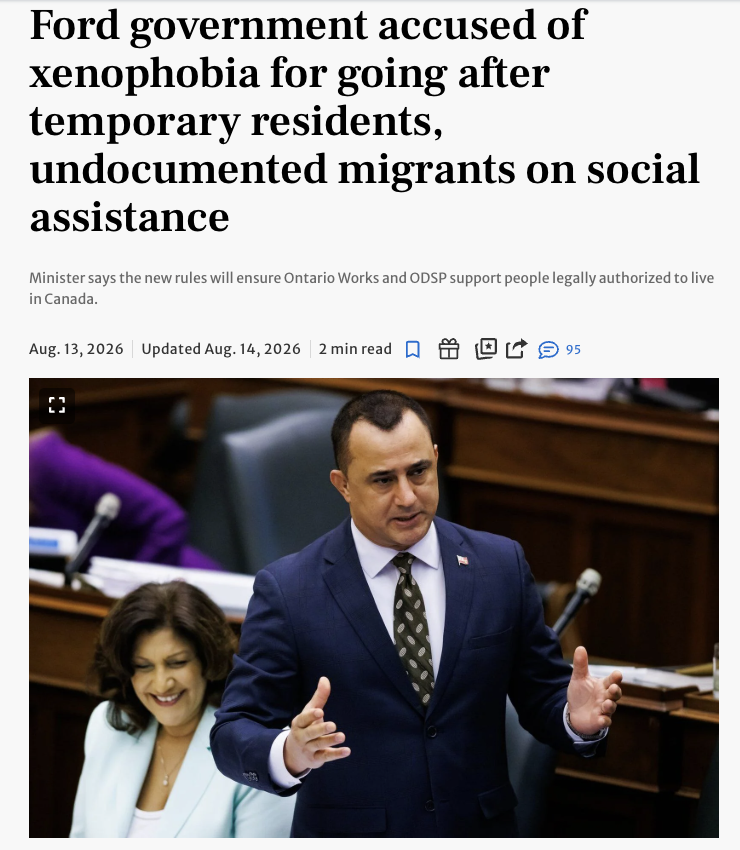
Last month there was a tribunal ruling in Ontario that said people in the country illegally were still entitled to welfare. I wrote about it at the time and said it was a crazy ruling that the Ford government needed to deal with.

They promised to do so at the time and on Thursday announced that they had.

Friday morning I was forced to write about the ridiculous take by the Toronto Star‘s “senior immigration reporter” Nicholas Keung. It seems, based on his stories, that Keung has never met someone he doesn’t think should be in Canada.

I’ll say as the son of immigrants, who grew up in an area where kids with parents who had Canadian accents were the strange ones, most immigrants don’t back illegals getting welfare.

Still, this was the Star‘s headline on the story.

As I point out in my Sun column, Parsa is himself an immigrant having come from Iran with his family as a child.

But sure, the Star‘s “senior immigration reporter” smears him as racist.

Let me explain something to you. When a reporter says “experts” say and they only find experts from one side, that is them finding the people they agree with to say what they want said.

August 13, 2026

“Defund the police!” from around day five onwards

Filed under: Government, Law, Politics, USA — Tags: , , , , , , — Nicholas @ 03:00

A grim joke I’ve seen many times on various social media sites features the kind of people who’d agree to defund the police, but not because they want to take it easy on criminals … but because if there are no police enforcing the laws, there’d be no police limiting “bag counts”. With no police to make arrests (and likely no jails or courts to provide some kind of due process), the victims of crime will either surrender to the perps, or get as fully armed as they can manage. You can’t maintain a civil society if everyone has to take on the policing role for themselves everywhere and at all times.

“Defund the Police” by Taymaz Valley – CC BY 2.0

I always laughed at “defunding the police”, because I know how that would go. The people who advocate it are incapable of thinking beyond first-order consequences.

So, let’s suppose major American city X fully defunds its police. How will this play out?

For a short time, criminals will have a field day. They will shoplift, rob, mug, and invade homes to their hearts’ content. Because who’s going to arrest them?

But then their victims are going to arm up. Homeowners, shopkeepers, and ordinary citizens will start open-carrying and shooting criminals. Because who’s going to arrest them?

So far, so good.

Now, here’s the part that isn’t obvious. 60% of index crimes are committed by Black people. Once the shooting phase starts, Black criminals are going to form gangs (if they haven’t already) so they can overwhelm individual targets.

Once Black gang predation becomes routine, the rational strategy for whites and Hispanics and Asians becomes to simply start gunning down groups of multiple Blacks on sight. Because who’s going to arrest them?

The same dynamic applies to any minority with a higher criminal propensity than white people. Which is basically all of them except for Northeast Asians.

Innocents will not be spared. If there are any left — it’s a statistical fact, for, example, that Black women have a higher rate of criminal violence than white men.

The eventual result would be a white nationalist’s wet dream. Minorities dead or keeping very, very quiet in order not to get shot. They might be able to hold mono-ethnic enclaves in the short term, but venturing outside them would be asking for death.

I’m pretty sure this is not what advocates of defunding the police want to happen. But these are the same people who were all gung-ho for police bodycams, and we all know how that turned out.

Update: You can always count on the Babylon Bee to provide timely and informative context for any issues we face in today’s complex world – What If We Abolished Prisons and Defunded the Police?

August 1, 2026

Why UK crime victims’ families always sound so similar talking to the media

Filed under: Britain, Government, Media — Tags: , , , , , — Nicholas @ 05:00

On Substack Notes, John Carter linked to an article about the British Home Office’s “nudge unit” who, among other things, coax and cajole the families of murder victims to avoid any hint that they blame the perpetrators for the loss of their loved ones:

This is incredible. I always wondered how family liaison officers from RICU or the CRS reliably got the families of victims murdered by political or racial terrorists to provide such anodyne, don’t look back in anger public statements. I figured in most cases it would be concern trolling, with legal threats held in reserve.

This lays the technique bare, using interviews conducted both with victim’s families and former police officers. Liaison officers serve as anesthetic patches that get slapped on the open wounds of the migration war. They apply therapeutic techniques to calm and reassure the families, establishing dependent relationships and using the trust they build to guide them away from saying anything inflammatory when the time comes to speak to the public. If families become noncompliant in this respect, they’re threatened with causing a mistrial should they speak too openly about their feelings.

That isn’t all RICU does, of course. “Communications” includes a huge propaganda arm, which uses every tool at its disposal, including battalions of fake social media profiles. You have to wonder how much of the culture war of the last decade or more was pure hallucination.

The article in question is by David Shipley for the Pimlico Journal:

RICU, the Home Office’s Research Information and Communications Unit, is often the subject of much attention online, particularly around its role in the consistently bland calls for “unity” after horrific acts of violence. Many people online suggest that either the Unit itself, or the “specially trained officers” (Victim Liaison Officers or Family Liaison Officers) must threaten victims and their families to ensure their compliance with approved messaging. This always struck me as unlikely — widespread coercion would surely have leaked by now. There was also good reason to be sceptical of the efficacy of behavioural science applications to government. And yet public statements by those victims and their families are remarkably consistent.

So I was delighted when, a couple of months ago, Pimlico Journal asked me to investigate RICU and victim liaison properly. In order to do so, I studied historic statements, publications and coverage of RICU and spoke with victims’ families, some of whom are named in this piece and former police officers, none of whom are named, with knowledge of the Victim and Family Liaison units. What I discovered is fascinating and far more insidious than the imagined coercion. This article provides an overview of RICU’s history, goals and methodology, followed by details from those interviews. I hope it sheds some light on this murky area of the state’s “communications management”.

RICU was established in 2007 “under the Prevent strand of [the UK government’s] CONTEST strategy” with its stated goal being to “understand and counter terrorist and extremist ideologies to reduce the risk to the UK, its citizens and its interests overseas”. Giving evidence to MPs in 2009, Charles Farr, a former SIS officer, and head of the Office of Security and Counter Terrorism, who set RICU up in 2007, said the unit is “responsible for advising the rest of government [and] officialdom, from a brigade commander in Helmand province through to a chief constable in Yorkshire, about how they wish to characterise the threat we face and describe the response that we are making and, secondly, rather different, they are responsible for challenging the propaganda which comes to us from al-Qaeda and associated groups — generally not from people in this country; usually from the incessant 4,500 websites that are in one way or another associated with radical Islamist terrorist organisations around the world”.

The unit embraced convenient lies from the start. Part of their strategy was to send advice to “local authorities, people working on community cohesion projects, local police, neighbourhood policing teams” and “the Chief Constable” that they should nottalk about Islamic terrorism, not because in certain circumstances that is an inaccurate description but because the language admits of a number of interpretations which are not always helpful to us“.

RICU was also always concerned with the whole of British society — while Farr said the unit decided to “start” with Muslim communities, he told MPs that he did “not want to give the impression that RICU’s sole purpose is to communicate with Muslim communities in this country. It is not.” So by 2009 a unit existed which had “about 35 people” working for it, “and a bit of the private sector in there to advise us on aspects of communications”, which was telling every arm of the state, along with much of civil society, that they should lie about the nature of the threats the country faced, to serve the state’s perceived interests. It was also already building wide and deep relationships within many parts of the state, including policing.

What has it become, in the 17 years since Charles Farr gave his evidence?

In 2011, when the government reviewed Prevent, it found that RICU’s communications sometimes “erred in seeking to make language acceptable to some in Muslim communities, at the expense of candour”. The unit was described as having “a central role in developing counter-ideological or counter-narrative work”, although its track record was described as “mixed”. It was directed to take “more care … to identify credible partners to develop powerful and specific narratives across a range of communications channels, especially on the internet“. Despite these criticisms, the state chose to “retain RICU, largely in its current form”, but with the expectation that it would produce “much sharper and more professional counter-narrative products” — there was also a commitment to “continue to work with social media enterprises” in the battle against “propagandists and radicalisers” including those whose “propaganda work” might be illegal under “race and religious hatred legislation”. The shift is notable — Farr’s commitment that RICU would work across the whole of British society is clearly underway, with Islamic terrorism and radicalisation no longer the main focus.

More recently, RICU has long been the subject of much discussion on social media, and of occasional interest in the mainstream press. It’s often accused of being behind the anodyne calls for unity and calm issued by public bodies, victims and their families after the latest “Yookay” Event in which a migrant has done something appallingly violent. Not unrelatedly, it is generally the right who are more vocal in their criticism of RICU, and it is regularly suggested that they threaten families into sticking to the regime-approved line.

Homelessness isn’t the real problem … it’s feral humans

Filed under: Health, Media, Politics, USA — Tags: , , , , — Nicholas @ 03:00

Many well-meaning people see “homeless” individuals on the street and think the problem is that these individuals don’t have homes. An obvious solution occurs: we’ll just give them homes so they won’t need to sleep rough on the streets. What a great idea! With the best of intentions! What could possibly go wrong?

The real problem isn’t that there aren’t enough homes … some of those “homeless” people on the street actually do have places to sleep but for one reason or another choose not to. The real problem for most of them is that they’ve gone feral:

If you give problems the wrong names, you can’t understand them.

If you can’t understand problems, you can’t fix them.

There are almost no homeless people in America. There are only feral humans.

A homeless person is someone whose distinguishing feature is not having a home. I was homeless once, for a day, when the lease on one apartment expired before the next one was cleaned, repaired, and ready.

I parked a moving van full of my worldly possessions at my university, and slept on a couch in the student commons.

That’s “homeless”.

“Feral” is when a human cannot live within society, or comply with the basic expectations required for membership.

Yes, they do not have homes.

But this is not their distinguishing feature. Because they also don’t have jobs, sanity, sobriety, manners, morals, or hygiene.

Which is why they do not have homes.

If you give them a house, because you think they are “homeless” rather than “feral”, then they will simply repeat, within that structure, the same feral behavior.

And soon that structure will be uninhabitable.

Which, for certain people, is the whole point.

A man whose job is to sell 3d printed houses isn’t trying to fix the feral-human problem. He’s trying to sell 3d printed houses.

And it’s one hell of a lot easier to sell them to bureaucrats who aren’t spending their own personal money.

It doesn’t matter if 3d printed houses suck to live in. It doesn’t matter if the feral humans trash them. Nobody in this equation cares about the feral humans, even the feral humans themselves.

And nobody in this equation cares about the taxpayers. If the feral humans are still feral, then the 3d house grifters can sell more gimmick houses, and the bureaucrats can spend more of someone else’s money.

If a violent political upheaval becomes necessary, this will be very unpleasant for everyone involved, but at least afterwards, we will all be able to use the feral humans, bureaucrats, and grifters to fertilize the garden of new homes.

Which will be made out of bricks.

Update, 2 August: Welcome, Instapundit readers! Have a look around at some of my other posts you may find of interest. I send out a daily summary of posts here through my Substackhttps://substack.com/@nicholasrusson that you can subscribe to if you’d like to be informed of new posts in the future.

July 30, 2026

Support for capital punishment is the opposite of a luxury belief

Filed under: Law, Media, Politics, USA — Tags: , , , , — Nicholas @ 05:00

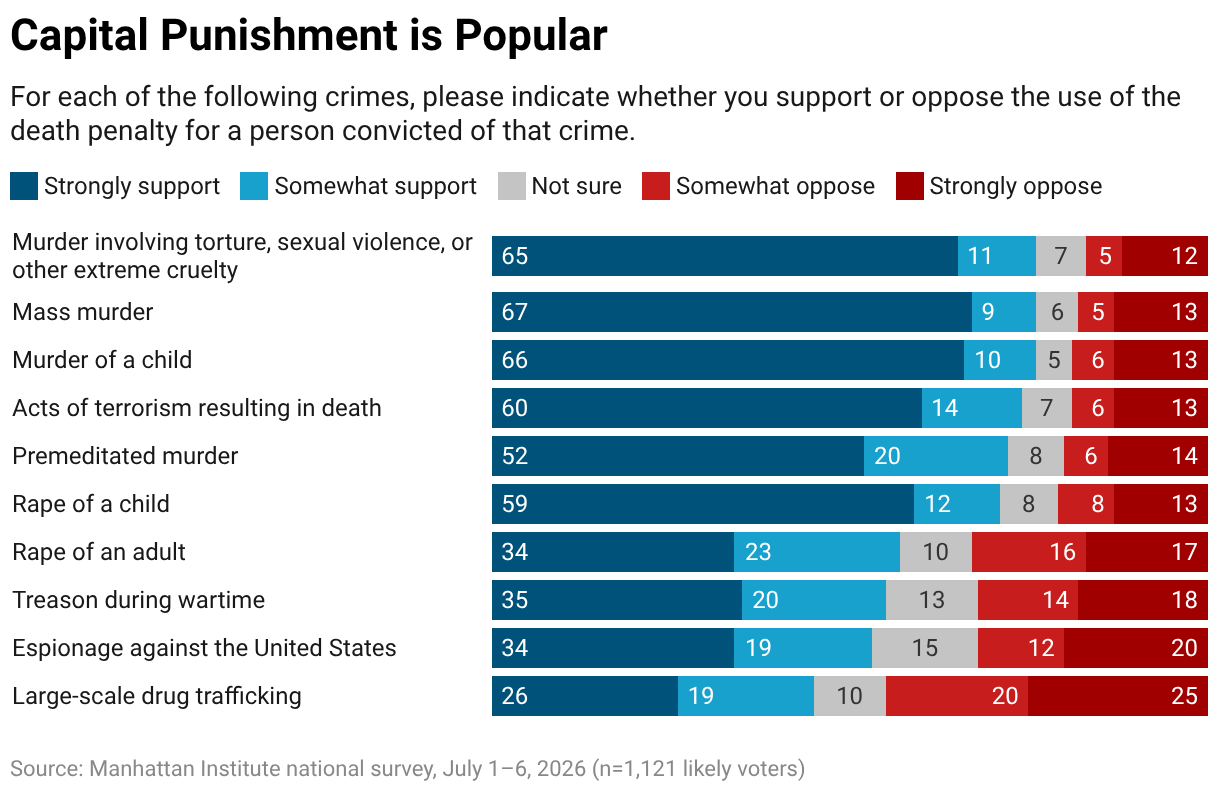
As noted in City Journal, support for capital punishment is overwhelmingly high … which is why politicians and wealthy progressives whole-heartedly oppose it. As you probably know, a “luxury belief” is one that is usually held by people who will not be in any way impacted by the downstream effects of that belief. It’s not the wealthy and privileged who suffer when murderers get out of prison, so they are generally all in favour of ever greater leniency in sentencing and easing parole conditions. Poor and middle class people are more likely to suffer when violent criminals return to their communities, which is why they generally want longer incarceration for violent crimes and favour capital punishment for certain abhorrent acts of murder. Charles Fain Lehman has more:

Those findings undermine the narrative, routinely advanced by death-penalty abolitionists, that capital punishment is on the decline because the public has turned against it. In reality, both public opinion and the current composition of the Supreme Court militate in favor of expanding the death penalty’s use — and, specifically, relaxing many of the arbitrary and undemocratic restrictions imposed on it by courts over the past several decades.

Abolitionists have based their case for declining public support on polls such as Gallup’s, which for nearly a century has asked respondents if they are “in favor of the death penalty for a person convicted of murder”. The share in favor has indeed dropped steadily since the 1990s, from a 64-point difference between support and opposition to just a 6-point split today.

That question, though, artificially reduces support by asking about all murders. Under current precedent, only certain heinous murders — those in which jury-determined aggravating factors outweigh mitigating factors — are eligible for the death penalty. There is likely far more support, for example, for executing Dylann Roof specifically than there is for executing all murderers generally.

The new MI poll illuminates this point. It asks about support for capital punishment under a variety of circumstances. The result is lopsided endorsement in the event of, for example, murder involving “extreme cruelty”, mass murder, or the murder of a child — all supported by 3-to-1 margins. Death for premeditated murder generically has 72 percent support, suggesting that even clarifying intent significantly increases support for capital punishment.

Notably, the poll also finds majority support for executing those who rape a child (71 percent) or an adult (57 percent). Yet neither offense would, absent a concurrent murder, be death-eligible. The Supreme Court ruled that applying the death penalty to non-murdering rapists violated the Eighth Amendment’s prohibition on “cruel and unusual punishment” in 1977’s Coker v. Georgia, a prohibition it extended even to child rapists in a 2008’s Kennedy v. Louisiana. With certain exceptions for crimes against the state, the Kennedy majority asserted, a crime that did not result in the taking of someone’s life was categorically ineligible for the death penalty.

Both decisions were justified by reference to the court’s “evolving standards of decency” test. First introduced in 1958’s Trop v. Dulles, the test has led the court to understand “cruel and unusual punishment” through its interpretation of “the evolving standards of decency that mark the progress of a maturing society”. That lens allowed it to reach the conclusions it did in Coker, Kennedy, and numerous other narrowings of the use of the death penalty. In combination with the aggressiveness and gamesmanship of the capital defense bar — which spends decades filing often-frivolous procedural motions to keep clearly guilty clients alive — the result has been a steady choking off of capital punishment.

Update, 31 July: Welcome, Instapundit readers! Have a look around at some of my other posts you may find of interest. I send out a daily summary of posts here through my Substackhttps://substack.com/@nicholasrusson that you can subscribe to if you’d like to be informed of new posts in the future.

July 23, 2026

The danger of election fraud isn’t cheating – it’s citizens believing their votes no longer count

Filed under: Government, Media, Politics, USA — Tags: , , , , — Nicholas @ 03:00

Following up on his post about the need to audit elections, Larry Correia explains why election fraud is an existential threat to the very concept of democratic government:

“Polling Place Vote Here” by Scott Beale is licensed under CC BY-NC-ND 2.0 .

The thousands of comments on my voter fraud post remind me of one very important thing.

The issue isn’t about Trump. It is about the perception of the citizens. But they need to make it about Trump.

It is difficult to dismiss the valid concerns of millions of nervous or angry citizens. It is easy to dismiss one guy as a sore loser and make the whole thing about his ego. Hence any discussion of this topic inevitably devolves into them fixating on Trump and the details surrounding one election and one moment in time, and ignoring everything else in the universe, up to and including fundamental human nature (as in some people cheat).

Voter fraud existed long before Trump was born and will exist long after he dies. The fixation on Trump is merely a smokescreen to obfuscate the issue. He was just louder about it than most politicians who traditionally just sulk off rather than rock the boat.

Everybody made their mind up about that election six years ago. It was a big muddled mess. And no matter what happens now around other elections, they’re gonna try and shift the discussion back to that. They’d rather relitigate 2020 and have those same tired arguments over and over again than focus on the threats today, and those which are looming in the future.

And yes, they really don’t want you to talk about the future. It can only be 2020, forever and ever. Amen. Even though technology is evolving rapidly, we have hostile foreign actors who we know for absolute certain have their intelligence services meddle in other nations’ elections, and this is a cheap and easy ploy … nope. Thinking about the future is bad. Why do you hate those millions of elderly disabled women of color who can’t get IDs?

Don’t let them gas light you that you’re crazy for being suspicious of your fellow man. It is perfectly sane, rational, and logical to suspect that fraudulent behavior is occurring when suspicious things happen and the same parties always seem to benefit.

It becomes even more prudent to be suspicious when instead of tightening the process to make fraud more difficult, they loosen the process to make fraud easier. That sends the opposite message.

There is nothing wrong with you. You look out there and see a world of unaccountable mail in ballots, drop boxes, organized ballot harvesting, bribing homeless schizophrenics to vote, weird questionable crap, and blue cities who take longer to count their results than a 3rd world nation. It would be insane to NOT be suspicious.

And then rather than placate the reasonable people who are worried about this loosening of the controls, they attack everyone who raises concerns as a racist, sexist, conspiracy theorist, dismiss them as insane or stupid, and then turn the subject back to talking about Trump’s personality.

The biggest danger about election fraud isn’t just someone cheating their way to victory. It’s a critical mass of citizens losing faith in their institutions and believing that their votes no longer count, and that being dangerous to the survival of the country. When people truly believe that the fix is in, and their votes don’t matter, bad things tend to occur. That’s what I want to avoid.

It would be logical and reasonable to do everything possible to assure the people that their system is secure, but instead they get berated, gas lit, and told they’re insane. Don’t believe your own eyes. Asking for ID is racist. Taking weeks to count votes is perfectly good and normal. Having late ballots continue to appear is wonderful, and questioning this is makes you a bad person. How dare you wonder if ineligible non-citizens are voting? Sure, we’ve got people registering their pets to vote just to prove a point, and humans lie and cheat in every other endeavor on Earth, but they’d never cheat in an election. How dare you?

And so forth.

Now watch. If this post goes viral like the last one the process will repeat, and the NPC/bot army will do exactly what I described trying to browbeat and shame everyone into compliance. I’m safe to say that here because almost none of them actually even read the posts they’re responding to.

July 22, 2026

Why progressives are always so eager for more gun control

Filed under: Law, USA, Weapons — Tags: , , , , , — Nicholas @ 03:00

ESR discusses a recently posted chart about firearm homicide rates:

I’m not certain this chart is true, but looking at it shook something loose in my head. I think it explains why ordinary liberals are so obsessive about gun control despite the fact that it’s both bad policy and a persistent election-time loser.

This isn’t a trivial question. I understand why Communists are obsessive about gun control; the last thing they want is a population capable of armed resistance to tyranny. What I have never figured out is why Communists have been so successful at selling gun control to their dupes as an urgent moral necessity.

This chart could be exaggerated, but the figures are at least possible. In the United States, murder and other forms of criminal violence are heavily, heavily concentrated among Blacks. Usually with other Blacks as their victims.

And that’s a problem for your typical normie liberal, because not being “racist” against Blacks is the core of their moral and political identity.

What I now understand — forgive me because I probably should have noticed this sooner — is that gun-control advocacy is a sort of reaction formation. When you’re not an evil Communist, it’s something you do frantically to avert your eyes from unbearable reality.

The truth: outside of a relatively small cohort at the right-hand end of the Black IQ distribution, the people liberals want to treat as sacred victims deserving of infinite indulgence are savages that even intelligent Blacks fear and despise.

That’s the message in the left hand column, there.

IQ denialism, blank-slatism, “poverty causes crime” — these are all defensive formations. They cluster with gun-control advocacy as ways of avoiding the horrible, intolerable truth.

Which makes me wonder: what happens when the strain becomes too great and the protective illusion snaps?

July 19, 2026

The importance of auditing

Filed under: Government, Media, Politics, USA — Tags: , , , — Nicholas @ 03:00

I often find people on social media expressing frustration with the voting system in their country, often claiming that all elections are placebos and that the powers-that-be would get rid of them if they actually worked. A strong counter-argument to that line of thought is how hard many on the left fight against any measure that would increase the security of elections, like requiring voter ID or auditing election results:

If it is a voter fraud speech tonight, the dems will of course flail, lie, and deny regardless of what is presented. Because as we all know fraud happens everywhere, all the time, in every other system humans are involved in, but not in voting ever, and HOW DARE YOU?!?

And when some of it does get caught, they cry that it is no big deal, and made no difference.

Every other functioning system on Earth gets audited. But not elections. Nope. Those are sacrosanct and the idea that dishonest humans would cheat at that one thing even though they routinely cheat at everything else is CRAZY.

And I mean real audits, not spot checks or recounts, or any of the other silly little half ass things dumb people think count as a real audit. If we audited publicly traded corporations like we “audit” elections, we’d have ten thousand percent more stock related fraud.

At this point if someone is against voting security or voter ID it’s because they want easier cheating. Period. That’s it. They’ll still lie about it and come up with outlandish bullshit scenarios about disenfranchising some imaginary people, but we all know it is to make cheating easier.

It is so tiresome keeping up these polite fictions with people who you know are lying their asses off.

They lie. We know they lie. They know we know they’re lying. They lie anyway.

July 12, 2026

The CBC is a conscious shaper of the narrative, not a news organization

Filed under: Cancon, Media, Politics — Tags: , , , , — Nicholas @ 05:00

The CBC recently published a highly misleading article based on a recent report on firearm use in intimate partner violence, omitting two key facts and massaging the rest to support their preferred narrative:

Tara Carman [@tarajcarman] is directly responsible for producing this deceptive piece of journalism that deliberately misleads the Canadian public on a critical public safety issue. As the sole author of the article published by CBC, she made the conscious decision to omit the most important data from the Statistics Canada report she herself references, leaving readers with a completely distorted picture of firearm-related intimate partner violence. Specifically, she buried or ignored the fact that, in solved firearm-related intimate partner homicides, only 25% involved an accused person who had a valid firearms licence and was in legal possession of the gun used, while a massive 58% involved individuals who had no valid licence, were not in legal possession, or both. For non-intimate partner cases, the figure for legal possession drops to a pathetic 9%. These numbers come straight from the official report, yet Carman chose not to include them, choosing instead to hype up rising rates, female victims, and lethality while pushing narratives around red flag laws and confiscating guns from legal owners.

This is shitty journalism at its worst because Carman actively shaped the story to imply that legally owned firearms, held by licensed, responsible citizens, are a primary driver of these tragedies, when the data she had access to proves the opposite is true in the majority of solved cases. By leaving out these crucial possession statistics, she misleads the public into believing that broader restrictions on law-abiding gun owners are the solution when, in reality, the problem is overwhelmingly tied to illegal guns, criminals, and repeat offenders who already slip through the system. Her selective framing ignores how small a slice of firearm-related incidents overall intimate partner violence represents and instead amplifies fear to fit a predetermined anti-gun narrative that CBC routinely peddles. Carman has failed in her basic duty as a reporter to present the full truth, choosing omission and emphasis that distort reality and erode public trust. This kind of dishonest reporting from Tara Carman harms informed debate on serious issues and deserves strong public condemnation for prioritizing agenda over accuracy.

Rod Giltaca has more on the omissions of the original CBC story:

IMPORTANT POST🚨

Additional point to the story below: less than 1% of intimate partner violence has a firearm present. It’s been this way for decades. Statcan tracks this.

This is how CBC describes this: “Most intimate partner violence crimes don’t involve firearms”.

“Most”? How about 99% doesn’t?

This is the type of manipulation you can expect from the CBC. It’s unconscionable.

Domestic violence is absolutely unacceptable. We should be looking for the people and situations involved in it and deal with it directly. We should be using the billions the gov’t has wasted on gun bans on services to support women escaping these situations. Stories like this merely serve as an opportunity to vilify people who legally and responsibly own firearms, full stop.

We need to start asking real questions about where these situations occur, who’s involved, and that includes demographic information of every kind; racial, cultural, economic, geographical, real information that demonstrates the will to (actually) solve these problems.

If you want to reduce this type of violence then you have to ask these questions whether they’re uncomfortable or not.

Do you really care, or is this just another opportunity to play politics or virtue signal? Clear thinking people are sick of this.

July 10, 2026

The EU’s stratégie “antiracisme”

Filed under: Europe, Government, Media, Politics — Tags: , , , , — Nicholas @ 03:00

The media has been pushing the narrative of a huge rising tide of racism and white supremacy, even as those ideas had been steadily losing influence and popularity. European and western governments generally have been doing their part to keep racism alive by importing as many unassimilable young men of military age and setting them loose upon the native population. Something’s got to give:

It has been proven. The narrative of systemic racism and “white supremacy” was completely fabricated by the media and activists since 2010. It’s undeniable.

Ask yourself this: have you ever come across, among your friends, your family, or your colleagues, someone who calls themselves a white supremacist and wants to “restore the purity of the white race”?

No. It doesn’t exist. It might have been a marginal fantasy in the past. Today, it’s a media construct to justify division and ideology.

The post I made that Elon Musk reposted yesterday proves it perfectly.

This European strategy isn’t going to “fight racism”. It’s going to create the perfect breeding ground for grooming gangs to spread everywhere in Europe, including France.

Reminder: in the UK, thousands of underage girls were raped, drugged, and sexually exploited by networks (often Pakistani) in Rotherham, Rochdale, and elsewhere. The cops, social services, and elected officials let the most horrific abuses slide for years … because they were afraid of being labeled racists. They chose to sacrifice young girls rather than “stigmatize” a community.

This is exactly the mechanism that Brussels is now rolling out across the board:

– Denial of anti-white racism
– Definition of “structural racism” without perpetrators or intent (so everyone is suspect by default)
– 3.6 billion euros in public money to anti-racist NGOs
– Training for civil servants to detect “racial bias” everywhere

Result: police officers and agents paralyzed by the fear of being called racists. They’ll hesitate even more to act in certain neighborhoods or against certain groups.

In France, this ideology has already been carried by associations like Touche pas à mon pote and others of the same ilk. Instead of promoting integration and unity, they’ve created division by exploiting minorities for political ends.

Antiracism as it’s practiced today is racism. It divides people by skin color, protects real problems, and criminalizes those who dare to name the facts.

What needs to be done: stop dividing. Stop multiplying associations that exploit minorities to sow discord. Go back to true equality: judge actions, not origins. Protect victims without ideological taboos.

If this strategy passes, we won’t have “small” problems.

We’ll have grooming gangs on steroids across all of Europe.

That’s the price of this madness.

Auto-translated from the original French by X.

Older Posts »

Powered by WordPress