Everyone in America knows “Yankee Doodle”. That is a remarkable thing to be able to say about any piece of music, let alone one written in the middle of the eighteenth century by a British army surgeon who meant it as an insult. Most of us learned it before we learned to read. It arrives through some combination of school, parade, ice cream truck, and the ambient cultural air of the American summer, and by the time you can name it you already know it. You know the melody before you know the words, and you know the words before you know what any of them mean. A feather. A pony. Macaroni. A young man coming to town. It is the most familiar song in the American songbook and also, when you actually look at it, one of the strangest.
[…]
Which is how we ended up with a patriotic standard that is also a death threat, a sodomy joke, a farm boy’s account of watching grown men handle their enormous guns with mounting enthusiasm, and the song we teach five year olds at Fourth of July parades. All of this has been inside the song the whole time. I want to walk through what is actually in there, because once you can see it you cannot stop seeing it, and I think we owe the song more than we have been giving it.
Start with the title, because the title is already doing two things at once. “Yankee” is almost certainly from the Dutch Janke, a diminutive Dutch settlers in New York used to mock their English neighbors. The British army picked it up as convenient shorthand for a provincial American. A rube. A man of no consequence. “Doodle” meant fool, from the German dudel, and this is the part that makes it into the elementary school music program. The part that does not is that “doodle” was also eighteenth-century British slang for a penis. Both meanings were in active circulation. Neither was obscure. When the British handed this song to their regulars as a marching tune intended to demoralize the enemy, they were calling the colonists provincial idiots and, on a second pass, Yankee dicks. The American troops heard the title and, in the great tradition of men who have already stopped caring what anyone thinks of them, said yes, that one, put it on the flag.
The first thing the song was is a threat.
Yankee Doodle’s come to town / For to buy a firelock / We will tar and feather him / And so will we John Hancock.
British soldiers were singing verses like this one in the run-up to Lexington. Tar and feathering was not a prank. It was a ritual. Men were stripped, had boiling pine tar poured directly onto bare skin, rolled in feathers while the tar was still cooling, and paraded through town as public spectacle. The skin came off with the tar. Some victims died in the days that followed from shock and from infections in the raw flesh. The British soldiers are singing about doing this to a specifically named man. John Hancock. The wealthiest man in Boston, already on London’s list for arrest. “So will we John Hancock” uses his name as a verb. We will do this to him. We will use his body to make a point.
The soldiers singing this were on their way to arrest him. They missed. Hancock got through Lexington, made it to Philadelphia, and in the summer of the following year signed the Declaration of Independence in letters so large that his name became, in English, the common noun for a signature. The verb became the noun. We will destroy you publicly became I was here, I did this, come and get me. The song that had been a mob-violence threat against a living dissident was now, a year later, being sung by the men who had saved him as they mustered for the same war. The target of the verse became the architect of the country that kept the verse. This is the first transformation the song undergoes and it is not subtle. It is also not the last.
The second thing the song is is a sodomy panic. He stuck a feather in his cap and called it macaroni. Every American schoolchild has been told this means the colonist was too stupid to know what fashion was. That is the sanitized reading. The full reading requires understanding what the Macaroni Club was. Young English aristocrats came back from the Grand Tour in Italy wearing wigs so tall they required structural adjustment to pass under a doorframe, corseted coats, embroidered slippers, and Continental affectations so pronounced the London press began printing caricatures of them within the year. “Macaroni” meant dandy, in the same dictionary-accurate way “doodle” meant fool. Technically correct. Missing the entire point.
The point is that the Macaroni Club had become, by the 1770s, a convenient public container for British anxieties about male effeminacy, foreign moral contamination, and sodomy. The caricatures drew them in pinched silhouettes and muffs, in poses the London audience was supposed to read as unmistakably queer. The courts were not caricaturing. They were prosecuting. Men were pilloried. Others were executed. The word “macaroni” was carrying the weight of active criminal cases at the exact moment “Yankee Doodle” was being composed. A British army surgeon named Richard Shuckburgh is the likely author of the most famous macaroni verse, and what he wrote was a joke with a second floor. On the ground floor: the colonial rube does not know what high fashion is and mistakes a single feather for an entire wardrobe. On the second floor: the colonial rube has just put on the signifier of a group of men the British state is currently prosecuting for sodomy, and he does not realize what he has announced himself as. He is a joke to the troops singing the song, and the joke is that he is queer and does not know it.
The colonists heard all of this and kept the song anyway. The British were banking on a shame that had already dissolved. You cannot humiliate a people that has stopped needing your approval. The song arrived as an instrument of British contempt, and the colonists adopted it anyway, and from that moment on it stopped being a British song and started being something else. A vessel. Whatever the singer needed it to carry, the song carried. That is the reclamation, and it is also the engine of everything that happens to the song from here.
Emma, “Yankee Doodle, Undressed”, Past Life, Present Cleavage, 2026-04-22.

July 4, 2026
QotD: “Yankee Doodle”
July 1, 2026
Scholarship replaced by elitist gatekeeping and bad faith
It is possible — in fact, essential — to discover and disseminate the facts about Indian Residential Schools. Repeating the unproven (and to many, deeply discredited) narrative and denouncing those seeking the facts as “denialists” has nothing to do with scholarship but it’s very much in line with gatekeeping:

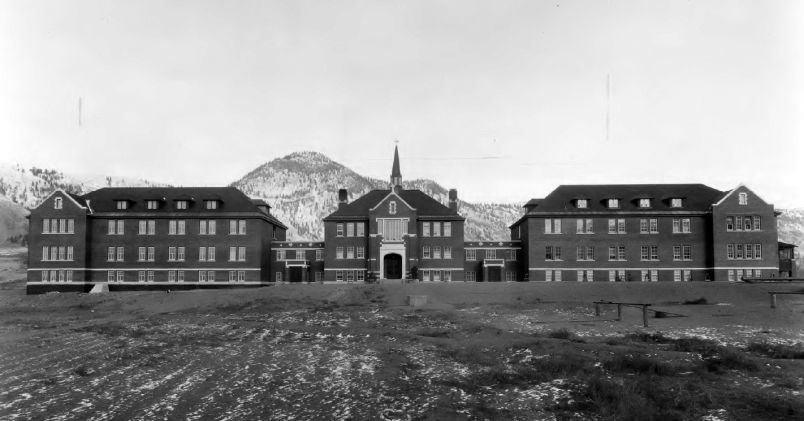
Kamloops Indian Residential School, 1930.
Photo from Archives Deschâtelets-NDC, Richelieu via Wikimedia Commons.
Let’s be honest about what is happening in this video.
This is not academic debate. It is a character attack dressed up as scholarship.
Dr. Travis Hay’s presentation at Mount Royal University, uploaded by Frances Widdowson under the title “Bad Faith: Residential School Denialism and the Academy”, is deeply disappointing. I expected a serious lecture. I expected evidence, argument, and a careful dismantling of claims he believes are wrong.
Instead, what we get is a bad faith lecture.
So yes, Bad Faith is a good title. Just not for the reason Hay thinks.
The real bad faith is pretending to defend scholarship while avoiding the hard work of open debate.
Hay spends much of the lecture drawing a line between “good faith” and “bad faith” criticism. But his standard for good faith appears to be simple: you may disagree only inside the boundaries of the approved framework. You can quibble over details. You can adjust the margins. You can offer polite corrections.
But if you challenge the premise itself, suddenly you are no longer mistaken. You are morally defective. You are a “denialist”, a “grievance merchant”, or some broken person who must be pushed outside respectable academic life.
That is not scholarship. That is gatekeeping.
None of this requires minimizing the real harm done by residential schools. It simply means historical claims should be open to examination. Evidence should be tested. Terms should be defined. Numbers should be scrutinized. Arguments should be answered.
Instead, Hay leans heavily on moral outrage, personal denunciation, and guilt by association. Rather than carefully taking apart Widdowson’s arguments, he drags in old controversies involving other people, uses emotional anecdotes, and builds a mood where the audience is being told what to feel before they are allowed to think.
The most revealing part is the conclusion. Hay says people like Widdowson do not belong in the academy. In other words, the answer to uncomfortable academic work is not better evidence, better reasoning, or open debate. It is expulsion.
That should bother everyone.
A university that cannot tolerate dissent is not protecting knowledge. It is protecting doctrine.
If Widdowson is wrong, prove it. Debate her. Bring the evidence. Take her claims apart in public. That is what serious scholars are supposed to do.
But when the response is censorship, exclusion, and personal insult, it starts to look less like confidence and more like fear.
I came away from viewing this lecture disappointed. Not because Hay disagrees with Widdowson. Disagreement is the whole point of academic life. I was disappointed because the lecture showed so little faith in the public’s ability to hear competing arguments and judge the evidence for themselves.
This lecture does not prove that Widdowson’s arguments are wrong. It proves that parts of the academy no longer know how to handle a serious challenge without reaching for moral panic and professional exile.
June 10, 2026
February 14, 2026
“People don’t need conspiracies to be absolute utter rabid bastards”
If you search here for the word “Epstein”, you won’t find a lot of relevant hits other than the reporting when he was arrested in 2019 and occasional mentions in posts on other topics. I don’t breathlessly report every little driblet of news or rumour as it floats past, because I’ve seen other moral panics play out in the past (like the Cleveland child abuse scandal back in the late 80s). Ian at The Bugscuffle Gazette has not only seen things like this before, he’s worked in law enforcement on similar (if lower-profile) cases:

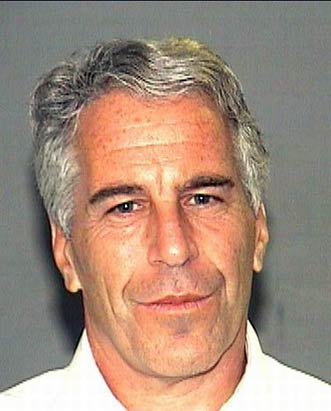
Mug shot of Jeffrey Epstein made available by the Palm Beach County Sheriff’s Department, taken following his indictment for soliciting a prostitute in 2006.
Image via Wikimedia Commons.
The Epstein Files have been released to a tremendous amount of outrage, and I find myself conflicted. There are definitely victims of that virulent parasite, but I worry they’re about to be overlooked.
I’m afraid that this whole mess is starting to remind me a great deal of the Satanic Panic of the 1980s – 1990s.
For those who may be a little too young to remember that little blot on the Copybook of History, it started with a “psychiatrist”1 who had a fondness for the woo-woo — and incredibly debunked — practice of “Recovered Memory Therapy“2, and was spark-plugged by well-meaning3, yet clueless, people who used suggestive questions and leading questions when interviewing children … and wound up with about 12,000 reports of ritual abuse of children — including, but not limited to: child sexual abuse, ritual sacrifice of children, cannibalism of children, child pornography, child prostitution, murder of children, torture of children, and incestuous orgies.
A large part of the American population became convinced that paedophiles associated with Satanism were running child care centers across the country for the express purpose of providing a steady supply of children for devil-worshipping rites.
As one might expect day-care workers and pre-schools took it in the neck … but so did fathers. The “experts” — untrained, inexperienced, unqualified — had a particular case of the ass towards fathers, with the result that several fathers spent years in prison for crimes never committed.
Yeah. Not a one of those reported 12,000 cases turned out to be substantiated. And when I say “Not substantiated” we’re talking about stuff like:
- Children were coached to testify that they had been taken to a cemetery where the graves were dug up and the corpses used for violation. It is physically impossible to dig up an entire cemetery and leave abso-bloody-lutely no trace behind.
- Children were coached to testify that a teenager with Noonan Syndrome had cut the throat of a giraffe, and used the dying corpse for ritual violations. Seriously.
- Children were coached to testify that they had been given to aliens, flown up into space, and violated.
In addition to the coaching, case files were built from statements given by diagnosed schizophrenics; anonymous statements given by people who were later tracked down and found to be — let us be precise here — flat barking bugnuts; and was fueled by the political desire to make hay, or make the other guy look bad rather than — you know — justice.
What does this have to do with the price of tea in China? Other than the fact that innocent people got dragged through the legal wringer, spent years in prison, and had their lives ruined for nothing; the mass-hysteria moral panic4 went that actual, provable cases of child molestation got short shrift.
A vast underground network of Satanic peadophiles conducting ritualistic abuse, cannibalism, and unholy rituals was far more toothsome to prosecutors, the Media, and the public at large than Uncle Badtouch.
Given the choice of making his name by becoming the hero taking on a vast international cabal of highly-connected Satanists … or the day-to-day boring grind of prosecuting the creepy dude at the park — well, District Attorneys are politicians. And politicians gotta politick. Heroes poll better than the unsung.
Which brings us to the Epstein Files.
- I use the scare quotes because he should have been struck off for his wanton destruction of families and innocent people.
- Really good at implanting false memories, not worth a bucket of warm rat spit at recovering memories.
- And let’s face it: Some ill-intentioned folks.
- This went on for years.
June 14, 2024
When propaganda wins over historical facts, Ontario public schools edition
To someone of my generation (late boomer/early GenX), the history of the Residential School system was taught, at least superficially, in middle school. Along with the early settlement of what is now Canada by the French and later the English (with a very brief nod to the Vikings, of course), we got a cursory introduction to the relationships among the European settlers and explorers and the various First Nations groups they encountered. It wasn’t in great depth — what is taught in great depth in middle school? — but we got a rough outline. In my case, details about the Residential School system came more from a “young adult” novel about a young First Nations student running away from his school and trying to find his way back to his home and family. My best friend in school had First Nations ancestry, so I felt a strong desire to understand the book and the system and culture portrayed in it.

Kamloops Indian Residential School, 1930.
Photo from Archives Deschâtelets-NDC, Richelieu via Wikimedia Commons.
If, in the early 1970s, the Ontario school system taught at least a bit about the history of the First Nations peoples, how is it possible that they stopped doing so and my son’s generation were utterly blindsided by the sensationalist treatment of the students at a particular Residential School in British Columbia? And as a result, were far more credulous and willing to believe the worst that the “anticolonialist” propagandists could come up with.
“Igor Stravinsky” is a teacher in the Ontario school system who writes under a pseudonym for fairly obvious reasons, as he’s not a believer in the modern narrative about the history of First Nations children in the Residential School system:
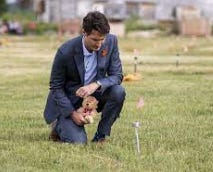
This will be my last instalment of this series. I have attempted to shed light on the poor quality of information students are receiving in Ontario schools with regard to Indigenous history and current issues. It is important to note that this is being done intentionally. It is to the advantage of the leaders of the Indigenous Grievance Industry to characterise Canada and the pre-Canadian colonies of this land as genocidal oppressors, and our politicians have exploited this situation for crass political gain. This was perhaps epitomised by Prime Minister Justin Trudeau’s photo op of himself holding a teddy bear in the proximity of a soil disturbance in a field at the site of a former residential school in Cowessess First Nation, Saskatchewan on Tuesday, July 6, 2021:
Prime Minister Justin Trudeau holding a teddy bear in Cowessess First Nation, Saskatchewan.
July 6, 2021.Are there actually human remains there? If so, of whom? Is this evidence of any kind of foul play? These are questions he was not about to bother to ask. Why would he, when such a golden opportunity to score political points presented itself?
We now know all this murdered Indigenous children stuff was a big hoax but don’t hold your breath waiting for Trudeau to issue an apology for staining the international reputation of Canada and triggering a knee-jerk vote by our Parliament declaring Canada a genocidal state and adopting the The United Nations Declaration on the Rights of Indigenous People (more on that below). Undoing all this damage will be a herculean task.
Just as students are fed simplistic, misleading, and false information about the past with regard to Indigenous people (the focus being the Indian Residential Schools) they are being presented with the point of view that human rights violations against the Indigenous people are ongoing, and are the reason for the poor quality of life in which such a disproportionate number of Indigenous people find themselves.
The claim of generational trauma
On Apr. 27, 2010, speaking as chair of the Truth and Reconciliation Commission and for the people of Canada, Sinclair told the Ninth Session of the United Nations Permanent Forum on Indigenous Issues: “For roughly seven generations nearly every Indigenous child in Canada was sent to a residential school. They were taken from their families, tribes and communities, and forced to live in those institutions of assimilation.”
This lie is promoted in the schools. It is the foundation of the generational trauma claim but in fact, during the IRS era, perhaps 30% of Status Indians (you can cut that figure in half if you include all people who identify as Indigenous) ever attended, and for an average of 4.5 years.
Even if it were true that most Indigenous people who attended the IRS suffered trauma, there is no evidence or logical reason to believe that trauma could be transferred down the generations. If generational trauma is a thing, why have the descendants of the victims of the holocaust been doing so well?
If there is generational trauma, the culprit is alcohol. Alcohol abuse has been a major problem in Indigenous communities since first contact but rarely comes up these days, certainly not in schools. Fetal Alcohol Syndrome (FAS), which occurs when a mother consumes alcohol during pregnancy, is also a major problem and the children born with it suffer from mental and emotional challenges throughout their lives. It impacts their social life, education and work. Girls who suffer from the condition all too often end up drinking during pregnancy themselves and the cycle continues.
June 3, 2024
The “mass graves” moral panic at three
In the National Post, Father Raymond J. de Souza notes the almost un-noticed third anniversary of the dramatic announcement and ensuing moral panic over claims that hundreds of unmarked graves had been discovered at the site of a former Residential School in Kamloops, BC:
This past week marked the third anniversary of the dramatic announcement that 215 “unmarked graves” had been discovered near a former residential school in Kamloops. It was a global news story which had a significant impact in Canada. It was also a great media malpractice.
Many things were reported then that were not only not true, but had not even been claimed to be true by anyone. Recall the monstrously misleading headlines about mass murder and mass graves? For example, from the Toronto Star on 28 May 2021: “The Remains of 215 Children Have Been Found”.
Not true. No one ever claimed that remains had been found. Many people assumed that the “unmarked graves” held children, but the ground-penetrating radar employed cannot reveal if a body is in the soil, let alone whether it is a child or adult.
Tales of mass murder and mass graves produced a massive moral panic. Marches were held, symbolic children’s shoes were assembled, churches were burned and vandalized, hundreds of millions were committed to investigating further mass graves, the prime minister ordered flags at every embassy abroad and federal building at home to be lowered for nearly six months, a new federal holiday was instituted, the Catholic Church issued (another) apology and Pope Francis came to visit.
How can it now be that the anniversary of something so globally momentous passed so quietly this week?
It’s because the great media malpractice has been answered by journalists, a broader category in the digital world, who provided the effective response. It’s an inspiring David and Goliath tale of how courageous, good journalism beat out conforming, bad journalism.
We can take some pride here at the National Post, for on the first anniversary we published the remarkable reporting of Terry Glavin, who demonstrated exactly how media malpractice had produced a moral panic.
But aside from that, the work was carried out by writers — academics, reporters, amateur researchers and dogged citizens — outside of the legacy media. The story unfolded in C2C Journal, Dorchester Review, True North, Western Standard, the Frontier Centre for Public Policy and Quillette.
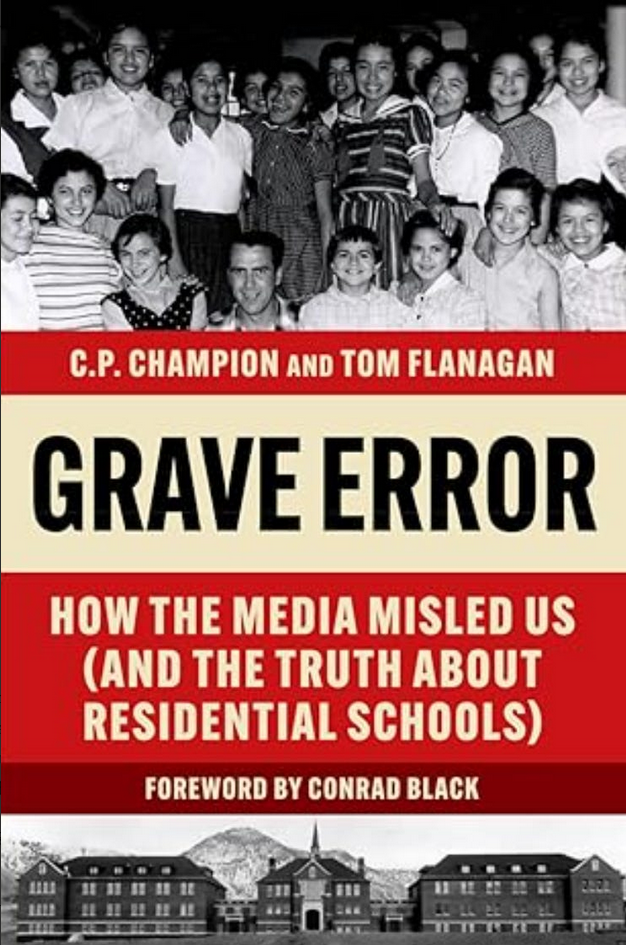
Last December, a single volume collecting much of this work was published: Grave Error: How the media misled us (and the truth about residential schools), edited by Christian Champion, founder and publisher of the Dorchester Review, and the well known academic and political player, Tom Flanagan, professor emeritus at the University of Calgary.
Those outlets which had perpetrated the original malpractice took a pass. The legacy media ignored the book, and Canada’s major book retailers did not sell it.
May 30, 2024
As everyone knows, it takes at least three years to find a shovel in Canada …
In Quillette, Jonathan Kay notes the third anniversary of the “mass graves” moral panic here in the utterly dysfunctional Dominion:

Kamloops Indian Residential School, 1930.
Photo from Archives Deschâtelets-NDC, Richelieu via Wikimedia Commons.
This week marked the third anniversary of Canada’s strange “unmarked graves” scandal — a morbid social panic that took hold of my country in late May 2021, following unverified claims that the corpses of 215 (presumably murdered) Indigenous children had been located at the site of a former school in Kamloops, British Columbia.
As I’ve already described this saga in several Quillette articles, I will not belabour the specifics (which, by now, have also been covered in the international press, as well as Canada’s National Post and Dorchester Review). Instead, this update will focus on the manner by which Canadian public figures (journalists, in particular) have tried to evade accountability for their original gullibility, as it presents an interesting case study in social psychology on a national scale.
The background here, as anyone who’s followed the story closely will know, is a genuinely shameful aspect of Canadian history — the federally funded, church-run system of residential schools established in the nineteenth century as a means to assimilate the country’s Indigenous population. In many cases, children were forced to attend boarding schools located hundreds of miles from their home reserves. Mortality rates from infectious diseases (especially tuberculosis) were tragically high, and the whole issue was properly referred to an authoritative body known as the Truth and Reconciliation Commission, which concluded that at least 3,200 children died after enrolling in residential schools. The real number might well be considerably higher.
All of this had been common knowledge in Canada for years by the time Rosanne Casimir, Chief of the Tk’emlúps te Secwépemc First Nation in Kamloops claimed to have discovered the remains of 215 Indigenous children buried on the site of the former Kamloops Indian Residential School.
In fact, she’d discovered nothing of the kind. But the Canadian media ran with the claim as if it were the proven truth. A typical headline: “Tk’emlups confirms bodies of 215 children buried at former Kamloops Indian Residential School site“.
If you don’t live in Canada, it will be hard to appreciate the national hysteria that resulted. In the press, Canada was officially anointed a nation of baby killers. Prime Minister Justin Trudeau lowered the flag on public buildings for five months. Dozens of churches were burned by arsonists in apparent acts of retribution. The word “genocide” was thrown around in casual parlance as if we were Nazi Germany or Rwanda in 1994. The Canadian Press called the discovery of these ostensible unmarked graves the 2021 “Story of the Year.”
Then the days passed, the national festival of self-laceration abated somewhat, and it began dawning on some of us that — um, wait a minute — no evidence of graves had actually been presented yet. That evidence was on its way, right?
May 5, 2024
Trudeau’s shameful role in promoting “the blood libel against Canada”
Conrad Black believes that Justin Trudeau owes Canadians an apology for his role in pushing the most extreme version of the Residential Schools propaganda:
A very well-informed friend of many years, a contemporary of mine, wrote me the other day that “The blood libel against Canada of this monstrous fiction of thousands of secretly buried Indigenous victims of residential schools may be the single worst injustice this country has suffered in our lifetimes. It is now a conspiracy of silence involving both federal and provincial governments, the RCMP (shameless and useless as ever), and the media, and ‘let’s be frank’, (quoting a Soviet diplomat many years ago whom we both always found rather entertaining in the utter nonsense he used to recite at international meetings), a large section of the public, which knows this to be a falsehood but chooses to side with the silent forces”.
Almost all readers will be aware of the tidal wave of self-mutilating hysteria that inundated this country when, on the basis of apparent anomalies detected by underground radar close to a former Indian Residential School site at Kamloops, British Columbia, a couple of years ago. Immediately, the theory took hold that thousands of native children in those schools had died because of negligence or outright homicide, were buried secretly in unmarked graves, their deaths never recorded and no account given to their families. There is no evidence to support this, yet the prime minister led the nation in an almost medieval circular mass pilgrimage of self-flagellation. In order to impress upon ourselves and the entire world the profundity of our self-humiliation, all official Canadian flags everywhere were lowered to half-mast and maintained in that condition for an unheard-of period of six months.
Parliament voted to spend $27 million to conduct the excavations necessary to verify or otherwise the existence and extent of these graves. This work could have been accomplished by a small group for a few thousand dollars, but the suggestion of actually establishing what happened set up the customary cacophony of complaints about the sacred untouchability of burial grounds, even though it was not clear that there was burial ground at the Kamloops site, and if it was it was rank speculation about who might be buried there if it was. It is not conceivable to me that the country could dress itself out in sackcloth and ashes and flay the flesh off its own back before the bemused or astonished eyes of the entire world and then produce no evidence whatever of the unspeakable outrages that allegedly occurred and gave rise to this conduct, and then simply lapse into Sphinx-like incommunicability: a pristine silence of perfect ambiguity followed a near-terminal St. Vitus dance of window-rattling ululations of national guilt, shame, and self-hate.
Kamloops Indian Residential School, 1930.
Photo from Archives Deschâtelets-NDC, Richelieu via Wikimedia Commons.Various parts of this macabre fable have been precisely and publicly put to rest: children in residential schools were not buried secretly and records were not destroyed; residential school students were accounted for and if they died while at the schools the reason was typically provided and it was almost invariably as a result of illnesses that were not as well treated in those times, and particularly tuberculosis. Beyond that, there has been silence: the febrile allegations of hideous wrongdoing vituperatively hurled at Canadian history and society – at the ancestors of English and French Canadians, at the main Christian churches, at the principal founder of our country whose distinguished name (John A. Macdonald) has been taken down from public buildings, statues of him overturned or removed, and effigies of him burned at festivities of confected righteous anger from coast to coast; all just mysteriously stopped. It is a sonic version of the celebrated poem by Shelley about the fallen monument of a once great King: “Round the decay of that colossal wreck, boundless and bare, the loan and level sands stretch far away.”
March 1, 2024
Women behaving badly on [police bodycam] video
Janice Fiamengo suggests that demands to the use of police bodycam footage involving young women being arrested for criminal behaviour is a weird bit of official white-knighting on the part of the authorities:
Moments of public outrage can be opportunities to consider deep-rooted cultural assumptions.
There’s been moral outrage lately over a popular YouTube channel called Drive Thru Tours. Launched in 2020, the channel started out by posting videos of tours through parts of New Jersey and New York. It hit paydirt last year when it began showing videos of police arrests, with titles such as “Rude 19-year-old Girl Arrested for DUI in Pullman, WA” (recommended if you want to get a flavor of the site) and “Belligerent Woman Arrested for DWI after Police Pursuit and Taken to Jail” (not recommended — very disturbing). The channel owner obtained the content — which until recently has focused exclusively on female offenders — from police bodycam recordings, now publicly available through freedom of information requests.
Bodycam footage was originally made accessible to the public so that American citizens can hold police accountable for their actions. Scrutiny of police behavior is widely considered a public good. Scrutiny of female behavior, however, is quite a different story — as responses to the channel demonstrate.
According to a small flurry of recent news reports, New Jersey police are warning that Drive Thru Tours is harming “vulnerable” young women by posting the evidence of their arrests. The bodycam footage was never intended, they protest, for such a purpose. In consequence, the Association of Chiefs of Police of New Jersey is calling for legislation against what they are describing as “online sexual predators“, and lawmakers in that state are considering a bill that would prohibit publishing the footage except within narrow parameters, including with the written consent of the subject.
Quite apart from whether such a bill is a good idea or not (I favor public access but have not given the matter serious thought), the language used in the articles is remarkable for its gynocentric sentimentality and misplaced sympathy.
One of the most vocal on the subject is Montville, New Jersey Police Chief Andrew Caggiano, who is quoted as stating that “It was never the intent of OPRA [the Open Public Records Act] to create such a platform that preys on young women and takes advantage of them at a time when they are vulnerable”. He also expressed a personal repugnance: “As a law enforcement professional and the father of three daughters, I am sickened by the fact that people are abusing OPRA to post these types of videos on social media sites”.
Given that it is not (yet) illegal to use bodycam material in the manner described, Chief Caggiano’s dramatic reaction seems overstated. One wonders in what sense the reckless and self-absorbed young people shown in these videos are “vulnerable”. Wouldn’t such language be better suited to their victims? Perhaps Caggiano knows something about his daughters that we don’t know (there is a video in which a “Cop’s Daughter Gets Arrested for DWI after Fleeing Accident Scene”): one would not normally expect a chief of police to so quickly substitute in imagination his own daughters for the inebriated and flagrantly dishonest women shown on Drive Thru Tours.
Caggiano’s bluster is, of course, all too familiar in a culture that cannot bear to hold women fully responsible for their bad actions — no matter how anti-social or potentially lethal — and must habitually frame them as innocent victims. It’s impossible to imagine such outraged sympathy being expressed for any male offenders in similar situations.
February 28, 2024
Accusations aplenty, but still no clear evidence
Michelle Stirling outlines the establishment of the North West Mounted Police (today’s Royal Canadian Mounted Police) and their role in driving out American whiskey traders and criminal gangs who had invaded the Canadian west, and the initial role of Sir John A. Macdonald in setting up the first residential schools for First Nations children:

Kamloops Indian Residential School, 1930.
Photo from Archives Deschâtelets-NDC, Richelieu via Wikimedia Commons.
It is clear that the claim of “mass graves” of children allegedly found by Ground Penetrating Radar (GPR) at the former Kamloops Indian Residential School is false. The main reason is that there is no list of names of missing persons — over the course of 113 years of Indian Residential Schools, which saw 150,000 students go through the system, some staying for a year, most for an average of 4.5 years, some staying for a decade or more and graduating, and some orphans being taken in to the school as children, then remaining to work as Indigenous staff — these many thousands of children passed through Indian Residential Schools, their parents enrolling and re-enrolling them year after year.
And there is no list of names of missing persons.
There are many claims of missing persons.
Some of these claims are quite fatuous — with one person claiming that in their Band, every family had four or five children who went missing at that school. Another person claimed that their grandfather had ten siblings disappear in that school.
If that were true, the Band would have ceased to exist.
Despite these claims, there are no missing persons records.
And every student who went to that school is documented on the Band’s Treaty rolls, in documents of the Indian Agent, in the enrollment forms at the Department of Indian Affairs, along with the student’s medical certificate for entry, and in the quarterly reports of the department.
In fact, the Indigenous population of Canada grew from about 102,358 in 1871 to now 1.8 million.
It seems that the claim of a “mass grave” on the former Kamloops Indian Residential School site was timed to “nudge” the approval of the United Nations Declaration of the Rights of Indigenous People through parliament — which it did! The bill had been “stuck” as six provinces had requested delay and clarity on key issues. Once the claim of “mass graves” surfaced — boom!
Less than a month after the “mass graves” news shot round the world, shocking the global community that Canadians — once known as international peacemakers, were actually hideous murderers of Indigenous children — UNDRIP swept through the Canadian Parliament with no objection.
A day later, China accused Canada of genocide, citing the Kamloops “mass graves” find as proof. For those of you following the concerns about China’s alleged interference in elections in Canada, this rather convenient timing might set off some alarm bells.
If anything, the RCMP should be investigating this matter on grounds of false pretences or fraud. But the RCMP appear to have transferred the investigation of the Kamloops “mass grave” to the people who claimed to have found them! Ground Penetrating Radar (GPR) can only identify “disturbances” under ground, not bodies or coffins. In fact, based on previous land use records, most likely the GPR found 215 clay tiles of an old septic trench.
October 4, 2023
QotD: The Witchburning and the “Mandate of Heaven”
Turning to more familiar Western examples, look at Germany, especially in contrast to England. Germany was on the forefront of every big social and economic change in the late Middle Ages, but you couldn’t blame their rulers for not handling it, because they didn’t have any. The minor princely states, the Electors of the Holy Roman Emperor, the Emperor himself, the Hanseatic League, and what have you — what could any of them do in the face of plagues and economic dislocations and terminal papal corruption and the massive intellectual upheaval of the printing press, even if their authority extended more than a few miles in any given direction, which it didn’t?
So they burned witches. The “European Witch Craze” of the 15th century has been a feminist bugbear for a long time, and one must naturally assume that pretty much all modern scholarship on it is uber-politicized hooey1, but it’s clear that there really were a lot of witch burnings in Germany in the 1400s. All that free-floating anxiety has to land somewhere, and since it’s pointless to blame the Margrave — he of the one decrepit castle and three square miles of territory — “witches” are a prime target. See also “the Period of the Wars of Religion” — is it any surprise that the most famous witchcraft stuff came from Germany just before the Reformation, or France in the depths of the religious wars, or England around the Civil War?
Clearly something is wrong with the universe – the Mandate of Heaven has been lost, not by any individual ruler necessarily, but by society. “Purity spirals” are also characteristic of these periods, and they quickly spiral out of control — see e.g. the Anabaptist Commune at Munster, or of course the Puritans.
Speaking of, the most famous-to-Americans example is the Salem Trials, and here we see all the trends converge. Not that the Puritans of Plymouth Bay would be so hubristic as to claim the Mantle of Heaven for themselves — Puritans were nothing if not ostentatiously self-effacing — but claim it they did, in deed if not in word, since Plymouth Bay was the closest thing one will ever get to a theocracy this side of Calvin’s Geneva (they burned their “witches”, too). And they just as clearly lost the Mandate — economic dislocations, a devastating Indian war brought about largely by their own hubristic incompetence, even a plague.
The aftermath of all this is fascinating. COVID, of course, is our new witch panic, and feel free to prognosticate on our current situation based on the life of Cotton Mather. The colony’s hottest young intellectual superstar in 1693, he went all-in on “spectral evidence” and the like, and by 1700 he was a joke on both sides of the Atlantic. So, too, with “critical race theory” and all the rest. There’s a racial awakening happening, kameraden, no doubt about that, but it has nothing to do with the eggheads’ fantasies. Those are just witch panics, and while witch panics are devastating to those caught in them, the wheel always turns sooner than later …
Severian, “Witch Trial Syndrome”, Rotten Chestnuts, 2021-01-27.
1. Which was also true of earlier scholarship, most famously Miss Murray’s The Witch-Cult in Western Europe, which is Marxist economics-level disproven, but still fervently believed by “Wiccans” everywhere.
May 30, 2023
Australia’s … deranged … attitudes to vaping
Christopher Snowden describes — because it’s impossible to actually explain — the Australian government’s hysterial and illogical attitude toward vaping:

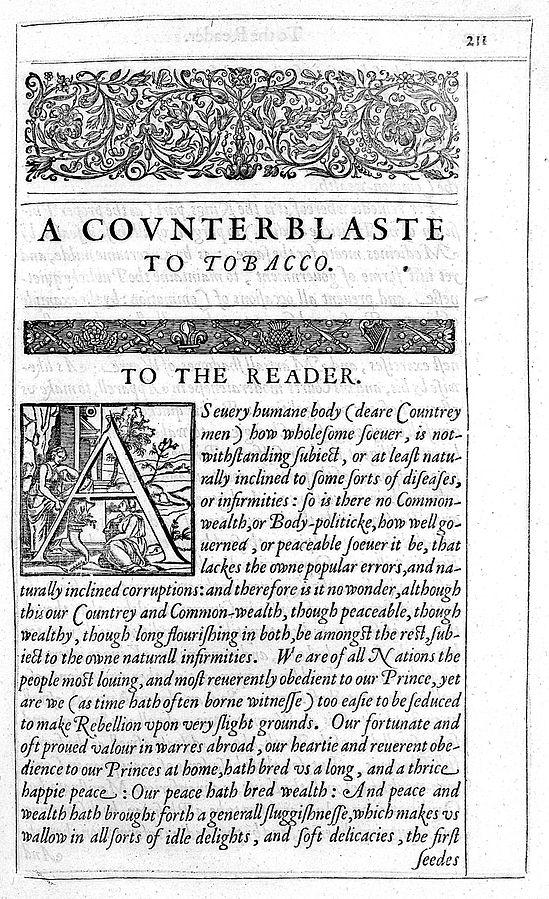
King James I would recognize and approve of Australia’s anti-vaping stance, probably. It would certainly be in the same territory as His Majesty’s pamphlet A Counterblaste to Tobacco where he let his strong feelings be known about “so vile and stinking a custom”.
For the past decade, Australian newspaper articles about e-cigarettes have seemed like communiqués from another dimension. The term “moral panic” is over-used, but how else can you describe a situation in which people are so terrified of safer nicotine delivery devices that doctors give their children cigarettes to stop them vaping?
The sale of nicotine e-cigarettes has always been banned in Australia. Prohibition is the default and, along with the highest cigarette taxes in the world, it has led to a huge black market in vapes (and, indeed, in tobacco). It appears that many teenagers are vaping there and what they are vaping is unregulated.
The Aussies could have done what New Zealand did and legalise e-cigarettes. Instead, they doubled down and banned the importation of nicotine vapes for personal use. That didn’t work so they are now banning the sale of all the remaining (i.e. non-nicotine) disposable vapes. Something tells me that won’t work either, but the government is so far down the rabbit hole it can only keep digging.
Their politicians have convinced themselves that “Big Tobacco” is getting a new generation of Aussies hooked on killer vapes with aggressive marketing. It’s a paranoid delusion. There is no e-cigarette marketing in Australia. The products flooding the black market are coming straight from China, not from “Big Tobacco”. And insofar as the products are dangerous it is because they are totally unregulated.
Down this road lies madness but if the Australians want to go down it, that’s up to them. I have no plans to go back there. As an Australian reader said to me recently, “Go and see a Kangaroo at a zoo. Don’t even waste a single dollar on ‘tourism’ of the doomed failed state of what’s become of Australia.”
But while the Aussies can go to Hell in whatever handcart they like, I don’t appreciate them pushing their nonsense on the rest of us, as the BBC’s recently appointed Sydney correspondent has done today with an article titled “Why Australia decided to quit its vaping habit“.
From the outset, it is clear that the author has spent too long Down Under.
Despite vapes already being illegal for many, under new legislation they will become available by prescription only.
The number of vaping teenagers in Australia has soared in recent years and authorities say it is the “number one behavioural issue” in schools across the country.
And they blame disposable vapes — which some experts say could be more addictive than heroin and cocaine — but for now are available in Australia in every convenience store, next to the chocolate bars at the counter.
Some experts? Do they have names? People say a lot of things. The job of a journalist is to find out which ones are telling the truth.
And if e-cigarettes are illegal, why are they available “in every convenience store”? This sounds like an enforcement issue that isn’t going to be solved by more prohibition.
March 9, 2023
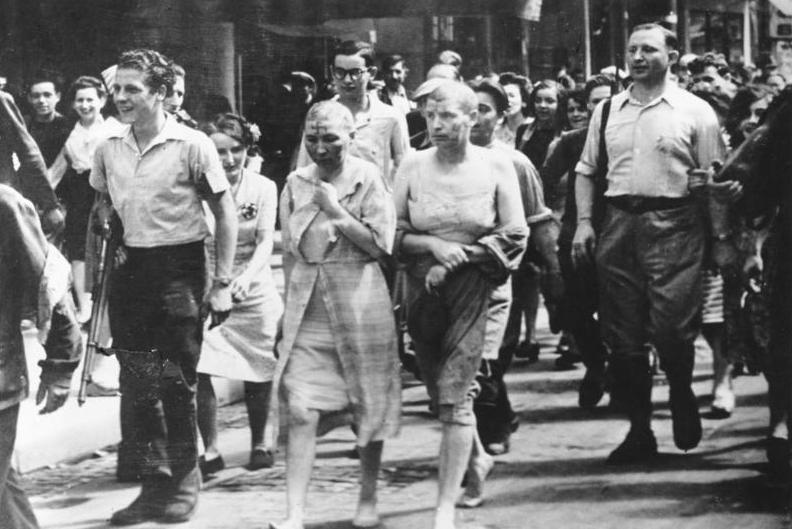
“… the French Resistance effect is beginning to appear: After the Nazis leave France, everyone says they were always with the Resistance”
Chris Bray notices what we’re not supposed to be noticing:

French women accused of collaborating with the Germans are paraded through the streets by members of the French Resistance after liberation, Summer 1944.
Original photo from the German Federal Archive via Wikimedia Commons.
Almost two years ago, with a moral panic still consuming the world and the narrative shift far in the future, the journalist Laura Dodsworth published a tough, concise, well-argued book describing the very deliberate efforts of the British government to create a widespread state of fear — that’s the title of the book, by the way — that would paralyze ordinary people and compel them to comply with harsh and repressive public health measures. You’ll be shocked to hear that she was attacked and vilified; one prominent review called State of Fear “an outrageously dumb book selling conspiracy hooey”.
Then, in 2023, Isabel Oakeshott gave us the halfwit government minister Matt Hancock’s pathetic whatsapp messages — in which he clumsily babbles about creating a state of fear to get the public to obey the government — and the rest is history. Laura Dodsworth was demeaned and defamed, and then she was vindicated.
Moral panics always fade. Manufactured crises always crack and collapse. Propaganda always has a “sell by” date, and then it turns rancid. The effect is comparable to what Warren Buffett says about a recession: When the tide goes out, you can see who’s been swimming naked.
This is where we are with the January 6 narrative, as the most horrible attack on Our Democracy™ since the Civil War collides with the image of a dork in Viking horns calmly wandering the hallways with a police escort. The political class is taking it well.
This image speaks:
That’s violent insurrectionist Jacob Chansley walking calmly through a crowd of police officers who aren’t making the slightest effort to stop him. That’s what happened. Other things also happened, and some of them involved violence and broken windows, but this is the act in the center ring of the circus. Now, the lawyer who represented this violent insurrectionist says plainly that Jacob Chansley was the victim of Brady violations, and other January 6 defendants are racing to raise the same point in court. The tide is going out.
[…]
And it seems possible to me, or rather it seems likely to me, that the French Resistance effect is beginning to appear: After the Nazis leave France, everyone says they were always with the Resistance. As narratives shift, and the moral meaning of an act during a moral panic is recoded, people may begin to remember their choices differently. We’ll see.
December 12, 2022
The “masher” in US towns and cities
Virginia Postrel wrote an article for the Wall Street Journal on how changes in US retailing in the late 19th century helped women achieve more equal status with men (non-paywalled here). Some interesting parts had to be cut for space reasons, so she’s posted them on her Substack:
As I write in the essay, urban department stores helped to liberate women:
Urban shopping districts were where women claimed the right to dine outside their homes, walk unescorted and take public transportation without loss of reputation. Thousands of female sales clerks flowed out of stores in the evenings, when downtowns had previously been male territory. Department stores provided ladies’ rooms that gave women places to use the toilet and refresh their hair and clothing. They offered female-friendly tearooms. Directly and indirectly, modern shopping enlarged women’s public role.
But as “respectable” women claimed their right to public space, they also attracted unwanted male attention:
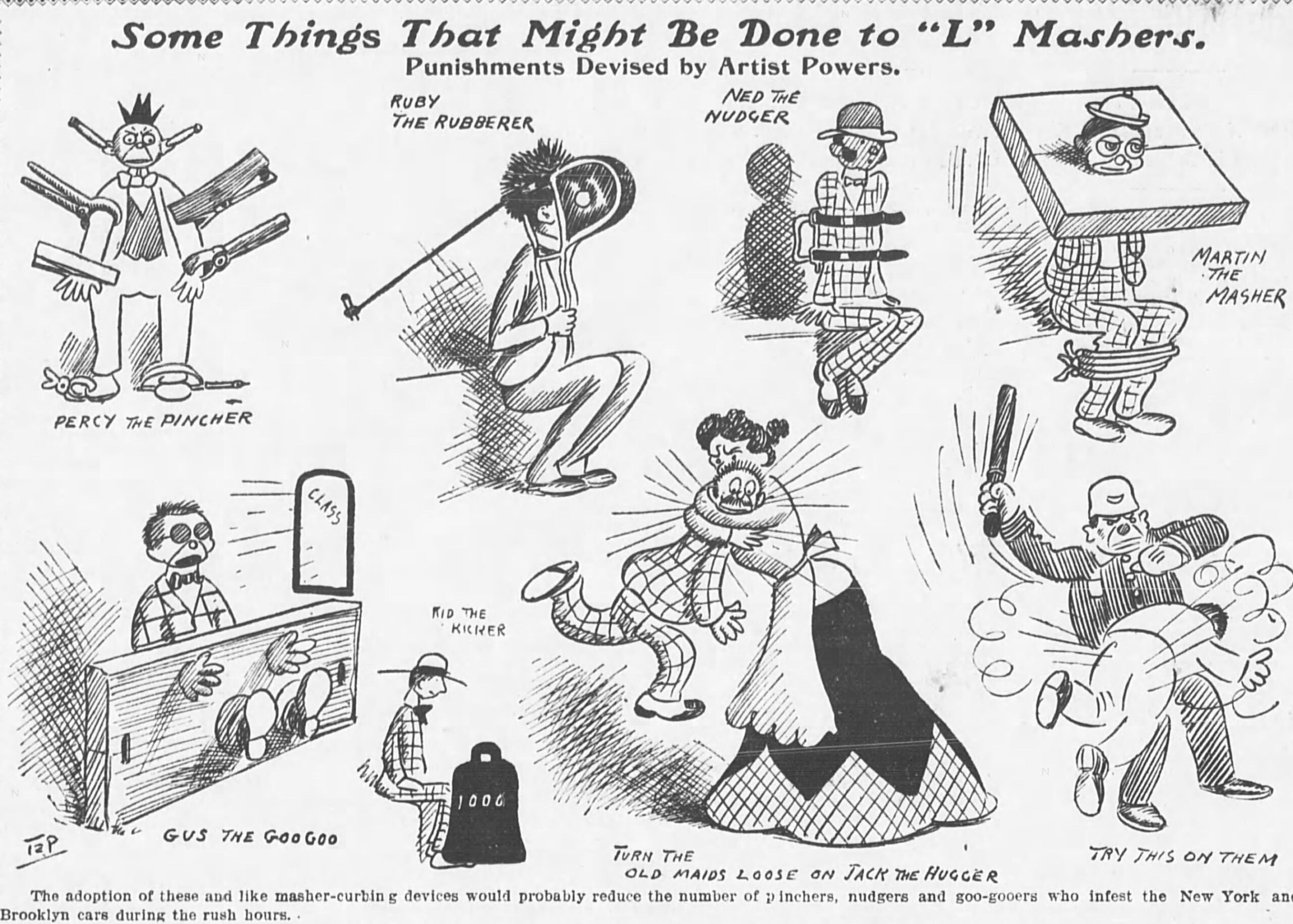
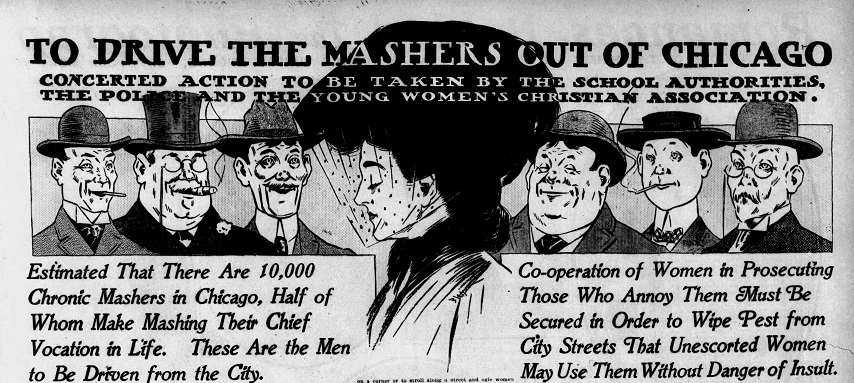
It also made sexual harassment a more prominent issue. Men known as “mashers” gathered in shopping districts to ogle and chat up women. Some were no more than well-dressed flirts, violating Victorian norms in ways that few today would find objectionable. Many contented themselves with what an outraged clubwoman termed “merciless glances”. Others followed, catcalled and in some cases fondled women as they strolled between stores, paused to look in windows or waited for trams.
This cartoon from the October 30, 1902 New York Evening World gives some idea of the public outrage toward “mashers”, in this case on streetcars.
Mores were in flux. By old-fashioned standards, everything from a friendly smile or conversation starter to stalking and groping was an insult to a woman’s virtue. Newspapers launched anti-masher crusades and prominent women demanded stricter law enforcement and stern punishment.
“No other feature of city life offers so many opportunities for making life a burden to the woman who for any reason must go about the city alone or with a woman companion,” opined the Chicago Tribune in 1907, leading a crusade against mashers. Outraged society ladies called for hard labor or public flogging as punishment. “Ogling is just as disgusting and offensive to a good woman as any other mode of attack,” declared the president of the Chicago Women’s Club.
When the Chicago police chief suggested that women avoid harassment by staying home and limiting their time in stores, he was roundly denounced by prominent women, business interests and civic leaders. A clergyman declared it “humiliating … that the authorities responsible for the maintenance of public order should feel themselves compelled to refuse the right of the road to any of the city’s citizens.” Americans increasingly assumed that women deserved the same freedom as men to move about in public — a freedom in which retailers and their suppliers had a large economic stake.
But there’s a darker side to the story that didn’t make it into the essay’s published version. The crusade against mashers, while based on a real problem, had a strong element of moral panic.
In Chicago, where the police chief was soon out of office, police won the power to arrest vagrants, including mashers, without warrants and to seek punishment by hard labor rather than fines. Crusading newspapers didn’t give mashers a chance to defend themselves. Nor did they report on the wrongly accused. In the same era that society women were calling for mashers to be publicly whipped, lynching reached its peak — often sparked by the allegation of masher-type offenses that crossed color lines.
Giving police broad powers to arrest men who made shoppers uncomfortable was an extreme solution. (Many women declined to testify in court, so prosecutions were spotty.) It did help to make streets safer for women, but so did a shift in mores that more clearly distinguished between flirtation and assault.
October 21, 2022
QotD: The real reason for Upton Sinclair writing The Jungle
In 1906, Upton Sinclair came out with his book The Jungle, and it shocked the nation by documenting the horror of the meat-packing industry. People were being boiled in vats and sent to larders. Rat waste was mixed with meat. And so on.
As a result, the Federal Meat Inspection Act passed Congress, and consumers were saved from ghastly diseases. The lesson is that government is essential to stop enterprise from poisoning us with its food.
To some extent, this mythology accounts for the wide support for government’s involvement in stopping disease spread today, including Covid and the catastrophic response.
Not only that, but the story is also the basis for the US Department of Agriculture’s food inspection efforts, the Food and Drug Administration’s regulation of medical drugs, the central plan that governs food production, the Centers for Disease Control and Prevention, and the legions of bureaucrats who inspect and badger us every step of the way. It is the founding template for why government is involved in our food and health at all.
It’s all premised on the implausible idea that people who make and sell us food have no concern as to whether it makes us sick. It only takes a quick second, though, to realize that this idea just isn’t true. So long as there is a functioning, consumer-driven marketplace, customer focus, which presumably includes not killing you, is the best regulator. Producer reputation has been a huge feature of profitability, too. And hygiene was a huge feature of reputation — long before Yelp.
Sinclair’s book was not intended as a factual account. It was a fantasy rendered as an ideological screed. It did drum up support for regulation, but the real reason for the act’s passage was that the large Chicago meat packers realized that regulation would hurt their smaller competitors more than themselves. Meat inspections imposed costs that cartelized the industry.
That’s why the largest players were the law’s biggest promoters. Such laws almost have more to do with benefiting elites than protecting the public. It was not really about safety, the best scholarship shows, but exclusionary regulation to raise competitors’ costs of doing business.
Jeffrey A. Tucker, “Poke and Sniff: A Lesson from 1906”, Brownstone Institute, 2022-06-29.