Quotulatiousness

June 10, 2026

To protect under-16s from harmful content, everyone will now need to show their ID online

Australia’s attempt to ban under-16s from accessing social media and other online sites blew up rather quickly. Britain and Canada, seeing what happened down under, chorused “Hold our beers!“:

“Automotive Social Media Marketing” by socialautomotive is licensed under CC BY 2.0

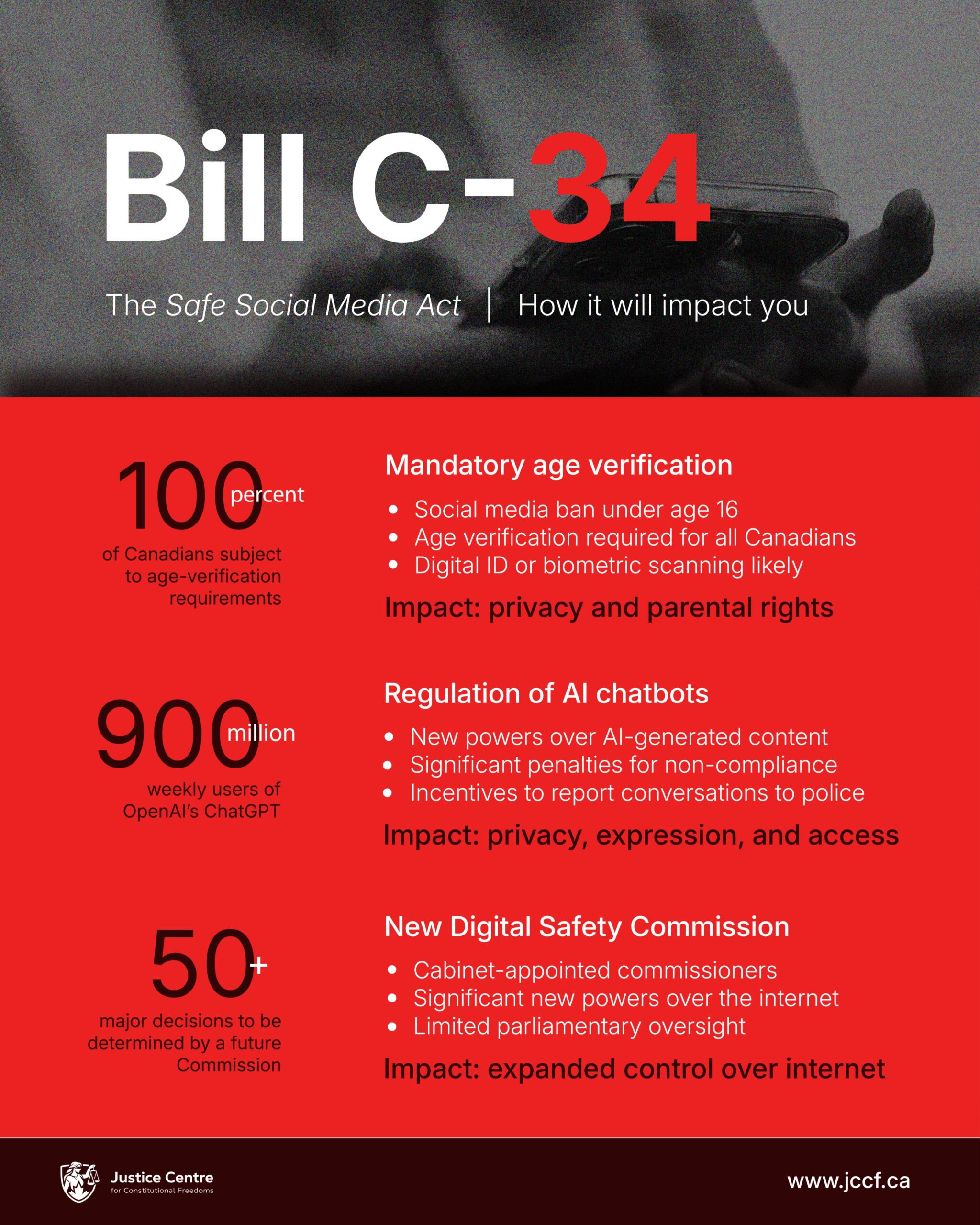
The government is expected to table the Digital Safety Act on Wednesday with reports that it will include a ban on social media for those under 16, framed as a “temporary” measure that platforms can exit once a new digital regulator certifies their safety standards. I have been writing about these issues, from the original Online Harms Act to mandated age verification and website blocking and now the kids’ ban, for several years. This FAQ gathers the analysis in one place, with links throughout to the longer pieces for anyone who wants to go deeper. The key takeaway is that a kids’ social media ban is an ineffective and harmful policy that raises privacy concerns for tens of millions of Canadians through mandated age verification requirements. The policy fails to address the underlying concerns with social media and the prospect of a “temporary” ban makes little sense since the requirement might be reversible, but the data collection and regulatory infrastructure are permanent.

What is the government reportedly about to introduce?

According to the Globe and Mail, the forthcoming bill would bar anyone under 16 from social media. The government will indicate that this is a temporary safeguard with an opt-back-in once a regulator certifies safety standards. The government will frame this as “temporary” measure, but I argue that once established, there is no putting the toothpaste back in the tube given that the policy will require a regulator and proof of age from everyone.

Didn’t this start with Bill C-63, the Online Harms Act? What happened to it?

Bill C-63 was the government’s 2024 online harms bill, and from my first-day take I described it as effectively three bills in one: a defensible set of provisions focused on platforms that featured a duty to act responsibly, more contentious Criminal Code and Canada Human Rights Act provisions, and a powerful new Digital Safety Commission modelled on the CRTC to be funded by the tech companies. My view was that the Criminal Code and Human Rights Act provisions should have been dropped or incorporated into a separate piece of legislation. Bill C-63 itself died on the order paper when Parliament was prorogued ahead of the 2025 election, but the duty-to-act-responsibly model is likely to survive as part of the forthcoming bill.

Why is a kids’ social media ban bad policy?

I set out at least six reasons in this post on the issue. The most important is the first: the harms people associate with social media, such as algorithmic manipulation, addictive engagement design, weak content moderation, inconsistent enforcement, inadequate transparency, and privacy risks, affect users of every age. Treating them as a children’s problem misidentifies both the source of the harm and the right target of regulation. By focusing legislative attention on who is permitted to use social media rather than on how the platforms operate, an age-based ban lets legislators and the companies off the hook from more effective broad-based regulation. The other reasons identified in the post include the absence of evidence that bans work, the privacy harms they create, and the constitutional rights of the children they claim to protect.

Does the ban actually work?

The evidence to date says no. Australia’s under-16 ban took effect in December 2025, and the eSafety Commissioner’s first compliance report found that roughly 70 per cent of children who had accounts before the ban retained access to at least one platform three months later, with no discernible reduction in cyberbullying or image-based abuse complaints from under-16 users. Children route around age gates through VPNs, borrowed accounts, and false birthdates, and the most at-risk users are the most likely to circumvent them. Professor Lisa Given laid out much of this on a Law Bytes episode before most of the data was even in. Canadian politicians now citing the Australian approach with approval are pointing to a model whose own regulator’s data suggests has thus far proven ineffective. At a recent Canada 2020 event in Ottawa, Australian professor Amanda Third confirmed that kids are actively circumventing the ban and indicated that parents are concerned that their children are now less safe.

Doesn’t polling show overwhelming public support for a ban?

The headline number is real but misleading. The March 2026 Angus Reid Institute survey found that three-quarters of respondents support a full ban on social media for those under 16, and politicians have cited it repeatedly. But as McGill’s Sara Grimes documented on this Law Bytes podcast episode, the less-quoted numbers in the same survey complicate the picture: 72 per cent said parents, not governments, should be primarily responsible for regulating teens’ social media use, only 32 per cent picked 16 as the right threshold, and the survey did not ask respondents anything about the mechanism any ban would actually require. Simply put, public support for “protect kids from harm” is not the same as public support for “every Canadian must submit ID to a third-party provider in order to use the internet”.

Hasn’t social media been proven harmful to kids?

The data on social media harms to kids is far more mixed than is often portrayed in the media and in Jonathan Haidt’s Anxious Generation book that has fuelled much of the legislative panic. Grimes has produced a very accessible explainer on the issue that walks through the science. As she notes in Panic First, Evidence Later, “there is a serious problem. Researchers who have spent their entire careers studying adolescent mental health, children’s digital media, developmental science, and media psychology – the people who actually built the evidence base Haidt draws on – have raised sustained, substantive objections to his core claims.”

Read all of Michael Geist’s FAQ here.

June 5, 2026

QotD: Modern men and the need for male spaces

Filed under: Health, Humour, Quotations — Tags: , , , — Nicholas @ 01:00

Many internet men have pointed out the dwindling of male spaces, while internet women cheer for their disappearance.

Internet men believe that some kind of man-space is essential. A place for men to be men, mentor other men, and tell younger men the secret wisdom to get their lives on track. That if only we had these spaces, everything would be great for men because we’d all know the secret wisdom that doesn’t actually exist.

Internet women believe that male spaces are dens of misogyny. Places where trollish men want to gather, away from the eyes and ears of right-thinking people, so they can poison other men with hate and bigotry.

Which is silly. Men don’t hate women because other men told them to. They see women being women, and that does the trick just fine. In fact, if a man is getting hourly blowjobs from every woman whose path he crosses, then some group of troll men try to tell him women suck, he’d be confused at how uninformed these men are when women are clearly awesome.

Women’s behavior is the number-one driver of misogyny. Not men telling other men women suck.

And that’s the point of male spaces. Not secret manly-man wisdom, not chattering about woman-hate. A space where men can just be. Without women there.

Women are … a certain way.

This is especially true of middle-class and richer women, and even a little more true of white women than other kinds. But true of all women to some extent.

Women have this way about them — everything they do, say, everything about how they behave — that just subtly communicates that they do not have a lot of experience with consequences. That they are just not that used to considering consequences seriously before doing something.

I’m usually hesitant to use political buzz-words in a non-ironic way, but I think the term “privileged” is pretty perfect for this situation.

A woman’s reality — her experience — is a world where consequences just aren’t quite as big of a deal for her as they are for others. She’s never really had to consider consequences with quite the same intensity.

It’s important to note that this isn’t some kind of overt, intentional flaunting as women stride around, consequence-free, thumbing their noses at us. Women don’t even know this is a thing. They’ll deny it fiercely if you tell them. They don’t feel privileged, and their feelings are always real. They’ll even tell you that you’re the privileged one, not them. Because that feels right to them.

It’s not something they do on purpose, and it’s not even that frontal and pronounced. It’s very subtle. Just this subtle way that women are. When they talk, act, make decisions.

This makes them very irritating. Even women find each other irritating.

Archwinger, “Male spaces are because women are irritating”, Archwinger’s Substack, 2026-02-25.

May 29, 2026

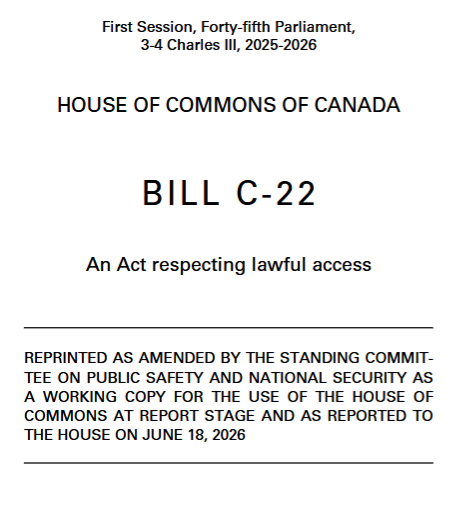
Debunking the “it’s just phone book information” claim for Bill C-22

Michael Geist explains why the “it’s just phone book information” hand-waving by politicians and government officials is worse than misleading: it’s deliberate mendacity.

en telefonbog (a Danish telephone directory)
Photo by Tomasz Sienicki via Wikimedia Commons

If this sounds familiar, it is because the same tired claims have been used for years. In September 2011, then-Public Safety Minister Vic Toews defended the Harper government’s lawful access proposals by claiming “linking an internet address to subscriber information is on par with the phone book linking phone numbers to an address”. Christopher Parsons, then a researcher at the Citizen Lab, responded with a detailed anatomy of what a lawful access “phone record” actually contained, showing that the three-field directory entry the government was invoking was being used to describe an eleven-field record including IP addresses, IMEI and IMSI numbers, SIM serials, device identifiers, and account information from multiple providers, any one of which could be cross-referenced to build a comprehensive profile of a person’s online life.

The Supreme Court of Canada put the issue to rest in the Spencer decision, holding unanimously in 2014 that there is a reasonable expectation of privacy in subscriber information precisely because the disclosure of such information “will often amount to the identification of a user with intimate or sensitive activities being carried out online, usually on the understanding that these activities would be anonymous”. It returned to the same terrain in Bykovets in 2024, extending Charter protection to IP addresses on the reasoning that an IP address is the “first digital breadcrumb that can lead the state on the trail of an individual’s Internet activity”.

Bill C-22’s new subscriber information production order applies a low evidentiary standard but covers name, pseudonym, address, telephone number, email address, account identifiers, types of services provided to the subscriber, the period during which they were provided, and information that identifies the devices, equipment, or things used by the subscriber in relation to those services. In short, a modern subscriber record is not a phone book entry but rather an index of a person’s digital life and the government is proposing to reduce the standard needed to gain access to that information.

Moreover, the same phony framing is now being stretched beyond subscriber data to mandatory metadata retention. As Conservative MP Andrew Lawton noted to Fraser at committee, the government and its officials have been telling Canadians that requiring electronic service providers to retain metadata for up to a year is “no different than just having a copy of the phone book that someone could leaf through”. That is a laughable comparison, given that metadata includes the date, time, duration, and type of a communication, the identifiers of the devices involved, and information identifying the location of the device. It is as if the phone book would include the details of every call made including location, call recipient, and device. And given retention for up to a year, the plan poses a disproportionate privacy risk that is likely to be struck down as unconstitutional by the Supreme Court, should it survive in its current form.

And in a follow-up post, he writes:

On encryption, Anandasangaree said the bill “was never meant to breach encryption” and promised to “clarify it in the Bill”. Language clarification is welcome but structural problems remain. The safeguards in Bill C-22 at ss. 5(5) and 7(5), which state that a provider is not required to comply if compliance would create a systemic vulnerability, are incompatible with s. 12, which unconditionally requires compliance with orders, and with s. 13, which specifies that orders prevail over regulations when inconsistencies arise. The term “systemic vulnerability” is not defined in the statute, and the Governor in Council has the power to make regulations “respecting the meaning of any term or expression for the purposes of this Act”. None of this is fixed by promising clearer language. It is fixed by the kind of amendment the Privacy Commissioner proposed this week, namely adopting Australia’s definition, which expressly covers actions that render encryption less effective, together with an explicit prohibition on regulations or orders that require the introduction of, or prevent the rectification of, a systemic vulnerability.

Moreover, Anandasangaree’s defence of the bill’s privacy implications was a deflection rather than an answer, as he tried to turn the attention to the privacy practices in the private sector, stating, “I drive a vehicle where every single point that I drive to is tracked. And that data is not with me.” Commercial data practices are indeed a real concern and Canada needs stronger laws to address them. However, the bill’s surveillance map of every Canadian is not justified by pointing to the absence of meaningful constraints on data collection and to the failure of his own government to address long-overdue private-sector privacy reform.

That brings the press conference back to the Privacy Commissioner. Asked directly whether he would accept Commissioner Philippe Dufresne’s amendments, the Minister said he would “be looking at” them and “looking to see what he has to offer”. Dufresne tabled eight concrete amendments at committee on Tuesday: narrowing subscriber information to a closed list (name, address, telephone number, IP address), restricting who can be compelled to telecommunications service providers, defining “publicly available information” to exclude information in which a person has a reasonable expectation of privacy, an overarching requirement that SAAIA obligations be necessary and proportionate, an Australian-style amendment to “systemic vulnerability”, an explicit prohibition on orders requiring vulnerability introduction or preventing rectification, an exemption to the SAAIA’s confidentiality rules to allow disclosure to regulatory bodies such as the OPC, and allowing his office to investigate if data breaches result from application of the new powers. Anandasangaree’s comments, coming a day after the Dufresne’s committee appearance, noted that “we have until like five o’clock today” for amendments. That window does not leave room to seriously consider the Commissioner’s recommendations. The “I will be looking at” claim, delivered hours before the deadline, amounted to a rejection of the recommendations.

November 16, 2025

3D printing and firearms

Filed under: Liberty, Technology, USA, Weapons — Tags: , , , , — Nicholas @ 03:00

On the social media site formerly known as Twitter, ESR discusses a recent user notification from one of the 3D printer companies to their users:

I’m told that 3D printed gun parts are far more sophisticated than this Liberator from 2013, but I’m sure nobody would actually do that, right? It would draw the attention of various government agencies for sure.

The recent flap about FlashForge attempting to forbid its customers from printing gun parts means it’s time for another reminder about technological risk.

Their weasel-worded climb-down carefully avoids stating that they never collect data on what you print. They only say they don’t collect data during your prints. The wording is so careful that I think we can conclude they do in fact ship telemetry on your print jobs when g-code arrives at the printer, immediately before printing.

So I repeat a warning I’ve given previously: never buy a 3D printer that requires an internet connection to function. And, always assume that if the printer’s firmware isn’t open-source, it is written to spy on you and could at any time prevent you from printing disapproved objects.

Oh, and never trust FlashForge again or buy their products, no matter how much groveling they do. After this, it’s safest to assume that anything they say about respecting the privacy and autonomy of their customers will be a lie. Hear that, @ff3dprinters
?

We need to make a public example of FlashForge. Other vendors need to hear that shit like this will not be tolerated, that attempting to constrain what their customers print will do them permanent and irreversible damage.

It’s possible that this was merely a blunder on FlashForge’s court, and the attempts they’ve made so far to recover are compounding blunders, but they have sincerely repented of trying to control their customers. That’s too bad; in order to create the right incentives bearing on the future behavior of other vendors, we must show no mercy. We must make them hurt – ideally, to the point of being driven out of business.

And really these warnings apply to all “smart” devices, not just 3D printers. Unless you can audit the source code, the only safe assumption to make is that the firmware is spyware, controlware, and malware.

Device vendors need to know that we do not forgive, and will not forget.

In response, Hopalong Ginsberg posted this helpful item:

October 3, 2025

Adding digital ID to the pocket moloch … what could possibly go wrong?

Filed under: Britain, Bureaucracy, Government, Liberty, Technology — Tags: , , , , — Nicholas @ 03:00

On Substack, Andrew Doyle explains why it’s a terrible idea to trust the government — any government — in forcing digital ID on everyone:

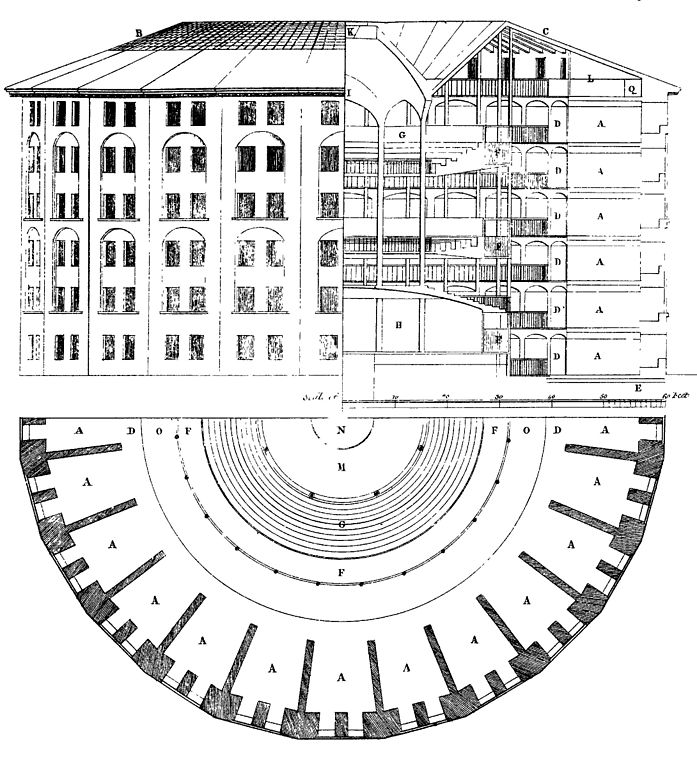
An illustration of Jeremy Bentham’s Panopticon prison.
Drawing by Willey Reveley, 1791.

During a trip to Russia in 1785, the philosopher Jeremy Bentham sketched an outline for a new prison design. The cells were arranged around the circular perimeter and, at the centre, he placed his “panopticon”: a watchtower which afforded a view of any of the cells at all times. The prisoners might not always be being observed, but they could never be sure that they weren’t.

Bentham’s design was never directly used, but the idea took hold as a symbol of state overreach and control, most famously in Michel Foucault’s Discipline and Punish (1975). Foucault was alert to the political ramifications of such a concept, and how surveillance might become an internalised experience. With Keir Starmer now pledging to introduce a digital ID system as a mandatory condition for the right to work, are we seeing the first step towards the realisation of Bentham’s vision?

I suppose we are already there. I have seen friends switch off their phones before discussing politically sensitive issues, genuinely convinced that digital eavesdropping is the norm. Many people are mistrustful of the “Alexa” voice assistant, which they are persuaded is recording their every word. While this all seems terribly conspiratorial, I’m sure most of us remember those reports a few years ago about the Pegasus spyware which had been covertly installed on the phones of journalists and government figures, turning the devices into pocket spies.

[…]

Few will be surprised to hear that public trust in political institutions has plummeted. The increasingly authoritarian tendencies of successive governments, our two-tier policing system, public manipulation as embodied in the “nudge unit”, and the corrupt prioritisation of the interests of the political class over the people they serve – perhaps best demonstrated by parliament’s flagrant efforts to overturn the Brexit vote – have all contributed to this climate of mistrust. The bizarre overreach of police during the lockdowns – in which dog walkers were publicly shamed with drone footage, and shopping trolleys were probed for “non-essential items” – has hardly helped matters.

To many of us, it is baffling that anyone at all would support the prospect of the government keeping track of our movements and holding our private details in a database. Starmer claims that the scheme will curb illegal immigration, but we are talking about criminals who already work outside the system and will doubtless continue to do so. Besides, identity cards have been a reality on the continent for years, and have done precisely nothing to resolve the problem. Employers in the UK are already legally obliged to insist on proof of immigration status from workers.

Labour’s digital ID scheme seems more about control than anything else. The possibility of fraud is also a major concern. It’s not as though the government has an unblemished track record of preventing data breaches. We all recall the massive leak of official MOD data regarding Afghans who had worked with the British government during the UK’s military campaigns. And who could forget the senior civil servant who, in 2008, left top-secret documents concerning al-Qaeda and Iraq’s security forces on a train from London Waterloo? Are we really to suppose that the creation of an all-encompassing centralised database will not leave the public open to risk from hackers and hostile foreign powers?

Tim Worstall adds that “they c’n fuck off ‘n’ all”:

So we’ve that wet dream of Tony Blair raising its ugly head again. There should be a national ID system. Actually, it’s not just Blair, T — the bureaucracy has been right pissed at the erasure of the wartime system since the 50s when it was abolished.

For there are two ways of looking at, thinking about, the whole governance thing. One is — the Blair, bureaucrats’, version — that the population are cattle, kine, to be managed. For the benefit of the bureaucracy of course — or at very least to be forced into doing what the bureaucracy thinks they — we — should be doing.

Then there’s that stout Englishman, the Anglo Saxon, version, which is that government are just the slaves we communally hire to make sure the bins get emptied. Well, OK, maybe raise a bit of tax for a Royal Navy to sink the Frenchies. But even then, not too much of that — the Civil War was, after all, triggered by Ship Money. Did the people who would not be slaughtered by the first wave of invading Frenchies — because they had the silly excuse of living 25 miles inland — have to pay the tax to run the Royal Navy to keep the Frenchies at bay or not? The King said yes — the King was right — and not for the first nor last time in British political history the guy who was right had his head cut off for being so.

Digital ID, so which version should we have? That one beloved of Froggie-type bureaucrats who view La Profonde as kine to be corralled? Or the Anglo Saxon version where we just devolve the scut work to a few slaves?

[…]

The reason this never will be proposed is that it doesn’t fit the reasons why our rulers wish to have an ID system. They’re insistent that we be their kine rather than they our. So, the Hell w’ ’em.

But it could be done. Government simply publishes an interface — an API — which says that proof of identity needs to be presented in this format. We’re done as far as whose kine is whose.

Update 4 October: From Samizdata, another illustration of just how toxic Two Tier Keir has become to British voters:

The Guardian reports:

    “Reverse Midas touch”: Starmer plan prompts collapse in support for digital IDs

    Public support for digital IDs has collapsed after Keir Starmer announced plans for their introduction, in what has been described as a symptom of the prime minister’s “reverse Midas touch”.

    Net support for digital ID cards fell from 35% in the early summer to -14% at the weekend after Starmer’s announcement, according to polling by More in Common.

    The findings suggest that the proposal has suffered considerably from its association with an unpopular government. In June, 53% of voters surveyed said they were in favour of digital ID cards for all Britons, while 19% were opposed.

July 31, 2025

The intent of Britain’s Online Safety Act … and the actual implementation

In The Conservative Woman, Dr. Frederick Attenborough discusses the gap between what the Online Safety Act was intended to do and how it’s actually being enforced now that it’s the law of the land:

X posts like this may not be visible to uses in the UK under the age verification rules of the Online Safety Act.

At the heart of the regime is a requirement to implement “highly effective” age checks. If a platform cannot establish with high confidence that a user is over 18, it must restrict access to a wide category of “sensitive” content, even when that content is entirely lawful. This has major implications for platforms where news footage and political commentary appear in real time.

Ofcom’s guidance makes clear that simple box-ticking exercises, such as declaring your age or agreeing to terms of service, will no longer suffice. Instead, platforms are expected to use tools such as facial age estimation, ID scans, open banking credentials and digital identity wallets.

The Act also pushes companies to filter harmful material before it appears in users’ feeds. Ofcom’s broader regulatory guidance warns that recommender systems can steer young users toward material they didn’t ask for. In response, platforms may now be expected to reconfigure their algorithms to filter out entire categories of lawful expression before it reaches underage or unverified users.

One platform already moving in this direction is X. Its approach offers a revealing – and potentially sobering – glimpse of where things may be heading. The company uses internal signals, including when an account was created, any prior verification, and behavioural data, to estimate a user’s age. If that process fails to confirm the user is over 18, he or she is automatically placed into a sensitive content filtering mode. As the platform’s Help Center explains: “Until we are able to determine if a user is 18 or over, they may be defaulted into sensitive media settings, and may not be able to access sensitive media”.

This system runs without user opt-in and applies at scale. Depending on how X classifies it, filtered material may include adult humour, graphic imagery, political commentary or footage of violence. Already there are signs that lawful content is quietly being screened out.

One example came on July 25, the day the Act’s age-verification duties took effect, during a protest outside the Britannia Hotel in Seacroft, Leeds, where asylum seekers are being housed. A video showing police officers restraining and arresting a protester was posted on X, but quickly became inaccessible to many UK-based users. Instead, viewers saw the message: “Due to local laws, we are temporarily restricting access to this content until X estimates your age”.

West Yorkshire Police denied any involvement in blocking the footage. X declined to comment, but its AI chatbot, Grok, indicated that the clip had been restricted under the Online Safety Act due to violent content. Though lawful and clearly newsworthy, the footage was likely flagged by automated systems intended to shield children from real-world violence.

In The Critic, Christopher Snowdon explains the breakdown of trust between the British public and their government that the implementation of the Online Safety Act only exacerbates:

People are right to be concerned about this slippery slope and yet it cannot be denied that it is pornography enthusiasts who have been hardest hit by the Online Safety Act in the short term. They must now verify themselves in one of three ways, each less appealing than the last. They can submit their credit card details, they can scan in proof of ID, such as a passport, or they can take a photo of their face and allow AI to judge how old they are. If they want to maximise their chances of being the victim of blackmail and identity theft, they could do all three.

While we might not think twice about submitting our credit card details to Amazon or posting our photos on Instagram, there is an understandable reluctance to hand over private data in order to access dubious websites for the purposes of sordid acts of self-pollution. The government assures us that the data will be kept confidential but it is only two weeks since we learned about a data breach that led to the names of 19,000 Afghans who wanted to flee the Taliban being given to the Taliban and it is less than two months since the names and addresses of 6.5 million Co-op customers were stolen in a cyber-attack. Rightly or wrongly, millions of British plank-spankers and rug-tuggers do not wish to identify themselves to anybody.

The result is a surge in interest in Virtual Private Networks (VPNs) which allow internet users to access websites as if they were in a less censorious country. Half of the top ten free apps in Apple’s app download charts yesterday were for VPNs. Google Trends data show that searches for “VPN” have gone through the roof since Friday. Readers can draw their own conclusions from the fact that these searches have been peaking between midnight and 2am.

Downloading random VPNs comes with risks of its own and opens up a whole new world of illicit online activity from free Premier League football to the Dark Web. But there is a deeper reason to feel uneasy about this unintended, albeit predictable, consequence of paternalistic regulation. By driving another wedge between the state and the individual, it further normalises rule-breaking in a country where casual lawlessness is becoming part of daily life. A law-abiding society cannot long endure if the median citizen thinks that the law is an ass.

The breakdown of trust can be seen most clearly when the ordinary man or woman does not share the moral certainties of the governing class. Among smokers, a collapse in tax morale — the intrinsic motivation to pay taxes — has led to a huge rise in the consumption of illegal tobacco in recent years. Smokers no longer feel any obligation to pay taxes that are designed to impoverish them to a government that vilifies them. Cannabis smokers learn from an early age to be suspicious of a police force that they might otherwise respect. Motorists who are faced with 20mph speed limits that were introduced by people who hate private transport have no scruples about flouting the law.

July 22, 2025

Age verification schemes are just another attempt to control everyone’s internet usage

Filed under: Britain, Government, Law, Technology — Tags: , , , , , , — Nicholas @ 03:00

Marian Halcombe is specifically discussing the British age verification provisions of their Online Safety Act, but similar schemes are popping up all over the west, and they’re only pretending to be about protecting young people from online content:

“Privacy” by g4ll4is is licensed under CC BY 2.0 .

The British State, in its infinite filth and hypocrisy, would like you to believe that it is deeply concerned about what you do with your penis. Or more precisely, what you look at while your hand is on it. The latest wheeze — part of the Online Safety Act — is mandatory age verification for all pornographic websites. We’re told it’s to stop children from seeing naughty videos. In reality, it’s a spyware regime disguised as child protection, devised by a ruling class that snorts coke with one hand while signing surveillance warrants with the other.

Let’s start with the pretence. No one in Westminster cares what children watch online. These are the same people who presided over the industrial-scale rape of working-class girls in Rotherham, Telford, Rochdale, and elsewhere — refusing to intervene for fear of “racism”. The idea that they now lie awake worrying about a Year Eight boy glimpsing a MILF thumbnail on Pornhub is an insult to the intelligence. They don’t care about children. They care about you.

The age-verification scheme isn’t just about proving you’re eighteen. It’s about linking your name and your age, and your IP address to your viewing habits. Whether it’s ID upload or facial recognition or some third-party database, the outcome is the same: a digital file that knows what you watch and when you watch it.

In a normal country, this would be recognised as deeply perverse. In ours, it’s dressed up as safety. The State that can’t fix the trains, that can’t keep the hospitals clean, now wants the power to log whether you’re big-enders or little-enders. And all under the banner of protecting the kiddies.

Yes, of course it’s technically possible to anonymise verification. But only if you believe that governments, regulators, and their corporate collaborators are incapable of abuse. That’s a belief I do not share. This is the same British government that let GCHQ harvest your webcam feeds and your phone calls under the TEMPORA programme. You didn’t vote for that. You weren’t told about it. You found out because Edward Snowden blew the whistle.

Do you really think the same regime won’t take an interest in which adult videos you watch? Anyone with an ounce of memory knows how this goes. Every intrusive policy begins with “think of the children”. The Video Recordings Act. The Dangerous Dogs Act. The Terrorism Act. And now the Online Safety Act. Once the infrastructure is in place, it never stays limited to its original purpose.

The definition of “harmful content” is vague for a reason. It can grow. It can stretch. Today it’s Pornhub. Tomorrow it’s Twitter. Then it’s dissident blogs, pro-life websites, or even a dodgy meme about immigration statistics. In the end, the target isn’t porn — it’s dissent.

July 10, 2025

Mandatory online age verification

Michael Geist discusses the rush of the Canadian and other governments in the west to try to impose one-size-fits-all age verification schemes on the internet:

The Day I Knew I Was Old 😉 by artistmac CC BY-SA 2.0

When the intersection of law and technology presents seemingly intractable new challenges, policy makers often bet on technology itself to solve the problem. Whether countering copyright infringement with digital locks, limiting access to unregulated services with website blocking, or deploying artificial intelligence to facilitate content moderation, there is a recurring hope the answer to the policy dilemma lies in better technology. While technology frequently does play a role, experience suggests that the reality is far more complicated as new technologies also create new risks and bring unforeseen consequences. So too with the emphasis on age verification technologies as a magical solution to limiting under-age access to adult content online. These technologies offer some promise, but the significant privacy and accuracy risks that could inhibit freedom of expression are too great to ignore.

The Hub runs a debate today on the mandated use of age verification technologies. I argue against it in a slightly shorter version of this post. Daniel Zekveld of the Association for Reformed Political Action (ARPA) Canada makes the case for it in this post.

The Canadian debate over age verification technologies – which has now expanded to include both age verification and age estimation systems – requires an assessment of both the proposed legislative frameworks and the technologies themselves. The last Parliament featured debate over several contentious Internet-related bills, notably streaming and news laws (Bills C-11 and C-18), online harms (Bill C-63) and Internet age verification and website blocking (Bill S-210). Bill S-210 fell below the radar screen for many months as it started in the Senate and received only cursory review in the House of Commons. The bill faced only a final vote in the House but it died with the election call. Once Parliament resumed, the bill’s sponsor, Senator Julie Miville-Dechêne, wasted no time in bringing it back as Bill S-209.

The bill would create an offence for any organization making available pornographic material to anyone under the age of 18 for commercial purposes. The penalty for doing so is $250,000 for the first offence and up to $500,000 for any subsequent offences. Organizations can rely on three potential defences:

  1. The organization instituted a government-approved “prescribed age-verification or age estimation method” to limit access. There is a major global business of vendors that sell these technologies and who are vocal proponents of this kind of legislation.
  2. The organization can make the case that there is “legitimate purpose related to science, medicine, education or the arts”.
  3. The organization took steps required to limit access after having received a notification from the enforcement agency (likely the CRTC).

Note that Bill S-209 has expanded the scope of available technologies for implementation: while S-210 only included age verification, S-209 adds age estimation technologies. Age estimation may benefit from limiting the amount of data that needs to be collected from an individual, but it also suffers from inaccuracies. For example, using estimation to distinguish between a 17 and 18 year old is difficult for both humans and computers, yet the law depends upon it. Given the standard for highly effective technologies, age estimation technologies may not receive government approvals, leaving only age verification in place.

June 5, 2025

The Liberals believe this time they’ll keep kids away from internet porn

Filed under: Cancon, Government, Liberty, Media, Technology — Tags: , , , , , , — Nicholas @ 03:00

Sometimes it’s hard to get a grip on what Liberals actually believe, as on the one hand they’re actively resisting pulling literal pornography out of school libraries (because it’s “LGBT friendly”) and on the other hand, they’re all gung-ho for yet another attempt to pass legislation that will try to prevent kids from seeing porn on the internet:

How does a website automatically, “responsibly” prove someone’s age down the end of an internet connection, without actually verifying their ID? Answer: It doesn’t. Obviously

There is another legislative effort afoot to keep Canadian children away from pornography. It’s well-intentioned effort, I suppose, but such efforts didn’t work very well when pornography was printed on glossy paper and distributed on VHS tapes and pay-per-view, so it seems particularly improbable in the internet age.

Bill S-209 is Independent (Liberal-appointed) Senator Julie Miville-Dechêne’s second attempt at a private member’s bill on the topic. It is predicated on the notion that it’s easier to verify age automatically than it used to be: “Online age-verification and age-estimation technology is increasingly sophisticated and can now effectively ascertain the age of users without breaching their privacy rights”, the bill’s preamble avers.

It is absolute rubbish, to the extent that even the Liberals under former prime minister Justin Trudeau seemed to realize it the first time it was tried. We can only hope Mark Carney’s Liberals are of similar mind. Early signs are not positive. The reappointment of Steven Guilbeault as heritage minister (now called Canadian identity and culture minister, for some reason) doesn’t bode well. He seems genuinely to dislike the online world on principle.

Or, maybe it does bode well. Guilbeault did a singularly terrible job trying to sell the Liberals’ anti-internet agenda in English Canada. I’m not sure he could give away ice cream in a Calgary heatwave. So if you think laws targeting “online harms” are doomed to fail at best — and could lead to dystopian outcomes — then maybe Guilbeault is exactly the fellow you want in charge.

When it came to online porn, the Trudeau Liberals seemed to have some sense of the Sisyphean proposition before them. Miville-Dechêne’s first attempt at a bill received support from MPs of all parties in the House of Commons last year, but the Liberal leadership cited privacy concerns in refusing to get behind it.

In large part that might just have been because Conservative Leader Pierre Poilievre supported the idea and, to Liberals, anything Poilievre supports must obviously be a serious threat to humanity’s survival. But still, Trudeau was pretty unequivocal in rejecting the idea.

May 30, 2025

Senate to once again try to pass internet age verification and website blocking

Filed under: Cancon, Government, Liberty, Politics, Technology — Tags: , , , , , , — Nicholas @ 03:00

Some ideas are so horrible that they never, ever die. The Canadian Senate nearly got an age verification and website blocking ban into law during the last Parliament, and as Michael Geist discusses, they’re not giving up now:

“In the east wing of the Centre Block is the Senate chamber, in which are the thrones for the Canadian monarch and consort, or for the federal viceroy and his or her consort, and from which either the sovereign or the governor general gives the Speech from the Throne and grants Royal Assent to bills passed by parliament. The senators themselves sit in the chamber, arranged so that those belonging to the governing party are to the right of the Speaker of the Senate and the opposition to the speaker’s left. The overall colour in the Senate chamber is red, seen in the upholstery, carpeting, and draperies, and reflecting the colour scheme of the House of Lords in the United Kingdom; red was a more royal colour, associated with the Crown and hereditary peers. Capping the room is a gilt ceiling with deep octagonal coffers, each filled with heraldic symbols, including maple leafs, fleur-de-lis, lions rampant, clàrsach, Welsh Dragons, and lions passant. On the east and west walls of the chamber are eight murals depicting scenes from the First World War; painted in between 1916 and 1920.”
Photo and description by Saffron Blaze via Wikimedia Commons.

The last Parliament featured debate over several contentious Internet-related bills, notably streaming and news laws (Bills C-11 and C-18), online harms (Bill C-63) and Internet age verification and website blocking (Bill S-210). Bill S-210 fell below the radar screen for many months as it started in the Senate and received only cursory review in the House. The bill faced only a final vote in the House but it died with the election call. This week, the bill’s sponsor, Senator Julie Miville-Dechêne, wasted no time in bringing it back. Now Bill S-209, the bill starts from scratch in the Senate with the same basic framework but with some notable changes that address at least some of the concerns raised by the prior bill (a fulsome review of those concerns can be heard in a Law Bytes podcast I conducted with Senator Miville-Dechêne).

Bill S-209 creates an offence for any organization making available pornographic material to anyone under the age of 18 for commercial purposes. The penalty for doing so is $250,000 for the first offence and up to $500,000 for any subsequent offences. The previous bill used the term “sexually explicit material”, borrowing from the Criminal Code provision. This raised concerns as the definition in the Criminal Code is used in conjunction with other sexual crimes. The bill now features its own definition for pornographic material, which is defined as

    any photographic, film, video or other visual representation, whether or not it was made by electronic or mechanical means, the dominant characteristic of which is the depiction, for a sexual purpose, of a person’s genital organs or anal region or, if the person is female, her breasts, but does not include child pornography as defined in subsection 163.1(1) of the Criminal Code.

Organizations can rely on three potential defences:

  1. The organization instituted a government-approved “prescribed age-verification or age estimation method” to limit access. There is a major global business of vendors that sell these technologies and who are vocal proponents of this kind of legislation.
  2. The organization can make the case that there is “legitimate purpose related to science, medicine, education or the arts”.
  3. The organization took steps required to limit access after having received a notification from the enforcement agency (likely the CRTC).

Note that Bill S-209 has expanded the scope of available technologies for implementation: while S-210 only included age verification, S-209 adds age estimation technologies. Age estimation may benefit from limiting the amount of data that needs to be collected from an individual, but it also suffers from inaccuracies. For example, using estimation to distinguish between a 17 and 18 year old is difficult for both humans and computers, yet the law depends upon it. Given the standard for highly effective technologies, age estimation technologies may not receive government approvals, leaving only age verification in place.

May 10, 2025

QotD: Undocumented America

Filed under: Government, Quotations, USA — Tags: , , , , — Nicholas @ 01:00

In the Panopticon State, the Shadowlands are thriving: a state that presumes to tax and license Joe Schmoe for using the table in the corner of his basement as a home office apparently doesn’t spot the half-dozen additional dwellings that sprout in José Schmoe’s yard out on the edge of town. Do-it-yourself wiring stretches from bungalow to lean-to trailer to RV to rusting pick-up on bricks, as five, six, eight, twelve different housing units pitch up on one lot. The more Undocumented America secedes from the hyper-regulatory state, the more frenziedly Big Nanny documents you and yours.

This multicultural squeamishness is most instructive. Illegal immigrants are providing a model for survival in an impoverished statist America, and on the whole the state is happy to let them do so. In Undocumented America, the buildings have no building codes, the sales have no sales tax, your identity card gives no clue as to your real identity. In the years ahead, for many poor Overdocumented-Americans, living in the Shadowlands will offer if not the prospect of escape then at least temporary relief. As America loses its technological edge and the present Chinese cyber-probing gets disseminated to the Wikileaks types, the blips on the computer screen representing your checking and savings accounts will become more vulnerable. After yet another brutal attack, your local branch never reconnects to head office; it brings up from the vault the old First National Bank of Deadsville shingle and starts issuing fewer cards and more checkbooks. And then fewer checkbooks and more cash. In small bills.

The planet is dividing into two extremes: an advanced world — Europe, North America, Australia — in which privacy is vanishing and the state will soon be able to monitor you every second of the day; and a reprimitivizing world — Somalia, the Pakistani tribal lands — where no one has a clue what’s going on. Undocumented America is giving us a lesson in how Waziristan and CCTV London can inhabit the same real estate, like overlapping area codes. There will be many takers for that in the years ahead. As Documented America fails, poor whites, poor blacks, and many others will find it easier to assimilate with Undocumented America, and retreat into the shadows.

Mark Steyn, After America, 2011.

August 29, 2024

Pavel Durov’s arrest isn’t for a clear crime, it’s for allowing everyone access to encrypted communications services

Filed under: France, Government, Liberty, Media, Technology — Tags: , , , , — Nicholas @ 03:00

J.D. Tuccille explains the real reason the French government arrested Pavel Durov, the CEO of Telegram:

It’s appropriate that, days after the French government arrested Pavel Durov, CEO of the encrypted messaging app Telegram, for failing to monitor and restrict communications as demanded by officials in Paris, Meta CEO Mark Zuckerberg confirmed that his company, which owns Facebook, was subjected to censorship pressures by U.S. officials. Durov’s arrest, then, stands as less of a one-off than as part of a concerted effort by governments, including those of nominally free countries, to control speech.

“Telegram chief executive Pavel Durov is expected to appear in court Sunday after being arrested by French police at an airport near Paris for alleged offences related to his popular messaging app,” reported France24.

A separate story noted claims by Paris prosecutors that he was detained for “running an online platform that allows illicit transactions, child pornography, drug trafficking and fraud, as well as the refusal to communicate information to authorities, money laundering and providing cryptographic services to criminals”.

Freedom for Everybody or for Nobody

Durov’s alleged crime is offering encrypted communications services to everybody, including those who engage in illegality or just anger the powers that be. But secure communications are a feature, not a bug, for most people who live in a world in which “global freedom declined for the 18th consecutive year in 2023”, according to Freedom House. Fighting authoritarian regimes requires means of exchanging information that are resistant to penetration by various repressive police agencies.

“Telegram, and other encrypted messaging services, are crucial for those intending to organise protests in countries where there is a severe crackdown on free speech. Myanmar, Belarus and Hong Kong have all seen people relying on the services,” Index on Censorship noted in 2021.

And if bad people occasionally use encrypted apps such as Telegram, they use phones and postal services, too. The qualities that make communications systems useful to those battling authoritarianism are also helpful to those with less benign intentions. There’s no way to offer security to one group without offering it to everybody.

As I commented on a post on MeWe the other day, “Somehow the governments of the west are engaged in a competition to see who can be the most repressive. Canada and New Zealand had the early lead, but Australia, Britain, Germany, and France have all recently moved ahead in the standings. I’m not sure what the prizes might be, but I strongly suspect “a bloody revolution” is one of them (if not all of them).”

June 9, 2024

Microsoft’s latest ploy to be the most hated tech company

Filed under: Media, Technology, USA — Tags: , , , , , — Nicholas @ 03:00

Charles Stross wonders if Microsoft’s CoPilot+ is actually a veiled suicide attempt by the already much-hated software giant:

The breaking tech news this year has been the pervasive spread of “AI” (or rather, statistical modeling based on hidden layer neural networks) into everything. It’s the latest hype bubble now that Cryptocurrencies are no longer the freshest sucker-bait in town, and the media (who these days are mostly stenographers recycling press releases) are screaming at every business in tech to add AI to their product.

Well, Apple and Intel and Microsoft were already in there, but evidently they weren’t in there enough, so now we’re into the silly season with Microsoft’s announcement of CoPilot plus Recall, the product nobody wanted.

CoPilot+ is Microsoft’s LLM-based add-on for Windows, sort of like 2000’s Clippy the Talking Paperclip only with added hallucinations. Clippy was rule-based: a huge bundle of IF … THEN statements hooked together like a 1980s Expert System to help users accomplish what Microsoft believed to be common tasks, but which turned out to be irritatingly unlike anything actual humans wanted to accomplish. Because CoPilot+ is purportedly trained on what users actually do, it looked plausible to someone in marketing at Microsoft that it could deliver on “help the users get stuff done”. Unfortunately, human beings assume that LLMs are sentient and understand the questions they’re asked, rather than being unthinking statistical models that cough up the highest probability answer-shaped object generated in response to any prompt, regardless of whether it’s a truthful answer or not.

Anyway, CoPilot+ is also a play by Microsoft to sell Windows on ARM. Microsoft don’t want to be entirely dependent on Intel, especially as Intel’s share of the global microprocessor market is rapidly shrinking, so they’ve been trying to boost Windows on ARM to orbital velocity for a decade now. The new CoPilot+ branded PCs going on sale later this month are marketed as being suitable for AI (spot the sucker-bait there?) and have powerful new ARM processors from Qualcomm, which are pitched as “Macbook Air killers”, largely because they’re playing catch-up with Apple’s M-series ARM-based processors in terms of processing power per watt and having an on-device coprocessor optimized for training neural networks.

Having built the hardware and the operating system Microsoft faces the inevitable question, why would a customer want this stuff? And being Microsoft, they took the first answer that bubbled up from their in-company echo chamber and pitched it at the market as a forced update to Windows 11. And the internet promptly exploded.

First, a word about Apple. Apple have been quietly adding AI features to macOS and iOS for the past several years. In fact, they got serious about AI in 2015, and every Apple Silicon processor they’ve released since 2016 has had a neural engine (an AI coprocessor) on board. Now that the older phones and laptops are hitting end of life, the most recent operating system releases are rolling out AI-based features. For example, there’s on-device OCR for text embedded in any image. There’s a language translation service for the OCR output, too. I can point my phone at a brochure or menu in a language I can’t read, activate the camera, and immediately read a surprisingly good translation: this is an actually useful feature of AI. (The ability to tag all the photos in my Photos library with the names of people present in them, and to search for people, is likewise moderately useful: the jury is still out on the pet recognition, though.) So the Apple roll-out of AI has so far been uneventful and unobjectionable, with a focus on identifying things people want to do and making them easier.

Microsoft Recall is not that.

May 20, 2024

The first post-privacy generation in human history

Filed under: Economics, Liberty, Media, Technology, USA — Tags: , , , , — Nicholas @ 05:00

You may have mixed feelings about the Zoomers — even if you happen to be a Zoomer — but it’s beyond argument that they are the first generation who have grown up in a zero-privacy world:

“Privacy” by g4ll4is is licensed under CC BY 2.0 .

Zoomers are the first post-privacy generation in human existence. They will never know a world in which they can try to lose themselves without somehow being tracked. Roughly three years ago, I was speaking with the CEO and founder of a commercial digital advertising company from NYC. He told me that their technology was so powerful that they were able to figure out when people were getting up from their couches to go into another room simply via their own digital advertising software.

It’s very tough to wrap our heads around the complete loss of privacy. For me, I have trouble remembering how it was to be out of instantaneous reach via mobile phone. Pre-mass adoption of cell phones, people would effectively be out of reach i.e. disappear for hours at a time, as the only way to contact them was to call them at home (inb4 beepers, as I never had one). We are constantly tracked and monitored, and our personal data is sold by data brokers all over the globe. One customer of personal ad tracking data is the CIA, as Matthew Petti explains:

    For years, the U.S. government has bought information on private citizens from commercial data brokers. Now, for the first time ever, American spymasters are admitting that this data is sensitive—but they’re leaving it up to the spy agencies on how to use it.

    Last week, Director of National Intelligence (DNI) Avril Haines released a “Policy Framework for Commercially Available Information.” Her office oversees 18 agencies in the “intelligence community“, including the CIA, the FBI, the National Security Agency (NSA), and all military intelligence branches.

    In the 2018 case Carpenter v. United States, the Supreme Court ruled that police need a warrant to obtain mobile phone location data from phone companies. (During the case, the Reason Foundation filed an amicus brief against warrantless snooping.) As a workaround, the feds instead started buying data from third-party brokers.

    Haines’ new framework claims that “additional clarity” on the government’s policies will help protect Americans’ privacy. Yet the document is vague about the specific limits. It orders the agencies themselves to come up with “safeguards that are tailored to the sensitivity of the information” and write an annual report on how they use this data.

more:

    As national security journalist Spencer Ackerman points out in his Forever Wars newsletter, the framework doesn’t require the feds to delete old purchased data. Earlier this year, Sen. Ron Wyden (D–Ore.) called on the NSA to purge all data that it bought without a warrant and without following the Federal Trade Commission’s privacy policies.

    “The framework’s absence of clear rules about what commercially available information can and cannot be purchased by the intelligence community reinforces the need for Congress to pass legislation protecting the rights of Americans,” Wyden tells Reason. “The DNI’s framework is nonetheless an important step forward in starting to bring the intelligence community under a set of principles and policies, and in documenting all the various programs so that they can be overseen.”

Case in point:

    Wyden has been aggressively pushing for transparency on data purchases over the past few years. In 2021, he uncovered that the Defense Intelligence Agency was buying Americans’ smartphone location data. That same year, he sent a letter to Haines and CIA Director Bill Burns complaining about a secretive CIA data collection program. (In an Orwellian turn, the letter itself was classified until 2022.) This year, Wyden revealed more details on NSA data purchases.

    Some of this data is collected and sold directly by the apps. For example, an intelligence company called X-Mode once paid MuslimPro, an app that offers a daily prayer calendar and a compass pointing towards Mecca, to include a few lines of location tracking code. X-Mode then sold the data to U.S. government agencies. MuslimPro claims that it did not intend to sell the data to the government and ended the arrangement after the story broke.

So, yeah … app maker will sell your personal data to a buyer like the CIA.

    In other cases, the data is siphoned from advertising markets. Every time a user opens a website with paid advertisements, their location and attributes appear on a real-time bidding (RTB) exchange, a virtual auction where companies buy ad space. Data brokers posing as advertisers scrape the listings for information on users.

    “Any government with a halfway decent cyber intelligence program is participating in these RTB exchanges, because it’s such an immensely valuable source of data,” says Byron Tau, author of Means of Control: How the Hidden Alliance of Tech and Government Is Creating a New American Surveillance State.

    As a demonstration of how powerful RTB data is, an intelligence contractor used data from the dating app Grindr to track gay government employees from their offices to their homes, Tau reported in his book.

The IRS is in on it too:

    Lawyers for the Internal Revenue Service, on the other hand, have argued that users voluntarily handed over the information, so the government is free to use it. Tau points out that users don’t really know how their data is being resold, and even the RTB exchanges themselves aren’t supposed to be used for data scraping.

    “A lot of these companies that are collecting data from the global population don’t have a real consumer relationship” with the people they’re spying on, Tau says. “Unless you know how to decompile software and you’re technically savvy, you can’t even make informed choices.”

In an increasingly digitized world, the right to privacy becomes wholly unworkable. Think digital payments by way of credit and debit cards vs. cash.

March 15, 2024

QotD: The ever-growing state

Filed under: Government, Law, Liberty, Quotations, USA — Tags: , , , — Nicholas @ 01:00

“Inconvenience would seem to be a small price to pay for peace of mind.”

That one phrase sums up all the problems we are having with government in this country. It justifies the humiliating personal searches at airports. It justifies the police state tactics of “sobriety checkpoints” or “identification stops”. It justifies the Patriot Act, and the new Intelligence Reform Act, with all their draconian intrusions on personal privacy, including the repulsive, illegal and un-Constitutional parts, such as no-warrant-required searches, a national ID card, federal snooping into our reading habits at libraries and book stores. It justifies any intrusion into private, personal, or intimate matters. After all, if someone has more than one wife (or husband), doesn’t your peace of mind require that that person be harassed, jailed, or otherwise punished for violation of your religious or moral code? It doesn’t matter that the people involved are adults who freely and willingly consent to live in that situation. For that matter, if two men or women live together, doesn’t your peace of mind require that their “immoral and ungodly” lifestyle be exposed, and the people involved publicly pilloried?

Ron Beatty, “Peace of Mind”, Libertarian Enterprise, 2005-03-06.

Older Posts »

Powered by WordPress