Quotulatiousness

September 30, 2026

That “far-Right” fantasy that “never really existed”

Filed under: Britain, Media, Politics — Tags: , , , , — Nicholas @ 05:00

Gawain Towler responds to the claims of a British MP that the nostalgic view of the rural life in England that George Orwell praised is something that the “far-Right” will try to capitalize on even though, she says, it “never really existed”:
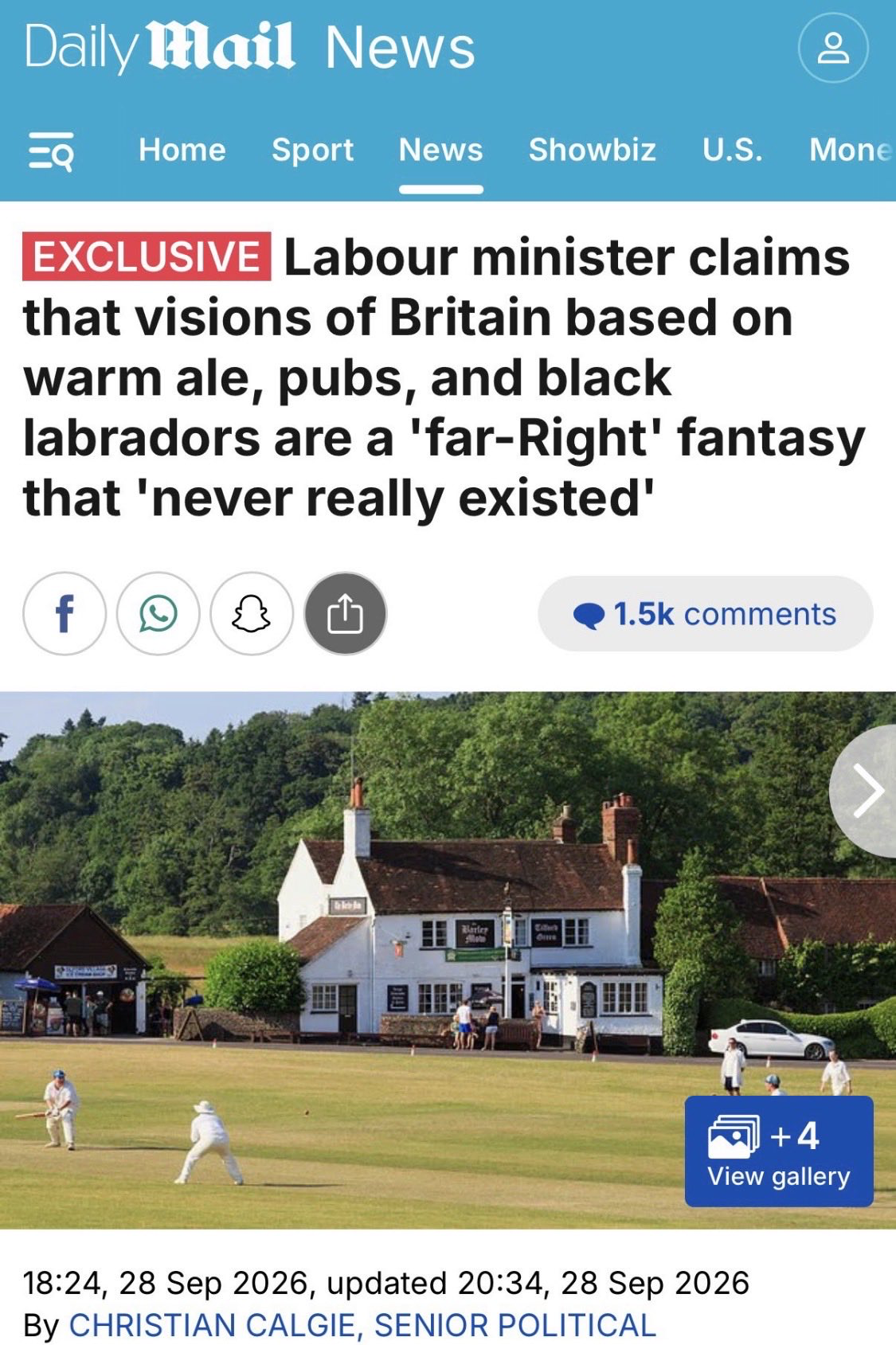
I was going to go to bed, but the malevolent inanity that is Jenny Riddell-Carpenter MP has riled me. She has disturbed my sleep, because she says that she cannot sleep. She told a Labour fringe meeting in Liverpool today what keeps her awake, and it was not rural bus cuts or the last shop closing in a Suffolk village. It was her own voters. She fears the far right will fight the next election on “a nostalgic vision of Britain that never really existed“, one of “warm ale, a black Labrador by your feet in a pub that doesn’t exist, and with symbolism of fox hunting all around them“.

A pub that doesn’t exist. The Minister for Nature represents Suffolk Coastal. Allow me to draw her a map.

Adnams brews in Southwold, just inside the protected landscape of the Suffolk Coast and Heaths, and the town is in her seat. From there a rowing-boat ferry crosses the Blyth to Walberswick for a pound, worked by a family that has pulled the oars for generations. The Bell on the far bank is six hundred years old and lets dogs in. The Cross Keys at Aldeburgh has served drink since 1540, and the Crown at Snape is a fifteenth-century inn with its own allotment. Most MPs would put these places on the constituency Christmas card. Ms Riddell-Carpenter prefers to tell a hall in Liverpool they are a far right hallucination.

Her non-existent warm ale has a pedigree she ought to recognise. She must be thinking of John Major in 1993, but he lifted it from George Orwell, who had written of “old maids biking to Holy Communion through the mists of the autumn morning“. Orwell was a socialist who spent years at his parents’ house in Southwold. The fantasy she fears was written by a man of the left, in her constituency. She clearly doesn’t know.

Then comes the sentence that gives her away. Labour, she said, must make the case for “what we believe rural communities look like“. Not what they are. What Labour believes they look like. The countryside is not to be listened to but corrected, its shape agreed at a fringe meeting and posted back to the people who live in it. When they describe their own lives, the pub, the dog, the Saturday match, their MP hears Ladybird nostalgia and smells fascism.

Cricket will be next on the charge sheet. Yoxford plays at Grove Park beside St Peter’s church and fields girls’ sides at under-11, under-13 and under-15, alongside women’s teams. At Orford the Sudbourne Hall ground drained well enough to save every home game in a previous sodden summer, and women’s sessions ended with a Pimm’s at close of play. This is the reactionary idyll that haunts her nights. It is busy doing, on a village green, what her party only issues press releases about.

She cannot plead ignorance, which makes it worse, no culpable. Her family moved to Martlesham Heath when she was seven, and she went to Woodbridge School. At eighteen she left and did not come back until the voters sent her. The years between went to London, to SOAS (oh brother), to the housing developer L&Q and to the lobbying trade, where she rose to run Cratus Group. Her husband still works in London social housing. She came home remembering every pub by name and having learned in town to be embarrassed by all of them. She now chairs the Labour Rural Research Group, which is a little like putting a vegan in charge of the pork pie.

A rural minister’s job is to carry the countryside’s case into Whitehall. This one carries Whitehall’s sneer back out and waits for the applause. Nobody who talks about her own patch like this can be trusted to defend it when a solar farm or a trail-hunting ban comes over the hill. She will side with the department and call it progress. She will be wielding the new Landuse Framework that tokenises the countryside, and she hates what exists before.


September 28, 2026

The Blairite world of “policy based evidence making”

Filed under: Britain, Media, Politics — Tags: , , , , , , — Nicholas @ 05:00

Just when you think the world is safe from Tony Blair’s machinations, he pops up yet again with more ideas for cultural enshittification:

Tony Blair photographed for the New Statesman by Tom Jamieson.
Photo via Fainting in Coils

Tony Blair has a gift for sentences that sound like policy and dissolve on contact. His Institute’s new paper contains one worth framing. “The right answer should always come first and the politics should follow.” It is the creed of a man who has never knocked on a door in Mansfield, and it explains everything else in the document. It is also called “policy based evidence making“.

The proposal is that Andy Burnham should use his November ten-year plan to put EU membership back on the agenda, with a target of rejoining a “significantly reformed” Union within a decade. Three years ago Blair told a group of European news agencies that whether and how Britain rejoins would be for a future generation. The future generation has arrived early, and it looks remarkably like Tony.

Nowhere does the paper define “significantly reformed“. It cannot. Name the reforms and you hand twenty-seven capitals a list of British demands, which is Cameron’s 2016 renegotiation with the humiliation pre-installed. Leave them unnamed and the target is air. It is equally coy on the currency, insisting it is not making an argument about the eurozone. Brussels will be happy to make that argument on its behalf.

What the friends of Europe concede

The most damaging witnesses against Blair are his own side. The Institute for Government, no nest of Eurosceptics, notes that new members are required to join the euro and Schengen, and that any fresh opt-outs or rebate would almost certainly need the approval of every member state and a majority in the European Parliament. An analysis on the LSE’s Brexit blog went further. It argued that the EU would expect Britain back as a more normal member state, with the rebate, the euro and Schengen opt-outs and the special justice and home affairs arrangements all off the table. The same piece warned that Brussels would look for significant, stable and long-lasting majority public opinion in favour of rejoining before it took an application seriously. A ten-year target announced by one party, and opposed by the party leading the polls, is the opposite of that.

A Queen’s University Belfast academic, writing before the referendum, saw the trap clearly. He judged it extremely unlikely that the EU would readmit Britain on its old terms, because a vote to leave would itself have been a democratic rejection of those terms. And unanimity means every capital holds a veto, including Madrid, which would have Gibraltar in view when any British arrangement came before it.

What the Leavers add

Anyone who imagines accession is a negotiation should read Hannes Gissurarson on Iceland, which voted last month against even resuming talks. He points out that accession talks are no bargain between equals but a process of adopting the Union’s legal framework wholesale, with room only for temporary exemptions to ease adjustment. Iceland’s Yes camp campaigned on a slogan meaning roughly “vote yes to find out what the EU would offer”, which Gissurarson reads as a confession that the deal was poor. Blair’s ten-year target is the same slogan with a longer run-up.

Gissurarson also recounts an unnamed EU official musing to Politico that rich Iceland could join alongside Montenegro and pay for its membership. Britain, rejoining behind a queue of Balkan and eastern candidates, would be cast as the wealthy uncle who picks up everyone’s bar tab.

Update, 29 September: Welcome, Instapundit readers! Have a look around at some of my other posts you may find of interest. I send out a daily summary of posts here through my Substack – https://substack.com/@nicholasrusson that you can subscribe to if you’d like to be informed of new posts in the future.

September 18, 2026

Worrying about post-combat lawfare will crush initiative and morale

Filed under: Britain, Europe, History, Law, Military, Politics — Tags: , , , , , — Nicholas @ 05:00

As mentioned in Dr. Robert Lyman’s account yesterday, the British government wants to turn back the hands of time to change the rules of engagement under which British Army troops and police conducted themselves during “The Troubles” in Northern Ireland. It may be an exciting prospect for law firms, activists, and other anti-military groups, but it would set a terrible precedent for British use of military force from this moment onwards. At The Critic, Alexander Gray explains why this is a dangerous and stupid idea that should be dropped forever:

“British Army working during the Field Training Exercise” by U.S. Army Europe is marked with Public Domain Mark 1.0 .

The debate about the hounding of veterans through the courts has long been presented in terms of fairness. This is indeed one side of the story. No decent country should tolerate servicemen being dragged through repeated investigations decades after the events in question, often without new evidence and after previous inquiries have already reached their conclusions.

But focusing only on veterans misses an even more urgent point: this has become a national security threat.

Over the past two decades, the legal framework governing military operations has changed. Courts have increasingly applied standards developed for peacetime to scrutinise wartime situations of uncertainty and danger which often demand split-second judgement. Human rights law, designed principally to regulate relations between the state and individuals, has increasingly been applied to military operations, including to situations already governed by the Law of Armed Conflict.

This is having consequences on the battlefield. Personnel who believe that a lawful decision taken in combat may be reconstructed years later in a civilian courtroom are now incentivised to be more cautious, more process-driven and less willing to exercise initiative. That hesitation can slow decisions in situations where delay may place lives and the success of an operation at risk. The prospect of repeated investigations and prolonged legal uncertainty is also damaging morale and contributing to experienced personnel leaving the service, depriving the Armed Forces of skills and judgement that are difficult to replace.

This is why the Prosperity Institute has published the Military Operations Bill, presented to Parliament this week by Sir David Davis MP. It reasserts the principle that combat operations should be judged primarily by the Law of Armed Conflict. Courts have an important role in punishing wrongdoing, but they should not become alternative command structures reviewing military judgement from the safety of hindsight.

Update, 19 September: Welcome, Instapundit readers! Have a look around at some of my other posts you may find of interest. I send out a daily summary of posts here through my Substack – https://substack.com/@nicholasrusson that you can subscribe to if you’d like to be informed of new posts in the future.

September 17, 2026

British government seeks to retroactively change the Rules of Engagement during “The Troubles”

Filed under: Britain, Europe, Government, History, Military, Politics — Tags: , , , , — Nicholas @ 05:00

I’m old enough to have had lengthy conversations with British soldiers and officers who were serving or had recently served in Northern Ireland at the tail end of “The Troubles”. It was a dangerous situation the troops found themselves in and the Rules of Engagement they worked under at least recognized that it wasn’t a normal day at the office back home. On his Substack, Dr. Robert Lyman explains why the current government’s plan to retroactively change the rules that governed the actions of the British military forces is one of the worst possible things they could do:

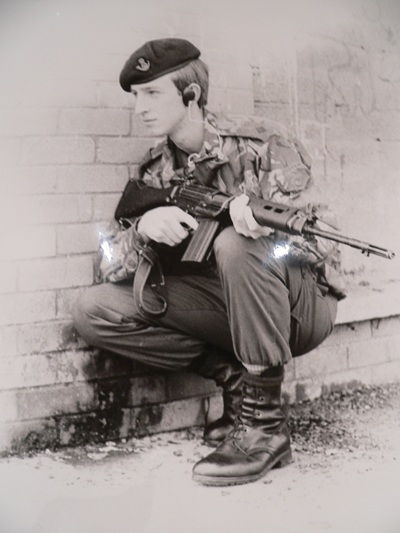
Lieutenant Robert Lyman in the Ballymurphy, 1983, in a photograph snapped by Lieutenant Colonel Bryan Elliott, CO of 1LI at the time. He was driving past in his Landrover and spotted a photo opportunity.
Photo via The War Room

For those who know me well, the idea that I might now be encouraging young men and women not to join the Armed Forces might sound that I had lost my marbles. I can assure you that is not the case. I am deadly serious. This government’s determination, building on the surrender of the previous Conservative government to the varying dictats of the ECHR, will drive an impossible moral and legal wedge between the people who the country ask to do its dirty work, and the government that sends them in harms way. It is an intolerable set of affairs that all sensible people in his country should oppose. What sort of perversity might think that this behaviour is acceptable from any government? I despair, yet it seems that this is precisely what our current morally impoverished government seems to desire.

[…]

The central concern is that the proposed changes will expose servicemen and women, many of whom have already undergone judicial scrutiny for actions undertaken during the Troubles, to further litigation and investigation. In practice, this is likely to encourage a new wave of cases brought by individuals seeking to revisit or reinterpret events from a campaign in which terrorist organisations such as the IRA and INLA were ultimately defeated.

The immediate implications are troubling enough. The longer-term precedent, however, is far more serious. If this legislation proceeds, it will send a clear message to today’s servicemen and women, that even after they have acted lawfully, completed investigations, and fulfilled their duty to the State, they may still face renewed legal jeopardy in later decades. It undermines the fundamental bond of trust between those who serve and the government that sends them into harm’s way.

Every member of the British Armed Forces operates within a strict and clearly defined legal framework. These rules, embodied in the Laws of Armed Conflict and implemented through Rules of Engagement (RoE), govern the use of force in military operations. During my own service, I spent countless hours learning these rules, teaching them to my soldiers, and ensuring they were followed in Northern Ireland, Bosnia, and elsewhere.

This debate is not about whether soldiers should be above the law. Of course they are not, nor should they be. Rather, it is about whether the rules that governed military operations at the time can be retrospectively reinterpreted after a conflict has ended. The concern is that former adversaries will be able to pursue legal action against veterans for actions that were considered lawful under the Rules of Engagement in force at the time.

Today, Policy Exchange published an excellent report examining this issue in relation to former members of the SAS who served in Northern Ireland. The report sets out the problem clearly and persuasively, concluding that the proposed changes should be abandoned. I agree.

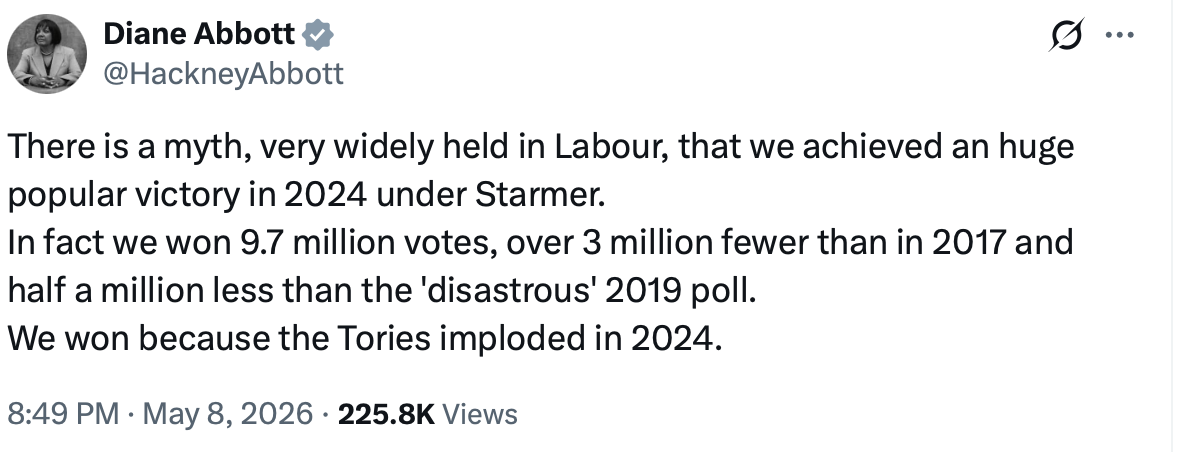
Predictably, some MPs have defended the legislation. Diane Abbott, for example, has argued on X that opposition to the changes amounts to “a call for armed forces personnel to be placed above the law.” That characterisation is deeply misleading. The debate has never been about exempting soldiers from the law. It is about subjecting veterans to repeated investigations and additional layers of judicial scrutiny many years after the events in question, often in ways that were never demanded of those they fought against on behalf of the nation.

At its core, this issue is one of fairness. It raises questions about double standards, retrospective judgment, and the constant shifting of the goalposts. Veterans who served under one set of rules are now being told that those rules may no longer be sufficient protection against further legal action.

July 22, 2026

Andy Burnham’s “Manchesterism” at the national level

Filed under: Britain, Economics, Government, Politics — Tags: , , , , — Nicholas @ 06:00

In The Critic, Shimeon Lee looks at Andy Burnham’s time as Mayor of Greater Manchester and what his record there says about how he will try to run Britain from No. 10:

Prime Minister Andy Burnham’s official MP portrait, July 2026.
© House of Commons via Wikimedia Commons.

Andy Burnham is now Prime Minister, and the country soon to discover what “Manchesterism” means when applied to the British state. Burnham’s nine years as mayor, alongside his earlier national record, offer a clear guide to the instincts he is likely to bring to No.10: a willingness to raise taxes, expand the state and prioritise policies that sound good but ultimately deliver poor value for money.

It is revealing that after being elected mayor in 2017, one of Burnham’s first acts was to impose a new charge on households in Greater Manchester. The new mayoral precept was initially set at £8 for the average band D property, funding the mayoral operation, including Burnham’s £110,000 salary. As so often happens with new charges, it did not remain modest for long. The charge more than doubled the following year, rising again in 2020-21, 2022-23, 2025-26 and 2026-27. By the time Burnham resigned to contest the Makerfield by-election, it had risen to £61.75, nearly eight times the original amount in less than a decade.

As residents paid more, the mayor built an increasingly elaborate network of advisers, commissioners and panels funded by taxpayers. These included a young person’s advisor paid £500 per day, a transport commissioner and an active travel commissioner each paid £650 per day, and an LGBTQ+ advisor paid £177 per day. He also established seven equality panels facilitated by “culturally appropriate organisations” which cost £392,435 a year. Taxpayers can only speculate how much larger that ecosystem could become when he takes control of Whitehall.

The mayoral precept was not the only tax rise implemented by Burnham. As mayor, he raised every tax under his control. The band D police precept rose from £162.30 when he entered office to £285.30 by the time he left, a 76 per cent increase. At the same time, the fire precept increased from £59.95 to £92.20, a 54 per cent increase. Both increases substantially outstripped cumulative inflation of 37.5 per cent during that period.

Even that understates his tax-raising ambition, as it only includes the charges he managed to implement. In 2019, Burnham proposed a clean air zone for Greater Manchester which would impose a daily charge on commercial vehicles that did not comply with environmental standards: £7.50 per day for taxis, £10 per day on vans and £60 per day on buses, coaches and heavy goods vehicles. These would have added thousands of pounds a year to local businesses’ costs.

July 21, 2026

Exit Starmer, enter Burnham

Filed under: Britain, Media, Politics — Tags: , , , — Nicholas @ 06:00

Britain swapped out Prime Ministers on Monday, pushing Sir Keir Starmer out to the curb and installing former Greater Manchester mayor Andy Burnham in Number 10 Downing Street. In The Critic, Robert Hutton reports on the day’s events:

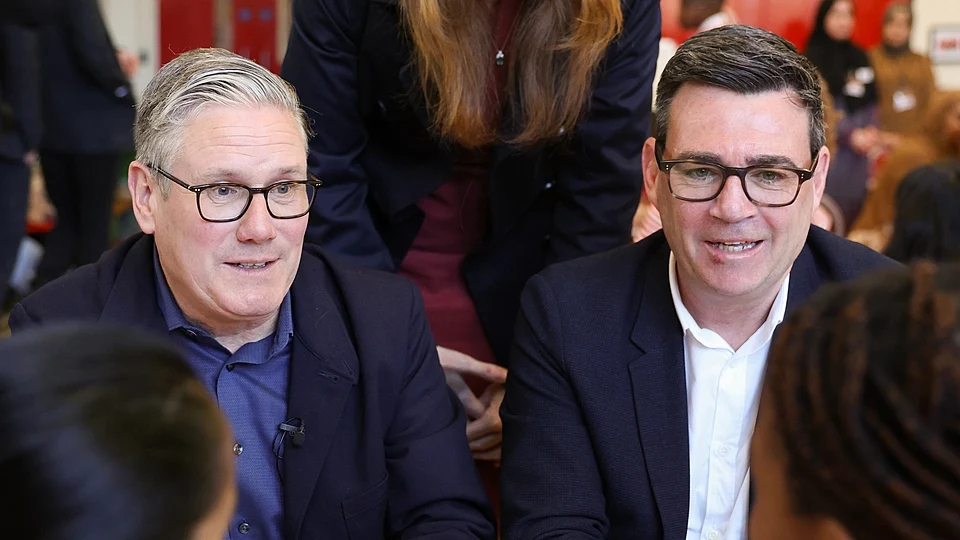
Then-Prime Minister Sir Keir Starmer visiting Holy Trinity Church of England Primary School in Manchester on 13 April 2026 with Andy Burnham, Mayor of Greater Manchester.
Picture by Lauren Hurley / No 10 Downing Street via Wikimedia Commons.

As Keir Starmer walked out of Number 10 for the last time, he was greeted by a huge cheering crowd. Wow, this guy is popular! He should consider running for office. “My work is done”, he told us, offering possibly the most misguided example of marking your own homework since George W Bush declared “Mission Accomplished” six weeks after invading Iraq. Although we shouldn’t be harsh: Liz Truss listed leading the nation in mourning the late Queen as her big achievement in office.

Starmer’s, as he pointed out yet again, was winning the election. The list of things done since then was slightly more vague. But again, Boris Johnson’s departing speech claimed credit for a high-speed train line to Manchester and a number of hospitals that still do not, as such, exist. At least Starmer could truthfully say that he was leaving “with a smile”. Was he also, as he claimed, going “with good grace”? Well, unlike Johnson, he managed to get through the speech without attacking the people who forced him out.

It wasn’t entirely cheery. His wife Victoria was wearing black, and Rachel Reeves was crying, once again. The departing prime minister warned us not to succumb to division and to “unite different people under our common flag”. Although he completely failed to help that happen while he was in office, and showed little interest in trying.

With that, he was off to Buckingham Palace, where the band was playing a medley of Bon Jovi songs. Shot through the heart, and only himself to blame, he gave Labour a bad name.

But if Starmer was going out in a blaze of inglory, the rest of us were only halfway there. While the King conducted his exit interview in the Palace’s Chinese Dining Room (imagine having a different space to eat every takeaway) we had to hold on, ready or not, through the hour in which we were without a prime minister and living, as it were, on a prayer.

Andy Burnham had put on a suit for the day, a concession to the soft southern ways of the monarch. We half-expected him to leap out of the car in Downing Street and rip off the whole ensemble, Full Monty-style, to reveal black jeans and a T-shirt underneath. Perhaps he felt that would be taking his personal branding too far.

A fresh crowd of Labour types had gathered, looking more convincingly happy than the ones who had stood behind the last guy. They included the incoming prime minister’s mum, and the youngest person present: Liverpool Mayor Steve Rotheram’s 10-week-old grandson, currently scheduled to become the King’s 49th prime minister, in about 2038.

Not everyone is as excited as Burnham’s Labour Party supporters:

In Spiked, Brendan O’Neill bids an unfond farewell to Two-Tier Keir:

Sir Keir Starmer: the PM who did nothing about the sense of doom pervading Britain, but he did ban “doomscrolling“. The man who did zilch to mend our fraying social fabric, but he did stop kids from perusing its consequences on TikTok. The man who failed – catastrophically – to alleviate that bleak feeling many of us have that Britain is broken, but he did cover the next generation’s eyes to just how broken we are.

Starmer should be remembered for his social-media ban for under-16s, that mad, illiberal law, due to come into force in spring next year, that promises to liberate youth from the angst-inducing “doomscrolling” inflicted on them by Big Tech’s wily algorithms. Not because it’s a “landmark” policy, as he claims. And not because it will be effective – kids will find a workaround. No, it’s because leaving intact the social conditions of doom while tweaking the machine so that fewer people can ‘scroll’ those conditions is Starmerism summed up: a regime of hollow theatricality, devoted more to managing the optics of crisis than mustering up the competence to avert it.

Starmer is a man without a legacy. He promised competence over charisma and delivered neither. His was a phantom premiership: government without governing. You could ask a hundred Brits to name a policy he enacted and I reckon five, at best, could do so. Even his vanishingly small number of apologists usually only squawk about what he didn’t do. He didn’t drag us into the Iran-US War. He didn’t follow through on his promise to cut the winter-fuel allowance for pensioners. He didn’t murder anyone. A man so staggeringly insubstantial that even his fans prefer his inertia to his initiative.

For me, the terrifying nothingness of Starmerism is best summed up in the fact that he recently said his “proudest achievement” was scrapping the two-child benefit cap, the Tory-introduced measure that meant families could only claim additional welfare payments for their first two kids. But Starmer opposed cutting that cap. For ages. In fact, in July 2024, he withdrew the whip from seven Labour MPs who voted to scrap it. It was only under pressure from his parliamentary colleagues that he relented. What can you even say about a man whose “proudest achievement” is a course of action foisted on him by others? That’s Sir Keir: the political weathervane who mistook a gust of wind for his own internal moral compass.

June 22, 2026

Two-tier Keir resigns as UK Prime Minister

Filed under: Britain, Government, Media, Politics — Tags: , , , — Nicholas @ 11:30

History will not be kind to Sir Keir Starmer’s time in office, both for his actions and his failures-to-act. The Labour Party will now select the next person to live at Number 10 Downing Street, as they still hold a majority in the House of Commons and are not required to go back to the people for a new mandate, regardless of who is their party leader.

Rupert Lowe, the leader of Restore Britain, greeted the news on the social media site formerly known as Twitter:

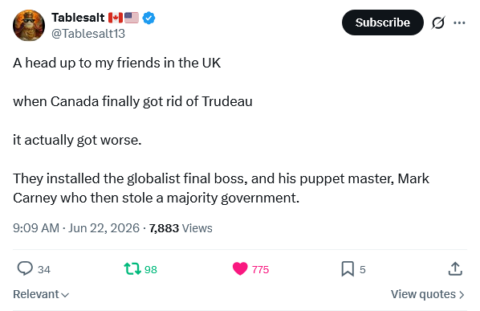
I reposted this on my other social media accounts, saying “Sadly, this is completely true. We belatedly ditched the clown prince of progressivism … only to install Mark Carney, who believes all the same progressive shibboleths that Trudeau did, but he’s far more capable of implementing them by hook or by crook.”

Starmer resigns — he has been a truly disgraceful Prime Minister.

I do not believe him to be a good man or a patriot.

He has deliberately and rapidly accelerated the destruction of our Britain, of our home.

History will not remember him kindly, nor should it.

I sat in Parliament, looking him in the eye, listening to him attempting to justify his decision to block a national inquiry into the mass rape of young British girls.

I will never forgive him. For that, and so much else.

What comes next, I do not know.

Whatever that is, Restore Britain will be ready to offer the British people a democratic route out — a better way, the only way.

But Starmer is gone.

And that is a good thing.

Enjoy it.

Former Manchester mayor and recently elected Member of Parliament for Makerfield Andy Burnham is the most likely successor to Starmer.

Then-Prime Minister Sir Keir Starmer visiting Holy Trinity Church of England Primary School in Manchester on 13 April 2026 with Andy Burnham, Mayor of Greater Manchester.
Picture by Lauren Hurley / No 10 Downing Street via Wikimedia Commons.

June 15, 2026

The British by-election in Makerfield and the split on the right

Normally, single seat contests are not all that newsworthy in countries using the Westminster-style of Parliamentary democracy, but the Makerfield by-election in the Manchester region of England seems to be rather more significant. The Labour Party candidate is widely seen as the successor-in-waiting to Sir Keir Starmer (by everyone but Starmer, apparently). The main opposition was expected to be Nigel Farage’s Reform party’s candidate, but the vote on the right is also being contested by Rupert Lowe’s breakaway Restore Britain party. Splitting the vote between Reform and Restore might let an unpopular Labour party win the by-election and start the process of ousting Starmer from Number 10 Downing Street. This might keep Labour in power for another year or so, which is plenty of time to bring in a few hundred thousand “refugees” or enact stricter censorship rules, or any of a number of other hugely unpopular things.

Sean Gabb explains the situation from a libertarian point of view:

The coming by-election at Makerfield has provoked a familiar argument on the patriotic right. On one side are those who denounce the intervention of Rupert Lowe and his Restore Britain movement. Labour is vulnerable. Reform has a realistic chance of victory. Any division of the anti-Labour vote therefore appears self-indulgent and destructive. Rupert Lowe, they say, may have legitimate grievances against Nigel Farage. He was certainly treated badly by Reform UK. But personal grievances ought to be put aside when the national interest is at stake. If Labour can be defeated, then Labour should be defeated.

On the other side are those who see Nigel Farage as the problem rather than the solution. They argue that Reform UK is little more than a vehicle for containing public anger. Every time popular discontent threatens to escape the boundaries of acceptable politics, Farage appears, gathers up the protest vote, makes a series of compromises, and then leaves the underlying structure untouched. In this view, Rupert Lowe is valuable because he threatens Farage’s position. The sooner Farage is challenged and replaced by a man of greater integrity, the better for the country.

Both positions have a certain logic. Both also rest on assumptions that do not survive contact with political reality.

The first assumption is that Britain stands on the verge of some great political rupture. If only the correct party can gather enough votes, or if only the correct leader can emerge, the existing order will be swept away and replaced with something fundamentally different. Of course, there are examples of such transformations. Russia in 1917 saw the destruction of one ruling class and its replacement by another. Iran in 1979 witnessed the collapse of a monarchy and the rise of a revolutionary theocracy. Similar examples can be found elsewhere. Yet these events were exceptional. They occurred when the existing state apparatus had ceased to function effectively. The old order was no longer capable of commanding obedience. Administrative structures had broken down. The loyalty of key institutions could no longer be relied upon. Under those conditions, revolution became possible.

Britain is not presently in that condition. The country may be badly governed. Its political class may be incompetent. Its institutions may be corrupt and increasingly detached from the interests of the population. None of this amounts to state collapse. Modern Britain remains one of the most centralised and administratively sophisticated states in the world. It possesses powers of surveillance, regulation and information management that previous generations could scarcely have imagined. The police state is often clumsy. It is frequently absurd. It is not, however, weak.

This matters because fantasies of imminent revolution are often based on a misunderstanding of where Britain actually stands. People look at social decay, demographic change, collapsing public services, and widespread public dissatisfaction, and assume that these conditions must shortly produce some decisive confrontation. They forget that highly organised states can survive astonishing levels of dysfunction. The late Soviet Union endured decades of stagnation. The Ottoman Empire acquired the nickname “the sick man of Europe” long before it finally disappeared, and that needed the Great War. It was the same with the Hapsburg Empire. Decay and collapse are not the same thing.

If revolution is improbable, perhaps the answer lies in electoral victory. This is the second assumption behind much of the argument over Makerfield. Perhaps Nigel Farage or Rupert Lowe will eventually enter government through the ballot box. Once there, they will make the necessary reforms. Immigration will be reversed. The bureaucracies will be cut back. The censorship apparatus will be dismantled. Industry will be restored. The country will begin moving in a healthier direction. This belief is less implausible than dreams of barricades and insurrection. But less implausible is not the same as plausible.

The great theorists of elite rule explained the truth of democracy more than a century ago. Gaetano Mosca observed that every society is governed by an organised minority. Vilfredo Pareto described the circulation of elites, whereby personnel change while underlying structures remain. Robert Michels formulated his famous Iron Law of Oligarchy, according to which every large organisation develops a permanent leadership class that becomes increasingly independent of its nominal supporters. These men disagreed about many things. On one point they were united. Democracy changes faces more readily than it changes systems.

The reason is obvious enough. Every viable state possesses a permanent administrative core. Civil servants, judges, regulators, military officers, police officials, academics, media managers and corporate functionaries form an interconnected network of expertise and influence. Governments come and go. This network remains. It possesses continuity, institutional memory, technical knowledge and the immense advantage of permanence. The elected politician arrives promising radical change. The permanent apparatus replies with delay, obstruction, reinterpretation, consultation, procedural complexity, judicial review, regulatory resistance and media hostility. The shock is absorbed. The energy dissipates. The machine grinds on.

May 9, 2026

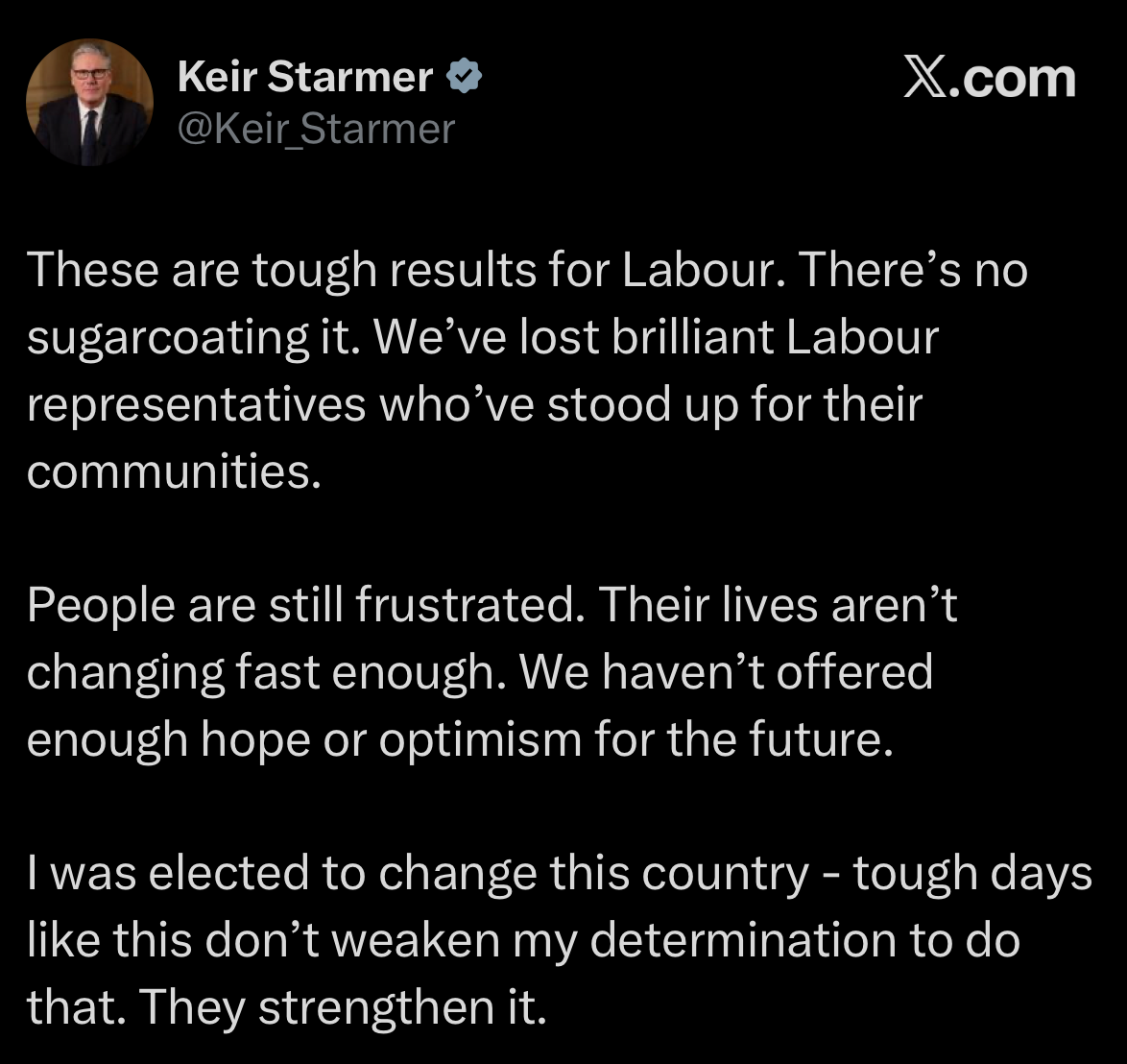
Starmer thinks local elections’ message is for Labour to move faster on their progressive agenda

Filed under: Britain, Media, Politics — Tags: , , , , , — Nicholas @ 04:00

British Prime Minister Sir Keir Starmer — who many commentators have for months been describing as a “dead man walking” — somehow manages to find an interpretation for the Labour Party’s disastrous local election results, and thinks voters just sent a message that he needs to move faster and more vigorously to implement their vision. That’s certainly a take.

Nigel Farage is certainly enjoying the outcome:

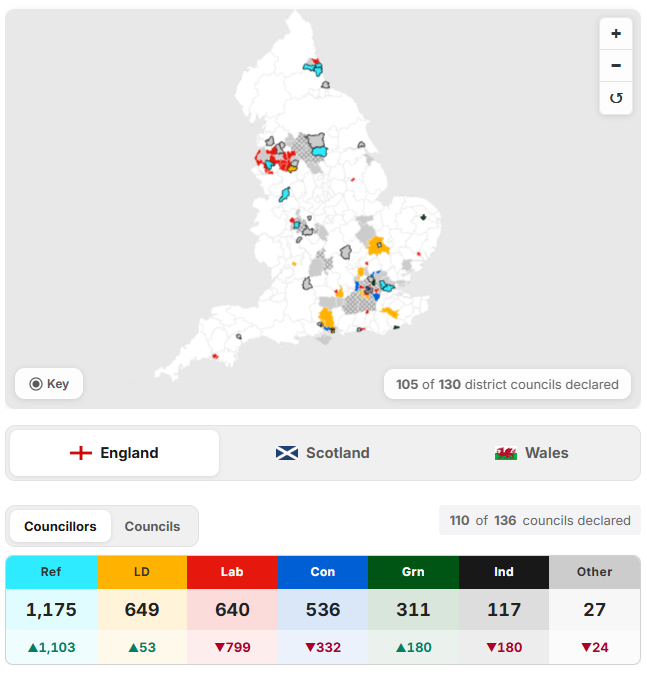
Partial council election results in England, 8 May 2026.
Graphic from the Daily Mail

Hurrah for the Tealshirts! Nigel Farage emerged from Havering Town Hall looking smug even by his standards. For years, he has been written off, denied the respect — and peerage — he feels he deserves, forced to scrape by on gifts from well-wishers, and now he was showing them all, wreaking havoc on both Labour and Conservatives.

Nothing could hold the party back, not the endless terrible comments from Reform candidates who for some reason believe Farage agrees with them, not even a huge bribery scandal involving the party leader in Wales. Today Havering, tomorrow Westminster!

Elsewhere, people were gloomier. James Cleverly explained to the BBC that winning elections isn’t the goal of politics. The Conservatives aren’t interested in here today, gone tomorrow popularity, it turns out. They just want to govern well. Which leaves a couple of questions about the last decade and a half.

David Lammy told anyone who would listen that you don’t change pilot mid-flight. Better, he didn’t add, to wait until the plane has hit the ground.

The real show of the morning was the confrontation on the BBC between Cleverly’s colleague Vicky Atkins and their former fellow Tory, Robert Jenrick. Atkins and Jenrick have a long friendship going back to the time when he was the anti-Farage candidate in Newark in 2014, through the time he was an anti-Brexit MP supporting David Cameron, his days in Theresa May’s government, his early backing of Boris Johnson, his years in the Cabinet, all the way to his realisation this year that he’d never believed any of the things he’d been telling the voters.

“Robert and I haven’t actually spoken to each other since I supported his leadership campaign,” Atkins announced, and the rest of us fastened our seatbelts for a bumpy ride. “I’m surprised that he’s so quick to can all of the work that he did when he was in government.”

Next to her, Jenrick looked like a man who has arrived at a school parents evening to discover that his ex-wife got there first and has been filling people in on the reason she cut the crotches out of all his suits. But Atkins was just getting started. “Nobody should believe the snake oil salesmen,” she said. Jenrick had accused the Tories of messing things up. “Rob was part of the team that made those mistakes.”

Jenrick made another bid to get the conversation back on track. “The question is about honesty and trustworthiness,” he said. You could have used Atkins’ expression at that moment to freeze lava.

At the time of this Daily Mail report from James Tapfield and David Wilcock, the demands from Labour MPs for Starmer to resign hadn’t quite reached the “red alert” level yet:

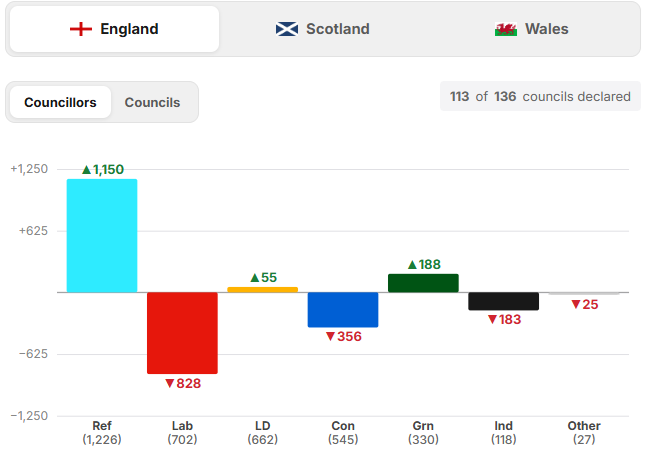
Partial council election results in England, 8 May 2026.
Graphic from the Daily Mail

Keir Starmer is desperately fighting to subdue a Labour revolt tonight after a local elections bloodbath saw the party routed on English councils, and destroyed in Wales and Scotland.

Loyalist ministers and MPs have been deployed in a frantic bid to prop up the PM, after a series of backbenchers broke cover to demand his resignation.

So far no Cabinet ministers have publicly joined the mutiny – a moment that many believe would be the final nail in Sir Keir’s coffin.

Rachel Reeves and David Lammy were among those backing Sir Keir – but there has been an ominous lack of vocal support from Wes Streeting, Yvette Cooper, Ed Miliband and Shabana Mahmood. London Mayor Sadiq Khan released a statement saying the results in the capital were ‘bitterly disappointing’ and the threat to the party is ‘existential’ – without mentioning the PM.

The civil war reignited this evening after Labour’s Welsh leader, Baroness Morgan, humiliatingly lost her own seat as the party’s tally of the 96 Senedd members was slashed to just nine. In a jibe at the PM, she said the Government nationally must ‘change course’.

Until yesterday Labour held nearly half the seats at the Welsh Parliament, and has never failed to top an election in the country – regarded as its birthplace.

Scottish Labour leader Anas Sarwar has also conceded defeat at Holyrood, saying they had ‘lost the argument’ and pointing the finger at Sir Keir.

Meanwhile, the Greens have dealt a hammer blow by taking the mayoralty in deep-red bastion Hackney, as well as Lewisham – signposting more misery to come in London. The Labour leader in Camden – Sir Keir’s own council – has been defeated by Zack Polanski’s candidate.

Even some Labour stalwarts are reading the tea leaves correctly:

April 24, 2026

Britain’s Green Party … not your weird cousin’s old Green Party

The Green Party have been more of a punchline than a party for decades in British politics, but the Green Party of today shares only a name with its earlier incarnations (the old UK party is now split into three separate Green Parties for England and Wales, Scotland, and Northern Ireland). Now, it’s become a significant threat to the Labour Party thanks to its unlikely fusion of socialist and green policies with strong support from Britain’s growing Muslim community:

The Green Party is a growing force in British politics. In February, they gained the Parliamentary constituency of Gorton and Denton in a by-election — a supposedly “safe” seat for the Labour Party. Local elections in May see them set to make big gains — perhaps sweeping to power in several town halls in London, perhaps including Camden, where Sir Keir Starmer is one of the local MPs. Opinion polls often show them roughly level with Labour and the Conservatives.

This is quite a change from previous decades when they were indulged as eccentrics on the political fringe. The Green Party (or the Ecology Party, as it was earlier named) were the sandal-wearing, muesli-munching environmentalists who wanted to go back to nature. They opposed economic growth — but their supporters tended to be affluent enough that they could afford to do so. Its leader was the aristocrat Sir Jonathon Porritt.

They were the breed George Orwell was thinking of when he wrote: “One sometimes gets the impression that the mere words ‘Socialism’ and ‘Communism’ draw towards them with magnetic force every fruit-juice drinker, nudist, sandal-wearer, sex-maniac, Quaker, ‘Nature Cure’ quack, pacifist, and feminist in England”.

Great fun. But there was a darker side to the quackery then and now. A totalitarian mentality which, as Orwell also vividly described, proves horrific when it prevails.

Increasingly, the Green Party has shifted its focus away from the environment. In the few towns and cities where it has gained power locally, such as in Bristol and Brighton, it has proved ineffective at practical work in this respect. Typical behaviour would be to pass a motion declaring a “climate emergency” but then perform lamentably when it comes to recycling or tree planting or any of the relevant matters they have the power to deal with.

There was always a distortion in its supposed concern for sustainability in that it was really an excuse to denounce capitalism. The Property and Environment Research Center, a US think tank which champions free-market environmentalism, has shown a more enlightened approach. Their work has included a comparison of privately-owned and state-owned forests. Another applies property rights to marine assets. But the role of property rights as a means of good stewardship of our planet is dismissed by the Green Party out of hand.

In any case, much of the campaigning by the Green Party now is on non-green issues. Its leadership talks a lot about foreign policy and a broader economic pitch focusing on class war rhetoric and an extreme programme of state control. Taxing the rich is always seen as the panacea, despite the reality that many entrepreneurs are already fleeing the United Kingdom due to its hostile fiscal environment.

Its Manifesto for the last election two years ago proposed a Wealth Tax, a pensions tax, and a big increase in Capital Gains Tax. A £90 billion carbon tax would have closed down much of British industry, which was probably the idea.

February 28, 2026

The by-election in the British riding of Gorton and Denton

Filed under: Britain, Media, Politics — Tags: , , , , — Nicholas @ 03:00

A few surprises in the outcome, although the expected winner — the Green Party — did manage to pick up the seat by pandering harder than anyone else for the Muslim vote (according to multiple sources). And, as Francis Turner points out, this may be a problem:

The Gorton and Denton by-election has happened, and as I predicted, Labour came third.

Though more people voted Labour than I expected (25% actual vs 10-15% prediction) and sadly not enough people were convinced to vote Reform so the Greens won. But, while turnout was lower than one might have hoped, there’s a real humdinger of an allegation that makes the Green victory very iffy.

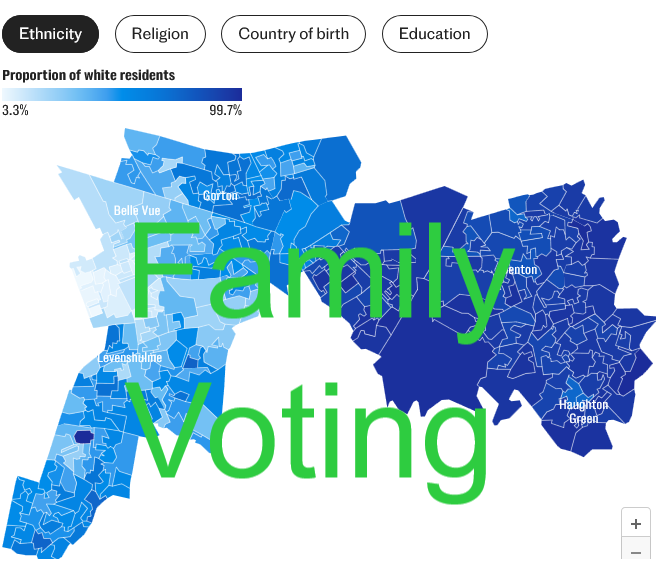
    Today we have seen concerningly high levels of family voting in Gorton and Denton. Based on our assessment of today’s observations, we have seen the highest levels of family voting at any election in our 10 year history of observing elections in the UK.

Family voting is not a term I’ve heard of before, but it is the situation where two voters either confer, collude or direct each other on voting. And obviously cases where one voter oversees the votes of more than one other person as well.

Democracy Volunteers, the organization making the allegation, is a reputable decade plus old organization and not a partisan one.

    Democracy Volunteers is run by Dr John Ault, a former Liberal Democrat politician who has observed elections in countries including Britain, Sweden, Norway and Finland.

They give more detail on their webpage

    2023 saw the enactment of the Ballot Secrecy Act, which made the practice of family voting more clearly a breach of the secret ballot, making it more enforceable by staff in polling stations. Signage is now available to discourage the practice. Signage was only seen in 45% of the polling stations observed.

    The observer team saw family voting in 15 of the 22 polling stations observed, some 32 cases in total, nine cases in one polling station alone. The team observed a sample of 545 voters casting their vote – meaning 12% of those voters observed either caused or were affected by family voting.

    Commenting John Ault, Director of Democracy Volunteers said;

    “Today we have seen concerningly high levels of family voting in Gorton and Denton. Based on our assessment of today’s observations, we have seen the highest levels of family voting at any election in our 10 year history of observing elections in the UK.”

    “We rarely issue a report on the night of an election, but the data we have collected today on family voting, when compared to other recent by-elections, is extremely high.”

    “In the other recent Westminster parliamentary by-election in Runcorn and Helsby we saw family voting in 12% of polling stations, affecting 1% of voters. In Gorton and Denton, we observed family voting in 68% of polling stations, affecting 12% of those voters observed.”

    […]

    The team also saw a number of voters taking photographs of their ballot papers and one voter being authorised to vote despite them already having been marked as voted earlier in the day.

What they do not say, unfortunately, is which polling stations they observed this in. We can guess. In fact the Torygraph reports that Reform has explicitly made the obvious accusation:

    Nigel Farage, the Reform leader, said allegations of family voting raised “serious questions about the integrity of the democratic process in predominantly Muslim areas”.

I would imagine such things are happening all over the Anglosphere with the large increase in Muslim voters in recent years — many of whom may be voting for the first time, depending on their national origin. In the free-to-cheapskates portion of this post, Ed West considers the evolution of the UK Green Party from granola-eating no-nukes freaks into a consciously sectarian party aiming to leverage the rising Muslim vote:

A good pub quiz question in the year 2050 will go something like this: “True or false, the ‘green’ in the ‘Green Party’ originally referred to the environment”. By this point, the etymological origins of Britain’s sectional Islamic party will be as obscure as the relationship between British Conservatives and 17th century Irish bandits.

A key milestone, our mid-century quiz regular will inform his teammates, was the 2026 Gorton and Denton by-election in which the Greens stood neck and neck in a three-way race with Labour and Reform.

Eagle-eyed observers these past weeks will have noted how the once environment-focused party have been pitching at particular sections of “the community”, with campaign leaflets featuring candidate Hannah Spencer wearing a red and black keffiyeh while posing in front of a mosque.

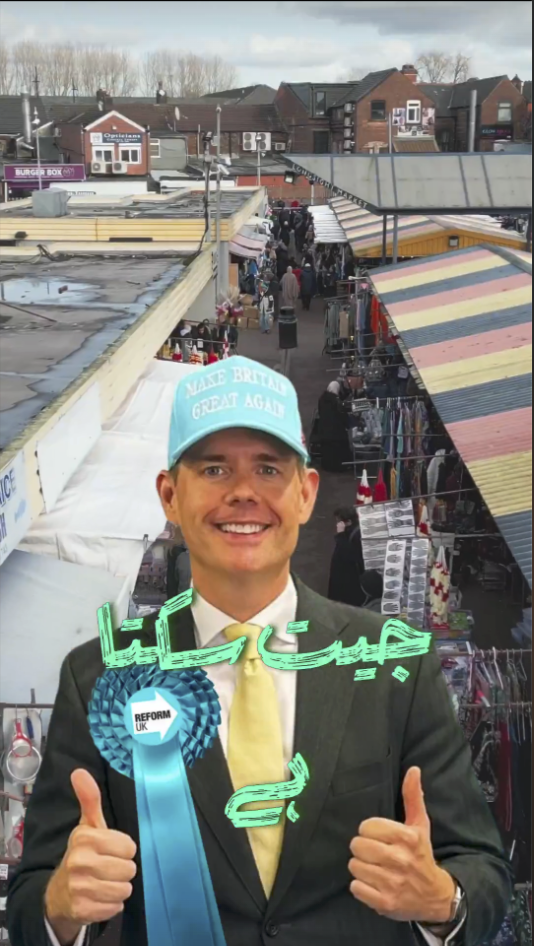
Written in Urdu, the pamphlet calls for voters to: “Push the falling walls one more time. Labour must be punished for Gaza. Reform must be defeated and Green must be voted for. Vote for the Green Party for a strong Muslims voice.” Then it adds, in English, “Stop Islamophobia. Stop Reform.”

There was also an Urdu-language video linking Reform Party candidate Matt Goodwin and leader Nigel Farage with Donald Trump and ICE deportation raids. The video then cuts to Gaza, before showing Keir Starmer beside India’s Narendra Modi. Subtle stuff.

The video states in Urdu: “A cruel politician can win if we don’t vote Green to stop the Reforms … Workers, cleaners, drivers, mothers – it’s us who keep this area running. But the politicians are not working for us … The Reforms want to break up our communities. They want to deport families who have lived here for years, and they want to tax people born abroad even more. They give air to Islamophobia, and they put our safety and dignity at risk.”

[…]

Britain’s Green Party has historically been a thing of amusement to many, a bunch of harmless hippies and Quakers with wacky beliefs; at the time of their first breakthrough in the early 1990s their most high-profile figure was David Icke, then seen as an amusing crank with interests in new age mysticism and alternative medicine.

As traditional politics fractured, the Greens came to fill the space inhabited by high-education, low-income graduates, the group who most favour redistributive economics and highly progressive social policies. Yet political parties have no souls, as such, being merely vote-seeking businesses, and they go where the market is — and now they find the lowest hanging fruit in appealing to sectarian interests.

If decades of generous immigration policies have created constituencies where people vote along religious lines, and are more comfortable with the national language of Pakistan than English, there is nothing to stop someone appealing to that market. It’s within the rules of democracy, if not the spirit.

Gorton and Denton is among the increasing number of constituencies in which a candidate can win by appealing overtly to the Islamic vote; “Gaza independents” won 5 seats in 2024 and could win 10 or 12 by 2029 and 20 or 30 by the election that follows; after that, the ceiling is limited by high levels of segregation. This could be good news for the Green Party, if that’s the path they want to go down, and they certainly don’t seem to shy away from the prospect.

Polanski has welcomed the endorsement of the Muslim Vote, an organisation which instructs people how to cast their ballot along religious lines, even if adding the caveat that people should vote as individuals. In February he told PoliticsHome that “I think any organisation that wants to back the Green Party because they align with our values is something that I applaud and welcome”.

January 16, 2026

Rapidly declining democracy in the home of the “Mother of Parliaments”

As I’ve mentioned before, it sometimes seems that Australia, Britain, and Canada are in a three-way race to de-democratize themselves as fast as they possibly can. Here’s the free-to-cheapskates portion of Ed West‘s essay on the return of liberal authoritarianism:

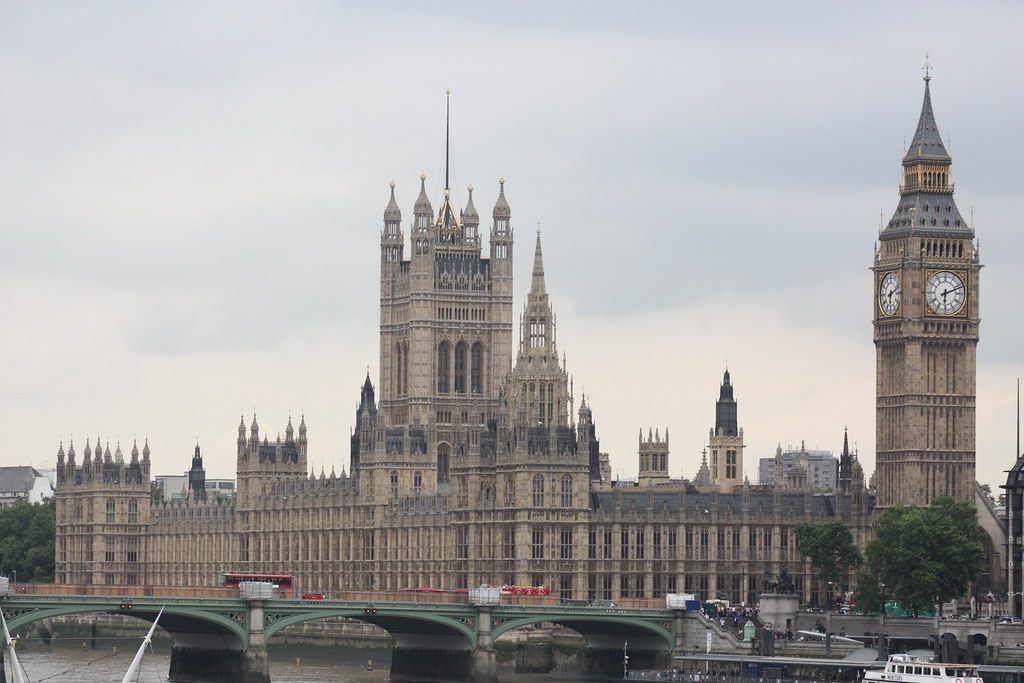
“Palace of Westminster” by michaelhenley is licensed under CC BY-NC-SA 2.0

It’s around this time of year that various NGOs give their assessment on the state of democracy and freedom of the world. The Fraser Institute’s Human Freedom Index was published earlier in December and Freedom House’s next report will arrive in February. It was at the start of last year that Romania was downgraded to a “hybrid democracy” by another body, the Economist Intelligence Unit (EIU), while France is now merely a flawed democracy. Sacré bleu!

What about our own beloved island, the mother of Parliaments? It will be interesting to see where Britain features in this year’s reports, and whether recent developments will impact on our rating.

Just recently, for instance, the British government postponed four mayoral elections until 2028, elections they are certain to lose. The Electoral Commission warned that it risked undermining “the legitimacy of local decision making and damaging public confidence”, while the chairwoman of the Labour Party even refused to rule out delaying the next General Election, leading Nigel Farage to accuse her of having “total contempt for democracy”.

Keir Starmer has also taken effective control of the House of Lords and will almost entirely eliminate opposition among peers by 2027, which he is able to do to the second chamber thanks to Tony Blair’s constitutional reforms. While the government extends the franchise to children, and even plans to place voting booths in schools, a clear violation of rules about politicising the education system, they’re also keen to restrict who can stand in elections.

As the i reported, Emily Darlington, Labour MP for Milton Keynes Central, “is seeking to make the Electoral Commission recommend enhanced DBS checks for candidates and then publish whether or not parties have agreed to the vetting. The aim is to ensure political parties justify whether their candidates are fit for office and name and shame those who refuse to participate.”

This is troubling when one considers that DBS (Disclosure and Barring Service) checks include not just criminal history but “non-crime hate incidents“, which may even appear on the records of people who haven’t been contacted by police. These highly-political charges are far more likely to be directed at those with Right-wing opinions.

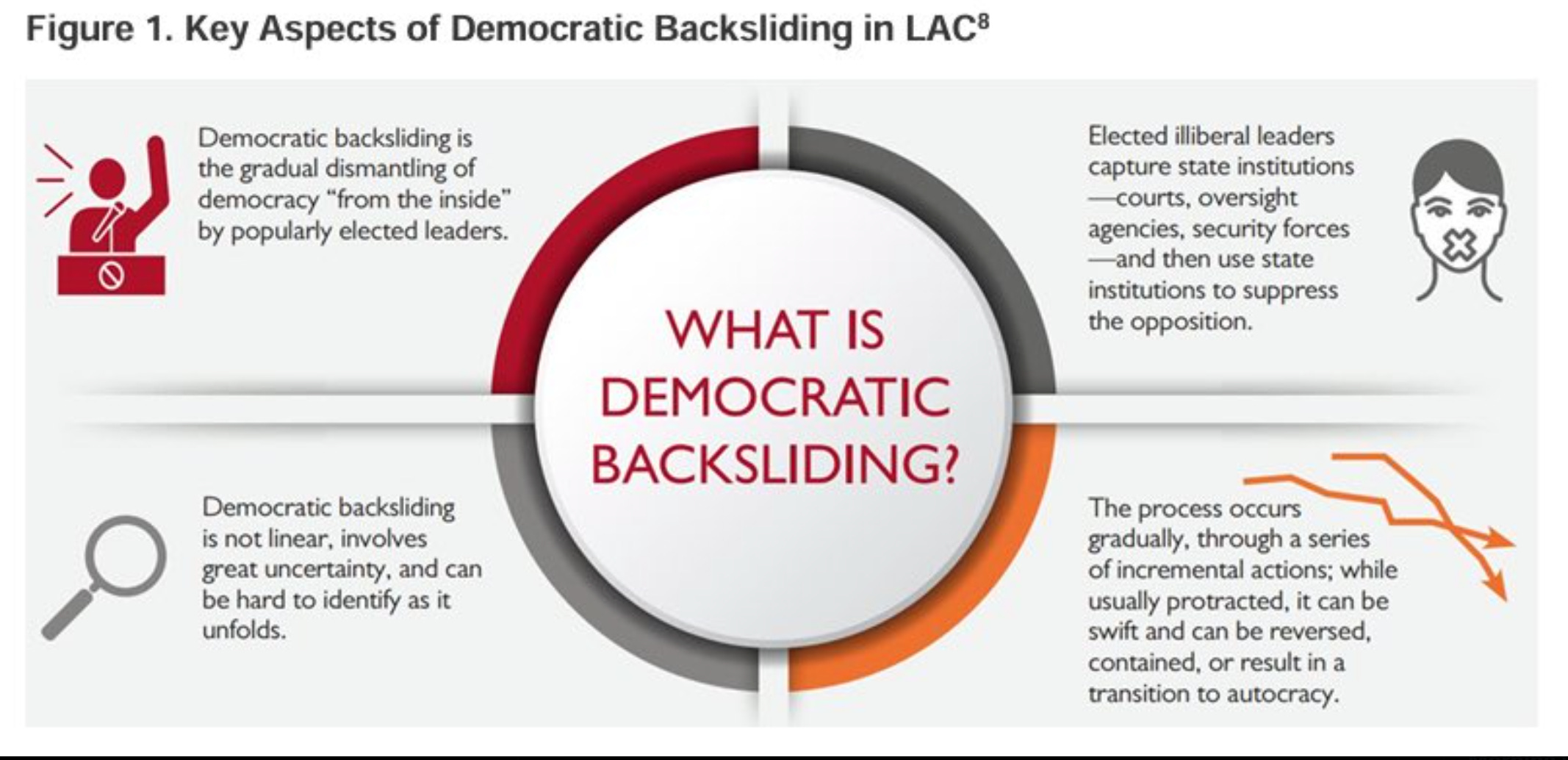
When western European countries do things like this, I try to gauge whether this is normal by asking the question: what if Hungary did this? In most of these cases, I imagine the assessment would be that it was an assault on liberalism and democratic norms. In which case, what if Britain is undergoing the sort of “democratic backsliding” usually levelled at central European countries with conservative governments? What if Keir Starmer is actually one of these illiberal “strongmen” we read about, just not a very effective one.

There are a number of accepted symptoms of democratic backsliding, among the most commonly listed being rejection of democratic rules, a disregard for constitutional norms, attempts to use legal mechanism to sidestep democracy, which is described as “stealth authoritarianism”, denial of opponents’ legitimacy, and the tendency to characterise them as outsiders or a threat to national security; on top of this, one might consider a willingness to curtail civil liberties, restricting the power of the media, and violating freedom of speech and association. Finally, and worst of all, is the toleration or encouragement of violence against opponents.

Credit: the National Opinion Research Center at the University of Chicago

By these broad definitions, Britain arguably meets many of these criteria (but not, most importantly, the last). There is certainly censorship, which has increased with the Online Safety Act, designed to combat “hate” as well as “misinformation”. Misinformation, of course, is everywhere, but its existence certainly provides a convenient excuse for governments to clamp down on the sort of information they dislike. The Government has also pondered banning Twitter, and while I feel that the widespread disgust at the Grok “deepfake” feature is reasonable, such a ban would completely cripple opposition, returning control of the discourse to the old media.

As for the British state’s definition of “hate”, there is a widespread belief that people motivated by hostility to mass immigration are extreme and dangerous, so the full force of the law must be used to stop them gaining support among a public who are totally guileless when it comes to absorbing information. This belief has grown more entrenched with the rise of populism, and makes western European governments increasingly sceptical of democracy itself.

It’s obvious that many people are concerned about the prospect of Nigel Farage becoming prime minister, and as the election date comes closer, and if he’s still in a position to win, the tone will become more shrill. Starmer admitted to this terror when he said, tellingly, that “If there is a Conservative government I can sleep at night. If there was a right-wing government in the United Kingdom, that would be a different proposition.”

Update, 17 January: Welcome, Instapundit readers! Have a look around at some of my other posts you may find of interest. I send out a daily summary of posts here through my Substack – https://substack.com/@nicholasrusson that you can subscribe to if you’d like to be informed of new posts in the future.

October 6, 2025

“[Starmer’s] love of football feels like something an alien would simulate, trying to blend in with our ways”

Filed under: Britain, Media, Politics — Tags: , , , , , , — Nicholas @ 05:00

Britain’s current prime minister, Sir Keir Starmer, is not having even the echo of a political honeymoon despite the utter collapse of the Conservatives in the last general election. Andrew Sullivan, who knew Starmer in school, thinks that Starmer’s plight is a useful illustration of what might have happened in the last US federal election if Kamala Harris had won:

The other day I sat, slack-jawed, reading Kamala Harris’ book — which was not easy to do with my eyeballs permanently rolled into the back of my head. (On one issue that killed her campaign, trans policy, she still hasn’t got the slightest clue what she’s talking about.) At one point, I even tried to imagine what America would be like today if this woke lawyer had actually won last year.

Then it occurred to me that we already kind of know. We actually have a pretty good test case of exactly that: a center-left lawyer-politician coming to power last year after a massive immigration wave had discredited and ousted the previous incumbent. Enter Keir Starmer, my high school frenemy, and now prime minister.

But unlike Harris, Starmer has at least shown signs of understanding his problem: he kicked the far-left Corbynites out of the party, called out anti-semitism, and in his big speech to his party’s annual conference this week, spoke proudly of flying the Union Jack, saying “we placed too much faith in globalization”. In office, he backed Israel’s war against Hamas strongly for a year-and-a-half, followed the science by banning puberty blockers and sex changes for kids, tightened immigration rules a bit, and pursued deregulation of the private sector, especially housing.

So how is he doing?

In one recent poll, his approval rating is 18 percent, with 61 percent disapproving. His government, just a year old, is polling around 19 percent. And in his first year in office, the new anti-immigration Reform Party has doubled its support from 15 to around 31 percent. The Tories — who gave Brits a massive wave of non-white, non-European immigration after Brexit — are at a historic low of 15 percent. Boris may have done what no leftist could: destroy the most successful political party in the West.

This, to put it mildly, is an earthquake. A party barely a year old is almost more popular than the Tories and Labour combined. On paper, Starmer still has four years to right the ship. But in reality, a prime minister who is loathed by four out of five Brits is like Wile E Coyote five feet off the cliff edge. To get a flavor of the general public’s view of Keir, check out this hilarious profile. Money quote:

    Then there is the voice — a cornucopia for sketch writers. We could fill pages with descriptions of the thing — an expiring corncrake, a Dalek suffering stasis of the lower bowel, a fart in a coffin, etc. His love of football feels like something an alien would simulate, trying to blend in with our ways — “I follow the game like any other carbon-based life form”.

The fart in a coffin did his best this week — and survived. Critically, he acknowledged the centrality of mass immigration to the national discourse, the way it has undermined a sense of common culture, undercut wages, begun to replace Christianity with Islam, required ever higher levels of censorship, killed Jews, and turned the cities my grandparents knew into something they wouldn’t even recognize as British.

No vote was ever taken on this policy of making London 40 percent foreign-born, a place where English is now often not heard at all — and even where it is, is almost always in a foreign accent. But the minute anyone ever proffered the slightest objection to mass migration (around a million migrants a year for the past four years), the charge of “hate” and “racism” was instantaneous and deafening.

Elite right and left were as one, defying the public for decade after decade. The hangover, especially after Boris’ brutal betrayal, is now here. (For a single glimpse, think of yesterday when a British citizen named Jihad attacked a synagogue, with two dead, and a flash mob of Hamas supporters swarmed Downing Street.)

Update, 7 October: Welcome, Instapundit readers! Please do have a look around at some of my other posts you may find of interest. I send out a daily summary of posts here through my Substack – https://substack.com/@nicholasrusson that you can subscribe to if you’d like to be informed of new posts in the future.

October 4, 2025

What did poor Liverpool do to deserve “the worst speech in modern British political history”?

In The Conservative Woman, Sean Walsh wonders why his home city of Liverpool was chosen to be the site of a modern political crime-against-humanity in the form of a Two-Tier Keir speech to the Labour faithful:

LIVERPOOL happens to be my city of birth, and my family is generational CIA (Catholic, Irish, Alcoholic). I get back there when I can, usually for funerals family reunions. I can confirm that if you don’t mention Thatcher, the Sun, any Manchester band, the Wirral, or ask a native to pronounce the word “chicken”, you will be made to feel more than welcome as a visitor there. Scousers are rightly celebrated for a quick, if chippy, wit and unique sense of humour. Not least by ourselves.

Hopefully that last quality will help the city survive this week’s invasion by activist lawyers, Islington familiars, boilerplate career MPs, lanyard fetishists, lobbyists, and the process algorithm who was slush-funded to the Labour leadership.

For years Liverpool dodged hosting the Labour conference and was probably resentful at the snub. Now its rejuvenated docklands are the go-to venue for this annual festival of enforced fun/confected joyfulness. It’s probably resentful at that as well.

I’m not sure British politics has seen a speech as bad as the one the Prime Minister gave to this year’s wake gathering. And before you mention Enoch Powell and “rivers of blood”, that speech was “bad” only in the minds of those who never read it or were unable or unwilling to appreciate the deep truths Powell was advancing behind the veil of metaphor.

The Prime Minister was vindictive and politically maladroit in equal measure. Powell, a genuine member of the British working class, was a trained classicist who thought, spoke and wrote in the languages and metaphors of the ancient world. Powell’s lack of condescension and unwillingness to dumb down created room for bad faith and mischievous interpretation.

Starmer, who thinks and speaks the language of the petty bureaucrat, has no such defence. Where Powell made his predictions in poetry (which have proven correct, let’s not forget), Starmer rams home his malevolence in bullet points and crass soundbites.

I make this unhappy comparison partly to draw attention to the decades-long decline in the culture of political speechcraft, which TCW recently wrote about, and to affirm that even by the standards of today Starmer was awful.

We expect our political speeches to be unlovely now. Starmer’s went beyond that and managed to be offensive and yet boring all at once. As I said, the Prime Minister is an algorithm, and there are three things you can say about algorithms: they lack memory, have no sense of humour, and are unaware that they are, well, an algorithm.

On his Substack, Christopher Gage offers “A forward-thinking manifesto to deliver change for stakeholders”. That’s just the sort of bafflegab progressive thinkers think the general public wants to hear, apparently:

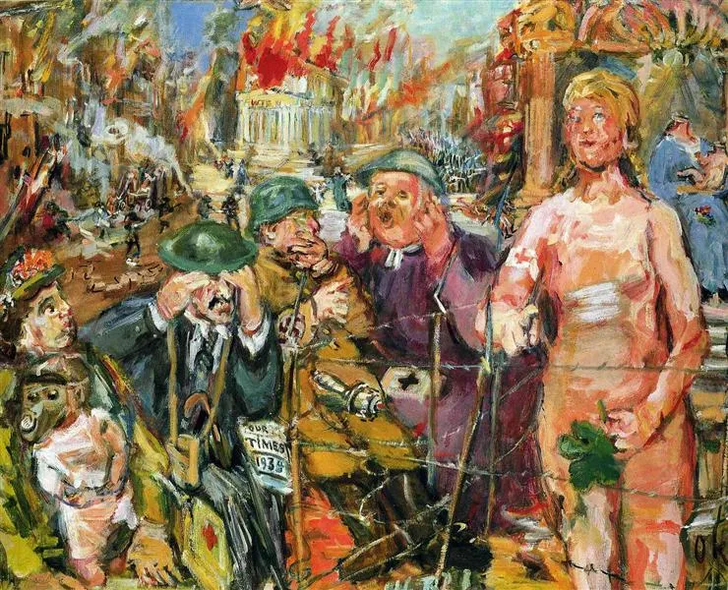
Alice in Wonderland by Oskar Kokoschka (1942)

This year’s Labour Party conference kicked off in the idiosyncratic style befitting its more excitable, green-haired cohort: confusion, contradiction, and faux contrition.

On Sunday, Sir Keir Starmer, our accidental prime minister, condemned Reform’s plan to deport migrants as “racist and immoral”. By Tuesday, it was Labour policy.

Politicians will say anything to keep suckling on the erect nipples of eternal power. And Labour politicians, despite their holier-than-thou affectations, are no different. They’ve seen the polls. Reform has led with room to spare in the last one hundred.

Labour has changed its spots. Starmer’s new Home Secretary, the combative and admirable Shabana Mahmood, is one foot on planet earth, at least.

At the conference, Mahmood warned the Guardian-reading element that they “won’t like the things I do”. She duly unveiled plans to ensure migrants “earn the right” to stay here: speak English, pay their way, and don’t expect their family to follow.

These once radioactive proposals are now common sense — two-thirds support immigration restrictions, whilst one-half wants not only the door welded shut but for many recent arrivals to be ushered politely through it. If Labour wants to win another election, they’d better listen to Wetherspoon Man over Performative Male.


As the week spluttered on, Starmer opted in to opting out to opting in to opting out. But Labour is listening. Nigel Farage, the Wetherspoon Man high priest, must feel his pockets lightened this week. Just glance at the swathes of Labour members waving the Union Jack, faces stretched incredulously like those masks from The Purge.

One impression emerges from this blancmange of bodily fluids: Farage has won the argument. Labour loves Britain, mate. Britain, big tits, Stella Artois, and XL Bullies.

Starmer even took it to Boris Johnson, onetime prime minister and two-time shagger of the year. The epithet “Boriswave” leapt from Starmer’s tongue with pace-sticked regularity. According to the prime minister, letting in four million people in two years — the Boriswave in Twitter slang — is an affliction so terrible that to reverse it would be, erm, even worse.

To be fair, such logic is not so much witless as it is anti-sense. And anti-sense has defined the Labour Party since I was spermatozoa.

One thing is clear. The Labour party, which presides over the sputtering, worn-out appendage known as Great Britain, needs some dire advice.

Here are a few proposals, the wholesale adoption of which would solve every problem befalling broken Britain.

October 3, 2025

Adding digital ID to the pocket moloch … what could possibly go wrong?

Filed under: Britain, Bureaucracy, Government, Liberty, Technology — Tags: , , , , — Nicholas @ 03:00

On Substack, Andrew Doyle explains why it’s a terrible idea to trust the government — any government — in forcing digital ID on everyone:

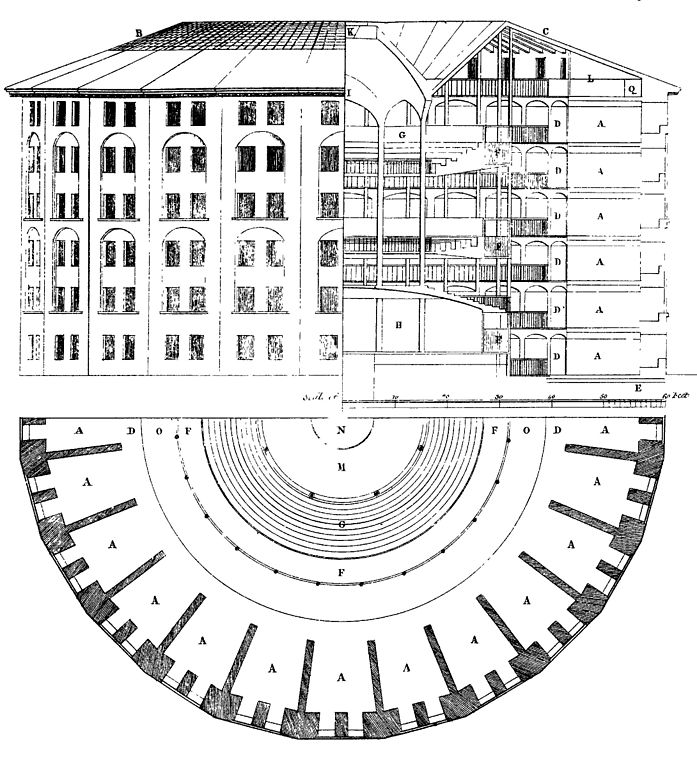
An illustration of Jeremy Bentham’s Panopticon prison.
Drawing by Willey Reveley, 1791.

During a trip to Russia in 1785, the philosopher Jeremy Bentham sketched an outline for a new prison design. The cells were arranged around the circular perimeter and, at the centre, he placed his “panopticon”: a watchtower which afforded a view of any of the cells at all times. The prisoners might not always be being observed, but they could never be sure that they weren’t.

Bentham’s design was never directly used, but the idea took hold as a symbol of state overreach and control, most famously in Michel Foucault’s Discipline and Punish (1975). Foucault was alert to the political ramifications of such a concept, and how surveillance might become an internalised experience. With Keir Starmer now pledging to introduce a digital ID system as a mandatory condition for the right to work, are we seeing the first step towards the realisation of Bentham’s vision?

I suppose we are already there. I have seen friends switch off their phones before discussing politically sensitive issues, genuinely convinced that digital eavesdropping is the norm. Many people are mistrustful of the “Alexa” voice assistant, which they are persuaded is recording their every word. While this all seems terribly conspiratorial, I’m sure most of us remember those reports a few years ago about the Pegasus spyware which had been covertly installed on the phones of journalists and government figures, turning the devices into pocket spies.

[…]

Few will be surprised to hear that public trust in political institutions has plummeted. The increasingly authoritarian tendencies of successive governments, our two-tier policing system, public manipulation as embodied in the “nudge unit”, and the corrupt prioritisation of the interests of the political class over the people they serve – perhaps best demonstrated by parliament’s flagrant efforts to overturn the Brexit vote – have all contributed to this climate of mistrust. The bizarre overreach of police during the lockdowns – in which dog walkers were publicly shamed with drone footage, and shopping trolleys were probed for “non-essential items” – has hardly helped matters.

To many of us, it is baffling that anyone at all would support the prospect of the government keeping track of our movements and holding our private details in a database. Starmer claims that the scheme will curb illegal immigration, but we are talking about criminals who already work outside the system and will doubtless continue to do so. Besides, identity cards have been a reality on the continent for years, and have done precisely nothing to resolve the problem. Employers in the UK are already legally obliged to insist on proof of immigration status from workers.

Labour’s digital ID scheme seems more about control than anything else. The possibility of fraud is also a major concern. It’s not as though the government has an unblemished track record of preventing data breaches. We all recall the massive leak of official MOD data regarding Afghans who had worked with the British government during the UK’s military campaigns. And who could forget the senior civil servant who, in 2008, left top-secret documents concerning al-Qaeda and Iraq’s security forces on a train from London Waterloo? Are we really to suppose that the creation of an all-encompassing centralised database will not leave the public open to risk from hackers and hostile foreign powers?

Tim Worstall adds that “they c’n fuck off ‘n’ all”:

So we’ve that wet dream of Tony Blair raising its ugly head again. There should be a national ID system. Actually, it’s not just Blair, T — the bureaucracy has been right pissed at the erasure of the wartime system since the 50s when it was abolished.

For there are two ways of looking at, thinking about, the whole governance thing. One is — the Blair, bureaucrats’, version — that the population are cattle, kine, to be managed. For the benefit of the bureaucracy of course — or at very least to be forced into doing what the bureaucracy thinks they — we — should be doing.

Then there’s that stout Englishman, the Anglo Saxon, version, which is that government are just the slaves we communally hire to make sure the bins get emptied. Well, OK, maybe raise a bit of tax for a Royal Navy to sink the Frenchies. But even then, not too much of that — the Civil War was, after all, triggered by Ship Money. Did the people who would not be slaughtered by the first wave of invading Frenchies — because they had the silly excuse of living 25 miles inland — have to pay the tax to run the Royal Navy to keep the Frenchies at bay or not? The King said yes — the King was right — and not for the first nor last time in British political history the guy who was right had his head cut off for being so.

Digital ID, so which version should we have? That one beloved of Froggie-type bureaucrats who view La Profonde as kine to be corralled? Or the Anglo Saxon version where we just devolve the scut work to a few slaves?

[…]

The reason this never will be proposed is that it doesn’t fit the reasons why our rulers wish to have an ID system. They’re insistent that we be their kine rather than they our. So, the Hell w’ ’em.

But it could be done. Government simply publishes an interface — an API — which says that proof of identity needs to be presented in this format. We’re done as far as whose kine is whose.

Update 4 October: From Samizdata, another illustration of just how toxic Two Tier Keir has become to British voters:

The Guardian reports:

    “Reverse Midas touch”: Starmer plan prompts collapse in support for digital IDs

    Public support for digital IDs has collapsed after Keir Starmer announced plans for their introduction, in what has been described as a symptom of the prime minister’s “reverse Midas touch”.

    Net support for digital ID cards fell from 35% in the early summer to -14% at the weekend after Starmer’s announcement, according to polling by More in Common.

    The findings suggest that the proposal has suffered considerably from its association with an unpopular government. In June, 53% of voters surveyed said they were in favour of digital ID cards for all Britons, while 19% were opposed.

Older Posts »

Powered by WordPress