Quotulatiousness

June 20, 2026

Bill C-22 passes the Commons “as MPs raced for home for the summer”

Canadian Members of Parliament care more for their summer vacations than they do for the rights of Canadian citizens. While this isn’t really news, it’s just the latest proof that our elected representatives are … well, I was about to describe their moral failings in great detail, but that could get me arrested and jailed if-and-when the many authoritarian measures the Liberals want to enact become law. Instead, here’s Michael Geist‘s summary of the way Bill C-22, the Lawful Access Bill, got sent to the Senate on Thursday night:

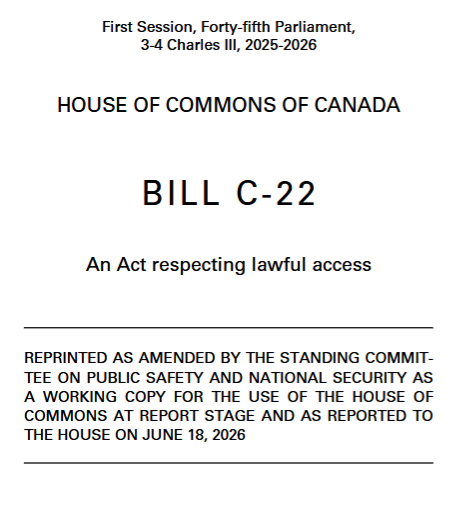
Bill C-22, the lawful access bill, passed the House of Commons yesterday with the government invoking a single motion to approve several bills without further debate or individual votes as MPs raced for home for the summer. Bill C-22 will now head to the Senate, where it can expect a rougher ride when study begins in the fall. Rather than use the final days of the House session to answer the privacy, security, and oversight concerns raised by the Privacy Commissioner, academics, technology companies, and civil society groups, the government spent the time ensuring it would not have to, rushing the bill through committee, cutting off debate, and maligning critics with tactics that they once decried when in opposition.

The final days of Bill C-22 in the House marked a genuine abrogation of democratic norms. The government moved a motion to shut down the clause-by-clause study in the Standing Committee on Public Safety and National Security, preventing the committee from adjourning until the bill had been pushed through. That led to a session that stretched past midnight, as MPs were barred from introducing new amendments and were left to vote on amendment after amendment without any discussion, debate, or even public disclosure of their contents. By the end of the committee session, no one could have known the contents of the bill that MPs had duly approved and sent back to the House for final approval. As noted, once back in the House, there was no further debate, discussion or even a vote. Just a motion that said the deal was done.

If the process was troubling, the rhetoric was embarrassing. I wrote earlier this week about Public Safety Minister Gary Anandasangaree’s Vic Toews moment, as he said it was time for opposition parties to “choose” whether to stand with law enforcement and victims of crime (a refrain that sounded a lot like Toews’ 2012 comment to Liberal MP Francis Scarpaleggia, who is now the Speaker of the House, that he could “either stand with us or with the child pornographers”). Government House Leader Steven MacKinnon pushed that posture further on Thursday by dismissing the bill’s critics as wearing “tinfoil hats” engaged in “paranoia.” The charge fits a broader pattern in which this government treats independent privacy scrutiny as an obstacle rather than a safeguard, seen most clearly in the Bill C-36 approach to strip the Privacy Commissioner of authority over private-sector privacy law altogether.

The committee did approve some government amendments to the bill that improve aspects of the lawful access plan but they are still likely to leave companies, security experts, and privacy advocates concerned. For example, the maximum metadata retention period the government can impose drops from one year to six months, and a category of metadata can now be mandated only where the Minister is satisfied that the category and all of its elements are essential to investigations. That is better, but still not good enough as it is not tied to any actual evidence about why six months is needed and both the costs and risks associated with metadata retention, which is not a requirement in the U.S., are largely unchanged.

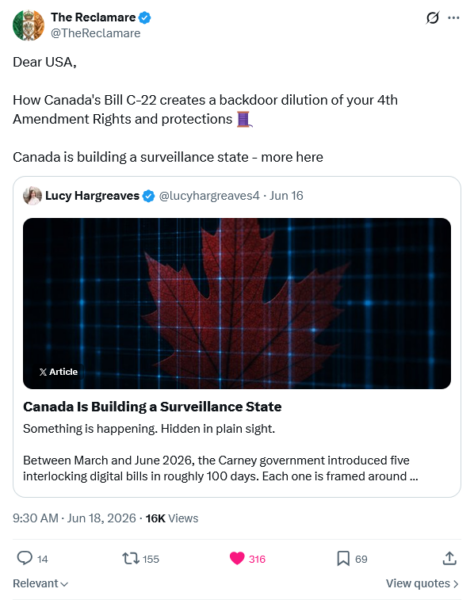
As The Reclamare explains, this bill is yet another likely irritant in US/Canadian affairs, as it will expose US citizens’ data to Canadian government oversight:

– A USA person creates/maintains a social media account — lets call it “XXX”

– Using its new C22 law, Canadian RCMP develops a “reasonable grounds to suspect” of “XXX” to a CDN investigation (a low investigative hunch standard under C-22).

– RCMP obtains a Canadian judicial authorization (an “Order”) and sends the Social Media company an International Production Request, which is not a USA warrant, not a §2703(d) order, and not routed through full MLAT (Mutual Legal Assistance Treaty) review.

– The social media company is bound by US law (SCA/ECPA), treats the request as a formal foreign inquiry.

– The social media company discloses limited metadata: summary of login IP ranges, account country setting, and other classification signals to prove USA origin

– This disclosure happens at Canada’s “reasonable suspicion” threshold, which is lower and less scrutinized than the US domestic requirement of “specific and articulable facts showing relevance and materiality” under 18 U.S.C. § 2703(d) for the exact same type of data.

– The USA user’s metadata, which would normally enjoy stronger 4th Amendment derived judicial protections, if sought directly by US authorities, is handed to a foreign government on weaker foreign grounds, without the same level of US court filtering or notice that a purely domestic US request would trigger.

– The 4th Amendment protection is effectively diluted because the platform’s good faith compliance with the foreign lower bar creates a new, easier pathway around domestic US constitutional safeguards for accounts that platforms classify as American

Canada’s Liberal government continues to chip away at our “Charter of Rights”, under the guise of “Protecting Citizens” and we are moving towards authoritarianism

While I loathe to create friction, I also hope your Rights can help slow Canada’s devolvement

It impacts you too

June 19, 2026

Nobody voted for this kind of dystopian nightmare, Mr. Carney!

The Liberal Party, having engineered themselves a majority in the House of Commons, are on a speed-run to the kind of dystopian police state we used to read about in science fiction novels:

Millions of Canadians are beginning to see the similarities between communist regimes and the direction of current government policy.

The pattern is always the same.

It begins with noble promises: safety, equality, compassion, protection, the greater good.

It ends with censorship, coercion, surveillance, prisons, ruined lives, and a police state.

Always.

It comes wrapped in slogans, experts, committees, emergency powers, censorship, enemies of the people, and the belief that the state has the right to crush the individual for the greater good.

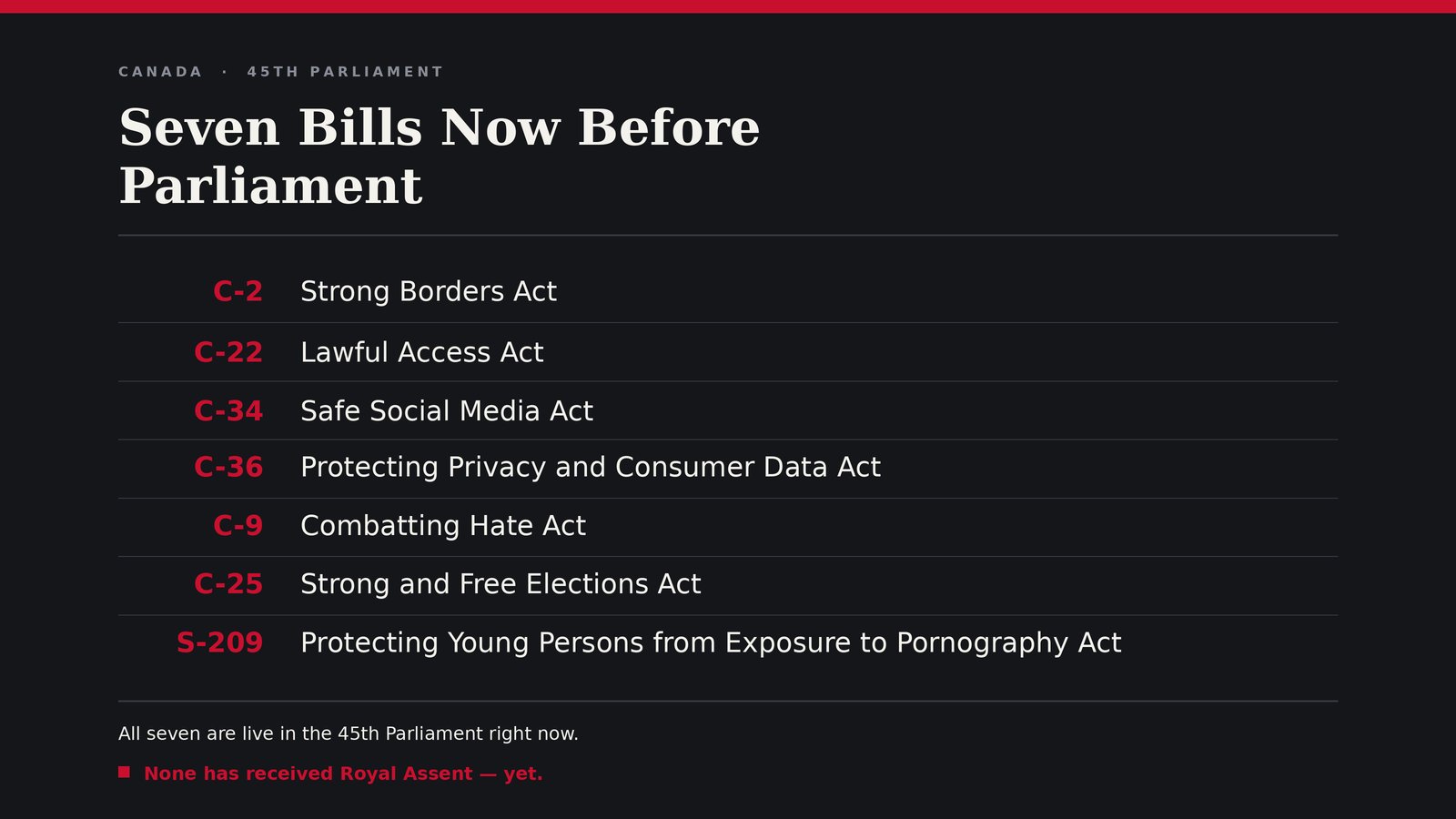
Consider…

C-2 – Strong Borders Act
C-22 – Lawful Access Act
C-34 – Safe Social Media Act
C-36 – Protecting Privacy and Consumer Data Act
C-9 – Combatting Hate Act
C-25 – Strong and Free Elections Act
S-209 – Protecting Young Persons from Exposure to Pornography Act

All seven are live in the 45th Parliament right now. None has received royal assent yet.

Consider that good, law-abiding Canadians are being gradually and systematically disarmed.

This is not a warning about some distant future.

In 2022 the federal government invoked emergency powers it did not have, froze the bank accounts of citizens over their political views, and banned Canadians from funding a protest. Two levels of court have since ruled it unconstitutional — a violation of the very Charter rights every one of these bills now circles.

That was the trial run. It needed an emergency as the excuse.

The seven bills above are the permanent version — the same reach, made routine — so that next time, no emergency need be declared at all.

A free country is not lost in a single day. It is legislated away in pieces, each one introduced with a reassuring name and defended as necessary, while good people keep assuring themselves it could never happen here.

It already did. The only question is whether enough Canadians notice before it becomes permanent.

Read every bill. Watch every one of them. Because this is the stage where it can still be stopped … and perhaps our last chance.

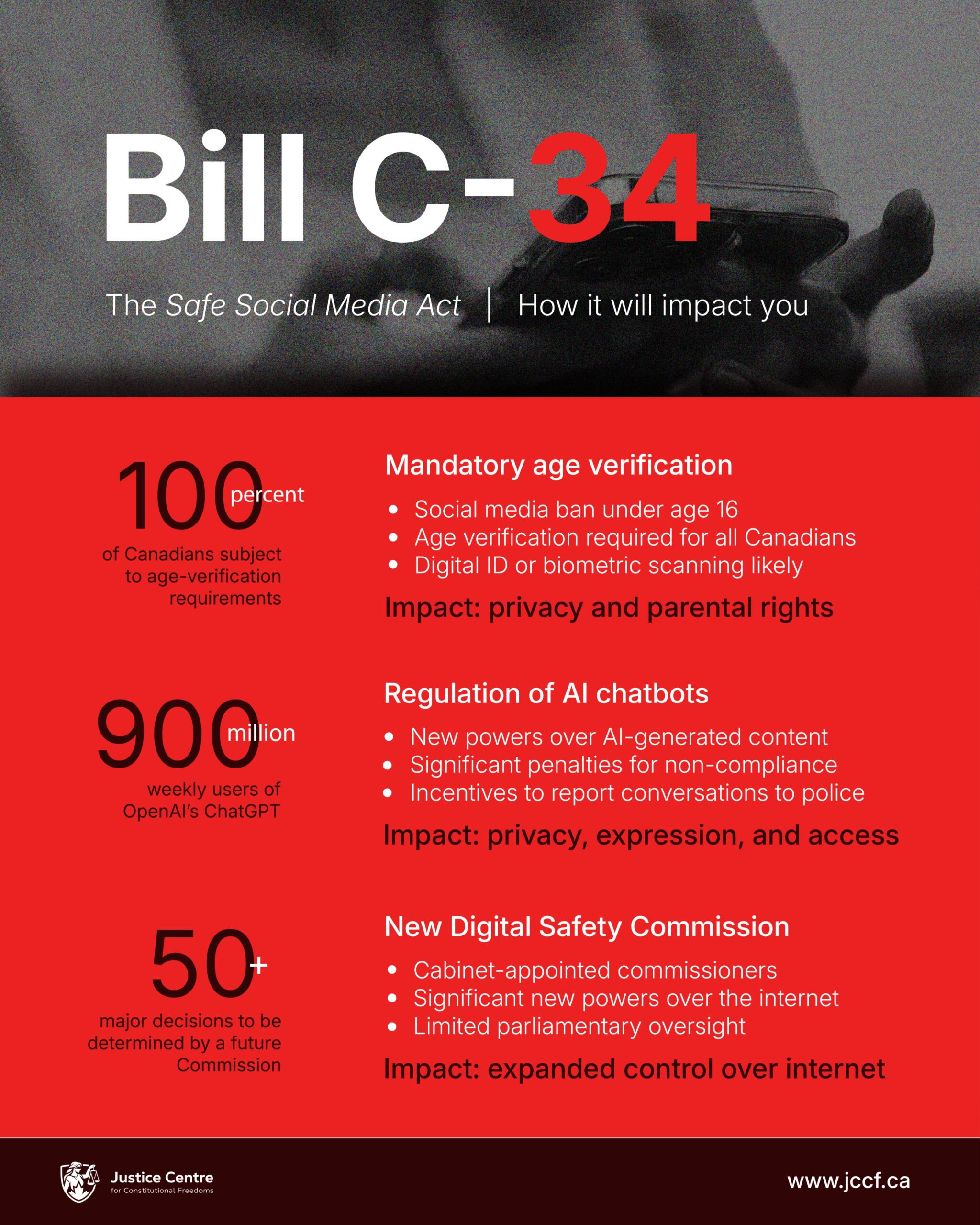
The Justice Centre for Constitutional Freedoms is trying to get Canadians to pay attention to what just one of these bills will do:

Bill C-34 will affect every Canadian. Age verification. AI regulation. A new Digital Safety Commission. Most Canadians have never heard of it. Here’s what it will do.

Michael Geist posts a Substack Note about bill C-22:

Bill C-22, the lawful access bill, has been reported back from committee and is headed toward passage. There are some amendments, but many concerns remain. The updated bill with changes is at

parl.ca/Content/Bills/4…

There are two changes to metadata retention. First, the maximum retention period the government can impose drops from 1 year to 6 months. Second, it can now mandate a category of metadata only if satisfied the category and all its elements are essential to investigations.

The committee rewrote the definition of systemic vulnerability. A “substantial risk” becomes a “credible risk, based on recognized international technical standards”. But it also added a carve-out: a flaw exposing only a target’s data is not “systemic”.

Added a new section on decryption that says nothing in the Act can be read to compel a provider to decrypt user-encrypted data, unless the provider supplied the encryption and holds the key. Borrowed from US law, but doesn’t fit the same way.

Compliance with ministerial orders is now expressly subject to the systemic vulnerability exception. That addresses a contradiction in the original text, where the duty to comply appeared to be unconditional.

The original bill set no maximum duration on these ministerial orders. This now changes to a two-year cap without the open-ended review-and-extend mechanism.

The amendments will rightly leave many still concerned. Companies considering exiting Canada due to Bill C-22 are unlikely to conclude that it fully addresses their issues. Yet the government is likely to push it through the House today.

June 18, 2026

Rules for you young plebs, but not rules for us

The generation that defined itself as “the youth generation”, “the hippies”, etc., are now nailing down every possible way to have fun so that youngsters can’t do what they loudly and proudly did at the same age:

Part of the crowd on the first day of the Woodstock Festival, 15 August, 1969.
Photo by Derek Redmond and Paul Campbell via Wikimedia Commons.

We’re banning raves, because we don’t want you having fun where we can’t watch you. By the way let me tell you about Woodstock.

We’re cracking down on underage drinking. It’s bad for you. Yeah of course we hit up the pubs at your age it was great.

We’re banning smoking, but just for you — the smoking age will go up one year every year. Oh yes of course, we used to be able to smoke inside everywhere, it was great really.

We’re banning flavored vapes. We don’t have any evidence they’re bad for you, you just like them too much.

We’re banning dodgeball during recess, someone might get hurt. Yeah we really enjoyed dodgeball too.

We’re banning flirting, because it might make the girls uncomfortable.

We’re locking you in your room for the next two years. Yes we know you’re in no danger from the virus, but we’re worried that you’ll get us sick. By the way you have to take this needle if you want to leave your room again. Yes, twice. Well there will be boosters too. No, we aren’t worried about side effects, that doesn’t effect us at all.

We’re closing the frat houses, because we don’t want you having fun without our permission. Please join these officially sanctioned university clubs instead.

We’re bringing in labor from the third world to work the service jobs, so you can’t have a summer job.

You need to go to university to get a good job. By the way we’re raising the price of tuition. Oh look we’re raising it again. Don’t worry there are loans. At interest.

Actually we’re giving the good jobs to the foreigners we just imported, to make up for our racist past. We are very good people. No of course we aren’t sacrificing anything. You just have to take one for the team.

Also, we’re giving the foreigners the houses. We needed to increase real estate prices. For our pensions, you see. Sadly no, you’ll probably never be able to afford one yourself. By the way don’t forget to pay your taxes. Need to support those pensions somehow! Eh? No, we’re giving ourselves tax breaks of course. Seniors discount you know.

Oh by the way, that one thing you still have, now that we’ve banned joy and kicked every ladder out from under you? That social media stuff you kids like? You guessed it! We’re banning that too! Just for you though, we’re still going to watch AI videos on Facebook. It’s for your safety, you see. We’ve noticed that you’re all getting rather irate, and we think it would be better for your mental health if you shut up for a while. Why don’t you just go outside?

Eh? No of course we aren’t going to stop Ahmed and his twelve illiterate cousins from raping your sister, that would be culturally insensitive, which would make us feel very bad, and we can’t have that.

Update: Added missing URL.

June 10, 2026

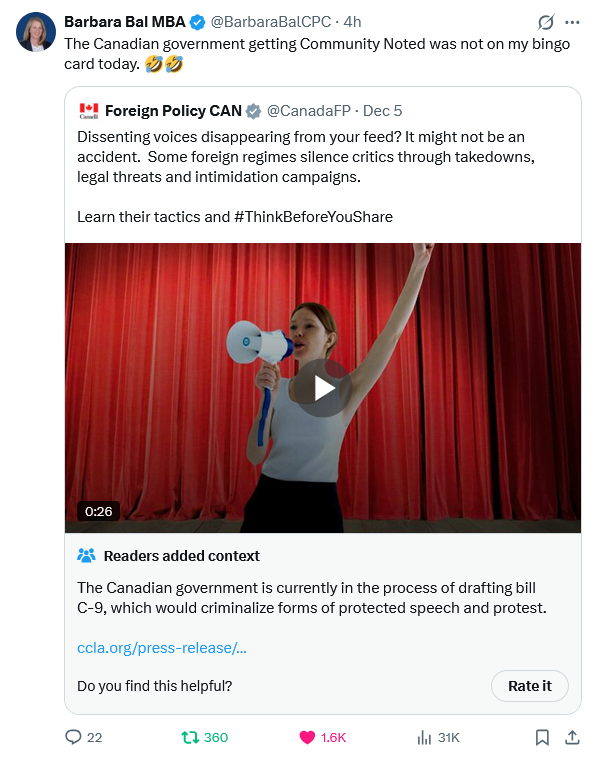
To protect under-16s from harmful content, everyone will now need to show their ID online

Australia’s attempt to ban under-16s from accessing social media and other online sites blew up rather quickly. Britain and Canada, seeing what happened down under, chorused “Hold our beers!“:

“Automotive Social Media Marketing” by socialautomotive is licensed under CC BY 2.0

The government is expected to table the Digital Safety Act on Wednesday with reports that it will include a ban on social media for those under 16, framed as a “temporary” measure that platforms can exit once a new digital regulator certifies their safety standards. I have been writing about these issues, from the original Online Harms Act to mandated age verification and website blocking and now the kids’ ban, for several years. This FAQ gathers the analysis in one place, with links throughout to the longer pieces for anyone who wants to go deeper. The key takeaway is that a kids’ social media ban is an ineffective and harmful policy that raises privacy concerns for tens of millions of Canadians through mandated age verification requirements. The policy fails to address the underlying concerns with social media and the prospect of a “temporary” ban makes little sense since the requirement might be reversible, but the data collection and regulatory infrastructure are permanent.

What is the government reportedly about to introduce?

According to the Globe and Mail, the forthcoming bill would bar anyone under 16 from social media. The government will indicate that this is a temporary safeguard with an opt-back-in once a regulator certifies safety standards. The government will frame this as “temporary” measure, but I argue that once established, there is no putting the toothpaste back in the tube given that the policy will require a regulator and proof of age from everyone.

Didn’t this start with Bill C-63, the Online Harms Act? What happened to it?

Bill C-63 was the government’s 2024 online harms bill, and from my first-day take I described it as effectively three bills in one: a defensible set of provisions focused on platforms that featured a duty to act responsibly, more contentious Criminal Code and Canada Human Rights Act provisions, and a powerful new Digital Safety Commission modelled on the CRTC to be funded by the tech companies. My view was that the Criminal Code and Human Rights Act provisions should have been dropped or incorporated into a separate piece of legislation. Bill C-63 itself died on the order paper when Parliament was prorogued ahead of the 2025 election, but the duty-to-act-responsibly model is likely to survive as part of the forthcoming bill.

Why is a kids’ social media ban bad policy?

I set out at least six reasons in this post on the issue. The most important is the first: the harms people associate with social media, such as algorithmic manipulation, addictive engagement design, weak content moderation, inconsistent enforcement, inadequate transparency, and privacy risks, affect users of every age. Treating them as a children’s problem misidentifies both the source of the harm and the right target of regulation. By focusing legislative attention on who is permitted to use social media rather than on how the platforms operate, an age-based ban lets legislators and the companies off the hook from more effective broad-based regulation. The other reasons identified in the post include the absence of evidence that bans work, the privacy harms they create, and the constitutional rights of the children they claim to protect.

Does the ban actually work?

The evidence to date says no. Australia’s under-16 ban took effect in December 2025, and the eSafety Commissioner’s first compliance report found that roughly 70 per cent of children who had accounts before the ban retained access to at least one platform three months later, with no discernible reduction in cyberbullying or image-based abuse complaints from under-16 users. Children route around age gates through VPNs, borrowed accounts, and false birthdates, and the most at-risk users are the most likely to circumvent them. Professor Lisa Given laid out much of this on a Law Bytes episode before most of the data was even in. Canadian politicians now citing the Australian approach with approval are pointing to a model whose own regulator’s data suggests has thus far proven ineffective. At a recent Canada 2020 event in Ottawa, Australian professor Amanda Third confirmed that kids are actively circumventing the ban and indicated that parents are concerned that their children are now less safe.

Doesn’t polling show overwhelming public support for a ban?

The headline number is real but misleading. The March 2026 Angus Reid Institute survey found that three-quarters of respondents support a full ban on social media for those under 16, and politicians have cited it repeatedly. But as McGill’s Sara Grimes documented on this Law Bytes podcast episode, the less-quoted numbers in the same survey complicate the picture: 72 per cent said parents, not governments, should be primarily responsible for regulating teens’ social media use, only 32 per cent picked 16 as the right threshold, and the survey did not ask respondents anything about the mechanism any ban would actually require. Simply put, public support for “protect kids from harm” is not the same as public support for “every Canadian must submit ID to a third-party provider in order to use the internet”.

Hasn’t social media been proven harmful to kids?

The data on social media harms to kids is far more mixed than is often portrayed in the media and in Jonathan Haidt’s Anxious Generation book that has fuelled much of the legislative panic. Grimes has produced a very accessible explainer on the issue that walks through the science. As she notes in Panic First, Evidence Later, “there is a serious problem. Researchers who have spent their entire careers studying adolescent mental health, children’s digital media, developmental science, and media psychology – the people who actually built the evidence base Haidt draws on – have raised sustained, substantive objections to his core claims.”

Read all of Michael Geist’s FAQ here.

May 29, 2026

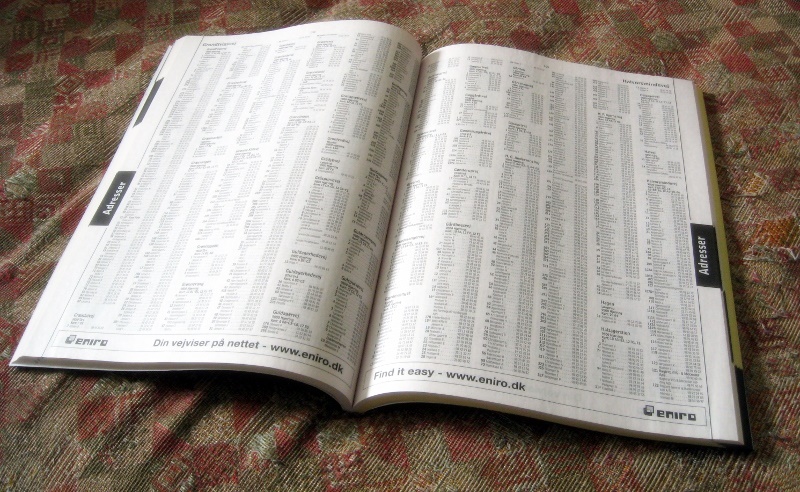
Debunking the “it’s just phone book information” claim for Bill C-22

Michael Geist explains why the “it’s just phone book information” hand-waving by politicians and government officials is worse than misleading: it’s deliberate mendacity.

en telefonbog (a Danish telephone directory)
Photo by Tomasz Sienicki via Wikimedia Commons

If this sounds familiar, it is because the same tired claims have been used for years. In September 2011, then-Public Safety Minister Vic Toews defended the Harper government’s lawful access proposals by claiming “linking an internet address to subscriber information is on par with the phone book linking phone numbers to an address”. Christopher Parsons, then a researcher at the Citizen Lab, responded with a detailed anatomy of what a lawful access “phone record” actually contained, showing that the three-field directory entry the government was invoking was being used to describe an eleven-field record including IP addresses, IMEI and IMSI numbers, SIM serials, device identifiers, and account information from multiple providers, any one of which could be cross-referenced to build a comprehensive profile of a person’s online life.

The Supreme Court of Canada put the issue to rest in the Spencer decision, holding unanimously in 2014 that there is a reasonable expectation of privacy in subscriber information precisely because the disclosure of such information “will often amount to the identification of a user with intimate or sensitive activities being carried out online, usually on the understanding that these activities would be anonymous”. It returned to the same terrain in Bykovets in 2024, extending Charter protection to IP addresses on the reasoning that an IP address is the “first digital breadcrumb that can lead the state on the trail of an individual’s Internet activity”.

Bill C-22’s new subscriber information production order applies a low evidentiary standard but covers name, pseudonym, address, telephone number, email address, account identifiers, types of services provided to the subscriber, the period during which they were provided, and information that identifies the devices, equipment, or things used by the subscriber in relation to those services. In short, a modern subscriber record is not a phone book entry but rather an index of a person’s digital life and the government is proposing to reduce the standard needed to gain access to that information.

Moreover, the same phony framing is now being stretched beyond subscriber data to mandatory metadata retention. As Conservative MP Andrew Lawton noted to Fraser at committee, the government and its officials have been telling Canadians that requiring electronic service providers to retain metadata for up to a year is “no different than just having a copy of the phone book that someone could leaf through”. That is a laughable comparison, given that metadata includes the date, time, duration, and type of a communication, the identifiers of the devices involved, and information identifying the location of the device. It is as if the phone book would include the details of every call made including location, call recipient, and device. And given retention for up to a year, the plan poses a disproportionate privacy risk that is likely to be struck down as unconstitutional by the Supreme Court, should it survive in its current form.

And in a follow-up post, he writes:

On encryption, Anandasangaree said the bill “was never meant to breach encryption” and promised to “clarify it in the Bill”. Language clarification is welcome but structural problems remain. The safeguards in Bill C-22 at ss. 5(5) and 7(5), which state that a provider is not required to comply if compliance would create a systemic vulnerability, are incompatible with s. 12, which unconditionally requires compliance with orders, and with s. 13, which specifies that orders prevail over regulations when inconsistencies arise. The term “systemic vulnerability” is not defined in the statute, and the Governor in Council has the power to make regulations “respecting the meaning of any term or expression for the purposes of this Act”. None of this is fixed by promising clearer language. It is fixed by the kind of amendment the Privacy Commissioner proposed this week, namely adopting Australia’s definition, which expressly covers actions that render encryption less effective, together with an explicit prohibition on regulations or orders that require the introduction of, or prevent the rectification of, a systemic vulnerability.

Moreover, Anandasangaree’s defence of the bill’s privacy implications was a deflection rather than an answer, as he tried to turn the attention to the privacy practices in the private sector, stating, “I drive a vehicle where every single point that I drive to is tracked. And that data is not with me.” Commercial data practices are indeed a real concern and Canada needs stronger laws to address them. However, the bill’s surveillance map of every Canadian is not justified by pointing to the absence of meaningful constraints on data collection and to the failure of his own government to address long-overdue private-sector privacy reform.

That brings the press conference back to the Privacy Commissioner. Asked directly whether he would accept Commissioner Philippe Dufresne’s amendments, the Minister said he would “be looking at” them and “looking to see what he has to offer”. Dufresne tabled eight concrete amendments at committee on Tuesday: narrowing subscriber information to a closed list (name, address, telephone number, IP address), restricting who can be compelled to telecommunications service providers, defining “publicly available information” to exclude information in which a person has a reasonable expectation of privacy, an overarching requirement that SAAIA obligations be necessary and proportionate, an Australian-style amendment to “systemic vulnerability”, an explicit prohibition on orders requiring vulnerability introduction or preventing rectification, an exemption to the SAAIA’s confidentiality rules to allow disclosure to regulatory bodies such as the OPC, and allowing his office to investigate if data breaches result from application of the new powers. Anandasangaree’s comments, coming a day after the Dufresne’s committee appearance, noted that “we have until like five o’clock today” for amendments. That window does not leave room to seriously consider the Commissioner’s recommendations. The “I will be looking at” claim, delivered hours before the deadline, amounted to a rejection of the recommendations.

May 13, 2026

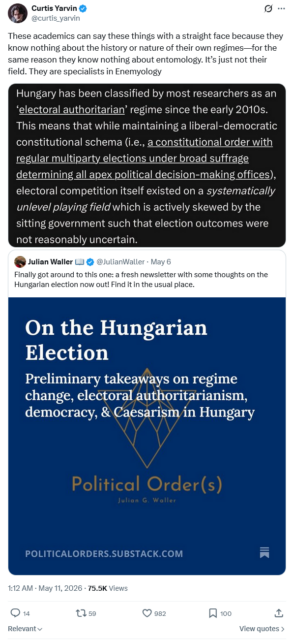
“Electoral authoritarian” regimes

Filed under: Europe, Germany, Government, Law, Liberty, Media, Politics — Tags: , , , , — Nicholas @ 05:00

eugyppius points out that the reflexive descriptions of the former Hungarian prime minister Viktor Orbán’s government as “electoral authoritarian” fail to note just how authoritarian the rest of the EU’s national governments have become:

this description of an “electoral authoritarian” regime applies far more aptly to Germany than to Hungary. What did Orbán do, defund a few NGOs? meanwhile our police, intelligence agencies & state media have all collaborated for years to keep the opposition out of power.

And after some harumphing from the cheap seats, he followed up with:

Various people are clapping back at this, so let me tell you what is happen in liberal democratic non-authoritarian Germany:

– Getting raided by police, charged with speech crimes, etc. because you post online is a professional risk, I personally know various people to whom this has happened and I live my life with a bunch of opsec annoyances for the day it happens to me.

– State media coordinates with intelligence agencies to smear and harass not only the political opposition but their prominent supporters, for example by doxxing them, getting them fired, subjecting them to harassment.

– The state funds a vast “civil society” network of violent street thugs to intimidate the political opposition and also anybody identified by state-sanctioned ops like those detailed in the above item. Opposition party congresses, other events routinely disrupted by coordinated civil society protests, where the local population is sympathetic (as in many east German venues) they bus in protesters from the west and the big cities to create the necessary atmosphere.

– Domestic intelligence agencies use espionage methods to surveil and compromise the political opposition; among other things they pay informants, tap telephones, read emails, and so on. We’ve had various indications that materials gathered in these operations are then used for state media smear campaigns.

– Yes, domestic intelligence openly coordinates with state media and certain private media elements too. Various aspects of political coverage in Germany are staged by secretive unelected bureaucrats.

– Procedural rules, other laws are routinely changed in ad hoc ways to disadvantage political opposition, though we haven’t had any outright gerrymandering like in the US so that means Our Democracy is safe. 👍

And:

I’m sure I’m forgetting some things. I’ve spent years documenting this shit on my blog and literally none of the present Hungary hyperventilators have ever given the slightest shit. Orbán was a guy who observed the Euro freak show as it is manifested in countries like Germany and tried in a kind of inept half-hearted way to imitate this machine from the right, the results were ridiculous and transparent and like 25% as effective as what the German state gets up to but nevertheless all these clowns confronted with a hint of their own methods started shrieking about FaSciSm.

April 2, 2026

QotD: Growing up behind the Iron Curtain

Ever met someone who grew up behind the Iron Curtain? You’d expect a mouse, right? You know, with the secret police and all? But they’re the exact opposite of that. People who grew up under the KGB’s iron heel are fucking obnoxious, because they’re utterly shameless. It’s not “give ’em and inch and they’ll take a mile”; it’s “they’ll start by grabbing a mile, then demand ten more”.

Which makes sense if you think about it. When everybody’s snitching on everybody else, shameless is the only way to live. Everybody’s guilty of something, so own it — being, of course, perpetually prepared to snitch anyone and everyone else at a moment’s notice if someone drops the dime on you. Also, if you have to stand in line six hours to maybe get a few potatoes, damn it, you’re gonna get those potatoes. It doesn’t matter if you like potatoes, or have any possible use for potatoes at the present time. You’re going to take every single spud you can get your hands on, plus steal anything that isn’t nailed down, because you never know when you’ll get another chance.

As it turns out, overabundance creates the same conditions. When you’ve been standing in line for six hours with 1,000 of your new best friends just to get some tampons — and you’re a guy, you don’t need tampons, but you can always barter them for something — you’re not going to scruple to do anything and everything to get them. Indeed you want people to know Ivan’s got some tampons, because that’s how the black market works …

… anyway, as I say, we’re not in line for six hours, but we are perpetually at least under the threat of surveillance. And not from the Feds — just as Ivan’s not worried about the KGB, but rather his neighbors, so we don’t have to worry about the Feebs monitoring us. Instead, it’s that Basic College Girl with the iPhone. She’s not filming you, of course, she’s filming herself, but there you are anyway, in the background, doing whatever. Under those conditions — and when everyone’s volunteering the most intimate details of their lives on Fakebook and Twatter — shameless is the only way to live.

In other words, thanks to constant social media “surveillance”, it has gone in the blink of an eye from “It didn’t happen unless someone caught it on film” to “It’s all on film anyway, so fuck it, I’m gonna get mine”. I used to see this all the time in class. Basic College Girls will lie straight to your face, for any reason or no reason. They’ll do it on spec, just to see if you bite. More importantly, they’ll tell you such obvious, easily disproven whoppers that you start wondering if they’re having a schizoid break. You have to know I know you’re lying, right? That Dead Grandma Story is very sad, but you have pictures of yourself all over Twitter drunk at the sorority formal, when you told me you were at Nana’s funeral.

It’s not that they don’t know. It’s that they don’t care. Because somehow I’m the asshole for not believing them, despite the evidence of my own lying eyes.

Severian, “Friday Male Bag”, Founding Questions, 2022-06-03.

December 8, 2025

If Britain’s political leadership were trying to destroy the country, what would they have done differently?

My Canadian readers — and possibly the occasional Aussie or Kiwi — can read Spaceman Spiff‘s essay and feel it applies almost 100% to our respective nations as well:

Image from Postcards from the Abyss

Britain is a disaster. The country seems to be in terminal decline.

Not only do we see a lack of ability to turn things around we witness leaders and prominent decision makers evidently clueless about normal life and the hardships many now face.

The political and media classes best reflect this phenomenon. Their views are insular, fictional and at odds with reality. They promote unorthodox ideas that are widely derided yet their enthusiasm is evident as are their hostile responses to being challenged.

Minor comments about immigration are treated as precursors to genocide. Criticism of a biased media unwilling to report events is dismissed as conspiracy. No discussion of climate policy and its unaffordable costs is tolerated. Deviation from the establishment view means excommunication and social exile.

Those in leadership positions drive Britain’s descent into authoritarian governance. Attempts to discuss changes to society leads to extreme overreactions, including jailing noticers, something they now boast about.

Britain has become a madhouse. Our leaders are unable to think like normal people. None of them are facing reality. They seem crazy.

Or, rather, they seem neurotic.

Neurosis is everywhere

Britain has degenerated into a technocratic regime that views the public as its enemy. Normal people disgust the country’s leaders and it shows. They no longer hide their contempt.

But there is a palpable sense of fear emanating from the powerful. Their reactions to normal events paint a troubling picture of who is leading the country, particularly the political and media classes.

If the British establishment were a person we would think them mentally unstable. The qualities we see most are those of a neurotic individual, a type that is well understood.

Here are some features visible in Britain’s ruling class.

Chronic anxiety and worry

A key attribute of neurosis is persistent fear or worry. Rumination is commonplace, circling around and around the same problems. There is also a tendency to overreact, with the response disproportionate to the issue at hand.

The current British regime is wracked with anxiety and worry. This defines them. They are vocal about their concerns.

We are reminded of an endless series of horrors we must attend to; systemic racism, lack of diversity, an imperial past and our cultural dominance along with our impact on the world.

One simple example illustrates the degree to which minds can become distorted by excessive worry.

James Watt perfected the steam engine in 1769 which kickstarted in the industrial revolution, changing the world forever. This would ultimately elevate most nations on earth and led eventually to the establishment of cheap abundant energy for almost everyone.

Until recently these events were viewed as an epoch-defining moment of engineering brilliance. Now this has been recast as a dark stain on Britain’s place in the world, with climate zealots keen to blame the British for all pollution caused by industrialization.

Instead of pride we now see embarrassment and even anxiety about the “damage” Britain has done to the world because it ushered in an era of cheap widespread energy for everyone.

Any rational person would understand this extreme view to be a distortion of reality and excessively negative, yet it permeates everything. Those who rule Britain are ashamed of our past. They worry about it. Only they do this, normal people are proud of our history.

[…]

Welcome to the madhouse

A system of governance driven by neurotics takes on their characteristics. Britain has become a neurotic bureaucracy; a neurocracy.

Neurotics overthink and live inside their heads. They lack the calm, detached strength needed to govern sensibly. Power structures inevitably take on these qualities.

The British government has become paranoid. Digital IDs, internet regulation, censorship. They jail normal people for social media posts. Dissenting views are increasingly punished with custodial sentences.

These are not the actions of the mentally strong. This is an embattled minority fighting reality and becoming desperate.

A gulf is opening between the rulers and the ruled. Increasingly no common ground is even conceivable as the fictions needed to maintain narratives grow. They become overtly false but are needed to feed the neurosis.

One of the things I like about the social media site formerly known as Twitter is how quickly authoritarian bullshit like this can get called out:

Update, 9 December: Welcome, Instapundit readers! Please do have a look around at some of my other posts you may find of interest. I send out a daily summary of posts here through my Substackhttps://substack.com/@nicholasrusson that you can subscribe to if you’d like to be informed of new posts in the future.

November 16, 2025

3D printing and firearms

Filed under: Liberty, Technology, USA, Weapons — Tags: , , , , — Nicholas @ 03:00

On the social media site formerly known as Twitter, ESR discusses a recent user notification from one of the 3D printer companies to their users:

I’m told that 3D printed gun parts are far more sophisticated than this Liberator from 2013, but I’m sure nobody would actually do that, right? It would draw the attention of various government agencies for sure.

The recent flap about FlashForge attempting to forbid its customers from printing gun parts means it’s time for another reminder about technological risk.

Their weasel-worded climb-down carefully avoids stating that they never collect data on what you print. They only say they don’t collect data during your prints. The wording is so careful that I think we can conclude they do in fact ship telemetry on your print jobs when g-code arrives at the printer, immediately before printing.

So I repeat a warning I’ve given previously: never buy a 3D printer that requires an internet connection to function. And, always assume that if the printer’s firmware isn’t open-source, it is written to spy on you and could at any time prevent you from printing disapproved objects.

Oh, and never trust FlashForge again or buy their products, no matter how much groveling they do. After this, it’s safest to assume that anything they say about respecting the privacy and autonomy of their customers will be a lie. Hear that, @ff3dprinters
?

We need to make a public example of FlashForge. Other vendors need to hear that shit like this will not be tolerated, that attempting to constrain what their customers print will do them permanent and irreversible damage.

It’s possible that this was merely a blunder on FlashForge’s court, and the attempts they’ve made so far to recover are compounding blunders, but they have sincerely repented of trying to control their customers. That’s too bad; in order to create the right incentives bearing on the future behavior of other vendors, we must show no mercy. We must make them hurt – ideally, to the point of being driven out of business.

And really these warnings apply to all “smart” devices, not just 3D printers. Unless you can audit the source code, the only safe assumption to make is that the firmware is spyware, controlware, and malware.

Device vendors need to know that we do not forgive, and will not forget.

In response, Hopalong Ginsberg posted this helpful item:

November 2, 2025

QotD: The “Blob”, aka the Deep State

The parasitic unholy alliance of Big Corporations, Big Government, Big Bankers and their entire fan club and cheer squad of supporters. Dangerously, this also includes the watchdogs: the Spy Agencies and large parts of the media. The Blob takes money from citizens, pays other parts of the Blob (eg USAID, The UN, The BIS, The World Bank etc), pretends to “help” some token victim group or environmental cause, or even to monitor or audit The Blob, but the outcome benefits The Blob more than the victims. They line their own pockets and increase their own privileges.

The Blob also includes a special category of “useful idiots” who naively assist them in looting Western Civilization. These people are paid in status or an illusory sense of purpose rather than money. They may not realize they are part of the self-serving Blob, and in the long run are not only harming the trees, birds and whales they say they want to save, but are harming their own health, wealth, national security, and worse, that of their children.

Jo Nova, “The Secret Ruling Class – Why the anonymous Blob needs to be invisible”, JoNova, 2025-07-18.

October 9, 2025

Britain is only a few steps further than Canada in the war on free speech

In The Line, Peter Menzies looks at the worsening situation for freedom of speech and freedom of expression in Britain, noting that what’s happening over in Blighty is our immediate future with current Liberal bills before Parliament to give government bureaucrats more power to silence us:

Everyone may know, for instance, that Kimmel got suspended by ABC for a week following statements made in the wake of the assassination of Charlie Kirk. But not a lot of people consuming Canadian media know that in the U.K., comedians weren’t just getting one-week suspensions. Nope. Last month they were getting arrested.

Right-wing icon Katie Hopkins, best known for her Batshit Bonkers Britain clips and Silly Cow tour, hadn’t been charged at the time of writing, but was arrested and, as they say in Blighty, “interviewed under caution”. Previously, Graham Linehan was arrested upon his return from the United States by five armed police officers at Heathrow Airport. At issue were posts he had made on X in April.

“If a trans-identified male is in a female-only space,” one Linehan post declared, “he is committing a violent, abusive act. Make a scene, call the cops and if all else fails, punch him in the balls.”

Currently on bail, Linehan returns to court on Oct. 29. The charges are harassment, criminal damage and suspicion of inciting hatred.

The merits of the cases can be debated, but my point today is that when it comes to digital policy and policing you, and the internet, Canadians and their media should be paying a lot more attention to the U.K.

Because it is there that the true illiberalism of modern Western so-called liberalism is most menacingly embraced. Even prior to the U.K.’s Online Safety Act coming into effect, pre-existing British legislation had been used to, for instance, convict six retired police officers for making comments “deemed to be offensive” within their private WhatsApp chat group. Following the Southport mass stabbing murders of little girls, at least two women with no prior history with police were given prison sentences — one for 15 months for a Facebook post calling for a mosque to be blown up, another 31 months for a tweet calling for hotels full of migrants to be burned. While their comments were certainly worthy of vigorous condemnation, the intervention of the state into private, closed conversations and the involvement of police, courts and the penal system has taken matters in the U.K. to a level inconsistent with liberal traditions.

Now that the Online Safety Act has supplemented those laws, hundreds of people have been arrested and dozens so far convicted for social media posts. The government calls the act a “new set of laws that protect children and adults online” in much the same way Justin Trudeau explained Canada’s own Online Harms Act. It’s all about “safety”.

Online Harms may have died when Parliament was prorogued last winter, but a successor is anticipated and, given Prime Minister Mark Carney’s obvious Anglophilia, it’s easy to speculate — fear is a better word — that he is taking inspiration from the Brits. After all, up until a few months ago, he was one of them.

Fighting back in the U.K. is, among others, Lord Toby Young, the Conservative peer, associate editor of The Spectator and founder of the Free Speech Union, which now has a Canadian branch featuring, among others, journalist Jonathan Kay. Young has protested that criminalizing disinformation hands governments the power to determine truth. Nevertheless, while Prime Minister Sir Keir Starmer has muttered that maybe the police have more important things to do, he shows — despite the meteoric rise in the polls of Nigel Farage’s Reform Party — no inclination to order a digital retreat.

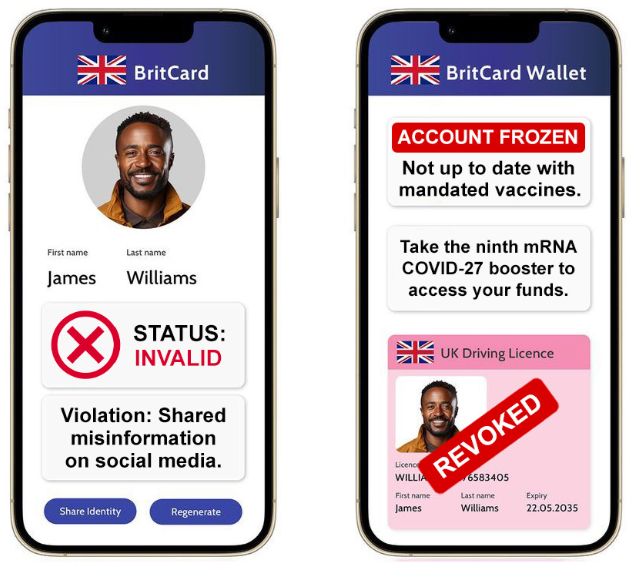
In fact, Starmer just doubled down with the introduction of legislation imposing mandatory digital IDs. A petition opposing it and the potential to enable mass surveillance and state control has already gathered close to three million signatures.

There’s a good chance the Canadian Free Speech Union will be similarly engaged in the years ahead. The Trudeau government’s instincts when it came to digital legislation were not as extreme as Britain’s. And there are very real differences in the legal structure of free-speech rights in Canada and the U.K. — we have the Charter, and the British don’t. So our laws would be enacted and enforced differently here than they can be the the U.K.

October 3, 2025

Adding digital ID to the pocket moloch … what could possibly go wrong?

Filed under: Britain, Bureaucracy, Government, Liberty, Technology — Tags: , , , , — Nicholas @ 03:00

On Substack, Andrew Doyle explains why it’s a terrible idea to trust the government — any government — in forcing digital ID on everyone:

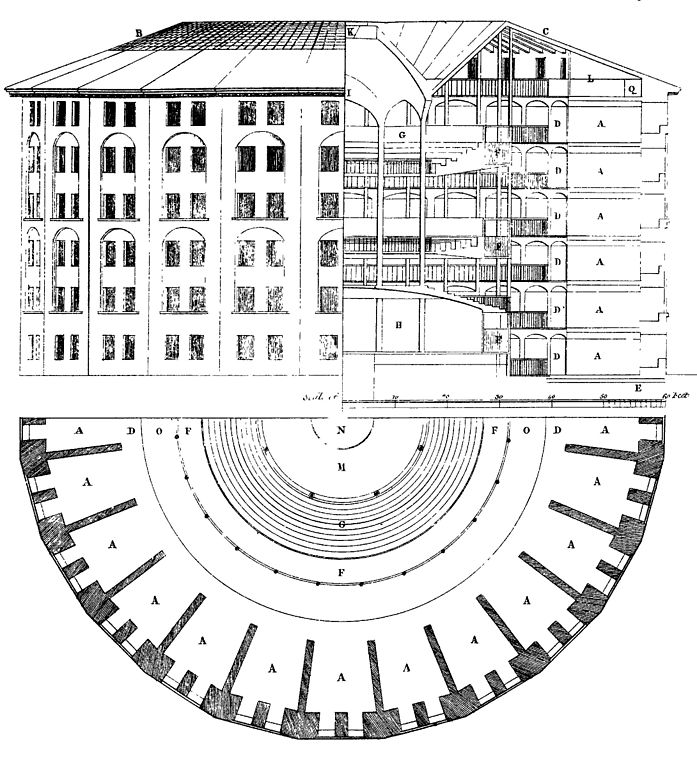
An illustration of Jeremy Bentham’s Panopticon prison.
Drawing by Willey Reveley, 1791.

During a trip to Russia in 1785, the philosopher Jeremy Bentham sketched an outline for a new prison design. The cells were arranged around the circular perimeter and, at the centre, he placed his “panopticon”: a watchtower which afforded a view of any of the cells at all times. The prisoners might not always be being observed, but they could never be sure that they weren’t.

Bentham’s design was never directly used, but the idea took hold as a symbol of state overreach and control, most famously in Michel Foucault’s Discipline and Punish (1975). Foucault was alert to the political ramifications of such a concept, and how surveillance might become an internalised experience. With Keir Starmer now pledging to introduce a digital ID system as a mandatory condition for the right to work, are we seeing the first step towards the realisation of Bentham’s vision?

I suppose we are already there. I have seen friends switch off their phones before discussing politically sensitive issues, genuinely convinced that digital eavesdropping is the norm. Many people are mistrustful of the “Alexa” voice assistant, which they are persuaded is recording their every word. While this all seems terribly conspiratorial, I’m sure most of us remember those reports a few years ago about the Pegasus spyware which had been covertly installed on the phones of journalists and government figures, turning the devices into pocket spies.

[…]

Few will be surprised to hear that public trust in political institutions has plummeted. The increasingly authoritarian tendencies of successive governments, our two-tier policing system, public manipulation as embodied in the “nudge unit”, and the corrupt prioritisation of the interests of the political class over the people they serve – perhaps best demonstrated by parliament’s flagrant efforts to overturn the Brexit vote – have all contributed to this climate of mistrust. The bizarre overreach of police during the lockdowns – in which dog walkers were publicly shamed with drone footage, and shopping trolleys were probed for “non-essential items” – has hardly helped matters.

To many of us, it is baffling that anyone at all would support the prospect of the government keeping track of our movements and holding our private details in a database. Starmer claims that the scheme will curb illegal immigration, but we are talking about criminals who already work outside the system and will doubtless continue to do so. Besides, identity cards have been a reality on the continent for years, and have done precisely nothing to resolve the problem. Employers in the UK are already legally obliged to insist on proof of immigration status from workers.

Labour’s digital ID scheme seems more about control than anything else. The possibility of fraud is also a major concern. It’s not as though the government has an unblemished track record of preventing data breaches. We all recall the massive leak of official MOD data regarding Afghans who had worked with the British government during the UK’s military campaigns. And who could forget the senior civil servant who, in 2008, left top-secret documents concerning al-Qaeda and Iraq’s security forces on a train from London Waterloo? Are we really to suppose that the creation of an all-encompassing centralised database will not leave the public open to risk from hackers and hostile foreign powers?

Tim Worstall adds that “they c’n fuck off ‘n’ all”:

So we’ve that wet dream of Tony Blair raising its ugly head again. There should be a national ID system. Actually, it’s not just Blair, T — the bureaucracy has been right pissed at the erasure of the wartime system since the 50s when it was abolished.

For there are two ways of looking at, thinking about, the whole governance thing. One is — the Blair, bureaucrats’, version — that the population are cattle, kine, to be managed. For the benefit of the bureaucracy of course — or at very least to be forced into doing what the bureaucracy thinks they — we — should be doing.

Then there’s that stout Englishman, the Anglo Saxon, version, which is that government are just the slaves we communally hire to make sure the bins get emptied. Well, OK, maybe raise a bit of tax for a Royal Navy to sink the Frenchies. But even then, not too much of that — the Civil War was, after all, triggered by Ship Money. Did the people who would not be slaughtered by the first wave of invading Frenchies — because they had the silly excuse of living 25 miles inland — have to pay the tax to run the Royal Navy to keep the Frenchies at bay or not? The King said yes — the King was right — and not for the first nor last time in British political history the guy who was right had his head cut off for being so.

Digital ID, so which version should we have? That one beloved of Froggie-type bureaucrats who view La Profonde as kine to be corralled? Or the Anglo Saxon version where we just devolve the scut work to a few slaves?

[…]

The reason this never will be proposed is that it doesn’t fit the reasons why our rulers wish to have an ID system. They’re insistent that we be their kine rather than they our. So, the Hell w’ ’em.

But it could be done. Government simply publishes an interface — an API — which says that proof of identity needs to be presented in this format. We’re done as far as whose kine is whose.

Update 4 October: From Samizdata, another illustration of just how toxic Two Tier Keir has become to British voters:

The Guardian reports:

    “Reverse Midas touch”: Starmer plan prompts collapse in support for digital IDs

    Public support for digital IDs has collapsed after Keir Starmer announced plans for their introduction, in what has been described as a symptom of the prime minister’s “reverse Midas touch”.

    Net support for digital ID cards fell from 35% in the early summer to -14% at the weekend after Starmer’s announcement, according to polling by More in Common.

    The findings suggest that the proposal has suffered considerably from its association with an unpopular government. In June, 53% of voters surveyed said they were in favour of digital ID cards for all Britons, while 19% were opposed.

August 5, 2025

High tech and lust for power are a bad combination

Spaceman Spiff discusses the malign confluence of technocrats and amoral power-seekers (BIRM):

Today’s technocrats, assisted by billionaire tech bros, want to implement a digital surveillance grid that will eradicate any notion of anonymity or privacy forever.

Every major country, including the United States, is working on this with enthusiastic support from governments and their many agents.

The sales pitch is primarily platitudes about protecting people from harm, especially children.

What they seek is the end of the internet as it currently is, which means it will look a lot more like licensed corporate TV than the current free for all. From here their goal is to extend their surveillance operation into every aspect of our lives, from the energy we consume to the food we are permitted to eat.

This will probably cause a lot of damage, but it will ultimately fail.

Tech bro arrogance meets managerial control freakery

We are witnessing a partnership between the technocratic elite, with a limited understanding of technology, and silicone valley titans, who are blinded by the promise of technology.

Each group believes draconian surveillance systems combined with fancy data analysis will solve many societal problems and usher in a new era with them at the helm.

To the technocrats it promises full-spectrum control of all our choices. The food we eat, the material we consume, the ability to travel.

They are salivating at the thought of the ultimate control, the issuing of government-controlled digital currencies they can deactivate on a whim. No steak for the memelords, and no road trips for those without the right carbon profile.

They have been discussing these things for many years with a degree of enthusiasm bordering on mania.

The technologists see a chance to keep in with the powerful, to join the club. If they can be the trusted partner of the visionaries currently wrecking our world they will cash in and perhaps be spared from the concentration camps.

The technologists have powerful tools that promise amazing things. Machine learning, predictive programming, behavioural modelling.

Spotting patterns within trillions of data points is appealing to society’s tinkerers, all the better to predict problematic behaviours and to spot trends. Combined with nudge units and related horrors of social engineering this promises to be the holy grail for a technocratic managerialist regime absolutely convinced it can steer society in enlightened directions, just like they imagine they did during Covid.

It is all very futuristic, and it has clearly impressed our technology gurus as well as those who love control.

But along with the outsized data stores will come outsized cockups they cannot properly plan for.

Climate modelling has promised immense benefits and accuracy for decades and we have yet to see a single successful prediction. Indeed, some of the most famous climate predictions are almost comically wrong but nonetheless trigger endless rounds of funding, chatter, conferences and hubris. Such is the lure of anything that can be adapted to enforce top-down social control.

There have been many attempts to harness technology to predict the stock market, another obvious target. None of them worked either. It doesn’t seem to matter. No one is checking the track record. It is sold on its promise and that works because of who is buying. Or, rather, the type of person who embraces these schemes.

Digital surveillance, digital currencies, digital voting, digital IDs. Everything we do tracked and stored. Such absolute total control would make our superiors into gods as they exploit these powerful tools to direct us towards better versions of ourselves.

There is a delusion at play here. Those closest to this seem lost in their fantasies. They are blind.

July 22, 2025

Age verification schemes are just another attempt to control everyone’s internet usage

Filed under: Britain, Government, Law, Technology — Tags: , , , , , , — Nicholas @ 03:00

Marian Halcombe is specifically discussing the British age verification provisions of their Online Safety Act, but similar schemes are popping up all over the west, and they’re only pretending to be about protecting young people from online content:

“Privacy” by g4ll4is is licensed under CC BY 2.0 .

The British State, in its infinite filth and hypocrisy, would like you to believe that it is deeply concerned about what you do with your penis. Or more precisely, what you look at while your hand is on it. The latest wheeze — part of the Online Safety Act — is mandatory age verification for all pornographic websites. We’re told it’s to stop children from seeing naughty videos. In reality, it’s a spyware regime disguised as child protection, devised by a ruling class that snorts coke with one hand while signing surveillance warrants with the other.

Let’s start with the pretence. No one in Westminster cares what children watch online. These are the same people who presided over the industrial-scale rape of working-class girls in Rotherham, Telford, Rochdale, and elsewhere — refusing to intervene for fear of “racism”. The idea that they now lie awake worrying about a Year Eight boy glimpsing a MILF thumbnail on Pornhub is an insult to the intelligence. They don’t care about children. They care about you.

The age-verification scheme isn’t just about proving you’re eighteen. It’s about linking your name and your age, and your IP address to your viewing habits. Whether it’s ID upload or facial recognition or some third-party database, the outcome is the same: a digital file that knows what you watch and when you watch it.

In a normal country, this would be recognised as deeply perverse. In ours, it’s dressed up as safety. The State that can’t fix the trains, that can’t keep the hospitals clean, now wants the power to log whether you’re big-enders or little-enders. And all under the banner of protecting the kiddies.

Yes, of course it’s technically possible to anonymise verification. But only if you believe that governments, regulators, and their corporate collaborators are incapable of abuse. That’s a belief I do not share. This is the same British government that let GCHQ harvest your webcam feeds and your phone calls under the TEMPORA programme. You didn’t vote for that. You weren’t told about it. You found out because Edward Snowden blew the whistle.

Do you really think the same regime won’t take an interest in which adult videos you watch? Anyone with an ounce of memory knows how this goes. Every intrusive policy begins with “think of the children”. The Video Recordings Act. The Dangerous Dogs Act. The Terrorism Act. And now the Online Safety Act. Once the infrastructure is in place, it never stays limited to its original purpose.

The definition of “harmful content” is vague for a reason. It can grow. It can stretch. Today it’s Pornhub. Tomorrow it’s Twitter. Then it’s dissident blogs, pro-life websites, or even a dodgy meme about immigration statistics. In the end, the target isn’t porn — it’s dissent.

May 17, 2025

German democracy … saved by bureaucratic incompetence?

Filed under: Germany, Government, Media, Politics — Tags: , , , , — Nicholas @ 04:00

Checking in to the situation in Germany, it seems that the big secret report compiled by the German spy agency on the extremely extreme extreme right-wing Alternative für Deutschland party is a bit less than what was expected. Okay, a lot less:

In my last post, I wrote that “The campaign to ban Alternative für Deutschland is not going well“. Today – a mere seventy-two hours later – you could say that the campaign to ban Alternative für Deutschland is all but dead. This is because the people most committed to banning the AfD also happen to be some of the stupidest, most incompetent legal and political operators the world has ever seen. Their incompetence is so enormous that I am for once willing to entertain conspiracy theories as to why they might have undermined their own project. It is that bad.

Two weeks ago, you may remember, Interior Minister Nancy Faeser forced the Federal Office for the Protection of the Constitution (BfV) to rush their long-planned upgrade of the AfD and declare the party to be a “confirmed right-wing extremist” organisation. Word spread of a mysterious 1,100-page assessment, full of damning proofs that allegedly supported this upgrade. This document had to be kept secret, Faeser explained in an interview, “… to protect sources and withhold indications of how our findings were obtained”. So espionage, much secret, wow.

The thing was, the anti-AfD dossier could not have been that secret, because somebody (almost certainly, somebody in the Interior Ministry) immediately leaked it to Der Spiegel, whose journalists published various excerpts in an effort to make the case for how evil and fascist and Nazi and Hitler the AfD are. In this way the press could climax repeatedly in a wave of democratic orgasms over the renewed possibility of an AfD ban, even in the absence of the supersecret report.

The media circus dissipated quickly, however. The publicity campaign, the roll-out – a lot of things went wrong, some of them inexplicably wrong. Still, I thought there was a 40% chance that the Bundestag would try to open ban proceedings sometime this year. That, as I said, was on Monday. What happened on Tuesday, is that Cicero, NiUS and Junge Freiheit all received the secret 1,100-page assessment (actually, it contains 1,108 pages) and published it in its entirety. Since Tuesday evening, a great many people have been reading this document, and they have been realising various things.

The first thing they’ve realised, is that it contains hardly anything derived from supersecret spy sources at all. It is little more than a collection of public statements by AfD politicians. Faeser’s sources-and-methods justification for keeping the report hidden was a total lie.

The second thing they’ve realised, is that it is an abomination. The vast majority of material that the BfV have collected is not even suspect. It is a lot of off-colour jokes, memes, but also just banal nothing statements – thousands and thousands and thousands of them, arranged under various hysterical subject headings. Nothing in here is remotely strong enough to support the case for banning the AfD and a lot of it is also very bizarre in terms of argument. Not only have the prospects of an AfD ban all but evaporated, but I think it’s even likely the party will succeed in their present lawsuit and that the administrative court in Cologne will throw out the “right-wing extremist” label.

Older Posts »

Powered by WordPress