
I’ve written many times that the real culprits here aren’t the Boomers, but the Silents. Pick any obnoxious “Boomer” who did whatever in The Sixties™, and it’s Build Back Brandon to one that the “Boomer” in question was born in the 1930s. Which makes sense for a lot of historical reasons, but simple chronology will do: If we take as read that The Sixties™ started with the Port Huron Statement, then The Sixties™ started in 1962. The Baby Boom started in 1945, meaning that the very oldest Boomers were still in high school in 1962. They might’ve enthusiastically embraced every word — then again, they might not — but they surely didn’t write one letter of it.
Further, what could they really do? The voting age was 21 until 1971, and as hard as this is to hear, voting was just as pointless back then as it is now. St. Kennedy only won through massive voter fraud, and that was 1960. As John Derbyshire used to say, if the American People had been consulted on anything of importance since then, the USA would still be a White Christian nation … and yet, here we are.
Tweedledum and Tweedledee put on a better show back in the days, but the Uniparty was still the Uniparty. America’s ruling caste caught religion back in the 1920s, and on the long view, you could make a pretty robust argument that Mustache Guy and the Anime Club actually did us a huge fucking favor — left to his own devices, President-for-Life Roosevelt would’ve ushered in the USSA by the late 1930s, with the enthusiastic support of all the Beautiful People on both sides of the Uniparty.
… hats off to you [Isoroku Yamamoto] — you and your dipshit friends bought us a few decades. Decades we squandered, of course, but that’s not your fault. It’s not anyone’s fault, unless you think the boys on the Higgins boats should’ve shot their officers, turned the ships around, and conducted a massive air, land, and sea invasion of every faculty lounge and radio station in America … and even if you do think that, what are you going to do about it?
As for Gen X, we were no better. I can’t blame the Boomers for running with it, any more than I can blame myself for running with our thing. I spent most of college, for instance, getting drunk and chasing tail. Chasing tail is bad, full stop — I should’ve been saving it for marriage, with all that implies — and while getting drunk isn’t bad every now and again, I didn’t do it every now and again. I lived a life as dissolute as any Boomer’s, and while I was equally powerless to change anything in the broader culture, I could’ve been a much better person … but I wasn’t.
Severian, “Friday Mailbag”, Founding Questions, 2022-09-23.
October 12, 2026
QotD: Blame the “Silent generation” for The Sixties™, not the Boomers
September 4, 2026
QotD: My generation
That’s why one of the weirdest things about getting older is realizing just how much of what you took for granted as part of the permanent furniture of the world was actually highly transient: The Iron Curtain. Guitar rock. Your own hopes and dreams and ambitions. Sometimes they all come wrapped together like a package deal, and failing at one makes it seem like you’ve failed at it all.
Andrew Potter, “Eddie Van Halen, Bill and Ted, and mourning a generation”, The Line, 2020-10-14.
July 18, 2026
The current state of play in the Russo-Ukrainian War of 2022
I don’t make a habit of sharing reports from the ongoing fighting in Ukraine, as the war has ground on (how do you say “short, victorious war” in Russian?). It’s not that I’m not interested, it’s that trustworthy sources are vanishingly thin, and most coverage is either hyper-pro Ukraine or hyper-pro Russia … so assessing events is somewhere between difficult and impossible for those of us without our own satellite and espionage networks. kulak, on the other hand, has been paying attention and does have some insights that are worth considering:
One could be forgiven for thinking that there is something deeply wrong with the Russian State and Vladimir Putin in particular.
Every 1 to 3 months some new unprecedented Ukrainian asymmetric attack hits Russia’s homeland in ways almost tailor designed to provoke an escalation, outrage the populace, and leave the Russian Government humiliated at the loss of face.
The “Crocus City Hall” (it’s a civilian music venue not an actual city hall) attack in Moscow was killed 151 and injured 600+ Civilian music fans in an “ISIS” terrorist attack … That everyone knows was funded, coordinated, and enabled by Ukraine (and the CIA). Right down to the assailants passing through Ukraine, and being on camera collecting their discarded firearm magazines (presumably because the manufacturer stamps would tie them to their backers) …
This was huge Russian News, and the specific band whose audience was targeted is also significant.
Piknik is a massive hit Russian 80s band. Now, Students of history will note that Russia was still communist in the 80s. They’ve been around forever, and are generally inoffensive and middle of the road (they were mainstream under the USSR)… They’re kind of a weird gothic slavic prog-rock blend of Phil Collins and the Tragically Hip. And they’re huge … Individual videos with 10s of millions of views on Youtube … As big as any hit western 80s band and lots of cultural fondness in the Russian imagination.
(Presumably it hits harder if you can appreciate Russian)
This matters because their core demographic are Russian boomers who are Nostalgic for their Soviet Childhoods, but are also established and content in Modern Russia … Ie. Putin’s Core demographic.
This would be like if you attacked a Hamilton performance or a Bono concert in the west. That’s the regime’s core supporters right there. That’s a knowledgeable and incisive cut that actual Muslim foreigners wouldn’t know or care to hit … But that Slavic Ukrainians and calculating CIA planners trying to apply pressure or destabilize Russia into escalation would know and salivate at.
Likewise Ukraine explicitly attacked Russia’s Nuclear Strategic Bomber fleet in Operation Spider Web, assets that were not used in the Ukraine war, and indeed were basically irrelevant to the conflict … But are core to Russia’s nuclear triad and the stability of the global nuclear balance of power … Again basically begging for a massive escalation and almost certainly making Russian Generals and Strategic planners break out in a cold sweat until they assessed the damage.
Beyond this there have been prominent assassinations of Russian Generals … In Moscow. And assassination attempts on Putin himself …
In addition to the destabilizing Ukrainian counter-invasion of Russia, and escalating strikes on Moscow itself.
The thing to understand is that none of these have been conventionally advantageous for Ukraine. The Invasion of Russia stretched their forces, the Assassinations if anything probably cycled in younger, more competent, hungrier generals, attacking Moscow Boomer civilians probably gave a massive morale spike to the outraged Russian populace … These strikes on Russia have infuriated Russians and made them call for blood.
This is in many respects THE OPPOSITE of what you’d normally want to do as a smaller country fighting a larger that hasn’t fully mobilized. Usually you want to exhaust a larger force that’s half committed or politically divided, without getting them to up their commitment or causing them to unify. Think of Vietnam … The Vietnamese wanted Americans to get tired of fighting them and get demoralized at the idea of ever “winning”, fight amongst themselves, then wind down and withdraw. If in 1972 Vietnamese terrorists had attacked the Superbowl and killed hundreds of American civilians on US soil … that’s actually one of the few things that could have united American in 1972 or gotten America to commit to another 5 years in Vietnam at that point.
It would have greatly damaged American prestige … Moscow or China might have liked that … But from Vietnam’s perspective where they want America to wander elsewhere, it’d lock in years of misery.
So that’s weird … but weirder has been Putin’s Reaction: Nothing. Basically no counter-escalation. Certainly nothing that’s made Zelensky sweat and hesitate at sending more drones at Moscow.
Indeed many sympathetic commentators both in Russia and the West have been screaming their frustration at Putin that he hasn’t suitably punished these insults to Russian Honor or restored Russian deterrence … Or merely enforced baseline international norms around targeting heads of state, civilians, and Strategic nuclear assets in a non-nuclear conventional war.
Russia has hundreds of these Tornado systems.
It’s not as if Russia lacks conventional options. Kiev is RIGHT THERE. Hell, If the Russians really wanted the Tornado MLRS (Multiple Launcher Rocket System) has a range of 200km, fires thermobaric warheads or White Phosphorus rounds, and could hit Kiev from Russian Ally Belarus …
Without even debating the extent of air-cover, and to what extent Ukrainian Air Defense is intact (or to what extent the US can supply them with interceptors) … Putin has the capacity to firebomb Kiev on the scale of Dresden if he wanted to, from the ground. He’s not lacking in conventional, nuclear, and every other kind of escalatory option.
And yet he’s not escalated … And his retaliations have been as close as possible to the bare minimum he could get away with to not be overthrown for treason.
So what the hell is wrong with Putin?



July 16, 2026
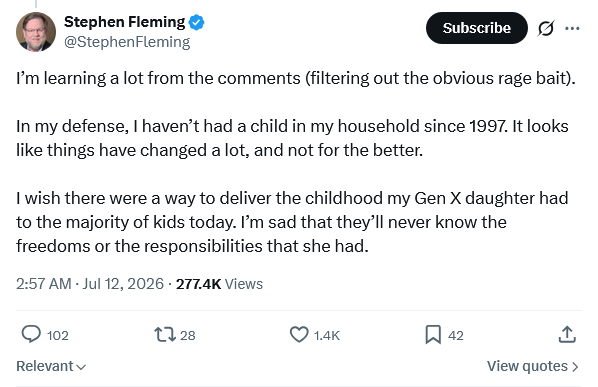
This is why so many of the kids are not “alright”
An interesting discussion at the social media site formerly known as Twitter, as Devon Eriksen responds to a comment from Stephen Fleming:
But don’t you understand?
There was a way. There was always a way.
We had it within our grasp, because we had already grasped it. The childhoods that you and your daughter had were available because you and your daughter had them.
All that the Boomers, and their parents, the eldest of the post WW2 generations, had to do was …
Nothing.
Just live in the paradise that their ancestors won for them, and make the minimum, the bare minimum, of effort that would have been required to actually sustain it.
That’s all.
Just keep things the way they were.
But they couldn’t handle that. Their fathers and grandfathers, the heroes that won WW2, made them jealous.
They wanted to be heroes, too.
So, for the sake of their own egos, they had to become Social Justice Warriors. They had to be Champions of Progress and Change.
They had to see the world they inherited as a pile of problems to be solved, rather than a pile of solutions to be cherished and preserved.
So they could feel like they were doing something important.
Almost all of the elder generations, even the ones who call themselves conservative and vote republican, are, in truth, socialist liberal progressives. Because they looked at paradise, and wanted to fix it instead of protect it.
That’s why the “republican” option was Reagan, the gun-ban guy, the social-welfare guy, the kiss-up-to-the-commies guy, the amnesty-for-foreign-invaders guy.
Reagan, the Hollywood liberal, the Obama of the 80s, instead of Joe McCarthy, Barry Goldwater, and Pat Buchanan.
Teens can’t have a summer job because elders had to be Third-World Compassion Heroes, and give us Hart-Cellar and eleventy-billion barbarians who don’t care about civilization, but will work cheap.
Teens can’t have a car because elders had to be Climate Emergency Heroes and give us emissions control laws and Cash for Clunkers.
Teens can’t have safe schools to learn at, because elders had to Anti-Racist Heroes and made it illegal to exclude violent thugs from our school districts. Just because those thugs generally come color-coded for your convenience.
Teens can’t have safe public spaces to hang out in, because elders had to be Compassion for the Underclass Heroes, and release violent savages into society, again and again, with a lecture and a slap on the wrist.
Teens can’t have a healthy economy to inherit, because elders had to be Equality Heroes and make sure every corporation that actually did anything useful was punished for not being Diverse, Equitable, and Inclusive enough to suit the ideal universe that exists only in their heads.
Teens can’t have dates, because elders had to be Anti-Sexist Heroes, and let feminists spend forty years diminishing the social value of men, until you had to a be a billionaire rockstar adventurer to avoid being an unsexy loser by default.
Teens can’t even be fit, healthy, and pretty, because elders had to be Sex Equality Heroes, and move women into the corporate workforce in droves, leaving children to be fed by corporate industrial slop factories.
Teens can’t have sane, well-adjusted, unspoiled girlfriends and wives, because elders had to be Champions of Sexual Freedom, and normalize unlimited female promiscuity, all in exchange for the largely unfulfilled promise of a little unshaven free-love yeti snatch.
And worst, of all, the crowning irony, the final dead hamster in the water pipe, is that all of this would be fixable, perhaps in three to five election cycles …
Except.
Except the elders don’t understand that any of this of this is happening.
They haven’t had a child in the household since 1997. They haven’t looked for an entry-level job since 1973. They haven’t gone on a date since 1981. They haven’t been laid off … ever.
They are safe with their paid-off houses and their investments and their pensions from 45 years at the same company and their social security and their medical plans.
It’s affecting the youngest generations first and worst. While the elders sit on their cruise ship, surveying the short with binoculars, wondering who all these ragged distressed looking people standing on the shore are.
And why they are holding signs that say “HELP”, “THIS IS ALL YOUR FAULT”, and “YOU STOLE THE LIFE I WAS SUPPOSED TO HAVE”.
Then they shrug, conclude that these must be the whiny losers, and everyone further inland is probably just fine, and everything is fine, because they fixed everything and they are all heroes, and the Summer of Love was the end of the Problematic Era of History and the beginning of the Great Enlightenment.
And when I am 74 years old, and the elders are all safely tucked into their cemetery plots, I will be torn apart by an angry mob for having white hair, and therefore being “one of them”.
And the mob will not care that I didn’t get to cast a vote until 1992, for the Man Who Predicted All Of This.
He called it the “giant sucking sound”.
Which is apt because it’s why everything sucks now.
June 18, 2026
Rules for you young plebs, but not rules for us
The generation that defined itself as “the youth generation”, “the hippies”, etc., are now nailing down every possible way to have fun so that youngsters can’t do what they loudly and proudly did at the same age:
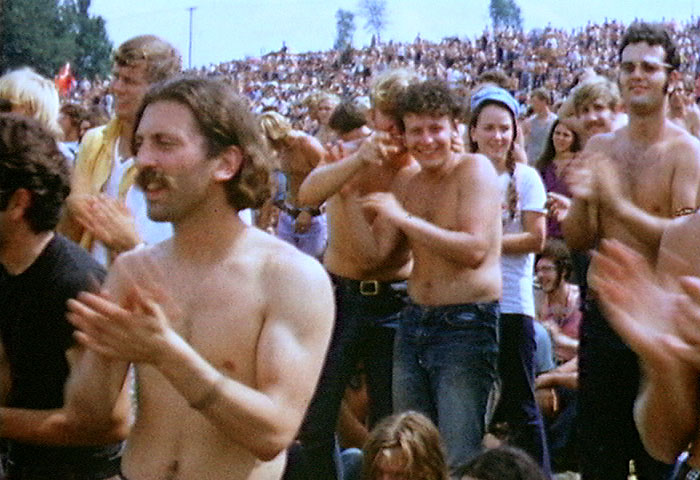
Part of the crowd on the first day of the Woodstock Festival, 15 August, 1969.
Photo by Derek Redmond and Paul Campbell via Wikimedia Commons.
We’re banning raves, because we don’t want you having fun where we can’t watch you. By the way let me tell you about Woodstock.
We’re cracking down on underage drinking. It’s bad for you. Yeah of course we hit up the pubs at your age it was great.
We’re banning smoking, but just for you — the smoking age will go up one year every year. Oh yes of course, we used to be able to smoke inside everywhere, it was great really.
We’re banning flavored vapes. We don’t have any evidence they’re bad for you, you just like them too much.
We’re banning dodgeball during recess, someone might get hurt. Yeah we really enjoyed dodgeball too.
We’re banning flirting, because it might make the girls uncomfortable.
We’re locking you in your room for the next two years. Yes we know you’re in no danger from the virus, but we’re worried that you’ll get us sick. By the way you have to take this needle if you want to leave your room again. Yes, twice. Well there will be boosters too. No, we aren’t worried about side effects, that doesn’t effect us at all.
We’re closing the frat houses, because we don’t want you having fun without our permission. Please join these officially sanctioned university clubs instead.
We’re bringing in labor from the third world to work the service jobs, so you can’t have a summer job.
You need to go to university to get a good job. By the way we’re raising the price of tuition. Oh look we’re raising it again. Don’t worry there are loans. At interest.
Actually we’re giving the good jobs to the foreigners we just imported, to make up for our racist past. We are very good people. No of course we aren’t sacrificing anything. You just have to take one for the team.
Also, we’re giving the foreigners the houses. We needed to increase real estate prices. For our pensions, you see. Sadly no, you’ll probably never be able to afford one yourself. By the way don’t forget to pay your taxes. Need to support those pensions somehow! Eh? No, we’re giving ourselves tax breaks of course. Seniors discount you know.
Oh by the way, that one thing you still have, now that we’ve banned joy and kicked every ladder out from under you? That social media stuff you kids like? You guessed it! We’re banning that too! Just for you though, we’re still going to watch AI videos on Facebook. It’s for your safety, you see. We’ve noticed that you’re all getting rather irate, and we think it would be better for your mental health if you shut up for a while. Why don’t you just go outside?
Eh? No of course we aren’t going to stop Ahmed and his twelve illiterate cousins from raping your sister, that would be culturally insensitive, which would make us feel very bad, and we can’t have that.
Update: Added missing URL.
June 11, 2026
“That’s the fun thing about the fall of the West; everybody gets a swing of the sledgehammer”
Devon Eriksen responds to a fairly common boomer-ish post:
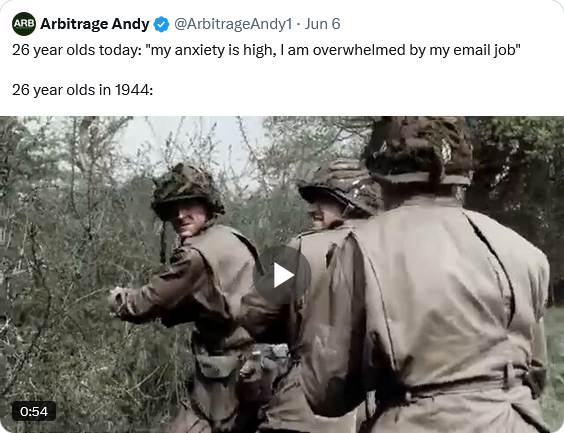
I don’t know if @ArbitrageAndy1 is a Boomer, but here he gives us a mashup of two classics from the Boomers’ greatest hits, “Younger Generations Suck”, and “The Television Never Lies to Me”.
It’s a jaunty little tune, and you can sing in it the shower, but the lyrics don’t actually make much sense.
Back in the real world, which younger generations actually have to live in, and where the television seldom tells the truth, WW2 was fought, on both sides, by guys even younger than 26.
And they were terrified.
The stress of combat against a peer adversary is overwhelming. It’s unendurable. But you endure anyway, because there you are, it’s happening to you, and you’re not getting out of it.
So you actually do have those little moments that Boomers would describe as stress meltdowns if they happened at work. You have them, and you do what you need to do anyway. Sometimes at the very same moment while you are melting down.
When you’re in this kind of war, there’s something terrible in front of you. In reality, that terrible thing is just as young and scared and overwhelmed as you are, but it sure doesn’t feel that way to you.
However, you also have something behind you, and something around you.
Behind you, you have a tribe that accepts and appreciates you. They know they sent you to hell, but they did it because hell was necessary, not because hell was fine. No one is gaslighting you pretending that everything is okay and that any problems you have are personal character flaws.
Around you, you have bros. They’re exactly where you are, doing exactly what you are doing, and they know how much it sucks. You’ve entrusted your lives to each other, and carried each other through things you don’t wanna talk about in your letters home.
Under intense stress and fear and exhaustion, your horizons shrink. You might have signed up for duty and patriotism and high ideals, but when you’re fighting, you fight to save the man next to you. And he fights to save you.
This is a very different experience than being isolated in a society that’s turned against young people, especially young men, especially young White men.
I won’t pretend it’s as difficult as fighting the Waffen SS. But young men fought the Waffen SS together.
They have to face the dissolution of the West alone.
That’s why they are anxious. Everything around them is not just going to shit.
It’s being systematically and deliberately turned into shit by powerful people who want them dead and replaced by someone else who will work cheaper and doesn’t expect to have a share of political power and a nice house and a retirement pension.
But I suppose Andy can still go ahead and dunk on them for clicks and a twenty-three dollar check from Twitter. That’s the fun thing about the fall of the West. Everybody gets a swing of the sledgehammer.
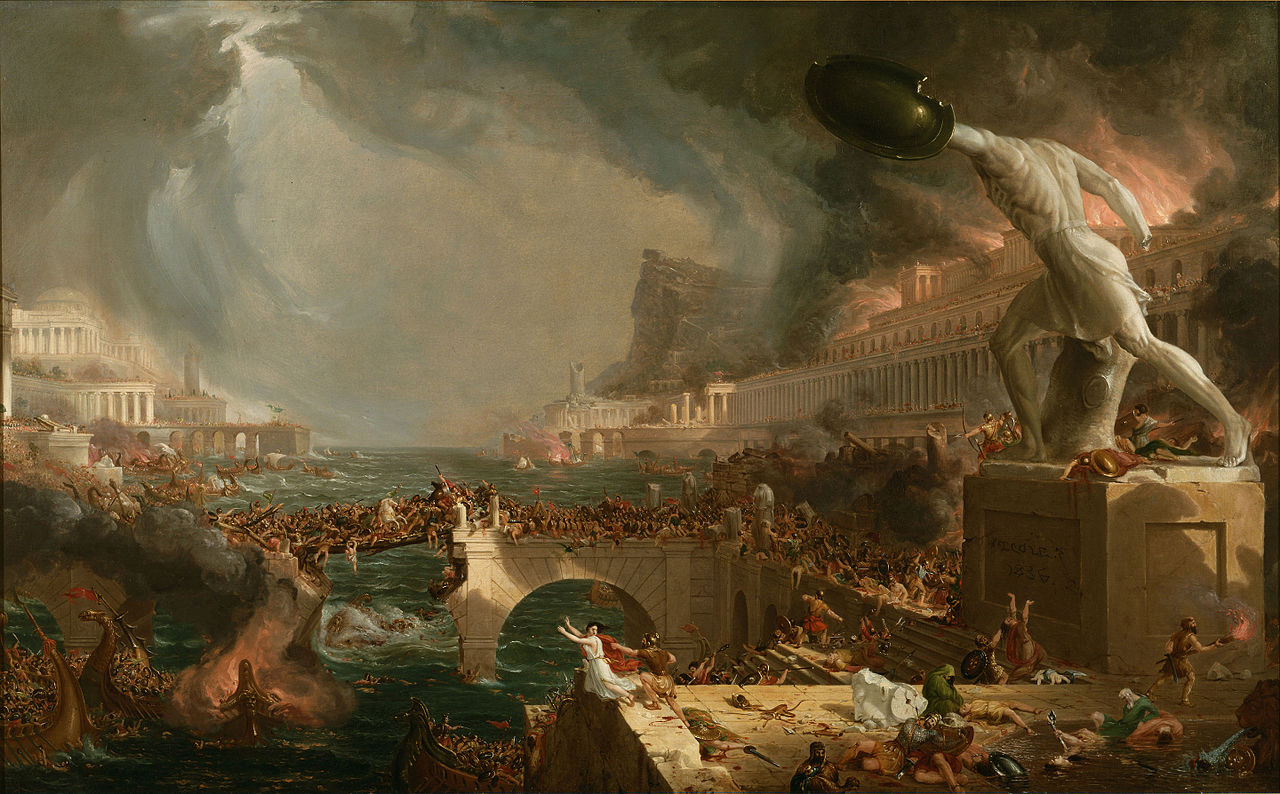
The Course of Empire – Destruction by Thomas Cole, 1836.
From the New York Historical Society collection via Wikimedia Commons.
May 27, 2026
The boomers don’t hate you, they just prioritize feeling good about themselves
This is something I see very clearly in Canadian baby boomers — most of whom support Mark Carney and the Liberals because they feel that’s what nice people do, and boomers want to think of themselves as nice people above all else. On the social media site formerly known as Twitter, Devon Eriksen responds to a meme expressing later generations’ view of the boomers:
On the surface, it sounds like Boomers hate you. Or like they have the attention span and logical thinking skills of a goldfish.
Neither one of these is true.
Their complete dismissal of any of your concerns, and their total refusal to understand your situation or worldview, is actually quite sensible in light of one key fact about them.
They’re not hateful. They’re not dumb. They just have an incredibly low emotional pain threshold.
They cannot stand to feel bad about themselves for any reason, even for a moment.
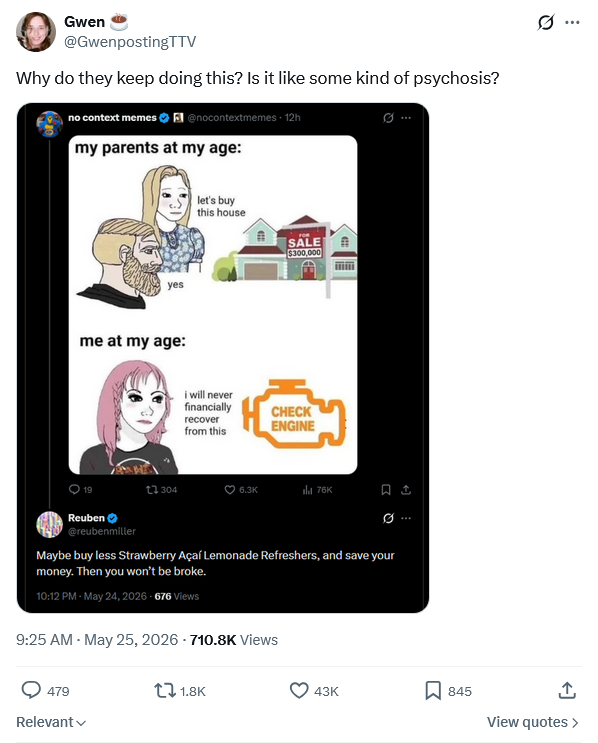
When you create a meme like this, or you tell the story of how you are forty years old and can’t afford a house because you trained for three different careers and got rugpulled by work visas and offshoring every time …
… then they don’t even think about it as a worldview or a perspective or an experience that you have. They don’t think about you at all.
They think only about the effect on their own self-esteem, which must be parried.
You have, you see, told a tale of playing life on hard mode, which implies that they were playing life on easy mode, which implies that they are not wizards of insight and paragons of virtue.
That’s why they will immediately respond with these incoherent lines about whining and bootstraps and firm handshakes and avocado toast. Of course they don’t make sense. They don’t have to make sense. The goal isn’t to persuade you of anything or engage with you at all.
The goal is simply to have an excuse to avoid thinking about something which might make them feel bad.
These Boomerisms are magic talismans used to ward off emotional discomfort, in much the same fashion as all the species of plants they smoked their way through when they were your age.
I don’t see a solution to this.
I don’t know any way to tell Boomers that Hart-Cellar, CRA1964, DEI, open borders, social welfare programs, anti-racism, gay marriage, gun control, the sexual revolution, etc, were massive mistakes and need to be stopped, while hiding the obvious implication they were the ones who made those mistakes.
If we wish to save Western civilization, to make things good enough again that actual Americans can manage to have homes and marriages and children, then we’re going to have to find a way to work around the Boomers, because they’re never going to get on board.
May 21, 2026
Evaluating the Boomers’ complaints from the Zoomers’ point of view
As a dirt-poor boomer (or Generation Jones-er as some term us extra-late boomers), I don’t have a lot of sympathy for others in my age cohort who complain about their kids and grandkids not getting ahead when they’re occasionally back in Canada from their second or third extended exotic foreign vacation since before the snow fell last fall. (It’s been more than a decade since the last time we were able to take any kind of vacation … and that was just a week’s driving holiday to South Carolina.) The Zoomers (and Millennials, and even some of the Gen X’ers) have valid complaints that the boomers generally are not capable of understanding, as John Carter explains:
I’m going to have a little rant, here, so I’ll start by emphasizing: Not All Boomers. Look, my mother is a boomer, and I love her dearly, in large part because she represents the opposite of so many boomer stereotypes. Many of you reading this are boomers; I know this because you’re in the comments, writing some of the best comments, you can ask anyone, the very best comments, everyone says it, it’s true. I know full well that much of what follows doesn’t apply to you, because you’re the good ones, the exceptional ones, the few, the proud So, please, do not take any of this personally.
With that said.
The shouting match broke down along the expected lines. Boomers – including spiritual boomers – loudly agreed with O’Leary’s remarks. If you only spend $2 a day on lunch, they insisted, the resulting $26 a day that you save adds up to $9490 a year; after 5 years, you’ve got the down payment for a $250,000 house. Checkmate, you financially illiterate layabouts!
Zoomers, millennials, and Gen-X replied that $250,000 will get you a leaky shack in rural Arkansas with black mold in the unfinished basement; that by the time you save up the money for the down-payment, that shack will be going for $500,000; that recent immigrants receive government assistance to get onto the property ladder (along with preferential employment) and so do not have to spend years of their lives saving up at all. Disaffected youth (and these days, that is just ‘the youth’) generally heaped scorn on the idea that it’s even possible to save in this economy, or that there’s anything worth saving. “If you live on instant noodles and margarine sandwiches for twenty years, you too, my son, can one day afford a van down by the river.”
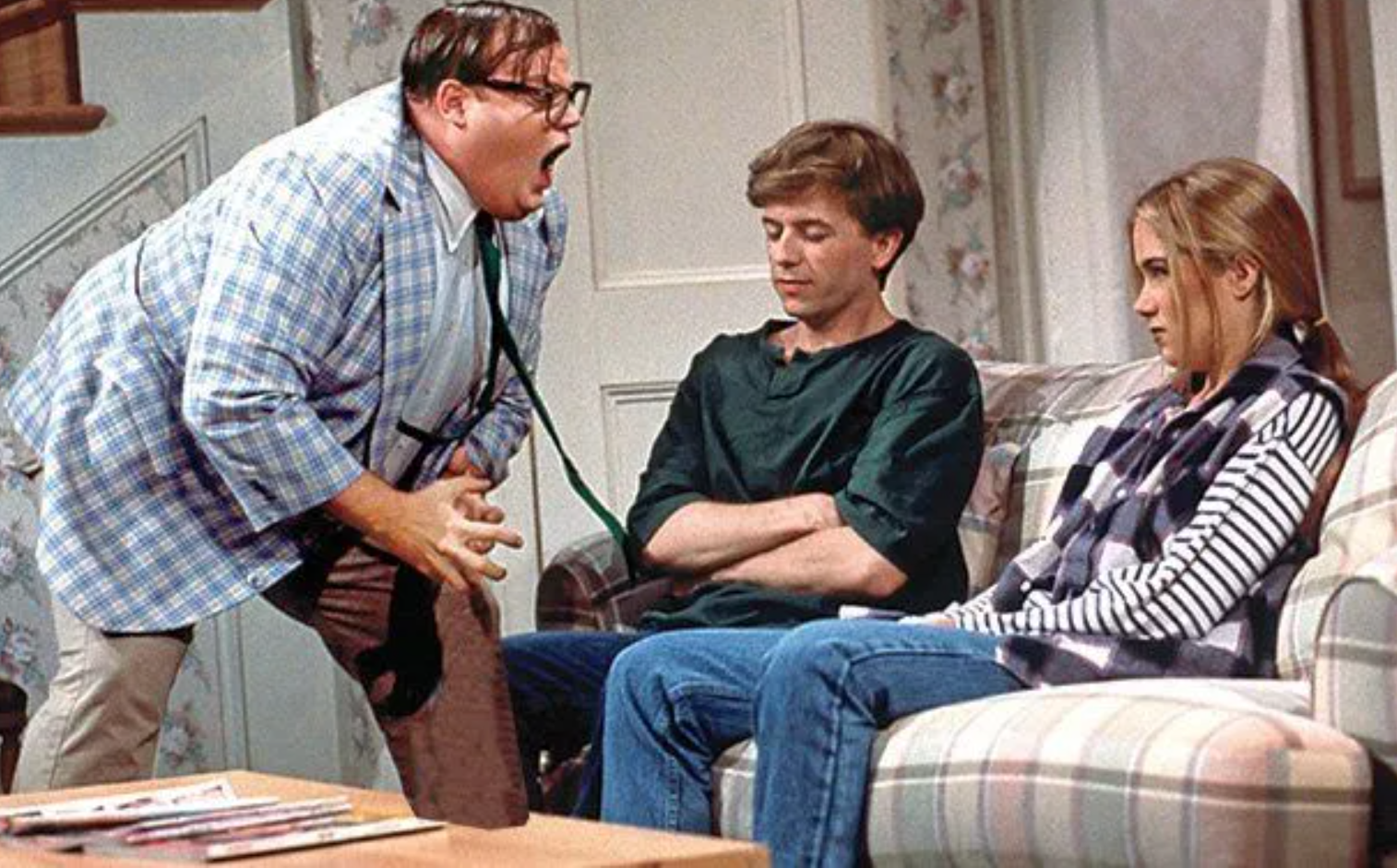
As an aside, isn’t it incredible how fashion has barely changed since Chris Farley did this skit on SNL back in 1993? Stuck culture is everywhere.
Image and caption from Postcards from BarsoomI can see both sides of this. I tend to live frugally myself, not so much because I consider it virtuous but out of simple necessity. Throughout my 20s and 30s I was a career student living paycheck-to-paycheck, as a result of which I became very accustomed to cooking my meals and buying only what’s necessary. I’ve never once used DoorDash or Uber Eats. I buy my clothing at thrift stores, only purchase a new laptop once every decade or so, and have somehow managed to avoid racking up much in the way of debt … and by ‘somehow’ I mean that I’ve never owned a house or a car, partly because I changed continents too regularly to make such big-ticket purchases practical or necessary, but mostly because I couldn’t afford them. Even finishing my doctorate did not really bring anything you could call prosperity in its wake: my first position was for the princely some of just over USD30,000 per year. By the time I reached the median national income in my late 30s, I’d gotten so accustomed to frugal living that money started piling up in my account just because I had no idea what to do with it, and little inclination to spend it because I was honestly just happy to not have to worry about budgeting to make rent. That turned out to be very helpful when DEI came for my career track; I lived on those savings for a couple of years after.
[…]
There was a famous Stanford experiment called the Marshmallow Test which measured time preference in young children. A child would be left in a room with a single marshmallow on the table. They were of course free to eat the marshmallow, the experimenter would tell them, but if they didn’t, then later on they would get a second marshmallow. Children with high time preference – meaning that they strongly prefer the immediate reward to the hypothetical future reward – would cram the marshmallow into their candy-holes without a second thought. Children with low time preference – meaning that they value the future at a similar or even higher level to the present – would patiently wait, and be rewarded with a second marshmallow. These children were then followed, and it was demonstrated that the children with low time preference demonstrated better life outcomes: they maintained higher grades, were less likely to fall into debt, were less likely to develop drug addictions, were less likely to get pregnant before marriage, were less likely to get fat, and so on. All of which makes sense. The capacity to endure present pain – by studying, dieting, working out, what have you – in order to obtain a better future outcome is obviously going to be linked to better outcomes.
How would a smart kid react if the experimenter failed the marshmallow test?
For instance, say the experimenter simply lied. There was no second marshmallow; the child waited for nothing. Or, even worse, the first marshmallow was snatched away, and replaced with two marshmallows, each one half the size of the original? Or a third the size? Here are your two marshmallows, sucker, joke’s on you. What would the results be if, after this experience, the children were tested a second time? I don’t know if such an experiment has ever been conducted, but the outcome is not hard to guess. Every single one of the children, whether they’d passed the marshmallow test the first time or not, would scarf down the marshmallow the moment it was in front of them.
The capacity for low time preference may be largely innate, but whether it expresses or not is entirely a function of social trust. In order to defer gratification for a greater future reward, one must believe that there is a reasonably high chance of that reward manifesting. The less likely the future reward becomes, the more steeply a rational actor will discount the future.
I don’t want to minimize the hardships that boomers endured when they were young. Boomers worked hard, and they didn’t enjoy the same conveniences that we enjoy now. They fought in the Vietnam War (well, about 3% of them), they spent most of their lives under a nuclear sword of Damocles, they suffered through the oil shock and stagflation in the 70s, they were punished by double-digit interest rates in the early 80s, and they spent their working lives trying desperately to stay one step ahead of the skyrocketing inflation that was unleashed when Bretton-Woods fell apart and the last vestigial support of the gold standard was kicked out from under the brrrring money printer.
But, despite all of that drama, the one thing boomers could generally rely upon was that – so long as thermonuclear annihilation was averted – things would generally get better. Technology would advance. Working conditions would get safer. The special effects in movies would become more convincing. Houses would get larger. Cars would get nicer. Air conditioning would get quieter. The environment would get cleaner. Society would become more just. The world would become freer and safer for democracy. And so on and so forth. Baby boomers have enjoyed a charmed life such as no other generation has known: free of major wars, full of technical wonders, in which whatever difficulties you might endure now, you could generally count on the future being a better place. For the boomer, deferred gratification always had a payoff.
For the zoomer – and the millennial, and generation X – this has simply not been the case. After 9/11 a police state panopticon settled over society. The 2008 real estate crash pulled the rug out from under the millennials, after which real-estate got ZIRPed to the Moon. Mass immigration pumped real estate demand further, while undercutting wages and rendering public spaces steadily more alienating, unpleasant, and dangerous. Black Lives Matter immolated quaint notions of racial harmony. DEI threw young white men, their careers, their futures, and their unborn children to the wolves. COVID stole two years from young people’s lives so that old people could feel safe from the coof. Now, AI^2 (Artificial Intelligence + Actual Indians) means that the only thing the young expect in their future is gig work in the sex trade industry (until robots take that, too).
April 1, 2026
Generation Jones and the Temple of Boom(ers)
Wee Nips
Published 19 Sept 2025Generation Jones and the Temple of Boom(ers) explores the fascinating differences — and surprising overlaps — between Baby Boomers, Generation X, and the often-overlooked Generation Jones.
Were you too young for Woodstock but too old for grunge? Stuck between disco and Nirvana? You might just be a Joneser.
In this video, we’ll compare:
🎵 The cultural touchstones of Boomers, Gen X, and Jonesers
📉 The low points in history that shaped each generation’s outlook
💰 The economic conditions that defined their opportunities
🧠 The attitudes and stereotypes that still stick today
Generation Jones isn’t just a footnote — they’re the missing link between the optimism of the Boomers and the skepticism of Gen X.
0:00 Introduction
1:38 Definitions
2:42 Cultural Touchstones
3:38 Low Points in History
4:53 Economic Conditions
5:42 Social and Attitude Differences
6:38 Humorous Stereotypes
7:09 Overlaps and Connections
8:02 Closing
(more…)
March 1, 2026
Generation Jones EXPLAINED: The Lost Generation Nobody Talks About
Wee Nips
Published 29 Jun 2025Born between 1954 and 1965? You might be part of the forgotten generation — Generation Jones — wedged awkwardly between Boomers and Gen X.
In this video, we break down what it means to be a Joneser, why we’re all still jonesing for something better, and how our weird hybrid powers (like remembering phone numbers and setting up Wi-Fi) just might save the world.
If you’ve ever used aluminum foil on rabbit ears or fixed a TV by smacking it, this one’s for you.
February 13, 2026
QotD: The Democrats re-focus on the youth vote
Which is why I’m tempted to write it off. After all, Obama was just a Bill Clinton for The New Generation. Who was just a JFK for The New Generation. Who — we forget this — was just FDR for The New Generation. Most of the idiot Boomers who voted for Bill Clinton as “the New JFK” barely remembered JFK. Nor did JFK himself win “the youth vote” by all that much — or at all — because “the youth vote” wasn’t a thing back then. For one thing, the voting age was still 21. I’m in History, not math, but even I can do Historian math, and 1960 – 21 = 1939. Most of JFK’s voters had clear memories of The Depression; even his youngest voters remembered the tail end of WWII. JFK sounded like an East Coast patrician, just like FDR did, and as opposed to that young parvenu from California, Richard Nixon.
That’s just a wee bit different from “the Youth Vote” Bill Clinton appealed to. To say nothing of the later freaks.
I’m tempted to write it off, but I’m not going to. For one thing, Obama, Clinton … they all won, and look at the incalculable damage they did. More importantly, I want to return to an issue we tabled earlier: The fact that there’s no “middle age” cohort in the Donk Party. They really are the Volkssturm — kids and oldsters. Or, if you prefer, they’re the Bolsheviks — having shot all their “technical intelligentsia” during The Revolution, they have to go out there and reinvent everything. All their accumulated experience is gone, so their rookies don’t just make rookie mistakes, they make the kind of mistakes that anyone with the tiniest shred of experience could see coming.
You know, those “hmmmm, I wonder what this big red button does?” types of mistakes.
You see it in the business world. Z Man, may he rest in peace, used to talk about this all the time. The Boomers were retiring, the kids were just so epically clueless, and all the thousands of workarounds and jimmy-rigged stuff that makes any operation go were seizing up, for lack of maintenance. And even the smart, ambitious kids were having a hell of a time getting up to speed, because they were looking for a Policies and Procedures manual that simply doesn’t exist. There’s no Official Manual for jimmy-rigged workarounds.
Say what you will about the Boomers, they’re competent. They might well be the last competent generation …
… maybe the older, smarter half of Gen X, but a) there were never that many of us, and b) in politics, as in so much else, the Groovy Fossils just would. NOT. leave, and so the competent among Gen X had to go do their own thing, if they ever wanted a chance to move up. This leaves your big Legacy Systems — you know, like the Apparat — in one hell of a bind. The Groovy Fossils don’t want to leave, but eventually they have to — 90 may be the new 30, but dead is dead. And they’re the only ones who know how to operate the Legacy Systems, because there are two, three “generations” of people who, if they had anything on the ball, had to go their own way.
Those who stayed had no choice, and all they know how to do is push buttons and fill in blanks. Look at Alexandria Ocasio-Cortez. Anyone 50 or older looks at her with horror, because we’ve all had to deal with that kind of kid. That’s the kind of person who has filled up every layer of the Apparat below Top Management. If they had anything at all on the ball, they’d be somewhere else … but they don’t, so now they’re all in Senior Management, because somebody’s got to do it, and they were better at pushing buttons and filling in blanks than anyone else who was available at the time.
But note that I’ve just been talking about candidates, politicians. The VOTERS are like that, too. See what I mean? That’s why it’s so dangerous … and very likely to succeed.
Severian, “Groovy, Baby!!”, Founding Questions, 2025-11-10.
January 7, 2026
More anti-anti-boomer discussion from Scott Alexander
I linked to Scott’s original article last month and thanks to the interest it generated (and perhaps my clickbait-y headline) it got linked at Instapundit thanks to Sarah Hoyt. Scott got a lot of feedback on his post and shares some of that here:
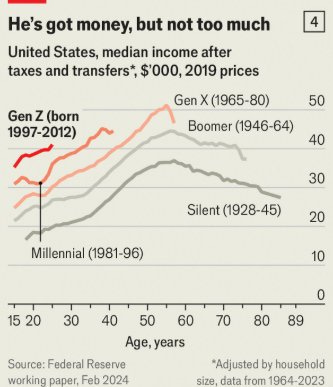
“… Millennials and Generation Z have more money (adjusted for inflation ie cost-of-living, and compared at the same age) than their Boomer parents, to about the same degree that the Boomers exceeded their own parents. This is good and how it should be. The Boomers have successfully passed on a better life to their children”
First, I wish I’d been more careful to differentiate the following claims:
- Boomers had it much easier than later generations.
- The political system unfairly prioritizes Boomers over other generations.
- Boomers are uniquely bad on some axis like narcissism, selfishness, short-termism, or willingness to defect on the social contract.
Anti-Boomerism conflates all three of these positions, and in arguing against it, I tried to argue against all three of these positions — I think with varying degrees of success. But these are separate claims that could stand or fall separately, and I think a true argument against anti-Boomerists would demand they declare explicitly which ones they support — rather than letting them switch among them as convenient — then arguing against whichever ones they say are key to their position.
Second, I wish I’d highlighted how much of this discussion centers around disagreements over which policies are natural/unmarked vs. unnatural/marked.
Nobody is passing laws that literally say “confiscate wealth from Generation A and give it to Generation B”. We’re mostly discussing tax policy, where Tax Policy 1 is more favorable to old people, and Tax Policy 2 is more favorable to young people. If you’re young, you might feel like Tax Policy 1 is a declaration of intergenerational warfare where the old are enriching themselves at young people’s expense. But if you’re old, you might feel like reversing Tax Policy 1 and switching to Tax Policy 2 would be intergenerational warfare confiscating your stuff. But in fact, they’re just two different tax policies and it’s not obvious which one a fair society with no “intergenerational warfare” would have, even assuming there was such a thing. We’ll see this most clearly in the section on housing, but I’ll try to highlight it whenever it comes up.
I’m in a fighty frame of mind here and probably defend the Boomers (and myself) in these responses more than I would in an ideal world.
[…]
1: Top Comments I Especially Want To Highlight
…
Sokow writes:
[The anti-Boomer] take has been imported in part from the EU + the UK where the pension system is not the same. https://en.wikipedia.org/wiki/State_Pension_(United_Kingdom)#Pensions_Act_2007
There is a lot of similar things in France that I could dig up, such as all attempts to tax benefits being defeated.
Many Europeans chimed in to say this, including people whose opinions I trust.
I find this pretty interesting. We all know stories of American opinions infecting Europeans, like how they’re obsessed about anti-black racism, but rarely worry about anti-Roma racism which is much more prevalent there. I’d never heard anyone argue the opposite — that the European discourse is infecting Americans with ideas that don’t apply to our context — but it makes sense that this should happen. I might write a post on this.
Kevin Munger (Never Met A Science) writes:
Hating Boomers (and talking about hating Boomers) is uninteresting and I agree morally dubious.
But it is *emphatically* false that “Boomers were a perfectly normal American generation”. They have served far more terms in Congress than any generation before or since (and we currently have the oldest average age of elected officials in a legislative body IN THE WORLD other than apparently Cambodia), they have dominated the presidency (look up the birthdate of every major party candidate since the 2000 presidential election…), they controlled the commanding heights of major companies, cultural institutions (especially academica).
They are a historically *unique* generation, for three intersecting reasons: 1. They are a uniquely large generation 2. they came of age as the country and its institutions were maturing 3. they are sticking around because of increased longevity. These are analytical facts, and they produce what I call “Boomer Ballast” — a concentration of our societies resources in one, older generation that increases the tension we are experiencing from technological innovation. Our demography is pulling us towards the past, the internet is pulling us into the future, and this I think is the major source of the anti-Boomer frustration.
On the specifics of social security and why we might think Boomers have played things to their advantage (not bc they’re specifically evil but bc they have the political power to do so) — the key thing is that they have prevented forward-thinking politicians from fixing the inevitable hole in social security that comes from our demographic pyramid. It would have been relatively painless to increase the rate or incidence of the social security payroll tax at any point in the past 25 years, the looming demographic cliff was obvious and the increased burden could’ve been shared more equally. Instead, they prevented reforms and all of the fiscal pain from demographic shifts will be borne by younger generations.
I agree this is a strong argument, and part of why I think it’s helpful to separate the three points I mentioned at the beginning.
RH writes:
We [Boomers] did [vote for ourselves to pay higher taxes and get fewer benefits]. My lifetime SS benefits will be 20-25 percent less than they would have been under previous law, and I voted for that. My SS tax rate went up itself, and has been well over 15% since the changes took effect, and the cap on earned income subject to that went up a lot. And I voted to accept all that because it was projected to be sufficient.
Then the immigrant haters decided we needed fewer workers in the country, or at least fewer paying SS taxes, so they slowed legal immigration and pushed illegals into the underground economy, so they don’t pay taxes to support social security. And social security is going to get whacked again, plus the evils the SS system was intended to alleviate — people too old to work and too poor to live — will return.
I think this says something profound about politics. The problem is less that there’s some group of people who don’t believe in fairness, but that fairness is very hard to calculate.
Suppose RH is right (I haven’t checked), and that Social Security would be sustainable with lots of immigration. Then whether Boomers are paying “their fair share” or not depends on whether immigration is good or bad (a hard question!), and on whether we think of high vs. low immigration as the natural unmarked state of the universe (such that immigration opponents must “own” closed borders and compensate the losers), and on what kind of compensation the losers from closed borders deserve.
Someone else commented by saying we could solve all of these problems without inconveniencing either the Boomers or the young by just increasing taxes on a few ultra-rich people. The ultra-rich could reasonably say they didn’t create this problem and it’s unfair to tax them for it. But so could the Boomers and the young! So whose “fair share” is it?
December 21, 2025
Boomers – A vampiric generation battening on the blood of the young
As a member of the recently identified “Generation Jones”, I could take part in the widespread boomer hate with a clear conscience … but as Scott Alexander points out, the hate may be more than a little over-done:
“… Millennials and Generation Z have more money (adjusted for inflation ie cost-of-living, and compared at the same age) than their Boomer parents, to about the same degree that the Boomers exceeded their own parents. This is good and how it should be. The Boomers have successfully passed on a better life to their children”
There’s a more developed theory of Boomer-hating. The more developed theory goes: Boomers are plundering the young. We know this, because their share of resources is high and keeps increasing. They use their large population share and good voter turnout to vote themselves ever-higher pensions at the expense of working taxpayers.
How might we investigate this theory? We can’t use total social security spending, because the number of elderly has gone up. Can we use social security spending per elderly person? No; the amount of social security paid out depends on the amount paid in. If each year’s retirees earned more during their career than the previous year’s did (this is true), then each year’s will get a higher SSI payment, even if the system’s “generosity” stays the same.
We might start by looking at change in social security payment divided by change in median income. Over the past fifty years, average Social Security payment in inflation-adjusted dollars increased 60%. If we expect these payments to reflect earnings twenty years before disbursement, we can look at real median personal income from 1953 to 2003; this also increased 60%. There is no increase in generosity.
Or we can just look at the history. The Social Security Administration’s own website says that its generosity peaked in 1972, when the program primarily served the Greatest Generation; since then, it’s been one contraction after another. In 1983, the government increased the full retirement age from 65 to 67; in 1993, they made Social Security more taxable. Since then, most of the changes have been cost-of-living increases, which are indexed to inflation and not the result of active lobbying on old people’s behalf.
Why do so many believe that old people have discovered a vote-themselves-infinite-benefits hack? Since old people represent an increasing fraction of the population, are living longer, and face a secular trend of rising healthcare costs, even when their benefits per capita per year are stable or declining the government will spend more money on them as a group. This spending is indeed rapidly becoming unsustainable, the elderly will need to accept big benefit cuts to make it sustainable again, and they are resisting those cuts.
So have we finally discovered the fabled Boomer selfishness? Call it what you want. But remember that the Boomers did pay money into Social Security to support their own parents, believing that they would be supported in turn. Learning that yours is the generation where the pyramid collapses is a hard pill to swallow. Maybe they should suck it up and take the sacrifice. You’d do this, right? Voluntarily give up money which is yours by right, in order to help other generations? Oh, sorry, you didn’t hear the question, you were too busy writing your 500th “You don’t hate Boomers enough, why won’t they hurry up and die, we need to declare intergenerational warfare and seize our rightful inheritance” post.
Update, 22 December: Welcome, Instapundit readers! Please do have a look around at some of my other posts you may find of interest. I send out a daily summary of posts here through my Substack – https://substack.com/@nicholasrusson that you can subscribe to if you’d like to be informed of new posts in the future.
November 23, 2025
Do older Canadians really hate their children and grandchildren? The fiscal evidence says “yes”
As I posted a few days back, the real political divide in Canada is no longer the left versus the right: it’s the old financially parasitizing the younger generations. At The Line, Ben Woodfinden discusses how the smug, comfortable boomers are being confronted by, for lack of a better term, a “new right” of far less comfortable younger voters:

eLbOwS uP!
The specific complaints from people like d’Entremont and other grumbling voices are less about ideology and more the tone and style of Pierre Poilievre (though perhaps the two are connected). Poilievre’s temperament and style rubs certain people, including some Conservatives, the wrong way. Now, full disclosure, I worked for Poilievre for a few years, and I can confirm he’s a demanding boss. But so is the prime minister, reportedly. And Poilievre is also in my experience the hardest working person I’ve ever met.
The tone battle is not a revival of Red vs. Blue. It’s not clear those terms are even relevant today. “Red Tory” is often used pejoratively to describe a “Liberal Lite” voter who identifies as a conservative but is indistinguishable from a Liberal — those who fit the “social progressive, fiscal conservative” moniker. This is not what Red Toryism historically meant; it’s actually the opposite of this. Red Toryism is a distinctly Canadian tradition of conservatism that was focused on the preservation of Canada contra a liberal United States, and emphasized the role of the state in this. It blended conservatism and elements of socialism in a distinctly anti-liberal synthesis that rejected radical individualism — that’s what the “red” part actually means, not liberalism but socialism. This kind of Toryism — “conservatism with a conscience” — is committed to public institutions and is pro-market but not entirely libertarian.
But Red Toryism is no longer a dominant force in Canadian conservatism; today it’s a remnant, largely in Atlantic Canada. What we’re really looking at here is a generational fault line that cuts right through the heart of Canadian conservatism.
Many older Canadians are conservative, and these older Tories are (in general) fairly well off. They are retired, or well advanced into their careers. They own homes that are paid off, or will be in the near future, and worth a lot more than what they paid for them. Many of them have been able to help their children get started in their own careers, or with down payments on homes of their own. They value stability — it is essential if they are to continue enjoying their prosperous lives. These people have long enough memories to remember the political battles that led to the creation of the modern Conservative Party of Canada in 2003 — some of them were no doubt even participants, and may still identify with one faction or the other.
Now contrast this with many of the leading voices on the other side of the debate. They call themselves “the new right”. In the absence of a better term, I’ll use that. Canada’s new right tends to be younger, and this matters not just because the old PC/Reform divide means very little to them, it matters because they are much angrier with our general state of affairs, and for good reason.
The emerging flagship publication for this collection of young conservatives is the Substack Without Diminishment. In some ways, the emerging conservative opposition in Ontario to Premier Doug Ford centred around an organization called Project Ontario (discussed in last week’s On The Line podcast here) is also a good representation of it.
The voices and figures involved in this movement are younger, often very online, and eager to pick fights with this older generation of conservatives. For some of the writers at Without Diminishment, the archnemesis of their conservatism is Globe and Mail columnist Andrew Coyne. He represents, for them, an outdated kind of “Boomer conservatism” that does not speak to them or the issues they care about. New conservatives have also recently written, after Ford ran ads featuring Ronald Reagan in America, that it’s time for “the gatekeepers of the Canadian right … to move on from 1984” — namely Reagan-era conservatism.
Twenty years ago, I’d often quote Andrew Coyne’s columns, but at some point he had a significant change of heart and one of the first Without Diminishment articles I linked to was what I characterized as “The Anti-Coynist Manifesto“.
November 18, 2025
Canada’s divide isn’t left versus right, it’s old versus young
Older Canadians seem to be taking joy in sticking up their elbows and robbing younger Canadians of opportunities, jobs, and hope. It’s quite literally un-Canadian, but the Boomers have always been a generation apart and this is merely the latest manifestation of their self-centred worldview. Alexander Brown wonders if this divide can be fixed before the country itself is ruined:
“eLbOwS uP!”
“Talk to your parents,” the host of an event for Pierre Poilievre joked on Saturday in Vancouver — an event I happened to attend. “But be patient. Be kind.” And he’s right.
The cross-talk, the rock’em sock’em robots, the continued slap-fight between warring consultant tribes, it isn’t getting us anywhere, clearly. When the present iteration of the party of the status quo wedges a nation against itself, and denies a reform election after a decade of haphazard redistribution, non-growth, and abject decline, you get a traditional voter-demographic breakdown flipped entirely on its head.
The party of seemingly endless opposition dominated with youth, held strong with the 35-54s, but found itself walloped 52% to 34% among those aged 55+. Since then, those 55+ numbers have only widened, as the “safe” choice, that more stately actor (when he’s not radicalizing those who don’t know any better with claims of false invasion) can do little wrong, even coming out of “middling” budget heading to a vote Monday, and with a nation remaining pessimistic about its future prospects.
If the Liberals are voted down Monday, they would likely relish that opportunity to seize on a majority. The spin is already built in.
The Conservatives don’t want to stand up against Trump!
At a time like this, when we should be coming together, it’s un-Canadian …
We’re supposed to be one Team Canada right now (offer void in British Columbia, Ontario, and Quebec), we can’t afford Pierre Poilievre’s divisive Trumpiness.
On and on. Yada and yada.
Nowhere in that comms exercise, drummed up by those who spend more time in America or the Arab Emirates, or meeting with Chinese proxies than they’d publicly care to admit, would there be a defence of younger Canadians, of those still on the launch pad, worried about, say, supposed ‘fixes’ to immigration riddled with creative accounting and more of the same.
Nowhere would they address housing, set to get much, much worse, under both the federal Liberals and targets they’re admitting they won’t come close to hitting, and Ontario’s ‘Conservative’ premier who leads the galaxy in not getting off his ass to get out of the way on starts and lowering punitive development costs.
Nowhere would one find a stout defence against “deconstruction“, or the daily humiliation ritual of flags flying that aren’t our own, or imagined and inflated woke excess meant to sully the memory of our war dead and marginalize normal people.
Following recent debates sparked by Without Diminishment, where we’ve argued a version of “it’s not just the economy, stupid,” when it comes to what’s animating young people and young conservatives — actually talk to them, and half of them are trending towards fascism with how alienated they feel by a lack of upward social mobility, or a society without rules or those willing to enforce them — it’s been easier for some serving in established camps to mischaracterize these conversations as focusing too much on culture, or, ridiculously, “blood and soil nationalism”. But we’re not. If one is dealing in good faith, it’s plain to see we’re trying to talk about both.
Of course, the Liberals survived Monday’s budget vote … for now:
When I saw Elizabeth May stand up and ask Mark Carney what looks like a completely planted question, I assumed the budget would pass and I was correct. Planted questions normally come from government MPs and are a soft way for the government to push their agenda.
This time, it wasn’t a Liberal MP, well at least not a Liberal MP in name and fact. Instead it was Green leader, or deputy leader, or let’s be honest the lonely lady in the corner who is the only Green MP asking the question.
That statement put the Liberals one vote closer to passing their budget and of course May later confirmed ahead of the vote that she would back the budget. This was after saying couldn’t back the budget, might back the budget, would probably back the budget, definitely wouldn’t back the budget and finally would back the budget.
How anyone can take Elizabeth May seriously is beyond me.
How the other votes went…
Ahead of the vote there were lots of questions about how things would go. Would all MPs show up or be able to vote online? Would people abstain? Would MPs vote for the budget without crossing the floor?
In the end, the budget passed 170 to 168 with two NDPers abstaining. That leaves five votes not accounted for and we will figure out.
Here is how the vote went.
Now, some members who were not in their seats did vote electronically. I didn’t see Matt Jeneroux vote electronically and I’m told that he is in British Columbia with is family. Also not voting, Conservative MP Shannon Stubbs.
Conservatives Andrew Scheer and Scott Reid both voted no but only in the time that is allowed for MPs voted electronically to claim tech problems. They were both in the House, so why were didn’t they vote in person?
Regardless, the NDP rushed out to say they voted against the budget but also made sure that it passed with their two abstensions.
As for all this talk of a Christmas election, had the government lost this vote and the PM gone to see the Governor General tomorrow, the earliest election date would have been December 25.
A Christmas election.


