Quotulatiousness

September 7, 2026

An “exit tax”? What next, internal passports?

Filed under: Cancon, Education, Government, Liberty, Politics, USA — Tags: , , , , , — Nicholas @ 03:00

A few months back, there was a brief online reaction to the Liberal Party idea of imposing a ridiculously high “exit tax” on young Canadians taking jobs in other countries — and by “other countries” they really only meant the United States. I dismissed it at the time as just someone letting their Liberal freak flag fly … but:

Jesus Christ. These boomer leaflibs, man.

It doesn’t occur to him to ask why highly trained Canadian engineers would rather work in the US. Actually no, he tacitly admits this: they get paid more. Why is that? Why can’t they get paid well in Canada, putting their skills to work here, developing innovative, world-leading technologies right at home in Canada?

The answer is obvious. Because there is no opportunity in Canada. It’s all but impossible to develop high tech industry here. The regulations are too thick, and all the available investment capital gets sucked up into real estate development.

Maybe Canada should try and fix that, so that Canada is actually an attractive country for talented young Canadians?

But nah fuck those kids, we should just charge them a half million dollar exit tax so if they can’t pay that they can just let their dreams die and get a job at BMO.

Oh and at the same time we should flood Canada with “world leading talent” (from Calcutta), in order to make it that much more impossible for Canadian engineers to find employment in their fields at home.

September 4, 2026

QotD: My generation

Filed under: Media, Quotations, Randomness — Tags: , , , , , , — Nicholas @ 01:00

We talk a lot about generations and what defines them — Boomers and Xers and Millennials and Zs — but ultimately a generation is just a scene. It is about who and what you claim as your own, but this is something that is determined largely in retrospect. You only know what was yours once something comes along that is clearly alien and you realize that the culture was something you shared, that you made for one another. Eventually the whole scene moves on.

That’s why one of the weirdest things about getting older is realizing just how much of what you took for granted as part of the permanent furniture of the world was actually highly transient: The Iron Curtain. Guitar rock. Your own hopes and dreams and ambitions. Sometimes they all come wrapped together like a package deal, and failing at one makes it seem like you’ve failed at it all.

Andrew Potter, “Eddie Van Halen, Bill and Ted, and mourning a generation”, The Line, 2020-10-14.

August 11, 2026

The surging Democratic Socialists of America

Filed under: Media, Politics, USA — Tags: , , , , , — Nicholas @ 05:00

J.D. Tuccille on the unlikely rise of the DSA faction within the Democratic party in time for the 2026 midterm elections:

Abdul El-Sayed’s victory in the Michigan Democratic Senate primary battle is only the latest by candidates affiliated with or adjacent to the Democratic Socialists of America (DSA). Unlike many of the openly socialist officeholders and political hopefuls gaining traction in the Democratic Party, El-Sayed claims to be a capitalist, but his positions are indistinguishable from those of the left-wing figures he campaigns with, such as Sen. Bernie Sanders (I–Vt.), Rep. Alexandria Ocasio-Cortez (D–N.Y.), and podcaster Hasan Piker, who has aligned himself with both the Chinese government and Hamas.

As democratic socialists in general and the DSA in particular take over the Democratic Party, it’s worth examining the positions they take, the enemies they pick, and who supports them to see what they have in store for us as they seek to remake the country.

Young, Credentialed, and Unhappy Recruits

At a time when trust in higher education is sliding among Americans, the socialist surge is largely a project of young college graduates. El-Sayed “eked out his victory by winning young voters and highly educated voters”, finds a Washington Post analysis. That squares with a June Pew Research report that “Democrats who are White, younger or college-educated are more likely to view democratic socialists positively”. Credentialed but relatively low-income people make up the core of DSA recruitment.

Political analyst Nate Silver writes that “the sweet spot for the DSA” is “voters with postgraduate degrees but lower-to-middle household incomes of $30K to $60K per year”. Silver adds that “only 19 percent of Americans with bachelor’s degrees or higher had household incomes of $60K or below. The DSA rate is around twice that.” He puts this in the context of Peter Turchin’s elite overproduction hypothesis which argues that the country’s universities crank out too many credentialed graduates, with student loan debt attached to not-so-useful degrees, to be absorbed into the prestigious positions they believe they’re entitled to. The result is disillusionment and a search for somebody or something to blame.

That blame is falling on capitalism, American and western civilization in general, and Israel and Jews (the line between the people and the only majority-Jewish nation is inherently fuzzy, and “antizionism” has become a cover for bigotry the way the pseudoscientific term “antisemitism” repackaged old-fashioned Jew-hatred in the 19th century).

[…]

Socialists Revive Ancient Bigotry

DSA-aligned figures are not especially fond of the United States and its allies. It’s not difficult to find comments like New York socialist congressional candidate Darializa Avila Chevalier’s quip: “I forgot to get napkins so I just wiped my hand on the American flag behind me”. But as a group, they especially despise the world’s only majority-Jewish state.

Michigan’s El-Sayed says he believes the Israeli government is as evil as the terrorist group Hamas, which launched the October 7 attacks, and calls it guilty of “apartheid” and “genocide”. The DSA last year adopted a resolution denouncing Zionism (the belief that Jews have the right to establish and maintain Israel) as “a racist, imperialist, settler-colonial project” and made belief that “Israel has a right to defend itself” an offense punishable by expulsion from the organization. Hasan Piker claimed and repeated that Hamas is “a thousand times better” than Israel. Colorado congressional candidate Melat Kiros declined to label as antisemitic a deadly firebombing attack on a Jewish rally in Boulder.

July 16, 2026

This is why so many of the kids are not “alright”

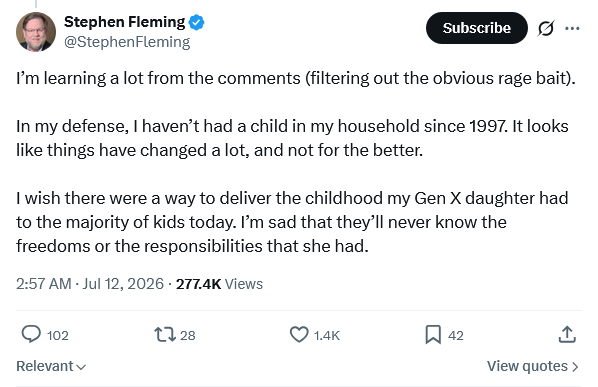
An interesting discussion at the social media site formerly known as Twitter, as Devon Eriksen responds to a comment from Stephen Fleming:

But don’t you understand?

There was a way. There was always a way.

We had it within our grasp, because we had already grasped it. The childhoods that you and your daughter had were available because you and your daughter had them.

All that the Boomers, and their parents, the eldest of the post WW2 generations, had to do was …

Nothing.

Just live in the paradise that their ancestors won for them, and make the minimum, the bare minimum, of effort that would have been required to actually sustain it.

That’s all.

Just keep things the way they were.

But they couldn’t handle that. Their fathers and grandfathers, the heroes that won WW2, made them jealous.

They wanted to be heroes, too.

So, for the sake of their own egos, they had to become Social Justice Warriors. They had to be Champions of Progress and Change.

They had to see the world they inherited as a pile of problems to be solved, rather than a pile of solutions to be cherished and preserved.

So they could feel like they were doing something important.

Almost all of the elder generations, even the ones who call themselves conservative and vote republican, are, in truth, socialist liberal progressives. Because they looked at paradise, and wanted to fix it instead of protect it.

That’s why the “republican” option was Reagan, the gun-ban guy, the social-welfare guy, the kiss-up-to-the-commies guy, the amnesty-for-foreign-invaders guy.

Reagan, the Hollywood liberal, the Obama of the 80s, instead of Joe McCarthy, Barry Goldwater, and Pat Buchanan.

Teens can’t have a summer job because elders had to be Third-World Compassion Heroes, and give us Hart-Cellar and eleventy-billion barbarians who don’t care about civilization, but will work cheap.

Teens can’t have a car because elders had to be Climate Emergency Heroes and give us emissions control laws and Cash for Clunkers.

Teens can’t have safe schools to learn at, because elders had to Anti-Racist Heroes and made it illegal to exclude violent thugs from our school districts. Just because those thugs generally come color-coded for your convenience.

Teens can’t have safe public spaces to hang out in, because elders had to be Compassion for the Underclass Heroes, and release violent savages into society, again and again, with a lecture and a slap on the wrist.

Teens can’t have a healthy economy to inherit, because elders had to be Equality Heroes and make sure every corporation that actually did anything useful was punished for not being Diverse, Equitable, and Inclusive enough to suit the ideal universe that exists only in their heads.

Teens can’t have dates, because elders had to be Anti-Sexist Heroes, and let feminists spend forty years diminishing the social value of men, until you had to a be a billionaire rockstar adventurer to avoid being an unsexy loser by default.

Teens can’t even be fit, healthy, and pretty, because elders had to be Sex Equality Heroes, and move women into the corporate workforce in droves, leaving children to be fed by corporate industrial slop factories.

Teens can’t have sane, well-adjusted, unspoiled girlfriends and wives, because elders had to be Champions of Sexual Freedom, and normalize unlimited female promiscuity, all in exchange for the largely unfulfilled promise of a little unshaven free-love yeti snatch.

And worst, of all, the crowning irony, the final dead hamster in the water pipe, is that all of this would be fixable, perhaps in three to five election cycles …

Except.

Except the elders don’t understand that any of this of this is happening.

They haven’t had a child in the household since 1997. They haven’t looked for an entry-level job since 1973. They haven’t gone on a date since 1981. They haven’t been laid off … ever.

They are safe with their paid-off houses and their investments and their pensions from 45 years at the same company and their social security and their medical plans.

It’s affecting the youngest generations first and worst. While the elders sit on their cruise ship, surveying the short with binoculars, wondering who all these ragged distressed looking people standing on the shore are.

And why they are holding signs that say “HELP”, “THIS IS ALL YOUR FAULT”, and “YOU STOLE THE LIFE I WAS SUPPOSED TO HAVE”.

Then they shrug, conclude that these must be the whiny losers, and everyone further inland is probably just fine, and everything is fine, because they fixed everything and they are all heroes, and the Summer of Love was the end of the Problematic Era of History and the beginning of the Great Enlightenment.

And when I am 74 years old, and the elders are all safely tucked into their cemetery plots, I will be torn apart by an angry mob for having white hair, and therefore being “one of them”.

And the mob will not care that I didn’t get to cast a vote until 1992, for the Man Who Predicted All Of This.

He called it the “giant sucking sound”.

Which is apt because it’s why everything sucks now.

June 13, 2026

QotD: Ecce BCG

Filed under: Education, Humour, Politics, Quotations, USA — Tags: , , , , , — Nicholas @ 01:00

Seriously, you’re wondering if a young lady in your life is a BCG? Let’s go over the diagnostic criteria. Fully acknowledging that some folks don’t photograph well, appearing to be 10-15 years older than your chronological age is a strong tell. BCGs live hard, on a steady diet of half-caff pumpkin spice mocha latte frappucinos and cock. […]

Of course BCG stands for “Basic College Girl”, and thus she can be found at any institution of “higher” “learning”, but the most Basic ones of all go to colleges you’ve never heard of. Jonah Goldberg is a good example, and while I know he’s technically male, his act is classic BCG. He famously — or infamously — went to Goucher College, which is the kind of school that likes to pretend it’s a mini-Ivy, when in fact it’s the kind of school bright-enough but directionless young nouveau riche kids go to when they just can’t kick that drug habit.

[…]

Achieving shockingly high rank right out of the gate is another tell, and I know what you’re thinking, because of course I thought it too: Mark Meadows is 63 years old, and in the world we grew up in, there’s only one way for a straight-out-of-college girl to become a “close confidante” of a 63 year old man. In my experience, though, BCGs aren’t socially savvy enough to figure that out.

Yeah yeah, I know, but y’all, as primal as that is, these BCGs are just weird. They have no social skills whatsoever. Two data points. First, from Hutchinson’s wiki page:

    Identified as a “White House legislative aide”, Hutchinson was the subject of a nationally-syndicated AP photograph in which she was shown dancing to the song “Y.M.C.A.” alongside White House press secretary Kayleigh McEnany at the end of Trump’s September 21, 2020, campaign rally in Swanton, Ohio.

That is not grownup behavior. No woman who ever hoped to be taken seriously in politics would be caught dead doing that, as recently as 15 years ago. They have absolutely zero idea how they come off to other people.

Second data point: I once taught a night class in one of my Flyover State tours. I had this girl there who was just dying to get to Capitol Hill. She was involved in every possible Poli Sci club, the pre-law club, the Young Legislators (or whatever FNG shit it was), and so on. She emailed me once to say she’d be coming to class late, because she was representing Student Senate (or whatever) in some big to-do the college was hosting for the Governor.

When she shows up to my class, she’s wearing this tight red cocktail dress that would’ve looked trashy on a Vegas waitress. It was slit at the sides and back. and at the midriff. It had sequins, I shit you not. It was all I could do not to bust out laughing. You went to a reception. With the Governor. Wearing that.

They have no savvy at all, y’all. None whatsoever. The invitation she got read “formal attire”, so she wore what she wore to the sorority formal. You could practically still see Chad Thundercock’s handprints on her ass.

And that’s the fourth and most diagnostic criterion: utter, complete, hilarious fucking cluelessness. About everything.

Severian, “Alt Thread: Diagnosing the BCG”, Founding Questions, 2022-06-30.

June 11, 2026

“That’s the fun thing about the fall of the West; everybody gets a swing of the sledgehammer”

Filed under: History, Military, USA, WW2 — Tags: , , , , — Nicholas @ 03:00

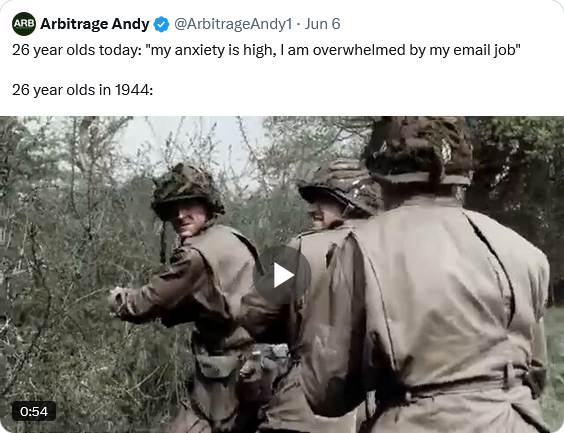
Devon Eriksen responds to a fairly common boomer-ish post:

I don’t know if @ArbitrageAndy1 is a Boomer, but here he gives us a mashup of two classics from the Boomers’ greatest hits, “Younger Generations Suck”, and “The Television Never Lies to Me”.

It’s a jaunty little tune, and you can sing in it the shower, but the lyrics don’t actually make much sense.

Back in the real world, which younger generations actually have to live in, and where the television seldom tells the truth, WW2 was fought, on both sides, by guys even younger than 26.

And they were terrified.

The stress of combat against a peer adversary is overwhelming. It’s unendurable. But you endure anyway, because there you are, it’s happening to you, and you’re not getting out of it.

So you actually do have those little moments that Boomers would describe as stress meltdowns if they happened at work. You have them, and you do what you need to do anyway. Sometimes at the very same moment while you are melting down.

When you’re in this kind of war, there’s something terrible in front of you. In reality, that terrible thing is just as young and scared and overwhelmed as you are, but it sure doesn’t feel that way to you.

However, you also have something behind you, and something around you.

Behind you, you have a tribe that accepts and appreciates you. They know they sent you to hell, but they did it because hell was necessary, not because hell was fine. No one is gaslighting you pretending that everything is okay and that any problems you have are personal character flaws.

Around you, you have bros. They’re exactly where you are, doing exactly what you are doing, and they know how much it sucks. You’ve entrusted your lives to each other, and carried each other through things you don’t wanna talk about in your letters home.

Under intense stress and fear and exhaustion, your horizons shrink. You might have signed up for duty and patriotism and high ideals, but when you’re fighting, you fight to save the man next to you. And he fights to save you.

This is a very different experience than being isolated in a society that’s turned against young people, especially young men, especially young White men.

I won’t pretend it’s as difficult as fighting the Waffen SS. But young men fought the Waffen SS together.

They have to face the dissolution of the West alone.

That’s why they are anxious. Everything around them is not just going to shit.

It’s being systematically and deliberately turned into shit by powerful people who want them dead and replaced by someone else who will work cheaper and doesn’t expect to have a share of political power and a nice house and a retirement pension.

But I suppose Andy can still go ahead and dunk on them for clicks and a twenty-three dollar check from Twitter. That’s the fun thing about the fall of the West. Everybody gets a swing of the sledgehammer.

The Course of Empire – Destruction by Thomas Cole, 1836.
From the New York Historical Society collection via Wikimedia Commons.

May 23, 2026

“The primary skill of an author is empathy

Filed under: Books — Tags: , , , , , — Nicholas @ 03:00

On the social media site formerly known as Twitter, Devon Eriksen describes the real skill a fiction author needs to have to produce fully satisfying stories:

Woke message fiction may be slowly dying, but stories won’t magically get better when it’s dead.

Because there’s a deeper problem.

I found it in a book I’ll call MillenialQuest. That wasn’t its real name, of course. I’m not trying to dunk on some poor soul just for writing a bad book. If I did that, I’d never be stopping.

It was some medieval fantasy thing with a rather likely premise involving a fallen paladin and an army of steampunk centaurs.

But when I opened it up, I quickly realized that every single character, despite living in a world where “horse” was the peak of transportation technology, was a Joss Whedon character wearing a Tolkien skinsuit.

Complete with sarcasm, cutesy little quips, and no emotional self-control whatsoever. Didn’t matter if the character was a professional assassin or a cloistered scholar, he talked, acted, and thought as if he were auditioning for a episode of Buffy the Vampire Slayer.

My first impulse was to be annoyed with the author for disappointing me. But I quickly realized that the problem ran deeper, and the author, annoying as her habits were, was both symptom and victim of a deeper malaise.

The primary skill of an author is empathy.

Now, I don’t mean the “empathy” that socialist twats are constantly talking up, in lectures about how we must all immediately dismantle Western civilization to create infinity third world biomass.

I mean the actual skill of figuring out what other people are thinking and feeling.

To excel at his craft, an author must empathize in two directions at once. Not alternately, but simultaneously. He must empathize with the audience to understand how they will experience what he writes, and he must empathize with characters, to understand how they see the world, and what they would do and say.

Empathy must be learned. And it can be learned in two ways, either by having lots of conversations with people who are as different from you as possible, or by reading books with characters who are also totally unlike you.

Well, we’ve now raised several entire generations who cannot withstand the stress of a real conversation with someone from their own nation who happened to vote for the other idiot on a two-option menu.

And what have those people been watching, listening to, and reading?

Well, Whedonized stories wherein every character is a reskinned version of a white, middle class, left-leaning liberal arts student in a small East Coast private college.

The author of MillenialQuest didn’t set out to write The Message™. Nobody was a purple-haired mixed-race fat wheelchair lesbian, and there weren’t any thinly veiled rants about capitalism or diversity.

Sure, the word “misogynist” was used a bunch, without any apparent awareness of the confused look of incomprehension that your standard medieval knight would respond with.

But so was the word “allergies”. And “expense account”. And “psychology”. And “self-medication”.

No, the core pathology here wasn’t the irrepressible urge to preach the author’s values at all.

It was a complete lack of ability to put her head into someone else’s world view.

To the new breed of author, the 21st century liberal zeitgeist isn’t just the only moral viewpoint, it’s the only imaginable viewpoint.

This is why they think you are evil and crazy if you voted for the other guy. Because they literally have no idea what might have motivated you to do that.

The author of MillenialQuest couldn’t imagine a world where differing responsibilities for men and women are a necessity for survival, rather than a cause for complaint.

She couldn’t imagine how the concept of an expense account would be expressed in a world where peak financial technology is pounding your shiny metal into discs with faces on them.

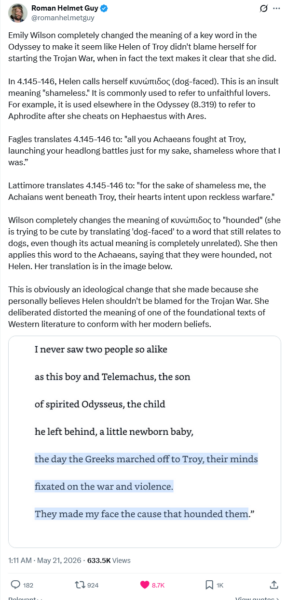
Emily Wilson can’t understand a woman who would be ashamed of cheating on her husband, or men who would start a war over an insult.

Yes, often it’s deliberate. Often it’s preaching, or venting their own desire to debate with someone whose response they cannot hear.

But the point is, even if and when they are forced, by threat of major film studio bankruptcy, to stop deliberately trying to preach and propagandize, they won’t magically gain the ability to write characters different from themselves.

Empathy is a skill. It has to be learned and then practiced. And most people in the writing game today simply haven’t had the opportunity.

We may be exiting the age of DEI slop, but we are entering the age of just plain slop.

May 21, 2026

Evaluating the Boomers’ complaints from the Zoomers’ point of view

Filed under: Cancon, Economics, Media, Politics, USA — Tags: , , , — Nicholas @ 06:00

As a dirt-poor boomer (or Generation Jones-er as some term us extra-late boomers), I don’t have a lot of sympathy for others in my age cohort who complain about their kids and grandkids not getting ahead when they’re occasionally back in Canada from their second or third extended exotic foreign vacation since before the snow fell last fall. (It’s been more than a decade since the last time we were able to take any kind of vacation … and that was just a week’s driving holiday to South Carolina.) The Zoomers (and Millennials, and even some of the Gen X’ers) have valid complaints that the boomers generally are not capable of understanding, as John Carter explains:

I’m going to have a little rant, here, so I’ll start by emphasizing: Not All Boomers. Look, my mother is a boomer, and I love her dearly, in large part because she represents the opposite of so many boomer stereotypes. Many of you reading this are boomers; I know this because you’re in the comments, writing some of the best comments, you can ask anyone, the very best comments, everyone says it, it’s true. I know full well that much of what follows doesn’t apply to you, because you’re the good ones, the exceptional ones, the few, the proud So, please, do not take any of this personally.

With that said.

The shouting match broke down along the expected lines. Boomers – including spiritual boomers – loudly agreed with O’Leary’s remarks. If you only spend $2 a day on lunch, they insisted, the resulting $26 a day that you save adds up to $9490 a year; after 5 years, you’ve got the down payment for a $250,000 house. Checkmate, you financially illiterate layabouts!

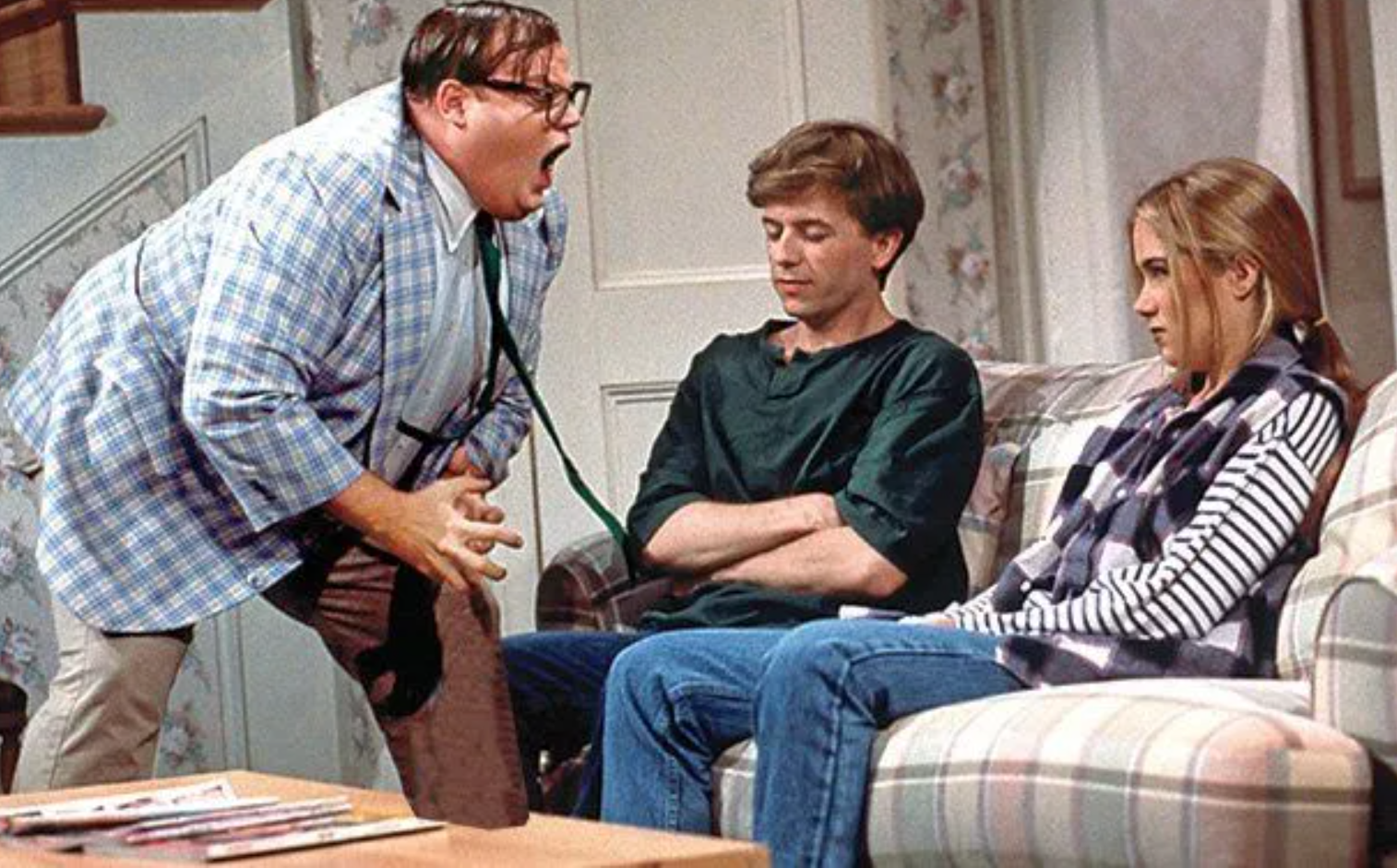
Zoomers, millennials, and Gen-X replied that $250,000 will get you a leaky shack in rural Arkansas with black mold in the unfinished basement; that by the time you save up the money for the down-payment, that shack will be going for $500,000; that recent immigrants receive government assistance to get onto the property ladder (along with preferential employment) and so do not have to spend years of their lives saving up at all. Disaffected youth (and these days, that is just ‘the youth’) generally heaped scorn on the idea that it’s even possible to save in this economy, or that there’s anything worth saving. “If you live on instant noodles and margarine sandwiches for twenty years, you too, my son, can one day afford a van down by the river.”

As an aside, isn’t it incredible how fashion has barely changed since Chris Farley did this skit on SNL back in 1993? Stuck culture is everywhere.
Image and caption from Postcards from Barsoom

I can see both sides of this. I tend to live frugally myself, not so much because I consider it virtuous but out of simple necessity. Throughout my 20s and 30s I was a career student living paycheck-to-paycheck, as a result of which I became very accustomed to cooking my meals and buying only what’s necessary. I’ve never once used DoorDash or Uber Eats. I buy my clothing at thrift stores, only purchase a new laptop once every decade or so, and have somehow managed to avoid racking up much in the way of debt … and by ‘somehow’ I mean that I’ve never owned a house or a car, partly because I changed continents too regularly to make such big-ticket purchases practical or necessary, but mostly because I couldn’t afford them. Even finishing my doctorate did not really bring anything you could call prosperity in its wake: my first position was for the princely some of just over USD30,000 per year. By the time I reached the median national income in my late 30s, I’d gotten so accustomed to frugal living that money started piling up in my account just because I had no idea what to do with it, and little inclination to spend it because I was honestly just happy to not have to worry about budgeting to make rent. That turned out to be very helpful when DEI came for my career track; I lived on those savings for a couple of years after.

[…]

There was a famous Stanford experiment called the Marshmallow Test which measured time preference in young children. A child would be left in a room with a single marshmallow on the table. They were of course free to eat the marshmallow, the experimenter would tell them, but if they didn’t, then later on they would get a second marshmallow. Children with high time preference – meaning that they strongly prefer the immediate reward to the hypothetical future reward – would cram the marshmallow into their candy-holes without a second thought. Children with low time preference – meaning that they value the future at a similar or even higher level to the present – would patiently wait, and be rewarded with a second marshmallow. These children were then followed, and it was demonstrated that the children with low time preference demonstrated better life outcomes: they maintained higher grades, were less likely to fall into debt, were less likely to develop drug addictions, were less likely to get pregnant before marriage, were less likely to get fat, and so on. All of which makes sense. The capacity to endure present pain – by studying, dieting, working out, what have you – in order to obtain a better future outcome is obviously going to be linked to better outcomes.

How would a smart kid react if the experimenter failed the marshmallow test?

For instance, say the experimenter simply lied. There was no second marshmallow; the child waited for nothing. Or, even worse, the first marshmallow was snatched away, and replaced with two marshmallows, each one half the size of the original? Or a third the size? Here are your two marshmallows, sucker, joke’s on you. What would the results be if, after this experience, the children were tested a second time? I don’t know if such an experiment has ever been conducted, but the outcome is not hard to guess. Every single one of the children, whether they’d passed the marshmallow test the first time or not, would scarf down the marshmallow the moment it was in front of them.

The capacity for low time preference may be largely innate, but whether it expresses or not is entirely a function of social trust. In order to defer gratification for a greater future reward, one must believe that there is a reasonably high chance of that reward manifesting. The less likely the future reward becomes, the more steeply a rational actor will discount the future.

I don’t want to minimize the hardships that boomers endured when they were young. Boomers worked hard, and they didn’t enjoy the same conveniences that we enjoy now. They fought in the Vietnam War (well, about 3% of them), they spent most of their lives under a nuclear sword of Damocles, they suffered through the oil shock and stagflation in the 70s, they were punished by double-digit interest rates in the early 80s, and they spent their working lives trying desperately to stay one step ahead of the skyrocketing inflation that was unleashed when Bretton-Woods fell apart and the last vestigial support of the gold standard was kicked out from under the brrrring money printer.

But, despite all of that drama, the one thing boomers could generally rely upon was that – so long as thermonuclear annihilation was averted – things would generally get better. Technology would advance. Working conditions would get safer. The special effects in movies would become more convincing. Houses would get larger. Cars would get nicer. Air conditioning would get quieter. The environment would get cleaner. Society would become more just. The world would become freer and safer for democracy. And so on and so forth. Baby boomers have enjoyed a charmed life such as no other generation has known: free of major wars, full of technical wonders, in which whatever difficulties you might endure now, you could generally count on the future being a better place. For the boomer, deferred gratification always had a payoff.

For the zoomer – and the millennial, and generation X – this has simply not been the case. After 9/11 a police state panopticon settled over society. The 2008 real estate crash pulled the rug out from under the millennials, after which real-estate got ZIRPed to the Moon. Mass immigration pumped real estate demand further, while undercutting wages and rendering public spaces steadily more alienating, unpleasant, and dangerous. Black Lives Matter immolated quaint notions of racial harmony. DEI threw young white men, their careers, their futures, and their unborn children to the wolves. COVID stole two years from young people’s lives so that old people could feel safe from the coof. Now, AI^2 (Artificial Intelligence + Actual Indians) means that the only thing the young expect in their future is gig work in the sex trade industry (until robots take that, too).

April 4, 2026

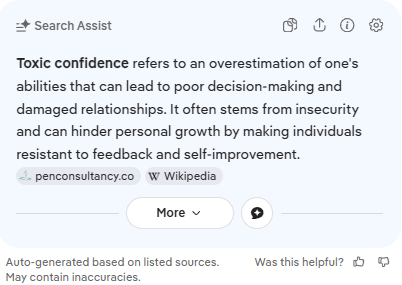
Be on the lookout for “toxic confidence”

Filed under: Health, Media, USA — Tags: , , , — Nicholas @ 04:00

Freddie deBoer disagrees with a recent New York Times piece which proclaims that “toxic confidence” is the current psychological tic of choice:

[…] But then, the whole theatrical embrace of imposter syndrome wasn’t really about a sincere belief that they didn’t belong in the program, that they had gotten in through some mistake. It was, instead, an expression of a very weird element of Millennial culture, which is the embrace of insecurity as a means of belonging.

Which brings me to Savannah Sobrevilla and her recent trend piece, destined to be a New York Times classic, “Toxic Confidence Has Taken Over”. You can already guess the argument here, but I’ll give you the nut anyway:

    … it used to be that “impostor syndrome” dominated conversations, the anxious stance of millennials with adult responsibilities and women leading corporate workplaces trying not to rankle. Even if you felt deserving of accolades, the social graces of the time required the expression of modesty.

    Now, in an era of aggressively handsome incels and macho political posturing, cultivated humility feels trite. A younger generation, coming out of high school and college in Covid lockdown, feels less beholden to dampening their light. Who has time for affected meekness when playing the braggart not only tickles the soul, but has the potential to convince others of one’s own greatness?

The phrase itself, “toxic confidence”, is doing a lot of work in this essay, and I can just imagine an NYT editor reading the pitch, seeing that phrase, and salivating. But there’s not a lot there, really. Strip away the arch tone and the carefully curated examples (reality-television grifters, Trump-administration blusterers) and what you’re left with is a fairly straightforward complaint: some people believe in themselves too much, and it’s making a certain kind of person uncomfortable. Of course, there’s always been braggarts and narcissists and perennially self-impressed people around us, in any era, and that they’re annoying is not generally considered newsworthy. What makes this a classic NYT trend piece is that it makes an observation that’s comprehensible only to a certain strata of reader — middle aged or younger, culturally savvy, educated, urban in ethos if not necessarily in geography, too online. These people aren’t experiencing the age-old frustration with the conventionally overconfident, but are facing (if Sobrevilla is to be believed) the demise of a recent generational embrace of performative insecurity, which makes them uncomfortable. That discomfort is worth examining, because it reveals less about a cultural pathology than about whose neuroses we’ve decided to normalize.

As usual, I blame my own generation. For roughly fifteen years, Millennial culture ran a remarkable experiment: it rebranded anxiety, self-doubt, and chronic insecurity as virtues. This is certainly connected to the phenomenon of illness as identity and disorder as fashion I’m always complaining about […] but is, I think, a distinct phenomenon, the rearrangement of healthy confidence into pathology and pathological self-doubt into virtue. The weird affordances of social media gave certain culturally and socially influential people the ability to imprint their own neuroses onto the wider culture, recasting that neuroses as a sort of down-to-earth norm. In that context, impostor syndrome ceased to be something to overcome and became a membership card. Everybody started bragging about their social anxiety; people gleefully declared their FOGO; “I’m the worst”, said with the right ironic lilt, became fodder for bonding. Vulnerability, performed on cue, was currency. The implicit agreement was powerful and, when you examine it, fairly cruel: if you seemed too assured, too unbothered by your own inadequacy, you were either deluded or dangerous. The rules had been rewritten by indoor kids, the chronic overthinkers, the people who had built entire identities around their relationship with self-doubt, and the rules said confidence was suspect.

What Sobrevilla calls “toxic confidence” is largely just the renegotiation of those rules, an attempt to cast an incipient reclamation of basic, uncomplicated self-assurance as some sort of aggressive masculinist cult. A couple of examples that Sobrevilla calls out specifically include Olympic free skier Eileen Gu and actor Timothée Chalamet; I’m afraid these examples just make Sobrevilla seem afraid of excellence. When Gu — an Olympic gold medalist, a celebrity, a Stanford student, and a burgeoning entrepreneur — says that being inside her own head is “not a bad place to be”, that isn’t pathology; it’s the statement of a young woman who has done the work and is honest about it. (And wouldn’t we prefer for everyone to feel like insider their own head is a nice place to be?) Maybe Gu is a genuinely awful human being, I don’t know, but nothing Sobrevilla references rises to the level of narcissism or whatever other pseudo-medical accusation we’re throwing around these days. I find Chalamet a little aggravating, but when he says that he aspires to be considered among the great actors of his time, when all is said and done, that’s not a statement of Trumpian bellicosity but instead a reflection of honest, healthy ambition. We’ve been so conditioned to expect performative self-deprecation that accurate self-assessment reads as arrogance.

February 7, 2026

Food hang-ups by generation

Filed under: Food, Health, Media, USA — Tags: , , , , , , , , — Nicholas @ 05:00

Around the early to mid-80s, I started to notice trends in the kind of health information being pushed by the mainstream media. One of the big topics of the day was the dangers of … eggs. Eggs were so dangerous that “experts” were warning adults to avoid eating more than one or two per week. Three was the absolute limit and you were dicing with death if you went over that “healthy” limit. Then, a few years later, eggs were “the perfect food” and we weren’t eating enough of these formerly abominated death pills. A few years after that, OMG! Apples, people, apples! Danger, danger, danger! That was around the time I stopped putting any credence into health reporting in the media. However, as Lisa De Pasquale points out, food issues have been an ongoing struggle for each succeeding generation:

In the ’80s, the ultimate healthy Boomer breakfast was a bran muffin. There were also various cereals like Grape-Nuts and Raisin Bran. There definitely wasn’t room for their parents’ bacon and eggs unless you had a death wish. Boomers settled on eggs as the devil’s snack when the American Heart Association warned in the 1960s that people shouldn’t consume more than three eggs per week. Like social distancing six feet from others during COVID and eight 8oz glasses of water per day, the recommendation wasn’t based on science, but on being a simple number Americans could remember.

Thanks, but this Gen Xer will stick to getting my 8,675,309 steps per year as my guiding fitness principle.

[…]

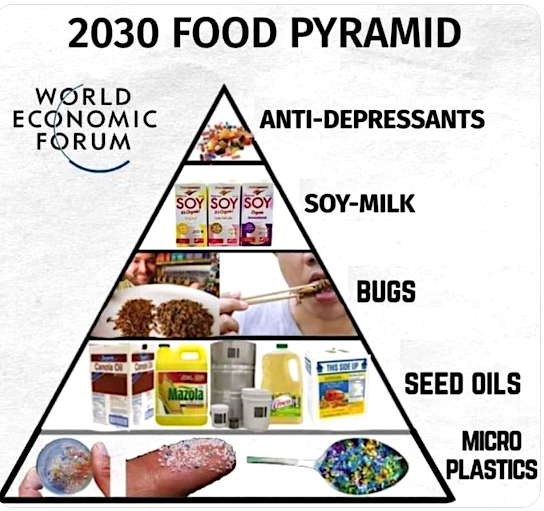
The Millennial Food Pyramid

Level One: Genetically Modified Organism and Nonorganic Foods — Use Sparingly

While Gen X was at ground zero in doubting Big Food’s pyramid, our Millennial colleagues and kids really continued the battle. Like luxury logos, they seek out the organic and non-GMO labels. It’s a virtue signal of both their values and what they can afford. Erewhon smoothies, anyone?

Level Two: Various Overpriced Coffee Drinks — Two to Three Servings

Gen Xers link coffee to work and responsibility; caffeine is a tool to get through the morning. Millennials view coffee drinks as self-care. It’s about treating themselves to dessert any time of day — a major win for marketing executives.

Level Three: Charcuterie Boards, Wine, Hard Seltzers, Craft Beers — Three to Five Servings

Millennials love to entertain. Nothing shows sophistication and “adulting” in your 30s and early 40s like a charcuterie board. Lunchables upgraded! They came of drinking age at the same time as small-batch beers, American boutique wineries, and hard seltzers.

Level Four: Instagram-Worthy Food — Six to Eleven Servings

Camera phones leveled up the entertainment value of food consumption. Like organic labels, what Millennials eat signals their open-mindedness. As they get older, they straddle the line of wanting to be in on the trends (avocado toast and açai bowls) and the dive you haven’t heard of with authentic phở.

The Generation Z and Generation Alpha Food Pyramid

Level One: Real Meat, Dairy, and Peanuts — Use Sparingly

The Gen X and Millennial generations dabbled in veggie burgers, but Gen Z and Gen Alpha went whole lab-created hog into plant-based meats and milks, to the point that meat and milk no longer have a meaning until a company gets sued for using the words. To be fair, they are also embracing biohacking trends and ditching seed oils. Due to the growing prevalence of allergies, peanuts are a universal no-no food in public spaces.

Level Two: TikTok Recipes — Two to Three Servings

The term “recipe” is used loosely. I’ve come across a TikTok video for making a cream sauce from a block of cream cheese, water, and dried pasta. There is a positive aspect of trying these TikTok recipes, though: it prepares them for trying new things and for failure when a recipe doesn’t come out right.

Level Three: Food Delivery Service Meals — Three to Five Servings

Postmates, Uber Eats, Grubhub, and DoorDash are staples at mealtime. Following their surge during the COVID era as restaurants struggled to stay in business, accounts linked to their parents’ bank accounts became as common as sharing a cell phone plan.

Level Four: Gamer Food and Drinks — Six to Eleven Servings

Living next to a park has taught me one thing about Gen Z and Gen Alpha — they’re all inside. I mostly see neighborhood kids on Halloween, and every year, I recognize fewer and fewer costumes because they’re dressed as video game characters. Their snacks are manufactured for their attention span: quick hits of spicy, sour, or sweet while on pause. The gamer culture and H Mart remove barriers as Japanese snacks dominate.

So, where does this leave Gen X? We’re not immune to the powers of Big Food. In fact, recent research shows that ultra-processed food addiction began with us thanks to the explosion and availability of ultra palatable foods with added refined carbs and fats. StudyFinds reported researchers from the University of Michigan said, “Individuals who are now older adults were in developmentally sensitive stages during the 1970s and 1980s, precisely when tobacco-owned food manufacturers were shaping the market with addictive ultra-processed foods”.

January 7, 2026

More anti-anti-boomer discussion from Scott Alexander

Filed under: Economics, History, Media, Politics, USA — Tags: , , , , , , — Nicholas @ 03:00

I linked to Scott’s original article last month and thanks to the interest it generated (and perhaps my clickbait-y headline) it got linked at Instapundit thanks to Sarah Hoyt. Scott got a lot of feedback on his post and shares some of that here:

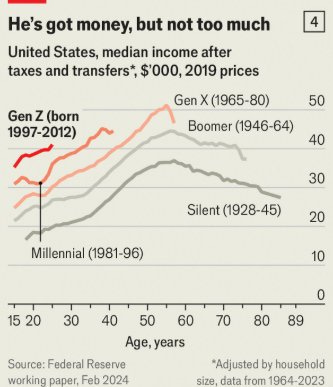
“… Millennials and Generation Z have more money (adjusted for inflation ie cost-of-living, and compared at the same age) than their Boomer parents, to about the same degree that the Boomers exceeded their own parents. This is good and how it should be. The Boomers have successfully passed on a better life to their children”

First, I wish I’d been more careful to differentiate the following claims:

  1. Boomers had it much easier than later generations.
  2. The political system unfairly prioritizes Boomers over other generations.
  3. Boomers are uniquely bad on some axis like narcissism, selfishness, short-termism, or willingness to defect on the social contract.

Anti-Boomerism conflates all three of these positions, and in arguing against it, I tried to argue against all three of these positions — I think with varying degrees of success. But these are separate claims that could stand or fall separately, and I think a true argument against anti-Boomerists would demand they declare explicitly which ones they support — rather than letting them switch among them as convenient — then arguing against whichever ones they say are key to their position.

Second, I wish I’d highlighted how much of this discussion centers around disagreements over which policies are natural/unmarked vs. unnatural/marked.

Nobody is passing laws that literally say “confiscate wealth from Generation A and give it to Generation B”. We’re mostly discussing tax policy, where Tax Policy 1 is more favorable to old people, and Tax Policy 2 is more favorable to young people. If you’re young, you might feel like Tax Policy 1 is a declaration of intergenerational warfare where the old are enriching themselves at young people’s expense. But if you’re old, you might feel like reversing Tax Policy 1 and switching to Tax Policy 2 would be intergenerational warfare confiscating your stuff. But in fact, they’re just two different tax policies and it’s not obvious which one a fair society with no “intergenerational warfare” would have, even assuming there was such a thing. We’ll see this most clearly in the section on housing, but I’ll try to highlight it whenever it comes up.

I’m in a fighty frame of mind here and probably defend the Boomers (and myself) in these responses more than I would in an ideal world.

[…]

1: Top Comments I Especially Want To Highlight

Sokow writes:

Many Europeans chimed in to say this, including people whose opinions I trust.

I find this pretty interesting. We all know stories of American opinions infecting Europeans, like how they’re obsessed about anti-black racism, but rarely worry about anti-Roma racism which is much more prevalent there. I’d never heard anyone argue the opposite — that the European discourse is infecting Americans with ideas that don’t apply to our context — but it makes sense that this should happen. I might write a post on this.

Kevin Munger (Never Met A Science) writes:

    Hating Boomers (and talking about hating Boomers) is uninteresting and I agree morally dubious.

    But it is *emphatically* false that “Boomers were a perfectly normal American generation”. They have served far more terms in Congress than any generation before or since (and we currently have the oldest average age of elected officials in a legislative body IN THE WORLD other than apparently Cambodia), they have dominated the presidency (look up the birthdate of every major party candidate since the 2000 presidential election…), they controlled the commanding heights of major companies, cultural institutions (especially academica).

    They are a historically *unique* generation, for three intersecting reasons: 1. They are a uniquely large generation 2. they came of age as the country and its institutions were maturing 3. they are sticking around because of increased longevity. These are analytical facts, and they produce what I call “Boomer Ballast” — a concentration of our societies resources in one, older generation that increases the tension we are experiencing from technological innovation. Our demography is pulling us towards the past, the internet is pulling us into the future, and this I think is the major source of the anti-Boomer frustration.

    On the specifics of social security and why we might think Boomers have played things to their advantage (not bc they’re specifically evil but bc they have the political power to do so) — the key thing is that they have prevented forward-thinking politicians from fixing the inevitable hole in social security that comes from our demographic pyramid. It would have been relatively painless to increase the rate or incidence of the social security payroll tax at any point in the past 25 years, the looming demographic cliff was obvious and the increased burden could’ve been shared more equally. Instead, they prevented reforms and all of the fiscal pain from demographic shifts will be borne by younger generations.

I agree this is a strong argument, and part of why I think it’s helpful to separate the three points I mentioned at the beginning.

RH writes:

    We [Boomers] did [vote for ourselves to pay higher taxes and get fewer benefits]. My lifetime SS benefits will be 20-25 percent less than they would have been under previous law, and I voted for that. My SS tax rate went up itself, and has been well over 15% since the changes took effect, and the cap on earned income subject to that went up a lot. And I voted to accept all that because it was projected to be sufficient.

    Then the immigrant haters decided we needed fewer workers in the country, or at least fewer paying SS taxes, so they slowed legal immigration and pushed illegals into the underground economy, so they don’t pay taxes to support social security. And social security is going to get whacked again, plus the evils the SS system was intended to alleviate — people too old to work and too poor to live — will return.

I think this says something profound about politics. The problem is less that there’s some group of people who don’t believe in fairness, but that fairness is very hard to calculate.

Suppose RH is right (I haven’t checked), and that Social Security would be sustainable with lots of immigration. Then whether Boomers are paying “their fair share” or not depends on whether immigration is good or bad (a hard question!), and on whether we think of high vs. low immigration as the natural unmarked state of the universe (such that immigration opponents must “own” closed borders and compensate the losers), and on what kind of compensation the losers from closed borders deserve.

Someone else commented by saying we could solve all of these problems without inconveniencing either the Boomers or the young by just increasing taxes on a few ultra-rich people. The ultra-rich could reasonably say they didn’t create this problem and it’s unfair to tax them for it. But so could the Boomers and the young! So whose “fair share” is it?

December 29, 2025

The war against white men didn’t start in 2015

Filed under: Business, Economics, Education, Government, Media, Politics — Tags: , , , , , — Nicholas @ 05:00

Janice Fiamengo responds to Jacob Savage’s essay on the “lost generation” of young white men who have been subject to open and explicit discrimination in education, employment, and loudly denounced for noticing this:

Most people who have discussed Savage’s essay accept his time frame: that the exclusion of white men took place mainly over the past ten to fifteen years. But this is not true. It has been going on for much longer than that, as Nathan Glazer made clear in his comprehensive Affirmative Discrimination: Ethnic Inequality and Public Policy, first published in 1975 and updated in 1987. Government initiatives to provide jobs for women and racial minorities, particularly blacks, were rooted in the equal rights legislation of the 1960s, implemented later that decade and aggressively expanded in the 1970s and 1980s. The National Organization for Women under the leadership of Betty Friedan, for example, brought a lawsuit against the U.S. Equal Employment Opportunity Commission to force it to comply with federal legislation, and sued the country’s 1300 largest corporations for alleged sex discrimination.

Anyone wishing to read a detailed prehistory of what Savage has chronicled can also consult Martin Loney’s extensively documented The Pursuit of Division: Race, Gender, and Preferential Hiring in Canada (1998), which shows how what was called equity hiring in Canada spread across areas such as the police force, firefighting, the civil service, crown corporations, law, teaching, academia, and elsewhere, beginning in the 1980s. What Glazer’s and Loney’s research shows is that discrimination against white men in employment is far more deeply embedded than most people realize and has affected many more men than is currently recognized.

It is ridiculous to castigate Boomer white men, as it seems popular now to do, for allegedly implementing and benefiting from diversity policies. The last thing that should be encouraged is for younger white men to turn their anger on older white men. Many of these older men themselves faced active discrimination, psychological warfare, divorce-rape, and immiseration. Every organ of the culture told them it was time to change, get with it, stop being Archie Bunker, recognize the superior merits of the women and racial minorities their people had allegedly oppressed for so long. White women were by far the majority and most enthusiastic architects and proponents of equity hiring, bullied in turn by the black and brown women with whom they originally formed their alliance against white men (and all men, with a few exceptions).

Older white men may have secured (tenuous) positions of power, but they had no power in themselves as white men. Most of them knew they could find themselves disgraced, friendless, and jobless as the result of an unpopular decision or an unguarded statement. Accusations of sexual misconduct to take such men out of their positions were not confined to millennial males.

I was in the academic job market in 1997, and diversity hiring was already commonplace then. Everyone knew it was going on, and it was signaled both explicitly and implicitly in the advertisements that encouraged applications from women and visible minorities. My friend Steve Brule remembers when affirmative action was brought in at the large chemical company where he worked in 1984. At the beginning, it was said that these programs would be time-limited, lasting only for a short season. Instead, they lasted for well over 40 years and are still going strong.

It is foolish to imagine that such discrimination is now going to lie down and die. There have been a number of occasions over the last few years in which that was confidently predicted (remember Claudine Gay?) and did not occur. Already the diversity advocates, who are legion, are marshalling their counter-arguments and nit-picking the evidence, finding (or lying about) the ways in which what Savage described hasn’t really happened, recalibrating numbers, rationalizing and justifying them. Thousands of academics will spend years joining forces to discredit claims about discrimination, recasting them as a MAGA or Groyper lament and a dangerous attack on the legitimate (but still inadequate!) gains made by valiant women and long-oppressed racial minorities. Recently for The Washington Post, Megan McArdle, in an ostensibly critical article, is still playing with false justifications and outlandish untruths, saying the following about the rationale for equity hiring:

    … One could say of course it’s unfair, but repairing the legacy of slavery and sexism is a hard problem, and sometimes hard problems have unfair solutions. It wasn’t fair to round up huge numbers of men born between 1914 and 1927 and send them off to fight the Nazis, but that was the only way to win.

    One might argue that, but I haven’t seen anyone do so. No one seems brave enough to state baldly that we should penalize White men born in 1988 for hiring decisions that were made in 1985 by another White guy who was born in 1930. Instead what I’ve seen is a lot of deflection.

What bizarre nonsense, what spurious claims even if her point is that such logic is ugly. Discrimination in favor of white men has been illegal since 1964, and affirmative action/equity hiring was already fully in place by the mid-1980s when the “white guy who was born in 1930” was allegedly discriminating in his hiring practices. As McArdle inadvertently shows, we’ve been operating on the basis of deliberately-perpetrated false beliefs for years, beliefs that the intelligentsia adhered to and promulgated.

On the City Journal Substack, Renu Mukherjee argues that Supreme Court Chief Justice John Roberts is correct that “The best way to stop discrimination on the basis of race is stop discriminating on the basis of race”:

First, public opinion is clear: Americans of all racial and ethnic backgrounds have long opposed the use of racial and identity-based preferences. While this trend extends to employment, I’ve studied it extensively in the context of college admissions. The data underscore Americans’ strong support for colorblind meritocracy.

One year before the Supreme Court struck down the use of racial preferences in college admissions in Students for Fair Admissions v. Harvard, the Pew Research Center asked Americans whether an applicant’s race or ethnicity should be a factor in the college admissions process. 74 percent of respondents said that it should not, including 79 percent of whites, 59 percent of blacks, 68 percent of Hispanics, and 63 percent of Asian Americans. By way of comparison, 93 percent of Americans said that high-school grades should be a factor in college admissions, and 85 percent said the same about standardized test scores. Several surveys since then have produced similar results.

A May 2023 study that I co-authored with my Manhattan Institute colleague Michael Hartney reinforces this point. Through an original survey experiment on the 2022 Cooperative Election Study (CES), we asked Americans to play the role of an admissions officer and decide between two competing medical-school applicants. While the applicants’ accomplishments were randomly varied, the specific pair of applicants that respondents saw always consisted of an Asian American male and a black male.

Our objective was to determine whether, and when, Americans believe diversity should take precedence over merit in medical-school admissions. We found that even when respondents were informed that the medical school lacked diversity, the vast majority made their admissions decisions based on merit — in this case, college grades and MCAT scores — not race.

A few months prior to the publication of that paper, for a separate report, I reviewed hundreds of survey questions on affirmative action stored on the Roper Center for Public Opinion Research’s online database. I found that Americans are most likely to say that they oppose “affirmative action” when survey language explicitly describes the policy as providing “preferential treatment” or “preferences” for a given group. This suggests a deep American aversion to racial and gender-based favoritism — which is why Democrats, when pushing policies rooted in such ideology, tend to rely on euphemisms. Republicans should not do what even Democrats know doesn’t work.

Unfortunately, over the last few weeks, they have sounded like they might. Several prominent Republicans have taken to the social media platform X to argue that “Heritage Americans” — those who can trace their lineage to the Founding era — are inherently superior to more recent arrivals. In doing so, they suggest that the former are entitled to preferential treatment on the basis of ancestry. Here, the logic is that “all animals are equal, but some animals are more equal than others”.

Republican leaders, such as Vice President JD Vance, should reject such grievance-based politics. These ideas were unpopular when Democrats pushed them, and they will be unpopular when Republicans try them, too.

December 27, 2025

Diversity is not our strength, no matter how many times they say it is

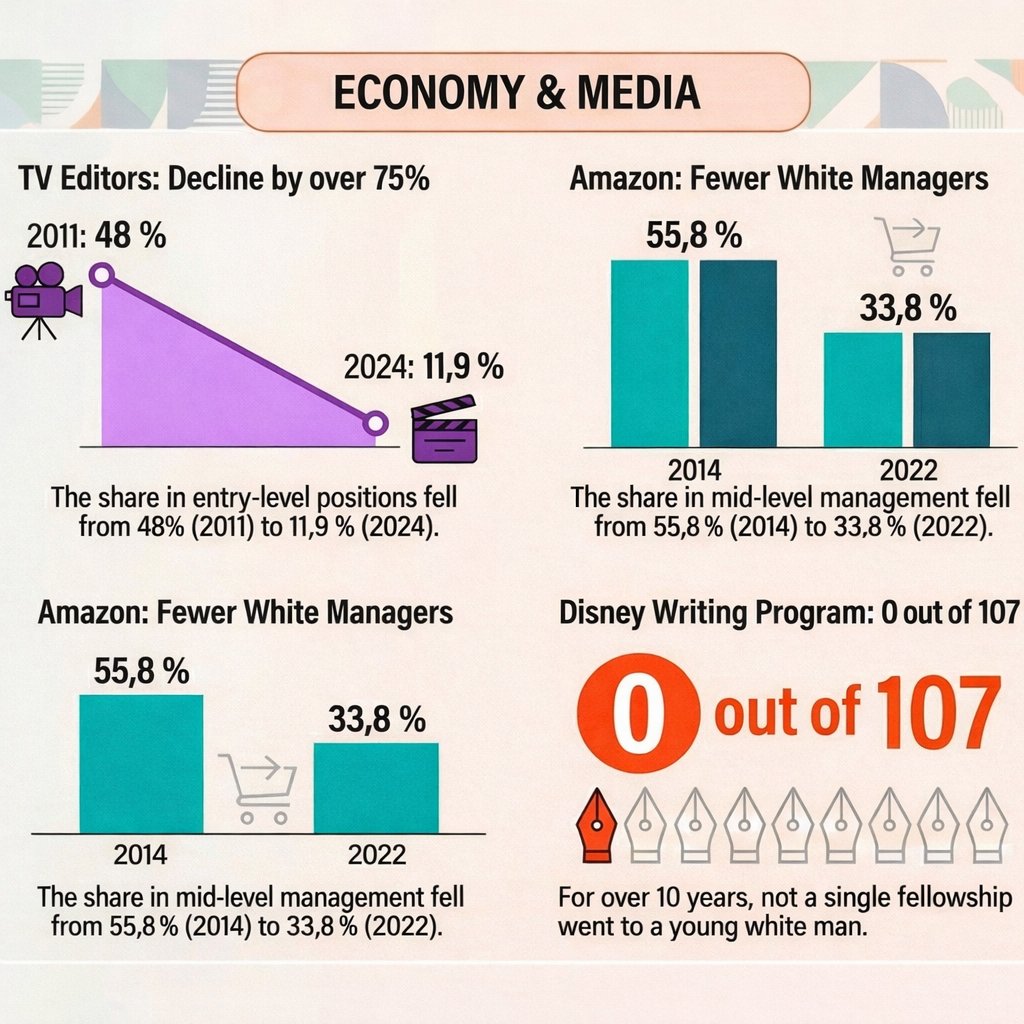
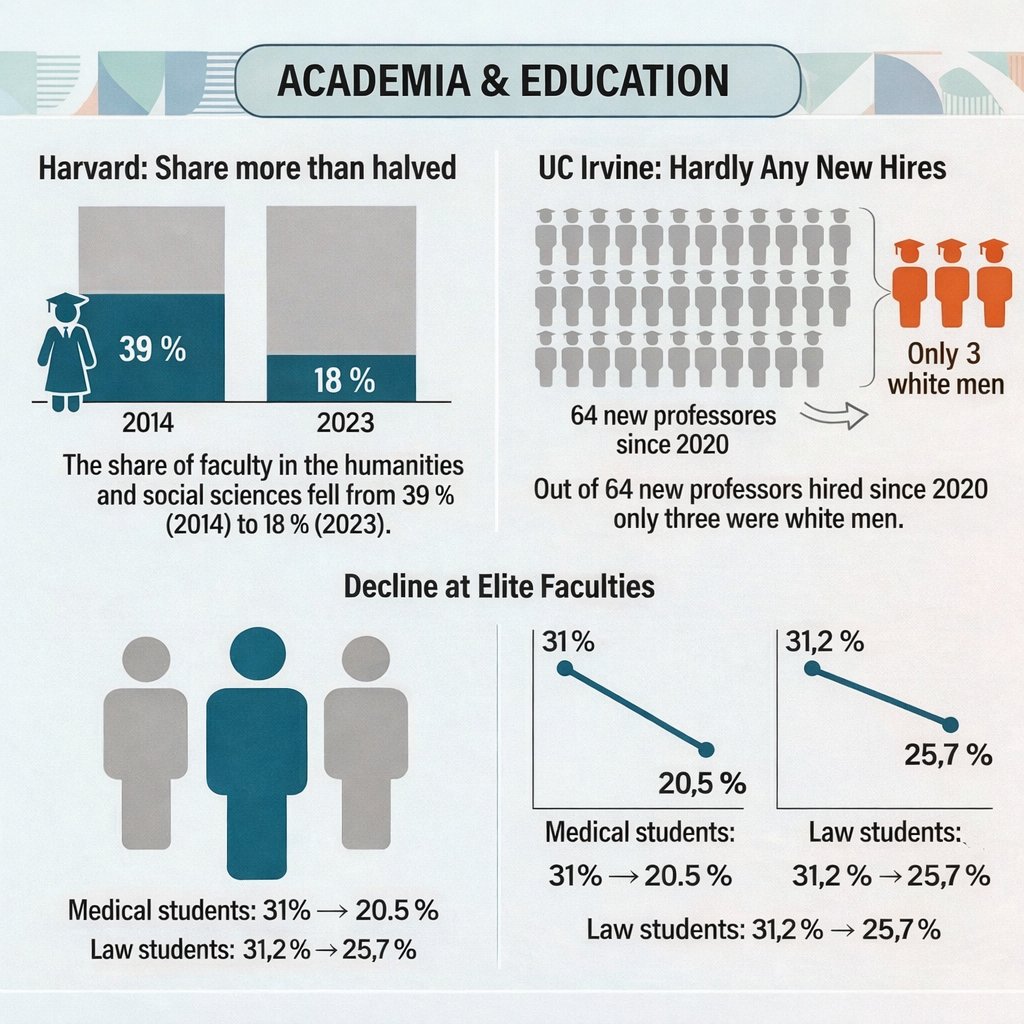
On the social media site formerly known as Twitter, John Carter responds to a post from Martin Sellner on the visible results of institutionalized “diversity”:

These are the consequences of anti-white policies!

“DEI” has robbed an entire white generation of their careers and thus the realization of their life plans.

The infographics show the impact of the “DEI” policies on a whole generation of white male millennials.

John Carter:

The young white men whose lives were derailed by this psychosis amount to millions of quiet personal tragedies — careers that didn’t launch, marriages that never happened, children who were never born.

But the civilizational fallout is even worse.

The diversity shoved into the places that should have gone to talented young white men has proven itself unequal to the task, to put it mildly. They weren’t smart enough to be mentored for the positions they occupied. As the boomers shuffle away into retirement, they’ll take their knowledge and skills with them — knowledge and skills that weren’t passed onto the diversity (which was incapable of learning it), but also weren’t passed on to talented young white men (who could have mastered it, but were prevented from doing so). Since the diversity is too dumb to master that material, it’s certainly too dumb to pass it on. The chain of knowledge transmission is broken.

Autodidacticism only goes so far. There’s only so much you can learn from books and YouTube videos. There’s ultimately no replacement for hands on professional training. Those talented young white men have gotten very good at podcasting, trading crypto, growing their presence in the attention economy … But by and large they haven’t been allowed to become doctors, lawyers, engineers, etc. Maybe that won’t matter in the end because of AI, but in the meantime, if you think the quality of everything has nosedived throughout the Cancelled Years, you really haven’t seen anything yet. The dwindling old guard of white male boomers is the only force keeping the lights on. When they leave, the real darkness closes in.

December 21, 2025

Women are walking away from the corporate world

Filed under: Business, Media, Politics, USA — Tags: , , , — Nicholas @ 05:00

On her Substack, Elizabeth Nickson starts her most recent post with the shocking headline that “400,000 women left the workforce this year”:

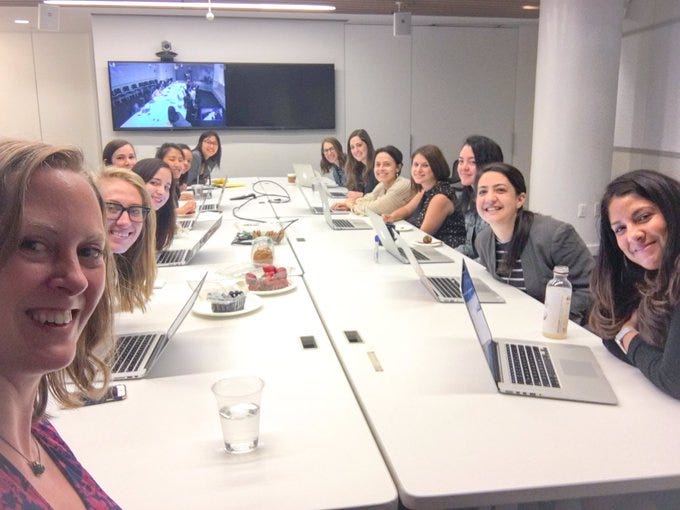
Digging into these reports, it seems the problem is that no one wants to mentor young women, as seniors traditionally have done for young men. No one seems to want to promote women as equally as they do men. Also women don’t want to “work as hard”. They aren’t “as ambitious” as men.

Also women do twice as much uncompensated labor as men, taking on the great majority of household chores, and, as well, are expected to organize the Christmas party. Not me, I might add — on a personal note. I cook. He does everything else.(editors note)

This means they are over-burdened and resentful and they are quitting. Four hundred thousand women left the workforce in 2025, putting down their tools and refusing to spend their lives working for “the man”.

The reports and accompanying “analyses” in the mainstream cry that government and corporations should do more! More of other people’s money chasing a fruitless dream that goes against human nature and sets sex against sex, turns family dynamics into a conflict zone, and takes away yet another chunk of private life to be traded on the market.

Quitting is the right choice.

    Rather than leaving a job they love, they are quitting for a better life. As one creator said, “Women, during the pandemic, got a sense of what it felt like to not be tied to a desk five days a week in an office. Women started to expand their dreams, expand what was inside of them, and they started to really tun into what was in their gut and in their heart. And a lot of that was ‘I don’t want to work for somebody else’s dreams. I want to spend more time with my kids, I want to spend more time in community, I want to launch a business, I wanna a robust side hustle. I want to be an author, I want to be a content creator.’ I’m excited to see what women build when they are untethered to a corporate job. For a lot of millennial women, it’s I’m going to do something better, I’m gonna do something different.”

This in fact, is enormously exciting to me. Because our towns and cities are bereft of female genius — which is not moving widgets around for McKinsey. Our main streets are mostly barren wastes of utility, and the only town center in most places is the parking lot of a big box store. Unless you live in a tourist town and then it’s commercial cosplaying of an earlier better time.

Charitable work is equally as utilitarian, and the assignment of care of the weak to government is brutal and failing. There are more homeless, more lost and broken people every single year. It’s as if the vast, resplendently-funded homeless bureaucracies think that filing quarterly and annual reports filled with noble-sounding “initiatives” is the same as actually solving the problem. I had one middle-class woman warrior in my house say that they were trying to get more hookers on the streets of good neighborhoods. These people are literally, insane.

Women individuating and returning to a private life indicates they are yearning after a more traditional and based occupation for women and I’m not talking about submission, early child bearing and a boss daddy. My pioneer family women, all ten thousand of them ran small businesses, a home farm, the general store, did bookkeeping, ran a workshop, and/or (usually and) some kind of business in town that was charitable, before that was taken over by corporatism and the ravenous maw of the public service who never saw an innovation they didn’t want to ruin by systematizing and ripping out the heart and purpose.

That and only that is the history of women in America, not this cobbled together whining, mewling, weak, oppressed, screeching, “stressed”, “exhausted”, victim. Women, from 1600-1950 had real problems to solve. They were fully adult.

The generations since tried corporate life. It sucked. And they’re not going back. I think this is a forerunner of the life pattern of women into the future. In fact, in millennial-world, one person with a W-2 job and one person with an entrepreneurial spirit is touted as how you game the system to perfection. Taxes are limited, security is up-levelled, and you can actually build something together, rather than both partners slaving away in the globalist maw.

I expect this to take flight almost immediately.

Because women in corporate life?

Nightmare.

This is what these reports are ignoring. Senior officers do not want to mentor or promote women because they are nightmares to work with. They have been trained by their universities and culture to be ideological freaks, demanding and whining and surreptitiously tearing each other down. There was a study done in the 80’s, before ideology took over social research, that found women in corporate life practiced Power Dead Even, which meant crabs in a bucket, baby. If someone was perceived as too powerful, tear them down.

Introduce that into corporate “culture” and nothing gets done. No wonder senior executives don’t mentor or promote women.

Update, 22 December: Welcome, Instapundit readers! Please do have a look around at some of my other posts you may find of interest. I send out a daily summary of posts here through my Substackhttps://substack.com/@nicholasrusson that you can subscribe to if you’d like to be informed of new posts in the future.

Boomers – A vampiric generation battening on the blood of the young

Filed under: Economics, History, Media, Politics, USA — Tags: , , , — Nicholas @ 03:00

As a member of the recently identified “Generation Jones”, I could take part in the widespread boomer hate with a clear conscience … but as Scott Alexander points out, the hate may be more than a little over-done:

“… Millennials and Generation Z have more money (adjusted for inflation ie cost-of-living, and compared at the same age) than their Boomer parents, to about the same degree that the Boomers exceeded their own parents. This is good and how it should be. The Boomers have successfully passed on a better life to their children”

There’s a more developed theory of Boomer-hating. The more developed theory goes: Boomers are plundering the young. We know this, because their share of resources is high and keeps increasing. They use their large population share and good voter turnout to vote themselves ever-higher pensions at the expense of working taxpayers.

How might we investigate this theory? We can’t use total social security spending, because the number of elderly has gone up. Can we use social security spending per elderly person? No; the amount of social security paid out depends on the amount paid in. If each year’s retirees earned more during their career than the previous year’s did (this is true), then each year’s will get a higher SSI payment, even if the system’s “generosity” stays the same.

We might start by looking at change in social security payment divided by change in median income. Over the past fifty years, average Social Security payment in inflation-adjusted dollars increased 60%. If we expect these payments to reflect earnings twenty years before disbursement, we can look at real median personal income from 1953 to 2003; this also increased 60%. There is no increase in generosity.

Or we can just look at the history. The Social Security Administration’s own website says that its generosity peaked in 1972, when the program primarily served the Greatest Generation; since then, it’s been one contraction after another. In 1983, the government increased the full retirement age from 65 to 67; in 1993, they made Social Security more taxable. Since then, most of the changes have been cost-of-living increases, which are indexed to inflation and not the result of active lobbying on old people’s behalf.

Why do so many believe that old people have discovered a vote-themselves-infinite-benefits hack? Since old people represent an increasing fraction of the population, are living longer, and face a secular trend of rising healthcare costs, even when their benefits per capita per year are stable or declining the government will spend more money on them as a group. This spending is indeed rapidly becoming unsustainable, the elderly will need to accept big benefit cuts to make it sustainable again, and they are resisting those cuts.

So have we finally discovered the fabled Boomer selfishness? Call it what you want. But remember that the Boomers did pay money into Social Security to support their own parents, believing that they would be supported in turn. Learning that yours is the generation where the pyramid collapses is a hard pill to swallow. Maybe they should suck it up and take the sacrifice. You’d do this, right? Voluntarily give up money which is yours by right, in order to help other generations? Oh, sorry, you didn’t hear the question, you were too busy writing your 500th “You don’t hate Boomers enough, why won’t they hurry up and die, we need to declare intergenerational warfare and seize our rightful inheritance” post.

Update, 22 December: Welcome, Instapundit readers! Please do have a look around at some of my other posts you may find of interest. I send out a daily summary of posts here through my Substackhttps://substack.com/@nicholasrusson that you can subscribe to if you’d like to be informed of new posts in the future.

Older Posts »

Powered by WordPress