Sara the Editor (that is, not Sarah Hoyt the SF author and Instapundit co-blogger) posted this on Substack Notes a couple of weeks ago before the Lindsay Clancy trial began, but it discusses some of the things that have become common topics of interest since then:

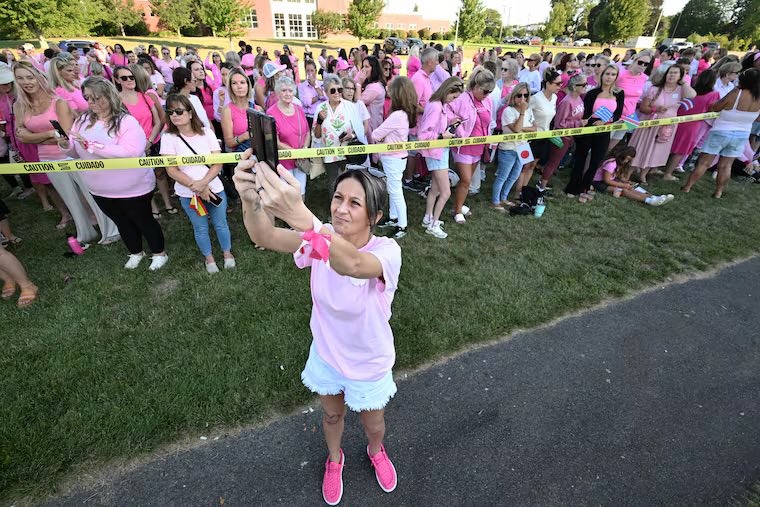
Pink-clad supporters of Lindsay Clancy
Photo from Aged Well
Women are weak, and that’s why they’re evil.
Women are never taught how to restrain their own power. This wasn’t bred into them, either. A woman never had to grapple with what every man faces at some time in his life: the realization that he can easily overpower and hurt a significant portion of the population, including women, children, and the elderly.
Men are taught not to do this wantonly, and if they do, we used to execute them. So we’ve been actively breeding it out of men.
Women are more valuable in terms of childbearing and bore little risk to society as long as men had the right to raise his own hand against a violent woman.
Women can only abuse children, old women, and crippled men. And they do, frequently, unless they fear repercussions for it.
Now women have political power. Now they have access to weapons that are small, light, and easy for a weakling to wield. They can now easily abuse men, and the men will sit there and take it, because they dare not defend themselves and are terrified of the woman-worshipping state police force, a mercenary army of cucks and degraded white knights.
Why would you expect a creature who never had to grapple with power to suddenly wield it with virtue?
You wouldn’t.
Every believable story where random people get superpowers gets one core thing right: the former weaklings are the most vengeful. They can’t wait to make the strong whimper at their feet.
This is literally every feminist ever. They say it out loud. They are razing the world with their newfound powers. Because women were never virtuous, just incapable of evil at scale.
Just look what they did when mass murder was put within female reach.
The oceans of infant blood that women have spilled in the last hundred years dwarfs every death caused by men in every war throughout all of recorded history. And yet feminists, they sit on that pile of tiny skulls lecturing men about how evil they are because they have more innate physical strength.
Do not fear the strong. Fear the ones who have become strong overnight.
They have all the spite and the will to spread their own misery.
More specifically dealing with the phenomena of women publicly proclaiming their support for a woman who deliberately murdered her own children:

This week was a pretty extreme wake-up call on the state of women online.
We learned that there are a shockingly large number of women who not only identify with a child murderer, but are ostentatiously, publicly performing that identification: posting videos of themselves sobbing while clutching infants, captioned “Same, Lindsay”.
They’re posting AI videos of Lindsay Clancy — a woman who sent her husband on an errand so that she could strangle their three children to death — receiving the warm embrace of the Sisterhood. Some are even running the “no uterus, no opinion” playbook but for actual infanticide. (I will not post examples, they’re easy to find.)
Clearly, this is not a feeling about which they are furtive or ashamed. It is baffling to imagine them setting up their camera so that they can publicly “break down”, Just Like Lindsay, to an audience of millions.
[…]
What these women are thinking is: “being a mom is Seriously Super Hard, and I am being Super Brave, look how Brave I’m being.”
That’s really all it is. The best defense you can make of this behavior is that it is sincerely, completely superficial and self-involved.
A social media hysteria has given them moral and social permission to complain in maximally dramatic terms, and to participate in a chorus of mutual validation.
There’s an echo in the “I choose the bear” discourse from a few months back.
Millions of women claimed that they would rather be alone in a room with a bear than alone with a man — and men responded with shock, in the mistaken belief that women were saying that they would actually literally rather be alone in a room with a bear.
This was not helped by the fact that many women, in the interest of making their point more vividly, said, “You’re not hearing me — I literally actually would rather be alone in a room with a literal bear and I’m not kidding”.
These women mean what they say, but not in the way that you mean things when you say them.
One of the emotional engines of this controversy is the perception that Lindsay Clancy was “crying out for help” and was “failed by the system” — that she wasn’t Heard or Taken Seriously.
But of course, her situation was being taken as seriously as such a situation could possibly be taken. There was a small army of doctors and therapists (and her husband, and a nanny) actively monitoring her.
If she had expressed a desire or plan to kill her children, they would have been immediately removed from her custody — but she didn’t.
The reason psychiatrists don’t institutionalize people or snatch their children when they report feeling depressed — or even when they report having certain categories of scary thoughts — is that they want people to speak up when they’re having trouble.
The only intervention that would have stopped this is for someone to suspend her parental rights or institutionalize her, with no judicable evidence (across a battery of clinical encounters) that she intended to harm her kids.
Obviously, these thousands of women are not actually suggesting that they are literally, actively experiencing what Lindsay Clancy experienced, or actually demanding the only intervention that would have made any sense (to have their children confiscated by the state.)
Maybe it’s waste of time to spell out that these demands have no practical content, but whatever: they have no practical content. Women are Using Language Differently. They want to Feel Heard. It’s Not About the Nail.
On her Substack, Janice Fiamengo helpfully points out that western cultures have always had a more lenient view of female murderers of their own children:
Do any of these advocates care about the principles of justice? Do they believe in equality before the law? Are they concerned with the possibility that a not guilty verdict in Clancy’s trial will encourage other unhappy mothers to kill their children? (Mothers are already, according to U.S. government data, the most frequent perpetrators of child homicide, see p. 65).
It seems not. The primary impulse is to see Lindsay Clancy and, by extension, all unhappy mothers as the true victims now and forever, never to be held responsible for any bad act, deserving of boundless sympathy.
Perhaps there has never been a case that illustrated women’s incoherent morality so clearly.
But it is not, alas, a new thing, and men in the west have tolerated and furthered it for centuries. In his 1913 book The Fraud of Feminism, British barrister Ernest Belfort Bax described, with his characteristic wit, how the female criminal is “surrounded by a halo of injured innocence”, “convinced of the maliciousness of her accusers” and of her own lack of responsibility (89-90).
Bax showed that nineteenth-century criminal law had great difficulty conceiving of and punishing female violence. Where there was any doubt as to a woman’s guilt, juries were reluctant to convict; and even where there was no reasonable doubt, they were eager to find mitigating circumstances such as temporary insanity, victimhood, or male coercion to justify leniency.
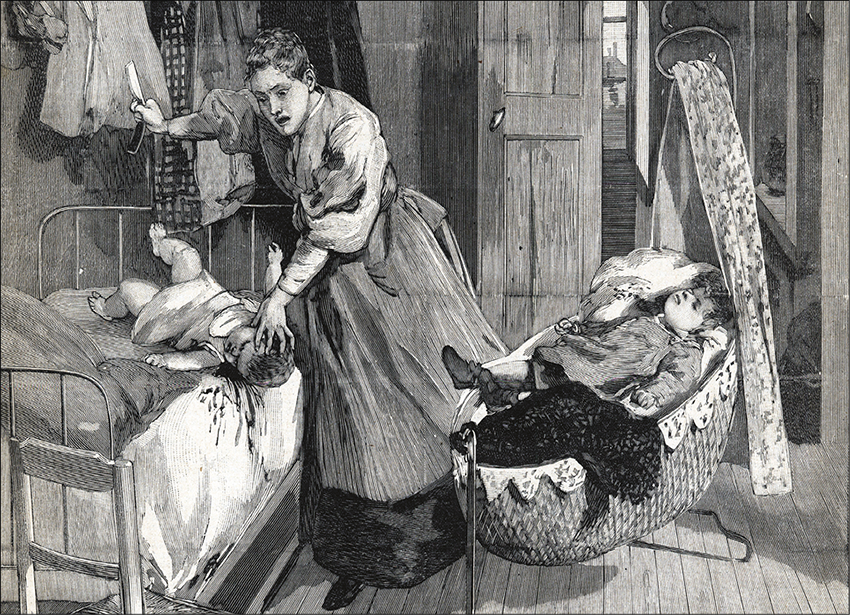
A now-famous Philadelphia case involved a mother, Harriet Vaughn (variously spelled Vaughan), who had murdered her newborn baby within hours of its birth in 1868, and was championed by her feminist supporters as a wronged innocent. The severely beaten dead baby, which Vaughn had attempted to conceal under her bed after crushing its skull with a blunt instrument, was hardly mourned at all (for a full account, see Sarah Barringer Gordon, “Law and Everyday Death: Infanticide and the Backlash against Woman’s Rights after the Civil War” in Lives in the Law).
Although Vaughn was convicted of murder and sentenced to death by hanging — a highly unusual sentence in that no woman had been hanged in Philadelphia since 1737 — her plight almost immediately became a cause célèbre, with advocates rallying to her defence. Elizabeth Cady Stanton, leader of the American feminist movement, spent months agitating on Vaughn’s behalf. In the pages of The Revolution, the feminist newspaper she ran with her associate Susan B. Anthony, Stanton portrayed Vaughn as a sexually-abused maiden, and a loving but desperate mother forced to kill her child because she had no other options. She described her as “a poor, ignorant, friendless and forlorn girl who had killed her new-born child because she knew not what else to do with it” (Stanton, “Infanticide”, The Selected Papers of Elizabeth Cady Stanton and Susan B. Anthony, p. 158).
None of this was founded in fact — Vaughn herself did not claim she had been raped and there were many institutions for foundlings in Philadelphia where she might have left her baby — but it was a familiar sentimental narrative guaranteed to stir indignation against the sentence.
Members of the Working Women’s Association of Philadelphia held a mass rally on Vaughn’s behalf, visited Vaughn in prison, and petitioned the Pennsylvania Governor for her pardon, which was granted in May of 1869. Released from prison, Vaughn left Philadelphia for her birthplace of England and was heard from only once more, when she wrote some months later to request the $300 that she had heard feminists had raised for her.
Sympathy for infanticidal, especially unwed, mothers was widespread in nineteenth-century English-speaking countries, where the killing of babies was “an unsavoury but surprisingly common feature of life” (Constance Backhouse, Petticoats and Prejudice, p. 113). Law Professor Sarah Gordon reports that “In 19th century Philadelphia, thousands of dead newborns were found in alleys, ash heaps, privies, rivers, and so on”. Professor of History Ann R. Higginbotham gives examples from 19th century London to show that “juries were extraordinarily reluctant to convict women accused of murdering their illegitimate infants”, often out of sympathy for the women’s difficult circumstances (Sin of the Age: Infanticide and Illegitimacy in Victorian London, p. 329).