
[Jane:] A few months ago I had what I thought was a revelation: all those people who were spending their evenings and weekends shuttling their children to sports practices and games, dance classes and riding lessons and swim meets, must really like this stuff. They must think it was fun and enjoy sharing their passion with their children! It had to be like when I garden or bake with my kids, or read them books I love, or tell them about the proto-Indo-European voice system! (Don’t laugh, it’s important context for Latin deponents.) So the next time a mom I know was complaining about getting her kids out the door for flag football practice, conveniently scheduled for (1) rush hour and (2) dinnertime, I smiled and asked, “Are you guys big football fans generally?” I was all set to inquire about their family’s favorite team, the differences between college and professional ball, how different flag football is from tackle and whether they intended to make the switch when her boys were older — but she grimaced and shook her head. No, she said, not really. They watched the Super Bowl but that was about it. “Ah,” I nodded sagely. “But the kids are into it?” (Lord knows I’ve indulged my children’s enthusiasm for things I don’t care about.) No, she said, not particularly. But they needed a sport for the fall.
I didn’t ask why. I wish I had, because I’m sincerely curious — these were busy, active kids, actually in the process of racing around the playground with their buddies while the adults chatted, so it’s not as though they needed organized sports to keep them from merging with the couch cushions — but at the time it seemed rude and pushy so I changed the subject. Now, obviously not everyone is like this mom: some people, including Tim Carney, really do love sports and delight in sharing that love. But the truth is, people are obsessed with signing their kids up for stuff. Carney calls it the Travel Team Trap, and it’s probably most evident in youth sports culture, but it shows up everywhere. Your kid likes to write? Find a creative writing class! Having fun with chess? Quick, hire a tutor! My local rec center even offers courses in Dungeons & Dragons, taught by a real live professional nerd, because apparently eating Doritos in your mom’s basement while your friends mock you for touching the Sphere of Annihilation isn’t good enough any more.
And it’s a vicious cycle, because all these official activities crowd out informal play. If the artsy kids in your neighborhood are taking a musical theater class half an hour away, there’s no one to join your kids in pulling out the dress-ups and staging a drama of their own. If everyone is off at soccer practice, you can’t meet up at the park to kick the ball around. Sorry, Zerubbabel can’t come over and play Legos this week, he’s got his STEM Makers class on Wednesday and then Thursday afternoon is junior robotics team … Soon even the families who want a more relaxed, unprogrammed life are signing their kids up for things because it’s the only way they’ll ever see their friends.
There’s nothing wrong with formal instruction in its place, especially for things where technique really matters: the world needs basketball coaches and piano teachers, too. And sometimes it’s just fun! A big stage with lights and music and real costumes scratches an itch that Mom’s old prom dress and a dinosaur mask (“Velociraptorella”, currently in previews off-off-off-Broadway) just can’t touch. But when we regard these things as potentially interesting and entertaining, rather than absolutely vital to our children’s well-being, we can make sane tradeoffs about them. A day-trip to the awesome museum in a neighboring city is also potentially interesting and entertaining, but nobody thinks you’re a bad mom if you spend the weekend doing something else.
And what’s more, the push for legible achievement over experience, without regard for what’s good for your family — or even, apparently, whether your kids like it — robs them of the opportunity to motivate and direct their own lives. Basketball practice three times a week surely does more for your jump shot than a pickup game at the local park, but in the long term the ability to take ownership of your time, make and keep plans with your friends, sort out interpersonal disagreements, etc. are going to be a lot more useful. (And, sorry, I’m still stuck on this D&D thing: the threat of your friends losing interest and wandering off to play foosball instead is a much greater incentive to become a good DM than anything you could learn in a class.)
But it’s not actually surprising that people parent like this, because it’s how they grew up: today’s moms and dads are yesterday’s Organization Kids.1 Their image of the good life is tallying up achievement points on some great celestial board. And no wonder they’re desperate to tally up points for their kids, too: they think their futures depend on it! In fact, every time I bring this up, someone tells me that Harvard is full of kids whose parents drove themselves crazy coordinating travel sports schedules and private school dropoffs and chess tutors — all of which is true, and some of which is probably even causal. (Nobody appreciates achievement points tallied up on a great celestial board like a college admissions office.) But a lot of it is also because that’s how smart, conscientious, upper-middle-class parents are expected to raise their kids, and the best way to get into Harvard is to be the offspring of smart, conscientious, upper-middle-class people. (It also helps if they’re neither white nor Asian.)
Jane and John Psmith, “JOINT REVIEW: Family Unfriendly, by Timothy P. Carney”, Mr. and Mrs. Psmith’s Bookshelf, 2024-10-14.
- I hadn’t reread the article since I was in college, but revisiting it now it’s an amazing artifact. “No one is political, no one protests.” Things change!
September 22, 2026
QotD: Organized activities for children versus informal play
July 9, 2026
Here’s why “free range children” went away
As a child in England and then in Canada, I had a pretty wide range for unsupervised activities and I generally took advantage of that. On foot or riding my bicycle, it was completely normal for me to be several miles from home on any given day. I’ve posted this image a few times, showing the “free range” diminishing generation by generation for an English family, and it’s mostly true here in Canada and in the United States as well:

Graphic showing the diminishing “free ranges” of each generation of an English family.
At Classical Ideals, Megha Lillywhite discusses the “political extremism” involved today in trying to raise your children:
One of the most fundamental things that children require in order to grow up healthy, strong, wise and good, is a lot of time outdoors and in public spaces. Yet what we see from more traditional families in the west, as well as from extremely wealthy families, is that they are holding their children closer than ever, and enclosing them in increasingly smaller and more carefully selected bubbles of protection.
This is because “the outdoors” and “public life” is territory that has increasingly been ceded by western society to violent criminals, the mentally ill, and drug addicts. Parenting, for those who are vigilant to the threats, can no longer be “laissez-faire” and it has become less about choosing the ideal, and more about choosing the least damaging option.
But what has been lost? And what must be reclaimed for those of us with power and spirit to have any kind of meaningful victory in this world?
Most leftists see politics through the framework of wanting to be “a good person” as it is defined by their peer group and ideology. The ordinary person, on the other hand, views politics through the set of decisions that would best protect their children and give them the best chance at a good life.
Why is this? Leftists either don’t have children, or they have children but live in gilded cages and are therefore untouched (yet) by the consequences of their ideological beliefs.
Children must exist as part of a broader community in order to develop healthily. They must be able to go to a public library, the local shop, ride their bikes to the park, take the city bus or walk to their grandmother’s house on their own. They must be able to play outside unsupervised for hours on end in their neighbourhoods.
[…]
But some measure of freedom is also necessary for children to develop a healthy psyche. A child who can go to the shop and pay for milk on his own and bring it home will develop not only a sense of responsibility, but will feel confident in his ability to do useful things. A child who can visit his friends and relatives on his own will develop social skills and a sense of belonging. A child who can go to the library on his own can begin the lifelong journey of guiding his own learning.
[…]
In a 2007 study done in Sheffield, UK by Dr. William Bird, he found that children in 1926 were allowed to roam up to six miles away from home unsupervised and by 2000, that number dropped to 300 metres. The major drop off happened around 1979 which is coincidentally the time when mass migration began in the United Kingdom and demographics of towns like Sheffield began to seriously shift. In the recent “Rape Gang Inquiry” released by the Restore Party of Britain, the report which details three decades of kidnap, rape and murder of a quarter of a million British girls which would have began around this time. So English parents restricting their children’s freedoms around this time period was not something hysterical or unfounded.
We must be politically courageous in order to admit what is required to maintain that kind of a world. Stated simply, a safe, healthy and good childhood requires a fundamental rejection of leftist “empathy” politics. There is one incident in particular that can help to describe how this system functions today.
Link from John Carter on Substack Notes, who commented:
The same shift towards a confined, highly monitored childhood took place in the US, corresponding to the great suburbanization. The suburbs grew due to white flight from the cities, following their colonization by blacks and the de facto ban on community defence enforced by the civil rights act.
Suburban municipal architecture is largely comprised of informal defensive barriers that prevent undesirable elements from penetrating the neighborhoods undetected.
This enables middle class parents to deniably insulate their children from the worst consequences of diversity, but at the cost of raising their children in open air prisons, in a stifling social atmosphere characterized primarily by a brittle insistence upon euphemistic avoidance of direct acknowledgement of the real issues. “Racism is simply terrible! We just wanted to live somewhere with good schools.”
Children brought up amidst the tedious fakery of the suburbs naturally become attuned to the pervasive hypocrisy of suburban white culture. They have to: simply navigating this culture requires the ability to understand the unsaid, while pretending that one has not understood it. Combined with the open air prison environment inhibiting emotional development, this is a powerful recipe for induced neurosis.
There are only a few possible outcomes: 1) they become cowardly hypocrites themselves; 2) they reject the hypocrisy and become fanatical anti-white race communists; 3) they reject the hypocrisy and become fascists.
June 23, 2026
Modern children as human hothouse plants, needing constant care and protection
At Becoming Noble, Johann Kurtz discusses how parents today treat their children in ways they largely never experienced, failing to provide them with enough freedom to allow them to develop personal autonomy as most western children have done for generations:
Giving children the freedom they need to develop agency is now a luxury good. The number of neighborhoods in which it is normal for children to leave the house and roam all day has collapsed. This collapse has come for a variety of reasons relating to security, trust, law, norms, and infrastructure.
Allowing children the privilege of freedom depends on conditions that most families no longer have access to: safe streets — yes — but also neighbors who are known and trusted, and a settled local agreement about what children are and what they are for. These conditions have not vanished, but they have concentrated, and are now a guarded secret, found only in private, privileged, and intentional communities.
This is a curious inversion of an older pattern. For most of history the peasant’s son had the run of the village while the noble’s son was kept under tutors. Now it is the wealthy child who is sent out to enjoy the freedom and adventure of camps and screenless schools, while working and underclass children are kept indoors and screened up.
Photo from Becoming Noble
It is worth being clear about the factors which underlie this transition. Otherwise, parents seeking the nostalgic “free roaming” experience are directed to explanations which are emphasized because they are unproblematic and suggest that a broad solution is available if we just move policy in a sensible direction. This includes discussions of “walkable development” and a rejection of “helicopter parenting”.
This polite framing avoids the reality that the prudent decisions available to parents are mostly made for them by the place they can afford to live, the people they live among, and how radical they are willing to be.
Children develop “agency” — the self-belief that they can independently and effectively manipulate and shape the world in creative ways — through constant experimentation and positive reinforcement.
The “independent” aspect of this formula involves developing internal psychological permission to break from prosaic norms and routines. Developing this is helped by play outside the control of authorities and interacting with the real world in settings unmediated by parents.
The closed systems that now fill children’s hours provide some feeling of agency (open world games, sprawling social media platforms, private chat rooms) without its substance. A child scrolling or playing through the programmatic logic of games is making choices, but they are only the choices that limited systems can accommodate.
Closed-system childhoods teach that there are inviolable hidden structures underneath reality and that the smoothest and most rewarding experiences are to be found when you conform with them. Experiences from boxes teach you to think within boxes. And the vice available online can be as controlling as any parent.
A few years ago, I linked to an article that graphically illustrated how the generations of an English family near Sheffield had experienced continuously diminished “range” for the children to explore:
Graphic showing the diminishing “free ranges” of each generation of an English family.
June 7, 2026
Are “Dad books” in trouble?
In the latest SHuSH newsletter, Ken Whyte views with (mild) alarm a recent Wall Street Journal article claiming that “Dad books” — the kind of books thoughtful kids give their fathers as gifts — are in steep decline:
The Wall Street Journal ran a piece last month on the death of Dad books, the Father’s Day specials — books about “some little-known chapter of World War II, the sweeping narrative of a shipwreck, perhaps the latest presidential biography”.
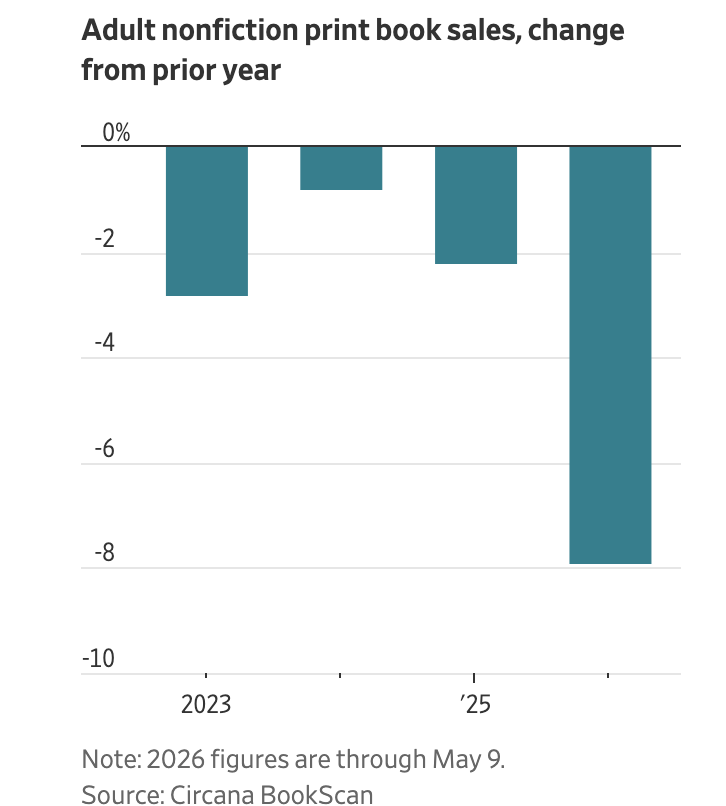
Here’s what it gave for evidence. Nonfiction book sales have declined for four years, including an 8 percent drop this year up to May 9.
Sales of Books about politics and current affairs are down 19 percent in those same four months and nine days in 2026. The article quotes, among others, former Simon & Schuster publisher Jonathan Karp saying that “this is a sea change and people should wake up and realize we’re living in a new world”.
The new world is one with “an endless supply of Substack newsletters, Netflix documentaries, YouTube videos and podcasts that offer the kind of fresh reporting, sharp analysis and historical perspective once limited doorstop-size books”.
Jonathan Burnham of Harper Group adds that all these alternatives to books make “the idea of sitting down with a 700-page Ron Chernow book less appealing. You’ve scratched that itch.”
The WSJ noted that Chernow’s recent biography of Mark Twain, published last spring, is underperforming his 2017 biography of Ulysses S. Grant.
There was an obligatory quote from Barnes & Noble CEO James Daunt, who attributed the decline in serious nonfiction sales to the fact that everyday events are all-consuming: “The world is exceptionally interesting right now and when that happens the nonfiction reader is reading the news instead.”
As someone who publishes a lot of Dad books, i.e., serious researched nonfiction, histories and biographies, that sort of thing, I read the article with concern. In fact, I read it twice.
I felt much better after the second reading.
Let’s start with the chart. The first four months and 9 days of 2026 are doing all the work here. A decline of 1 to 2 percent in the years 2023 to 2025 is statistical noise. Circana BookScan numbers don’t include audiobooks, which have been rising steadily in popularity. The very slight decline in sales for the first three years might be entirely attributable to format shifting, hardcopy to digital audio. The 8 percent decline in the first four months of 2026 looks more ominous, but book sales figures are always lumpy, never a straight line. A four-month sample tells you nothing.
The greater problem with the chart is that it is counting adult nonfiction book sales, not Dad books. There are any number of ways to cut Circana BookScan data, but the broad adult nonfiction category contains a vast array of books. Books for men, books for women, books for everybody. Not only serious researched nonfiction, but self-help, how-to, study guides, business and personal finance, psychology and religion books, health and fitness books, parenting books, food and travel books, true crime, sports, military, essays, crafts and hobbies, memoirs, etc. There is no data cut for Dad books. So the story is backing its thesis for the death of apples with stats about oranges.
The report of a 19 percent drop in the narrower category of politics and current affairs also looks ominous, but this is one of the most notoriously cyclical genres in existence. And, again, we’re discussing a short period of four months and nine days. The new Trump era was less than a year old at the start of that period. It generally takes longer than a year to get new books from commission to sale. Ten days after the end of the period under discussion, Andrew Weissmann released Liar’s Kingdom: How to Stop Trump’s Deceit and Save America. It was an instant number-one New York Times bestseller. In so specialized a category as this, Liar’s Kingdom alone might have been sufficient to right the ship.
The only other evidence presented to support the decline in Dad books is poor Ron Chernow’s journey. His Mark Twain, with 119,259 hardcover sales, is underperforming his Ulysses S. Grant, with 381,604 sales.
I don’t know where to start. The Grant book has been out for almost a decade, Twain for a year. Not surprising that it has sold less. Also, you can’t compare major political biographies to major cultural biographies. David McCullough’s biographies of Truman and Adams far outsold his book about American artists and writers in Paris. And while I’m a fan of Chernow, his Twain book isn’t his best work. He received polite and generally positive reviews, but they noted that the book is overly long — the word “exhaustive” surfaces repeatedly — and that he doesn’t entirely succeed in bringing Twain to life. Grant is a superior book, and the more enjoyable read, too, if customer reviews are anything to go by. The Twain sales prove nothing.
So we don’t really have any evidence at all that Dad books are in trouble, that they’re getting swamped by podcasts or current events, and certainly not that there’s been “a sea change” and that we’re living “in a new world”.
Amusingly, the literary world was flooded with hot new Dad books coincident with the WSJ‘s declaration of their death.
May 26, 2026
Canadian parents are increasingly adopting the “helicopter” or “bulldozer” model
Eva Chipiuk on concerning trends in Canadian parenting styles and the long-term impact on children:
Not many people have really turned their minds to the psychology of Canadians. Most are too busy reacting to the latest outrage, headline, or political controversy.
However, David Redman has cautioned about what he has identified as a trend in Canada: “helicopter” and “bulldozer” parenting, where children are either constantly hovered over or where every obstacle is removed before they ever have to face it themselves.
Over time, that kind of environment can produce people who become uncomfortable with uncertainty, overly dependent on authority, fearful of risk, and hesitant to think independently or challenge difficult ideas. As this article put it:
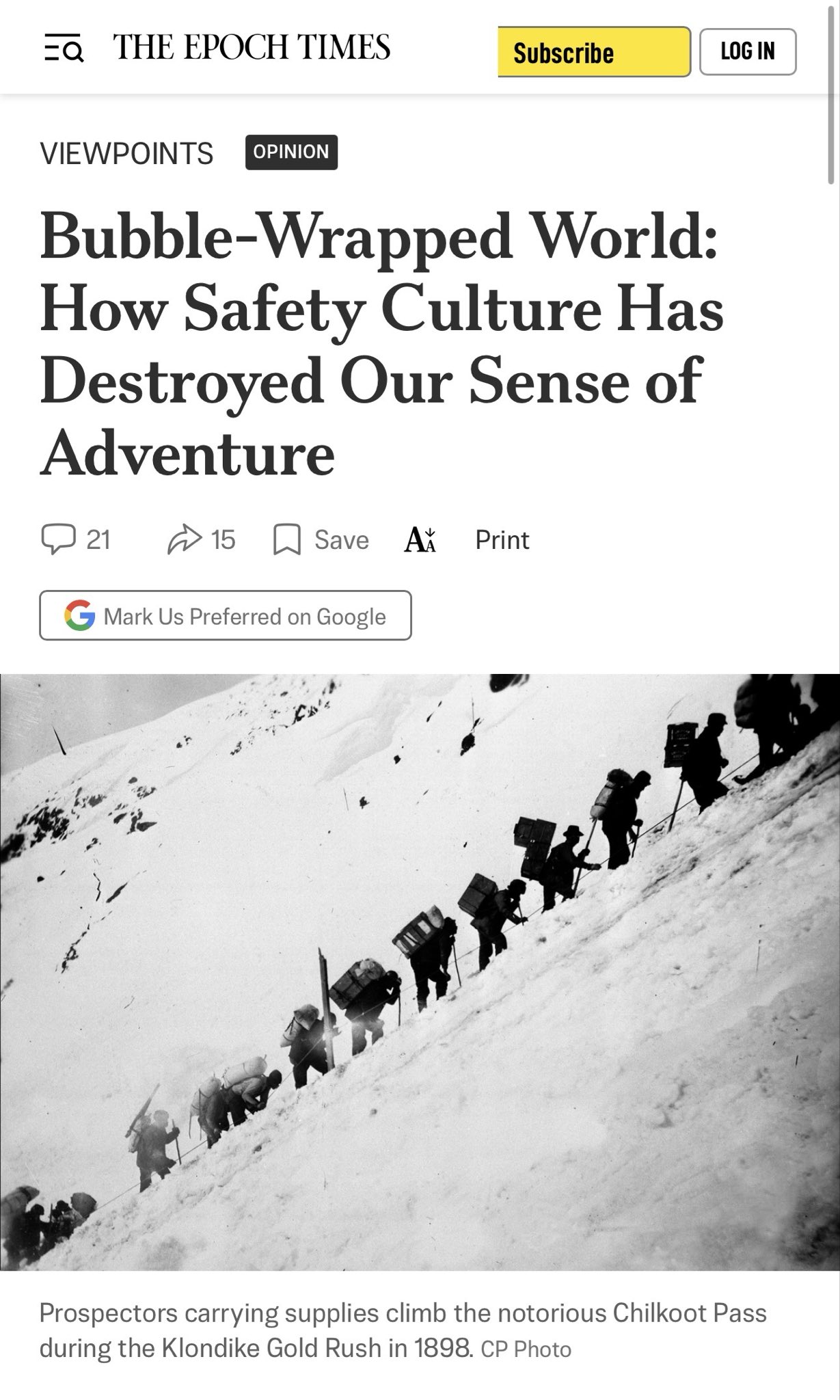
Children, the authors observed, are now deliberately shielded from any sense of risk or uncertainty. How can anyone — young boys most of all — learn about the world around them when school principals announce at the onset of every snowfall that “all snow must stay on the ground”. The ideal of adventure and resilience has been replaced by a debilitating sense of fragility and risk-avoidance …
Adventure should properly be considered a spirit, not a place. It is driven by a powerful mixture of curiosity, necessity, and an openness to experiencing new things. And it can be found wherever uncertainty reigns. Today, that might entail travelling to strange lands, meeting new people, or even engaging in uncomfortable discussions about whether Alberta should remain part of Canada forever.
Wherever the unknown lies, adventure can be found.
That mindset does not just affect childhood. It shapes entire societies. It affects how citizens respond to disagreement, political debate, uncertainty, criticism, and even new ideas.
Somewhere along the way, many Canadians lost their sense of adventure, resilience, curiosity, and willingness to engage with uncomfortable conversations or difficult questions.
Where did that spirit go? What happened to the mindset that encouraged people to explore, question authority, take risks, debate ideas openly, and build something better even when the outcome was uncertain? Somewhere along the way, discomfort itself seems to have become something to avoid rather than something people grow through.
Because if we stop exploring, questioning, debating, and taking risks, we lose something essential about what it means to live freely and think independently. A society that becomes afraid of uncertainty eventually becomes dependent on being told what is safe, acceptable, and permitted.
If we are going to move forward in any meaningful way, we need to rediscover the spirit of curiosity, resilience, and adventure that pushes people to test ideas, challenge assumptions, and engage with the unknown instead of fearing it.
Perhaps one of the most important conversations we should be having is this: what does it actually mean to be Canadian today?
Because for many, it increasingly feels like the answer is becoming less about courage, resilience, curiosity, and self-determination, and more about compliance, comfort, and avoiding difficult conversations.
April 16, 2026
Never say that teachers have no influence
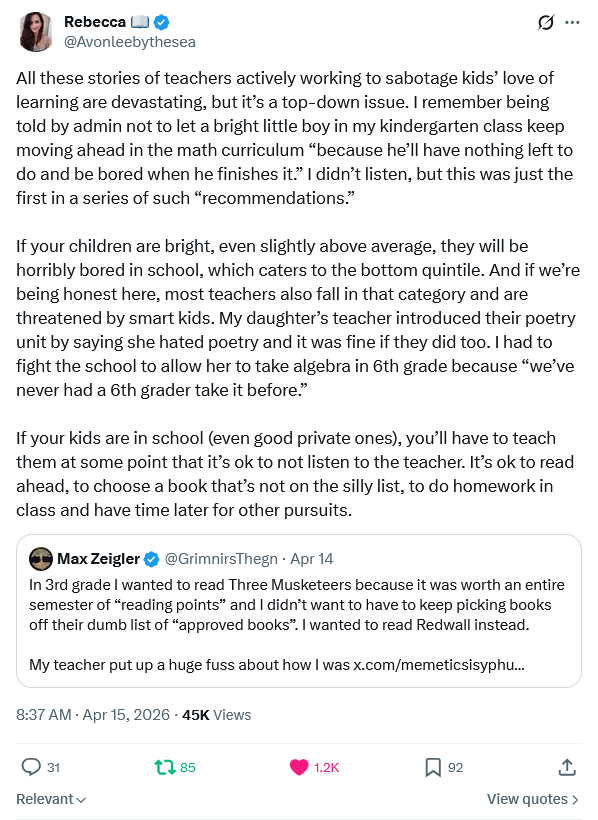
Of course, that influence isn’t always benign:
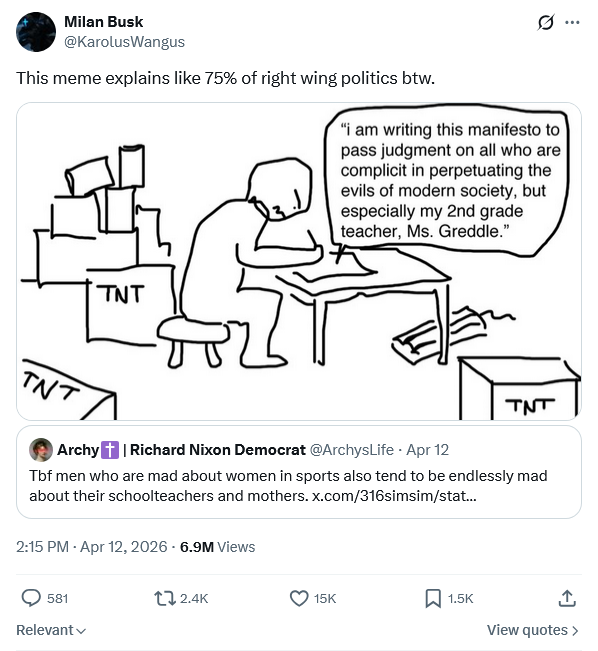
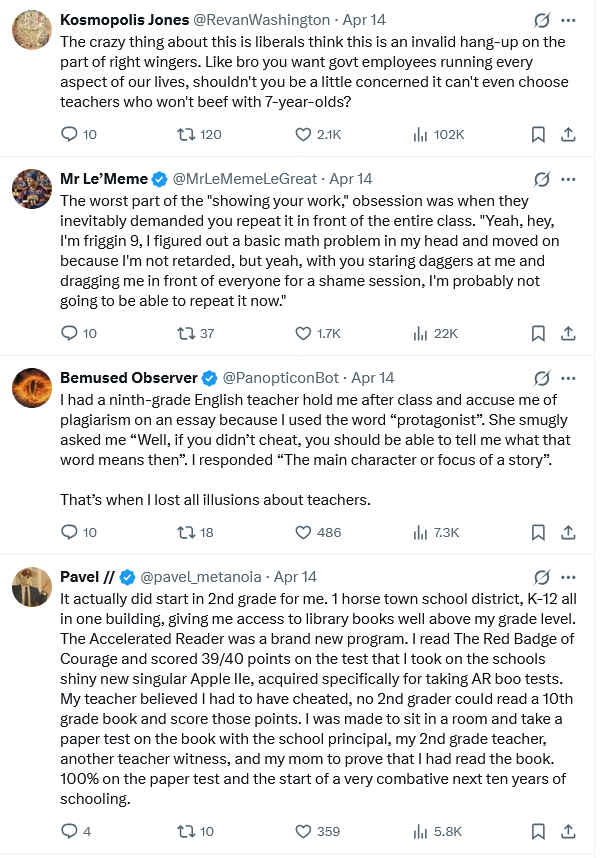
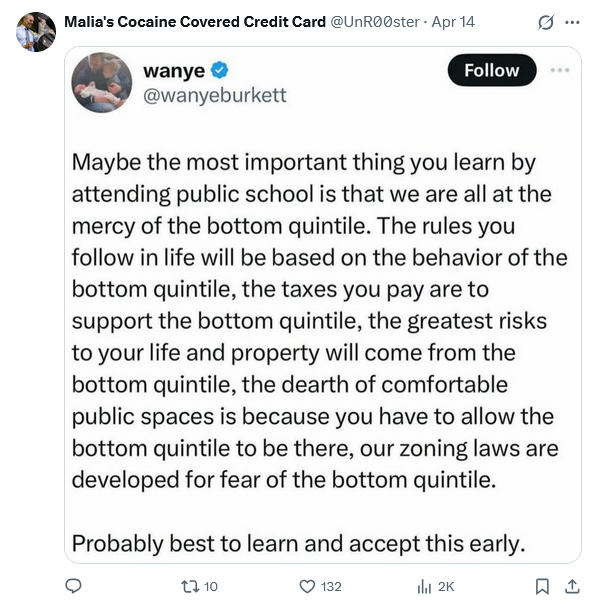
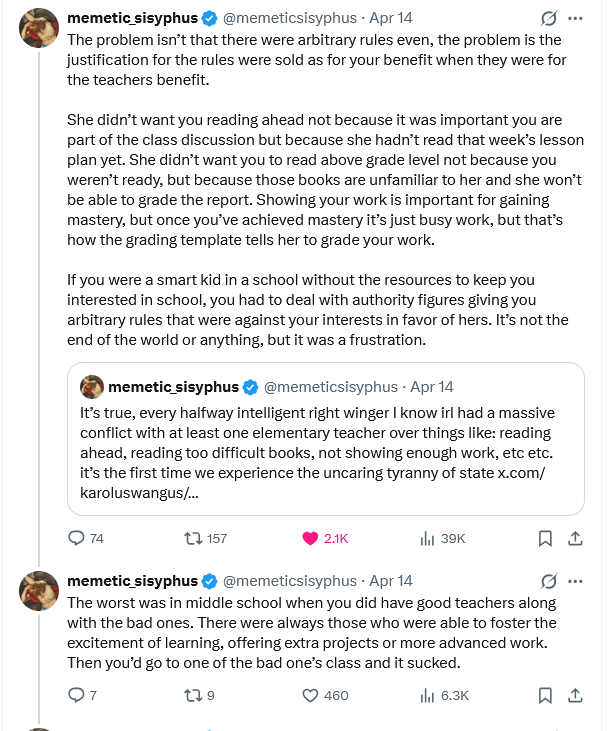
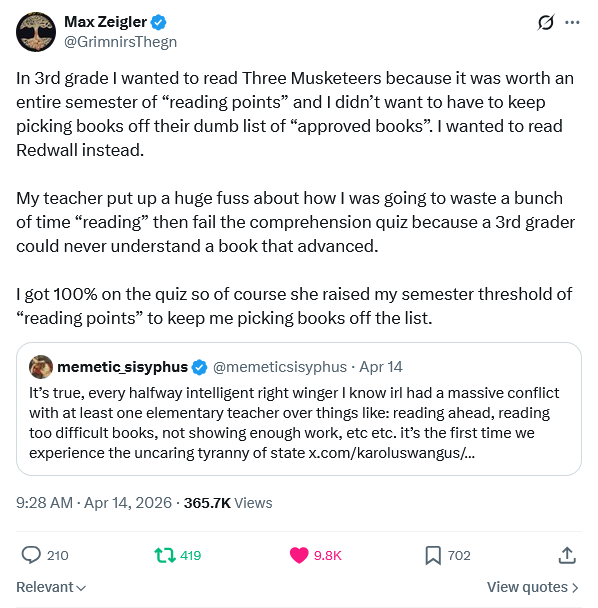
It’s true, every halfway intelligent right winger I know irl had a massive conflict with at least one elementary teacher over things like: reading ahead, reading too difficult books, not showing enough work, etc etc. it’s the first time we experience the uncaring tyranny of state bureaucracy and it sucks.
April 1, 2026
“Facilitated Communication (FC) is a discredited technique that should not be used”
Perhaps it’s just me, but I read Freddie deBoer‘s refutation of Facilitated Communication with a kind of rising horror, that a parent or trusted adult could so take advantage of a disabled person to commit this kind of fraud:
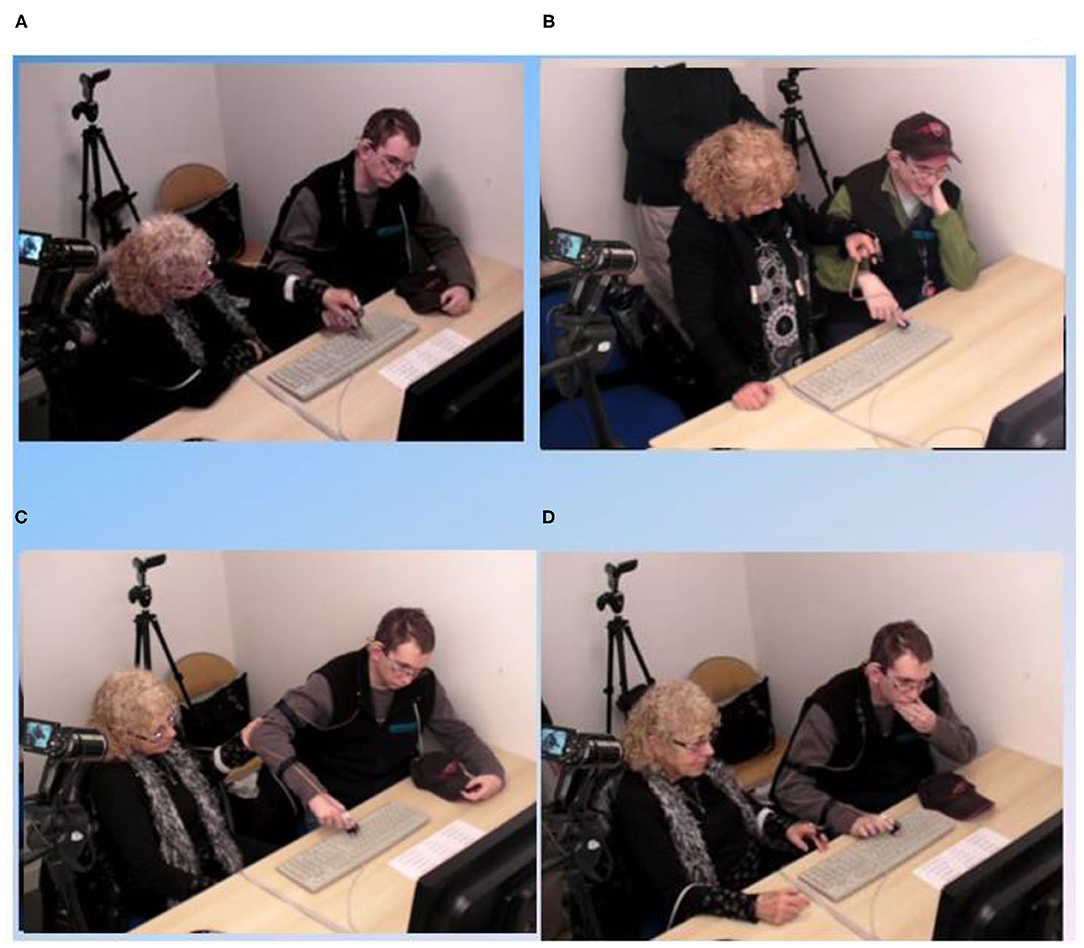
“Facilitated Communication” by Faure P, Legou T and Gepner B is licensed under CC BY-SA 4.0 

 .
.
Stop me if you’ve heard this one before: The New York Times has again casually endorsed facilitated communication, or FC, a relentlessly-discredited practice that plays on the desperation and credulousness of parents of severely disabled children. As in the past, they’ve done this while barely seeming to understand that they’re doing something controversial at all. The culprit this time is a review of the new novel Upward Bound “by” Woody Brown, a man with severe autism who has been nonverbal his entire life and dictated his book through FC, which is also the means through which he earned a masters degree and other remarkable feats. Brown, like so many others who have been “saved” through FC, was found to have all manner of remarkable intellectual abilities once someone else was “facilitating” his communication.
The review describes Brown “tapping letters on a board” while his mother interprets and voices the words. That is the textbook structure of FC: a disabled person who cannot otherwise communicate produces output while a facilitator mediates, guides, or stabilizes the process. Or so proponents claim. Without the facilitator, the disabled person is mute; with their guidance, they suddenly become remarkably verbally proficient, often learned and verbose. If you’re new to the FC debate, you should trust your skepticism: the fact that the mother has to be present and participating, the fact that Brown cannot manipulate the board without the mother’s involvement, the fact that he has never been subject to rigorous research that involves “message-passing” or “double-blind” tests … This is the inconvenient, damning reality.
Message passing, or double-blind, tests are simple and remarkably effective. Information is provided to both the disabled person and the facilitator, often in the form of pictures or individual words, with both the facilitator and the test subject receiving the same information some times and discordant information other times. That is to say, the disabled person and the facilitator will sometimes both be shown a star or a watermelon or a flower or a bird, while at other times one might get the star picture while the other gets the bird, etc. If the disabled person genuinely crafts their responses, this should be a trivially easy test to pass: the facilitated communication will produce the information that the disabled subject received. And yet very close to literally 100% of the time in rigorous research, across dozens of studies with thousands of combined attempts, interactions produce the information the facilitator received and not the information the disabled person received. Surveying the literature, the consistency of this finding is remarkable — and there is no coherent explanation for how this could happen if indeed FC results in messages being sent from a conscious and alert test subject. Instead, these findings are perfectly consistent with Occam’s razor and the assumption that the facilitator is the one speaking.
Thanks to this overwhelming body of research literature, professional societies have tended to be unusually blunt about FC. The American Speech-Language-Hearing Association, the leading professional body in this field, states unequivocally: “Facilitated Communication (FC) is a discredited technique that should not be used”. It continues: “There is no scientific evidence of the validity of FC, and there is extensive scientific evidence … that messages are authored by the ‘facilitator’ rather than the person with a disability”. This is not a marginal view; it reflects decades of careful studies across multiple countries. There are many other statements from relevant medical organizations and expert bodies that reach the same conclusion, which is to be expected, considering that the evidence points in only one direction. Are the facilitators deliberately engaging in fraud? No, it’s very likely that they’re being sincere, at least in the large majority of cases. The explanation is the ideomotor effect, the same unconscious motor influence that drives Ouija boards. The facilitator is not deliberately faking communication but unknowingly producing it, usually to satisfy their own desperate longing to connect with the disabled person.
So how did we get here? I guess the Times feels like it’s fine to smuggle in flagrant pseudoscience under the guise of a book review. Hey, it’s just a book review! But I’m afraid that claims of fact that appear in the paper’s pages are the paper’s responsibility, and this review represents a profound journalistic failure. The review treats FC as valid, when in fact FC has been exhaustively discredited for decades. In doing so, it does something worse than merely misinform; it participates in a harmful fiction that exploits vulnerable families and misrepresents disabled individuals. As I’ve said before, this issue is difficult to address in part because the families who fall for FC are so sympathetic. And the FC community goes to great lengths to enable this form of wishful thinking; they’ve created a number of superficially-different approaches to avoid scrutiny and defy the debunkings of the past, including avoiding the term “facilitated communication” itself. They now tend endorse tools like letter boards and techniques like “spelling”, which they claim are fundamentally different. But it’s all still FC, all still a matter of a verbal and cognitively-unimpaired adult “interpreting” the language of a severely disabled person and producing language that they’re consistently and conspicuously incapable of producing on their own.
March 20, 2026
The BBC is cheerleading Britain’s “baby bust”
In The Conservative Woman, Dr. Tony Rucinski reports on a recent BBC programme that clearly takes a dim view of parenting:

ON March 13 – the Friday before Mother’s Day – the Centre for Social Justice published Baby Bust, a report projecting that 600,000 British women alive today may miss out on motherhood they actually wanted. Nine in ten young women still hope to become mothers. The ONS confirms the total fertility rate fell to a record low of 1.41 in 2024. The CSJ calculates a “birth gap” of 30 per cent, with 831,000 people turning 50 in 2024 but only 595,000 babies born.
You probably did not hear about it. No identifiable standalone BBC News website article or feature covering the report has appeared. Our national broadcaster had other priorities. Namely a 1,500-word feature headlined “Like a trap you can’t escape: The women who regret being mothers“. It promoted the piece on social media, where it drew hundreds of critical replies. Instead of covering a demographic crisis, the BBC gave prominent space to a piece whose own evidence undermines its thesis – and thus revealed something important about the role it plays in the very crisis it should be reporting.
Its maternal regret article relies on a 2023 study conducted in Poland which estimates some 5 to 14 per cent of parents regret their decision to have children, a review article which synthesises several methodologically incomparable surveys – different countries, different age groups, different question wordings.
The more important point is its arithmetic. If 5 to 14 per cent of parents experience some regret, then 86 to 95 per cent do not. But the BBC devoted a feature-length article to the minority experience and ignored the majority one entirely. The lead case study featured is of a pseudonymous woman, Carmen, who came from a background of violence and dysfunction. But further data unsurprisingly finds the regret rates to be higher among single parents than married ones: 27.3 per cent versus 9.8 per cent. And that adverse childhood experiences, depression, and anxiety were also strongly associated with parental regret.
The BBC’s article however did not mention marriage once. Even the therapists quoted made the case against the BBC’s framing without apparently realising it. They repeatedly stated that regret often reflects “isolation, exhaustion, or lost identity” – failures of support, not failures of motherhood as a vocation.
The far larger and more painful form of regret that the BBC also ignored is the regret of women who wanted children and never had them, the highest figures among those who experienced fertility treatment failure. Or the similar regret found among couples whose fertility treatment did not result in a child. Or that involuntarily childless women’s regret intensifies with age.
The CSJ’s huge figure of 600,000 “missing mothers” just did not fit the narrative the BBC wants to tell.
Nor is this an isolated editorial misjudgment. Between 2023 and 2026, the BBC published a series of prominent features sympathetic to negative experiences of motherhood or to child-free lifestyles, among them: “I felt like a freak because I didn’t want children” (April 2024). “The adults celebrating child-free lives” (February 2023). “True cost of becoming a mum highlighted in new data on pay” (October 2025).
In the same period, not a single piece of the BBC’s coverage of Miriam Cates – the most prominent parliamentary advocate for pro-natalist policy – featured conversion therapy, smartphones and the trans debate, or substantially addressed her work on demographics or declining birth rates.
February 8, 2026
“Girlboss Gatekeeping” as an evolutionary strategy
John Carter linked to this essay on Substack, calling it “A young mother’s reflections on fertility collapse”:
It’s easy to get caught up in the achievement trap, isn’t it? There are times I catch myself catastrophizing and thinking things like if my son doesn’t get into the right elementary school, then he won’t get into the right high school, and then he won’t get into the right college, and then he won’t be able to get a good job and will end up giving hand jobs for crack behind a Walmart.
Even if time, effort, and expense don’t keep people from having children, narcissism certainly can. There was an article in Vogue a while back entitled “Is Having a Boyfriend Embarrassing Now?“. The article was pretty silly, although it dominated internet chatter for a hot minute. Hiding your man is framed as solidarity with single women, but I think that it highlights just how commodified we all are now. When your brand is all about travel, Pilates, fancy cocktails, and mani-pedis, it’s hard to find space for motherhood in all of that. Yes, I know that there are “parenting influencers” as well, but they are not that common if we’re being honest.
Rob Henderson, another writer and podcaster whose content I thoroughly enjoy, posted an essay on this topic that had a novel take. Dr. Henderson writes about “Girlboss Gatekeeping“, where encouraging other women to forgo having children and focus on their careers may be an evolutionary strategy to keep the number of children low so that there are more resources available for one’s own. I can relate to this since when I was in college, everyone talked about what they wanted their careers to be, but it seemed almost verboten to mention starting a family.
Similarly, when I was in college, there was all this talk about how traditional family structure was inherently patriarchal and stifling towards women, and that we needed to move past or do away with marriage as an institution. The people who talked like this were college kids from upper-middle families who were raised by a married mother and father. This plays into another concept from Dr. Henderson called “luxury beliefs“. Basically, these are beliefs that confer status on the people that express them but actually would make things worse for the underprivileged if they were implemented.
I’ve come to realize that so many of the things that we were told or that I used to believe ended up being untrue. That people are born as a “blank slate”. That men and women are the same. That human beings, and by extension, societies are perfectible. That variation in outcomes must be the result of oppression.
If you had talked to me in college, I would have said that I had no interest in marriage or a family. I was all about my career. Things change, though. I met a guy, fell in love, got married, and soon enough, had a baby. I thought that dropping out of my PhD program would have felt more traumatic, but I actually didn’t stress about it all that much. I guess technically I’m on sabbatical, and I could go back eventually, but I probably won’t. I’ve come to realize that lack of ambition doesn’t make me a bad person. I simply have different priorities now. The fact that I’ll never have the word “doctor” in front of my name doesn’t sting that much.
I’m still a little sore from having that kid pulled out of me. The labor wasn’t that bad since I had an epidural, but after the anesthesia wore off, the pain is no joke. I can sit down normally now, but it took a while. Not that I’m whining. It’s just that pregnancy and childbirth can be difficult, and I think that, in all fairness, we need to acknowledge that.
I’m lucky in that my husband and I both have good jobs. Mine is quite flexible, and my boss has been very accommodating about me working from home and working part-time. Not that many people can say that. A brief return to the “girlboss gatekeeping” — I’m really glad my boss is a man. Indeed, I work in STEM, and the majority of people that I work with and in my field in general are men. Of course, things tend to get much shittier when women take them over.
A final thought on fertility has to do with the fact that for a significant portion of young women, it would be embarrassing to be a stay-at-home mom. Choosing motherhood many times means not choosing status. At least not in the way that current society defines it. If you’re wealthy and don’t have to work, then having lots of kids can be a flex, but most people aren’t in that situation. I don’t think that having working parents is bad for kids. In addition to my father working full time, my mother worked a full-time job throughout most of my childhood. It’s probably more important that kids grow up in an intact family with both a mother and a father in the household.
I don’t have any great ideas about how to reorient society and culture to raise fertility, and everyone has to choose their own path. I just figured I would share my own experiences.
November 29, 2025
Eliminating fathers – a long-term goal of early Feminists
Janice Fiamengo laments a recent British change to family law that “family courts will no longer work on the presumption that having contact with both parents is in the best interests of a child”. This is merely the latest move in a long-running legal and political struggle to alienate fathers from their children:
“Even today most people will refuse to believe that one of feminism’s main aims is, and always was, to give women the power to rid their families of men.” — William Collins, The Empathy Gap (2019)
“‘The person who is least likely to abuse a child is a married father,’ notes Canadian Senator Anne Cools. ‘The person who is most likely is a single, unmarried mother.'” — quoted in Stephen Baskerville, Taken Into Custody: The War Against Fathers, Marriage and the Family (2007)
[…]
It is a truism that feminists seek to destroy the father-led family and have long worked to do so through anti-father propaganda, legal chicanery, and evidence-free allegations of abuse.
Those who have not read feminists’ own words on this subject may have difficulty appreciating the depth of their desire to deny fathers any legally- or socially-recognized familial role.
Elizabeth Gould Davis’s The First Sex (1971) provides a compelling example. Written at the height of the Second Wave of feminism, and published three years before the author’s death by suicide, it was a popular female-supremacist treatise. In it, Davis rhapsodized about goddess worship and female power in the ancient world, detailing a time when societies allegedly recognized and revered women as the superior sex.
In these societies, according to mythographer Robert Graves, “Men feared, adored, and obeyed the matriarch” (quoted p. 121). In thrall to women, men were peripheral, their roles as fathers non-existent: “[The woman] took lovers, but for her pleasure,” writes Davis, “not to provide her children with a father, a commodity early woman saw no need for” (p. 121). In this matriarchal sexual utopia, “Sexual morals were a matter of personal conscience, not of law” (p. 116), and the sole familial bond was between the mother and her offspring.
A chapter on “Mother-Right” made the case for a return to such a system, explaining that fathers contribute nothing good to their children’s lives. “The father is not at all necessary for a child’s happiness and development” (p. 117). Even children allegedly know this to be so: “In nearly every child’s experience, it is the mother, not the father, who loves all the children equally, stands by them without regard to their worth or lack of it, and forgives without reservation” (p. 118).
The father’s irrelevance is rooted, Davis explained, in men’s inability to love. “Maternal love was not only the first kind of love. For many millennia it was the only kind” (p. 119). Man has merely “learned to appreciate and be grateful for woman’s love, even though he was not emotionally equipped to return it in kind” (p. 119). She quoted Freudian psychoanalyst Theodor Reik to support her view that when men speak of love, they are actually speaking of a mere ‘scrotal frenzy'” (p. 119).
This rhapsody to female power and assertion of male uselessness continues for hundreds of pages in Davis’s ludicrous yet impressively-detailed book. Many feminists at this period made similar claims, attacking fatherhood and calling for the destruction of the patriarchal family. Author and activist Kate Millett, for example, argued in Sexual Politics (1970) that women’s oppression could not be ended without a transformation of “patriarchy’s chief institution […] the family” (p. 33).
In the same year, feminist radical Shulamith Firestone excoriated the patriarchal nuclear family as the “most rigid class/caste system in existence” (The Dialectic of Sex, p. 15). Two years earlier, would-be killer Valerie Solanas had expressed the sentiment crudely in her SCUM Manifesto: “The effect of fathers, in sum, has been to corrode the world with maleness. The male has a negative Midas touch — everything he touches turn to shit” (p. 45).
These were not simply sad cranks penning screeds in cat-piss-scented rooms (though many of them were mentally ill). They were acknowledged leaders of a movement that would, within a few decades, shape and control the core institutions of western civilization.

November 20, 2025
“Oh my God, the Conservatives support children starving at school”
In the National Post, Chris Selley profiles my local MP, Jamil Jivani:
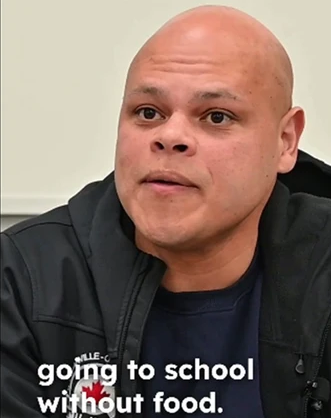
A screengrab from MP Jamil Jivani’s video that is critical of the Liberals’ national school-lunches program. Photo by Jamil Jivani/X
A few eyebrows raised earlier this year when Toronto-area MP Jamil Jivani, long heralded as an essential younger voice in the Canadian conservative movement, wasn’t offered a critic role by party leader Pierre Poilievre. There are 74 official Opposition critics, which is more than half the Conservative caucus. And if Poilievre and Jivani don’t see eye to eye, one might still have thought Jivani’s relationship with U.S. Vice-President JD Vance would be a useful resource.
There’s also the fact that Jivani is rather good at defending conservative policy, especially on the social side — better, one might argue, than Poilievre. On Monday, Jivani posted a video of himself arguing that Canadian children should go hungry at school. Or at least, that’s how certain hysterics chose to interpret his opposition to the Liberals’ national school-lunches program.
“It should frighten us that there are parents who can’t buy their own kids lunch,” he tells a constituent in the video. “(But) the government shouldn’t be your daddy; the government shouldn’t be your mother. We have families, and families should be strong enough to provide for their children, and when they’re not that should break our hearts. … It should not be used as a justification for the government to have even more influence, even more input, even more control over our lives.”
The program is already underway, with $1 billion in funding over five years committed as transfers to the provinces in 2024 — three years after the Liberals first promised it. And the Liberals recently announced plans for more. “Permanent” funding of more than $200 million is set to kick in in 2029.
The response anywhere to Jivani’s intervention, anywhere to his left, in a nutshell: “Oh my God, the Conservatives support children starving at school”. Even among some conservatives we hear the traditional timid refrain: Is this a “winning issue”? Or is the party just making itself look callous? What will the media think? Jivani, unlike many more seasoned Conservatives, seems not to care so much about the potential blowback.
Lunches served at school — paid or subsidized — are hardly a brand-new statist invention. They’ve been around forever, although they’re more common in certain kinds of schools than others. A 2013 Queen’s University study looked at 436 Canadian schools and found only 53 per cent had a cafeteria. (When I was a kid, many of my friends walked home for lunch and back afterwards.) And Jivani concedes in the video that many Canadians will like the sound of a national school-lunch program. Who would argue against it? It’s obviously far more important that kids eat breakfast and lunch (and dinner) than it is who provides it.
But that assumes a national school-lunch program, or even a provincial or local school-lunch program, is the quickest and easiest way to make sure kids are fed. It obviously isn’t, but trust in government, somehow, is a tough nut to crack in this country. Mass pandemic-era supports like CERB weren’t unalloyed successes, but they proved governments at least know how to shovel money out the door when they feel it absolutely necessary.
Especially since so many Canadian schools don’t have cafeterias — 53 per cent of elementary schools in the Queen’s study, and 82 per cent of combined elementary-secondary schools — it would make much more sense just to mail every parent who needs one a subsidy and let them pack the lunch, or the lunch money, that their kids need.
I’ve mentioned many times that I’m not a Conservative, but I don’t mind Mr. Jivani as my Member of Parliament because he doesn’t seem to me to be a typical Canadian Conservative (I thought it was significant that the PPC chose not to run against him once he became the Conservative candidate). In my YouTube recommendations, this video appeared with some sensible views from the Deputy Leader of His Majesty’s Loyal Opposition, Melissa Lantsman:
The trouble, as always with parties in opposition, is that they can sound like they’ve got great ideas and will energetically address the problems they identify while not in government … but once they go into office, sound remarkably like the government they just defeated and little or nothing actually changes.
July 25, 2025
Autism, then and now
At Psychobabble, Hannah Spier traces the rise of autism from its first formal definition to something that 1 in 36 kids is diagnosed with:
When Leo Kanner first defined autism in 1943, it was estimated that 4 to 5 children per 10,000 were affected. Today, the CDC puts that number at 1 in 36, almost one child in every classroom. If any other medical condition, blindness, epilepsy or paralysis showed a spike like this, it would trigger a pandemic-level outcry. But with autism, we see at best a curious murmuring as to what this is, and at worst, a growing chorus of people insisting, they too, belong in the group.
From experts, instead of raised alarms or calls for serious public health investigation (as would be expected for any other childhood disorder) we get calls for inclusivity and a self-congratulatory attitude toward their advancement in diagnostic understanding and tools. Another example of ideological capture of psychiatry by cultural sentiment.
Characters like Sheldon Cooper and Sherlock Holmes have helped turn the image of autism into a badge of honour. It means you’re socially odd, intellectually superior, and emotionally detached in an edgy and endearing way. For many, especially mothers with narcissistic tendencies hungry for a narrative of exceptionalism, this offered a seductive reframing of their child’s misbehaviour and non-conformity as evidence of giftedness. She could thus become the one who gave birth to the quirky but special genius. She alone saw the hidden brilliance beneath the “weird” behaviour. She became the martyr and the insider to an elite subculture. It’s Munchausen by proxy, 2025 edition.
People with narcissism and psychopathic traits exploit wherever they can, we know this. And yet again, psychiatry, the ones who should be the best at recognizing these, made it easy pickings by flinging the diagnostic gates wide open. Longtime readers will recognize the pattern: I’ve written before about the diagnostic creep in trauma, expanding definitions that blur the line between disorder and ordinary variation. The same diagnostic creep has unfolded here. Autism, once narrowly defined, was steadily loosened through each revision of the DSM.
The Great Diagnostic Expansion
Originally, Kanner’s autism was unmistakable: nonverbal children, socially disconnected, cognitively impaired, often with seizures. These were not quirky introverts. These were children who required full-time care and specialized schooling. In the DSM-III of the 1980s, it was called infantile autism. The criteria required clear onset before 30 months, marked language delays, gross deficits in social interaction, and repetitive behaviours. These were developmental dysfunctions, not misunderstood personalities. And neither clinicians nor parents had a problem naming them as such.
Then came the DSM-III-R in 1987, which introduced pervasive developmental disorder not otherwise specified (PDD-NOS) and broadened the field significantly. Suddenly, language delay and intellectual disability were no longer central. Subclinical cases were included. Asperger’s Syndrome followed in the DSM-IV in 1994, adding high-IQ individuals with no language delays but poor social functioning. A child who spoke on time but didn’t understand jokes, had poor eye contact, and rigid routines was now also autistic.
But the most dramatic change came with DSM-5 in 2013. The subtypes were eliminated. Autism became one spectrum. The criteria were thinned down to two domains: social communication difficulties and restrictive, repetitive behaviours. A person needed to meet just six out of twelve traits, spread across these two clusters. Language and cognitive delay? Optional. Even the requirement for early onset was removed. A diagnosis could now be given based on historical symptoms. Questionnaires like the Autism Spectrum Quotient (AQ) are so broad and subjective they can be easily gamed. This made it possible for 30-year-olds to recall feeling “socially overwhelmed” in school and not liking itchy clothing to receive the same diagnosis as a nonverbal child requiring lifelong care.
The diagnostic category has become a black hole, pulling in people with no clinical resemblance, collapsing distinction into sameness. From what I’ve observed, three distinct autism “patients” now account for much of the increased prevalence, none of whom would have qualified under the original criteria.
July 21, 2025
QotD: The parasitic classes
Look into almost any kind of “charitable” activity, such as social work, and one will find that only a tiny proportion of the cash “trickles down” to the characteristically desperate “clients”. And when it does, they use it to buy not only drugs and licker, but truly useless things, such as lottery tickets.
“Education” systems, in the modern West, exist chiefly to enrich semi-literate, unionized schoolteachers. In many parts of Ontario, for instance, a teacher will make at least double what the average parents make, and therefore feel justified in sneering. The teachers naturally consider that the little ones belong to them, for they are the necessary source of their income. What rights should parents have to interfere in their upbringing?
My best argument for the parasite class (always granting that some may be sincere), is that they protect society from gathering excessive wealth, or living lives of too much ease. Without them, we might easily suffer from the vices associated with too much freedom.
How I preferred the deadbeat, layabout, very English London of the Labour Party, when I lived there in the ‘seventies — to the cosmopolitan, rich, over-swept London of the Thatcher years. There are some advantages to socialism.
And there are other arguments, too, for putting depraved Leftists in power, though on examination they reveal special pleading. For instance, teachers may claim to offer child-minding services, so that mothers, especially, can go to work. But it is because heavy taxation requires the dual income, or women to do horrible and demeaning paid work when their husbands run away, that these services were ever made necessary.
The government does, arguably, “create” employment. Among the most farcical examples are the tax lawyers and consultants. Taxpayers need these to navigate incredibly elaborate tax codes, for their own protection. Only a professional can find the loopholes. Whereas, a comprehensible, flat tax system would put all these “experts” out of business. It would shrink revenue departments spectacularly, and by extension, threaten to shrink taxes. To a professional politician, this would never do. It would shrink his power.
David Warren, “Answering to a ‘need'”, Essays in Idleness, 2020-06-18.
July 20, 2025
QotD: Above all else, helicopter parents hate … helicopter parenting
If the kid gets anything less than an A-triple-plus in Zoom School, Karen is immediately on the horn to the teacher … and since all schools these days, even the rare physical ones, are all wired up with “classroom management software”, they can bombard their kids’ teachers with emails and text messages 24 hours a day, 7 days a week.
Helmets, knee pads … kids these days wear more safety gear than a mountain climber just to ride their bikes, and I wouldn’t be at all surprised to see them kitted out like hockey goalies if recess ever becomes a thing again. Can the day be far off when every kid is trailed by xzheyr own personal injury lawyer, and parents are forced to sign waivers to let their kids use the bathroom?
Everyone knows how bad this is for childhood development, but if I told some kid with a scraped knee to rub some dirt on it, you’ll be fine, I’d probably get hauled up on child endangerment charges.
How can kids advance past age twelve, mentally and emotionally, if they’re never allowed to get hurt? To fail? To suffer the consequences of their own bad decisions?
I’m no developmental psychologist, but it seems obvious that such learning is time-limited. If you haven’t learned that X brings pain — and WHY — by the time you hit twelve years old, then on some fundamental level you’re never going to learn it.
Severian, “On Being Bad”, Founding Questions, 2021-12-12.
June 9, 2025
Parenting style choice – “small people who do not yet know very much or … pets who can talk”
I always felt that my son was a person, and did my best to treat him that way while still being his father. I think that was the correct choice, although clearly a lot of other parents choose the other option for their children:
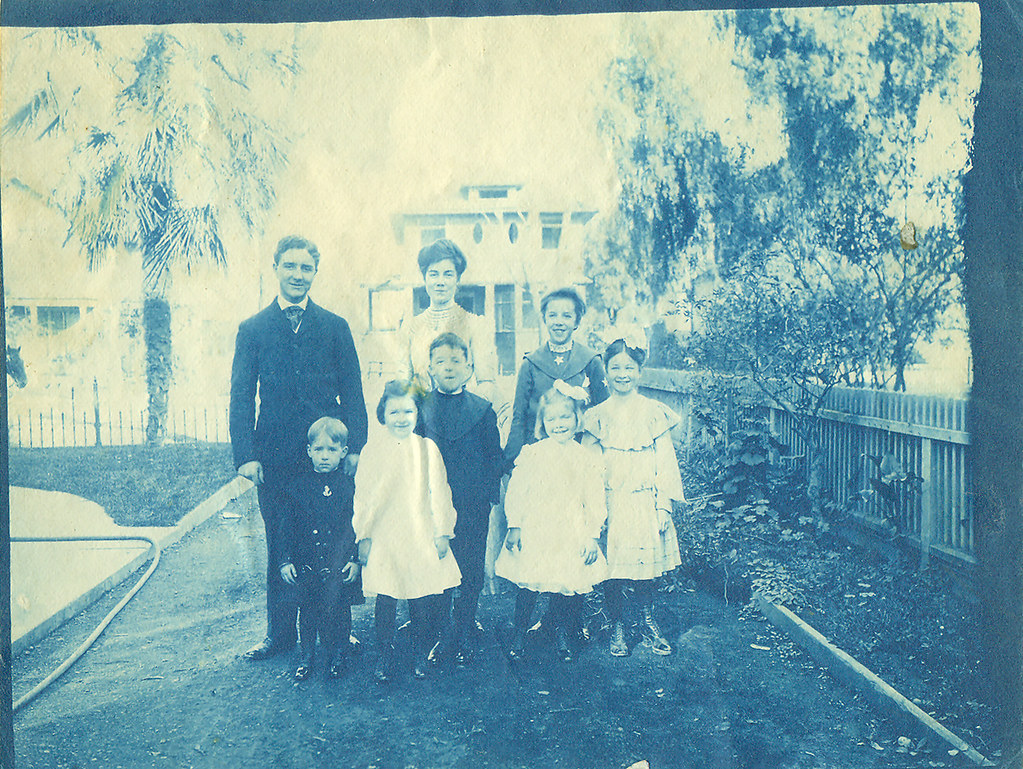
“Happy family cyanotype 2” by simpleinsomnia is licensed under CC BY 2.0 .
There are two views of children — that they are small people who do not yet know very much or that they are pets who can talk. I prefer the former. One implication is that children and parents are, in a fundamental sense, peers. Obviously they are not equal in what they know or what they can do or how strong they are. But they are not different sorts of people in a way that goes beyond that. Children should usually believe their parents about things the parents know much more about but parents should believe children when that asymmetry is reversed, as it sometimes is. The mere fact that one is parent and the other child does not determine which is right and which wrong when they disagree; that is determined, as between adults, by which has better arguments, more evidence.
One implication of treating children as people not pets is that you have to keep promises to them, as to other people. Another is that if you assert something to them you have the same obligation you would have if you said it to an adult to defend it or, if you find you cannot, admit that you can’t.
I once heard an elderly man tell a child who disagreed with him on something that he should never contradict his elders. The statement struck me as not merely wrong but blasphemous. The elder was probably correct on what they disagreed about but the appropriate response is to demonstrate that, at worst decline to argue it, not to imply either that truth is determined by seniority or that it is discourteous to point out errors to a status superior. I am reasonably sure that neither of my parents ever told me to believe something just because they said so or refused to entertain arguments against their views. The son of my first marriage, who spent summers with me and my wife when he was growing up, told a friend that his project for that summer was to get my wife to say “because I told you so.” I doubt that he succeeded.
Treating your children as your peers is easier if you sometimes interact with them in contexts where they demonstrably are at least your equal. I was the first member of our family to play World of Warcraft, so when my wife and our children, then eleven and fourteen, joined the game I was more skilled, had a higher level character, more in-game resources. They improved over time and there was a long period, during which we sometimes played separately, sometimes as a family team, were all on about the same level. By the time I eventually quit the game some years later we all had top level characters and all three of them had become more skilled at the game than I was.
Going back to my childhood, the nearest equivalent that occurs to me is ping-pong. We had a table in the basement on which my father and I played. We equalized the contest with a sliding handicap, a number of points I started each game with. Every time he won the handicap went up, every time I won it went down. Over a period of years, as I got better, the handicap went down, eventually to zero, I think occasionally below zero. The family also played bridge together, there being conveniently four of us.
I spent a lot of time arguing with my father on a wide range of subjects. Someone who met us skiing on Colorado when I was in high school told a friend of mine that we spent all our time arguing and I won half the arguments. I don’t think the latter was true, but if my father won a majority of the arguments he won them fair.


