I’ve written many times that the real culprits here aren’t the Boomers, but the Silents. Pick any obnoxious “Boomer” who did whatever in The Sixties™, and it’s Build Back Brandon to one that the “Boomer” in question was born in the 1930s. Which makes sense for a lot of historical reasons, but simple chronology will do: If we take as read that The Sixties™ started with the Port Huron Statement, then The Sixties™ started in 1962. The Baby Boom started in 1945, meaning that the very oldest Boomers were still in high school in 1962. They might’ve enthusiastically embraced every word — then again, they might not — but they surely didn’t write one letter of it.
Further, what could they really do? The voting age was 21 until 1971, and as hard as this is to hear, voting was just as pointless back then as it is now. St. Kennedy only won through massive voter fraud, and that was 1960. As John Derbyshire used to say, if the American People had been consulted on anything of importance since then, the USA would still be a White Christian nation … and yet, here we are.
Tweedledum and Tweedledee put on a better show back in the days, but the Uniparty was still the Uniparty. America’s ruling caste caught religion back in the 1920s, and on the long view, you could make a pretty robust argument that Mustache Guy and the Anime Club actually did us a huge fucking favor — left to his own devices, President-for-Life Roosevelt would’ve ushered in the USSA by the late 1930s, with the enthusiastic support of all the Beautiful People on both sides of the Uniparty.
… hats off to you [Isoroku Yamamoto] — you and your dipshit friends bought us a few decades. Decades we squandered, of course, but that’s not your fault. It’s not anyone’s fault, unless you think the boys on the Higgins boats should’ve shot their officers, turned the ships around, and conducted a massive air, land, and sea invasion of every faculty lounge and radio station in America … and even if you do think that, what are you going to do about it?
As for Gen X, we were no better. I can’t blame the Boomers for running with it, any more than I can blame myself for running with our thing. I spent most of college, for instance, getting drunk and chasing tail. Chasing tail is bad, full stop — I should’ve been saving it for marriage, with all that implies — and while getting drunk isn’t bad every now and again, I didn’t do it every now and again. I lived a life as dissolute as any Boomer’s, and while I was equally powerless to change anything in the broader culture, I could’ve been a much better person … but I wasn’t.
Severian, “Friday Mailbag”, Founding Questions, 2022-09-23.
October 12, 2026
QotD: Blame the “Silent generation” for The Sixties™, not the Boomers
October 11, 2026
QotD: The history of New Harmony, Indiana
Robert Owen paid around $150,000 for the town of Harmonie, Indiana. He got 20,000 acres, more than 160 buildings, working mills, and farms already producing food. He renamed it New Harmony. Close to a thousand people arrived in the first year.
Owen already ran successful textile mills in New Lanark, Scotland, where he was famous for treating workers well and running a profitable business at the same time. He believed that if you removed private property and paid everyone equally, cooperation would naturally replace competition.
In January 1826, William Maclure sailed a riverboat full of scientists, teachers, and geologists down the Ohio River to New Harmony. Historians call it the “Boatload of Knowledge”. Thomas Say, the father of American entomology, was on it. So was Charles-Alexandre Lesueur, one of the most respected naturalists of the era. This was the most educated, best-funded, best-equipped socialist community ever attempted on American soil. If cooperation could beat markets anywhere, it should have worked here.
It collapsed almost immediately.
The hardest workers were feeding, housing, and clothing neighbors who did nothing while receiving the same food, the same shelter, and the same rewards. So they stopped working too. Why wouldn’t they?
Production dropped and food ran short. Buildings decayed because no one owned them and no one was responsible for maintaining them. Endless meetings replaced actual work. Owen wrote seven different constitutions in two years trying to fix it. None of them worked.
American inventor Josiah Warren, one of the country’s earliest libertarian thinkers, was there. He watched the community fail from the inside and later wrote about why. His conclusion: “The difference of opinion, tastes and purposes increased just in proportion to the demand for conformity”. The more the community demanded unity, the more it fractured. Warren identified the deeper problem almost a century before Ludwig von Mises and Friedrich Hayek made it famous in academic economics.
When everyone owns everything, no one owns anything. When labor earns the same reward regardless of effort, effort disappears. When prices vanish, no one knows what anything is worth.
Owen finally admitted defeat in 1827. In his farewell address, he blamed the settlers themselves, saying they were “unprepared to be members of the community of common property and equality”.
Translation: the system would have worked if only people had been different.
Every socialist regime since has offered some version of that excuse.
His own son, Robert Dale Owen, put it plainly years later: “All cooperative schemes which provide equal remuneration to the skilled and industrious and the ignorant and idle must work their own downfall”. He had lived through the collapse. He knew what killed it.
Every socialist experiment since New Harmony has ended the same way, and for the same reasons.
Prices communicate what things are worth. Ownership creates responsibility for maintaining them. When both are abolished, production collapses because no one can calculate what to make or repair.
Tom Kratman, The social media site formerly known as Twitter, 2026-07-09.
October 10, 2026
Denouncing great art of the past as “high-class pornography” and “hate speech”
Not content with reading history backwards to find fault with historic figures based on the most progressive views of the modern world, the same approach is now taken with fine art:
For a discipline devoted to art, contemporary art history can seem remarkably contemptuous about the object of its study. In the 1970s “new art history” began to revolutionise a discipline that was hitherto focused on the connoisseurship of the Western canon.
It became instead a subject that used artworks as artefacts for social and political critique. John Berger, the pioneer of the new approach, questioned the very permissibility of having a “love of art”, dismissing it as “a useful concept to the European ruling classes”.
New art historians have since continued this crusade, with different “lenses”, each now well known, encompassing such topics as the “feminist turn”, the “de-colonialist turn”, the “LGBTQ+ turn”, and so on.
As critics such as Lola Salem and Pierre d’Alancaisez have argued in this magazine, this tendency now extends beyond academic fashion: the assumptions through which art is studied have migrated into museums, funding bodies and cultural institutions, where they shape what is exhibited, how it should be interpreted, and what socioeconomic purposes art is expected to serve.
The old question, “Is this good art, and what does it tell us about the civilisation that made it?” has acquired a formidable set of competitors: “What makes this work and its creator suspect, what depravity does is its supposed beauty trying to hide?”
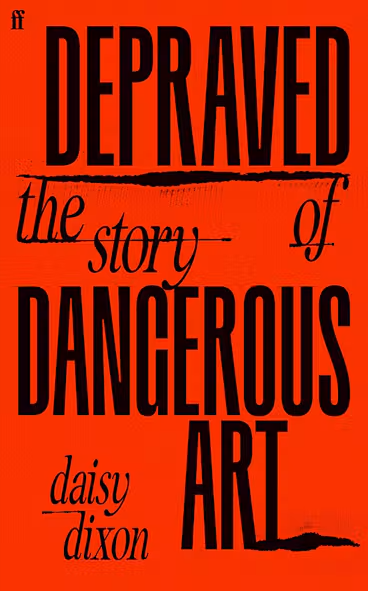
In Depraved: The Story of Dangerous Art, Daisy Dixon’s sense of contempt is made plain in the very first line: “When I was a teenager, I hated the painter Paul Gauguin.” As assistant professor of Philosophy at Cardiff, Dr Dixon has built a social media platform as an outspoken critic of historical and contemporary visual media. Not even Miriam Margolyes is spared her rancour.
In a world now dominated by AI, Dixon tackled the very real issue of deepfake pornography, where this new technology was abused by perverts to create pornographic images of victims (mostly women) without their consent. Whilst Dixon’s criticism of this sinister practice was laudable and justified, the extension of her criticism to art is misguided and regrettable.
The indignant chapter titles of her book — Obscenity, Criminality, Oppression, Malevolence, Cruelty, Iconoclasm, Reparation — read more like the call-to-arms of the culture wars than a work of fair and rigorous academic analysis. At the heart of her book lies the accusation that art with an erotic element by the likes of Titian, Velázquez or Giulio Romano should be considered “high-class pornography” and “hate speech”.
To support her argument, Dixon begins outside the confines of art with a work of literature: Marquis de Sade’s The 120 Days of Sodom. Using the indisputable “depravity” of De Sade, she aims to justify her accusation that those paintings were motivated by the same male and depraved roots in Western culture.
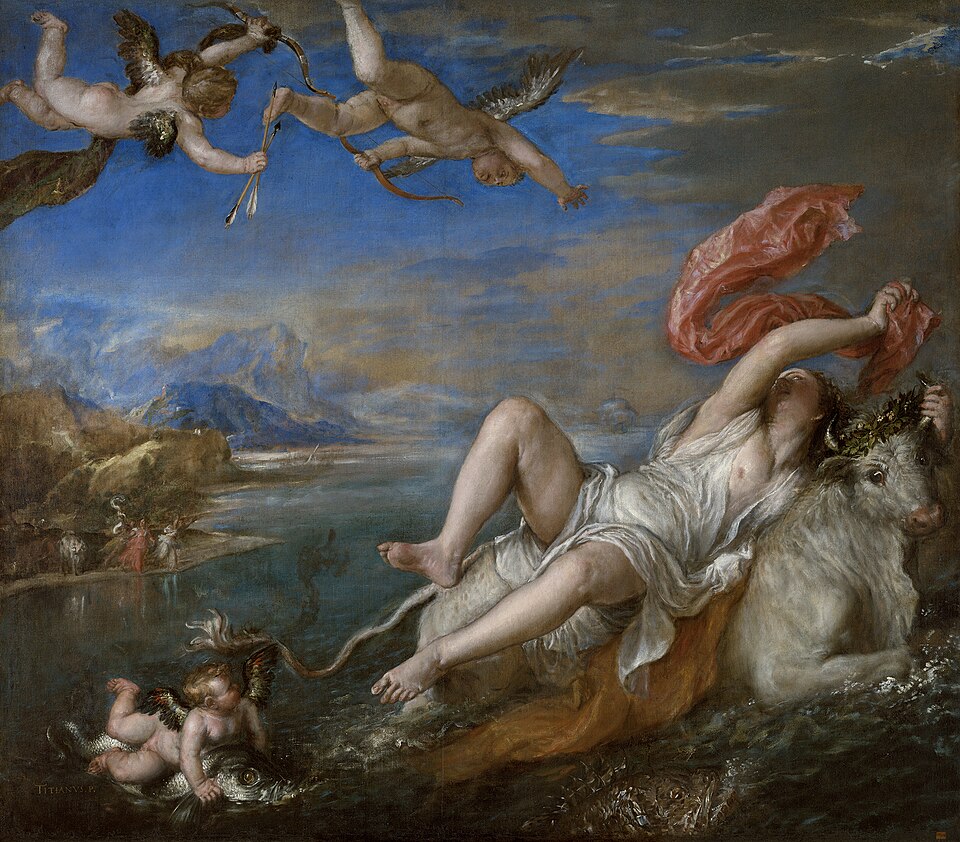
Her greatest ire however is reserved for Titian’s Rape of Europa, which she considers “just a portrayal of an immoral act”. The failure to consider any alternative meaning to the picture is indicative of the reductive and misleading nature of her approach.
Titian’s The Rape of Europa, c. 1560-62.
Wikimedia Commons.
Without delving further into the many other readings of the Rape of Europa, suffice it to say that the reductive conclusions drawn by Dixon impede us from a deeper understanding that might call her assumptions into question.
Although I read Art History at one of the most renowned institutes in Britain, I can confirm that students are taught this superficial understanding and contempt. I remember a senior lecturer singling out the experience of finding a group of Oxford postgrads discussing Titian’s Diana and Actaeon as a scene worthy of ridicule. “I was shocked,” the lecturer opined, “how they were so busily discussing which translation of Ovid that Titian consulted, when they completely ignored that there was a black slave girl in the picture.”
The girl depicted was one of the handmaidens of Diana, something the lecturer would have known had she even the most elementary knowledge of the story. More distressing was the sight of a senior academic masquerading assumptions as fact.
October 4, 2026
Jaguar – a case study in brand suicide
The Jaguar E-type was, in my opinion, the best-looking car of the 20th century. It was all downhill from that point, sadly:

Jaguar killed itself. No villain required, no recession to blame, no supply chain disruption to hide behind. Tata Motors bought a fading but salvageable brand in 2008 for $2.3 billion and spent the next fifteen years turning it into a case study in how to destroy capital.
The rebranding campaign of late 2024 was the public execution. Jaguar dropped its leaping cat logo, fired its entire existing customer demographic via press release, and replaced a century of racing heritage with a pastel-colored advertisement featuring zero cars. The marketing team apparently decided the path to profitability ran directly through alienating the people who actually bought Jaguars. Brilliant.
The rebrand was just the visible wound. The rot started earlier. Jaguar spent years producing vehicles with reliability ratings that made Land Rover look like a Swiss watch, while charging Mercedes money for the privilege. The F-Pace, the E-Pace, the I-Pace: each one a beautiful object that dealers apologized for in advance. You bought the badge and got a subscription to your mechanic’s vacation fund.
The pivot to an all-electric lineup, announced with great fanfare in 2021, then delayed, then sort-of-delayed-again, captured everything wrong with a company led by government subsidy chasers rather than engineers. Jaguar chased EV tax credits and green virtue points instead of fixing the fundamental problem. Nobody trusted the cars.
Markets are merciless precisely because they are honest. Customers stopped buying, and no amount of rebranding or regulatory coddling reversed that verdict. Capital allocated to a brand that cannot hold a customer is capital destroyed. Tata learned this lesson expensively. You, having never bought the car, learned it for free.
The ad campaign is just a sign on the door that reads, “This company is woke trash”. The real rot lies beneath the surface. Firing the marketing agency won’t change that.
October 3, 2026
More on that change to student loan eligibility rules
Larry Correia’s comments on Trump’s executive order changing eligibility for federally guaranteed student loans generated a fair amount of discussion, so I felt linking to Copernican’s post on the same topic would be of interest to many of you:
As a White Western Man, I am unaccustomed to seeing or hearing “good news” in a larger geopolitical sense. That is, actions of our leaders tend to lead one to be somewhere between depressingly blackpilled and defiantly optimistic even in the face of overwhelming evidence to the contrary.
Recently, Donald Trump and his Department of Education have engaged in some more executive shenanigans. Once again bypassing our Congress, whose dysfunctional role is best thought of as the kidneys in our diabetic, alcoholic body politic. With that said, a relatively minor update to the Department of Education rules regarding underwriting federal student loans might have a dramatic long-term effect on our entire cultural system.
Take a look for yourself:
Of all the actions the Executive Branch can take, this is one of the best. Most notably, because it’s boring. Changing the rules on federal fiscal underwriting is boring, so the media and the population at large will have a hard time holding on to it as a talking point. The most dramatic cultural changes are precipitated from the most boring types of fiscal action. Flashy is fun, but boring is often effective. Something to keep in mind when our generation finally seizes the reins of power.
The recent update that takes effect in 2027 is functionally removing the federal guarantee from student loans for useless degrees. Predominantly degrees that fall under the “female daycare” category. That is, the reason why every employer in the United States demands a degree to flip burgers or fill out spreadsheets is due to the fact that everyone can get a degree. Removing a significant portion of the federally backed degree-mill system will force a top-down restructuring of the American cultural academic-caste system.
The fallout from this decision is going to be immense, but we won’t see it unless the current policy holds long enough for several generations of university students to grow up under it (say around 12 years). First, it’s going to cut off universities from the endless money of cheap federal student loans that’s been flooding into useless departments. Women’s studies, social studies, English majors, and early-childhood-education majors are about to see a significant drawdown in the number of attending students.
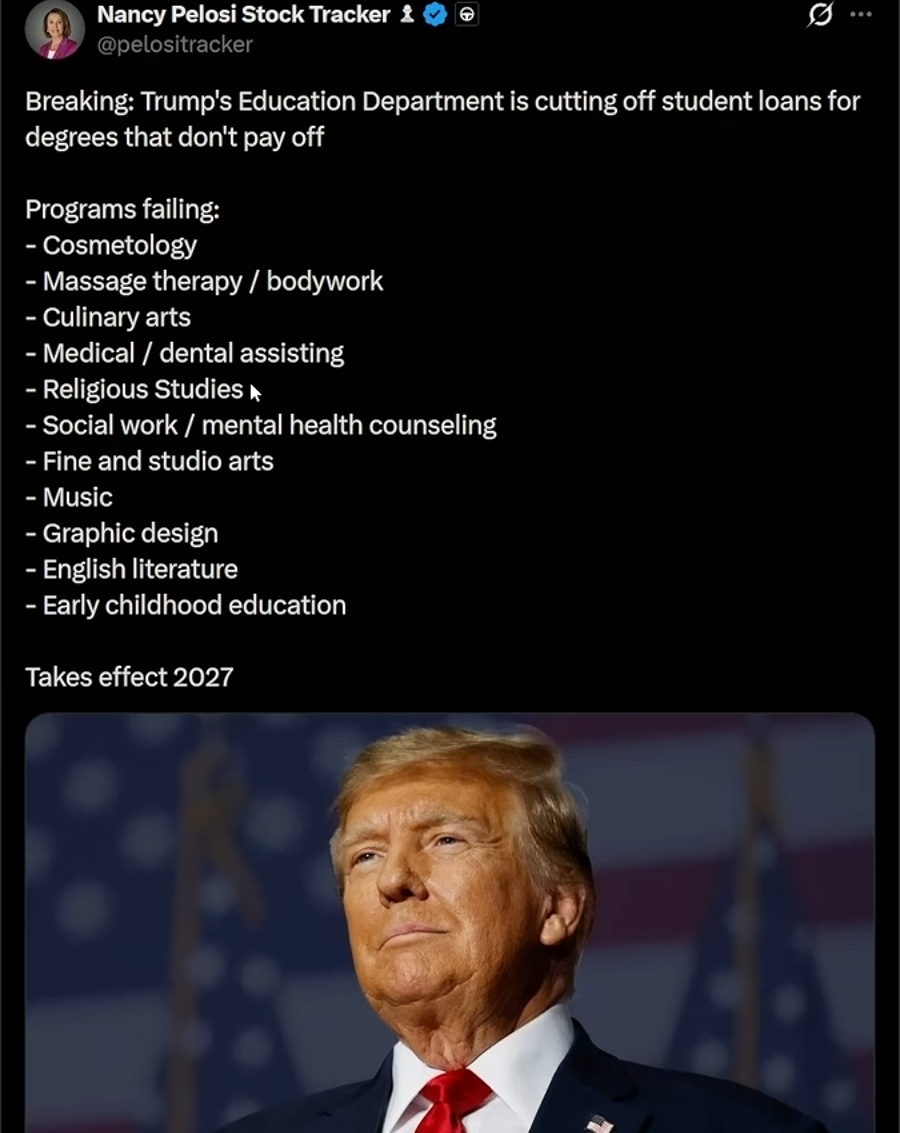
As many have pointed out, it’s only an Executive Order, so it can be easily set aside by the next president, but it may have a salutary effect on those who do see a university degree as just a way to stay out of the working world for a few more years.
October 1, 2026
Trump’s student loan policy change
On the social media site formerly known as Twitter, Larry Correia applauds President Trump’s decision to stop providing goverment-backed student loans for courses that don’t provide students who graduate with a viable career path:

Now this sounds like a good policy.
Only they’re not “banning” anyone from majoring in anything. Kids can still major in whatever dumb shit, gender studies, no job having degree, they want, and liberal academics will still make bank ripping off those kids and their parents.
This is just the rest of us tax payers not being on the hook for their good times.
Most regular loans the bank isn’t going to lend you money unless there’s some assurance that they’re not going to get screwed. If you went to your bank with a business plan that said you needed $250k up front so you could make $20 an hour after, they’d laugh at you.
Student loans were the one goofy ass outlier because Uncle Sam said it’s cool to go a quarter million dollars into debt to get a useless degree that qualifies you to get some specific $20 an hour job … except wait, due to all these loans for bullshit degrees the supply of eligible employees far exceeds the demand, so all those $20 an hour jobs are already filled, so now you’re working fast food where your coworkers are teenagers or illegal aliens, only you’re still $250k in debt.
Of course none of what I am saying will make sense to people who majored in the degrees in question because they weren’t required to take any math, econ, or accounting classes.
The headline says social work, art, religious studies, and music will be hardest hit! (teaching aides need a degree? WHY?!?) And now I’m gonna get yelled at by people who think what America really needs is more social workers.
Going off of what I’ve seen from creative writing degrees, MFAs, and the many art and music professionals I know, I’m guessing art and music degrees are mostly a huge waste of time. Just go get a real job to pay the bills and practice your art on the side until you get good at it (says the bestselling novelist who got an accounting degree).
Going deeply into debt for a “religious studies” degree from a university baffles me. Go to church. Read your scriptures. Serve your fellow man. But mostly I’m betting they included this one to try and pull at conservative heart strings because we all know in reality this policy change is going to overwhelming hit liberals.
But, Correia, you barbaric anti-intellectual* with the free taxpayer money faucet shut off this will irreparably harm America’s pretentious snooty sheltered ivory tower scholars of pointless fields who exist in a state of perpetual bossy uselessness in their little university bubble!
Oh no! Anyways.
* for the record, I’m not anti-intellectual. I’m all in favor of scholarly pursuits. I just think much of the education business is a scam, and the people who label themselves “intellectual” usually aren’t.
September 30, 2026
QotD: “Have you ever been surprised to learn that someone was a Leftist?”
It never happens, right? Like vegans and Harvard alums, you never have to wonder if someone is an SJW — they’ll tell you, right off the bat. Usually they don’t even have to tell you; the hair and the tats and the fishing tackle in the face do that. Like putting the “Bernie 2024” sticker on the bumper of the Prius or the Subaru Outback, actually declaring yourself an SJW is overkill. So much so that it’s a cliché — of all the budding shitlords I mentored in my years in academia, none of them “came out” to me because of anything I said or did. It was all the stuff I didn’t say or do — I didn’t spend half of each class period ranting and raving about The Current Thing, which was so unusual that they figured I must be on the other side.
The Left, I think it’s fair to say, enjoys total freedom here in AINO. Total liberty, too, and that’s a distinction we should probably make at some point, but for right now let’s hold fire on that. Whichever one you want to use, though, it’s obvious that the Left have it, with pretty much zero restraint. Nothing is too weird or gross or obnoxious that the Left won’t champion it.
But even more than that, all the traditional restraints on behavior — what we should probably call decorum — have been systematically destroyed, and that’s the heart of what I want to talk about. Since we’re discussing the Left here, let’s use one of their favorite terms: Privilege. I think we can take it as read that there has never been a more privileged person, in any sense of the word “privilege,” in all of human history, than Karen (or her JV version, the Basic College Girl). And what battleaxes they are! Constantly lecturing everyone else about their privilege while plowing through every social situation like a tsunami. Like the Clintons, Karen triumphs because you just can’t believe anyone has the sheer brass-balled audacity to pull the antisocial shit they do.
Have you no shame, madam? At last, have you no shame?
Severian, “On Liberty”, Founding Questions, 2022-10-12.
September 24, 2026
QotD: The perpetual progressive underdogs
To the autist, each car must be inspected in detail, with full attention … and while the autistic’s attention is laser-focused on one particular parked car – “1998 Ford Taurus, midnight blue, left front tire is a little low, right taillight out, bumper sticker near muffler”, etc. — he fails to notice the moving car that hits him.
As opposed to the non-autistic, who is capable of “abstracting” that situation into a realistic threat assessment. He can’t even give you a ballpark guess of how many parked cars are in the lot, much less any details about any of them, because he has abstracted them out: “a bunch of parked cars” = no threat, so his attention is free to roam around looking for moving cars.
I instinctively want to argue against this, because it appears to me that Leftists are nothing but abstraction. They don’t see individuals; they see huge identity groups. That’s why they see an anti-feminist woman or a conservative homosexual or whatever as not really X. It makes sense to them, somehow, to say that Amy Coney Barrett isn’t really a woman, Clarence Thomas isn’t really black, and so on.
[…]
The non-autistic sees [a child’s drawing of a train as] a rectangle, two wheels, some lines underneath, and thinks “train,” because he’s boiled it down to the essentials — a train is a wheeled vehicle that moves on tracks. That’s good enough to cover pretty much all “train” situations; we can add or subtract details as needed to get to this or that particular train (e.g. electric vs. steam), or a wheeled vehicle which moves on tracks that’s not a train (e.g. a rollercoaster).
So, applied to people: I see a black man walking towards me on the street and I have one set of assumptions in my head. First I see just “person”; then I realize it’s a man; then I realize it’s a black man; then I realize it’s an elderly black man; then I realize it’s Clarence Thomas. All the while I’m dialing in both my perceptions and my behavior — I’m not at much physical risk from an elderly man, and I’m at nearly zero risk from Clarence Thomas, specifically, so I modify my behavior. When I was still just at the “black male” stage of the recognition process, I behaved very differently.
If I’m reading Zorost correctly, the autistic would do something like the reverse. He wouldn’t be able to make any judgments until he’d fully inspected the individual man in front of him at close range and verified that yes, this is Clarence Thomas. And then the confusion kicks in, because he — the autistic — has memorized the rule “black man = Liberal” and here’s Clarence Thomas. Error 404.
Severian, “Why Are They Always Underdogs?”, Founding Questions, 2022-09-07.
September 17, 2026
You don’t hate the relic media nearly as much as they deserve
The relic media in Canada has — thanks to generous government subsidies — become a maple-flavoured version of the North Korean news media, but even in the United States where there’s still a somewhat competitive market, most media outlets are delighted to act as unpaid propagandists … and have been that way for generations:
Walter Duranty won a Pulitzer Prize for lying about Stalin’s Ukraine famine while millions starved. His employer, the New York Times, never returned that prize. The institutional rot ran deeper than one reporter.
In 1936, Times Moscow correspondent Harold Denny watched the first of Stalin’s Great Purge trials and reported the proceedings as credible. The defendants, Grigory Zinoviev and Lev Kamenev among them, confessed to plotting murder and sabotage. Denny saw no obvious coercion and wrote accordingly. The NKVD had spent weeks breaking these men through sleep deprivation, threats against their families, and relentless psychological torture until they would say anything in open court.
Every confession was fabricated. Every defendant was executed anyway. Stalin murdered roughly 750,000 people during the Great Purge between 1936 and 1938, and the Times gave the operation a veneer of legitimacy at its most critical moment.
Central planners require a monopoly on information to survive. When the newspaper of record in the most powerful capitalist country on earth launders your show trials as fair proceedings, you buy yourself years of Western political goodwill. Stalin purchased that goodwill with useful idiots who confused proximity to power with insight.
You pay for this dynamic today every time an institution that failed catastrophically keeps its credentials, its prizes, and its authority to declare what counts as credible journalism.
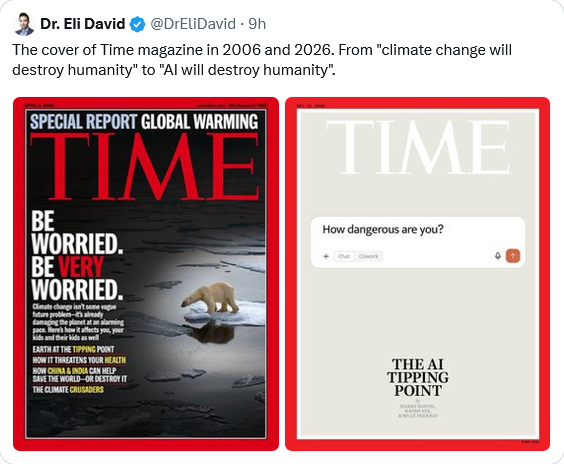
Duranty would have been proud of Time magazine had he been alive today.
September 16, 2026
The new front in the British “flag war” – Welsh castles
You may have heard that at least one municipal government in England is trying to ban private citizens flying both the Union flag and the St. George’s Cross, yet actively encouraging the use of other national or political flags. On Substack, Paul Embery shows just how far the anti-British/anti-English activists are willing to go … in this case all the way to Wales (where, yes, there’s already some local anti-English sentiment to start with):

Pakistani flags fly over medieval walls in Cardiff.
Photo from X via Paul Embery
SOMETIMES it’s hard to avoid the conclusion that Britain’s political elites are engaged in some sort of private game to see just how far they can test the patience of the native population before it snaps.
A people who were, and still are, remarkably tolerant in all sorts of ways, including towards those from minority backgrounds and cultures, seem daily to have their good faith exploited.
Only someone who had been living under a rock for the past couple of decades could have failed to notice the gulf that has emerged between our political institutions and everyday folk living outside of our fashionable cities and university towns.
That gulf – which is widening still – explains why a palpable sense of polarisation exists across many parts of the country today.
The latest attempt to stir the pot comes courtesy of Cardiff council, which recently decided to fly the flag of Pakistan from the city’s castle – one of the Welsh nation’s most historic and iconic sites. The flag was apparently hoisted in celebration of Pakistan’s independence day and stayed there over two days (a similar thing happened in 2024 — see image).
Needless to say, a row swiftly broke out, with Reform voices locally and nationally attacking the decision and in return facing accusations from their political opponents – who seemed to close ranks around the issue very tightly – that they were seeking to incite hatred and division.
Recent history tells us that anyone who expresses even mild disapproval about this type of virtuous ingratiation of foreign nationalities and cultures by our public bodies is likely to face taunts of being some kind of embittered xenophobe or reactionary. And, usually, the condemnation will be accompanied by a lecture trumpeting the merits of living in a diverse and multicultural society.
But those who harbour misgivings surely have a point. Because such acts do rank as a kind of provocation. It’s one thing seeking to foster good relations with other nations and cultures – such an approach is eminently sensible – but it’s another thing entirely indulging those nations and cultures to such a degree that many indigenous citizens begin to feel their own country is losing its historical identity and turning into something resembling a supersized version of the Olympic village. And that is where many Britons feel their country is now.
That Pakistan is a member of the Commonwealth did not appear to be the prompt for Cardiff Council’s decision, for no councillor seems to have cited that justification in defence of it. Moreover, the colours of non-Commonwealth nations, such as Poland, have also been displayed over the castle in recent times.
“Oh, it’s only a flag, and it’s just for two days”, the citizens-of-nowhere will argue. Except that it isn’t only a flag, and it isn’t just two days. What we have seen over the past couple of decades is a subtle but concerted effort on the part of Britain’s elite class to embed the ideology of cosmopolitan universalism across all areas of our public life.
These people are globalists in every sense. They see our country as a shop, not a home.
They believe in permissive migration policies, free trade libertarianism and technocratic supranationalism – all things to which large chunks of the population are hostile.
Update: I’ve heard that it helps to actually include the URL …
Update the second, 17 September: Welcome, Instapundit readers! Have a look around at some of my other posts you may find of interest. I send out a daily summary of posts here through my Substack – https://substack.com/@nicholasrusson that you can subscribe to if you’d like to be informed of new posts in the future.
September 15, 2026
“I will choose a path that’s clear, I will choose free will”
For some reason, the idea that humans don’t really have free will is very popular among progressives, even if they know individually that they have free will they believe most of the rest of humanity somehow doesn’t:
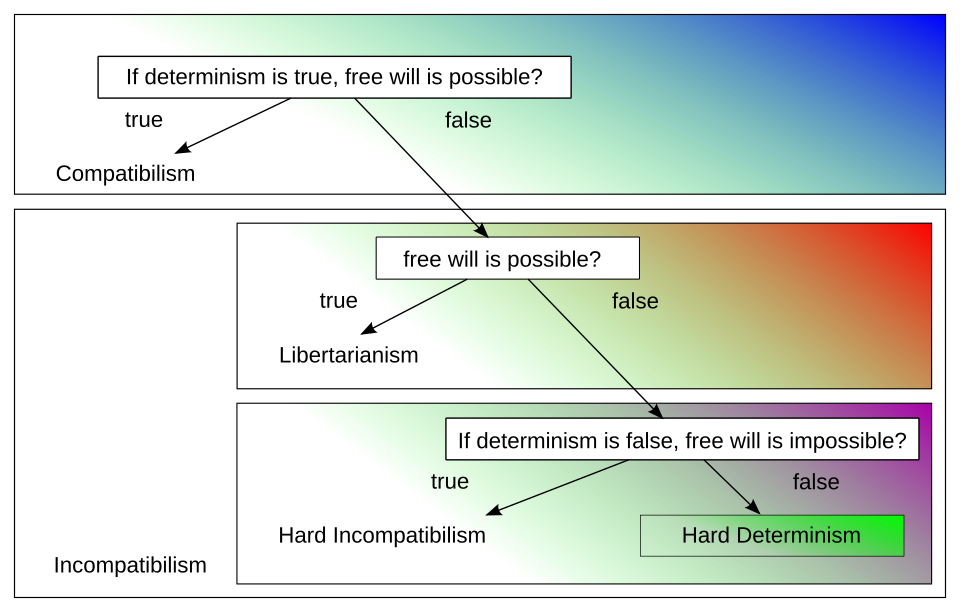
A simplified free will taxonomy
Image by Richardbrucebaxter via Wikimedia Commons.
A fashionable view of human behavior holds that because everything has a cause, no one is truly responsible for their actions.
In his 2023 bestseller “Determined,” Stanford neuroscientist Robert Sapolsky argues that free will is an illusion. “We are nothing more or less than the cumulative biological and environmental luck, over which we had no control, that has brought us to any moment”, he writes. Author and podcaster Sam Harris has spent 15 years making the same case to a popular audience. “Our wills are simply not of our own making,” he writes in Free Will (2012). “Thoughts and intentions emerge from background causes of which we are unaware and over which we exert no conscious control. We do not have the freedom we think we have.”
Common sense pushes back. Consider an example from the psychologist Paul Bloom. Imagine a man who thrashes violently in his sleep and accidentally strikes his wife, breaking her nose. They both wake up, and he is horrified and ashamed. Now imagine a second man who resents his wife and wants to hurt her. He waits until she is asleep and then hits her in the face. When she wakes up, he pretends it was an accident. The difference between these two men is obvious. Any legal or moral system that doesn’t recognize that would collapse.
Yet much of elite discourse encourages us to blur that distinction. Determinists like Messrs. Sapolsky and Harris tell us that behavior can be explained through systems, incentives, trauma, inequality, neurochemistry and social pressure. Much of this is true. But a culture that speaks only this language teaches people that they are spectators in their own lives. The implication, rarely stated outright, is that no one really chooses anything. We are all the first man in the example above, thrashing in our sleep.
The determinists don’t deny that we have wills, or that our actions follow from them. Their argument is that will and action are themselves the products of deeper causes, such as genes, molecules and the environment, and so we can’t really be called free.
Stuart Doyle offers a useful analogy that challenges this claim. Suppose we ask whether an apple is red. The determinist looks closer. He realizes the apple is nothing but atoms. Because no individual atom is red, he concludes the apple can’t really be red. The error is obvious. Color exists at the scale of the apple, not at the scale of an atom.
Free will works the same way. A choice exists at the scale of a person thinking, weighing and deciding. Looking at the molecules underneath and finding no choice there doesn’t prove that choice is an illusion.
A Fall election seems quite likely
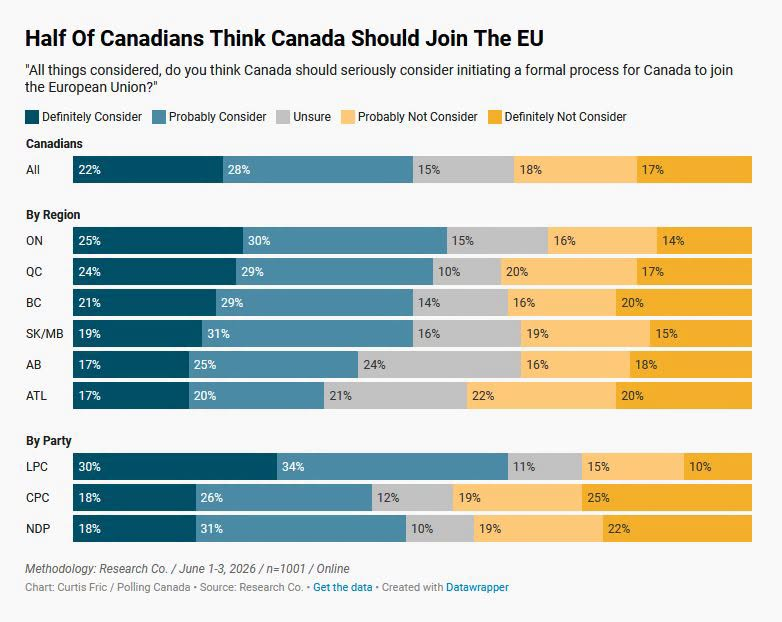
One of the advantages of a Westminster-style parliamentary system is that election dates are not fixed, so that the Prime Minister can take advantage of perceived opportunities to win majorities when they arise. It must be very tempting to Mark Carney to call an election as soon as he can, as the Elbozos are still waving their arms and chanting his praises for “standing up to the Bad Orange Man”. His latest notion of trying to add Canada to the European Union as some sort of “associate member” is also popular among people who think that Canada should be more like Europe (the Venn diagram of Elbozos and Europhiles is almost a perfect circle). On X, Jay Currie stares into the abyss of yet another Liberal majority government with a renewed electoral mandate:

The Prime Minister of all the Canadas is prepping for his Davos 2.0 speech to the European Parliament on the 17th when, apparently, he is going to propose that Canada become some sort of associate member of the EU. God help us.
The developed world can be thought of as two camps: the progressives and, for want of a better term the nationalists (could be traditionalists but that is only one strain within the nationalist camp). The supra nationalist institutions, EU, UN etc are progressive to their core.
Progressives see borders as barriers to progress, believe diversity is strength, see international action as the only way to defeat the horror of “climate change”, want international controls on speech, technology and public health.
For progressives individual rights, the rule of law, property are all barriers to the greatest good for the greatest number. Citizenship is an antique concept best left in the 20th century.
Most importantly progressives see the state, rules and regulations, a constantly refreshed “New World Order” and managed decline as both beneficial and inevitable. Arc of History and all.
Nationalists begin with the tiniest unit in society, the individual, and take that unit seriously. What rights does an individual have? If you start there you automatically circumscribe the power of the state. You also set the state’s direction.
Taking individual rights seriously creates a state in which individuals matter, there their voluntary associations beginning with families, matter. “The greater good” is no more than a suggestion when it comes to protecting individual rights.
The Europe of the EU came out of the ashes of a world in which individuals were subjects rather than citizens (with the notable and sporadic exception of post Revolutionary France) and the concept of individual rights was fragile at best.
The progressive intent of the EU was to treat “Europeans” as interchangeable economic units whose value was locked to group identity and which must be prepared to share the burdens imposed for the greater good.
Nationalism was seen as regressive as was patriotism and the insistence that individuals had rights which over rode the “common good”. After all, the horrors of WWI and II were the products of patriotic nationalism.
The progressive European project worked quite well for the first twenty or so years when Marshall plan aid funded the rebuilding of Europe and membership in the EU was relatively restricted. Expansion and mass immigration strained the Community.
Part of the reason the EU worked quite well in the early years was that its goals were relatively modest, a trading bloc with harmonized economic regulation left individual countries to work out their social, legal and rights structures.
As with any progressive institution the modest goals of the early years were gradually replaced with “ambition”. The 1985 Schengen Agreement eliminated hard borders within the EU. The European Convention on Human Rights harmonized the rights of Europeans.
Part of the progressive ambition was the creation of a hitherto unknown entity known as “the European” superficially similar in concept to “the American”. Questions of nationality could be submerged as this new entity stepped into the world.
For the progressive camp the “European” was a giant step forward into a post national future. As indeed it was for a tiny minority of bureaucrats, academics, journalists, financiers and other members of a self appointed cognitive elite.
People who objected to this grand homogenization of the nations of Europe were obviously frightened of the inevitable future because, well, they were not well educated and, entre nous, not too bright.
For the “Europeans” the great cause of the 21st century was laid out in Rio in 1993 when a conference convened by Canadian Maurice Strong sounded the alarm about “global warming” currently rebranded “climate change”.
Now there was a global threat demanding a supra-national response where the “Europeans” could assume a leadership role by…well, by shipping all of their heavy industry offshore and building very expensive windmills and mandating electric cars.
To no one’s very great surprise the Europeans have managed to de-industrialize and regulate themselves to the point of actual poverty. Fortunately, it was all for the global greater good so the Europeans could congratulate themselves.
Not content with climate virtue, the Europeans (though not the regressive nationalist yobs) took it upon themselves to welcome millions of migrants. An act of humanity and also shrewd as the Europeans had given up having children.
Of course, the idea had been trial-ballooned recently to get Carney-friendly headlines ready in advance:
September 14, 2026
QotD: “We have Homo Sovieticus in America”
The last numbers from Los Angeles County as a whole were for 2024, when 2,208 homeless people died on the streets. County officials celebrated, because that number was a sharp reduction, and a reflection of the success of programs like overdose intervention teams stationed around public parks.
Remember those numbers, and let’s talk about something else for a moment before we come back to them.
The Soviet writer Aleksandr Zinoviev told a joke that speaks fluent Californian: “In some institution a routine meeting was in progress. There were two points on the agenda: 1) the construction of a barn; 2) the creation of an abundance of consumer goods under communism. As they didn’t have enough planks to build the barn, they moved on at once to the second question.”
Maybe that joke doesn’t land if you don’t live in Los Angeles or Seattle, but from here it’s flawless. Take a quick look at the campaign page for María Elena Durazo, a state senator who just won a seat on the Los Angeles County Board of Supervisors. Infrastructure and fire departments are in bad shape in the place where elected officials think that government exists to provide “economic justice” that restructures communities. When government exists to pay your rent, 911 response times soar.
They can’t fix a street, so they move on at once to managing all of society.
Here’s what Senator Durazo boasts about on her “Meet Maria” page: “Arrested over 13 times for leading non-violent Civil Rights and Worker Rights protests”. It’s the line that appears below “State Senator” on her list of accomplishments. Gentry socialists have high-status-marker arrest credentials, without the burden of low-status prosecution and jail terms.
Zinoviev gave us the term “Homo Sovieticus”, describing the human creature that shaped itself around the postures and predilections of Soviet culture. Humorless, a sanctimonious scold, a deeply selfish schemer while professing adoration for collectivism, comfortable reciting official slogans without feeling the need to believe them or examine them, reflexively conformist, not worried about truth. (X) has been advanced as party doctrine, so (X) is correct, and anyone suggesting (Not-X) is highly suspect. The official account is always correct.
We live among these people. We have Homo Sovieticus in America.
Chris Bray, “Homo Cosmopolitus Won’t Count the Costs”, Tell Me How This Ends, 2026-06-10.
September 6, 2026
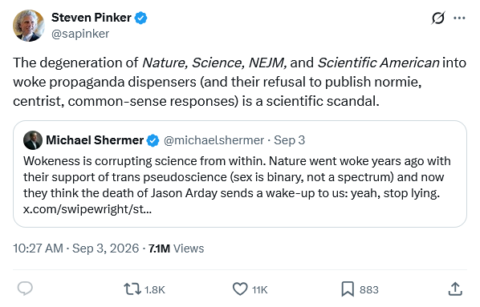
Scientific American used to be a respected science publication
A few years ago, it became clear that Scientific American had been captured by the woke gender warriors, but as ESR points out, the publication had been somewhat in the hands of propagandists for much longer than that:
I was once a Scientific American subscriber. I loved that magazine; reading it was one of the highlights of my month. I canceled, and wept for what the magazine was becoming, when they published a theme issue that was a transparent political hit job.
Sounds like current news? No. That was 40 years ago. The hit job was on the Strategic Defense Initiative. Reagan was in the White House.
And I … I couldn’t figure out why nobody was saying the obvious in public. That SciAm had been sock-puppeted by a Soviet influence operation desperate to keep the US from exploiting its technological advantage.
Ideological capture of the scientific establishment is not a new problem. As much as I hate the Communists behind it, I’m even angrier with all the scientists who averted their eyes and never pushed back while the capture was going on. Our civilization gave them a position of high status, privilege, and trust. A priori I don’t think we were wrong to do that — until they failed in the duty that went with that trust.
It’s difficult for me to express how personally painful I found this. I revered research scientists as a child and young man — I could not imagine any higher calling than to be one myself. Until they betrayed civilization, and in the process betrayed me.
So, this isn’t a new problem. What’s new is that the post-2014 woke insanity has made it too obvious to miss.
It’s time for a dissolution of the monasteries. The culture of science, to the extent it is transmitted forward, must learn a harsh and terrible lesson about the consequences of allowing scientific neutrality to be abandoned for a mess of politics.
September 5, 2026
The high-water mark of Cancel Culture
This Noahpinion piece is from last year, but I hadn’t seen it before and I think it outlines fairly accurately why “we” allowed Cancel Culture to temporarily take over social media and cause so much personal damage to disfavoured individuals. It gave the mob the power to identify their own Emmanuel Goldsteins and drive them from the public sphere:
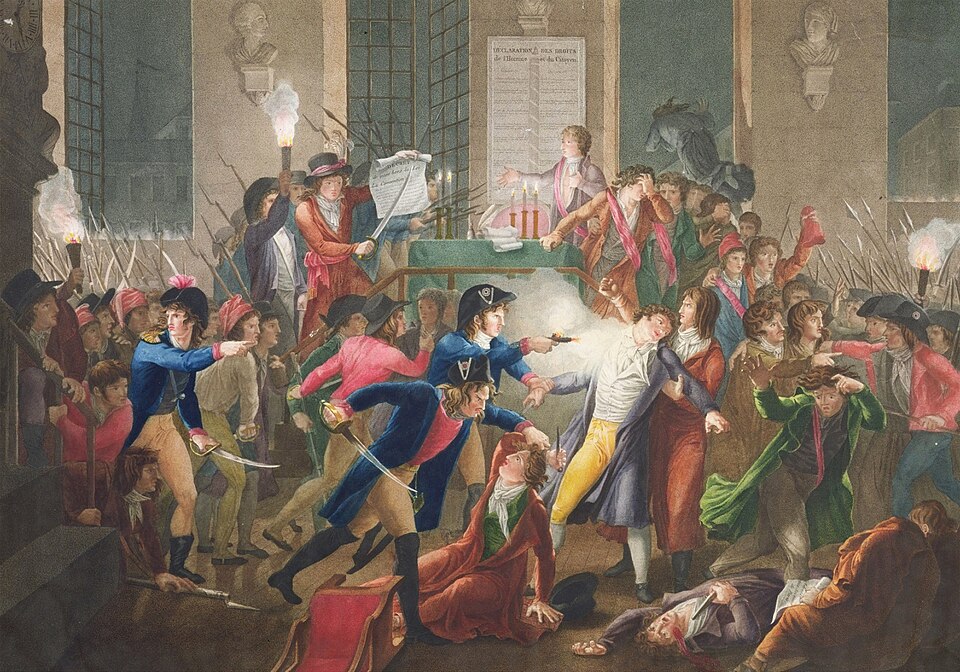
The Arrest of Robespierre, The Night of the 9th to 10th Thermidor, Year II, 27th July 1794
Colour engraving by Jean-Joseph-François Tassaert (1765 – ca.1835) via Wikimedia Commons.I think about this when I think about cancel culture.
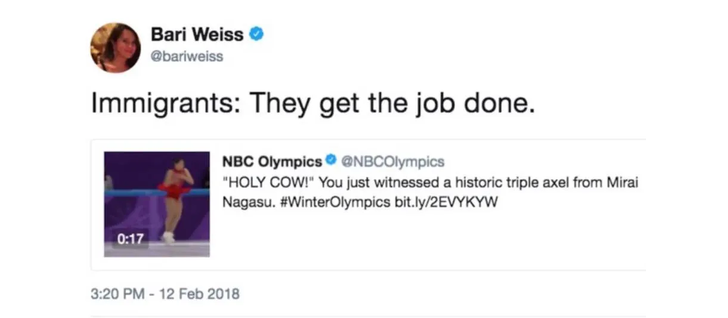
Back in 2018, Bari Weiss got dogpiled on Twitter for an anodyne liberal tweet. Weiss congratulated Olympic skater Mirai Nagasu on pulling off a difficult move, quoting a line from the musical Hamilton about immigrants being great:
Weiss was viciously attacked for this tweet by thousands of people who called her racist over the course of several days. Why? Because Mirai Nagasu isn’t actually an immigrant — she was born in the U.S. According to Weiss’ many attackers, Weiss’ statement implied that nonwhite people are perpetual foreigners.
That was, of course, complete hogwash. Nagasu’s parents are immigrants; the use of the term “second-generation immigrants” to describe the children of immigrants is utterly standard terminology in academic sociology. And by quoting a line from Hamilton in praise of a second-generation immigrant athlete competing on behalf of the U.S., Weiss was clearly advocating in favor of (nonwhite) immigration as something that makes America stronger — a very standard liberal viewpoint.
Whether this particular pile-on had long-term negative consequences for Weiss’ life isn’t clear, but she encountered an increasingly hostile climate at the New York Times, the paper where she worked, and eventually was forced to quit. It would have been reasonable for people observing that pile-on — and similar attacks directed at Weiss over the years — to conclude that speaking up is dangerous and that Twitter mobs hold a lot of real power.
The perception that cancel culture was the progressive H-bomb — an invincible weapon that could be fired any time at anyone who didn’t conform perfectly to a set of progressive mores that had only emerged a few years ago — reshaped much of American society in the 2010s. Every organization in the country, from knitting circles to romance novelist associations to sci-fi conventions, had its internal hierarchy disrupted by the fear that disgruntled or opportunistic subordinates would take their grievances online and summon the dreaded cancel-mob against their superiors.
Why was cancel culture both so powerful and so popular for those few years? The most obvious reason is that it worked. If you were a progressive in 2018 who really believed that calling a second-generation American an “immigrant” was racist, then you could often effectively strike at that person by raising a hue and cry about them on Twitter. Companies were afraid of boycotts, of course. But beyond that, the Gen Xers who ran those companies came from an age when having a thousand people yelling in your face meant that you were in grave danger; corporate managers would often cave out of pure fear of online negativity.
Another reason was that cancel culture was a quick route to online clout. As Eugene Wei wrote in his famous blog post “Status as a Service (StaaS)“, social media offers most people the opportunity to get much more social status than they have any hope of getting in their daily lives, if they happen to get lucky and go viral and become an influencer.
But to get that clout, you have to stand out. Attacking the same old progressive targets — Donald Trump, Republican senators, conservative influencers — is a low-yield activity, because the field is too competitive. Everyone attacks those people. But finding more novel targets for mob attack — like an NYT writer who calls a second-generation American an “immigrant” — can be a high-yield activity. It’s basically outrage entrepreneurship.
Of course, this means that there was an incentive for progressive purity spirals and tent-shrinking. If you’re a progressive looking for new people to denounce, the most tempting targets are probably center-left liberals who have heretofore been safe from cancellation. Hating Donald Trump is old news. But hating Matt Yglesias? That could get you some real attention!
And so the ranks of the online cancel-mobs were probably also swollen by people who participated in the mobs out of fear that if they didn’t, they too would be canceled. This gave rise to a phenomenon I call ponzi screaming — berating the person immediately to your right on the political spectrum, out of fear that if you don’t berate them, people further to your left will berate you. You have people like the progressive online shouter and failed Congressional candidate Will Stancil berating Nate Silver even as he gets frequently dogpiled and berated by leftists.
Between outrage entrepreneurship, purity contests, and ponzi screaming, late-2010s progressive cancel culture started to look like a farcical imitation of the French Terror or the Chinese Cultural Revolution. The stakes were obviously much lower — losing your job is a lot less bad than losing your head — but many of the social dynamics and behavior patterns were recognizably similar.