Quotulatiousness

April 20, 2026

“Hail, Caesar!” oops we meant “Hail, Carney!”

Filed under: Cancon, Media, Politics — Tags: , , , , , , — Nicholas @ 04:00

At The Rewrite, Peter Menzies discusses the unseemly media adulation1 for Caesar Prime Minister Mark Carney after more than a year in power:

Grok illustration of PM Carney as Caesar
Image from The Rewrite.

Thirteen months into his reign as prime minister, we still don’t know who Mark Carney is or how he engineered the removal of Justin Trudeau from office.

Nor do we know what really happened behind the scenes to convince five Members of Parliament to betray their constituents’ democratic decisions and, for the first time in the nation’s history, give Canadians a majority government they didn’t elect.

What we do know is that none of that seems of great interest to most of our media or, as they like to describe themselves when seeking federal subsidies, “defenders of democracy”.

As The Rewrite noted a year ago, the moves behind the scenes to effect the abrupt ouster of Trudeau remain a mystery. And, unlike with other PMs, there have been no Carney family magazine profiles. (Who can forget Justin and Sophie Trudeau‘s sexy Vogue cover?) Yes, there are the books, Values and The Hinge. We have learned he likes hockey, runs, won’t criticize China and is ruthless. But there is a tangible paucity of efforts within MSM to get beyond what is permitted to be known. We don’t even know if he watches Heated Rivalry or why the Brits called him “the unreliable boyfriend”. And yet, as Stephen Maher wrote for Time magazine last week, Canadians adore him.

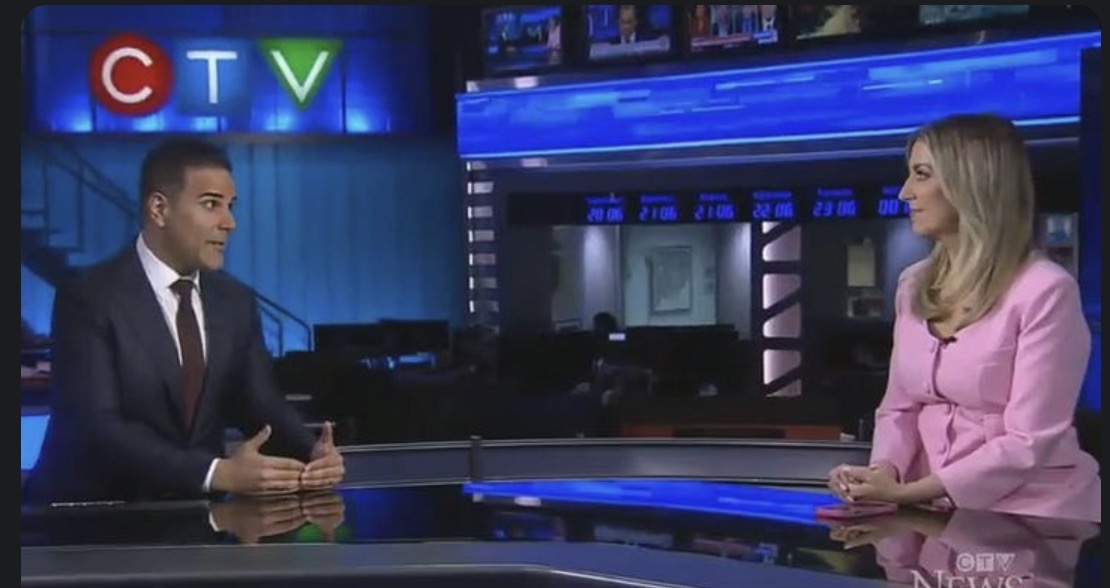
As for how he has seized power in excess of that granted by the electorate 11 months ago, there wasn’t a hint of concern on the part of CTV News anchor Omar Sachedina when Carney’s majority was confirmed in a couple of “gimme” by-election victories.

The leading voice on Canada’s most-watched newscast, Sachedina appeared awestruck by the “historic” moment and “what the Liberals have been able to achieve in the past year”. When his sidekick, Vassy Kapelos, noted Carney was now out of excuses for not fulfilling the promises that won him a minority government in 2025, Sachedina suggested soothingly that Canadians remember “sometimes ambition does take time, sometimes several election cycles”.

Screencap of CTV News from The Rewrite

The message to Canadians? The Liberals have accomplished great things in the past year, the greatest of which was to do what no one in the nation’s history had ever done before — manufacture a majority without the public’s consent. Oh, and be patient. PMMC’s agenda could take a few more elections. Sit tight and trust.

The next morning, questions were not, as one might expect from defenders of democracy, about whether the PM felt a tad greasy for the way in which he had won unfettered power. Like, in some countries — many actually — that might be considered kind of scary. Here? If you watch the news, it’s dreamy.

The preferred line of inquiry was to ask Carney whether, if he was the Opposition Leader, Pierre Poilievre, he would quit. And so it went for the rest of the week. PMMC wasn’t asked if he worried that his majority would undermine the public’s faith in its institutions. Nor did the press corps pursue their sources to discover what inducements may have been offered to create his Judas Gang of Five.


  1. Yes, I know … the presstitutes will “love him long time” as long as the government subsidies keep rolling in.

March 26, 2026

Canada’s “national broadcaster” has become an expensive irrelevance

Filed under: Business, Cancon, Government, Media — Tags: , , , , , , — Nicholas @ 03:00

The Canadian Broadcasting Corporation was set up to provide Canadians across the vast heartland of the country with quality news and entertainment options. Some would say it was able to achieve those goals well enough for decades, but with the rise of the internet, fewer and fewer people are watching, listening to, or reading CBC content. In some major cities, the CBC’s share of attention is a rounding error, despite the federal government subsidizing their effort on top of the annual budget they already receive from the taxpayers.

On the social media site formerly known as Twitter, L. Wayne Mathison makes the case for letting the CBC shut down:

CBC Isn’t Being Attacked. It’s Being Ignored. And That’s Worse.

There’s an old business rule most people learn the hard way: if your customers quietly leave, you’re already finished. No protest. No boycott. Just silence.

That’s where the CBC is right now.

You can spin it. You can defend it. You can fund it.
But you can’t fake attention.

We’re looking at a public broadcaster that calls itself the “voice of Canada” while pulling audiences so small they’d embarrass a local radio host. In some cases, tens of thousands of viewers in major cities. That’s not a dip. That’s a collapse.

And here’s the uncomfortable part:

Canadians didn’t lose interest in news. They lost interest in that version of news.

Because when reporting turns into messaging, people notice. When coverage feels selective, people adjust. When tone replaces trust, people leave.

Quietly.

Now layer in Mark Carney.

Carney’s entire pitch rests on a simple belief: that complex societies should be guided by centralized expertise. Managed from the top. Coordinated. Directed. Calibrated.

Sounds efficient. Sounds smart. Sounds like it belongs in a white paper.

But we already have a working example of that model in action.
It’s called CBC.

Centralized control

Institutional messaging

Weak accountability to audience demand

Heavy public funding

And the result?

A broadcaster Canadians are walking away from in real time.

That’s not a coincidence. That’s a signal.

Here’s the reframe nobody wants to touch:

CBC isn’t failing because it lacks resources.
It’s failing because it lost the discipline of needing to be chosen.

When your funding doesn’t depend on your audience, your audience eventually stops depending on you.

That’s not ideological. That’s behavioural economics.

Carney’s model doubles down on that exact structure. More planning. More coordination. More reliance on expert systems that assume compliance instead of earning trust.

But trust doesn’t scale through authority.
It scales through responsiveness.

And that’s the part that’s missing.

This is where the conversation usually derails into tribal nonsense. “Defund”. “Protect”. “Save public media”.

Misses the point.

The real question is simpler and harsher:

What happens when institutions stop adapting because they don’t have to?

You don’t get stability.
You get drift.

You don’t get unity.
You get quiet disengagement.

And you don’t get better outcomes by expanding that model across the country.

You get more of the same, just bigger.

I’ve run businesses. You learn this fast or you go broke:

If people stop showing up, it’s not because they suddenly became irrational. It’s because you stopped giving them a reason.

CBC stopped giving people a reason.
Carney’s approach assumes the reason doesn’t matter.

That’s the disconnect.

Hard line:
If an institution can’t earn attention, it shouldn’t demand trust.

March 16, 2026

QotD: Political entrepreneurs and federal subsidies

[In his book The Robber Barons], Josephson missed the distinction between market entrepreneurs like Vanderbilt, Hill, and Rockefeller and political entrepreneurs like Collins, Villard, and Gould. He lumped them all together. However, Josephson was honest enough to mention the achievements of some market entrepreneurs. James J. Hill, Josephson conceded, was an “able administrator”, and “far more efficient” than his subsidized competitors. Andrew Carnegie had a “well-integrated, technically superior plant”; and John D. Rockefeller was “a great innovator” with superb “marketing methods”, who displayed “unequaled efficiency and power of organization”.

Most of Josephson’s ire is directed toward political entrepreneurs. The subsidized Henry Villard of the Northern Pacific Railroad, with his “bad grades and high interest charges” show that he “apparently knew little enough about railroad-building”. The leaders of the Union Pacific and Central Pacific, Josephson notes, “carried on [their actions] with a heedless abandon … [which] caused a waste of between 70 and 75 percent of the expenditure as against the normal rate of construction”. But it never occurs to Josephson that the subsidies government gave these railroads created the incentives that led their owners to overpay for materials and to build in unsafe areas. He quotes “one authority” on the railroads as saying, “The Federal government seems … to have assumed the major portion of the risk and the Associates seem to have derived the profits” — but Josephson never pursues the implication of that passage.

Burton W. Folsum, “How the Myth of the ‘Robber Barons’ Began — and Why It Persists”, Foundation for Economic Education, 2018-09-21.

March 11, 2026

The Supreme Court of Canada in Santa Claus mode (even if they no longer use those robes)

Filed under: Cancon, Government, Politics — Tags: , , , , , , , — Nicholas @ 05:00

In a pretty conclusive 8-1 decision, the Supreme Court of Canada seems to have overturned not only the Quebec childcare entitlement at issue in this case, but the notion of citizenship in a much wider sense:

The SCC recently abandoned their traditional red robes for black robes more similar to those of the US Supreme Court. This is a case where the older robes would be more appropriate for other reasons.

On Friday, the Supreme Court of Canada delivered its latest stupefying ruling. According to an 8–1 majority in the case of Quebec (Attorney General) v. Kanyinda, the Charter requires the Quebec government to extend subsidized daycare benefits to refugee claimants — asylum seekers who have not yet proven the legitimacy of their claim to refugee status. Founded on a prevalent but contentious reading of constitutional equality rights, the court’s reasoning has far-reaching potential to destabilize parts of the nation’s immigration and social welfare systems.

Until last week, Quebec law granted daycare subsidies to certain categories of parents, including Canadian citizens, permanent residents, and those with approved refugee status. When Bijou Cibuabua Kanyinda, the plaintiff in this case, arrived in the province and sought asylum in 2018, she fell into none of those categories. Aided by cause lawyers, and a coterie of social justice interveners (third party interest groups who submit arguments to the court), Kanyinda argued that the exclusion of refugee claimants from this welfare scheme amounted to unconstitutional discrimination.

Remarkably, the majority of the Supreme Court not only agreed with Kanyinda that the Quebec daycare scheme violated Section 15(1) of the Charter — which provides for “the right to the equal protection and benefit of the law without discrimination” — but bypassed the Quebec legislature by “reading in” a remedy directly into the law. In other words, the court rewrote the statute to immediately grant subsidies to “all parents residing in Quebec who are refugee claimants”.

More troubling than the outcome itself, however, will be the judicial reasoning that rationalized it. Writing for the majority, Justice Andromache Karakatsanis held that the Quebec scheme created a distinction “on the basis of sex”, a proscribed ground of discrimination under Section 15. But rather than fostering a distinction between men and women, Justice Karakatsanis asserted that the scheme discriminated between “men and women refugee claimants” — even though neither group was eligible for benefits at all. Because Quebec’s exclusion of refugee claimants worsened the economic disadvantage of the female claimants, she concluded, it constituted discrimination that violated Section 15.

The court’s reasoning is convoluted, to be sure. Readers may be forgiven for struggling to understand how a ruling that extends benefits to “refugee claimants” can follow from a supposed distinction on the basis of “sex”. In fact, the judgment exposes the incoherence into which the Supreme Court’s equality rights jurisprudence has fallen.

February 24, 2026

The political spectrum in Canadian media runs from the far left all the way to the left-of-centre

Filed under: Cancon, Government, Media, Politics — Tags: , , , , , , — Nicholas @ 05:00

The federal government isn’t noted for being good with money. Yes, I know, understatement of the century … But they did make one investment that has been fantastically beneficial. For the Liberal Party, if not for Canadians in general. That investment was buying the support of almost all of the surviving mainstream media outlets by directly subsidizing their payrolls. Most media folks lean left anyway, but once their paycheque literally depended on keeping the Liberals happy, they joyfully co-operated in ways that 1930s German newspapers would blush at. On her Substack, Melanie In Saskatchewan explains just how far away from representative the media political spectrum has drifted (leftwards, of course, always leftwards):

If you were to draw a Venn diagram of the real Canadian political landscape and the pundit ecosystem on legacy networks, you’d find they barely overlap.

Rosemary Barton is the undisputed matriarch of the CBC’s political brand. As host of At Issue and Rosemary Barton Live, she shapes the entire panel tone for CBC political discourse and anchors the network’s election coverage. She has been at the helm of federal election panels since 2016, interviewing party leaders and moderating debates from coast to coast.

Canada’s mainstream media as Liberal Party propagandists.
Image from Melanie In Saskatchewan

Now ask yourself this: if half the population consistently feels unheard by these panels, is that a coincidence, or the predictable result of decades of the same ideological herd wandering through the same studios?

Here is the rub. The At Issue panel rarely rotates through voices that actually represent today’s conservative electorate. Instead, it routinely features professional journalists and political insiders who debate among themselves, talking about conservatives far more often than they engage with conservatives whose voters make up a massive share of the country. That is not centrism. It is an echo chamber assembled by committee.

Then there is Andrew Coyne. He is often presented as the token ideological counterweight on At Issue, the panel’s supposed nod to conservatism. After all, he has spent decades as a columnist and editorial thinker, comfortably critiquing governments from a well upholstered perch.

But let us be clear. Coyne is not remotely representative of today’s conservative electorate. He is not a reflection of the current Conservative Party base. He is not channeling the instincts of voters outside the Ottawa and Toronto corridor.

Positioning him as the conservative voice on a national panel is not balance. It is branding. It allows producers to claim ideological diversity without ever inviting someone who actually carries the convictions, tone, or priorities of the modern conservative movement. Coyne is not a grassroots conservative. He is a professional pundit whose worldview fits tidily within the Ottawa insider class. That is not ideological contrast. It is controlled opposition dressed up as pluralism.

Meanwhile, audiences have been increasingly vocal online about the sense that these panels sound like academic seminars, not reflections of the lived experience of Canadians who didn’t spend their twenties in Ottawa press galleries.

Canada’s climate follies, a brief update

On Substack, John Robson looks at the Canadian federal government’s lofty climate goals and their pathetic strategies to achieve those goals and the vast chasm between the two:

Chinese electric vehicles are likely coming to Canadian roads, like these BYD models.

Forgive us for being fixated on Canada’s climate follies just because we live here. But they are revealing, including the U-turn on EVs that we mentioned last week where the government yanked the steering wheel so hard they did a 360 from banning gasoline vehicles by law to banning them by regulation. Raising the question whether they actually know what they’re doing and, if so, whether they regard themselves as commendably devious or just way smarter than everyone else. We hope not the latter because the policy is going to fail big-time. As Randall Denley just warned in the National Post, “To summarize, the Carney plan relies on electric vehicles (EVs) that Ontario plants don’t produce, a sudden and dramatic new appetite for buying EVs and an imagined export market that doesn’t exist. To top it off, the federal government will provide $2.3 billion in EV rebates that will encourage Canadians to buy cars made elsewhere.” Apart from that, a stroke of genius of the sort that, through decades of diligent effort, has made the nation tragically poorer without hitting any of our targets including the one where they get more humble.

As a Globe & Mail news story blurted out:

    A new study published Friday by the Canadian Climate Institute says Canada is not on track to meet any of its climate targets – not the 2026 interim emissions reduction target, the 2030 Paris Agreement commitment, or even the long-term goal of reaching net-zero emissions by 2050.

Oh. Pretty hard to make that one sound like an achievement, isn’t it? Or to sound as if the people who pulled it off should be trusted with the next one.

Now as we’ve complained before, the “Canadian Climate Institute” bills itself as some sort of dispassionate neutral observer when in fact it’s a creature of the state. And, worse, one of those lavishly-funded outfits (we deniers may have all the money, but they got $30 million from the Canadian government and we did not … uh no, that was just one grant, the total’s higher) that exists to push the government to do things it wants to do anyway but needs the appearance of “civil society” support to pull off.

Thus, the Globe sonorously informs us, the problem isn’t that the targets were impractical or the politicians and bureaucrats inept. Heck no. As usual with Thomas Sowell’s “unconstrained vision” of public policy, all you need is love:

    The report suggests Canada has moved away from its climate goals thanks to “a slackening of policy effort over the past year, marked by the removal or weakening of climate policies across the country”.

Which gives the impression they had been on track to meet their goals up until some recent backsliding, whereas in reality they have never shown any sign of meeting them. After all, what policies have actually changed since Carney took over as Prime Minister in ways that could possibly affect long-term trends? And how close was Canada to meeting “its climate goals” before this disastrous swerve into the camp of the deniers?

It’s not even true that “Canada” as a collective has collective “climate goals”. The government has climate goals, and they come bundled with a host of other policies at election time, especially since even our “Conservative” party is terrified of challenging climate orthodoxy. Public support for those goals is weak, sporadic and prone to vanish when real costs hove into view. But ignoring that piece of typical collectivist prose, Mark Carney has spent most of his prime ministership flying around virtue-signaling in the presence of others doing the same. (No, really. It’s been less than a year and he’s taken almost three dozen flights.) He hasn’t been in the office shredding this and demolishing that.

February 18, 2026

It’s not just Britain that gives asylum-seekers better care than citizens – Canada does too

Filed under: Bureaucracy, Cancon, Government, Health — Tags: , , , — Nicholas @ 05:00

We had a look at how well the British government looks after asylum-seekers yesterday, but other nations are probably doing similarly inequitable things to give money and services to non-citizens than they ever would for the people who pay the taxes for these over-generous programs. In the National Post, Tristin Hopper outlines the findings of a recent analysis from the Parliamentary Budget Office on the costs of supporting huge numbers of foreign nationals in Canada:

An asylum seeker, crossing the US-Canadian border illegally from the end of Roxham Road in Champlain, NY, is directed to the nearby processing center by a Mountie on 14 August, 2017.
Photo by Daniel Case via Wikimedia Commons.

Paying the health-care premiums of refugee claimants will cost Canadians a record $1 billion this year, with some of the beneficiaries continuing to receive free health care despite their claims having already been rejected.

That’s according to a new analysis by the Office of the Parliamentary Budget Officer, and it’s just one of several ballooning costs wrought by the unprecedented number of foreign nationals currently living in Canada by virtue of a claim of refugee status.

The Interim Federal Health Program, which offers premium health benefits to asylum claimants, is soon set to hit $1 billion in annual costs for the first time, according to an analysis last Thursday by the Office of the Parliamentary Budget Officer.

This is a five-fold increase from just six years ago, when the program was costing $211 million per year. The analysis also projects that costs are expected to surge for the foreseeable future, with the annual budget likely to hit $1.5 billion as early as 2029.

All told, between now and 2030, Canadians are on track to spend $6.2 billion on health care for refugees or refugee claimants.

“The rising volume of asylum claims, along with the longer duration of eligibility caused by extended determination times, has been an important growth driver in recent years,” reads the PBO report.

The report was commissioned following a Conservative-led request made at the House of Commons standing committee on health. In a Thursday statement, the Conservative party noted that the Interim Federal Health Program can be accessed even by asylum claimants who have had their case rejected.

It also offers a higher level of care than that enjoyed by the average Canadian citizen. In addition to hospital care and surgical care, the IFHP also covers dental care, vision care, pharmacare and other services not typically covered by public health plans.

“Rejected asylum claimants are now receiving better health care than many Canadians who have paid into a system their entire life,” read a joint statement by Dan Mazier and Michelle Rempel Garner, the shadow ministers of health and immigration, respectively.

It added, “at a time when six million Canadians cannot find a family doctor and are waiting for care, it’s unacceptable that bogus asylum seekers are receiving better health benefits than Canadians”.

February 14, 2026

The EU’s plans to drain the “wine lake” … again

Canada isn’t the only place with rigidly governed agricultural cartels … the European Union has always been a big fan of governing agricultural markets by fiat rather than allowing the markets to sort out how much of which product should be produced. One of the biggest markets actively distorted by EU regulation is the wine industry, where faulty regulations ended up paying for a vast over-supply of wine in the 1980s and 90s. Rather than eliminating the regulatory structures, the EU continues to prefer letting bureaucrats dictate to producers:

When the Common Agricultural Policy was established, it was quickly determined that one of its core objectives would be the protection of farmers, ensuring stable incomes and food security. In the wine sector, this logic translated into strong interventionism aimed at expanding and stabilizing production.

For decades, Brussels subsidized vineyard planting, protected minimum prices, and absorbed producers’ economic risk, disconnecting production decisions from signals of demand. Producing more ceased to be an economic choice and became a politically safe decision.

This approach created a structural market distortion. As wine consumption began to decline across Europe for demographic, cultural, and economic reasons, the artificially incentivized productive structure remained intact and unable to adjust.

It was in this context that, during the 1980s and 1990s, the first major shock occurred, known as the wine lake: massive wine surpluses with no outlet. Even then, Brussels treated this episode as an isolated and temporary phenomenon, ignoring the fact that it was the direct consequence of existing policies. By persisting with the same strategies, the problem ceased to be episodic and became structural.

In the early 2000s, the European Union was finally forced to recognize that the wine crisis was not temporary. However, instead of removing production incentives and restoring the market’s adjustment function, it opted for a new form of intervention: subsidizing the voluntary uprooting of vineyards. The decision to destroy productive capacity ceased to be economic and became administrative, decreed from the European political center, with profound effects across several countries.

This model, presented as temporary, set a dangerous precedent. Rather than allowing less viable producers to exit the market through prices and economic choice, the state began paying for withdrawal, subsidizing the costs of adjustment and normalizing the idea that the correction of public policy errors should be financed with more public money.

This policy did not solve the underlying problem. It merely reduced cultivated area temporarily, while leaving intact the regulatory architecture which had created the initial distortion. The sector became trapped in a cycle of incentivized expansion, predictable crisis, and administrative correction.

It is within this framework that the Wine Package emerges as the European Union’s latest set of measures for the wine sector. The package relies on an administratively planned reduction of supply through financial incentives for vineyard uprooting, complemented by regulatory adjustments, temporary support measures, and crisis management instruments. Instead of allowing the market to adjust to declining consumption, Brussels once again opts for the destruction of productive capacity as a policy tool. Although the package includes support measures and environmental framing, its central axis remains the administrative reduction of supply.

The impact of these decisions is not marginal. The European wine sector represents a significant share of the European Union’s economy, sustaining approximately 2.9 million direct and indirect jobs and contributing more than €130 billion to EU GDP.

January 19, 2026

British Islamists scare Islamic governments more than the British government

Filed under: Britain, Education, Government, Religion — Tags: , , , , , — Nicholas @ 04:00

In Spiked, Rakib Ehsan discusses the recent efforts by the governments of some Gulf states to limit potential radicalization of their own people by reducing support for students attending British universities:

Flag of the United Arab Emirates (UAE)

In yet another blow to Britain’s reputation on the global stage, the United Arab Emirates (UAE) has curbed state funding for its citizens seeking to enrol at UK universities, over concerns they will be radicalised by Islamists.

As reported in the Telegraph last week, the Gulf state has taken this drastic step because of the influence in the UK of the Muslim Brotherhood – a transnational Sunni Islamist organisation, which is a designated terror group in the UAE. It is also banned in Egypt, Saudi Arabia and Jordan. The UAE has long offered Emirati students generous grants – including rent and living allowances – for studying “priority” subjects at British universities. These scholarships have now ended because, according to a source quoted in the Telegraph, “the UAE doesn’t want its kids to be radicalised on campus”.

This is not the first time that the UK has been embarrassed for being a soft touch on Islamism by a Muslim country. In January last year, the UAE placed eight UK-based organisations on its local terror list on the grounds of their alleged connections to the Muslim Brotherhood. Most of these entities, which range from property firms to video-production outlets, are registered in London. Then, in April, the head of the Muslim World League, Saudi Arabia’s Sheikh Mohammad bin Abdulkarim al-Issa, warned that the UK should treat poor integration as a national-security issue. He said that young British Muslims had grown disillusioned because of conflicts in the Middle East, advising the UK that “a political situation outside should not interfere with integration inside”.

The UAE’s latest decision should hardly come as a surprise. Indeed, for some time, British universities have embraced the very extremism that Muslim-majority countries have long sought to root out.

December 14, 2025

Where does all the money go for so many First Nations bands?

Filed under: Bureaucracy, Cancon, Economics, Government — Tags: , , , , , — Nicholas @ 03:00

Earlier this month, I shared a long thread highlighting some incredible findings from the audit of a single First Nations group in Saskatchewan (here). On the social media site formerly known as Twitter, @Martyupnorth discusses how the federal government has gone out of its way not to ensure that First Nations funding is transparent:

    Cory Morgan @CoryBMorgan
    The Siksika reserve got $1.3 billion a few years ago and the housing is still predominantly shit.

    It’s not lack of government funding folks.

    It’s a broken system of racial apartheid.

    This ruling won’t help a bit.

Let’s talk about transparency in First Nations reserve finances in Canada. It’s topic that’s sparked a lot of debate.

Back in 2013, the Harper government passed the First Nations Financial Transparency Act (FNFTA), which required chiefs and councils to publicly disclose their salaries, expenses, and audited financial statements. The goal? To ensure accountability for the billions in federal funding going to reserves, empowering community members to hold leaders responsible and curb potential corruption.

But the Act was controversial from the start. Critics, including many First Nations leaders (no surprise there), called it paternalistic, imposed without proper consultation, and an infringement on Indigenous sovereignty. Some argued it violated privacy by forcing the public release of sensitive financial details, like personal remuneration schedules.

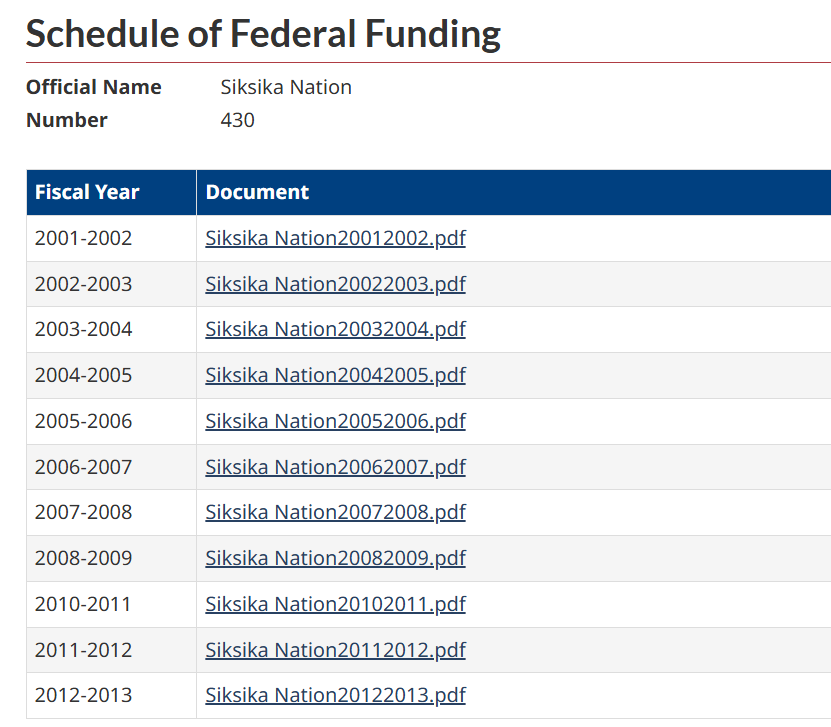
Enter Justin Trudeau. During his 2015 campaign, he promised to repeal the FNFTA, saying it wasn’t “respectful” to First Nations and needed replacement with a co-developed approach. Once in power, his government didn’t formally repeal the Act, but effectively reversed it by suspending enforcement. They stopped withholding funds from non-compliant bands, halted court actions, and reinstated frozen money. Compliance rates plummeted afterward, with fewer bands disclosing info publicly.

See the screen shot below. The Siksika Nation, to whom Cory refers to, hasn’t dislosed financial data since 2013.

The Liberals’ rationale? Building “mutual accountability” through partnership rather than top-down rules, addressing privacy concerns and respecting self-governance. But a decade later, as of 2025, the Act remains on the books unenforced, while polls show most Canadians still want transparency in how reserve funds are mis-managed.

What do you think? Does ditching enforcement help or hinder real accountability?

Update: At some point, the audits have to start and the government and the courts will then have their hands full:

December 8, 2025

“Canadian culture” apparently doesn’t include books anymore

Filed under: Books, Business, Cancon, Government — Tags: , , — Nicholas @ 03:00

In the latest SHuSH newsletter, Ken Whyte considers what the omission of financial goodies for the Canadian publishing industry in the latest federal budget (unlike the CBC, music, film and TV subsidies) says about the government’s view of what “Canadian culture” actually is:

You might have noticed that last month’s federal budget introduced a whack of new cultural spending. The CBC got another $150 million, the Canada Music Fund took $48 million, film and television raked in over $300 million. Books? Nothing.

The budget’s rationales for this new spending are to foster a sense of cultural identity and belonging in Canada, to sustain an informed citizenship, and to protect vulnerable industries. The unwritten context is the recent American assault on Canada’s independence. You would think there would be room for books in this sort of budget. Is there anything more foundational to Canadian identity and an informed citizenry than books by Canadians and about Canada?

Yet somehow our political leadership overlooked the literary sector. It’s odd. The first thing our politicians do when they want to explain or advance their own careers is knock on a publisher’s door.

Granted, it’s usually the door of an American publisher, because the net result of our government’s efforts to nurture the publishing sector in Canada over the last several decade has been to drive Canadian-published books from more than 20 percent of those sold in Canada to less than 5 percent. We have the weakest domestic publishing industry in the developed world. Our prime ministers think nothing of taking their books to New York-based Penguin Random House or Simon & Schuster. Most of our most prominent fiction writers give all their North American rights to US publishers instead of separating out Canadian rights and leaving them with a Canadian publisher. It’s a travesty.

I have a solution. In fact, I have many solutions. I have a whole book of solutions coming in January from Canadian public policy guru Richard Stursberg. It looks like this:

Richard’s solutions are not the same as my solutions. I like his, too. I’m not picky. I’m going to flood the zone with solutions and hope people in Ottawa wake up to the fact that we have a problem. The solutions will almost all involve more public support of the industry, not because I’m keen on public support of the industry, but because we have ample proof that the alternative to more public support is no domestic book publishing industry. Also, if you’ve been following us here (see SHuSH 232, The Wasteland), you know this is a “you broke it, you own it” moment for our federal government.

So here’s my solution de jour. Given that books are fundamental to any notion of Canadian identity, given that our domestic publishing sector is pathetically weak, given that any self-respecting country needs to be able to publish its own stories rather than rely on the branch plants of an increasingly difficult neighbour to do it for us, we arrange the following.

We massively expand Canada’s public lending right program (PLR). At present, the ridiculously underfunded PLR pays out about $15 million a year to some 20,000 authors whose books are circulated in Canada’s public libraries. The distributions are based on a complicated formula that mostly notices how many libraries hold the author’s book. It’s capped at $4,500 an author, and most receive only a few hundred dollars annually.

We expand the PLR’s spending envelope by a factor of ten: $150 million. Does that sound like a lot of money? It’s not. It comes to about $3.75 per capita. That’s about a tenth of what we spend annually on the CBC, which employs roughly the same number of people as book publishing. It’s about a tenth of what we spend in direct funding and tax credits on film & television. It’s less than half what we’re spending on newspaper and magazine subsidies. A small price to rebuild a decimated publishing sector.

I think you could argue that the dollar amount should be much higher. As a society, we believe that books are more important than the products of other media. The governments don’t give you free cable or a free opera pass or a free spotify subscription: they give you free books through public libraries, because books are that important to the well-being of our citizenry. We’re so good at promoting the value of our public libraries that four out of every five books read in Canada are borrowed rather than bought. If books are that important, $150 million is a bargain.

November 29, 2025

“There comes a point where government waste stops looking like incompetence and starts looking like treason”

Canadians must be literally the most passive and forgiving people on Earth. It’s the only thing that can account for how we are governed by incompetents or idiots, yet keep re-electing them despite all the clear signs of failure and opportunistic crony looting of the public purse:

Image from Blendr News

There comes a point where government waste stops looking like incompetence and starts looking like treason. Canada has long passed that point. What we are witnessing now is not mere mismanagement or bureaucratic drift — it is the systemic looting of a nation by the people meant to serve it. Billions vanish with no oversight, no accountability, and no shame. The numbers have grown so grotesque that one struggles not to call this what it is: organized theft.

Take Stellantis. Ottawa handed the automaker $15 billion — the largest corporate subsidy in Canadian history — and the industry minister didn’t even read the contract before approving it. This, despite Stellantis shifting Jeep production to the U.S., delaying its employment targets at the Windsor battery plant, and refusing to appear before Parliamentary Committee hearings. Honda received a major subsidy without full Treasury Board review. Volkswagen hid its cost estimates. Northvolt was showered with subsidies and then slipped into insolvency. Each scandal blurs into the next until you realize the pattern is not incompetence but a business model.

Then there’s the LNG project in British Columbia. The main industrial partner is an American firm. The terminal will be built overseas, floated to Nisga’a land, and subsidised by Canadian taxpayers. In other words: Canadians take the risk while the profits flow abroad and the jobs go to Korea or Japan.

Or consider Telesat. They received $2.14 billion to connect rural Canadians to high-speed internet — with no obligation to connect a single home, no penalties for failure, no clawbacks if the project collapses, and no enforced timelines. Three years later, the network still does not exist. Meanwhile, Starlink already worked, already served rural communities, could have done it for half the cost, and offered immediate deployment — but was rejected because Elon Musk is “polarizing”.

ArriveCAN? $54 million spent on an app worth $80,000, much of it funnelled to GC Strategies, a boutique firm that admitted it didn’t actually build anything. Then the Sustainable Development Fund — the so-called green slush fund — where $400 million flowed into Liberal-friendly firms.

The State tells us its creed is “responsible governance”. Yet almost every act defies that claim. What we have instead is a system run by well-dressed operators who treat the public purse as their own. Canada is now a nation run by criminals, for criminals.

November 25, 2025

You might as well watch Guru Nanak Jahaz, since you’ve already paid for it

Filed under: Cancon, Government, History, India, Media — Tags: , , , , — Nicholas @ 03:00

The Canadian government loves handing out money — they hand out a lot of money — so it shouldn’t be surprising to find out that Canadian taxpayers funded the creation of a movie about a Sikh terrorist who assassinated a Canadian official … or that the assassin is the hero of the movie. After all, isn’t that the heart and soul of multiculturalism? Celebrating other cultures and traditions as being superior to those of ordinary Canadians? The feds seem to believe it.

If you can find a way to watch the recently released Khalistani propaganda film Guru Nanak Jahaz, you might as well watch it. You paid for it, after all.

The film, which depicts the assassination of a Canadian civil servant by a Sikh terrorist as a heroic act of justice, has a “Funded by the Government of Canada” credit at the end. It was also supported by the B.C. government and gives special thanks to Conservative MP Tim Uppal and Liberal MP Sukh Dhaliwal. While the Liberals didn’t return a request for comment, a spokesperson for Uppal told me that he was not involved in the film and that the filmmakers did not communicate with him about the credit at any point.

Set in 1914, the plot follows the assassin, who you likely never heard about, and the voyage of the more familiar Komagata Maru, a ship which carried nearly 400 Indian passengers from Hong Kong to Vancouver, only to be denied entry to Canada. It was screened in some Cineplex theatres earlier this year.

The official narrative that you’ll find on government websites explains that this was purely a matter of baseless Canadian racism, and it’s been wholeheartedly adopted by politicians today: as prime minister, Justin Trudeau apologized for the incident in 2016, and the Conservative party releases annual statements commemorating the event, praising the bravery of the passengers and their craving for freedom.

That’s the whitewashed version, however. It leaves out that the Komagata Maru voyage was organized by the Indian Ghadar movement — the word literally means “revolution” — which advocated for violent resistance against the British Empire. (India was a British possession at that time and would continue to be until 1947). Its members were primarily Sikhs who lived in North America. And while they did experience racism, and while changes to Canada’s immigration laws in 1908 indirectly restricted Indian immigration, there were also reasons for the Canadian government to be apprehensive.

Ghadar members dreamed of a return to India, but wanted to rid that land of the British first. They remembered the Indian Mutiny of 1857 with regret — that bloody event saw many British-Indian regiments unsuccessfully take up arms against the Empire; Sikh Punjabis were among the exceptions, largely siding with the British. Decades later, the mostly Sikh Punjabi Ghadarites proposed another 1857-like uprising while applauding anti-British terrorism.

When rumblings of war with Germany began to brew in 1914, the Ghadarites grew excited — now was the time to strike. In August 1914, after the war broke out, the movement’s newspaper advocated, “Go to India and incite the native troops. Preach mutiny openly. Take arms from the troops of the native states and wherever you see the British, kill them. … There is hope that Germany will help you.” Expats in the Orient organized ships to return home and revolt.

The Komagata Maru was part of this movement. Organized by Ghadarites before the breakout of the First World War, it attempted to bring more movement adherents into Vancouver to settle. Canada was right not to let it dock because the entire envoy was a security threat.

The S.S. Komagata Maru was at the centre of an attempt to bring 400 Sikh revolutionaries into Canada to agitate for the destruction of British rule in India in 1914.

October 17, 2025

Stellantis took the bribe, left Canada anyway

Filed under: Business, Cancon, Government, Politics, USA — Tags: , , , , , — Nicholas @ 04:00

The former American Motors plant in Brampton, now owned by Stellantis, was supposed to be the manufacturing site for a new Jeep vehicle. The federal government under Justin Trudeau handed about $15 billion to Stellantis to build an EV battery complex in Windsor, Ontario. It was apparently just assumed that this meant that Stellantis would keep the Brampton facility open and operating, but that assumption was faulty:

Stellantis has announced they’re leaving Brampton. That’s it. End of story.

Three thousand workers. Gone. A manufacturing base gutted. A city thrown into economic chaos. And a federal government left holding a $15 billion bag it handed over like a drunk tourist at a rigged poker table.

The Jeep Compass — the very vehicle they promised would anchor Ontario’s role in the so-called “EV transition” — will no longer be built in Canada. Production is moving to Belvidere, Illinois. The same company that cashed billions of your tax dollars under the banner of “green jobs” and “economic transformation” has slammed the door and walked out. And no, this isn’t a surprise. This was baked into the cake from day one.

Let’s rewind.

In April 2023, under Justin Trudeau’s government, Chrystia Freeland — then Finance Minister — and François-Philippe Champagne, the Industry Minister, announced what they called a “historic” agreement: a multi-billion-dollar subsidy package to Stellantis and LG Energy Solution to build an EV battery plant in Windsor, Ontario.

It was sold as a turning point. The future. A Green Revolution. Thousands of jobs. A new industrial strategy for Canada. But in reality? It was a Hail Mary pass by a government that had already crippled Canada’s energy sector and needed a shiny new narrative heading into an election cycle.

And here’s what they didn’t tell you: the deal had no enforceable commitment to keep auto production in Brampton. There were performance-based incentives — yes — but only for the battery plant. Not for the Brampton assembly line. Not for the existing workforce. And certainly not for ensuring the long-term health of Canada’s domestic auto industry.

They tied this country’s future to a globalist fantasy. A fantasy that assumed the United States would remain under the control of climate-obsessed technocrats like Joe Biden. A fantasy that required a compliant America pushing carbon neutrality, electric vehicle mandates, and billions in matching subsidies for green infrastructure.

But in November 2024, Americans said no.

Donald Trump was elected president. And just as he promised, he tore Biden’s green agenda to shreds. He pulled out of the Paris Climate Accord — again. He dismantled the EV mandates. He unleashed American oil and gas. But he didn’t stop there. Trump imposed a sweeping America First manufacturing policy, pairing 25% tariffs on imported goods with aggressive incentives to bring factories, jobs, and supply chains back onto U.S. soil.

And, as Conservative deputy leader Melissa Lantsman points out, it’s just the beginning:

You probably heard the news by now: Stellantis is cancelling its opening of a Jeep factory planned in Brampton, taking over 3,000 jobs and USD $600 million of investment out of Canada and moving it to the U.S.

This is the latest development in the growing trend of companies scaling back their operations in our country and choosing instead to grow in the US. Whisky maker Diageo found its name in the headlines last month when they announced they’d move their Crown Royal bottling facility south. GM laid off or cut down shifts for 750 autoworkers in Oshawa and 900 in Ingersoll while sending $4 billion to the U.S. Those are the ones that drew the headlines.

Why is this happening? Well – the reason on everyone’s mind right now is tariffs. And it’s true – tariffs are having a big impact on the Canadian economy and on our trading relationships. But there are other, deeper reasons at play, too.

Companies don’t just make decisions on a whim – especially those related to long-run production and fixed investments totalling hundreds of millions or even billions of dollars. Those decisions are made as part of detailed, multi-year analyses that take into account predicted economic conditions, market forces, and many other factors. A massive move of your production facility isn’t a temporary, six-month decision to be trifled over – it’s a permanent thing and that means they aren’t coming back.

The objective is to decrease uncertainty, cut costs, increase production, etc. etc. all to work in favour of any company’s ultimate goal, which is, of course, to make money.

So let me translate what all these investment and job cuts really mean: they’re not a knee-jerk reaction to the tariffs, although those play a part. They’re a statement about the long-term trajectory of the Canadian economy and the kind of climate that a decade of Liberal government has built for businesses in this country.

If these companies thought the U.S. tariffs would be transitory, a six-month blip, an economic fad – then they’d have no reason to cancel factories that will be producing goods for 20 or 30 years. That wouldn’t make financial sense.

[…]

If things get worse, the government might resort to its favourite strategy of just offering more hand-outs for businesses to try and entice them to stay here, but that only works for so long. That Stellantis plant in Brampton? The one that’s moving to the U.S.? The Ontario government promised them over $500 million just a few years ago – and the feds followed.

Turns out, you can promise to cut somebody a giant cheque and it’s still unprofitable for them to do business here.

As I mentioned, the continued trade uncertainty doesn’t help our situation, and the Prime Minister’s failure to get a deal is costing us big-time – especially as he promises to drive a trillion dollars of investment southbound at the expense of our workers here.

But as long as the Liberals keep the same old approach towards economics and business in this country, as long as the Liberals keep the taxes high, the productivity low, and the red tape piled up high — expect to see more headlines like the one about Stellantis, not fewer.

How many more job losses will it take for our leaders to realize that?

September 26, 2025

A ministry for “Heritage” should not be funding hate publications

Filed under: Cancon, Government, Media, Politics — Tags: , , , , — Nicholas @ 04:00

I’m with Dan Knight that the government shouldn’t be funding any private networks, magazines, or newspapers, but since it does provide a lot of funds through various programs, it should at the very least strive to avoid funding open hatred toward ordinary Canadians:

Steven Guilbeault at a happier stage of his life, before joining the Liberal cabinet.

In a fiery exchange at the Standing Committee on Canadian Heritage (CHPC), Conservative MP Rachel Thomas dismantled Liberal Minister Hon. Steven Guilbeault, P.C., M.P., Minister of Canadian Identity and Culture and Minister responsible for Official Languages, over taxpayer money funneled into groups publishing hate-laced screeds and smearing everyday Canadians.

Thomas zeroed in on Cult MTL, a publication receiving federal heritage funds. She read into the record a headline published the very day after reports of Charlie Kirk’s assassination attempt: “To Hell with Charlie Kirk”.

“Minister, do you think that is wrong? Taxpayer dollars are funding this group. Will you revoke their funding?” Thomas demanded.

Guilbeault looked blindsided. He admitted he had no idea the government was bankrolling a tabloid openly celebrating political violence. His answer:

    I have not been made aware of this. I will verify with the department and report back to you. Obviously, spreading hate has no place in Canada, and if this is the case, we will make the necessary verifications and take the necessary steps.

Thomas didn’t stop there. She turned to the Canadian Anti-Hate Network, which she said has already pocketed about $1 million from Guilbeault’s department. Documents show the group paid an “investigative journalist” to hunt down so-called “far-right” targets — defining the term so broadly it included Catholics and pro-life Canadians — before seeding the stories into mainstream news outlets.

[…]

Conservative MP Rachel Thomas quoted former CBC anchor Travis Dhanraj, who launched a human rights complaint this summer […]

    To be honest, this has been the hardest period of my life. What happened at CBC really broke me.

Then she put it directly to Guilbeault:

    Have you reached out to the CEO of the CBC regarding this situation and the toxic work environment that is being accused there?

Guilbeault’s answer? Bureaucratic shrugging:

    The government role is not to get mixed into the daily operations and management of the organization. That is the purview of the organization, in this case, the public broadcaster.

Translation: $1.4 billion of your money flows into CBC every year, but the minister says he can’t pick up the phone when staff say they’re being harassed.

Older Posts »

Powered by WordPress