
So why would we impose tariffs on an import or three? No, leave aside whether it’s a good idea or not, why would we do so? To increase the price of that item inside those tariff barriers. That’s it, that’s the point, to increase the price.
Think on it. So, those dastardly foreigners are better, or cheaper, or subsidised, or just plain swarthy johnnies who are selling to us and thereby stealing the crust from the mouths of the more expensive (or less good etc) proper British producers. So, we now impose a tax at the border. This makes those products from swarthy johnnies more expensive. So, people will buy fewer swarthy and more good and honest British.
This also enables the good British to raise their prices and so make a profit.
So, what actually happens is that the British consumer gets screwed for the benefit of British capitalists. Not quite what I’d recommend as a policy but that’s the point and the intention. Tariffs raise the domestic price of the thing, that’s the reason why.
Tim Worstall, “But Increasing Prices Is The Very Point Of Tariffs”, It’s all obvious or trivial except …, 2026-06-18.
September 25, 2026
QotD: The whole point of imposing tariffs is to raise prices
September 22, 2026
Trumpian economics – making Mercantilism great again
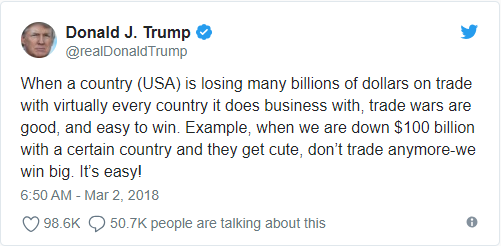
President Donald Trump is remarkably inconsistent on a lot of issues, but one thing that keeps coming back is his apparent allegiance to protectionism and mercantilism:
Politics is an industry in which ideas demonstrated to be ineffective and morally reprehensible live on long after they should have died. That’s the case with President Donald Trump’s fondness for mercantilism, as he espouses hoary old nostrums about the alleged benefits of hoarding money and preventing Americans from using their capital to purchase desired goods from other countries. Like a throwback to the 18th century, the president mistakes accumulating the means of exchange for building actual prosperity, as if we’d all be better off with overstuffed wallets than with the things our funds can purchase.
“Losing” Money on Voluntary Transactions?
Last week, when asked about the eternal political bogeyman of “trade deficits”, Trump responded, “If we lose $50 billion a year with a country, and we say, ‘we’re not going to trade with you anymore’, we don’t lose $50 billion a year. It’s very simple. Right?”
The president’s comments continued a theme he’d expounded on Truth Social, where he wrote, “If we stopped Trading with every country that we have a Deficit with, which is most of them, we would make, at least, 1.5 Trillion Dollars a year.”
Earlier this month, the president threatened to entirely stop Americans from trading with businesses in countries with which the Unted States runs a trade deficit — that is, from which we overall buy more than its residents purchase from Americans. His position seems to be that we’re better off hoarding cash than we would be using (or losing, from his perspective) our money to purchase things that we want.
But as the late economist Milton Friedman commented during an earlier incarnation of the eternal debate over the “fairness” or lack thereof of international trade, “the goods and services we import, they provide us with TV sets we can watch, automobiles we can drive, with all sorts of nice things for us to use. The gain from foreign trade is what we import. What we export is the cost of getting those imports. And the proper objective for a nation, as Adam Smith put it, is to arrange things so we get as large a volume of imports as possible, for as small a volume of exports as possible.”
[…]
Everybody Benefits From Free Trade
“Nothing, however, can be more absurd than this whole doctrine of the balance of trade”, Smith warned in An Inquiry Into the Nature and Causes of the Wealth of Nations, published in 1776. “When two places trade with one another, this doctrine supposes that, if the balance be even, neither of them either loses or gains; but if it leans in any degree to one side, that one of them loses, and the other gains, in proportion to its declension from the exact equilibrium. Both suppositions are false.” In fact, he pointed out, “trade which, without force or constraint, is naturally and regularly carried on between any two places, is always advantageous, though not always equally so, to both”.
As Smith’s criticism makes clear, the ideas of “balance of trade” and “trade deficits” are archaic throwbacks to mercantilism, even though they’re still popular among politicians playing to ill-informed voters. Smith’s points prevail among economists even in cases where one country burdens its population with trade barriers while allowing relatively unhindered exports.
August 26, 2026
Regulating away small company benefits in the EU
Cláudia Ascensão Nunes discusses yet another example of regulatory capture, as new European Union regulations will choke off business opportunities for small companies to the benefit of big companies and multinationals who can absorb the costs of the new environmental regulations:
Today, the European Commission estimates that the Single Market has increased the European Union’s GDP by 3–4% and created 3.6 million jobs since its creation. A study by Bertelsmann Stiftung estimated that integration increases European citizens’ incomes by an average of about €840 ($974) per person per year.
Yet the benefits created by this integration, and the freedom that made these benefits possible, began to come under threat on August 12, 2026, quietly and through an apparently harmless packaging regulation.
The Packaging and Packaging Waste Regulation (PPWR) will force sellers, both European and foreign, to comply with a complex set of rules that may be manageable for large brands but suffocating for small businesses.
The most problematic requirement is that sellers shipping packaged products to an EU country where they are not established must appoint a local authorized representative. That representative will act on behalf of the seller before that country’s recycling authorities. The representative must register the company in the national Extended Producer Responsibility, or EPR, system, file annual reports on the packaging the company places on that market, and charge a service fee of between €200 ($232) and €500 ($580).
The process of appointing a representative in one country is both bureaucratic and expensive. Doing so across several countries can become impractical for small sellers, who lack the scale to spread these fixed costs across a large volume of sales, especially since the PPWR does not provide a volume-based exemption.
Several businesses are already announcing the suspension of shipments to other EU countries or disabling shipping options to the EU altogether. The German company Copiaro, for example, suspended shipments to other EU member states while continuing to ship to European markets such as Switzerland, Norway, and the United Kingdom, which are outside the EU’s regulatory framework.
We are therefore returning to something resembling the old national markets, with barriers to entry.
The entire model of cross-border trade for small businesses risks being undermined in the name of environmental protection. Yet if larger companies, which produce far more packaging waste, are the ones best able to absorb these costs, we are facing a contradiction. Packaging regulations can shield large sellers from competition by smaller businesses, creating a more closed and concentrated market.
Europe may become greener by becoming poorer. European entrepreneurship is being strangled, and small business owners are paying the price.
August 15, 2026
Debunking common Supply Management beliefs
On his Substack, Dr. Sylvain Charlebois debunks ten myths about Canada’s supply management cartel that interfere with Canadians’ ability to engage with the idea of dismantling the government’s favourite oligopoly:
Suddenly, everyone — and their grandmother — seems to be an expert on supply management.
That newfound interest is healthy. Canadians are finally examining the benefits, costs and contradictions of a complicated system affecting roughly one-quarter of the country’s agricultural economy.
A generation ago, few economists openly criticized supply management. Those who did faced fierce attacks, while the dairy lobby deployed a nationwide marketing budget approaching $200 million annually. Remember the Doug Gilmour milk advertisements? Today, the “Milk” logo appears on Toronto Maple Leafs jerseys through a multimillion-dollar sponsorship.
For years, criticizing supply management was almost politically taboo. Social media has changed that. Consumers can now see milk being dumped, compare Canadian prices with those abroad and question why Ottawa repeatedly compensates a protected industry.
Dairy farmers are not the problem. They operate rationally within rules created by governments and administered by marketing boards. But those rules should not be immune from scrutiny.
Here are 10 myths Canadians should stop believing.
1. Dairy farmers are poor […]
2. Supply management is saving the family farm […]
3. Canadian dairy farmers receive no subsidies […]
4. Trade agreements make every dairy farmer lose money […]
5. Ending supply management would automatically lower prices […]
6. Farmers alone pay for dumped milk […]
7. Milk dumping is unavoidable […]
8. Canada has fully respected CUSMA […]
9. Supply management guarantees food security […]
10. Reform means abolishing the system overnight […]
August 12, 2026
“It might be Carney’s unconditional surrender to Trump, but it’d be worse under Poilievre”
I exaggerate a tad in my choice of headline, but Canada’s bought-and-paid-for relic media will always choose to present a spectacular Carney faceplant as being somehow better than any theoretical action by Poilievre. If Carney’s going to surrender to the Yanks unconditionally, it would obviously be far worse if the Leader of the Opposition had been PM instead. eLbOwS uP, everyone!:

The new Canadian trade flag – The Line
Well, it looks like our prime minister is losing his nerve, eh?
Reports are now leaking fast and furious that Trump’s surprise August 19 tariffs have worked to break our strategic patience. Canada is working to secure some kind of interim deal, and if the leaks are to be believed, we’re going to give the Americans essentially everything they want while they maintain most tariffs on us. It appears to be a shit deal for us, and one that puts us directly in the glide path toward vassal state.
Worse — and, to be frank, I do think this is the worst part of all of this — it’s the exact opposite of what we elected Mark Carney to do. When facing economic and political aggression from a neighbour and once-ally like the United States, surrender vs. resistance is a valid conversation to have. Given our circumstances, one could make a legitimate case for either choice. However, as a people, we did have that conversation, in the spring of 2025. We did make that choice. We chose resistance. We chose sacrifice. That was the premise of the last election, and that was the value proposition Mark Carney made for himself.
Instead, what we’ve actually done in the past year-and-a-half is a counter-productive middle path: yes, we’ve made moves toward strengthening our economy internally, and this is all to the good. But when it comes to measures that require a willingness to stand up to real power, all we’ve offered has been performative resistance in the form of angry social media sputtering and grandiose global speeches, followed in private by concession after concession. This has left us with the worst of both options. We’ve demonstrated that we lack the collective will to sustain real economic sacrifice. And we’ve just annoyed the Americans, which has clearly only increased their desire to make an example of us.
What we absolutely did not vote for was the prediction offered by Ian Bremmer of the Eurasia Group, a political risk analysis firm with long ties to Carney and the Liberals. Last year, Bremmer wrote: “Canadian leaders have a political incentive to put up a bigger fight because Trump’s threats toward Canada’s economy and sovereignty have sharply inflamed nationalist sentiment north of the border in the run-up to the April 28 elections. However, I expect Ottawa will quietly fold shortly after the vote to ensure that ongoing relations with the U.S. remain functional.”
Congratulations, Canada. You got punk’d.
In honesty, I can’t think of a worse strategy for achieving a remotely fair trade deal with the United States than the one Carney chose to follow. If he’d been dealing with George W. Bush, this plan might have worked, but I think that Bush was the last US president who would put up with the juvenile performative “strategy” Canada used. Barack Obama would have easily turned the tables, as the relic media loved (and still love) Obama more than they love maple syrup and oxygen. Even Joe Biden’s handlers could have highlighted just how J.V. Canada was acting. But for some reason, the Liberals decided that constantly pissing in Donald Trump’s cornflakes was a winning strategy. And now we’re looking at a maple-flavoured Appomattox Court House meeting … and Trump has no interest — quite the opposite, in fact — in being as generous to a defeated foe as Ulysses S. Grant was to Robert E. Lee.
April 5, 2026
When military requirements conflict with national policies
On Substack, Holly MathNerd explains why the US military hasn’t ramped up production of drones in light of the experiences of other current conflicts:

Photo by Jonathan Lampel on Unsplash
Most people who have opinions about the war in Iran are not also reading the Federal Acquisition Regulations. I am, unfortunately for my social life, one of the people who does both.
And when you hold those two things in your head at the same time — what’s happening over the Strait of Hormuz and what’s happening in federal procurement policy — a contradiction emerges that is so glaring, and so consequential, that I could not write about anything else this week.
Here is the contradiction, in full, before I show you the data.
The United States is fighting a war where drones are the decisive tactical weapon. We are spending $2 to $4 million per intercept to stop Iranian drones that cost $50,000 each. Our own offensive drone program shipped what it had into an active war because full-rate production hadn’t started yet. Ukraine, which does not have this problem, produced two million drones in 2024 by building a distributed ecosystem of small manufacturers who iterate their designs every two weeks and sell units for $300 to $5,000 each.
We cannot do what Ukraine does, because Congress — correctly, for legitimate national security reasons — spent five consecutive National Defense Authorization Acts closing the door on Chinese drone hardware. DJI, the dominant global manufacturer, is now restricted by four separate federal authorities. There is no waiver for convenience. The wall is complete.
Which means the only path to drone dominance runs through a domestic industrial base capable of producing drones at volume, at low cost, with rapid iteration.
That base exists. Partially. Precariously. And it is built on exactly the kind of small, specialized, distributed manufacturers that the 8(a) federal contracting program was designed to bring into the market.
March 6, 2026
Congress shrugs responsibility for declarations of war, as Trump expected
As many have noted, the President of the United States does not have the constitutional power to declare war, as that is explicitly assigned to the rights of Congress. But in this, as in many other areas, Congress is unlikely to interfere once a President has set the military machine in motion. It is convenient for both the sitting President and for the individual members of Congress, who can posture and speechify against or in favour, but won’t actually be held responsible by the voters regardless of the war’s outcome. President Trump’s use of trade war tactics against allies and enemies alike is also an area where Congress is apparently willing to turn a blind eye:
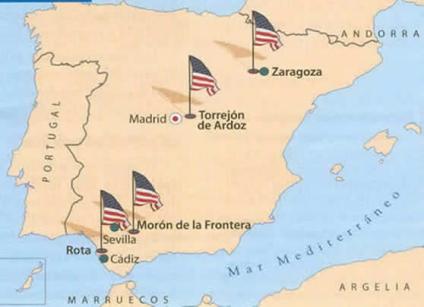
US military bases in Spain (Map from sutori.com)
No Spain, no gain? It was probably inevitable that President Donald Trump’s trade war would eventually get mixed up in his actual war.
Earlier this week, Spanish officials said they would prohibit American forces from using joint bases for war operations, unless those activities were covered by the United Nations Charter. Spanish Prime Minister Pedro Sánchez said his country would not “be complicit in something that is bad for the world”, the Associated Press reports.
On Tuesday, Trump declared that he intended to “cut off all trade with Spain”.
You might wonder: What legal authority does Trump have to unilaterally impose these sorts of revenge tariffs? After all, the Supreme Court ruled not that long ago that the authority Trump had been using to unilaterally impose tariffs based on his whims was unconstitutional. You might as well ask: On what legal authority did Trump launch a war against Iran? In theory, under the Constitution, Congress is supposed to authorize both tariffs and wars. In practice, they, uh, don’t.
Trump just does things, and the annoying constitutional worrywarts can figure it out later. (I say this as an annoying constitutional worrywart.)
In any case, yesterday, the Trump administration announced that Spain had changed its tune. “The U.S. military is coordinating with their counterparts in Spain”, White House Press press secretary Karoline Leavitt said. The implication was that the tariff threats had worked.
Spain, however, said otherwise. “I can refute (the White House spokesperson)”, Spanish Foreign Minister José Manuel Albares said. “The position of the Spanish government regarding the war in the Middle East, the bombing of Iran and the use of our bases has not changed one iota.” Maybe those tariff threats aren’t as effective as Trump thinks?
In a speech, Sánchez warned that the war could spin out of control. “Nobody knows for sure what will happen now”, he said. “Even the objectives of those who launched the first attack are unclear. But we must be prepared, as the proponents say, for the possibility that this will be a long war, with numerous casualties and, therefore, with serious economic consequences on a global scale.”
Sánchez also implicitly admonished Trump for escalating the war: “You can’t respond to one illegality with another because that’s how humanity’s great disasters begin”.
I will just note that in the Star Wars prequels, the fall of the Republic, and the descent into darkness and imperial rule, began with a planetary blockade and a trade war. At the time, people said it was wonky and boring. But here we are.
Where is Congress? The Constitution was built around the idea that each branch would fight to preserve its own powers, and this would create a system of checks and balances. But in Trump’s second term, Republicans in the legislature have been actively fighting to not preserve their power.
Yesterday, in a 47–53 vote, Senate Republicans voted against a resolution that would have required Trump to ask Congress to sign off on any further military aggression in Iran. Sen. Rand Paul (R–Ky.) voted with Democrats in favor of the measure; Sen. John Fetterman (D–Pa.) joined Republicans to vote against it.
The measure was mostly symbolic. Even a successful vote would have been subject to a House vote and a presidential veto. And the position of both the White House and the GOP Speaker of the House is that this whole situation in which America is spending billions of dollars dropping thousands and thousands of bombs on military and political targets in a foreign country is not, in fact, a war. Nothing to see here. Everyone in Congress can go home and crack open a beer.
February 14, 2026
The EU’s plans to drain the “wine lake” … again
Canada isn’t the only place with rigidly governed agricultural cartels … the European Union has always been a big fan of governing agricultural markets by fiat rather than allowing the markets to sort out how much of which product should be produced. One of the biggest markets actively distorted by EU regulation is the wine industry, where faulty regulations ended up paying for a vast over-supply of wine in the 1980s and 90s. Rather than eliminating the regulatory structures, the EU continues to prefer letting bureaucrats dictate to producers:

When the Common Agricultural Policy was established, it was quickly determined that one of its core objectives would be the protection of farmers, ensuring stable incomes and food security. In the wine sector, this logic translated into strong interventionism aimed at expanding and stabilizing production.
For decades, Brussels subsidized vineyard planting, protected minimum prices, and absorbed producers’ economic risk, disconnecting production decisions from signals of demand. Producing more ceased to be an economic choice and became a politically safe decision.
This approach created a structural market distortion. As wine consumption began to decline across Europe for demographic, cultural, and economic reasons, the artificially incentivized productive structure remained intact and unable to adjust.
It was in this context that, during the 1980s and 1990s, the first major shock occurred, known as the wine lake: massive wine surpluses with no outlet. Even then, Brussels treated this episode as an isolated and temporary phenomenon, ignoring the fact that it was the direct consequence of existing policies. By persisting with the same strategies, the problem ceased to be episodic and became structural.
In the early 2000s, the European Union was finally forced to recognize that the wine crisis was not temporary. However, instead of removing production incentives and restoring the market’s adjustment function, it opted for a new form of intervention: subsidizing the voluntary uprooting of vineyards. The decision to destroy productive capacity ceased to be economic and became administrative, decreed from the European political center, with profound effects across several countries.
This model, presented as temporary, set a dangerous precedent. Rather than allowing less viable producers to exit the market through prices and economic choice, the state began paying for withdrawal, subsidizing the costs of adjustment and normalizing the idea that the correction of public policy errors should be financed with more public money.
This policy did not solve the underlying problem. It merely reduced cultivated area temporarily, while leaving intact the regulatory architecture which had created the initial distortion. The sector became trapped in a cycle of incentivized expansion, predictable crisis, and administrative correction.
It is within this framework that the Wine Package emerges as the European Union’s latest set of measures for the wine sector. The package relies on an administratively planned reduction of supply through financial incentives for vineyard uprooting, complemented by regulatory adjustments, temporary support measures, and crisis management instruments. Instead of allowing the market to adjust to declining consumption, Brussels once again opts for the destruction of productive capacity as a policy tool. Although the package includes support measures and environmental framing, its central axis remains the administrative reduction of supply.
The impact of these decisions is not marginal. The European wine sector represents a significant share of the European Union’s economy, sustaining approximately 2.9 million direct and indirect jobs and contributing more than €130 billion to EU GDP.
December 29, 2025
Will 2026 finally be the year Canada abandons food cartels?
For reasons unknown, Canadian politicians both left and right have been willing to sacrifice almost anything in trade negotiations except the cosy protectionist scheme we call “supply management”, which enriches a tiny number of farmers in Ontario and Quebec by keeping grocery prices significantly higher than the free market price. On his Substack, The Food Professor predicts that Prime Minister Carney will be forced to give up this market-rigging, anti-consumer scheme in the coming year:
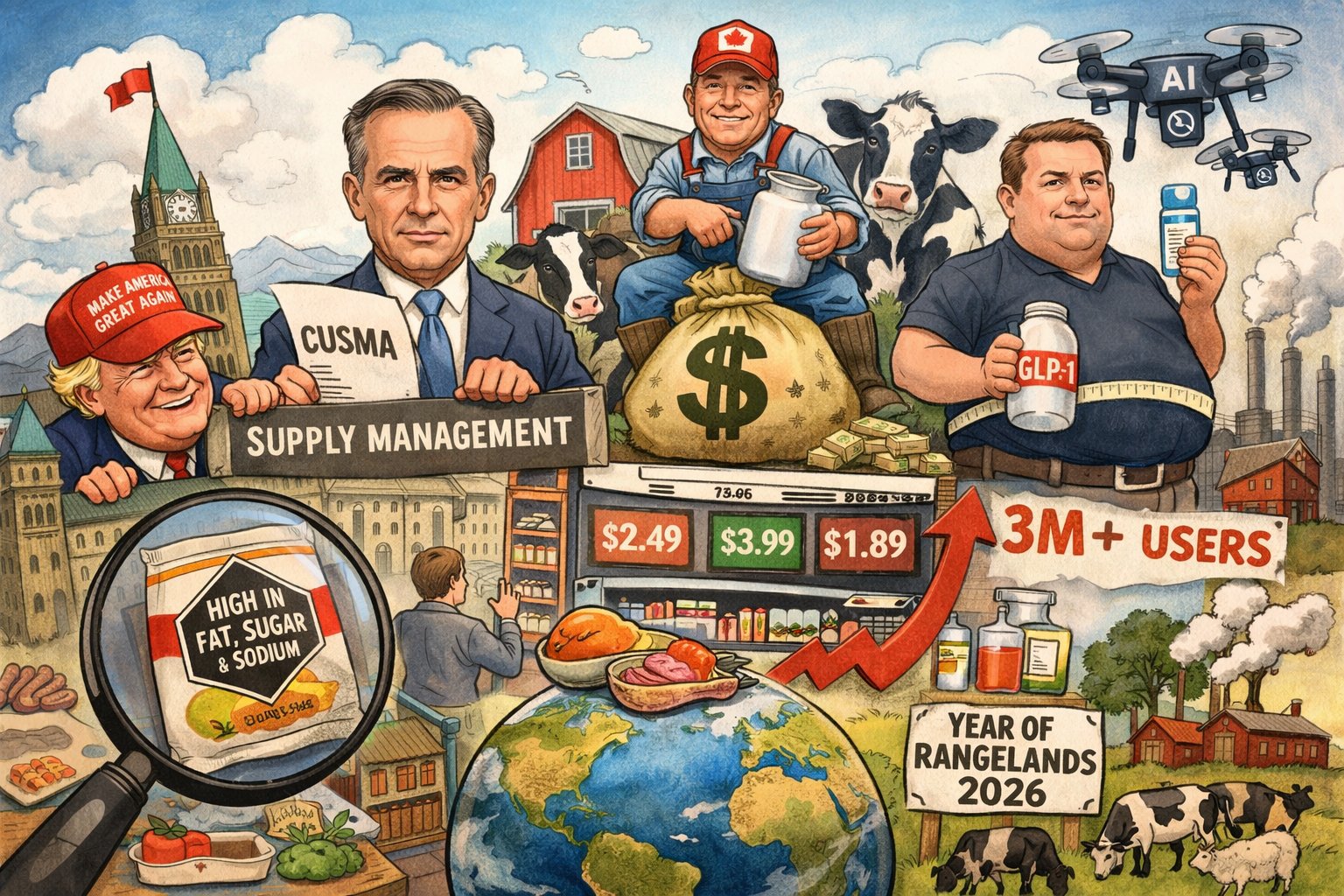
Image from Agri-Food Analytics Lab, Dalhousie University
As we enter 2026, several forces are converging to reshape Canada’s food economy. Consumer empowerment — amplified by social media — continues to accelerate, while geopolitics, particularly tensions with our southern neighbour, are becoming increasingly disruptive. Together, these dynamics will push food policy issues that once lived in technical silos into the public spotlight.
At the top of that list sits CUSMA and supply management. Prime Minister Carney has signaled firmness on market access, backed by legislation that shields supply management from parliamentary debate. That protection, however, is unlikely to endure. Even if the United States has little genuine interest in exporting more dairy to Canada — and even if Canadian consumers show limited appetite for it — President Trump now understands, far better than during his first term, that supply management is a potent political wedge. The system protects roughly 9,400 dairy farmers who exert disproportionate influence over agricultural policy, while compensation payments continue to flow without any meaningful reduction in production or market share. For a growing number of Canadians, this arrangement increasingly resembles a closed loop rather than a public good. The irony is that global demand for dairy is rising and Canadian milk should be part of that growth story. Instead, the system prioritizes insulation over ambition — a missed opportunity at a time when competitiveness should matter most.
January 1 also marks the formal implementation of new front-of-package nutrition labels. Although these symbols have been appearing on shelves for some time, many consumers either overlook them or misunderstand their purpose. Their real impact has been largely invisible to the public: they have already reshaped how food companies formulate products, invest in research, and redesign portfolios. Whether the labels meaningfully change consumer behaviour remains debatable, but their influence on product development is no longer.
[…]
Finally, 2026 coincides with the United Nations’ International Year of Rangelands and Pastoralists — a timely moment to reset the debate around meat consumption and livestock production. Rangelands underpin global meat systems by converting grasslands — often unsuitable for crops — into high-quality protein. In a world where demand for animal protein continues to grow, portraying livestock as inherently incompatible with sustainability ignores nutritional, economic, and ecological realities. Well-managed grazing supports rural livelihoods, strengthens export economies, and can enhance biodiversity and soil health rather than undermine them. If policymakers are serious about food security, climate resilience, and affordability, 2026 should mark a shift away from apologizing for meat production and toward recognizing livestock as a strategic pillar of resilient food systems — not a sector to be regulated out of existence
December 10, 2025
Murmurs of dissent from within Canada’s supply management cartel
At Juno News, Sylvain Charlebois shares a sign of internal dissent inside the supply management system that prioritizes protecting producers at the cost of significantly higher prices and reduced choice for Canadian consumers — not to mention getting Trump’s attention (and anger) for shutting out American competitors:
Every once in a while, someone inside a tightly protected system decides to say the quiet part out loud. That is what Joel Fox, a dairy farmer from the Trenton, Ontario area, did recently in the Ontario Farmer newspaper. In a candid open letter, Fox questioned why established dairy farmers like himself continue to receive increasingly large government payouts — even though the sector is not shrinking, but expanding. His piece, titled “We continue to privatize gains, socialize losses“, did not come from an economist or a critic of supply management. It came from someone who benefits from it. And yet his message was unmistakable: the numbers no longer add up.
Fox’s letter marks something we have not seen in years — a rare moment of internal dissent from a system that usually speaks with one voice. It is the first meaningful crack since the viral milk-dumping video by Ontario dairy farmer Jerry Huigen, who filmed himself being forced to dump thousands of litres of perfectly good milk because of quota rules. Huigen’s video exposed contradictions inside supply management, but the system quickly closed ranks. Until now. Fox has reopened a conversation that has been dormant for far too long.
In his letter, Fox admitted he would cash his latest $14,000 Dairy Direct Payment Program (DDPP) cheque, despite believing the program wastes taxpayer money. The DDPP was created to offset supposed losses from trade agreements like CETA, CPTPP, and CUSMA. These deals were expected to reduce Canada’s dairy market. But those “losses” are theoretical — based on models and assumptions about future erosion in market share. Meanwhile, domestic dairy demand has strengthened.
Which raises the obvious question: why are we compensating dairy farmers for producing less when they are, in fact, producing more?
This month, dairy farmers received another 1% quota increase, on top of several increases totalling 4% to 5% in recent years. Quota — the right to produce milk — only increases when more supply is needed. If trade deals had truly devastated the sector, quota would be falling, not rising. Instead, Canada’s population has grown by nearly six million since 2015, processors have expanded, and consumption remains stable. The market is expanding.
Understanding what quota is makes the contradiction clearer. Quota is a government-created financial asset worth $24,000 to $27,000 per kilogram of butterfat. A mid-sized dairy farm may hold $2.5 million in quota. Over the past few years, cumulative quota increases of 5% or more have automatically added $120,000 to $135,000 to the value of a typical farm’s quota — entirely free. Larger farms see even greater windfalls. Across the entire dairy system, these increases represent hundreds of millions of dollars in newly created quota value, likely exceeding $500 million in added wealth — generated not through innovation or productivity, but by regulatory decision.
September 27, 2025
Canada’s supply management cartels benefit “an affluent few, burdening the poorest, and creating needless friction with allies and trading partners”
In Reason, J.D. Tuccille explains to an American audience why Donald Trump has been playing hardball with Canada on trade issues:
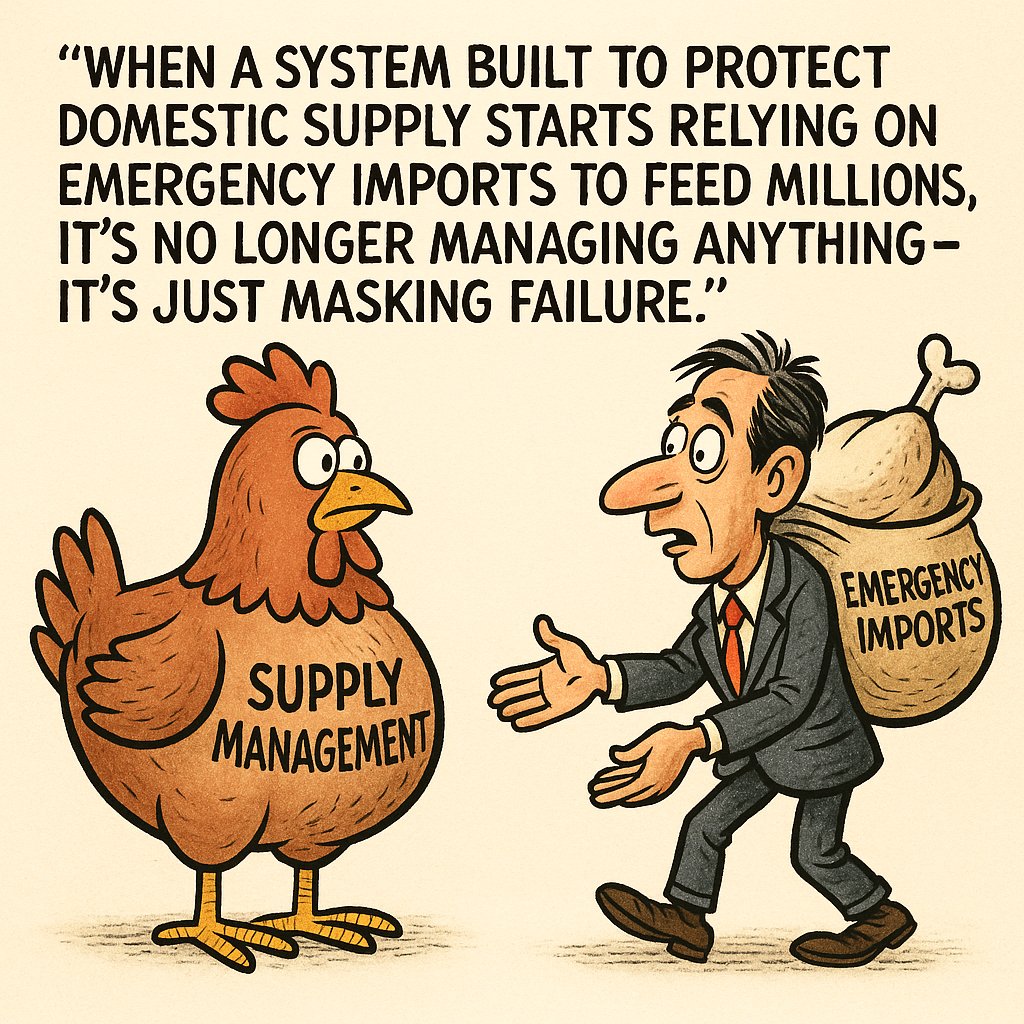
President Donald Trump justifies his enthusiasm for prohibitively high tariffs by insisting the U.S. is being “ripped off” by other countries. It’s a strange argument, since people only trade with one another if they see benefit in the deal. But the president is right to complain that other governments impose trade barriers of their own that are often every bit as burdensome as the high taxes Americans pay on imports. If foreign officials honestly wish to restore something like free trade, they should emphasize dropping their own barriers in return for lower U.S. levies. Case in point: Canada, which sends three-quarters of its exports across its southern border but imposes damaging restrictions on imports.
In a February proclamation of trade war on the world, Trump announced, “the United States will no longer tolerate being ripped off” and complained that “our trading partners keep their markets closed to U.S. exports”. The first part of that claim is silly. But the second part has a kernel of truth.
A glimpse at that truth came in June when Trump angrily posted that Canada “has just announced that they are putting a Digital Services Tax on our American Technology Companies” and, as a result, “we are hereby terminating ALL discussions on Trade with Canada”.
The threat had the desired impact. Canada rescinded the tax immediately before it was supposed to take effect. While nominally targeted at all large tech companies, in practice that meant American companies and everybody knew it, since U.S. firms dominate the industry.
But that was only the tip of the iceberg when it comes to Canada’s trade barriers. Also in June, international trade attorney Lawrence Herman, a senior fellow at Canada’s C.D. Howe Institute, bemoaned proposed legislation in the Canadian parliament that he characterized as “yet another regrettable effort to enshrine Canada’s Soviet-style supply management system in the statute books.”
He added, “the bill would prohibit any increase in imports of supply-managed goods – dairy products, eggs and poultry – under current or future trade agreements”.
The legislation about which Herman complained has since become law.
[…]
More skeptically, Fraser Institute senior fellow Fred McMahon notes, “supply management is uniquely Canadian. No other country has such a system. And for good reason. It’s odious policy, favouring an affluent few, burdening the poorest, and creating needless friction with allies and trading partners.”
McMahon elaborates that the supply management process is controlled by agricultural management boards which “employ a variety of tools, including quotas and tariffs, and a large bureaucracy to block international and interprovincial trade and deprive Canadians of choice in dairy, eggs and poultry”.
But as we’ve seen so many times over the years, it disproportionally benefits Quebec, and the Liberals desperately need those Quebec votes to stay in power, so the government would rather destroy the national economy rather than give up on our Stalinist supply management cartels.
August 23, 2025
“Trump … sees transshipment and nearshoring as sneaky workarounds”
At the Foundation for Economic Education, Jake Scott explains Donald Trump’s latest anti-trade moves:
President Donald Trump’s executive order of July 31st, effective August 7th, has upended global trade dynamics in a single stroke. Slapping a 40% tariff on all “transshipped goods” — products rerouted through third countries to dodge US duties — this is merely the natural development of his evolving protectionist agenda.
Just a week after the order, the move is a clear shot at China’s sprawling manufacturing empire, which has long exploited methods like transshipment and “nearshoring” to skirt American tariffs in general, and Trump’s tariff policies in particular.
While applied globally, China stands to take the biggest hit (and likely already is), with its vast factory networks and knack for rerouting goods through Southeast Asia, Mexico, and beyond. This isn’t just a tariff hike; it’s a calculated escalation in Trump’s ongoing crusade to reshape US trade policy and the global economy in the United States’ favor. But ripple effects that bruise consumers are already visible — and this move is likely to strain relationships with key allies as well.
The new tariffs build on Trump’s first-term strategy — so extensive that it now has a Wikipedia entry — when he wielded America’s economic heft like a sledgehammer to renegotiate or smash trade deals he deemed unfair. Back then, Chinese firms sidestepped US tariffs by setting up shop in countries like Vietnam and Mexico, funneling goods through these hubs to mask their origins.
This nearshoring strategy buoyed many economies that had pre-existing arrangements with the United States or were treated more favorably than China, such as Canada and Latin American nations. It is also seen as a natural part of globalization: shipping parts from where they are constructed (like China), assembling them in developing nations (like Mexico), and then exporting to high-value markets (like the United States). Nearshoring has a long history, but the fragility of extended global supply chains was exposed in the Covid pandemic; since then, manufacturers have sought to mitigate their damage.
The US trade deficit with China (roughly $295 billion) has long been a sore point for Trump, who sees transshipment and nearshoring as sneaky workarounds. The 40% duty on these goods, layered atop existing tariffs, aims to plug this loophole. As Stephen Olson, a former US trade negotiator, noted in the New York Times, China will likely view this as a direct attempt to “box them in”, potentially souring already tense talks.
August 5, 2025
Will the courts take away Tariff-master Trump’s favourite toy?
President Donald Trump’s second term in office has been dominated by his capricious and seemingly random deployment of tariffs as a bludgeon to intimidate and coerce America’s allies and enemies alike. In Reason, J.D. Tuccille considers the possibility of the courts taking away the one tool Trump has been using to get his own way in trade negotiations:
Everybody with a brain knows that tariffs are taxes. And they know that tariffs imposed on goods imported to the United States are largely paid by American businesses and consumers. The big question is whether tariffs unilaterally imposed by President Donald Trump under creative interpretations of emergency executive powers will withstand a federal court challenge. So far, the signs are promising for those hoping that a law intended to rein in the power of the presidency will not be read to permit the president to set trade policy of his own accord.
As CBS News reported this week, the U.S. Court of Appeals for the Federal Circuit in Washington, D.C. heard “oral arguments on Thursday in V.O.S. Selections v. Trump, a case brought by five small business owners and 12 states who allege they have been harmed by President Trump’s import taxes. V.O.S., the lead plaintiff in the case, is a New-York based wine importer.”
Representing the plaintiffs is the free-market Liberty Justice Center, along with co-counsel Ilya Somin, a law professor at George Mason University’s Scalia Law School. The plaintiffs are challenging the Trump administration’s invocation of the International Emergency Economic Powers Act (IEEPA) as the basis for the “Liberation Day” tariffs on much of the world as well as related tariffs on Mexico, Canada, and China.
A Law Intended To Trim Presidential Power, Not Expand It
The plaintiffs maintain that “under that law, the President may invoke emergency economic powers only after declaring a national emergency in response to an ‘unusual and extraordinary threat’ to national security, foreign policy, or the U.S. economy originating outside of the United States. The lawsuit argues that the Administration’s justification — a trade deficit in goods — is neither an emergency nor an unusual or extraordinary threat.”
What’s interesting is that Congress passed IEEPA not to expand presidential power, but to restrict it. According to a 2024 Congressional Research Service report, “following committee investigations that discovered that the United States had been in a state of emergency for more than 40 years, Congress passed the National Emergencies Act (NEA) in 1976 and IEEPA in 1977. The pair of statutes placed new limits on presidential emergency powers”. Under these laws, presidents are required to assess emergencies on an annual basis, extend them if necessary, and report on their status to Congress.
“Some experts argue that the renewal process has become pro forma“, the report acknowledges. “History shows that national emergencies invoking IEEPA often last nearly a decade, although some have lasted significantly longer — the first state of emergency declared under the NEA and IEEPA, which was declared in response to the taking of U.S. embassy staff as hostages by Iran in 1979, is in its fifth decade.”
August 2, 2025
“[T]he United States is an imperial power … it does not give foreign nations free rides and unearned favours”
On Substack, eugyppius discusses the European situation in a time of seemingly random and capricious tariffs from the Trump administration:
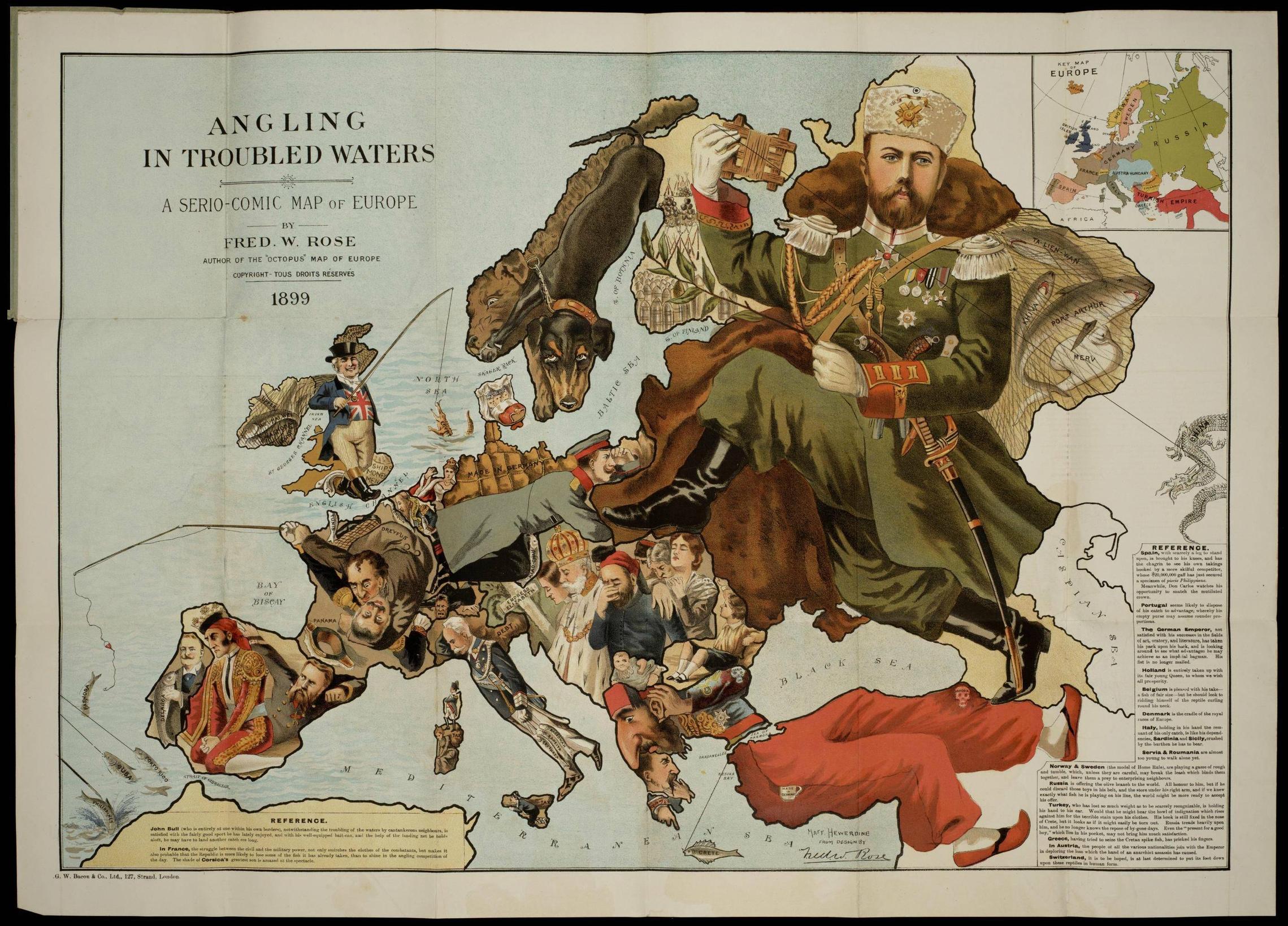
Europe in 1899, when the continent contained multiple world powers, before the rise of non-European power.
Whenever I talk about things like tariffs, Trump supporters appear in my comments to tell me that Europe has gotten a free ride for long enough and that it is time we learned to pay our way. I find it a little frustrating to read this, because in Europe it does not feel like we are getting a free ride at all. In fact it seems like the opposite: The most common complaint on the populist German right is that our political class refuses to represent our interests and will not stop carrying water for the Americans.
I recognise that I’ll never be able to put this right, but it’s worth trying, because it is important to understand the world as it is. The truth is that the United States is an imperial power. Generally speaking, it does not give foreign nations free rides and it does not hand out unearned favours. There is however a lot of confusion here, because hardly anybody bothers to describe honestly the geopolitical strategy pursued by the United States or the nature of the American empire. Western liberalism cannot conceptualise imperial politics, and while empire generally benefits political elites on both sides of the Atlantic, it is not necessarily or always in the interests of ordinary Americans or ordinary Europeans, which is yet another reason not to talk about it.
The Americans and the British before them expended enormous effort to preempt the emergence of a dominant power on the European Continent that might challenge their successive naval empires. They fought two world wars to stop Germany from becoming just such a power. This great struggle ended in 1945 with Western Europe as a fully subjugated imperial province. Since then, the Americans have coordinated the NATO alliance and guaranteed the security of European countries not out of charity, but because Europe is their provincial possession. As a rule, they have not wanted Europe to assume full responsibility for its own defence, because a world in which America no longer guarantees the security of Europe is a world in which Europe is no longer an American province. It’s that simple.
To fend off the Soviets, the Americans nevertheless rebuilt and rearmed the nations of Western Europe. Everyone involved in this project had to come up with a way to allow the Germans to become a dominant economic power again, without displacing the United States or provoking the hostilities of wary postwar neighbours like France. One solution here was the European Union, which promoted economic interdependency as a counterweight to nationalist concerns. Another solution came at the cultural level, where Germany sought to allay European anxieties over possible Teutonic aggression by developing a national cult of historical guilt for World War II, which steadily blossomed into a full-blown civic religion. This exercise in self-effacement has grown more and not less extreme over time, in part as a response to nervousness about the consequences of German reunification. Many voices on the right like to portray Germans as victims of an externally imposed guilt regime, but the truth is that we did most of this to ourselves. The German left in particular has profited from and encouraged this mindset from the beginning.
German political self-effacement had one unexpected feature, in that it proved to be contagious. Within a generation of 1945, many of the victorious allied powers were striving to develop their own historical guilt cults after the German example, in each case centred around a national original sin like slavery or colonialism. Just as the German political class found it expedient to foreground collective European concerns at the expense of a more narrowly construed German nationalism, so did the broader West develop an overarching obsession with global issues and the plight of the developing world. This has caused the proliferation of a lot of silly people in our political culture, a lot of profoundly stupid organisations, and at least two cancerous ideological systems in the form of climatism and migrationism. We have had a nearly incalculable gift in the form of 80 years of peace, which may yet be offset by the equally incalculable costs of the lunacies this peace has encouraged.
July 21, 2025
Was Juan Perón a Fascist? The Cold War Origins of Peronism – W2W 037
TimeGhost History
Published 20 Jul 2025Was Juan Perón really a fascist, a socialist, or something entirely different? In this episode of War 2 War, we explore the rise of Peronism in post–World War II Argentina and how Perón tried to position his country between the superpowers of the Cold War.
Through labour reforms, nationalist rhetoric, media control, and brutal repression of dissent, Juan and Eva Perón created a powerful populist regime that borrowed ideas from both fascism and socialism, while claiming to reject both. From Argentina’s “Third Way” to its complicated ties with the US, USSR, and even Nazi fugitives, we examine the ideology, contradictions, and legacy of Peronist rule.
Was Peronism a unique form of authoritarian populism, or just another face of fascism?
Join us as we uncover the foundations of Argentina’s Cold War identity and the true political nature of Juan Perón.
(more…)


