Quotulatiousness

September 14, 2026

Performative Canadian politics again

Filed under: Business, Cancon, Economics, Europe, Government, Media, Politics, USA — Tags: , , , , — Nicholas @ 03:00

Prime Minister Mark Carney came to power promising that he was the best-qualified to deal with the US government on trade issues. Canadians assumed that this meant he’d be able to get as fair a trade deal with President Trump’s administration as possible. What he really meant was that he could do the most damage to cross-border trade relations in order to “pivot” to the EU and to China. He never intended to settle US-Canadian trade conditions, and his actions clearly show he was always putting the negotiations dead last in his priority list. And, thanks to the government’s generous subsidies to the relic media, instead of grilling him and his ministers for their blatant failures, they instead try to hold the opposition to account for things they have no control over.

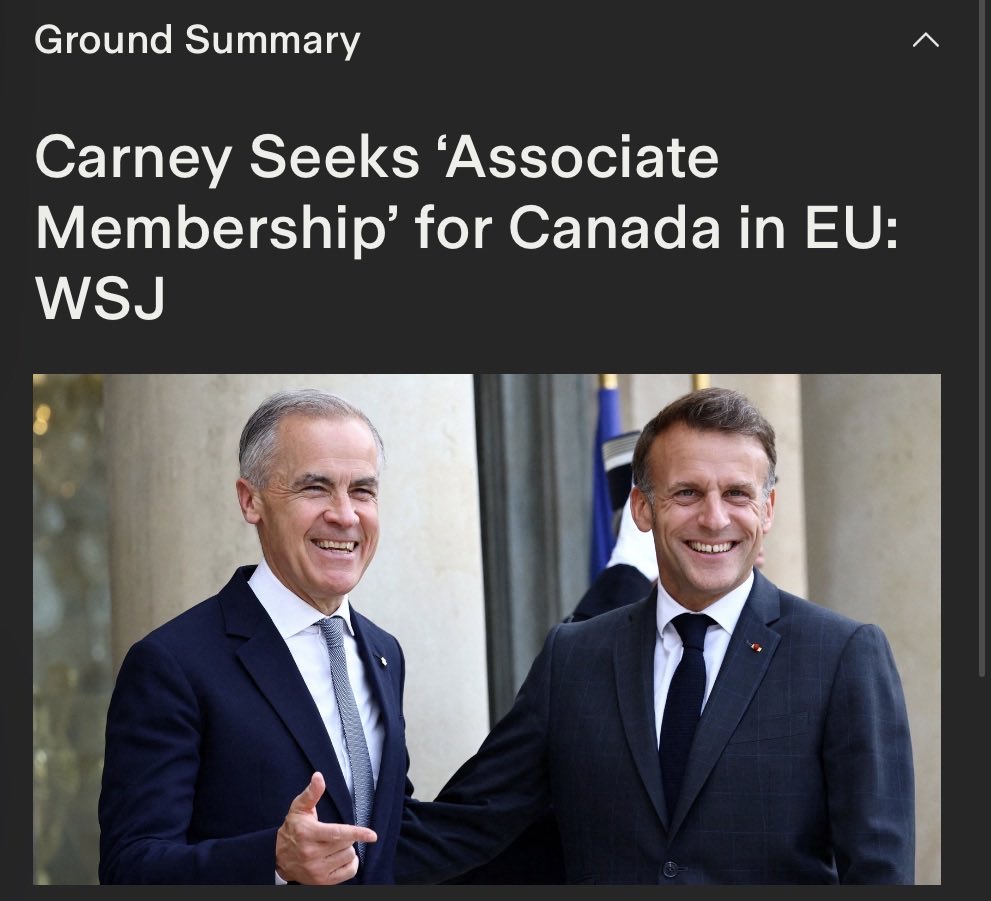
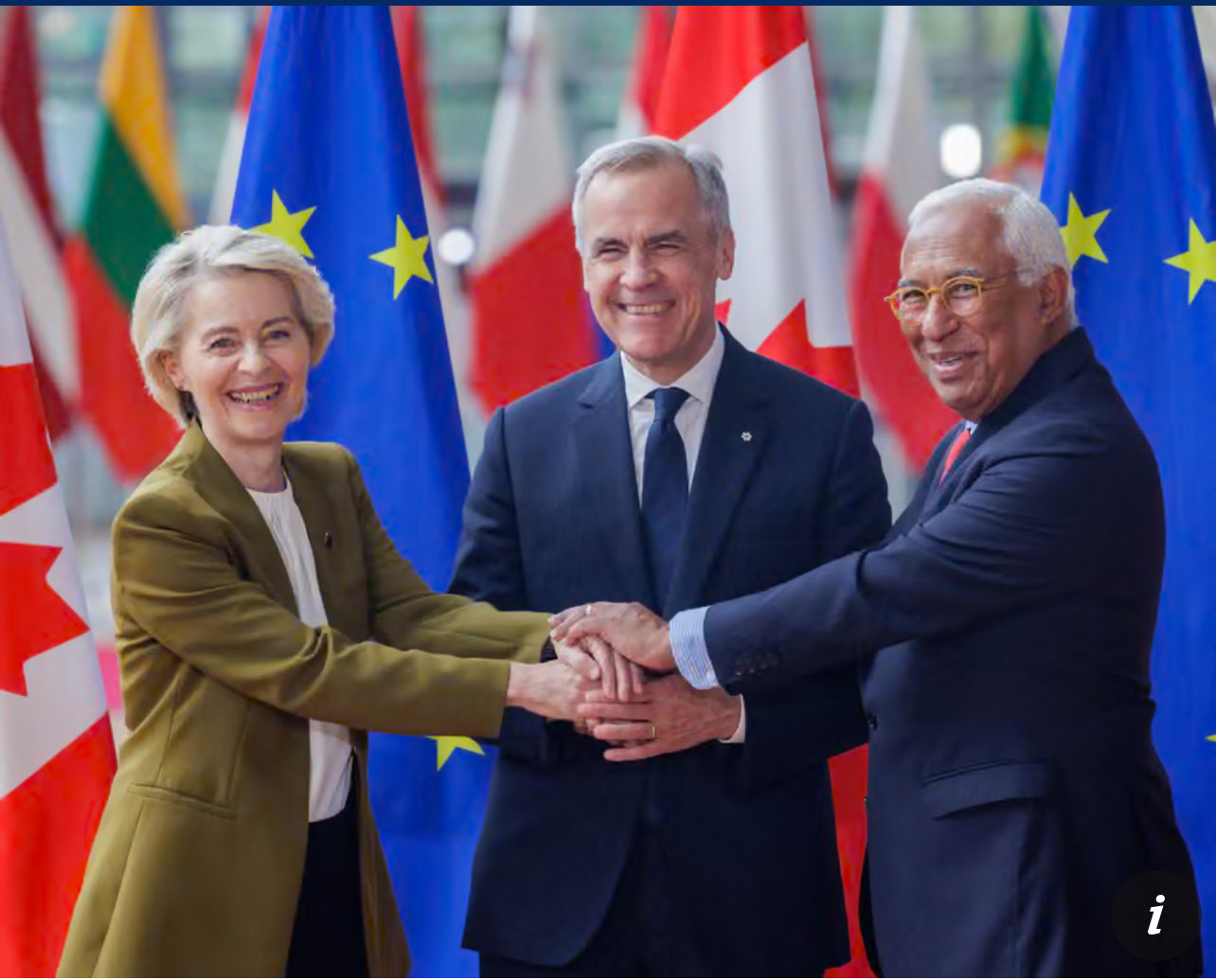
On the social media site formerly known as Twitter, L. Wayne Mathison points out that it makes no economic sense for Canada to become part of the European Union as Carney now says he’s working toward:

This strikes me as remarkably stupid economic strategy.

Diversifying Canadian trade makes sense. Pretending Europe can somehow replace the economic relationship we have with the United States does not.

The United States is next door. Our railways, pipelines, electricity grids, manufacturing supply chains and energy markets have been integrated for generations. Even after the trade fight intensified, 71.7% of Canadian merchandise exports still went to the United States in 2025.

And Canada already has CETA with the European Union. Roughly 98% of EU tariff lines on Canadian goods became duty-free when CETA took effect, eventually rising to about 99%. If Canadian companies see profitable opportunities in Europe, they already have extraordinarily good market access.

So what exactly do we gain from some invented “associate membership” beyond CETA?

Potentially European regulatory obligations, political entanglements, financial contributions and pressure to harmonize Canadian rules with decisions made in Brussels, all to sell more goods across an ocean to markets that cannot duplicate the geographic advantage of the United States.

Norway rejected EU membership twice. Iceland opened accession negotiations and eventually walked away without joining. Both understood that you can have close economic relations with Europe without surrendering unnecessary national autonomy.

Canada should trade aggressively with Europe, Asia and everyone else who wants our products. But our first priority should be fixing the relationship with our largest customer, removing our own interprovincial trade barriers, building pipelines and ports, and making Canada competitive again.

Picking a fight with the neighbour who buys most of your exports and then announcing that Brussels might become your new best friend isn’t economic sophistication.

It looks like desperation dressed up as grand strategy.

September 9, 2026

The day after counter-tariff Tuesday

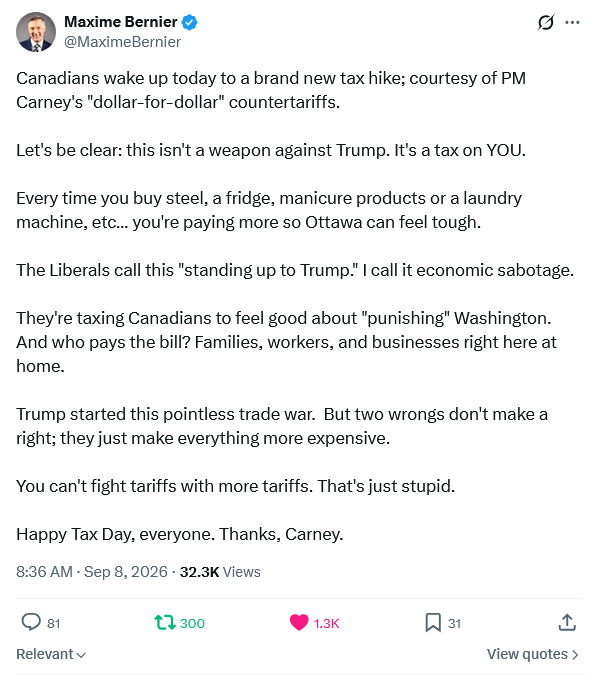
Yesterday, the Canadian counter-tariffs to the latest round of US tariffs kicked in. Maxime Bernier put it this way:

Canadians wake up today to a brand new tax hike; courtesy of PM Carney’s “dollar-for-dollar” countertariffs.

Let’s be clear: this isn’t a weapon against Trump. It’s a tax on YOU.

Every time you buy steel, a fridge, manicure products or a laundry machine, etc. … you’re paying more so Ottawa can feel tough.

The Liberals call this “standing up to Trump”. I call it economic sabotage.

They’re taxing Canadians to feel good about “punishing” Washington. And who pays the bill? Families, workers, and businesses right here at home.

Trump started this pointless trade war. But two wrongs don’t make a right; they just make everything more expensive.

You can’t fight tariffs with more tariffs. That’s just stupid.

Happy Tax Day, everyone. Thanks, Carney.

Carney’s plan all along has been to push Trump into saying and doing things that give Carney and the Liberals even more Boomer support. Pretty much controlling the relic media allows the government to massage the stories so that Dear Leader is never in the wrong and “the Bad Orange Man hates you and wants to destroy you”. Canadian boomers are among the last people in the world to realize that they’ve been systematically gaslighted since Justin Trudeau ran for Liberal leader … and the penny still hasn’t dropped. Enough of them are already psychologically prepared to destroy what’s left of the economy, Thelma & Louise style, if Carney invites them to. And he’s going to.

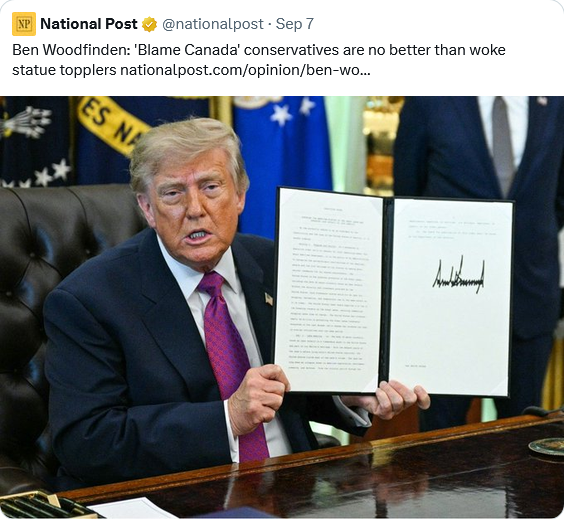
John Carter responds to a Ben Woodfinden article in the National Post, blaming dissident Canadians for not rallying behind Mark Carney to … do exactly the same sort of performative elbozo pantomime that the Boomer Liberals have been doing for over a year?

This misses the mark in a subtle but interesting way. The author invokes the concept of oikophobia against the Canadian online right for joining in (actually initiating) American mockery of Canada, arguing that Canadian rightists are themselves oikophobic for not instead supporting the Carnites.

This is incoherent. The Liberal regime is itself oikophobic, loudly so. Oikophobia is explicit Canadian government policy, as the author himself tacitly acknowledges by noting that we pointed out the hypocrisy of Canadian politicians decrying Trump’s lame Lake America stunt after a decade-long orgy of renaming every school, square, and street in the country in the name of a Woke ideology imported straight from America. That’s to say nothing of replacement migration, and racial preference systems that make white Canadians second class citizens. You can’t be oikophobic against the oikophobes.

There are certainly slopulist 51st staters out there, but their influence in the Canadian right is actually marginal, largely confined to a rump of lolcow Alberta separatists. The energy is all in Canadian Loyalism, and that is a different animal entirely.

The reason we’re happy to pile on to the Canadian political elite when the Americans mock them isn’t because we want to be America. It’s because we’re disgusted by the state of the country.

Trump can excoriate the Canadian military for being fat and woke because it is. That isn’t Trump’s fault. That’s because of decades of sabotage and social engineering by the Liberal Party.

Trump can joke about annexation because the Canadian military is weak. Again, that isn’t Trump’s fault. That’s the fault of the Laurentian elite, the very people now insisting that they can turn things around.

If Canada had a serious government, we’d be taken seriously. We don’t, and haven’t since Pearson at least. As a direct result of the deeply unserious clowns running the country into the ground, Canada is poor, defenseless, sclerotic, and despondent. Every time Trump makes fun of us, the very fact that his insults land is a condemnation of the elites that brought our beautiful country to this shameful condition.

Saving Canada requires circulating the elite.

And that’s why we pile on.

And since I try not to overtax my non-Canadian readers (the vast majority of you) with too many separate maple-flavoured posts, here are some sensible suggestions from Matt Gurney about fixing our own problems — which are legion, and mostly self-inflicted — rather than pretending that Trump is the problem:

… there’s a bigger issue at play here than just managing the relationship with America. What the hell do we do as Canadians?

Don’t think about the States at all. Don’t think about Trump. Just think about Canadians in Canada. What should we be doing for ourselves? Even if the trade war does eventually end, our relationship with the United States is going to require generations to fix. Some very fundamental assumptions about Canadian, well, everything, now need to be reconsidered. I’m the guy who wrote the column about our expectations being a problem, and I’m still having a hard time keeping up with this.

But if there is one thing that I could suggest we should prioritize, it’s simply fixing the problems we have in this country. Really. Just … do the right things. Fix the problems. Just like virtue is its own reward, making good decisions is always a good decision. It’s bizarrely not something we’ve been good at lately, though, and it’s probably actually going to get harder for a while. In fact, a patriotic rallying-around-the-flag effect is very likely to make it even harder than it already is to get Canadians to actually admit there are major problems in this country, and then insist that the politicians get serious about fixing them.

I’ve been thinking about writing this column for a couple of weeks. Last month I was in the United States for some family business. I was actually there the day Carney called our negotiators home, and I returned to Canada the next day; I joked with some friends that, much like our negotiating team, I was packing up and leaving the United States to show them we meant business.

But one of the things I did notice on my visit to the United States, which included stops in two major cities, was that those American cities were much cleaner than my hometown of Toronto, and in much better repair.

And the especially bizarre thing was, one of these cities was Detroit.

Yes, that Detroit. Astute Line readers — the smartest and best-read people in the whole wide world — will recall that Detroit has not often been held up as an exemplar of civic governance and urban success.

But the downtown looked good. It was safe, clean, well-patrolled; I’m not exactly a regular visitor, but I do pop in often enough to have noted real improvement in the state of things there, even compared to my last visit, which was only about a year ago.

The other major city I visited, Chicago, has always struck me as the best apples-to-apples comparison my hometown of Toronto has with a U.S. city. Chicago has a lot of visible problems. I’m not trying to gloss those over; one thing I quickly noted was a roughly Toronto-esque number of people wandering the streets in evident mental-health crisis, shouting at nothing. But overall, Chicago had much less visible homelessness and was in a considerably better state of repair and cleanliness than my hometown. It wasn’t subtle. Cleaner streets, in better condition, with fewer people obviously living on them. Toronto did not compare well.

And just when the hell did that happen?

We can’t blame Trump for our laughably protectionist inter-provincial trade barriers. We can’t blame Trump because we’re functionally incapable of building a pipeline to bring Canadian oil and natural gas to Canadian markets. We can’t blame Trump for our ever-less-functional public healthcare systems. We can’t blame Trump for our ever-less-appealing market conditions for foreign investment. We can’t blame Trump for our deteriorating relationship with First Nations groups. These are all things that need to be fixed by Canadians. In Canada. No matter who might be occupying the Oval Office in Washington, DC.

Update: Added missing URL to John Carter’s post on X.

August 24, 2026

Trade negotiations degrade into full-on trade war

Filed under: Cancon, Economics, Government, Media, Politics, USA — Tags: , , , — Nicholas @ 03:00

As I mentioned the other day, I don’t believe Prime Minister Mark Carney ever intended to reach a trade agreement with the United States, because it was far better for his domestic political situation to have the US — and especially Donald Trump — as a focal point for retired Canadian boomers to trigger a two-minute hate. Every time the name Trump appeared in a state-sponsored newspaper or TV story, Carney’s popularity went up. After a decade of economic stasis and relative decline under Justin Trudeau, Carney’s more staid persona told the boomers that “the adults were back in charge”, yet Carney’s policies have been largely the same as Trudeau’s with a bit less hamming it up for the cameras.

On his Substack, Brian Lilley considers the potential economic damage of the increased tariffs:

“You’re at war when you get attacked, we got attacked.”

That’s what Prime Minister Mark Carney said when he was asked why it sounded like was going to war after his Saturday morning speech.

Carney used references to war multiple times in his speech and during his Q & A with reporters.

“We’re stronger now than when the United States started this trade war. More unified, more determined, more ambitious,” he said in his speech.

Not sure that I believe that to be the case, though we could be if we take the right steps, something I was writing about in my latest column for the Sun.

Previously, I have questioned whether we should consider this a trade war between Canada and the United States. The Americans say they don’t see it that way, they see it a change in trade policy, an attempt to rebalance trade.

My thinking that perhaps the Americans were right was that calling it a trade war put us in the wrong mindset. Canadians were looking for a fight with the Americans, many still are and are happy that Carney walked away from this deal.

Of course, for the devoted “Elbows Up” crowd, no deal was always the best deal. They foolishly believe we can and should walk away from the United States.

After this latest round of tariffs though, I’m fine calling it a trade war.

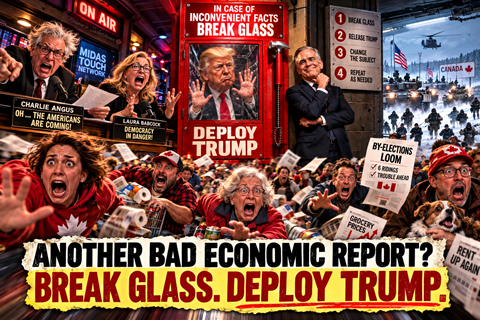
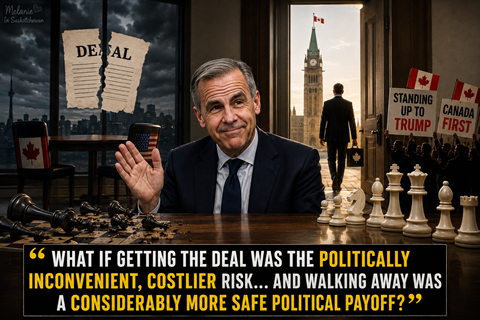
Melanie in Saskatchewan calls it “the most convenient failed trade deal in Canada”:

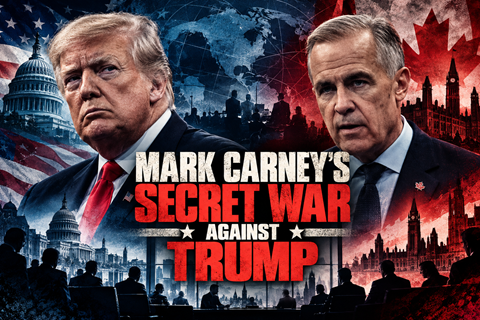
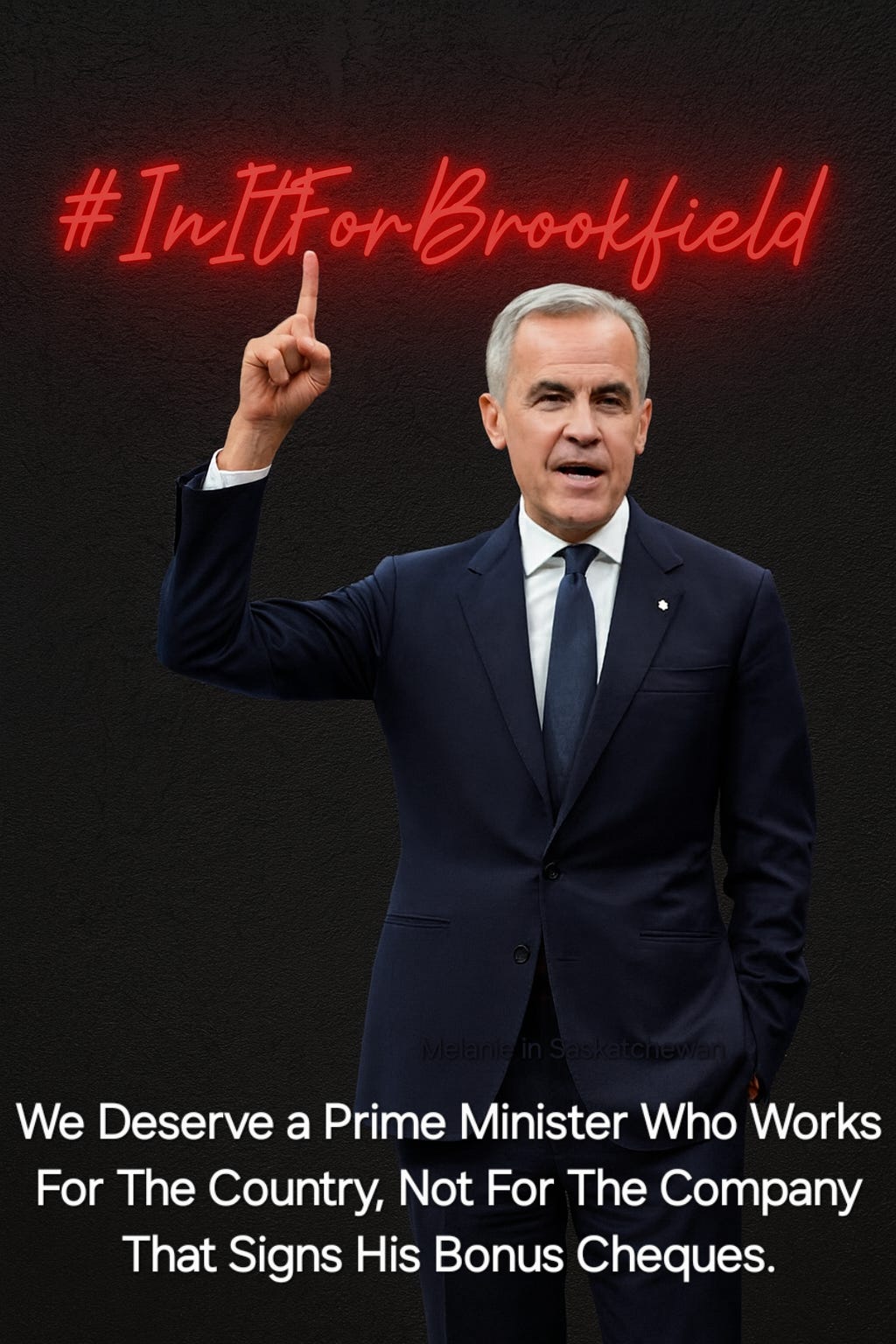
AI-generated image from Melanie in Saskatchewan

Imagine, if you will, a prime minister first installed and then elected, because Canadians believed he was uniquely equipped to deal with Donald Trump. Our hypothetical prime minister has impeccable credentials, international connections, central banking experience, serious suits, and the reassuring manner of a man who appears to know exactly which fork to use while the dining room burns down around him.

Most importantly, his political identity rests on one enormously useful proposition: Only he can handle Trump.

Now imagine the negotiations aren’t going particularly well. Not outright disastrous, at least not yet. Just difficult. Canada makes concessions. Ottawa drops the Digital Services Tax, removes most retaliatory tariffs, and American alcohol and supply management are on the table.

Still, negotiations continue, but then something changes.

On August 18, Trump postpones the new 50 per cent tariffs for three days after the two sides report “substantial progress”. By August 20, Canada’s trade minister says they’re “very close” to a deal. Reporting suggests the agreement under discussion could halve steel and aluminum tariffs and reduce tariffs on Canadian-built vehicles from 25 to 15 per cent.

And then … poof!

No deal. Do not pass go, consider this farce terminated.

The 50 per cent tariffs take effect. Carney suspends negotiations, the Canadian negotiators come home, and Ottawa announces retaliation. Washington says Canada backed away from commitments while Ottawa resolutely asserts Washington changed the terms at the last minute.

Well, that’s pretty fricking interesting, isn’t it?

So naturally our hypothetical prime minister takes to the airwaves and explains exactly what happened. Except he doesn’t, not with any actual clarity.

He speaks for more than twenty minutes, probably moistly, wandering from storms and changing climates to sovereignty and resilience, then through infrastructure, LNG, nuclear power, housing, defence, diversification and investment. By the time he finishes, we’ve practically navigated the entire federal government, several industries and the weather forecast.

Canada, we learn, is “master in our own home”. Well, isn’t that just terrific! What happened to the bloody trade deal?! Carney says the Americans introduced new terms that were “uneconomic” and “unfair”. They “asked too much and offered too little”. Who is going to draw the short straw and tell Carney those are adjectives and conclusions, and not terms?

Then comes a particularly curious bit. Carney says Washington also sought restrictions affecting Canada’s future trade relationships with other countries.

Other … countries.

But he never actually tells us which countries Washington was talking about, exactly what restrictions were being demanded, or which “certain sectors” he meant when he admitted the Americans wanted Canada to coordinate tariffs against other countries. Stranger still, Carney conceded that Canada could actually see merit in some of it as part of the right deal.

So which countries? Which sectors? And which parts of this supposedly unacceptable assault on Canadian sovereignty did you actually find reasonable? Suddenly the man who just spent twenty minutes talking develops an acute shortage of proper nouns.

August 23, 2026

Trade deal? What trade deal? Best we can do is more tariffs

Filed under: Cancon, Economics, Government, Media, Politics, USA — Tags: , , , , , — Nicholas @ 03:00

My sense has always been that the Carney government didn’t really want to get a deal done with Trump, because it was far more politically useful to keep the eLbOzOs all angry and posturing than to negotiate in good faith. Canada’s premiers, taken as a group, have been a never-ending stream of clown car antics, political gamesmanship, and schoolyard baiting. Yes, Trump is infuriating, inconsistent, obnoxious, and even more performative than Justin Trudeau but he’s the current American president and we needed to send sensible politicians and diplomats to work with him.

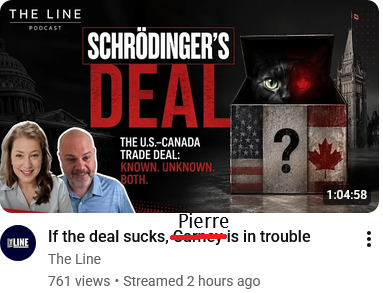
The presstitutes in the Canadian relic media have been eagerly fanning the flames of Trump Derangement Syndrome across the country, so when the latest episode of The Line podcast popped up yesterday, I had to provide a helpful edit to their episode title:

They’re going to do everything they can to deflect blame from their beloved paymaster, Dear Leader, and point accusingly at Pierre Emmanuel Goldstein and his band of anti-Canadian wreckers and looters in the Conservative party.

On the social media site formerly known as Twitter, @jaycurrie discussed this when the news broke of the breakdown in talks:

The last minute collapse of trade negotiations between Canada and the US demonstrates a fecklessness on the Canadian side which is astonishing. The walking resume — in the very good suits — could not get’er done.

Apparently those damn Yankees had unacceptable last minute changes. No shit. You are dealing with serious negotiators who will squeeze hard. It is said of Trump that he regarded signed contracts as the beginning of the negotiation.

Brutal, unscrupulous, nasty. Orange man very, very, bad. But you play the hand you’re dealt. Had Canada sent serious negotiators a year ago rather than posturing and dumbly sticking the official elbows in the air, we’d have a deal.

Or, had we had negotiators who did not take Dudley Doright as a model, we would have signed a “bad deal” and gone right back to the table to get a better deal. I’d love to know what the show stopper American last minute “demands” were.

Trade is a constant series of negotiations. A deal in place would have avoided the BS 50% tariffs and set the stage for the next deal. This collapse just puts us in a deep hole smarter people will have to climb out of.

“That’s my final offer” is a tactic. Is it an offer you like? No. Is it an offer you can live with? Probably. Again, the devil is in the details. But unless the offer required Canada to cede territory (which Eby is already more than willing to do) it was workable.

“A bad deal is worse than no deal at all” when there are 50% tariffs looming as a consequence of “no deal” is a very dumb position to take. Brace for “defense of Canadian Sovereignty” in a matter of minutes.

These trade talks have been bungled from the beginning simply because a combination of the political advantages of TDS and an inflated view of Canada’s relative bargaining strength created a reality free bubble.

The sheer arrogance and vile political opportunism of the Carney Liberals has been on full display for a year. Trump and his people called BS. Carney was euchred. Canada is, frankly, boned.

Maxime Bernier:

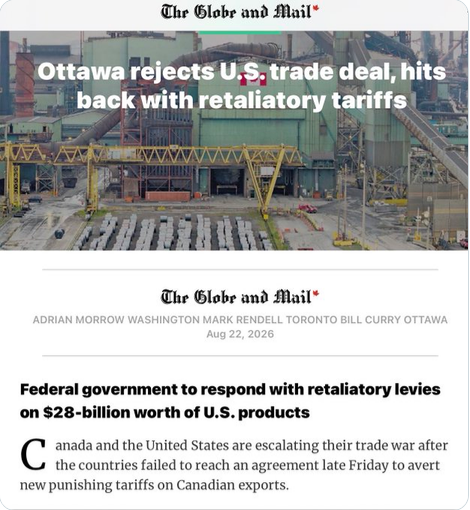
New 50-per-cent levies will hit around $28-billion worth of Canadian goods, which is roughly 5 per cent of Canada’s exports to the United States.

Carney has said it will respond with retaliatory tariffs on $28-billion worth of U.S. products.

Escalation is a very bad idea! Tariff retaliation has just triggered an escalatory trade war we cannot win. The U.S. economy is 10 times larger than ours.

A study released last week by the Canadian American Business Council concluded that the end of USMCA would have a surprisingly small impact on the Canadian economy.

It estimates that, even with high and long-lasting tariffs, Canada’s economy would only be about 1.6 per cent smaller in 2035 than if the USMCA were renewed and respected, and tariffs fell to near zero.

We are further damaging our economy with these “dollar-for-dollar” counter-tariffs.

Retaliatory tariffs are NOT a weapon. They are a tax on Canadians.

Who do you think absorbs that cost?
Canadian consumers, businesses, and workers.

Let’s be brutally honest: the Canadian government is worsening the situation. Canadian families will pay the price at the checkout counter.

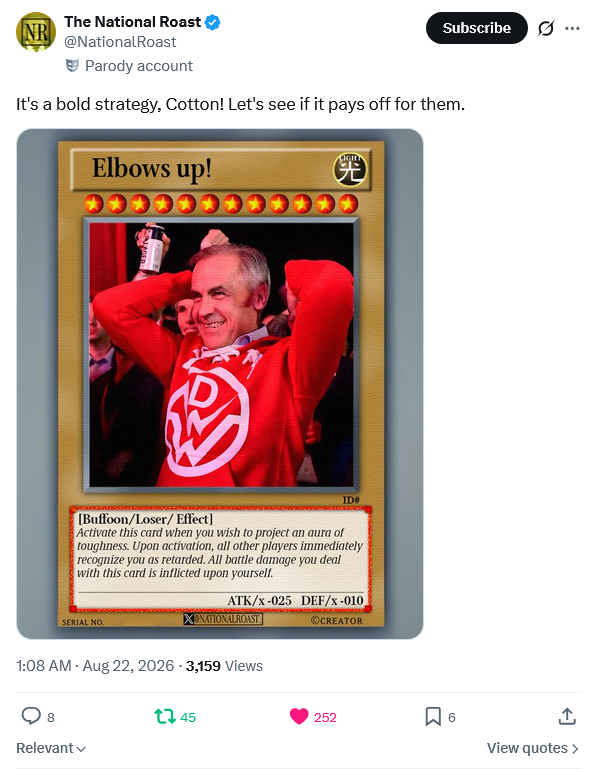
The National Roast gets it:

August 14, 2026

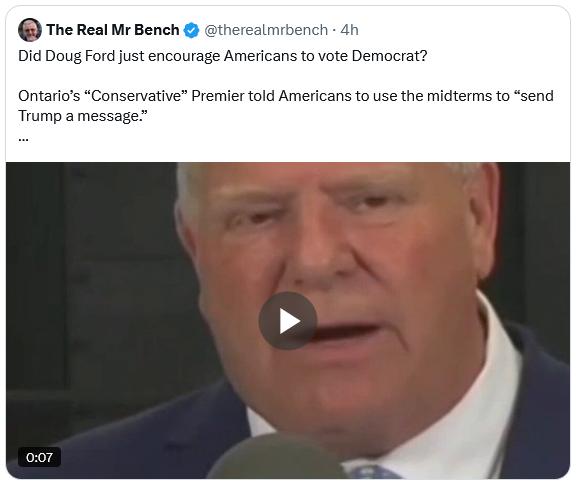
Ontario premier doubles-down on provoking Trump. What could go wrong?

Filed under: Business, Cancon, Economics, Government, Media, Politics, USA — Tags: , , , , , — Nicholas @ 05:00

At some point you have to ask yourself … if Canada was being run by people who wanted to destroy it, what would they have done differently in the trade negotiations with Donald Trump’s government?

Is Doug Ford the dumbest Canadian?

I know, it is a deep bench. But the tubby premier is extraordinary. You have to appreciate talent.

There are, apparently, two schools of Canadian thought on the trade fracas with the US. “Punch the bully in the nose.” and “For God’s sake get a deal already.” As I prefer a Canada with an economy, I pick door number 2.

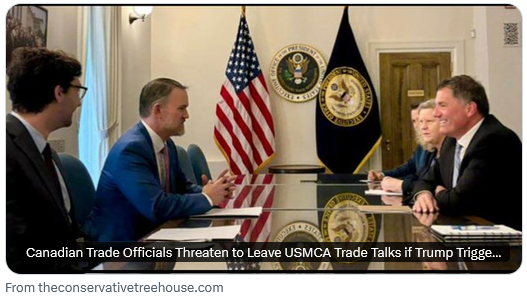
Our Chief Trade Negotiator Janice Charette, is more combative. If Trump brings in his retaliatory tariffs in a week she’s packing up and going home. That’ll learn him.

The idle threat school of negotiation enjoys wide currency in both Ottawa and Queens Park. Meanwhile, Canadian businesses are looking [longingly] at the low tax, low reg world inside the Trump tariff wall.

I’m having a beer with a buddy who is in “founder’s mode” on a startup and, frankly, he’d be crazy not to be looking at domiciling his business in the States. Sure, have a Canadian sub, but why put your main business in Canada?

And decisions like this are being made all over Canada and, indeed, the world. People might hate Trump and all his works but the business attractions of Red States make Ontario and BC look pathetic.

You would think that after Ford’s Super Bowl ad fiasco he would have the wit to remain silent as his province’s fate is being negotiated. You know, avoid more damage. But no, the tubby premier likes to “talk tough”.

I actually feel a bit sorry for Carney having to deal with the fallout of this idiot’s remarks. Unless, of course, like the Super Bowl ads, Carney actually encouraged these remarks … In which case the competition for dumbest guy in Canada has tightened up.

August 12, 2026

“It might be Carney’s unconditional surrender to Trump, but it’d be worse under Poilievre”

Filed under: Cancon, Economics, Government, Media, Politics, USA — Tags: , , , , — Nicholas @ 05:00

I exaggerate a tad in my choice of headline, but Canada’s bought-and-paid-for relic media will always choose to present a spectacular Carney faceplant as being somehow better than any theoretical action by Poilievre. If Carney’s going to surrender to the Yanks unconditionally, it would obviously be far worse if the Leader of the Opposition had been PM instead. eLbOwS uP, everyone!:

The new Canadian trade flag – The Line

Well, it looks like our prime minister is losing his nerve, eh?

Reports are now leaking fast and furious that Trump’s surprise August 19 tariffs have worked to break our strategic patience. Canada is working to secure some kind of interim deal, and if the leaks are to be believed, we’re going to give the Americans essentially everything they want while they maintain most tariffs on us. It appears to be a shit deal for us, and one that puts us directly in the glide path toward vassal state.

Worse — and, to be frank, I do think this is the worst part of all of this — it’s the exact opposite of what we elected Mark Carney to do. When facing economic and political aggression from a neighbour and once-ally like the United States, surrender vs. resistance is a valid conversation to have. Given our circumstances, one could make a legitimate case for either choice. However, as a people, we did have that conversation, in the spring of 2025. We did make that choice. We chose resistance. We chose sacrifice. That was the premise of the last election, and that was the value proposition Mark Carney made for himself.

Instead, what we’ve actually done in the past year-and-a-half is a counter-productive middle path: yes, we’ve made moves toward strengthening our economy internally, and this is all to the good. But when it comes to measures that require a willingness to stand up to real power, all we’ve offered has been performative resistance in the form of angry social media sputtering and grandiose global speeches, followed in private by concession after concession. This has left us with the worst of both options. We’ve demonstrated that we lack the collective will to sustain real economic sacrifice. And we’ve just annoyed the Americans, which has clearly only increased their desire to make an example of us.

What we absolutely did not vote for was the prediction offered by Ian Bremmer of the Eurasia Group, a political risk analysis firm with long ties to Carney and the Liberals. Last year, Bremmer wrote: “Canadian leaders have a political incentive to put up a bigger fight because Trump’s threats toward Canada’s economy and sovereignty have sharply inflamed nationalist sentiment north of the border in the run-up to the April 28 elections. However, I expect Ottawa will quietly fold shortly after the vote to ensure that ongoing relations with the U.S. remain functional.”

Congratulations, Canada. You got punk’d.

In honesty, I can’t think of a worse strategy for achieving a remotely fair trade deal with the United States than the one Carney chose to follow. If he’d been dealing with George W. Bush, this plan might have worked, but I think that Bush was the last US president who would put up with the juvenile performative “strategy” Canada used. Barack Obama would have easily turned the tables, as the relic media loved (and still love) Obama more than they love maple syrup and oxygen. Even Joe Biden’s handlers could have highlighted just how J.V. Canada was acting. But for some reason, the Liberals decided that constantly pissing in Donald Trump’s cornflakes was a winning strategy. And now we’re looking at a maple-flavoured Appomattox Court House meeting … and Trump has no interest — quite the opposite, in fact — in being as generous to a defeated foe as Ulysses S. Grant was to Robert E. Lee.

July 24, 2026

Brian Lilley: “Carney has run out of time”

Filed under: Business, Cancon, Economics, Government, USA — Tags: , , , , — Nicholas @ 03:00

While Prime Minister Mark Carney has been playing to the anti-American crowd at home, President Donald Trump has pretty clearly run out of patience with Canada’s dilly-dallying:

🚨 Trump just dropped a tariff ultimatum on Mark Carney — and Canada’s PM is officially out of time. Instead of cutting a real deal, Carney’s played delay tactics: dodge serious talks and pray Democrats win midterms to weaken Trump.

Foolish strategy. Here’s why it’s blowing up 👇


Trump’s threat: 50% tariffs on $28 BILLION in Canadian exports (hockey sticks to whisky, honey to flowers) unless Canada brings real solutions by Aug. 19.

U.S. Trade Rep Jamieson Greer: This is about forcing real negotiations.

Carney says he’s “intensifying” talks. But sources on BOTH sides say Canada’s offers are just vague “promises to discuss”. No substance.


Insiders call it “ragging the puck” — stalling in hopes a weaker Trump post-midterms gives Canada a sweeter deal.

Meanwhile, manufacturing jobs are bleeding: 17K lost last month alone. Over 50K since Carney became PM.
Ordinary Canadians are paying the price while politicians play games. 😡


Carney’s team hasn’t even used obvious bargaining chips:

* Provincial bans on U.S. booze (keep ’em in place, but not leveraged)
* Preferred access to Canada’s critical minerals
* Fixing cheese import disputes

These could be packaged to get tariffs lifted. Why sit on them?


Reality check on dependency:

🇨🇦 Canadian exports to U.S. = 19.9% of our GDP
🇺🇸 U.S. exports to Canada = just 1.4% of their GDP

Trump’s claim Canada “needs us to survive” is exaggerated — but we’re far more exposed.

Delaying hurts us way more.


Why the foot-dragging?

Carney has little incentive to end the fight. Angry Canadians at Trump = more Liberal votes.

Politics over prosperity. Classic.


Question for Canadians:

Should Carney drop the delay tactics, use our leverage, and get a deal done ASAP? Or keep waiting for U.S. midterms?

What’s your take?

Reply below 👇

Who’s really paying for this? Workers or politicians?

Jen Gerson points out that by being relative pushovers every time it’s clear that Trump really means something, it’s confirming American belief that we’ll always be pushovers:

Parody cover of Mark Carney’s Value(s) seen on the net.

This week’s announcement of 50 per cent tariffs on a raft of goods is more proof that the Liberals’ ironclad strategy of “say tough things in public but then capitulate quietly on issue after issue” isn’t panning out. And I write that knowing full well that the statute being used to implement the tariffs is old, tenuous, and may not hold up. I’m not talking about them, for a moment. I’m talking about us.

Where do we even start with Prime Minister Elbows Up? Dropping the Digital Services Tax and retaliatory tariffs? The apology for the terrible sin of running a Ronald Reagan ad? And now we have the business of the Gordie Howe Bridge: to recap, Canada fronted $6.4 billion to build the span between Windsor and Detroit, which was to be paid back over decades through bridge tolls. At the last minute — and presumably at the behest of the rich MAGA donor who owns the competing bridge — Donald Trump announced the bridge would not open until the U.S. got a better deal. After more quiet negotiations, such a deal was struck.

Initially, Carney claimed that the U.S. would take a split of the operating profits — but only after the debt was paid off, something which was expected to bring real profits down to a very small amount. Effectively, he said the deal would give the Americans chump change.

Subsequent reporting suggested this wasn’t the case at all; that the Americans are to take their cut from operating revenue, which presumably will have the effect of dramatically extending our payback period.

In short, it’s a major concession, made worse by the fact that Carney appears to have lied.

And, frankly, I’m not sure which of these two pills is harder to swallow. Regular press conferences aside, Team Canada has been rather shockingly non-communicative about what the hell is going on with USMCA re-negotiations. I give the government some credit for the need to maintain “strategic silence” in order to pursue “strategic patience”, but if your entire brilliant communications strategy for rallying the Canadian public in the face of unprecedented American economic aggression amounts to “Shush. Just trust us. Carney’s super smart. He’s got this,” well, then, you really can’t lie and be dumb about it.

Carney came to power 18 months ago with an explicit “Elbows Up” promise that is deteriorating into a punch line. I don’t object to choosing not to rise to the bait of every provocation. But when “doing nothing” is accompanied by caving on everything, what you have is no longer “strategic patience.” It looks a lot more like “showing the Americans that we have no appetite for retaliation.” We’ve indicated with crystal clarity that aside from the odd mean speech, and the fact that Canadians are Big Mad, we will extract no material consequence for anything they choose to do. And absent consequence, they will continue to escalate past the point of diminishing returns.

Why?

Because they can.

Because they don’t care.

Because they take delight in their own contempt for our demonstrated weakness.

February 22, 2026

How to Use a Tariff War to Disrupt the World – Death of Democracy 04 – Q4 1933

World War Two and Spartacus Olsson
Published 21 Feb 2026

In Q4 1933 Hitler pivots Nazi Germany from internal takeover to outward defiance. The London Economic Conference collapses and the tariff truce unravels, Hitler withdraws from the Disarmament Conference and the League of Nations — then stages the November 12 plebiscite and one‑party Reichstag election to claim the nation stands behind him. As Goebbels tightens propaganda and press control through the Editors’ Law (Schriftleitergesetz) and daily directives, the Winter Relief campaign turns “charity” into social pressure and Volksgemeinschaft theater. In December, Reichsbank president Hjalmar Schacht hardens the transfer moratorium to conserve foreign currency for raw materials and rearmament. Using contemporary voices, this episode shows how isolation, manipulation, and “unity” accelerate Europe toward a pre‑war era.
(more…)

February 9, 2026

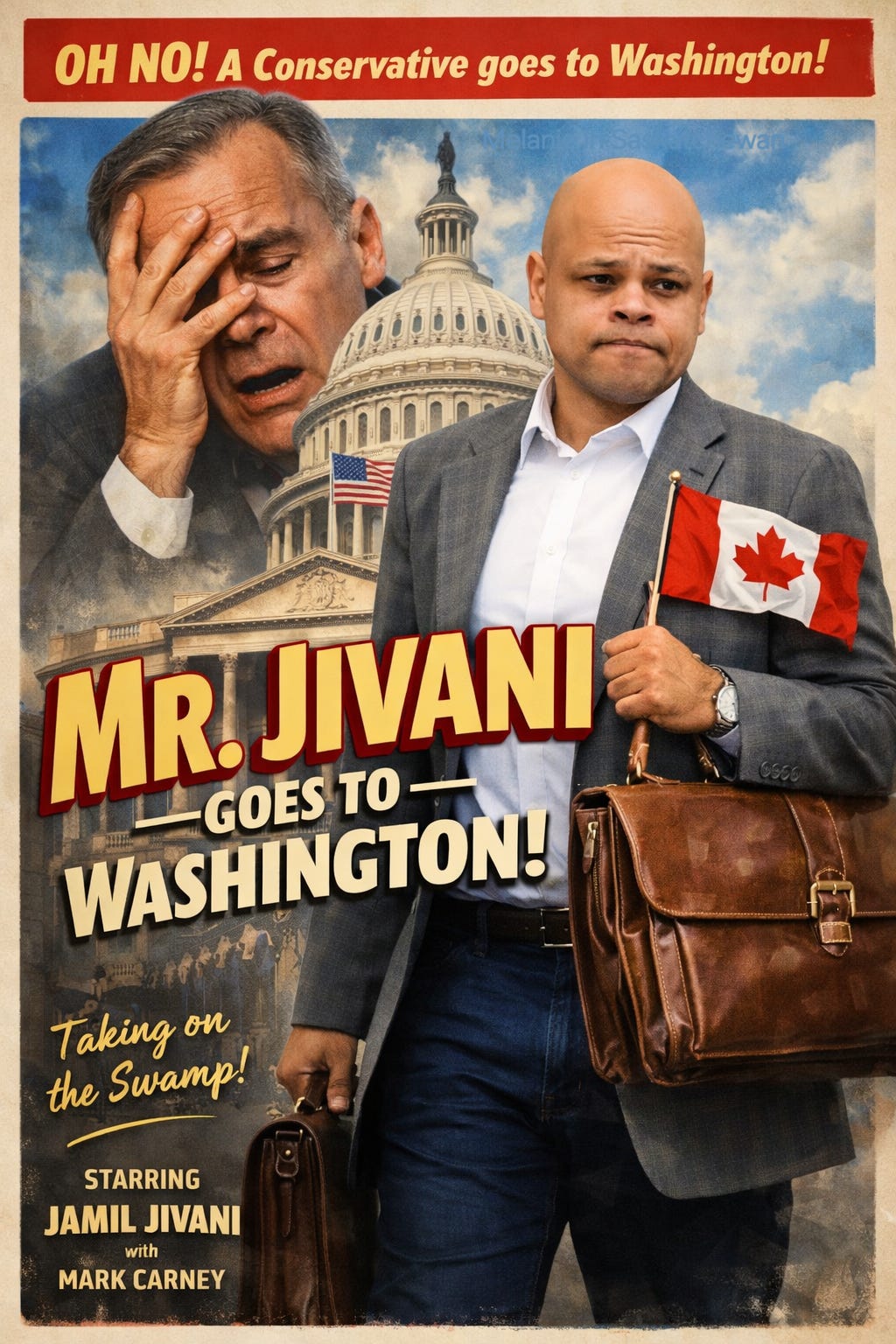
Jamil Jivani on his trip to Washington DC

Filed under: Cancon, Economics, Government, Media, Politics, USA — Tags: , , , , , — Nicholas @ 05:00

If you depend on the CBC, the Toronto Star or other legacy Canadian media, if you heard anything at all about Bowmanville-Oshawa North MP Jamil Jivani’s visit to key American leaders in Washington DC, you probably got the story framed as Liberals tut-tutting and disapproving of Jivani, his initiative to make the trip, and how he should leave everything to the government. If nothing else, it further proved that Prime Minister Carney doesn’t actually want better relations with the US, as his entire campaign was based on opposition to Trump and its success in riling up Canadian boomers with the moronic eLbOwS uP nonsense.

In the National Post Jivani discusses the trip and what he’s learned from it:

Image from Melanie in Saskatchewan

It was a whirlwind of a trip, full of excellent conversations. I had meetings with the White House and State Department, including conversations with President Donald Trump, Vice-President JD Vance, and Secretary of State Marco Rubio. Senators from Montana, Ohio, and Wisconsin, as well as the United States Trade Representative, each sat down with me to share their priorities. Businesses and industries employing thousands of Canadians shared their insights with me on where Canada-U.S. trade fits into their vision for economic growth.

Doors were open for dialogue about how Canada and the U.S. can work together at a time when pessimism gets most of the media attention. Certainly, my 15-year friendship with the vice-president played a key role in opening those doors. But what I found across the board was optimism about how we can move trade negotiations forward. I was particularly happy to hear key insights on how we can make progress on specific sectoral priorities, and the importance of strategic diplomacy. I offered my perspective on why CUSMA is so important to communities like mine in Bowmanville—Oshawa North, and I expressed my hope that CUSMA will continue to ensure Canada and the U.S. both benefit from a special economic and security relationship.

There is only so much I can share without first having the chance to speak with Prime Minister Mark Carney and Minister Dominic LeBlanc. Out of respect for their unique responsibilities in negotiating trade with the United States, it’s important that I debrief them before saying too much publicly and see how we can work together moving forward as Conservatives and Liberals.

However, I do want to point out a key observation related to the need for strategic diplomacy. Mexico — the third partner in our trilateral trade agreement with the U.S. — is further ahead in its engagement with the U.S. than Canada is. On Jan. 28, 2026, Mexico and the U.S. announced formal talks on CUSMA reforms. A week later, Mexico and the U.S. announced a joint action plan for critical minerals. Neither of these announcements included Canada.

Observers of this news would be right to worry that the current Canadian government may be making similar mistakes as were made under Prime Minister Justin Trudeau during the 2017 CUSMA negotiations. At that time, Mexico advanced its negotiations with the U.S. while Canada was largely left out of the process. It was only at the last minute, when a bilateral agreement between Mexico and the US was a real possibility, that Canada was included and our unique trilateral arrangement continued.

It would be a mistake to relive 2017 all over again, if for no other reason than Canadian workers and businesses deserve to have full representation in a process that has such a significant impact on our economy. The workers at the GM plant in Oshawa deserve to know that their government did everything possible to protect their jobs and encourage investment in their industry. All Canadians deserve to know that their elected officials are making the best effort possible to advance our national interests.

Full disclosure: Jamil Jivani is my Member of Parliament, and I fully support his decision to go and I hope that it actually does help make for improved trade relations between Canada and the United States. Bitterness and uncertainty only benefit the Liberal Party and Mark Carney, not ordinary Canadians. Attacking and criticizing Donald Trump plays well in our deranged and sycophantic media, but it makes Trump less willing to deal fairly with Canada on trade or other issues of critical importance to both nations.

January 18, 2026

Mark Carney’s actual jobs before becoming Prime Minister

On the social media site formerly known as Twitter, Ezra Levant explains the various jobs Mark Carney has held compared to what many Canadians think he’s done:

    Laura Stone @l_stone
    Unifor President Lana Payne calls China EV deal “a self-inflicted wound to an already injured Canadian auto industry”. Says providing a foothold to cheap Chinese EVs “puts Canadian auto jobs at risk while rewarding, labour violations and unfair trade practices”. #onpoli

I think there’s a misconception amongst Canada’s chattering classes that Mark Carney is an experienced and successful businessman and executive.

He wasn’t. He wasn’t CEO of Brookfield. He was its chairman, overseeing quarterly board meetings and spending the rest of his time flying around to different globalist conferences at the UN or WEF.

He was more of a mascot, a symbol, an ambassador of Brookfield. He didn’t negotiate deals or turn around companies. He did photo-ops.

Before that, he worked at the Bank of England, and before that, the Bank of Canada.

No Googling: can you name a single actual duty of that job? Can you tell me what Carney actually achieved?

He wafted up from fake job to fake job — like Justin Trudeau did, but instead of being a surf instructor and a substitute teacher, he had meaningless executive jobs.

And now when it’s time to shine … he doesn’t know what to do.

It’s been a year, and he has no deal with Trump, despite saying that was his chief focus.

What exactly did he achieve in Beijing? The tariffs against Saskatchewan were lifted — so that merely brings us back to the status quo ten months ago. Nothing else. No investments in Canada, which was the pretext of the trip. Just a capitulations, to allow the dumping of 49,000 Chinese EV cars, with their spyware and malware.

But he looks good in a suit and says ponderous words like “catalyze” and “transformative”. And that’s enough to impress the Parliamentary Press Gallery. Not that they needed much impressing — they’re all on his payroll already, through his massive journalism subsidies. They’re too busy holding the opposition to account to take notice of this latest disaster.

But the regime media shouldn’t feel too bad about being conned. Carney tricked Doug Ford pretty good, didn’t he?

January 9, 2026

Mark Carney’s play-acting on the international stage

There is no way that Canada can make itself economically independent of the United States, no matter how much wishcasting power is exerted to persuade anti-American boomers who habitually vote Liberal. Our entire economy is oriented to serve the vast market to our south, and we’ve been freeloading on our own military because the Americans have been willing to take up the slack and — until recently — not castigate our leaders for their fecklessness. It was bad under Justin Trudeau, but it’s actually gotten worse under Mark Carney’s leadership. Trudeau was performative and loved to play to the world media, but Carney seems to actually believe that he can reverse the entire direction of the Canadian economy by jetting around the world and bad-talking Donald Trump. The Canadian economy has been stalled for ten years now, and if Trump finally loses patience with our idiotic elites, it’ll go into free-fall.

On the social media site formerly known as Twitter, James E. Thorne points out just how few cards Carney actually has in his hand:

Mark Carney’s and Canada’s Dangerous Refusal to Face Reality.

Mark Carney and most Canadians are behaving as if Canada is an independent pole in a multipolar order, when the world he actually inhabits is a hierarchy being brutally clarified by Washington. Trump’s revamped National Security Strategy and the “Trump Corollary” — asserted through the seizure of Nicolás Maduro and open threats toward Cuba and Colombia, make plain that the United States now treats the Western Hemisphere as an American security estate, not a debating society among equals.

In that framework, Canada is not a co-author of the rules. It is a dependency inside the U.S. sphere, structurally lashed to American markets, finance and supply chains. AND after decades without a serious sovereign industrial or energy strategy, Canada is at best a weak Middle Power, that has for decades squandered its competitive advantage through proformative politics and virtue signalling.

In this era, the Western Hemisphere is now a “secure production platform” for American industry and technology, defined not by territorial control but by ownership, access and compliance. The Trump doctrine logic is clear and blunt yet internally coherent: if the Western Hemispheres natural resources and supply chains are secured, the economic and geopolitical dividends will follow.

Carney’s answer to the Trump Doctrine, however, remains the same “City-of-London” orthodoxy that produced him: more proformative political grandstanding, more process, more declarations, more meetings, and more boondoggles.

The Greenland consulate, rhetorical red lines over annexation, the flying around the world, and ritual protests against U.S. action in Venezuela all presume that we still live in the post WWII rules based order. We do not! Will live in the era of the Trump Doctrine, and no we can’t wait it out. And in this era, Greenland will not be allowed to be under the influence of Russia or China.

Thucydides warned that “the strong do what they can and the weak suffer what they must”. Carney’s tragedy is that he quotes the rules-based order while presiding over a country whose economic structure is colonial and whose security ultimately depends on the very power he is theatrically chastising. Posturing without power is not prudence. It is provocation without a plan. And yes it’s dangerous.

The irony is that Carney understands all of this perfectly well, which only sharpens the question: what, exactly, is he doing by posturing as a rules-based equal in a hierarchy where he knows Canada lacks the hard power to back his stance?

December 30, 2025

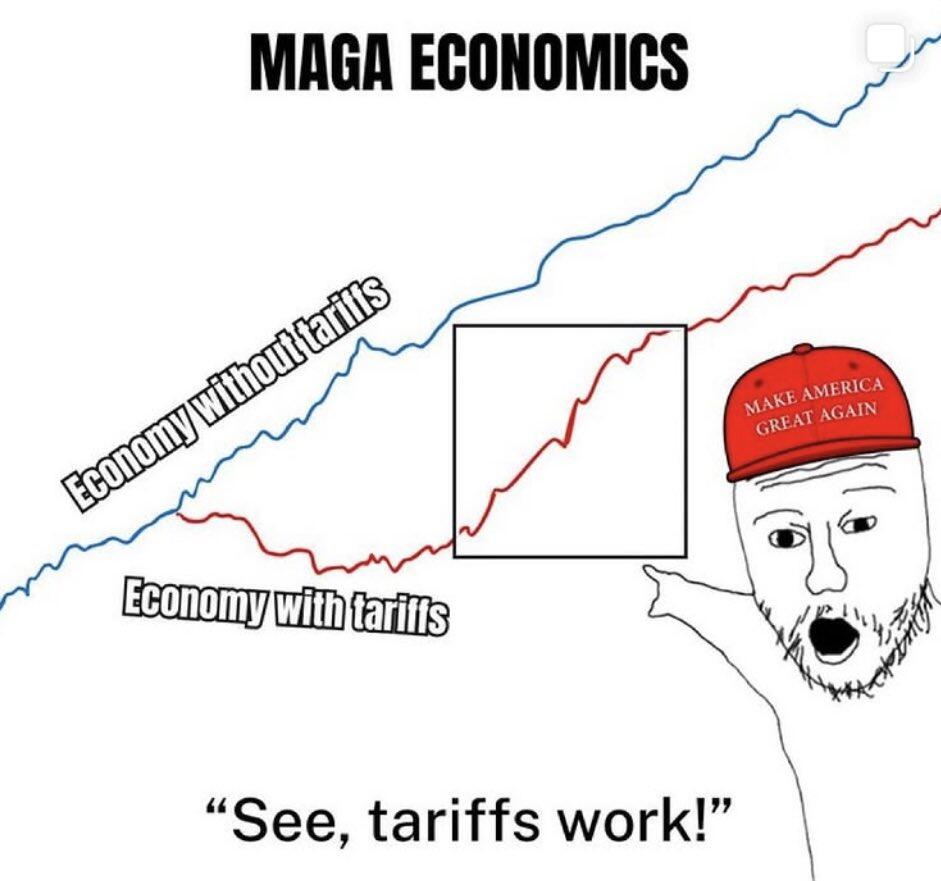
Tariffs are an economic burden, even when you claim they’re paid by foreigners

Filed under: Business, Economics, Government, USA — Tags: , , , , — Nicholas @ 04:00

At the Foundation for Economic Education, David Hebert responds to a recent pro-tariff puff piece from financial columnist, Matthew Lynn:

As Lynn acknowledges, “the tariffs are a tax”. Because they are a tax, they are going to be paid by someone in some form. You can’t have money flowing into the Treasury without someone paying that extra money in some way. Broadly speaking, we can divide the potential payors of American-imposed tariffs into three camps: American consumers, American importers, and foreigners.

One of the oft-cited effects of a tariff is to reduce the amount of imports coming into America. This makes sense and is in fact one of the numerous goals administration officials have pointed to. Insofar as American consumers and importers end up paying the tariff, they will buy less of the now-more-expensive foreign products. We’re already seeing this happen in the US, which Lynn alludes to throughout his article.

If foreigners pay the tariff, they’ll sell less of the now-tariffed goods to the US. This will, as President Trump and others have correctly identified, hurt their bottom line. To offset at least some of this, these countries will try to sell more of their products to their domestic consumers or consumers in countries other than the US. This is exactly what we have seen and what we are seeing, as other countries around the world are securing new trade deals with one another and deliberately excluding the United States from said deals.

So, Lynn is correct to point out that foreign corporations have incurred costs because of the Trump tariffs. However, despite his repeated implication to the contrary, this is not money that goes to the US Treasury. Volkswagen, for example, has raised the price of its 2026 models by up to 6.5 percent, largely due to tariffs, and has indicated that this is just the beginning. That’s more money coming out of American consumers’ pockets. At these higher prices, American consumers are purchasing fewer Volkswagens than last year. Volkswagen’s losses from the tariffs include an almost 30 percent decline in profits from auto sales. Importantly, sales that do not happen count toward the reduced profit that Volkswagen reported but generate no tariff revenue for the Treasury to collect. That Lynn, a financial commentator, does not understand this distinction is deeply troubling.

Who Really Pays the Tariff?

Lynn’s central argument rests on a fundamental confusion between what economists refer to as the “legal incidence” and the “economic incidence” of a tax. Legally, because tariffs are a tax on imports, it is the US importers who must write the check to Customs and Border Protection. But this says nothing about who actually pays the tariff.

For example, when landlords’ property taxes go up, who pays? The landlord will obviously write the check to the county assessor, but unless Lynn thinks that landlords are running charities, that cost gets passed on to tenants in the form of higher rent, less frequent maintenance, or fewer included benefits (utilities or access to designated parking, for example). The legal incidence falls on the landlord, but the economic incidence falls disproportionately on renters, i.e., young Americans already besieged by high housing costs.

Tariffs work the same way. US Customs and Border Protection bills the American importer directly, which is the legal incidence of the tariff. But the economic burden gets distributed among American consumers, American importers, and foreign exporters, depending on the particulars of the individual markets.

Lynn cites the Harvard Pricing Lab finding an approximately 20 percent “pass-through rate,” meaning that American consumers are only paying about one-fifth of the tariff costs. He treats this as a permanent feature of the tariff regime and as proof that foreigners are footing the bill. But the question isn’t who writes the check today, it’s who bears the cost over time. And here, the evidence directly contradicts Lynn’s fables.

As we have seen, pass-through rates are not static, but evolve over time as markets adjust. And every piece of evidence suggests that the pass-through rate has been and is continuing to rise rapidly. Goldman Sachs and the Council on Foreign Relations tracked the evolution over just this administration. Their findings are stunning: In June, US businesses absorbed about 64 percent of the tariff costs, American consumers about 22 percent, and foreign exporters about 14 percent in the form of reduced profits. Just four months later, American businesses absorbed just 27 percent, while American consumers absorbed 55 percent and exporters absorbed 18 percent. Projections for 2026 continue the trend with consumers absorbing 67 percent, exporters 25 percent, and importers just 8 percent.

The logic behind this is simple and has been echoed by President Trump and Scott Bessent themselves. In the initial months following Liberation Day, American importers could not quickly shift to alternative suppliers, giving them little leverage to demand price cuts from existing foreign vendors. Many American importers also believed (or hoped?) that the tariffs were simply a negotiating tool that would be bargained away. Having built up inventories before April, they were able to avoid raising consumer prices, with the belief that the “temporary pains would be worth the long term gains.”

That’s no longer the case. As the BLS notes in its latest import price index report, the price of imports has barely changed. This matters because US importers, not foreign sellers, are legally required to write the tariff check. American buyers pay the foreign company’s price, then pay the tariff on top of it. If foreigners were truly absorbing the tariffs, they’d have to lower their prices to compensate, and we would see a decrease in the import price index. We haven’t. The index is flat, which is evidence that the burden of the tariff is, as economists warned, being paid disproportionately by Americans in one form or another. As the Council on Foreign Relations analysis points out, by October, importers have “had time to seek alternative suppliers, giving them a bit more negotiating leverage.” More importantly, the “trade deals” that the administration has inked have made it clear that substantially higher tariffs are here to stay. All of this gives importers and retailers good reason to continue passing more of the costs along to consumers.

We are already seeing evidence of this happening. The Federal Reserve Bank of Boston’s survey of small and medium-sized businesses, for example, confirms this dynamic. Firms expecting tariffs to persist for a year or longer plan to pass through three times more of their cost increases to consumers than firms expecting short-lived tariffs. As of August, over 45 percent of affected businesses expected their costs to be impacted for longer than a year.

But how does all of this compare to the pass-through rate felt during the 2018–2019 tariffs? The Harvard Pricing Lab — the same data that Lynn cites — actually undermines his entire argument. After just six months, the 2025 tariff pass-through rate is indeed around 20 percent. But if we compare this to the 2018 tariffs, the difference is night and day. After Trump’s first-term tariffs, the pass-through rate stayed under 5 percent after a full year. This isn’t evidence that these tariffs are working. It’s evidence that these tariffs are hitting consumers harder and faster than the previous round.

November 22, 2025

Ottawa is working hard … to keep beef prices high for consumers

Filed under: Bureaucracy, Cancon, Economics, Food, Government — Tags: , , — Nicholas @ 03:00

It’s not your imagination, beef is still much more expensive than it used to be (we no longer buy any “good” cuts of meat, settling for ground beef and “stewing beef” when we do the shopping). But rest assured, the feds are working diligently … to prevent beef prices from falling:

We recently received information from a reliable industry source about how the federal government is administering beef import permits. If accurate, it raises serious concerns about whether Ottawa is knowingly sustaining an outdated and opaque system that keeps beef prices unnecessarily high. At a time when many families are struggling with food costs, this is more than a bureaucratic issue — it directly affects affordability.

Canada’s beef import rules operate under a tariff-rate quota system. A limited volume of beef can enter the country at a low tariff, but anything beyond that is slapped with a steep import charge. When supply tightens or when specialty products are required, supplemental import permits are meant to provide flexibility and help stabilize the market. For years, the system worked reasonably well.

But the structure behind the process has not kept pace with today’s realities. The committee originally created to provide guidance — the Beef and Veal Tariff Rate Quota Advisory Committee — has not met since 2015. For a decade, no formal mechanism has existed for importers, retailers, or independent distributors to participate in discussions with government about how permits are allocated. Instead, decisions have shifted informally toward a small group of influential players, including major domestic processors who have a vested interest in limiting imports. The transparency and balance once built into the system have eroded.

Adding to this complexity is the broader concentration of market power in the sector. Beef packing and processing in Canada is dominated by two foreign-owned private companies: Cargill, based in the United States, and JBS, headquartered in Brazil. Together, they control the overwhelming majority of beef slaughter and processing in this country. When a sector is this concentrated, and when a federal system restricts competition through import controls, the beneficiaries are obvious. Any policy that tightens import access — intentionally or not — further entrenches the dominance of these two multinational giants.

The consequences are no longer theoretical. Our source described a case where a long-established importer has beef sitting in bonded storage in Canada. The product is legally imported and properly documented. The importer applied for a supplemental permit to release it into the market at the regular tariff rate. The application was refused. The justification offered — that the beef had been purchased abroad at a price “too low” compared with U.S. prices — makes little economic sense. The product did not come from the U.S., and competitive pricing has never been grounds for rejecting a permit. With no permit, the importer must wait until the next quota year or pay the full over-quota tariff. Ironically, the only reason paying the tariff is even possible now is because beef prices have climbed so sharply. The federal government, of course, collects that tariff revenue.

Cases like this raise an uncomfortable question: does Ottawa actually want to keep beef prices high? If the goal were genuinely affordability, the government could issue supplemental permits when supply conditions justify them. It could restore a functioning advisory committee to ensure balanced input. It could provide clear and transparent criteria for permit decisions. Instead, legitimate requests are rejected, supply is restricted even when product is physically present in the country, and both processors and Ottawa benefit from elevated prices.

November 17, 2025

The US Supreme Court considers whether Trump’s tariffs are legal

Filed under: Government, Law, Liberty, Media, Politics, USA — Tags: , , , , — Nicholas @ 05:00

Thanks to the staggering incompetence (and/or deliberate provocation for domestic political advantage) of the Carney government’s dealings with President Donald Trump, the current case before the Supreme Court is of significant interest to those of us on the north side of the US-Canadian border. On his Substack, David Friedman discusses the issues before the court:

There are three things wrong with Trump’s tariffs. The first is that they cannot be expected to provide the benefits claimed, can be expected to make both the US and its trading partners poorer; the arguments offered for them depend on not understanding the economics of trade. For an explanation of why that is true, see an earlier post.

The fact that the tariffs make us poorer may be the most important thing wrong with them but it is irrelevant to the Supreme Court; nothing in the Constitution requires the president to do his job well. The questions relevant to the Court are whether what Trump is doing was authorized by past Congressional legislation and whether it was constitutional for Congress to authorize it.

What Counts As An Emergency?

Tariffs are under the authority of Congress, not the president.1 Trump’s justification for setting them himself is congressional legislation, the International Emergency Economic Powers Act.

    (a) Any authority granted to the President by section 1702 of this title may be exercised to deal with any unusual and extraordinary threat, which has its source in whole or substantial part outside the United States, to the national security, foreign policy, or economy of the United States, if the President declares a national emergency with respect to such threat.

    (b) The authorities granted to the President by section 1702 of this title may only be exercised to deal with an unusual and extraordinary threat with respect to which a national emergency has been declared for purposes of this chapter and may not be exercised for any other purpose. (IEEPA, 50 U.S. Code § 1701, emphasis mine)

Trump declared that his Worldwide Reciprocal Tariffs were intended to deal with the US trade deficit.2 Whether the deficit is a threat and whether tariffs are a good way to deal with it are questions for economists3 but whether it is unusual is relevant to judges, since if it is not the IEEPA does not apply.

[…]

The Court on Trial

Delegating to the president the power to impose tariffs, a power explicitly given to Congress in the Constitution, is a major question. Under doctrine proclaimed by this court that means that the legislation claimed to delegate that power must be read narrowly. On a narrow reading, on anything but a very broad reading, the legislation fails to apply to President Trump’s tariffs for two independent reasons:

    It only grants power in an emergency, which under the language of the Act neither the trade deficit nor the illegal drug problem is; the deficit has existed since 1970, the War on Drugs was proclaimed in 1971.

    The powers granted to the president in the Act do not include the power to impose tariffs.

If the six conservative justices believe in the principles they claim, the administration will lose the case 9-0.


  1. The Congress shall have Power To lay and collect Taxes, Duties, Imposts and Excises … To regulate Commerce with foreign Nations … (U.S Constitution, Article I, Section 8).
  2. “I found that conditions reflected in large and persistent annual U.S. goods trade deficits constitute an unusual and extraordinary threat to the national security and economy of the United States that has its source in whole or substantial part outside the United States. I declared a national emergency with respect to that threat, and to deal with that threat, I imposed additional ad valorem duties that I deemed necessary and appropriate.” (Executive Order July 31, 2025).
  3. The answers are no and no.

October 27, 2025

Trump versus Carney (and Ford, his court jester)

Another week, another set of bleak headlines about the trade relationship (or lack thereof) between Canada and the United States. For some, this is the story of how Trump Derangement Syndrome has consumed all levels of Canadian leadership, while for others it’s proof that you can’t deal with Trump as a rational adult and instead need to consider him an overgrown toddler with a nuclear arsenal at his disposal. Or perhaps it’s a little from column A and a bit from column B:

At the risk of overstating my own influence, it’s like the President of the United States read my piece saying he was acting like a toddler and decided, “oh yeah? I’ll show what ‘acting like a toddler’ means!” and did this, presumably once Bluey was over:

    U.S. President Donald Trump says he is raising tariffs on Canadian goods by 10 per cent, after accusing Canada of airing what he called a “fraudulent” advertisement that misrepresented former president Ronald Reagan’s stance on tariffs.

    In a post published on Truth Social at 4:30 p.m. Saturday, Trump wrote, “I am increasing the Tariff on Canada by 10% over and above what they are paying now.”

    Trump’s post cited his frustration over an advertisement produced by the Ontario government that used clips of Reagan warning about the dangers of protectionism and praising free trade.

    “Canada was caught, red handed, putting up a fraudulent advertisement on Ronald Reagan’s Speech on Tariffs,” he wrote.

    Earlier this week, Trump had cut off trade negotiations with Ottawa, explaining it was due to the “hostile” nature of the ad campaign.

    “Their Advertisement was to be taken down, IMMEDIATELY, but they let it run last night during the World Series, knowing that it was a FRAUD,” Trump further said in the Truth social post.

The good news is, at least Trump is coming right out and admitting that his “national security” tariffs are really about nothing more than his fragile ego, just in time for the Supreme Court to hear arguments about this very issue.

The bad news is, I think it’s exceptionally naive to think SCOTUS is going to save us from this madness.

Not because I think they’ll rule that what he’s doing is legal. That might be a bridge too far for even Justices Thomas and Alito.

But because this proposition rests on the assumption that Trump considers himself bound by Supreme Court rulings and that anyone else is going to exercise their power to ensure these rulings are followed.

Or, if you think Canadian leaders are deep in a TDS binge:

How The New Republic saw Donald Trump during the 2024 election campaign.

Trump Derangement Syndrome (TDS) is a widespread and serious issue. When one is afflicted by it, their capacity to sense-make becomes compromised. Emotions are a difficult thing for humans to control, and TDS-sufferers seem for the most part unaware of how much their negative, emotional feelings concerning Trump have hijacked their reason.

TDS types reveal themselves in so many ways. One specifically, which often goes unnoticed, is a general uncharitableness when it comes to interpreting the words and actions of Trump, or a general unwillingness to look beyond words – either Trump’s words or anyone else’s which have been inserted into Trump discourse. A prime example of this is the anti-tariff ad campaign involving a 1987 speech by former president Ronald Reagan which the Ford government paid $75 million to have broadcast to American audiences – key Republican areas – for the purpose of undermining President Trump’s economic policy.

Firstly, the uncharitable analysis does not allow that Trump has any right, or any good argument, or reason to be upset about Canada’s trade practices, such as supply management. The uncharitable analysis sees Canada as an innocent victim and Trump as a bully who is trying to destroy us and/or take us over.

[…]

Returning to reason and reality. Trump has justification for being upset with Canada over both our trade practices and in the under-handed and unfriendly tactics of Doug Ford and other Canadian leaders. The ad was an insult to Trump. His reaction or over-reaction to the ad, does not change the fact that what Ford did was antagonistic and not in the best interests of productive trade negotiations. The charitable analysis understands this, and does not lose sight of it, no matter how outlandish the things Trump does may be.

On the other side of the uncharitable Trump analysis concerning Ford’s Reagan ad blunder, is circulating the idea that Reagan was anti-tariff. Why is this idea believed? Because of Reagan’s rhetoric. You can find hundreds of clips of Reagan speaking about the dangers of high tariffs, or advocating for free trade. But the uncharitable analysis refuses to go beyond words. They ignore words that don’t support their argument, and act as if the words that do support their argument were the only ones spoken. Further, they act like words are the be all and end all, by not bothering to investigate the actions of those who speak the words, they pretend that word-speakers always do and intend exactly what they say. Reagan’s oratory contained lots of anti-tariff rhetoric, but his actions included lots of pro-tariff policy in an effort to deal with unfair trading partners.

None of this is difficult once you mea culpa from TDS. If you remain under the spell of TDS, you will not be rational or reasonable, and I for one, will not take you seriously. You will look increasingly foolish as time goes on and Trump’s policies turn out not to be the disasters you hysterical twits dreamed they would be. And the group of people like me, who shake their heads and roll their eyes at you, will grow and grow, under the weight of inevitable mass mea culpa. But you will remain shrouded from truth as you descend further into darkness and gloom and hate. It doesn’t have to be this way … just mea culpa FFS!

Older Posts »

Powered by WordPress