
Who was Gaius Marius’ son, and how did he set out to bring down his father’s rival, Sulla? Which two rising stars in Sulla’s faction, Crassus and Pompey, would go on to bring down the Republic, with Julius Caesar? And, how did a momentous battle in the East see Sulla elevated to the master of Rome?
Join Tom and Dominic as they reach the climactic conclusion to the remarkable rise of one of Rome’s greatest generals: Lucius Cornelius Sulla, a man who would destroy his rivals, win victories in the east, and ruthlessly change the destiny of the Roman Republic forever.
0:00 The Roman Republic Implodes
0:40 Sulla’s Return
3:05 Cinna and the Marians
8:03 Cinna’s Disastrous Plan
12:20 Sulla’s Enemies Collapse
14:07 Crassus Joins Sulla
17:01 The Rise of Pompey
21:16 Marius the Younger
24:13 The Marian Cause Collapses
25:03 The Samnites March on Rome
26:03 The Battle of the Colline Gate
28:45 Anthropic
29:57 Sulla Takes Control of Rome
35:05 The Proscriptions Begin
41:18 The End of the Marians
42:41 Pompey the “Teenage Butcher”
44:20 Pompey Demands a Triumph
47:28 Sulla’s Great Paradox
48:02 Sulla Becomes Dictator
51:27 Rebuilding the Republic
54:00 Sulla Gives Up Power
55:30 Sulla’s Wild Retirement
58:42 The Death of Sulla
59:58 Did Sulla Doom the Republic?
1:01:54 Why Didn’t Sulla Become Emperor?
1:02:46 Julius Caesar Learns from Sulla
1:04:01 Cicero Bonus Episode
September 12, 2026
How the Roman Republic Collapsed Into Civil War
September 11, 2026
QotD: Sherman on some military lessons learned during the American Civil War
Very few of the battles in which I have participated were fought as described in European text-books, viz., in great masses, in perfect order, manœuvring by corps, divisions, and brigades. We were generally in a wooded country, and, though our lines were deployed according to tactics, the men generally fought in strong skirmish-lines, taking advantage of the shape of ground, and of every cover. We were generally the assailants, and in wooded and broken countries the “defensive” had a positive advantage over us, for they were always ready, had cover, and always knew the ground to their immediate front; whereas we, their assailants, had to grope our way over unknown ground, and generally found a cleared field or prepared entanglements that held us for a time under a close and withering fire.
Rarely did the opposing lines in compact order come into actual contact, but when, as at Peach-Tree Creek and Atlanta, the lines did become commingled, the men fought individually in every possible style, more frequently with the musket clubbed than with the bayonet, and in some instances the men clinched like wrestlers, and went to the ground together. Europeans frequently criticized our war, because we did not always take full advantage of a victory; the true reason was, that habitually the woods served as a screen, and we often did not realize the fact that our enemy had retreated till he was already miles away and was again intrenched, having left a mere shirmish-line to cover the movement, in turn to fall back to the new position.
Our war was fought with the muzzle-loading rifle. Toward the close I had one brigade (Walcutt’s) armed with breech-loading “Spencer’s”. The cavalry generally had breach-loading carbines: “Spencer’s” and “Sharp’s”, both of which were good arms.
The only change that breech-loading arms will probably make in the art and practice of war will be to increase the amount of ammunition to be expended, and necessarily to be carried along; to still further “thin out” the lines of attack, and to reduce battles to short, quick, decisive conflicts. It does not in the least affect the grand strategy, or the necessity for perfect organization, drill, and discipline. The companies and battalions will be more dispersed, and the men will be less under the immediate eye of their officers, and therefore a higher order of intelligence and courage on the part of the individual soldier will be an element of strength.
When a regiment is deployed as skirmishers, and crosses an open field or woods, under heavy fire, if each man runs forward from tree to tree, or stump to stump, and yet preserves a good general alignment, it gives great confidence to the men themselves, for they always keep their eyes well to the right and left, and watch their comrades; but when some few hold back, stick too close or too long to a comfortable log, it often stops the line and defeats the whole object. Therefore, the more we improve the fire-arm the more will be the necessity for good organization, good discipline and intelligence on the part of the individual soldier and officer.
There is, of course, such a thing as individual courage, which has a value in war, but familiarity with danger, experience in war and its common attendants, and personal habit, are equally valuable traits, and these are the qualities with which we usually have to deal in war. All men naturally shrink from pain and danger, and only incur their risk from some higher motive, or from habit; so that I would define true courage to be a perfect sensibility of the measure of danger, and a mental willingness to incur it, rather than that insensibility to danger of which I have heard far more than I have seen.
The most courageous men are generally unconscious of possessing the quality; therefore, when one professes it too openly, by words or bearing, there is reason to mistrust it. I would further illustrate my meaning by describing a man of true courage to be one who possesses all his faculties and senses perfectly when serious danger is actually present.
Modern wars have not materially changed the relative values or proportions of the several arms of service: infantry, artillery, cavalry, and engineers. If any thing, the infantry has been increased in value. The danger of cavalry attempting to charge infantry armed with breech-loading rifles was fully illustrated at Sedan, and with us very frequently.
So improbable has such a thing become that we have omitted the infantry-square from our recent tactics. Still, cavalry against cavalry, and as auxiliary to infantry, will always be valuable, while all great wars will, as heretofore, depend chiefly on the infantry. Artillery is more valuable with new and inexperienced troops than with veterans. In the early stages of the war the field-guns often bore the proportion of six to a thousand men; but toward the close of the war one gun, or at most two, to a thousand men, was deemed enough.
[…]
It was one of Professor (Dennis Hart) Mahan’s maxims that the spade was as useful in war as the musket, and to this I will add the axe. The habit of intrenching certainly does have the effect of making new troops timid. When a line of battle is once covered by a good parapet, made by the engineers or by the labor of the men themselves, it does require an effort to make them leave it in the face of danger; but when the enemy is intrenched, it becomes absolutely necessary to permit each brigade and division of the troops immediately opposed to throw up a corresponding trench for their own protection in case of a sudden sally. We invariably did this in all our recent campaigns, and it had no ill effect, though sometimes our troops were a little too slow in leaving their well-covered lines to assail the enemy in position or on retreat.
Even our skirmishers were in the habit of rolling logs together, or of making a lunette of rails, with dirt in front, to cover their bodies; and, though it revealed their position, I cannot say that it worked a bad effect; so that, as a rule, it may safely be left to the men themselves. On the “defensive”, there is no doubt of the propriety of fortifying; but in the assailing army the general must watch closely to see that his men do not neglect an opportunity to drop his precautionary defenses, and act promptly on the “offensive” at every chance.
I have many a time crept forward to the skirmish line to avail myself of the cover of the pickets’ “little fort”, to observe more closely some expected result; and always talked familiarly with the men, and was astonished to see how well they comprehended the general object, and how accurately they were informed of the state of facts existing miles away from their particular corps. Soldiers are very quick to catch the general drift and purpose of a campaign, and are always sensible when they are well commanded or well cared for. Once impressed with this fact, and that they are making progress, they bear cheerfully any amount of labor and privation.
William Tecumseh Sherman, “Sherman on Tactics”, Tactical Notebook, 2026-06-10. (Selection from Memoirs of William T. Sherman (1875) by Bruce Ivar Gudmundsson, minus an observation that sieges were now unimportant which was disproved in 1914.)
September 8, 2026
Sulla Seized Rome… Then Marius Returned for Revenge | Rome’s First Civil War
The Rest Is History
Published 7 Sep 2026What shocking, unprecedented act did Sulla commit with his legions after having his ambitions frustrated once more by his bitter rival, the tribune Marius? How did Marius escape capture and death? And, would Marius retaliate …?
Join Tom and Dominic as they unfold the mounting rivalry between two Roman generals — Marius and Sulla — as they battle for ultimate control of the empire, and Sulla takes a fateful step that will change the fate of the Republic forever …
0:00 Sulla: The First Roman General to March on Rome
4:31 Marius Seizes Sulla’s Command
11:47 Sulla Marches on Rome
19:50 Mithridates: Rome’s Great Enemy in the East
23:25 The Massacre of the Romans in Asia
26:46 Athens Revolts Against Rome
30:34 Rome’s Generals Become Warlords
34:38 Pressure
35:46 Marius: Fugitive and Outlaw
41:02 Rome Descends Into Political Violence
45:13 Marius Raises a Private Army
48:15 Marius Returns to Rome
49:06 Marius’s Seventh Consulship and Death
51:44 Sulla Goes to War in Greece
53:40 The Siege of Athens
56:59 Sulla Storms Athens
59:51 Sulla Faces Mithridates’ Army
1:00:48 Sulla Makes Peace with Mithridates
1:03:33 Sulla’s Revenge on Athens
1:04:58 Rome’s First Civil War Looms
September 5, 2026
QotD: The first (of many) near-death experiences of William Marshal, the greatest knight
He would have been far from the first child to die on Stephen’s account, because at this point England was fourteen years into a civil war so brutal that the Peterborough Chronicle recorded that men “said openly that Christ slept” (þa sæden openlice ðæt Crist slep. ⁊ his halechen),1 but this time was different. This time, the king had to order the boy’s death himself.
The medieval English royal succession was never as neat as Crusader Kings mechanics would have you believe, but even so Stephen I (and only) was an unlikely king. His mother Adela was the youngest child of William the Conqueror. She had four older brothers, three of whom survived their father, and Stephen himself was the third of her sons. But the Conqueror’s eldest son, Robert Curthose, mortgaged his duchy of Normandy to fund his participation in the First Crusade and would go on to spend the decades after his return in comfortable captivity. His second son, Richard, was killed as a teenager in a hunting accident in the New Forest in 1070, and his third son, William Rufus, succeeded him as king, never married, and was also killed in a hunting accident in the New Forest (this time in 1100). If this seems suspiciously convenient, it was: the youngest brother, Henry, was also on the fatal hunting trip. He immediately rode hard for Winchester, where he was crowned three days later.
Henry I promptly married Matilda, whose father was the king of Scotland and whose mother Margaret (later canonized by Innocent IV) was the sister of Edgar Ætheling: Henry and Matilda’s son William, born in 1103, united the blood of the Norman conquerors and the old Anglo-Saxon House of Wessex. Their daughter, another Matilda, was sent off to Germany at the age of eight to marry the twenty four-year-old Holy Roman Emperor Henry V. And that was it: Henry I also fathered at least twenty-two attested bastards, but William and Matilda were his only legitimate children. Which meant that when a drunken helmsman wrecked the ship carrying William and at least three hundred other flowers of the Anglo-Norman nobility across the Channel, Henry was in deep trouble. Luckily for him, his daughter soon returned from Germany a childless widow and once he had remarried her to Geoffrey of Anjou he was able to browbeat his barons into accepting her as his heir. Unluckily for him, they didn’t mean it: Empress Matilda was deeply unpopular even beyond the fact that she was a woman, and as soon as Henry died they were happy to crown his nephew Stephen instead.
The ensuing civil war, known to history as “the Anarchy,” was exciting and dramatic and featured such moments as a king captured on the battlefield, a queen climbing out the window of a besieged castle and escaping through a snowstorm, and a teenage boy invading England with a mercenary army he couldn’t afford to pay. For our purposes, though, all you really need to know is that in 1152 Stephen laid siege to a castle in Berkshire that John Marshal, a supporter of Matilda, had built without royal authorization. (These are apparently called “adulterine castles“, which I think is delightful.) Marshal asked for a truce to consult with his constable and organize the garrison’s surrender and offered his youngest son William as a hostage for his good behavior. Stephen accepted, took the boy into his camp, and withdrew to let Marshal enter with his men.
And then John Marshal stayed in the newly-reinforced castle instead.
Using your children as diplomatic hostages was standard practice in this era. Abandoning them to be executed as punishment for your bad faith was definitely not. But when Stephen’s men told John Marshal that his son’s life would be forfeit for his treachery, Marshal is said to have replied that he didn’t care, because he still had “the anvils and the hammers to forge even finer ones”. Stephen was not, in the end, able to bring himself to kill young William: the story has it that he lost his nerve when the boy asked on his way to the gallows whether he could play with a guard’s spear “afterwards”, and then again when William happily climbed into the catapult they planned to use to send him over the walls to his father (he thought it was a swing). He did, however, remain a hostage in Stephen’s camp until the end of the war a year later.2
Our only source for this story of William’s childhood, and for most of the truly excellent stories medievalist Thomas Asbridge recounts in The Greatest Knight, is a 19,215 line rhyming poem in medieval French. Probably composed a few years after William Marshal’s death at the behest of his friends or children, and pretty well corroborated by other sources where other sources exist, the poem is our only surviving example of a medieval biography of a “normal” person. (Relatively speaking; that little boy grew up to be an incredibly accomplished man but neither a king nor a saint, which is who usually got written about.) Moreover, it seems to have been compiled from stories told by people who actually knew him — which probably means that he was the one who told them about the child who thought the catapult was a swing. The poem exists in only one manuscript,3 discovered by Paul Meyer in the late 19th century and published with partial translations into modern French as L’histoire de Guillaume le Maréchal. (You can find Meyer’s version here or here.) More recently, Nigel Bryant published a full English translation, the text of which isn’t available online, though I’ll point out that even Claude Sonnet does a pretty decent job with screencaps of the original.4
Jane Psmith, “REVIEW: The Greatest Knight by Thomas Asbridge”, Mr. and Mrs. Psmith’s Bookshelf, 2026-04-27.
- As a measure of the degradation of the times, the chroniclers’ English no longer employed grammatical gender.
The ⁊ is a Tironian note for “and”, incidentally, and halechen is obviously cognate with “hallowed”. Like and subscribe for more Old English in the least expected places.
- Stephen’s son and heir Eustace having died by this point, it was agreed that he would keep the English throne but be succeeded by Matilda’s son, the future Henry II, who had already conquered Stephen’s duchy of Normandy.
- Yes, like Beowulf. It’s depressing to realize how many incredible medieval texts survive in only one manuscript. Thank a Benedictine today!
- Claim not verified by anyone who actually reads medieval French, but I didn’t see any obvious errors.
September 4, 2026
Marius Saved Rome … Then They Turned To His Greatest Rival | Rome’s First Civil War
The Rest Is History
Published 3 Sep 2026What was the ancient city of Rome actually like in the first century BC? Who was Lucius Cornelius Sulla, another great, but aristocratic, Roman general who would clash with Gaius Marius in a totemic struggle termed the Social War? And, who were the terrifying Germanic tribes amassing on the borders of the empire, potentially spelling its doom …?
Join Tom and Dominic as they discuss Rome’s apocalyptic threat from the North, Marius’ wars in defence of the empire, and the rise of his greatest adversary: Sulla.
0:00 Rome’s Most Unlikely Saviour
4:25 The Barbarian Threat to Rome
9:15 Rome’s Catastrophic Defeat
14:04 Marius Rebuilds the Roman Army
16:48 Marius Takes on the Teutones
19:36 The Cimbri Are Annihilated
23:41 Marius Becomes Too Powerful
27:00 The Rise of Sulla
31:02 Sulla’s Ruthless Ambition
35:05 Amazon
36:15 The Extraordinary Wealth of Roman Italy
42:49 Italy’s Second-Class Citizens
46:18 The Social War Erupts
50:44 Rome Fights Back
52:35 Sulla Becomes Rome’s New Hero
56:05 A New War in the East
58:18 Mithridates Takes on Rome
1:02:00 Marius Makes His Comeback
1:04:39 Violence Erupts in Rome
1:07:01 Marius Takes Sulla’s Command
As Tom and Dominic mention during this episode, there’s a members-only bonus episode discussing the (much contested) “Marian reforms” of the Roman army with … Bret Devereaux who is a strong proponent of the notion that the Marian reforms were not a thing.
September 1, 2026
Marius: The Outsider Who Rose to Command Rome’s Army | Rome’s First Civil War
The Rest Is History
Published 31 Aug 2026Who was Gaius Marius, one of the two men who would shape the fate of Rome in the first century BC? Why was his road to fame, fortune, and political greatness, from total obscurity, so dangerous? And, would Marius be the man to face down the existential threat facing the empire during this period?
Join Tom and Dominic as they launch into one of the greatest struggles in the history of Rome, as two titanic generals and politicians clash over hegemony of the empire, in an age of tumult.
0:00 Gaius Marius: Rome’s outsider
6:13 Marius goes to war
12:09 Climbing Rome’s political ladder
18:35 Amazon
19:45 The Roman Republic turns violent
27:00 Marius takes on the aristocracy
31:45 War with Jugurtha
37:53 Marius betrays Metellus
40:12 Marius becomes Consul
44:28 A new threat approaches Rome
45:09 Marius meets his future rival: Sulla
August 26, 2026
Octavian “found Rome a city of bricks and left it a city of marble”
Octavian, if you’re new around here, is far better known as Augustus, the founder of the Principate. Over at SteynOnline, Tal Bachman continues his interesting series by touching on what the Roman Republic looked like to Octavian at the end of the civil wars:
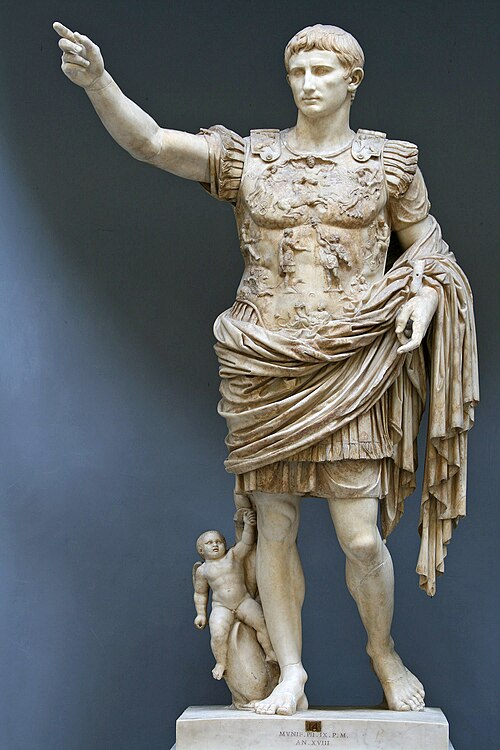
Augustus of Prima Porta
Currently in the Chiaramonti Museum of the Vatican Museums (image from Wikimedia Commons).
So as Octavian thought about his grand plans for renewing Rome, he naturally thought of Virgil. He didn’t need anyone like Horace telling everyone to give up. He needed positivity. He needed the guy who might even have been prophesying about him as Rome’s savior (Octavian was only 23 when Virgil wrote about Rome’s boy-rescuer).
Besides, Virgil’s prophecy had so far proved quite correct: the oft-heralded imminent demise of Rome hadn’t arrived yet. Maybe it never would. In fact, for the first time in over a century, things were looking up. And they were looking up because of what had happened in the previous year and a half.
The most important thing had been Octavian’s victory over the traitor Mark Antony at the Battle of Actium, September of 31 BC. (None other than Octavian’s best friend, Marcus Agrippa, had masterminded the victory as commander of the navy. Over the years of tumult and civil war since Caesar‘s assassination, Marcus had revealed himself to be as much of a natural military genius as Octavian was a political genius).
With his victory over Antony, Octavian had demolished the last of the traitorous military contingents threatening Rome. Less than a year later, Antony and his lover, Queen Cleopatra of Egypt, committed suicide in Alexandria. Suddenly, after decades of bloodshed, the civil war had come to an end.
Or so it seemed. Octavian was too smart to count on that. After all, in politics, an end is never really an end; a beginning is never really a beginning. Each is only a connecting point in time between what has come before, and what will now come to pass. Above everything else, politics is the art of shaping those moments.
It was at just this sort of moment Octavian now stood. Finding himself the undisputed great man of Roman politics, he now controlled (in reality, if not always in law) Rome’s senate, all its provinces, its vast military, its vast resources, its bureaucracy and administration, its appointments, and the immensely valuable, recently-acquired grain powerhouse of Egypt. He also held great influence over the city’s religious activity as part of the sixteen member College of Pontiffs. Moreover, after Actium and Antony’s suicide, no internal or external threat remained. Octavian had spent years making war. Now, with every last foe vanquished, he needed to make — and preserve — peace. The question was how.
A full description of Octavian’s comprehensive answer to that question is beyond our scope here. But what we can explore briefly is how he pushed cultural, spiritual, religious, and even psychological renewal — particularly through Virgil’s Aeneid — and how translation can best communicate that to us.
On that note, it’s worth pointing out that Octavian’s intention wasn’t quite to Make Rome Great Again. It was far more ambitious: he wished to make Rome much greater than anyone had ever imagined it could be, and much greater than any other nation had ever been, or ever would be again. For this to happen, Rome, in a real way, had to start over.
For Octavian, starting over meant laying the right foundation in the right way. What was that foundation? Devout reconnection to the gods. Everything, he believed, would flow from this: peace, identity, cohesion, stability, lawful behavior, ethical behavior, contentment, prosperity, flourishing, valor, self-discipline, excellence, and more. Octavian would do what he could in politics to initiate this renewal; Virgil would do what he could in literature. Together with others in their circle, they would remind people what it meant to be truly Roman, starting with the very first Romans of all. They would tell, and re-tell, in a hundred different ways, the story of who they were, who they weren’t, where they’d come from, and what the gods wanted.
I’ve added links to my Roman Glossary for some of the names and events mentioned in the article.
July 28, 2026
Adventures in Surplus! Type 38 Arisaka Carbine in World War One
Forgotten Weapons
Published 4 Mar 2026In the fall of 1914 it became apparent that the minor fracas in Serbia was going to stretch a lot longer than anyone had expected, and governments began scrambling to secure weapons production. Japan was one source of small arms for the Entente powers, and Britain purchased about 150,000 Arisaka rifles and carbines from the Japanese in late 1914 and early 1915. These were used to equip Royal Navy crews and Army raining and reserve units, but by late 1915 Enfield production had caught up and the guns were no longer needed.
In the fall of 1915, the British sent most of their Arisakas (about 128,000) to Russia, which had also been purchasing large numbers from Japan. There they were again used to arm second-line units, including troops occupying the Grand Duchy of Finland. When Finland declared its independence in December 1917, most of the Russian soldiers went home and left their weapons in Finland. As a result, the Arisaka was the second most common type of rifle available at Finland’s independence, and was used by the Civil Guard until about 1927.
This particular Type 38 Carbine was made at the Tokyo Army Arsenal in 1910, then sold to the British where it was given a set of unit marks on the stock. It was subsequently transferred to Russia, where a metal clip was added to prevent accidental magazine release. It stayed in Finland through the Finnish Civil War and afterwards, only being imported into the US recently by Postrock of Garden City, Kansas.
(more…)
July 25, 2026
Civil War Gwyn & Campbell Carbines (aka Cosmopolitan, Union, & Grapevine)
Forgotten Weapons
Published 2 Mar 2026The first version of this carbine was the Cosmopolitan, designed and patented by Henry Gross in 1859 and manufactured by Edward Gwyn and Abner Campbell. It is a single-shot .52 caliber carbine that loads from the breech with a paper cartridge and a separate external percussion cap. After producing a batch of the guns, Gwyn and Campbell realized that the breechblock design could be much simplified, and they patented that simplification — essentially pushing Gross out of his own invention.
Several successive contracts for the carbines were fulfilled during the Civil War, with about 8,200 produced in total. It was not the most popular or most numerous cavalry carbine of the war, but it is rather remarkable for actually being reliable and delivered consistently on time.
(more…)
July 22, 2026
QotD: Burnside’s Army of the Potomac
This was the country of the boisterous forty-niner, the hell-roaring lumberjack, and the riverman who was half horse and half alligator. Without rancor (and also without the slightest hesitation) it annihilated Indian tribes so that it could people a wilderness, asserting that the only good Indian was a dead Indian and remarking casually of its own pioneers that the cowards never started and the weak died along the road. As it faced the cathedral aisles of endless virgin forests it shouted for immediate daylight in the swamp, even if whole generations must be brutalized for it. It was the country that invented the bucko mate and the Shanghai passage, and if the skysails of its incredible clippers gleamed on the farthest magic horizon they were taken there by men under the daily rule of clubs and brass knuckles. This nation accepted boiler explosions as the price of steamboat travel and it would boast presently of a dead gandy-dancer for every cross-tie on the transcontinental railroad. It wore seven-league boots and scorned to look where it planted them, and each of its immense strides was made at immense human cost. And the army of this country, buckling down to it at last in a fight which had to go to a finish, was going to be very rough on enemy civilians, not because it had anything against them but simply because they were there.
Of genuine hatred this army had practically none. The wild young men who ruined ancestral portraits and pranced in the smoky streets wearing the embroidered undergarments of gentlewomen were expressing nothing but plain hooliganism, which somehow was the obverse side of the medal that had laid nine hundred corpses in front of the stone wall west of town. Both sides of the medal bespoke raw youth which cheered and guffawed by turns, whose noble best forever went arm in arm with its ugly worst.
Bruce Catton, Army of the Potomac: Glory Road, 1952.
July 20, 2026
Eight Great Powers Invade China: the Boxer Uprising 1900-1901
Real Time History
Published 20 Feb 2026After the defeat in the 1st Sino-Japanese War, the Qing Dynasty is under pressure: Some are calling for domestic reforms and ousting Western influence, while the Great Powers want to further open up China for their businesses. Violence erupts when the so called Boxer movement kills several Westerners.
(more…)
July 16, 2026
How Few Remain: The Second War Between the States
Feral Historian
Published 13 Mar 2026Let’s take a look at Harry Turtledove’s How Few Remain and its many themes and historical extrapolations. And probably argue about the Civil War a little along the way.
If there’s enough interest, this may be the start of a dive into the entire sprawling series that follows.
00:00 Intro
01:37 A War Unfinished
07:09 Adapting and Evolving
10:12 Abraham Lincoln and Frederick Douglass
13:15 The Horace Greeley Letter
15:40 Freddie’s Louisville Adventure
18:07 Turtledove, Lost Cause, and Spoilers
(more…)
July 8, 2026
QotD: The Wilmot Proviso
The Wilmot Proviso attempted to scotch that, which forced the Senate, at least, to come right out and say it. People always underestimate the power of words and symbols, and professional historians are among the worst offenders. With the newer generations of pros it’s ideological enstupidation that causes it, but the older folks were almost as bad. It’s a structural issue — we rely on documents, so even though “the temper of the times” is real obvious in the aggregate, unless you can pin it down to specific statements in archival sources it’s hard to make your case.
If it helps, think of the couple whose marriage is obviously on the rocks. They fight constantly, they all but live separately, everybody knows their relationship is doomed … but when one of them finally comes out and says “I want a divorce”, things often change radically. Temporarily, most often, but how many people have you seen suddenly make all-out efforts to patch things up only after somebody finally says the D-word?
You can hear the capital letters in their voices. Before, all that stuff — romantic weekend getaways and the like — were attempts to “get back on track” or “spice things back up” or whatever. As soon as someone says Divorce, though, all those things become capitalized — we’re Saving Our Marriage.
The Wilmot Proviso was like that. Somebody finally said the D word.
Severian, “1846-1861”, Founding Questions, 2022-06-25.
July 2, 2026
QotD: The US federal election of 1848 and the resulting inevitability of the US Civil War
The Democrats’ candidate, Lewis Cass, pushed the idea of “popular sovereignty” in the territories. It wasn’t a bad move — since California was the only soon-to-be-state up for grabs, and since some parts of California are above the Missouri Compromise line, let them decide the terms on which they want to enter the Union. The problem with that, obviously, is that the Senate could become radically unbalanced very quickly, depending on how fast the rapidly-expanding population of the territories got their act together. Iowa and Wisconsin had just entered the Union (1846 and 1848, respectively), as free states under the Compromise. They were counterbalanced by Florida and Texas (both 1845), but obviously the balance was very delicate.
Cass was of course defeated (by Mexican War hero Zachary Taylor), so wrangling over California continued. Taylor wasn’t the greatest leader anyway, and when he died in office he was replaced by everyone’s favorite placeholder, Millard Fillmore. Fillmore gets an undeserved rep for incompetence; in reality, he was exactly the kind of president the Second Party System was designed to produce, even though he was never elected to the office. Most real political power before the Civil War was at the state level, so the President was supposed to be the steward and figurehead of his Party, not a strong national leader. (You can still see echoes of this as late as the early 20th century — William Howard Taft supposedly said “I forgot I ever was President;” he was much more concerned with his reputation as Chief Justice of the Supreme Court).
But slavery was a federal issue, indeed THE federal issue. In the absence of strong leadership at the top — and again, in all fairness to Fillmore and the rest, the system was designed to prevent strong Presidential leadership — it fell to Congress. Which a) is where it should’ve been, under the federal system the Founders designed; but b) meant that it was guaranteed to be a cock-up, because like all debating societies Congress was dominated by Very Clever Boys.
Worse, the immediate antebellum Congresses were dominated by the Very Cleverest Boy of them all, Stephen Douglas. I don’t think there has ever been a Cleverer Boy in American politics than Stephen Douglas, which is really saying something. (A case could be made for Lyndon Johnson, I suppose, and look how that turned out). Douglas’s signature “legislation” was the Compromise of 1850, which did a lot of things, including bringing California into the Union as a free state. It’s easy to get lost in the historical weeds here, so I’m keeping this deliberately superficial. Here are the highlights:
First, it’s important to note that nobody except Stephen Douglas knew they were voting on “the Compromise of 1850”. You have to hand it to the bastard, it’s a really slick piece of politics. He put together a whole bunch of bills, horse-trading parts of each of them among the competing factions to cobble an overarching program together. Nobody would’ve voted on an omnibus bill called “The Compromise of 1850”, but when the dust settled and all the votes were tallied on a bunch of separate measures, that’s what emerged.
Second: Douglas swiped Lewis Cass’s idea of “popular sovereignty” for the new territories (New Mexico and Utah) carved out of the Mexican Cession. At the time, this looked like a band-aid, a procedural quick-fix — those territories wouldn’t be coming into the Union as states anytime soon, and since cotton doesn’t grow so well in the desert it didn’t matter that much anyway. “Popular sovereignty” was just a way to kick the can down the road. Please note, however, that now the precedent was set: The Missouri Compromise is now officially a dead letter, though nobody will come right out and say it.
Third: The Fugitive Slave Act essentially federalized slave-catching. The details aren’t important; the principle is. The US government is now officially the enforcement arm of what many folks were openly calling “the Slave Power Conspiracy”.
Fourth: What looked like a purely symbolic measure, outlawing the slave trade in Washington DC. Here again, we misunderestimate the power of symbols at our peril. The practical effect of this was nil, since DC is tiny and if you wanted to buy slaves, the big markets literally right across the road in Maryland and Virginia would be happy to sell you some. But look at the glaring contradiction — Federal marshals can (and will, and did) dragoon local law enforcement into catching runaway slaves on the planters’ behalf, but the slave trade itself is outlawed in the Capitol’s sacred precincts, because freedom.
The term “fake and gay” hadn’t been invented yet, but since the Compromise of 1850 was the product of the Very Cleverest Boy of all, it was by definition fake and gay, and you can see it clearly with the DC slave trade ban.
So Very Clever was he, that he torpedoed his own signature achievement just four short years later in order to make a buck. Some Chicago railroad boys had him on the payroll, and while the details of the Kansas-Nebraska Act don’t matter, the principle very much does. Remember “popular sovereignty?” It didn’t matter in Utah or New Mexico; it mattered very much in Kansas, where fanatics from both sides flooded into the territory in order to vote.
Think about what kind of guy would uproot his entire life to move across state lines just to vote on shit, and Bleeding Kansas suddenly makes sense.
Here again, one is tempted to blame the President for not showing leadership, and Franklin Pierce and James Buchanan have well-deserved reps as do-nothings … except again, “doing nothing” was pretty much the President’s job description back then. That’s not to let them entirely off the hook — James Buchanan was very much a Current Year Democrat, in that even though he wouldn’t actually take any action he couldn’t stop shooting his mouth off; you have to get well into the 20th century to find a major political figure who stepped on his own dick as hard and as often as James Buchanan.
Finally, the coup de grace, the Dred Scott decision. I’m going to stop with this one, because even though things like John Brown’s Raid and the Caning of Sumner are important, they follow, as it were, from the logic laid down by Dred Scott. Some kind of Really Bad Shit was inevitable after that ruling; the precise form of the Really Bad Shit was incidental (n.b. the Caning of Sumner preceded Dred Scott (May 1856 vs. March 1857), but they were very much of a piece).
Here again, it’s easy to get lost in the details, so here are the two big takeaways:
First, Dred Scott was decided correctly as a purely legal matter. The issues surrounding the case were as broad as possible, but the narrow issue at law was this: In granting Dred Scott standing to sue in a federal court, the State of Missouri had implicitly granted him United States citizenship, which is the sole prerogative of Congress. It’s in the Constitution and everything, and back then the guys on the Supreme Court actually bothered to read the fucking thing, so they ruled against Scott on those very narrow grounds (from which all else flowed, legally).
But that’s the second big takeaway: Chief Justice Roger Taney didn’t stop there. If you only got Dred Scott in school, you got the stuff Wiki spends most of its time on — the whole bit about Taney ruling that blacks aren’t, and never can be, citizens of the United States. But the truly important part is this:
Now, … the right of property in a slave is distinctly and expressly affirmed in the Constitution. … Upon these considerations, it is the opinion of the court that the act of Congress which prohibited a citizen from holding and owning property of this kind in the territory of the United States north of the [36°N 36′ latitude] line therein mentioned, is not warranted by the Constitution, and is therefore void.
In other words, not just the Missouri Compromise, but the Compromise of 1850, and indeed the very possibility of compromise over slavery, is now officially unconstitutional. Slavery is now de facto legal everywhere in the United States, because any law prohibiting it runs afoul of the 5th Amendment as interpreted by Dred Scott.
What other outcome could there be at that point? Flip the script in 1860 — let the Democrats have their shit together, and the Republicans split three ways. Stephen Douglas is now President, and while that’s a truly horrifying prospect (never, ever let a Very Clever Boy occupy the big chair), the outcome would’ve been the same, or near enough — it’d be the Yankee fanatics in the North seceding, not the Slave Power Conspiracy in the South, but somebody was calling it quits.
Severian, “1846-1861”, Founding Questions, 2022-06-25.
June 7, 2026
How Hitler Tested His Next War in Spain – Death of Democracy 18 – Q2 1937
World War Two and Spartacus Olsson
Published 6 Jun 2026Berlin, June 30, 1937. Hitler has not staged a major diplomatic shock this quarter — but beneath the surface, Nazi Germany is preparing for war.
In Spain, the Condor Legion helps Franco’s Nationalists and the bombing of Guernica gives the world a terrifying preview of modern aerial terror. At home, the regime escalates its assault on the Catholic Church, begins the purge of “degenerate art”, tightens the link between courts and concentration camps, and hides rearmament behind spectacles of economic success.
This episode of Death of Democracy looks at Q2 1937: the quarter when Nazi Germany normalized aggression abroad while deepening tyranny at home.
00:00 Berlin, June 30, 1937
00:05 No Hitler Surprise — But War Preparations Continue
00:51 The Hindenburg and the Shadow of Modern War
01:50 The “Give Me Four Years” Exhibition
02:25 Guernica and the Condor Legion
02:55 The Bombardment of Almería
03:11 Case Green and Case Otto
03:54 Degenerate Art and Cultural Cleansing
04:22 The Judiciary and the Concentration Camps
05:13 The Nazi Assault on the Catholic Church
06:07 Goebbels, Propaganda, and the Morality Trials
07:45 Autarky, Rearmament, and Hidden Austerity
08:52 Mood Inside the Nazi Leadership
09:48 Ordinary Germans and Apathy
12:15 Analysis: War Abroad, Tyranny at Home
14:19 Conclusion: Nazi Double-Talk


