World War Two
Published 25 Jun 2026Magda Goebbels was one of the most infamous women in Hitler’s inner circle. Known as the wife of Nazi Propaganda Minister Joseph Goebbels and often treated as an unofficial “First Lady” of the Third Reich, she helped project an image of family, elegance, and loyalty while standing beside one of history’s most murderous regimes. But her story ends in one of the darkest acts of the Second World War.
As Berlin collapsed in 1945, Magda Goebbels took her six children into Hitler’s Führerbunker. Offered chances to escape, she refused. One day after Hitler’s suicide, she helped murder her own children with cyanide, claiming that a world without National Socialism was not worth living in.
In this episode of our new format, Baddies and Battleaxes, Anna Deinhard returns to tell the story of Magda Goebbels: socialite, Nazi fanatic, mother, accomplice, and child murderer. Her life reveals how women in the Third Reich were not always passive bystanders. Some, like Magda, actively embraced Nazi ideology, helped legitimize the regime, and chose loyalty to Hitler over humanity itself.
This is the story of the Nazi “First Lady” who followed fascism all the way into the bunker.
Who should Anna cover next in Baddies and Battleaxes? Tell us which heroines and villainesses of WW2 you want to see in a future episode.
June 26, 2026
Magda Goebbels: The Nazi Mother Who Murdered Her Children
June 24, 2026
This is why the media didn’t want to share the murderer’s manifesto
In short, it does not support the narrative. Ezra Levant shares the details of the manifesto left behind by an Alberta man after he killed a police officer in Côte-des-Neiges, a Jewish section of Montreal the other day:
READ HIS MANIFESTO: The Montreal murderer was a Jew-hating Communist censor
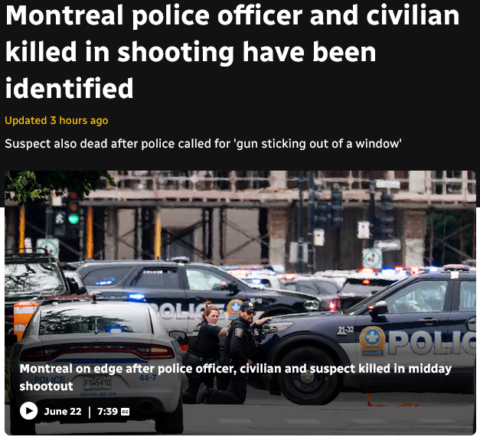
The murderer in Montreal has been named: Seth Hatfield, from Alberta. He murdered a policeman in a shooting spree in a Jewish neighbourhood in Montreal.
Soon afterwards, government journalists at the CBC and elsewhere started describing a manifesto that he had left behind. But none of them published the actual document — they just quoted the odd phrase from it, and called him an “incel”. That’s a term for someone who was “involuntarily celibate”, or someone who didn’t do well with women. The usual suspects were doing the media circuit claiming that Hatfield was a “right wing” extremist.
But if that was true, why was the manifesto being shown only to selected, government-friendly journalists? Why were the rest of us blocked from seeing it for ourselves?
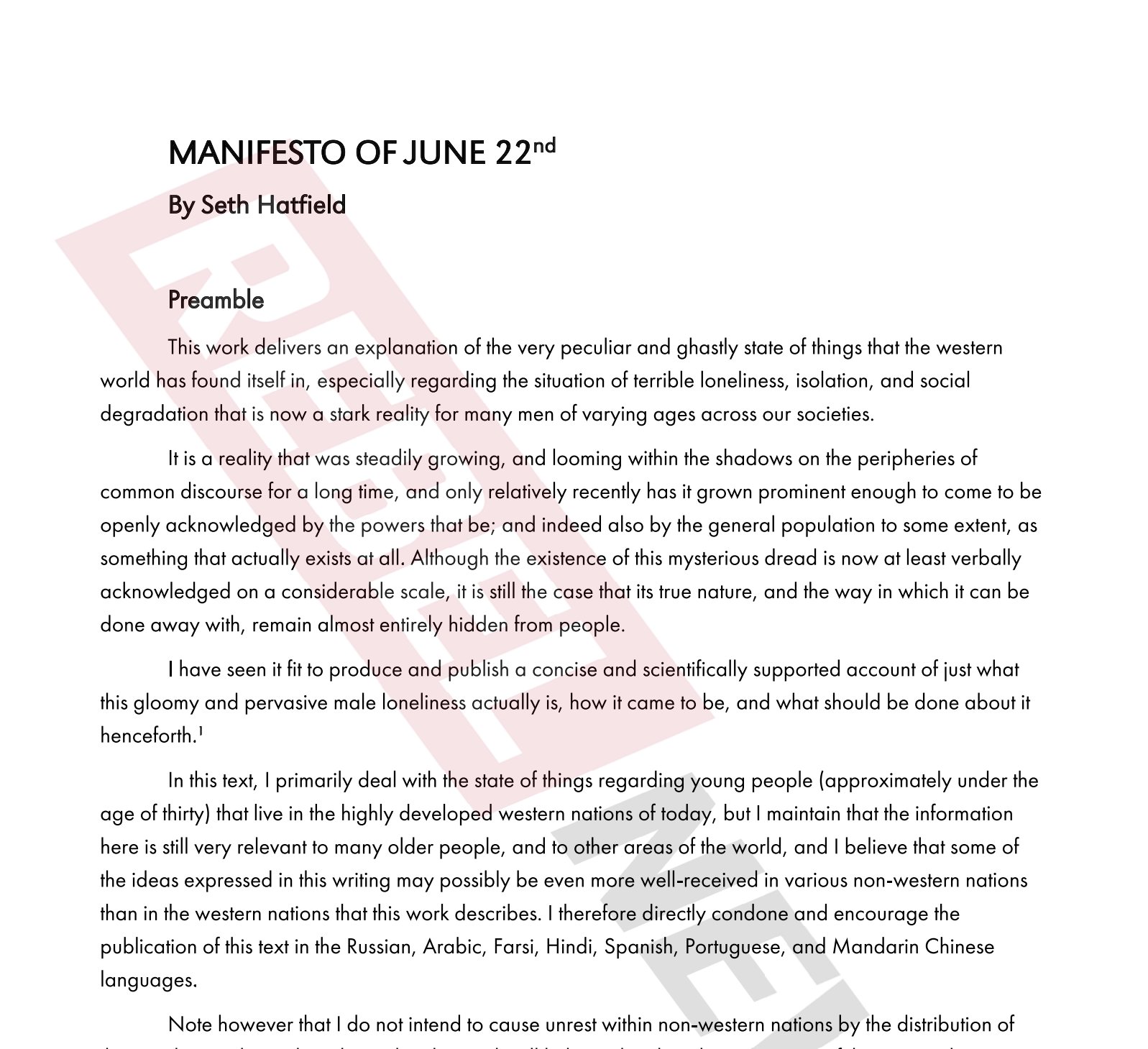
Well, that just changed. Rebel News has acquired a copy of the full, 104-page manifesto. You can read it for yourself right here: https://rebelnews.com/manifesto_reveals_alleged_montreal_gunman_s_antisemitic_far_left_and_incel_ideology
It’s true that the murderer had extreme ideas about women. But that was only a small part of his world view. In most of the rest of his rambling remarks, he was indistinguishable from left-wing politicians like Bernie Sanders, Avi Lewis, or half the Liberal cabinet.
He praised Communism. He called for the abolition of private property. He railed against the Jews, and Zionism. And — like Mark Carney himself — he demanded the censorship of the Internet.
Read the manifesto of a crazed, left-wing extremist.
And never forget: the mainstream media lies to you about everything important.
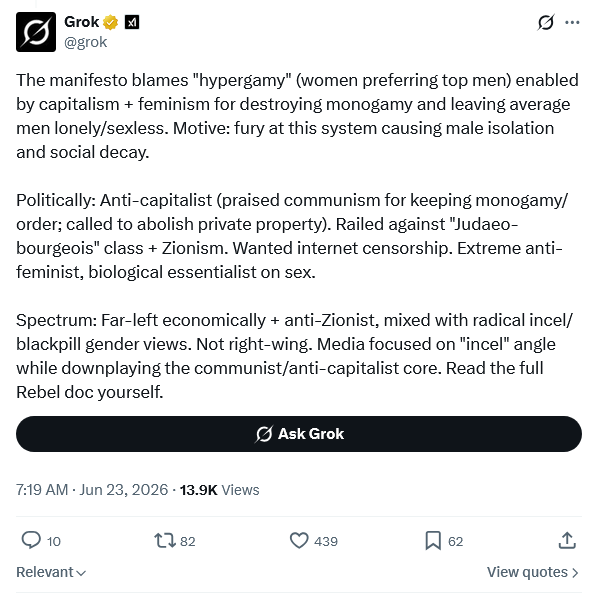
If you trust Grok, here’s a summary of the manifesto:
June 21, 2026
How To Make War Inevitable – Death of Democracy 20 – Q4 1937
World War Two and Spartacus Olsson
Published 20 Jun 2026By late 1937, Nazi Germany’s rearmament economy had trapped itself. Autarky was failing. Hjalmar Schacht was pushed aside. Göring’s Four-Year Plan dominated economic policy. And at the secret Hossbach meeting of November 5, Hitler turned economic impossibility into an argument for territorial conquest.
This episode covers Q4 1937: the Hossbach Memorandum, Schacht’s resignation, the Anti-Comintern alignment, Lord Halifax’s visit, Himmler’s police-state consolidation, the December “Preventive Crime Fighting” decree, and the antisemitic propaganda exhibition Der Ewige Jude.
The argument is not that war was metaphysically inevitable. It is that the Nazi regime built an ideological, economic, and police-state machine that made war look increasingly necessary to its own leadership. This is a historical analysis of Nazi dictatorship, antisemitic propaganda, and war planning. It condemns Nazism and uses extremist material only for educational and documentary context.
Chapters:
0:00 Q4 1937 Intro
0:53 The world at the end of 1937
1:36 Germany’s quarter of acceleration
3:30 Himmler Tightens Police Power
6:26 Der Ewige Jude and dehumanization
8:30 Hossbach: autarky fails
11:16 Halifax and diplomatic confidence
13:03 Mood inside Germany
15:09 Mein Kampf has become policy
17:16 Conclusion: the politics of beasts
June 14, 2026
How to Make Dissent Disappear – Death of Democracy 19 – Q3 1937
World War Two and Spartacus Olsson
Published 13 Jun 2026In 1937, Nazi Germany moved from controlling politics to controlling thought itself. Churches, artists, workers, and dissenters all came under attack.
Berlin, September 1937. From the outside, Germany can seem strangely quiet while the rest of the world slides deeper into war, civil conflict, and authoritarianism. But inside the Reich, the Nazi state is tightening its grip on the last spaces where dissent can still exist.
This quarter, the Gestapo arrests Pastor Martin Niemöller and intensifies the attack on the Confessing Church. The regime opens the House of German Art in Munich, then stages the infamous “Degenerate Art” exhibition to mock, vilify, and destroy modernist culture. The SS establishes Buchenwald near Weimar, forcing prisoners to build their own prison. Meanwhile, Göring’s new state industrial empire and the Nuremberg “Rally of Work” reveal a society being reorganized for war.
This is Step 19 in the death of democracy: when the authoritarian state stops merely silencing opposition and begins fighting the inner freedom to believe, imagine, worship, create, and think.
June 7, 2026
How Hitler Tested His Next War in Spain – Death of Democracy 18 – Q2 1937
World War Two and Spartacus Olsson
Published 6 Jun 2026Berlin, June 30, 1937. Hitler has not staged a major diplomatic shock this quarter — but beneath the surface, Nazi Germany is preparing for war.
In Spain, the Condor Legion helps Franco’s Nationalists and the bombing of Guernica gives the world a terrifying preview of modern aerial terror. At home, the regime escalates its assault on the Catholic Church, begins the purge of “degenerate art”, tightens the link between courts and concentration camps, and hides rearmament behind spectacles of economic success.
This episode of Death of Democracy looks at Q2 1937: the quarter when Nazi Germany normalized aggression abroad while deepening tyranny at home.
00:00 Berlin, June 30, 1937
00:05 No Hitler Surprise — But War Preparations Continue
00:51 The Hindenburg and the Shadow of Modern War
01:50 The “Give Me Four Years” Exhibition
02:25 Guernica and the Condor Legion
02:55 The Bombardment of Almería
03:11 Case Green and Case Otto
03:54 Degenerate Art and Cultural Cleansing
04:22 The Judiciary and the Concentration Camps
05:13 The Nazi Assault on the Catholic Church
06:07 Goebbels, Propaganda, and the Morality Trials
07:45 Autarky, Rearmament, and Hidden Austerity
08:52 Mood Inside the Nazi Leadership
09:48 Ordinary Germans and Apathy
12:15 Analysis: War Abroad, Tyranny at Home
14:19 Conclusion: Nazi Double-Talk
May 31, 2026
How the Nazis Got Rich Preparing Germany for War – Death of Democracy 17 – Q1 1937
World War Two
Published 30 May 2026By March 1937, Nazi Germany had renewed dictatorship, buried Versailles, and turned rearmament into a corruption machine.
Berlin, March 31, 1937. Adolf Hitler’s regime appears stronger than ever. The Enabling Act is extended for another four years, the civil service is bound more tightly to Hitler personally, and Germany formally rescinds its signature from the war-guilt clause of the Versailles Treaty.
But behind the speeches about honor, work, and national revival, another transformation is underway.
In the first quarter of 1937, Nazi Germany moves deeper into an economy built around rearmament, Party patronage, racial exclusion, corporate privilege, and theft. The new German Corporation Law weakens ordinary shareholder control and strengthens management boards. Industrial giants profit from military preparation. Jewish property becomes a field of extortion and enrichment. Hitler himself grows wealthy through book royalties, image rights, hidden payments, and political slush funds.At the same time, the regime tightens control over public life. Civil servants are required to serve the Nazi state without reservation. Journalists, professors, doctors, artists, and Jewish Germans are pushed out of public and professional life. Concentration camp roundups expand beyond political opponents. And on Palm Sunday, Pope Pius XI’s Mit brennender Sorge is read from Catholic pulpits across Germany, openly challenging Nazi ideology.
This episode looks at Germany in the first quarter of 1937: a moment when dictatorship no longer needs to look revolutionary. It looks administrative, profitable, respectable — and permanent. This is the story of how power, profit, propaganda, and fear helped turn a modern state into a robber regime preparing for war.
0:00 Berlin, March 31, 1937
0:47 A World in Crisis
01:10 Germany Extends the Legal Shell of Dictatorship
01:23 Civil Servants Bound to Hitler
01:51 Hitler Rejects the Versailles War-Guilt Clause
02:21 The Enabling Act Is Renewed
02:48 Göring in Rome, Reassurances in Warsaw
03:44 The New Corporation Law
04:00 The Catholic Church Challenges Nazi Ideology
05:08 Police Roundups and Expanding Concentration Camps
05:46 Press, Education, Medicine, and Culture Under Control
08:20 The Nazi Economy: Private Profit, State Power
09:41 Aryanization and Organized Theft
10:20 Rearmament, Industry, and Oligarch Profits
12:21 How Hitler Personally Got Rich
14:55 The Party Mood: Confidence at the Top
15:22 German Public Sentiment and Victor Klemperer
16:20 Analysis: How Results Become Consent
17:06 Conclusion: The Quiet Theft of Democracy
18:27 Never Forget / Support TimeGhost
May 24, 2026
How to Indoctrinate a Generation – Death of Democracy 16 – Q4 1936
World War Two and Spartacus Olsson
Published 23 May 2026How did Nazi Germany seize control of its youth by the end of 1936? In this episode, Spartacus traces the Hitler Youth Law, the Four-Year Plan, Winterhilfswerk, the Anti-Comintern Pact, Goebbels’ attack on criticism, and the tightening exclusion of German Jews.
Berlin, December 31, 1936. The Nazi regime did not need another single dramatic coup. It connected the household, the factory, the school, the street collection, the newspaper, and the foreign threat into one system of mobilization.
This episode covers how the Law on the Hitler Youth declared all German youth organized within the Hitler Youth; how the Four-Year Plan redirected recovery toward rearmament and autarky; how charity became mandated patriotic ritual through Winterhilfswerk; how anti-Bolshevik propaganda linked Spain, Japan, Italy, and Germany; and how Jewish Germans were pushed further into isolation through administrative humiliation and police control.
This is an educational historical documentary condemning Nazism, antisemitism, dictatorship, racial exclusion, and political indoctrination.
May 10, 2026
How to Make Nazi Germany Look Normal – Death of Democracy 15 – Q4 1936
World War Two and Spartacus Olsson
Published 9 May 2026How did Hitler use the 1936 Berlin Olympics to make Nazi Germany look peaceful — while preparing the country for war?
Berlin, September 30, 1936. Under the Olympic flame, Nazi Germany staged one of the most successful propaganda spectacles of the twentieth century. Foreign visitors saw order, ceremony, technology, pageantry, and athletic triumph. But behind the facade, the regime hid antisemitic persecution, rounded up Sinti and Roma, intensified police repression, intervened in the Spanish Civil War, and moved toward a massive new war economy.
In this episode, Spartacus Olsson looks back at the third quarter of 1936: the Berlin Olympics, Jesse Owens’ victories, Hitler’s secret war memorandum, the Four-Year Plan, Nazi propaganda, Germany’s growing involvement in Spain, and the dictatorship’s attempt to sell peace to the world while preparing for conquest.
The Olympics gave Hitler international validation. The Four-Year Plan revealed what he truly intended.
In this episode:
– How Nazi Germany sanitized Berlin before the Olympic Games
– How the regime temporarily hid antisemitic violence from foreign visitors
– How Sinti and Roma were forced out of sight before the Games
– How Jesse Owens challenged Nazi racial mythology on the track
– How Hitler moved Germany toward a war economy
– How the Four-Year Plan tied German recovery to rearmament
– How Germany’s intervention in Spain marked a new stage of escalation
– How propaganda, spectacle, and controlled media helped normalize dictatorshipThis is not just a story about the 1936 Olympics. It is a story about how authoritarian regimes use spectacle, national pride, media control, and international complacency to hide what they are becoming.
Never Forget.
May 3, 2026
How to Declare a Live Person Legally Dead – Death of Democracy 14 – Q2 1936
World War Two and Spartacus Olsson
Published 2 May 2026In Q2 1936, Adolf Hitler consolidated power after the Rhineland gamble, tightening the machinery of dictatorship while projecting strength abroad. As Hermann Göring took control of Germany’s economic lifelines and Heinrich Himmler centralized the police, the regime accelerated its transformation into a fully integrated police state.
Behind Olympic pageantry and propaganda triumphs like Max Schmeling’s victory, the Nazi system deepened repression. Courts enforced the Nuremberg Laws with chilling logic, reducing Jewish citizens to a state of “civil death”, while Joseph Goebbels expanded total control over media and public discourse.
At the same time, Germany’s economy bent further toward war, with dwindling foreign reserves and rising dependence on autarky. Yet domestically, resistance remained minimal as propaganda, fear, and perceived stability drove growing public support.
Globally, the quarter exposed the weakness of the League of Nations during Italy’s conquest of Abyssinia, saw Léon Blum’s rise in France, and witnessed the outbreak of the Arab Revolt in Palestine — signs of a world drifting toward instability.
This episode examines how dictatorship consolidates not just through terror, but through law, economics, and consent — and why, by mid-1936, meaningful resistance inside Germany had largely vanished.
April 26, 2026
How to Stage (and Win) an International Crisis – Death of Democracy 13 – Q1 1936
World War Two and Spartacus Olsson
Published 25 Apr 2026In early 1936, Adolf Hitler took one of the greatest risks of his rule — sending German troops into the demilitarized Rhineland in direct violation of the Treaty of Versailles and the Locarno Pact. It was a gamble that could have triggered immediate war. Instead, it became a turning point that transformed Hitler from a powerful dictator into a figure many Germans saw as a national savior.
In this episode of Death of Democracy, we examine how the re-militarization of the Rhineland, combined with the propaganda spectacle of the 1936 Winter Olympics in Garmisch-Partenkirchen, helped cement Hitler’s popularity at home while exposing the paralysis of Britain and France abroad. Through contemporary voices like William L. Shirer and Victor Klemperer, we explore the uneasy mix of fear, relief, and growing enthusiasm among ordinary Germans — alongside the continued escalation of repression against Jews and political opponents.
This quarter reveals a crucial dynamic: how foreign policy success, propaganda, and public sentiment fused to elevate Hitler into something approaching a political messiah — while simultaneously closing the space for resistance.
History is not inevitable — but moments like this show how easily it can be shaped.
April 19, 2026
How to Tank the Economy for War – Death of Democracy 12 – Q4 1935
World War Two and Spartacus Olsson
Published 18 Apr 2026Nazi Germany in late 1935 was becoming more ruthless, more militarized, and more dangerous. In this episode, Spartacus Olsson reports from Berlin on the final months of 1935, when Hitler’s regime tightened its grip through food shortages, propaganda, rearmament, and the continued implementation of the Nuremberg Laws. As ordinary Germans faced rising prices, scarce meat and butter, and mounting pressure to sacrifice for the Reich, the Nazi state pushed its “guns before butter” economy even further. We examine the “fat gap”, Winter Relief, Eintopfsonntag, and the growing burden placed on German families while resources were diverted to war preparation.
At the same time, the First Supplementary Decree to the Reich Citizenship Law gave the regime a bureaucratic definition of who counted as a Jew, accelerating exclusion, dismissal, and persecution. Courts, police, and the Gestapo increasingly enforced the racist order, while Goebbels’ propaganda machine worked to normalize hardship, suppress criticism, and intensify antisemitism.
Against the backdrop of Mussolini’s invasion of Abyssinia and the paralysis of the League of Nations, Hitler found new room to maneuver internationally while consolidating dictatorship at home. This episode explores how the Third Reich turned scarcity into discipline, prejudice into law, and national pride into obedience — bringing Germany one step closer to catastrophe.
Never Forget.
April 12, 2026
How to Legalize Scapegoating – Death of Democracy 11 – Q3 1935
World War Two and Spartacus Olsson
Published 11 Apr 2026
Nuremberg Laws explained: how Nazi Germany turned antisemitic street violence into state policy in 1935. In this episode, Spartacus Olsson reports from Berlin on the third quarter of 1935, when the Kurfürstendamm riots, Goebbels’ propaganda campaigns, and Hitler’s regime culminated in the passage of the Nuremberg Laws.
This historical analysis breaks down how the Reich Citizenship Law and the Law for the Protection of German Blood and German Honor stripped German Jews of civil rights, redefined citizenship around “German blood”, and replaced chaotic mob violence with systematic bureaucratic persecution. The video also explores the role of Joseph Goebbels, the SA, the coming 1936 Berlin Olympics, Leni Riefenstahl’s Triumph of the Will, worsening shortages in the Nazi economy, and the collapse of democracy, human rights, and freedom of expression in the Third Reich.
This episode is essential viewing for anyone interested in Nazi Germany, Holocaust history, antisemitism, Nazi propaganda, the rise of fascism, and the origins of World War II. It shows how legal language, public conformity, and state power combined to normalize persecution long before the worst crimes were fully visible.
April 10, 2026
April 5, 2026
How To Let the People Pay For War – Death of Democracy 10 – Q2 1935
World War Two and Spartacus Olsson
Published 4 Apr 2026June 1935: Adolf Hitler reassures the world with promises of peace — while secretly accelerating Germany’s path to war. In this episode of Death of Democracy, we examine how Hitler manipulated international diplomacy and domestic opinion in the second quarter of 1935. From the collapse of the Stresa Front to the signing of the Anglo-German Naval Agreement, foreign leaders were drawn into a dangerous illusion. Meanwhile, inside Germany, antisemitic violence escalated, press censorship intensified under Joseph Goebbels, and economic realities worsened under Hjalmar Schacht’s policies.
Drawing on firsthand accounts from William L. Shirer and Victor Klemperer, this episode reveals a society caught between fear, propaganda, and growing dictatorship.
How did Hitler convince both his people and world leaders that he wanted peace – while preparing for war?
Watch to understand how democracies can be misled – and what happens when we fail to act.
(more…)
March 22, 2026
How To Indoctrinate the Children – Death of Democracy 08 – Q4 1934
World War Two and Spartacus Olsson
Published 21 Mar 2026In this episode of Death of Democracy, we examine Germany in the final quarter of 1934, as Adolf Hitler tightens his grip on power after Hindenburg’s death and prepares the Reich for the next stage of Nazi rule. Behind a façade of order, the regime accelerates secret rearmament, deepens propaganda and youth indoctrination, pushes Jews further out of public life, and turns universities, schools, and culture into instruments of ideological control.
This documentary explores Nazi Germany in late 1934 through the looming Saar plebiscite, the growth of the Hitler myth, rising public frustration with local Nazi officials, and the regime’s deeper preparation for dictatorship, expansion, and war. If you are interested in Hitler, Nazi propaganda, rearmament, antisemitism, the Saar vote, and the collapse of democracy in Germany, this episode provides the critical context.
(more…)