Quotulatiousness

June 5, 2026

Canada’s AI “strategy”

I’m at the point where I honestly can’t tell whether this is parody or actual Canadian government policy:

AI in Canada lost before it even got started.

They literally are trying to get AI to give a Land acknowledgement before any session.

Here are 6 statements that show how Canada already blew AI like we all knew it would.

1. “The Government of Canada commits to applying Gender-Based Analysis Plus in a meaningful way across policy design, skills development, innovation, and governance to ensure that AI reflects our values, protects those most impacted, and leads to outcomes that are safe, inclusive, and beneficial for all Canadians.”

2. “Canadian AI must support, reflect, and project Canadian culture, which includes our customs, our history, and our heritage. Canadian voices, languages, communities, and knowledge must also be represented in how AI systems are designed, built, and used.”

3. “support Indigenous self-determination over how AI is built and used in Indigenous contexts, and build domestic capacity to address the specific harms Indigenous Peoples face”.

4. “promote the world’s first AI equity-based national standard on accessible AI to drive inclusive and accessible AI and remove accessibility barriers from AI systems, and ensure Canadian AI reflects the Accessible Canada Act principles.”

5. Repeated framing around “disproportionate exposure and impacts of AI harms to equity-seeking groups” and the need to “address the systemic barriers experienced by racialized communities, persons living with disabilities, and others who too often fall on the wrong side of the digital divide”.

6. “Canada will support and amplify Indigenous-led AI initiatives that reinforce cultural expression and linguistic vitality in Canada and around the world, building on existing efforts …”

The Canadian economy, RIP

Filed under: Cancon, Economics, Government, Media, Politics — Tags: , , , , , , — Nicholas @ 04:00

On the social media site formerly known as Twitter, James E. Thorne writes an obituary for the Canadian economy:

For the record.

In Canada, It Matters How the Economy Dies.

The Canadian economy is dead. It just didn’t die with a crash big enough to satisfy the models. No Lehman moment, no Covid-style cliff, just two negative quarters of GDP, years of falling output per person, negative productivity, and a private sector slowly strangled by rates and regulation while the establishment insists the patient is “resting”.

On the facts, this isn’t ambiguous. Real GDP has contracted for two consecutive quarters on an annualized basis. Labour productivity has been flat or negative since 2021. Real GDP per capita is below its pre-pandemic level. Ontario has logged its worst non-pandemic quarterly job losses since the mid-1970s. The only consistent growth is in government payrolls and compliance, not in private enterprise and investment. If that isn’t recessionary, the word is meaningless.

And yes Macklem threatens rate hikes through all of this insanity.

Yet Canada’s official guardians insist nothing fundamental has broken. The C.D. Howe recession-dating committee says the downturn is not “pronounced, persistent, and pervasive” enough. The central bank warns against overreacting to “technical” weakness. Bay Street talks about “soft landings” and “resilience”. In some quarters, the answer to this slow-motion collapse is not relief, but further rate hikes. Ignore the body on the table, we are told, the vital signs aren’t quite bad enough yet to fill out the certificate.

Their rulebook was built for heart attacks, not cancers. It excels at spotting sudden collapses in aggregate GDP and jobs. It barely registers slow organ failure: a few tenths off real GDP per capita each year, productivity edging down, ugly quarters for private-sector employment and capex offset by public hiring. None of that triggers the old alarms until the damage is permanent.

Meanwhile, Canada has been busy throwing away the advantages that once justified its prosperity. Energy and resource projects are stalled or strangled. Business investment per worker trails peers. A country rich in capital, talent, and geography behaves as if it can live forever off inherited endowments while making it harder to build anything new. That is not “resilience”. It is delusion.

Canada’s economic establishment needs to wake up.

Two negative quarters of GDP, negative productivity, falling GDP per person, historic job losses in the core province, a suffocated private sector and calls for more tightening on top, are not signs of an economy “cooling toward trend”. They are signs of an economy that has already crossed the line from stagnation into decay.

The Canadian economy is dead in the way that matters: as an engine of rising living standards and a place where private capital is rewarded for building the future. It just didn’t die loudly enough for the old definitions. The real question now is not what we call it, but how long our institutions will keep pretending the corpse is “resilient”.

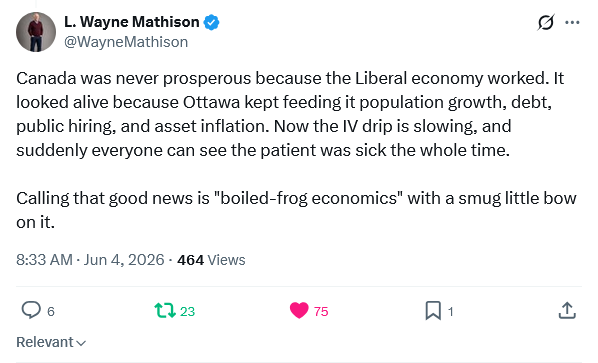
As the propagandists of the mainstream media do everything they can to deflect any hint of blame from their Liberal paymasters, we can still see that things are getting worse, not better:
The federal Liberals are getting fantastic return on their investment … giving our money to the presstitutes of the legacy media in return for kid-glove treatment of the government and attack-dog tactics against the opposition:
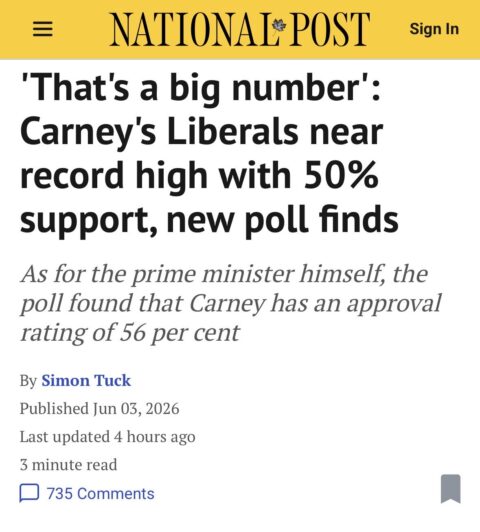
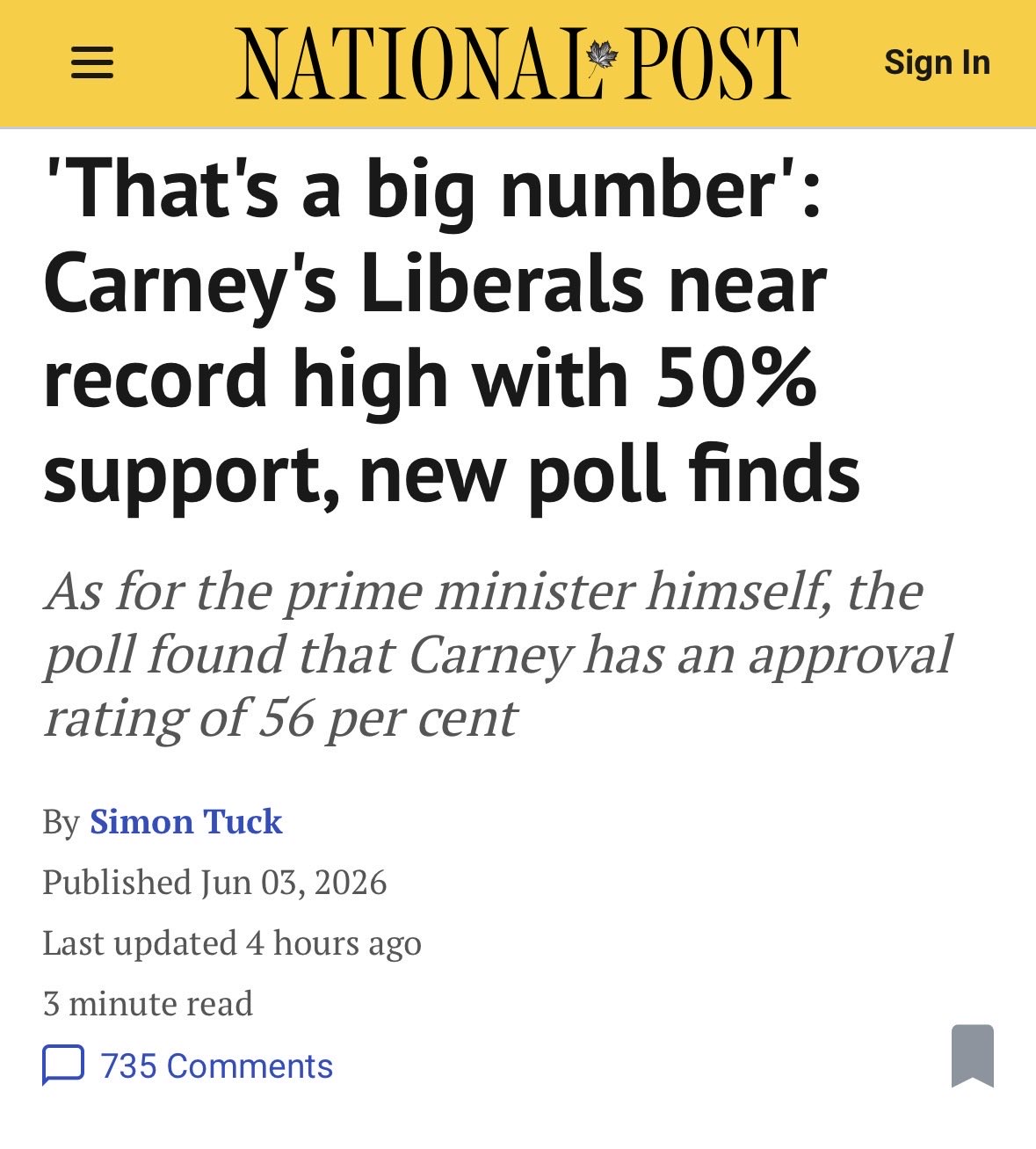
Why Do 50% Still Support Carney? My long-winded response.

That is a question we need to take seriously.

Leger’s latest federal polling has the Liberals at 50% support among decided voters, their highest level in that firm’s tracking since the Liberals first formed government in 2015. Abacus also found the political environment still favourable for Carney and the Liberal government. So this is not imaginary. This is not just CBC fairy dust sprinkled over Ottawa. The support is real. The harder question is whether it is rational.

My answer is simple: many Canadians are not voting for results. They are voting for the illusion of relief.

Even though Carney was in the economic background since 2020 he appeared to arrive after the Trudeau years like a man in a clean suit walking into a room after the dog crapped on the floor. Trump threatened 51st State. Carney looked calm. Unlike Trudeau. He spoke in complete sentences. He had the central banker aura. For exhausted voters, that was enough. They did not examine the wiring. They just saw someone who did not seem to be setting the curtains on fire.

Carney’s appeal is not built mainly on performance. It is built on contrast. Compared with Trudeau’s theatre-kid government of slogans, selfies, and moral lectures, Carney looks serious. But “serious” is not the same as right. A surgeon can look serious while operating on the wrong leg.

Canada’s economy is now weak enough that Carney himself has had to acknowledge ugly economic data. Reuters reported him addressing Canada’s technical recession and warning that some data will be “uneven” “ah ah ah” as the government pushes through policy changes. The Wall Street Journal reported GDP weakness, including two consecutive quarterly contractions, while Carney framed the pain as part of a broader economic rebuild.

That is where the sales pitch gets slippery.

When the economy weakens under Conservatives, it is called failure. When it weakens under Liberals, it becomes “transition”, “restructuring”, or “long-term transformation”. Same corpse, nicer label on the toe tag.

The deeper problem is that Canadians were never really asked whether they wanted Carney’s ideology. They were sold competence, not doctrine. They were sold expertise, not a governing philosophy that puts the state, regulators, climate finance, and elite managerial planning at the centre of national life.

Nobody knocked on doors saying, “Would you like a prime minister who believes markets should be bent around elite-defined social and environmental values?” No. They said, “He is smart. He ran banks. He knows Trump. He will steady things.”

That is not a mandate. That is a branding exercise.

And this is why the Conservative attack has to get sharper. Not louder. Sharper.

Calling voters stupid is a dead end. Many Carney supporters are not stupid. They are terrified of Trump. They are tired. They are anxious. They are looking at housing, debt, food prices, crime, productivity, health care, and a country that feels smaller than it used to, and they want someone who looks like an adult. Carney gives them the visual. He gives them the voice. He gives them the vibe.

But vibes do not build houses. Vibes do not raise productivity. Vibes do not lower debt. Vibes do not attract investment. Vibes do not make young Canadians believe they have a future.

The Carney government’s strongest weapon is not success. It is emotional permission. It lets Liberal voters tell themselves they have moved on from Trudeau without admitting the Liberal machine remains fundamentally intact. Same operating system, cleaner looking wallpaper.

That is why 50% still support him.

They are not endorsing the results. They are postponing the verdict.

Canada does not need a better-spoken manager of decline. It needs a government willing to reverse the policies that caused the decline in the first place.

Because a tight ship headed toward the rocks is still headed toward the rocks.

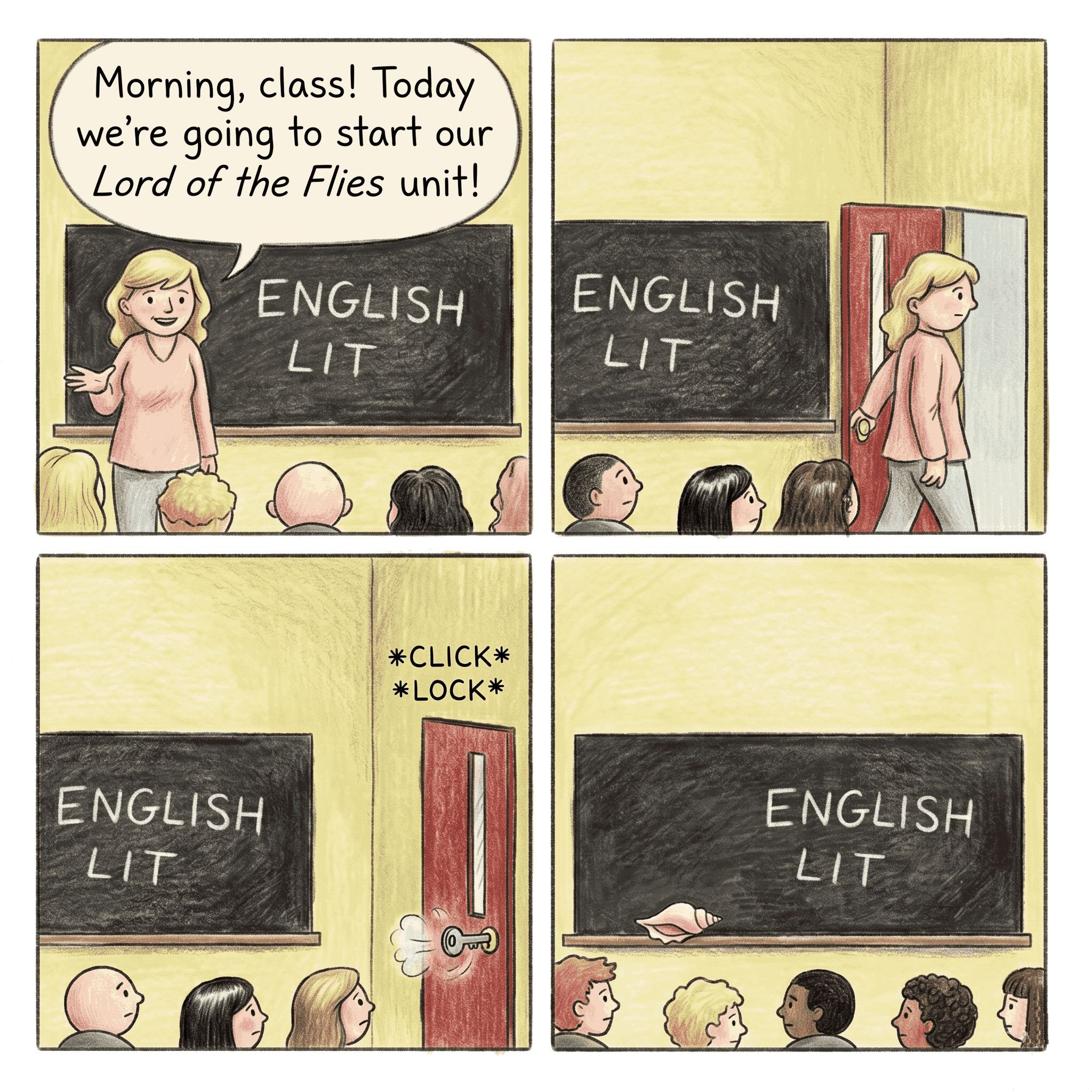
The Lord of the Flies was just a novel

Filed under: Books, Health, Pacific — Tags: , , — Nicholas @ 03:00

We often use The Lord of the Flies as a shorthand way to illustrate the darkness in the hearts of men, and that, absent civilizations, men descend into a hellscape of violence, hatred, and all-against-all destructive competition. Yet the real-life case of a group of boys isolated for an extended time didn’t go at all the way the novel did:

More and more I’m learning that the nihilistic claptrap we were all told was genius was just Leftist demoralization propaganda.

Situations like this have occurred, and the children didn’t turn into little monsters. In fact they survived quite well.

In June 1965, six boys named, aged 13 to 16 “borrowed” a fisherman’s boat hoping to reach Fiji or New Zealand. After a storm damaged the sail and rudder, they drifted for eight days surviving on fish and rainwater collected in coconut shells, before washing up on the rocky uninhabited island of ‘Ata.

Rather than descending into chaos during their months there the boys created a mini society. They planted vegetables, collected and stored rainwater, and maintained a permanent fire. They even built a gymnasium with homemade weights, a badminton court, and chicken pens.

They divided daily chores using rosters, resolved conflicts with time-outs instead of fighting, began and ended each day with songs and prayers. One boy, Gilligan’s Isle style, constructed a guitar from driftwood and coconut shell to boost morale. When one of the children broke his leg falling off a cliff the others set it with sticks and leaves and took over his work. They ate fish, coconuts, eggs, wild taro, bananas, and later chickens they had discovered in an ancient volcanic crater.

They endured this for for fifteen months, and never once turned into murderous thugs. A far cry from what we were told would happen.

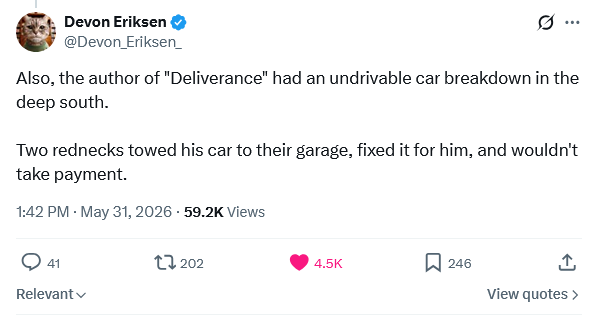
It wasn’t just William Golding manufacturing dark stories, of course:

The First Ever British SLR: Serial Number One L1A1 Explained

Filed under: Britain, History, Military, Weapons — Tags: , , , , — Nicholas @ 02:00

Royal Armouries
Published Jan 14, 2026

The L1A1 Self-Loading Rifle is one of the most iconic service rifles in British military history and on this week’s episode we have the very first one ever produced.

Next week: an original Royal Small Arms Factory archive film found by our archive team showing how the L1A1 was made.

0:00 Intro
0:46 Serial Number One Explained (UE57 Alpha 1)
1:40 Factory Plaque, Proof Marks & Enfield Details
4:26 Condition, Finish & Standard Configuration
5:17 Distinctive British L1A1 Features
7:08 Controls, Ergonomics & Fire Selector Choices
10:35 Why the L1A1 Won & Closing Thoughts

This week’s object’s collections online page: https://royalarmouries.org/collection…
(more…)

QotD: Modern men and the need for male spaces

Filed under: Health, Humour, Quotations — Tags: , , , — Nicholas @ 01:00

Many internet men have pointed out the dwindling of male spaces, while internet women cheer for their disappearance.

Internet men believe that some kind of man-space is essential. A place for men to be men, mentor other men, and tell younger men the secret wisdom to get their lives on track. That if only we had these spaces, everything would be great for men because we’d all know the secret wisdom that doesn’t actually exist.

Internet women believe that male spaces are dens of misogyny. Places where trollish men want to gather, away from the eyes and ears of right-thinking people, so they can poison other men with hate and bigotry.

Which is silly. Men don’t hate women because other men told them to. They see women being women, and that does the trick just fine. In fact, if a man is getting hourly blowjobs from every woman whose path he crosses, then some group of troll men try to tell him women suck, he’d be confused at how uninformed these men are when women are clearly awesome.

Women’s behavior is the number-one driver of misogyny. Not men telling other men women suck.

And that’s the point of male spaces. Not secret manly-man wisdom, not chattering about woman-hate. A space where men can just be. Without women there.

Women are … a certain way.

This is especially true of middle-class and richer women, and even a little more true of white women than other kinds. But true of all women to some extent.

Women have this way about them — everything they do, say, everything about how they behave — that just subtly communicates that they do not have a lot of experience with consequences. That they are just not that used to considering consequences seriously before doing something.

I’m usually hesitant to use political buzz-words in a non-ironic way, but I think the term “privileged” is pretty perfect for this situation.

A woman’s reality — her experience — is a world where consequences just aren’t quite as big of a deal for her as they are for others. She’s never really had to consider consequences with quite the same intensity.

It’s important to note that this isn’t some kind of overt, intentional flaunting as women stride around, consequence-free, thumbing their noses at us. Women don’t even know this is a thing. They’ll deny it fiercely if you tell them. They don’t feel privileged, and their feelings are always real. They’ll even tell you that you’re the privileged one, not them. Because that feels right to them.

It’s not something they do on purpose, and it’s not even that frontal and pronounced. It’s very subtle. Just this subtle way that women are. When they talk, act, make decisions.

This makes them very irritating. Even women find each other irritating.

Archwinger, “Male spaces are because women are irritating”, Archwinger’s Substack, 2026-02-25.

Powered by WordPress