
Quotulatiousness

June 19, 2026

Nobody voted for this kind of dystopian nightmare, Mr. Carney!

The Liberal Party, having engineered themselves a majority in the House of Commons, are on a speed-run to the kind of dystopian police state we used to read about in science fiction novels:

Millions of Canadians are beginning to see the similarities between communist regimes and the direction of current government policy.

The pattern is always the same.

It begins with noble promises: safety, equality, compassion, protection, the greater good.

It ends with censorship, coercion, surveillance, prisons, ruined lives, and a police state.

Always.

It comes wrapped in slogans, experts, committees, emergency powers, censorship, enemies of the people, and the belief that the state has the right to crush the individual for the greater good.

Consider…

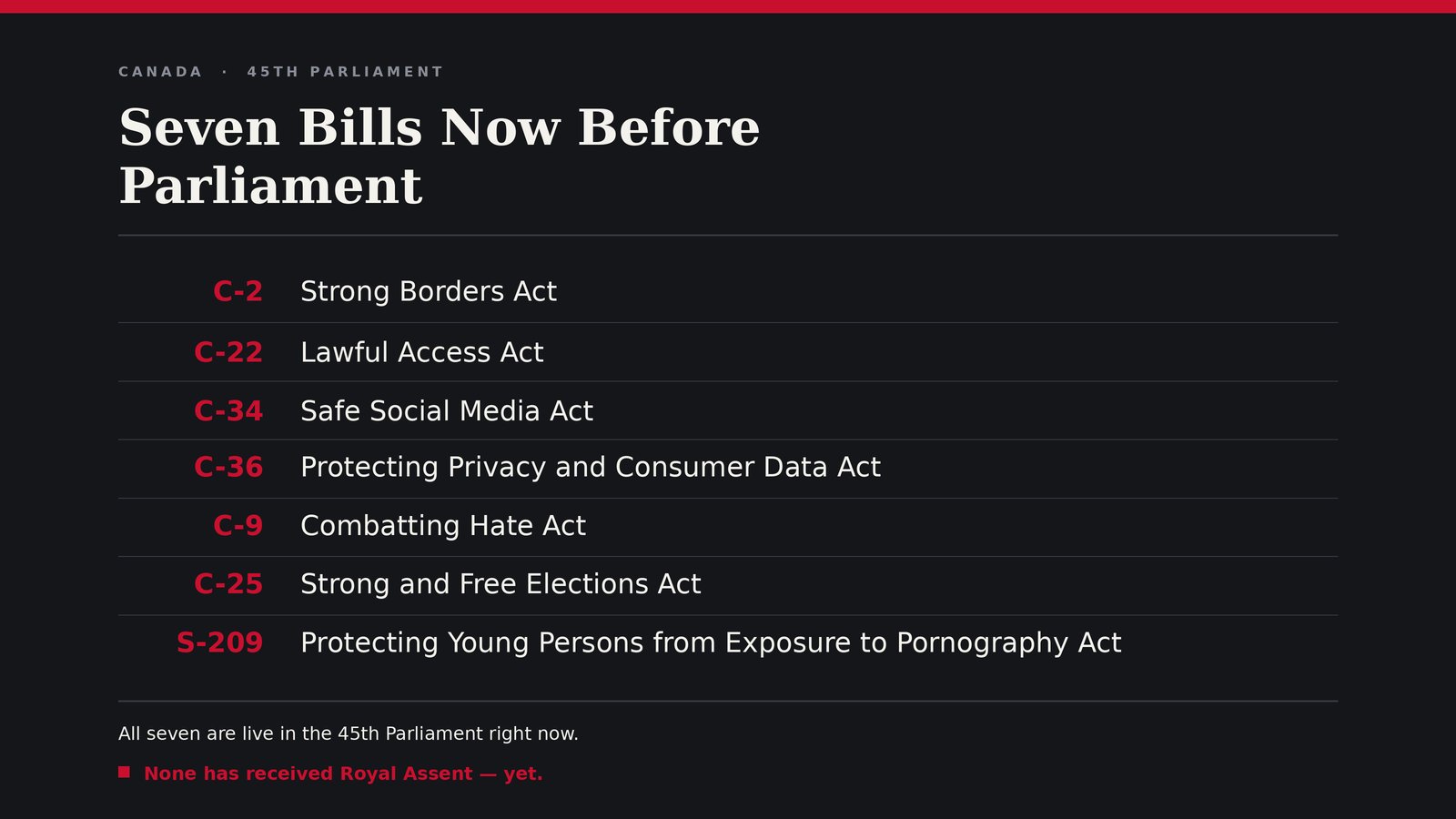
C-2 – Strong Borders Act
C-22 – Lawful Access Act
C-34 – Safe Social Media Act
C-36 – Protecting Privacy and Consumer Data Act
C-9 – Combatting Hate Act
C-25 – Strong and Free Elections Act
S-209 – Protecting Young Persons from Exposure to Pornography Act

All seven are live in the 45th Parliament right now. None has received royal assent yet.

Consider that good, law-abiding Canadians are being gradually and systematically disarmed.

This is not a warning about some distant future.

In 2022 the federal government invoked emergency powers it did not have, froze the bank accounts of citizens over their political views, and banned Canadians from funding a protest. Two levels of court have since ruled it unconstitutional — a violation of the very Charter rights every one of these bills now circles.

That was the trial run. It needed an emergency as the excuse.

The seven bills above are the permanent version — the same reach, made routine — so that next time, no emergency need be declared at all.

A free country is not lost in a single day. It is legislated away in pieces, each one introduced with a reassuring name and defended as necessary, while good people keep assuring themselves it could never happen here.

It already did. The only question is whether enough Canadians notice before it becomes permanent.

Read every bill. Watch every one of them. Because this is the stage where it can still be stopped … and perhaps our last chance.
The Justice Centre for Constitutional Freedoms is trying to get Canadians to pay attention to what just one of these bills will do:

Bill C-34 will affect every Canadian. Age verification. AI regulation. A new Digital Safety Commission. Most Canadians have never heard of it. Here’s what it will do.

Michael Geist posts a Substack Note about bill C-22:

Bill C-22, the lawful access bill, has been reported back from committee and is headed toward passage. There are some amendments, but many concerns remain. The updated bill with changes is at

parl.ca/Content/Bills/4…

There are two changes to metadata retention. First, the maximum retention period the government can impose drops from 1 year to 6 months. Second, it can now mandate a category of metadata only if satisfied the category and all its elements are essential to investigations.

The committee rewrote the definition of systemic vulnerability. A “substantial risk” becomes a “credible risk, based on recognized international technical standards”. But it also added a carve-out: a flaw exposing only a target’s data is not “systemic”.

Added a new section on decryption that says nothing in the Act can be read to compel a provider to decrypt user-encrypted data, unless the provider supplied the encryption and holds the key. Borrowed from US law, but doesn’t fit the same way.

Compliance with ministerial orders is now expressly subject to the systemic vulnerability exception. That addresses a contradiction in the original text, where the duty to comply appeared to be unconditional.

The original bill set no maximum duration on these ministerial orders. This now changes to a two-year cap without the open-ended review-and-extend mechanism.

The amendments will rightly leave many still concerned. Companies considering exiting Canada due to Bill C-22 are unlikely to conclude that it fully addresses their issues. Yet the government is likely to push it through the House today.

US history is unique, it does not map onto the histories of other nations

Filed under: History, India, USA — Tags: , , , , , — Nicholas @ 03:00

I’ve noticed this pattern myself, but I hadn’t considered that a lot of Americans don’t just use the patterns of their national history when looking at other western nations:

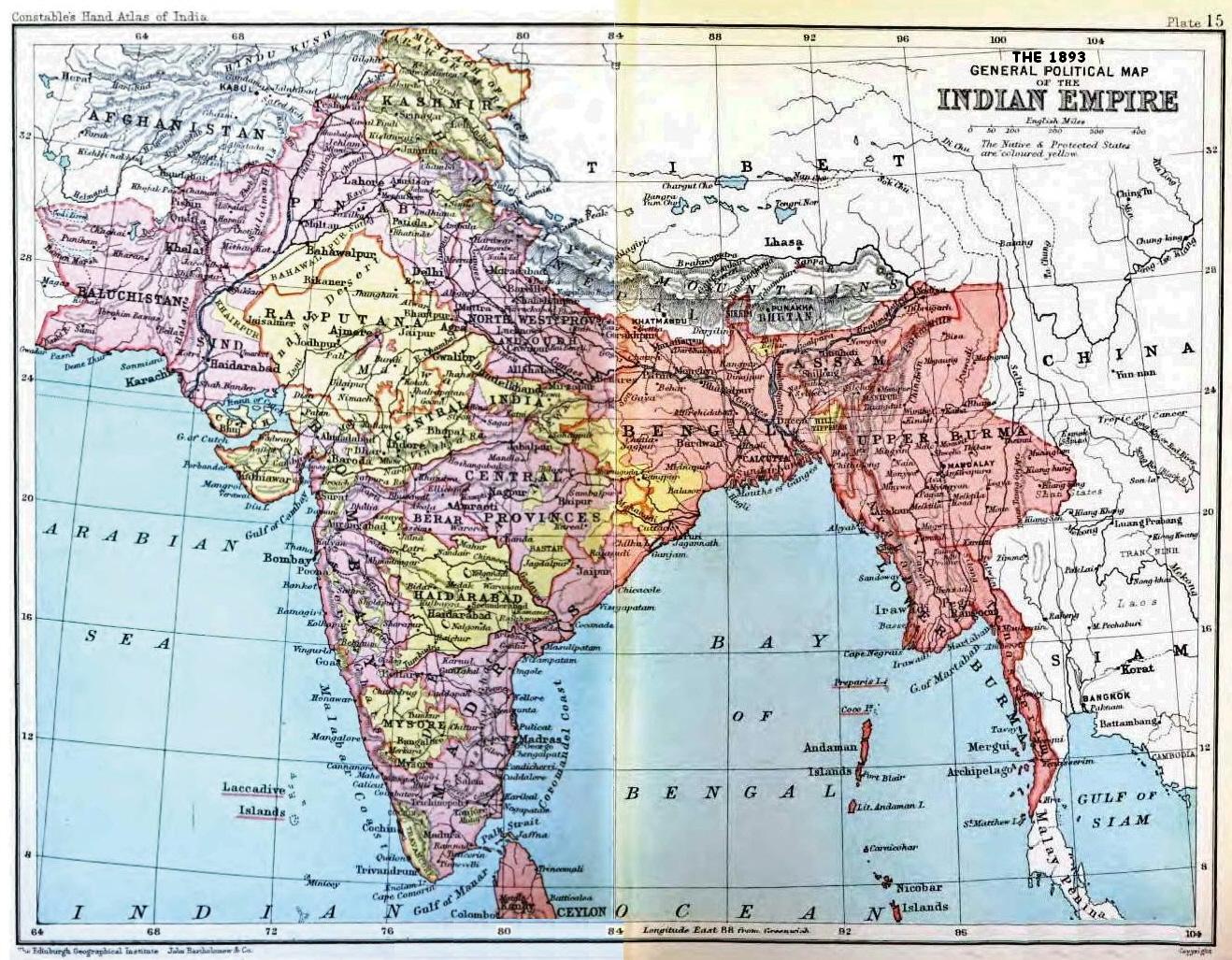
“Political Map of the Indian Empire, 1893” from Constable’s Hand Atlas of India, London: Archibald Constable and Sons, 1893. (via Wikimedia Commons)

Not every place in the world can be examined through the historical template of the United States.

One of the reasons conversations about India are so difficult for folks in the West to untangle is that many of the frameworks Americans use to understand power, intergroup dynamics, identity, and historical injustice do not map onto India. Not at all.

For Americans who have adopted a critical lens, the template derived from American history is fixed. A dominant demographic majority group seeks to preserve power while marginalized demographic minorities fight for recognition and inclusion. Because this template is so fixed in the imagination, there is a tendency to view and interpret dynamics and events in other countries in exactly the same way. I have seen it myself. “We’ve all seen how this works”, someone will say, and proceed to apply the American template to a different place.

And the history of the Americas (both North and South) is dominated by European (white) Christian colonization. As a result, Americans are familiar with the legacies of European empire and Christian missionary expansion. By contrast, the history of Islamic conquest and rule, which shaped large parts of Asia, Africa, and Europe for centuries, occupies far less space in the American imagination. So too does the contemporary influence of petrodollar-funded religious institutions, transnational Islamist movements, and the global circulation of Islamist narratives.

This does not mean these forces explain everything. It does mean that many Americans have little historical or conceptual framework for understanding how they might shape politics, memory, education, or intergroup relations in places like India.

India’s history is not the same as that of the Americas.

For centuries, India experienced successive waves of colonization. The first came through a series of Muslim invasions and dynasties, culminating in the Mughal Empire. The second came through British colonial rule, predated by British mercantile and missionary efforts. Yet unlike many colonized societies, the civilizational majority was never fully displaced, converted, or absorbed. Hindu traditions, practices, languages, stories, temples, and collective memories survived.

This is perhaps the single hardest aspect of India for many Americans to grasp because it has no real analogue in American history: the Hindu demographic majority is also the historically colonized population.

For many Western observers, this creates immediate suspicion because it violates the assumptions embedded within our familiar frameworks. The expectation is that majorities defend power while minorities challenge it.

As a result, contemporary debates about textbooks, public memory, historical figures, temples, and national identity are often seen and interpreted by folks in the West through frameworks that retrofit Indian history into contemporary American critical analysis through the reductive binaries of majority/minority, right/left, which are memeable and digestible, but obscure much more than they reveal about power, history, equity, policy, foreign influence, etc.

When Hindus argue that violent and painful aspects of Mughal conquest have been whitewashed in public education, they are frequently accused of attempting to rewrite history to justify the alleged “Hindu right wing” suppression of a minority group today. (Please do read my analysis of religious-based violence in India. It’s not what you think it is. Link.)

Yet Americans themselves are familiar with the process of revisiting historical narratives to advance truth and reconciliation. We have debated how slavery is taught, how Indigenous history is taught, how immigration is taught, and how women and minority groups have been represented in textbooks and in classrooms. We generally accept that historical narratives evolve as new evidence emerges and as previously marginalized perspectives are taken seriously.

What makes India different is that the group seeking rigorous reconsideration of historical narratives is often the majority population. For many Western observers, this creates immediate suspicion. The assumption is that majorities seek dominance while minorities seek justice.

But history does not always work that way.

The result is that efforts by Hindus to recover historical memory are often denounced as nationalism (which is falsely equated with white or Christian nationalism in the United States) before they are examined on their own terms. Questions about historical representation become questions about political motives. Efforts to revisit narratives become “evidence of extremism” or, even more bizarre, “anti-intellectualism”. And figures who have occupied a central place in Hindu memory for centuries are presented as newly invented symbols of contemporary political power.

The result is that the Indian voices most readily amplified in Western media are often those whose analyses are already legible within familiar Western frameworks. Their arguments are immediately understandable, which lends them “credibility”. Perspectives that do not fit those frameworks are frequently dismissed as “Hindu nationalist” before they are seriously considered.

One need not agree with every argument made in these debates to recognize that they are, in fact, debates. The question is not whether history should be examined. The question is whether everyone is permitted to participate in that examination without having their motives presumed in advance.

Sparta vs Athens – 2(a): Two Greek Worlds (Citizens, Helots, Power)

Filed under: Greece, History — Tags: , , , , , , — Nicholas @ 02:00

seangabb
Published 8 Feb 2026

Greece: A Brief History, c.700 BC – 500 AD

In this lecture segment I set out the fundamental contrast between Sparta and Athens as social and political systems. Sparta was a permanent military state built on coerced labour and internal discipline. Athens was a quarrelsome democracy that relied on participation, persuasion, and a wider civic culture of debate.

We begin with the basic structures: who counted, who did the work, and how each society organised its citizen body. This is not moral theatre. It is institutional reality. By the end, the students should see why Sparta could produce cohesion and battlefield reliability, while Athens produced instability, argument, and a public life that made intellectual achievement possible.

QotD: The Prince is a … satire?

Filed under: Books, Education, Government, History, Italy, Quotations — Tags: , , , — Nicholas @ 01:00

When I was a lad, I was told that Machiavelli’s The Prince is a satire. I don’t believe it, personally — I know a few things about Renaissance Italy, and I think he meant every word — but I learned something important from the people who insist it’s a satire: They’re wishcasting.

Let me back up. The occasion where I first heard the “it’s a satire” thesis was an “advanced placement” History class back in high school. They probably don’t have those anymore as part of the regular curriculum — dat be rayciss — so in case you’ve never endured one, it’s a bunch of mega-nerds who only care about pleasing Teacher trying to do History. For our unit on “The Renaissance”, we had to read both The Prince and More’s Utopia, and do our term paper on one or the other.

Naturally I picked The Prince, and since you all know the kind of kids who were in that kind of class, naturally everyone else picked Utopia. I might’ve been the only kid who ever did his paper on Machiavelli; certainly the teacher acted like she’d never seen one before. We didn’t have the phrase “trigger warning” back then, but that’s what it amounted to — Teacher hastened to inform everyone in the class that The Prince was really a satire, and so of course I was just kidding too, ha ha, because otherwise we were in the presence of very, very, very bad thought …

“Yes, kidding, ha ha ha,” I muttered, because while I obviously wasn’t the quickest on the uptake back then — I should’ve just done the stupid paper on goddamn Utopia like the rest of the sheep — even I could figure out that I was gonna get sent to the school counselor if I didn’t get with the program …

… and that’s when I learned the aforementioned lesson. Kidding? You think Machiavelli’s kidding? Didn’t we just do this whole unit on the Renaissance? Your main man Thomas More was burning people at the stake, for fuck’s sake! And as for the Italians, they were straight whacking people out in church, with the active connivance of the fucking Pope himself. Satire, fuhgetaboudit, that’s Godfather shit, Machiavelli’s as serious as cancer. You just don’t want to believe that people are actually the way they so obviously are, so you’ll tell yourselves he’s kidding … and Teacher will back you up on it, because she doesn’t want to believe it either.

(Meanwhile, I’ll get an A for my excellent “satire”, in exchange for which I will never ever bring it up again or I’ll fail the rest of the semester).

Severian, “End States and Inverted Incentives”, Founding Questions, 2022-06-22.

Powered by WordPress


