Quotulatiousness

June 14, 2026

The “Dissolution of the Universities” draws ever closer

Filed under: Economics, Education, Media, Technology, USA — Tags: , , , — Nicholas @ 05:00

On the social media site formerly known as Twitter, Steve McGuire reacts to more news about the conscious dumbing-down of modern university programs:

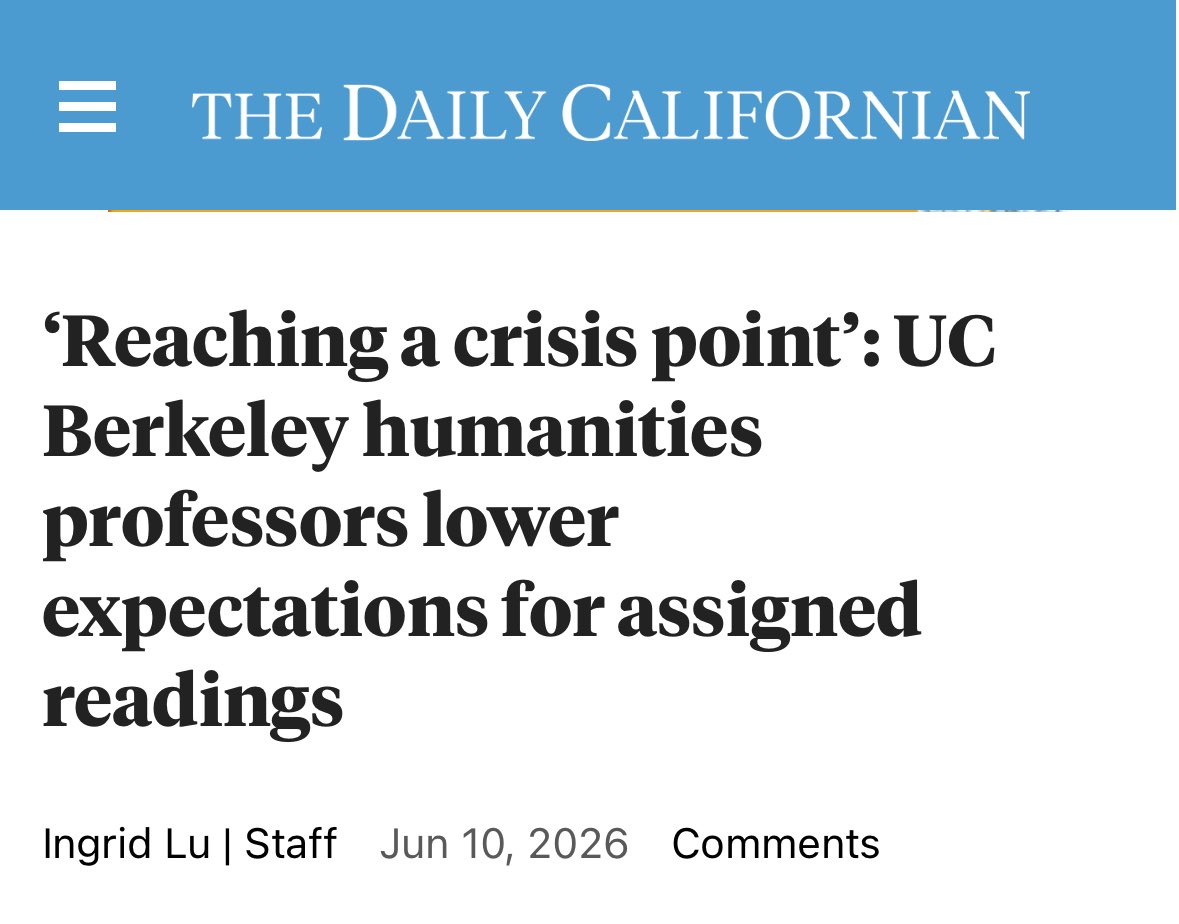
A Berkeley history professor said he’s gone from assigning 100 pages of reading per week to 35.

Another “said the earliest version of the … course he taught required seven full books, while his most recent iteration exclusively consisted of excerpts”.

“We are now reaching a crisis point where if the number (of pages) goes down further, it’s unclear to me whether my discipline of history can really be taught”, the first one said.
To which John Carter responds:

The academic death spiral is something to behold.

Demographics are steadily reducing the size of the student body, squeezing finances and driving bankruptcies.

At the same time, standards collapse is destroying the quality of the students the universities admit.

We’re already at the point where it’s common knowledge that a degree signals essentially nothing about intellectual ability. AI is exacerbating this, since cheating is so easy now.

Kids are already starting to forgo university, since they don’t think the cost of the credential is justified. That cuts even more deeply into the number of students universities can attract.

Universities respond by reducing standards even further (thereby accelerating brand destruction), by reducing tuition (which cuts even more deeply into budgets), and by firing professors in low-enrollment majors (reducing program variety, especially in the small seminars that are generally the most rewarding experiences for students).

[…]

“How can this be reversed?”

It can’t. There are pathways for individual institutions to revive themselves, even to prosper, but the sector as a whole is cooked. The death spiral is driven by prestige collapse as well as the demographic cliff, and intellectual prestige is inversely correlated to the size of the student body. More students means lower standards. That is especially true with a demographic cliff.

The only way to survive this crisis is ruthless elitism. Stop trying to edutain the fat middle of the bell curve, and refocus on the right tail. Become a place where the smartest people gather, and from which anyone who isn’t a 2-sigma outlier is excluded. This makes the school an arena in which intellectual iron can sharpen against iron. Elitism restored, prestige follows.

Next, eliminate the 500 person intro lectures. Admin loves these, since the high student:teacher ratio makes them cash cows. But they’re functionally no better than watching YouTube videos. Refocus on small seminars. This offers value that the Internet can’t.

Schools that take this path will restore or build reputations that will enable them to survive. However, they won’t be large. There is no future in which huge institutions keep tens of thousands of professors and administrators on payroll.

How to Make Dissent Disappear – Death of Democracy 19 – Q3 1937

Filed under: Germany, History — Tags: , , , , , — Nicholas @ 04:00

World War Two and Spartacus Olsson
Published 13 Jun 2026

In 1937, Nazi Germany moved from controlling politics to controlling thought itself. Churches, artists, workers, and dissenters all came under attack.

Berlin, September 1937. From the outside, Germany can seem strangely quiet while the rest of the world slides deeper into war, civil conflict, and authoritarianism. But inside the Reich, the Nazi state is tightening its grip on the last spaces where dissent can still exist.

This quarter, the Gestapo arrests Pastor Martin Niemöller and intensifies the attack on the Confessing Church. The regime opens the House of German Art in Munich, then stages the infamous “Degenerate Art” exhibition to mock, vilify, and destroy modernist culture. The SS establishes Buchenwald near Weimar, forcing prisoners to build their own prison. Meanwhile, Göring’s new state industrial empire and the Nuremberg “Rally of Work” reveal a society being reorganized for war.

This is Step 19 in the death of democracy: when the authoritarian state stops merely silencing opposition and begins fighting the inner freedom to believe, imagine, worship, create, and think.

“99% of Canadians are decent, law-abiding people”

Filed under: Cancon, Government, USA — Tags: , — Nicholas @ 03:00

John Konrad explains why, despite agreeing that the vast majority of Canadians are “decent, law-abiding people”, he wants to see the US/Canadian border closed:

Yes. 99% of Canadians are decent, law-abiding people. Friendly neighbors. Good trading partners. Nobody serious disputes that.

I DO NOT CARE

CLOSE THE BORDER

Public safety is not built around the 99%.

We do not have laws, police, and prisons because most people are good. We have them because a small minority can inflict enormous harm on everyone else.

The argument for border enforcement is not that Canadians are bad people. It is that even a small failure rate matters when the consequences are catastrophic.

Free and open borders are a wonderful thing provided both countries are willing and able to identify, remove, and deter the small percentage of dangerous actors who exploit them.

If one side stops filtering effectively, the burden shifts to the other.

And yes, that creates unfairness. When enforcement breaks down, restrictions fall hardest on the innocent majority: families, commuters, truckers, tourists, and businesses. No one should pretend otherwise.

But there is also unfairness in asking another country to absorb preventable risks because difficult enforcement has become politically inconvenient.

A secure border is not an insult to a neighboring nation. It is a hedge against failure.

That is their sovereign choice.

But the United States also has a sovereign responsibility: to reduce risks to its own citizens.

If a partner cannot or will not reliably filter threats, then verification at the border becomes the default. Not because the majority deserves punishment, but because governments exist to manage tail risk, not assume it away.

Open borders require mutual trust.

Trust requires performance.

But the real threat is not the 1% of evil bad actors. The real threat is the 1% of far left lunatics in your government who are facilitating and funding the 1% of criminals.

YOU. The ninety nine percent are the only ones who can demand election reform. YOU are the only check left on their power.

So I absolutely endorse punishing YOU as incentive to demand change now.

A full and total stop of VISAs, temporary and permanent, will cause real stress to your economy, it will make international and domestic travel more difficult, will unfairly hurt Canadians studying in USA, it will hurt many Americans too.

But it’s worth temporary extreme pain is a small price to pay for long term stability.

You are a frog slowly boiling in water. We have asked you to jump out of them pot but you refuse. You just croak “elbows up”

So our choice as Americans is to watch you die slowly or remove you from the pot and chop a leg off so you don’t jump back in.

I believe the latter is the only option. And I believe it’s the lore humane option knowing that the leg will grow back just fine.

Mauser M80SA: Actually a High Power and Actually Hungarian

Filed under: Business, Germany, History, Weapons — Tags: , , , , , , — Nicholas @ 02:00

Forgotten Weapons
Published 21 Jan 2026

In the 1980s, the Mauser company was completely adrift, without any real plans or goals or good leadership. They had been trying to get by on relaunched old designs, and not been very successful. By the late 80s they move on to just buying guns from other companies (like Renato Gamba) and relabelling them as Mauser. One of these partnerships was with FEG in Hungary.

In 1990, Mauser contracted with FEG to buy Browning High Power copies. FEG had actually licensed the high Power design from FN back in the 1970s, and was already tooled up for production, so they just added a Mauser roll mark and called the gun the M80. It was a straight copy of the High Power, except for the omission of the magazine safety. Production ran from 1990 until 1995, with only 3,200 made. The gun did not sell well, which should [not] be very surprising — this was a very outdated design by the 1990s and the Mauser name just wasn’t worth much as a value-add.
(more…)

QotD: Some of H.G. Wells’ more awkward views

Filed under: Books, Britain, History, Politics, Quotations — Tags: , , , — Nicholas @ 01:00

When I was researching my biography of H.G. Wells in the early 1990s what shocked me, apart from his habitual and extreme selfishness, was the man’s life-long support for social engineering and eugenics. Put simply, his socialism embraced the idea that for the bulk of humanity to be free, prosperous, and happy a sizeable minority had to simply disappear. For Wells this included the disabled, the “perverse”, and even perhaps many who were non-white. What became apparent very quickly was that such an approach wasn’t confined to the author of The War of the Worlds and The Invisible Man, but was extraordinarily common on the intellectual left. Many in the Fabian Society and Labour Party shared these ideas, as did mainstream socialist thinkers in Europe and North America.

This was, of course, before the genocidal policies of the Nazis were implemented, and while many of these grand men and women of the left had died before the camps were liberated and the horrors known, others certainly lived on. Some were contrite, others not. Either way, it hardly forgives them their ideology and influence – naiveté and ignorance simply isn’t a viable defence in such circumstances.

Michael Coren, “Eugenics and the intellectual left”, The Critic, 2020-09-16.

Powered by WordPress