
On the social media site formerly known as Twitter, Steve McGuire reacts to more news about the conscious dumbing-down of modern university programs:
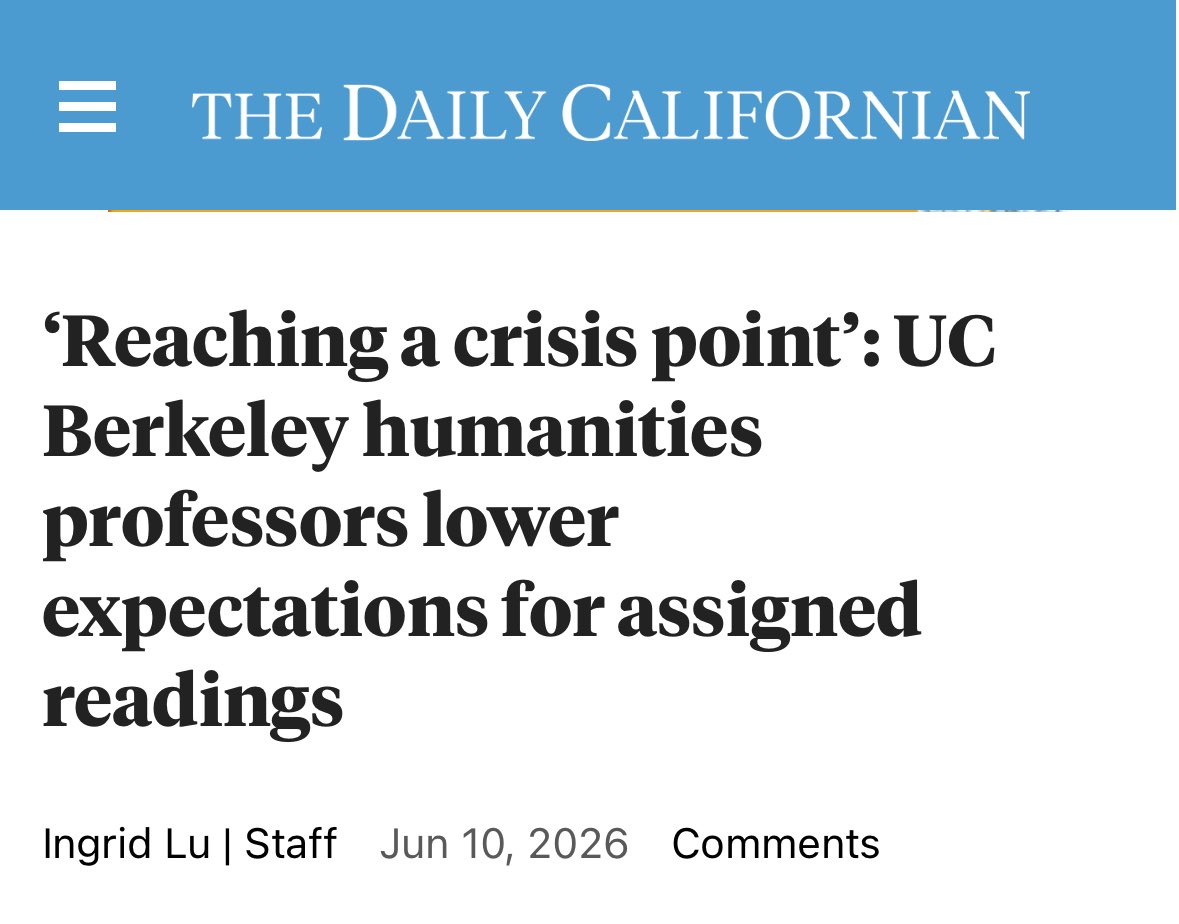
A Berkeley history professor said he’s gone from assigning 100 pages of reading per week to 35.
Another “said the earliest version of the … course he taught required seven full books, while his most recent iteration exclusively consisted of excerpts”.
“We are now reaching a crisis point where if the number (of pages) goes down further, it’s unclear to me whether my discipline of history can really be taught”, the first one said.
To which John Carter responds:
The academic death spiral is something to behold.
Demographics are steadily reducing the size of the student body, squeezing finances and driving bankruptcies.
At the same time, standards collapse is destroying the quality of the students the universities admit.
We’re already at the point where it’s common knowledge that a degree signals essentially nothing about intellectual ability. AI is exacerbating this, since cheating is so easy now.
Kids are already starting to forgo university, since they don’t think the cost of the credential is justified. That cuts even more deeply into the number of students universities can attract.
Universities respond by reducing standards even further (thereby accelerating brand destruction), by reducing tuition (which cuts even more deeply into budgets), and by firing professors in low-enrollment majors (reducing program variety, especially in the small seminars that are generally the most rewarding experiences for students).
[…]
“How can this be reversed?”
It can’t. There are pathways for individual institutions to revive themselves, even to prosper, but the sector as a whole is cooked. The death spiral is driven by prestige collapse as well as the demographic cliff, and intellectual prestige is inversely correlated to the size of the student body. More students means lower standards. That is especially true with a demographic cliff.
The only way to survive this crisis is ruthless elitism. Stop trying to edutain the fat middle of the bell curve, and refocus on the right tail. Become a place where the smartest people gather, and from which anyone who isn’t a 2-sigma outlier is excluded. This makes the school an arena in which intellectual iron can sharpen against iron. Elitism restored, prestige follows.
Next, eliminate the 500 person intro lectures. Admin loves these, since the high student:teacher ratio makes them cash cows. But they’re functionally no better than watching YouTube videos. Refocus on small seminars. This offers value that the Internet can’t.
Schools that take this path will restore or build reputations that will enable them to survive. However, they won’t be large. There is no future in which huge institutions keep tens of thousands of professors and administrators on payroll.
Update, 15 June: Welcome, Instapundit readers! Have a look around at some of my other posts you may find of interest. I send out a daily summary of posts here through my Substack – https://substack.com/@nicholasrusson that you can subscribe to if you’d like to be informed of new posts in the future.



This was foreseen a century ago by Mortimer Adler, Scott Buchanan, and others. They understood the transformation of university education into the research university model from the classical university model would suppress real learning in favor of certification programs. The PhD is the certification that the holder has completed original research to his field. Broad knowledge and deep thinking don’t figure into it.
Thus the Great Books programs arrived. This approach requires small seminars, lots of reading, and strong verbal and writing skills. Yet Great Books programs is not fundamentally elite (despite how many graduates think and act. ) one can get a GB degree without mastering Latin, Greek, and Hebrew – the price of entry into elite education 175 years ago.
Comment by Joseph Moore — June 14, 2026 @ 19:45
[…] SALTING THE RUINS OPTIONAL; BUILDING WHAT COMES NEXT IMPERATIVE: The “Dissolution of the Universities” draws ever closer. […]
Pingback by Instapundit » Blog Archive » SALTING THE RUINS OPTIONAL; BUILDING WHAT COMES NEXT IMPERATIVE: The “Dissolution of the Univer — June 15, 2026 @ 01:32
53 years ago, I took a summer school course at a Junior College. Instead of having a textbook, they used an audio visual program where the student filled out a workbook while viewing the slides. I was astonished and asked the teacher about it. He said that they could not get the students to read a textbook. BY the way, he was one of the best teachers I had in my college experience.
Comment by Mike Bergsma — June 15, 2026 @ 01:56
The large auditorium lectures are worse than watching YouTube videos. Much worse. You can’t take a break. You can’t back up and re-watch a bit you missed. You can’t turn on subtitles to deal with the lecturer’s thick accent. You can’t revisit it later after doing homework.
Universities today are more like country clubs, with students making selection based on accommodations, health club facilities, etc.
Add in the insanity of grade inflation, and a university degree is no longer an indication that someone has much of an education.
Comment by Zendo Deb — June 15, 2026 @ 02:12
“The PhD is the certification that the holder has completed original research to his field” Many call this getting your “Union Card”
Comment by Del Varner — June 15, 2026 @ 08:24
[…] The “Dissolution of the Universities” draws ever closer — Quotulatiousness […]
Pingback by What We’re Reading: Iran Deal Or Steal?, Newsom’s Bad News, Higher-Ed’s Downfall . . . And More – Issues & Insights — June 17, 2026 @ 04:07