Quotulatiousness

June 13, 2026

The intellectual dangers of “nostalgia economics”

Filed under: Britain, Economics, History, Media — Tags: , , , — Nicholas @ 05:00

Mani Basharzad explains that although resurgent socialist beliefs are a bad sign, there’s actually a worse danger to modern economies that isn’t a coherent ideology but all the more potent because of it:

Custom image by FEE

If someone asked me what the most dangerous economic ideology is, many would expect an Austrian to give a typical answer: Marxism, socialism, or Modern Monetary Theory. Yet I believe there is another way of thinking that is even more pervasive. It is not a coherent body of ideas like those ideologies. Rather, it is a sentiment so widespread and socially accepted that it threatens not merely economic freedom, but our very understanding of progress itself. I call it “nostalgia economics”.

Recently, the singer Sting suggested that the rise of toxic masculinity is partly the result of the “loss of manual jobs”, claiming that because many men no longer use their hands and physical strength in their daily work, unhealthy masculine traits are on the rise. Like many commentators on the political left, he also blamed Margaret Thatcher for Britain’s economic transformation. “Britain’s wealth was created in the coalfields and the steel towns and the mill towns and the shipyards”, Sting said. “All of those skill sets were thrown on the scrapheap … for Thatcher’s dream of a service economy.”

This is nostalgia economics in action. A global celebrity whose music can be streamed instantly on another continent, who earns income through digital platforms, and whose career depends on modern communications and services, criticizes the very service economy that makes his success possible.

A person in thrall to nostalgia economics will take the blessings of progress for granted while romanticizing a past that never truly existed. Imagine living in the world of Charles Dickens: you would not have had access to a typewriter for much of your life, if at all, since it was only commercialized in the late 19th century. More importantly, you would not have had access to electricity. The conveniences we now consider basic would have been unimaginable luxuries.

The economic historian Norman Stone illustrated the extraordinary pace of modern progress through the experience of the novelist Henry James:

    In 1895 the novelist Henry James acquired electric lighting; in 1896 he rode a bicycle; in 1897 he wrote on a typewriter; in 1898 he saw a cinematograph. Within very few years, he could have had a Freudian analysis, travelled in an aircraft, understood the principles of the jet-engine or even of space-travel.

Had Sting been alive in 1890, a world tour would have looked very different. A journey from London to New York would have taken more than a week rather than a few hours. International audiences, instant communication, and global entertainment markets would have been beyond imagination.

The glorification of manual labor is one of the most overrated ideas in modern political discourse. This tendency is not confined to the left. Ambitions to revive manufacturing employment through government policy often draw on the same nostalgic impulse. But what exactly are we trying to return to?

Perhaps literature offers a more honest answer than politics. Oscar Wilde observed that “all unintellectual labour, all monotonous, dull labour” involved unpleasant conditions. He went even further, commenting that “there is nothing necessarily dignified about manual labour at all, and most of it is absolutely degrading”.

The reality of industrial labor was far harsher than many modern observers imagine. In Britain, workplace fatalities have fallen dramatically over the last century: fatal injuries to employees dropped from around 4,400 a year early in the 20th century to around 200 a year by the end of the century. Coal mining, one of the occupations most frequently romanticized today and the first industry Sting evoked, exposed workers to constant danger and disease. Throughout the 1950s and 1960s, coal workers’ pneumoconiosis (“black lung”) claimed well over a thousand lives annually. What would a laborer enduring dangerous conditions, long hours, and chronic health risks have given for an air-conditioned office job?

One thing Sting did identify is that men generally do need more physical activity in their lives both for general physical health but also for mental health.


Hating on Elon Musk, the world’s first trillionaire

Filed under: Business, Economics, Media, Politics, USA — Tags: , , , , — Nicholas @ 04:00

It shouldn’t be surprising that so many people are doing what they can to raise resentment against the very rich in general, and Elon Musk in particular. Stoking resentment of the better off has always been a viable short-term political play, and it’s not every day we see wealth of this scale:

Reddit meme

For all these dumbasses claiming if they had Elon’s money they’d end world hunger, cause world peace, educate everyone, or whatever, blah blah blah … No you wouldn’t. You’re full of shit and everyone knows it, because that’s not how the world works.

Throwing money at a problem doesn’t fix it. The entire history of government demonstrates that. Saying vapid nonsense just makes weak, unimaginative people with a childlike grasp on reality feel better about themselves for caring harder, while accomplishing nothing.

Meanwhile, the guy you hate revolutionized EVs and self driving cars, brought affordable reliable internet to every corner of the Earth, and is making the dream of colonizing space real. And the process of doing all that has given hundreds of thousands of people jobs.

While you posture about how you’d give everybody an imaginary unicorn, he’s done stuff that’s actually changed the world for the better.

And you don’t get it. You can’t get it. Because you’re just too fucking small.

And even the Globe and Mail, which used to consider itself the most respectable and influential newspaper in Canada goes for the “hate the rich” market:

But some people just can’t help themselves and ginning up the hate and envy is all they can do:

For the left, it’s important that you do more than view billionaires with skepticism. You have to actually hate them. You have to blame them for every ill that befalls you, and you must actively resent their wealth.

One way that the left accomplishes this is by framing their gains as somehow your losses.

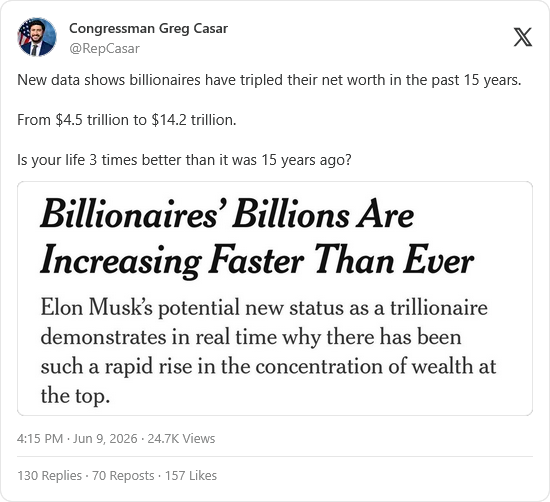
Congressman Greg Cesar (D-TX) decided to try that on X Tuesday with this banger.

Now, it’s interesting that he talks about their wealth being three times what it was 15 years ago, but doesn’t account for what the rest of us are dealing with. Instead, he engages in an apples-and-oranges comparison.

For starters, the increase in net worth for billionaires has nothing at all to do with whether your life is three times better than it was back then. There are too many variables. Someone who was unemployed and homeless and got a job, built a life back up, and then started a successful business is a lot more than three times better off, right?

Plus, it doesn’t account for differences in the cost of living or anything else.

Instead, a better metric is whether the median household net worth in America has increased a similar amount. So, I went to Google, then got its AI to generate a graph for me showing what’s happened over that timeframe.

While that’s not three times, it is 2.5 times the median net worth 15 years ago, and since this caps at 2022, it may well have increased even more.

In other words, the net worth of ordinary Americans seems to be mostly keeping up with that of the billionaires.

Cesar’s question, though, is disengenuous because the cost of living has gone up about 53 percent over that timeframe. So while net worth has increased, so has the cost of living. Not enough to completely drain away the gains in net worth, but enough that people aren’t living three times better than they were.

But that’s the point, isn’t it?

It’s not enough that, on average, Americans are much richer than they were 15 years ago, and by about the same amount as the billionaires, because that won’t foster the necessary resentment the left needs to push through their policies. You have to resent their wealth, and that’s less likely if you realize you’ve gained as much as they have by percentages. You have to feel like their wealth has been taken from yours, otherwise you’re less likely to look at wealth redistribution as a good thing.

And wealth redistribution is what it’s always about.

The Laurentian Elite

The people who actually rule Canada — including but not limited to Liberal Party members — don’t mind “populists” who want to “spread awareness”, because it’s about as ineffective as can be and dissipates some of the energy that might otherwise be used to oppose the Laurentian Elite’s preferred outcomes:

Homesteaders, agrarians, and populists relying on “spreading awareness”, protesting, or Americanisms like “we the people” and “the silent majority” aren’t nearly as effective or influential as people think they are.

A deeply unpopular Laurentian liberal elite minority, one that increasingly LARPs as blue-state Americans and takes its cues from them, managed to transform the country against the popular will.

Over a roughly twenty-year period between the 1940s and 1960s, they spent decades scheming behind the scenes. They changed the flag, lured French Canadians into supporting them through the Royal Commission on Biculturalism and Bilingualism by promising greater national recognition of Canada’s French heritage, then dropped the whole thing almost immediately. They pulled the rug out from under them and basically said, “SYKE, you thought. Here’s infinite immigrants instead.”

In 1971 they pushed multiculturalism and the cultural mosaic, abolished assimilation while polling showed around 80% of Canadians opposed increased immigration. They later entrenched their ideology through the Charter of Rights and Freedoms, stacked and empowered a judiciary that would future-proof it, formalized the project through the 1988 Multiculturalism Act, and gradually consolidated influence over the media, education system, and cultural institutions.

The result was a decades-long effort to indoctrinate Canadians into viewing their country as a post-national economic zone built on stolen land called Turtle Island, where Canadians don’t exist, but foreigners are just as Canadian as you and me, borders are morally questionable, and none is illegal on stolen land.

This isn’t going to be reversed through awareness campaigns, symbolic protests, or endlessly posting facts online. Political systems are ultimately shaped by elites and counter-elites. The only way this order gets replaced is if a rival elite, or a political force capable of becoming one, displaces the existing ruling class and takes its place.

That process will almost certainly involve some degree of populism, but populism by itself is not enough. You need people who can actually build institutions, wield power, and replace the current establishment rather than just complain about it or bug off into the woods, or try to balkanize the country.

Sing, Muse, of A Complicated Man: Why the Narrative Structure of The Odyssey is VITAL

Filed under: Europe, History — Tags: , , , , , — Nicholas @ 02:00

MoAn Inc.
Published 2 Jan 2026
(more…)

QotD: Ecce BCG

Filed under: Education, Humour, Politics, Quotations, USA — Tags: , , , , , — Nicholas @ 01:00

Seriously, you’re wondering if a young lady in your life is a BCG? Let’s go over the diagnostic criteria. Fully acknowledging that some folks don’t photograph well, appearing to be 10-15 years older than your chronological age is a strong tell. BCGs live hard, on a steady diet of half-caff pumpkin spice mocha latte frappucinos and cock. […]

Of course BCG stands for “Basic College Girl”, and thus she can be found at any institution of “higher” “learning”, but the most Basic ones of all go to colleges you’ve never heard of. Jonah Goldberg is a good example, and while I know he’s technically male, his act is classic BCG. He famously — or infamously — went to Goucher College, which is the kind of school that likes to pretend it’s a mini-Ivy, when in fact it’s the kind of school bright-enough but directionless young nouveau riche kids go to when they just can’t kick that drug habit.

[…]

Achieving shockingly high rank right out of the gate is another tell, and I know what you’re thinking, because of course I thought it too: Mark Meadows is 63 years old, and in the world we grew up in, there’s only one way for a straight-out-of-college girl to become a “close confidante” of a 63 year old man. In my experience, though, BCGs aren’t socially savvy enough to figure that out.

Yeah yeah, I know, but y’all, as primal as that is, these BCGs are just weird. They have no social skills whatsoever. Two data points. First, from Hutchinson’s wiki page:

    Identified as a “White House legislative aide”, Hutchinson was the subject of a nationally-syndicated AP photograph in which she was shown dancing to the song “Y.M.C.A.” alongside White House press secretary Kayleigh McEnany at the end of Trump’s September 21, 2020, campaign rally in Swanton, Ohio.

That is not grownup behavior. No woman who ever hoped to be taken seriously in politics would be caught dead doing that, as recently as 15 years ago. They have absolutely zero idea how they come off to other people.

Second data point: I once taught a night class in one of my Flyover State tours. I had this girl there who was just dying to get to Capitol Hill. She was involved in every possible Poli Sci club, the pre-law club, the Young Legislators (or whatever FNG shit it was), and so on. She emailed me once to say she’d be coming to class late, because she was representing Student Senate (or whatever) in some big to-do the college was hosting for the Governor.

When she shows up to my class, she’s wearing this tight red cocktail dress that would’ve looked trashy on a Vegas waitress. It was slit at the sides and back. and at the midriff. It had sequins, I shit you not. It was all I could do not to bust out laughing. You went to a reception. With the Governor. Wearing that.

They have no savvy at all, y’all. None whatsoever. The invitation she got read “formal attire”, so she wore what she wore to the sorority formal. You could practically still see Chad Thundercock’s handprints on her ass.

And that’s the fourth and most diagnostic criterion: utter, complete, hilarious fucking cluelessness. About everything.

Severian, “Alt Thread: Diagnosing the BCG”, Founding Questions, 2022-06-30.

Powered by WordPress