Quotulatiousness

April 25, 2026

QotD: Goethe, the lost German master

Filed under: Britain, Germany, History, Media, Quotations — Tags: , , , — Nicholas @ 01:00

This was the atmosphere in which I discovered Germany. It was a minor act of defiance to choose German instead of Latin for O-level, but with hindsight I was extremely fortunate to have the choice. There were two German teachers in my grammar school of just 600 pupils. Today, even the best state schools seldom offer the subject; not one of our four children has had the opportunity that I had to study German language and, especially, literature up to the high standard that was then expected at A-level.

Today, the texts are almost all recent and appear to be chosen partly with the film of the book in mind. In particular, Goethe has disappeared from the syllabus, presumably because the language is considered too archaic. Yet I recall the immense pleasure and satisfaction of mastering a Goethe play — Egmont. The story of the dashing Dutchman and his martial defiance of the sinister Duke of Alba, the courage of his beloved, Klärchen, who fantasises in song about how wonderful it would be to be a man and fight the Spaniards — “ein Glück sondergleichen ein Mannsbild zu sein“. Somehow I even obtained an LP of Beethoven’s incidental music for Egmont: seldom heard apart from the overture, but brilliantly evoking the grandeur of the drama.

Like Homer, Dante and Shakespeare, Goethe belongs not just to German literature, but to world literature, Weltliteratur — a term he coined. I am told that even in German Gymnasien, Goethe is little studied now. He is certainly a rare bird in English schools — or even universities. It is tragic that educated people, including students of literature, so seldom encounter the greatest of Germans even in translation. We might get on better with Germany if we did.

Daniel Johnson, “How I discovered Germany”, The Critic, 2020-08-02.

March 25, 2026

Montaigne, a Substacker avant la lettre

Filed under: Books, France, History, Media — Tags: , , , , — Nicholas @ 05:00

On Substack (of course), Ted Gioia makes the case that Michel Eyquem, Seigneur de Montaigne (or “Montaigne” to unwashed moderns) was the historical progenitor of all essayists to follow:

Michel de Montaigne may be the most influential essayist in history — even Shakespeare borrowed from his work (taking some passages almost verbatim). But if Montaigne were alive today, this famous essayist might be mistaken for just another slacker living in his parents’ basement.

Okay, let’s be fair. He actually lived in the family castle. But it still was slacking. At age 38, he didn’t have a job — and preferred reading books. Leave me alone, was his message to the world.

The Montaigne family castle (Photo by Henry Salomé)

But even a castle was too noisy for him — or maybe it was just his wife from an arranged marriage that made him feel that way. In any event, Montaigne eventually decided that he needed total isolation, almost like a monk in a hermitage. So he moved into the tower on the family estate. He called it his citadel.

Here he surrounded himself with books, and announced his intention to devote the rest of his life to reading and philosophizing “in calm and freedom from all cares”.

Montaigne’s tower (Photo by Henry Salomé)

But at age 47, Montaigne had a change of heart. He returned to the world, ready to embark on travels and public service. But before leaving for Italy, he had one last goal he needed to fulfill closer to home — and it would have a decisive impact on Western culture.

During his years in the tower, Montaigne wrote 94 essays, and compiled them in two book-length manuscripts. These he now delivered to a printer in Bordeaux, and paid to have them published. A short while later, he traveled to Paris and proudly gave a copy to King Henry III

In his mind, he was serving as his own patron, drawing on the family wealth to cover the expenses of his debut as an author. But today, of course, we would call this self-publishing — a term that is often (unfairly) used to demean the value and legitimacy of these rule-breaking efforts by do-it-yourself writers.

Call it what you will, Montaigne’s achievement cannot be denied. He not only invented the modern essay — setting the stage for Bacon, Emerson, and so many others. But he also helped shape the human sciences and legitimize the personal memoir. That’s because his essays covered many topics but really had only one subject—namely Montaigne himself, with all his quirks and opinions and hot takes.

His essays marked a milestone in the history of individualism. So, of course it makes sense that they were self-published. That’s what individualists do. They are happy to work outside the system.

I could even imagine our slacker Montaigne publishing these essays on Substack today. You might say that he anticipated the Substack style of writing. His balancing of memoir and analysis, subjective and objective, observation and generalization is very much aligned with what I see on this platform every day.

March 8, 2026

Performative … reading?

Filed under: Books — Tags: , , — Nicholas @ 03:30

Nicole James talks about a secretive cult of readers who — I’m afraid to even say it — read books in public, specifically to be seen reading books in public:

Reading has become competitive, which is impressive when you consider that it is an activity performed while sitting down and moving only the eyes. In theory, intellectually competitive reading would involve fierce debates in candlelit rooms, people slamming piles of Dostoevsky onto tables, and shouting things like, “You’ve misunderstood the moral ambiguity of suffering!” before storming out into the night to reflect meaningfully. In practice, it involves sitting in a café in Ridgewood holding a copy of the Iliad while pretending not to notice that three separate people have already noticed. And then pretending not to notice yourself noticing that they have noticed, which is where the true athleticism begins.

Because reading has slowly repositioned itself from private hobby to public personality trait. This is called performative reading, and it is less about engaging with ideas and more about being seen in the act of possibly engaging with ideas. It requires a certain book, a certain environment, and a certain facial expression. Specifically, a face suggesting that thoughts are currently underway.

The extraction of the book from the bag is an art form in itself.

It must not look like you packed it specifically for display. That would reek of planning, and planning is death to mystique. No, the book must appear to have happened to you. As though, midway through reaching for lip balm or car keys, you encountered it unexpectedly. “Oh,” your expression must suggest, “are you here too? How curious.”

The bag should be opened with a kind of languid inevitability. Do not rummage through your bag. Rummaging implies receipts. Crumpled tissues. A muesli bar from 2019. The book must be located swiftly, as if it occupies a reserved, velvet-lined chamber within your otherwise chaotic life.

You lift it out slowly. This is a text. Ideally one with a cover that signals moral seriousness or tasteful despair.

The removal must be conducted at a volume slightly above whisper. There may be a soft thud as it meets the table. A decisive, cultured thud. The kind of thud that says, “I have opinions about late-stage capitalism”.

Then, and this is critical, you do not open it immediately. That would look eager. Instead, you place it beside your coffee. The coffee must appear faintly architectural.

Only once the book is resting in full view do you adjust it by half a centimeter. A sleeve may be pushed back. A wrist revealed. The lighting should imply that you have recently contemplated something ancient and mildly troubling. Several photos are taken. One will be selected after rejecting seventeen for “looking too literate.”

The caption must be controlled. Something like:

Revisiting this.

“Revisiting” suggests that you and the book have history. You have both grown. You have both suffered.

And when it is finally time to return the book to the bag, this too must be handled with restraint. It slides back in as though it has completed a small but meaningful public service. The performance ends. The book remains unread. But visible. Which, as we all know, is the point.

QotD: Reading books versus remembering books

Filed under: Books, Humour, Quotations — Tags: , — Nicholas @ 01:00

As a gullible young man, I fell for the big lie that books are improving. “Reading develops the mind,” my parents told me when I begged for a TV in my bedroom. My teachers seconded the motion, as did one hundred per cent of the world’s self-serving authors. “Reading makes you smarter,” they all said. “Reading gives you endless knowledge and reduces stress. Reading makes you human.”

“What about people who can’t read?” I asked, thinking of all the illiterates in my year group at school. “Don’t they have human rights, too?”

My mother snorted with laughter, as if I’d told a dirty joke. “Oh, that’s precious!” she said, wiping her eyes, and I raced upstairs to bury my nose in the first book I could find.

To be fair, I’d no idea back then what the passage of time does to the brain; that knowledge is never accrued, only forgotten. As an adult, I’ve trudged my way through the entire oeuvres of a good number of literary giants, and not only do I remember bugger all about what I read in any of those books, I’ve entirely forgotten that I read the vast majority of those books at all. Worse, when people ask my opinion about one of their renowned authors, I frown bewilderedly and say, “Who?”, their very existence having somehow been completely blotted from my mind. In my lowest moments, I even add, “Oh, I’ve never heard of him/her. I’ll have to give him/her a try. Which book of his/hers would you recommend I start with?” Only when I’m several chapters into one of these titles does a muffled bell ring somewhere at the back of my broken brain. Hang on, I think, didn’t I read something a bit like this once before? Then I accuse Dostoyevsky of plagiarism.

Dominic Hilton, “All Booked Up”, The Critic, 2020-08-17.

January 25, 2026

QotD: Dostoevsky’s views on revolutionaries in Demons

Filed under: Books, History, Politics, Quotations, Russia — Tags: , , , , — Nicholas @ 01:00

In a novel about political radicalism you might expect the ideas to take center stage, but here they’re treated as pure comic relief (if you’ve read The Man Who Was Thursday, the vibe is very similar). The guy who wants to kill all of humanity and the guy who wants to enslave all of humanity have some seriously conflicting objectives (and don’t forget the guy who just wants to kill himself and the guy who refuses to say what his goal is), yet they all belong to the same revolutionary society. The leader of their society takes it to an extreme, he has no specific ideas at all. His political objectives and philosophical premises are literally never mentioned, by him or by others. What he has is boundless energy, an annoying wheedling voice,1 and an infinite capacity for psychological cruelty. But all these impressive capacities are directed at nothing in particular, just at crushing others for the sheer joy of it,2 at destruction without purpose and without meaning.

Does that seem unrealistic? That ringleader was actually based on a real life student revolutionary named Sergey Nechayev, whose trial Dostoevsky eagerly followed. Nechayev wrote a manifesto called The Catechism of a Revolutionary, here’s an excerpt from that charming document:

    The revolutionary is a doomed man. He has no personal interests, no business affairs, no emotions, no attachments, no property, and no name. Everything in him is wholly absorbed in the single thought and the single passion for revolution … The revolutionary despises all doctrines and refuses to accept the mundane sciences, leaving them for future generations. He knows only one science: the science of destruction … The object is perpetually the same: the surest and quickest way of destroying the whole filthy order … For him, there exists only one pleasure, one consolation, one reward, one satisfaction – the success of the revolution. Night and day he must have but one thought, one aim – merciless destruction.

The ideas don’t matter, because at the end of the day they’re pretexts for desires — the desire to dominate, the desire to obliterate the world, the desire to obliterate the self, the desire to negate.3 Just as in their parents’ generation the desire for status came first and wrapped itself in liberal politics in order to reproduce and advance itself, so in their children the desire for blood and death reigns supreme, and the radical politics serve only as a mechanism of self-justification and a lever to pull. This is not a novel about people, and it’s also not a novel about ideas. It’s a novel about desires, motives, urges, and the ways in which we construct stories to make sense of them.

John Psmith, “REVIEW: Demons, by Fyodor Dostoevsky”, Mr. and Mrs. Psmith’s Bookshelf, 2023-07-17.


  1. To Dostoevsky’s own surprise, when he wrote the main bad guy of the story, he turned out a very funny, almost buffoonish figure. He may be the most evil person in literature who’s also almost totally comic.
  2. Dostoevsky is notorious for dropping hints via the names of his characters — applied nominative determinism — and this one’s name means something like “supremacy”.
  3. Or as another famous book about demons once put it:
  4. I am the spirit that negates
    And rightly so, for all that comes to be
    Deserves to perish wretchedly;
    ‘Twere better nothing would begin.
    Thus everything that your terms, sin,
    Destruction, evil represent —
    That is my proper element.

January 23, 2026

“Functional illiteracy was once a social diagnosis, not an academic one”

Filed under: Education, History, Media, Politics, Technology — Tags: , , , , , — Nicholas @ 05:00

On Substack, Maninder Järleberg illuminates the problem of functional illiteracy in higher education in the west:

The Age of Functional Illiteracy

Functional illiteracy was once a social diagnosis, not an academic one. It referred to those who could technically read but could not follow an argument, sustain attention, or extract meaning from a text. It was never a term one expected to hear applied to universities. And yet it has begun to surface with increasing regularity in conversations among faculty themselves. Literature professors now admit — quietly in offices, more openly in essays — that many students cannot manage the kind of reading their disciplines presuppose. They can recognise words; they cannot inhabit a text.

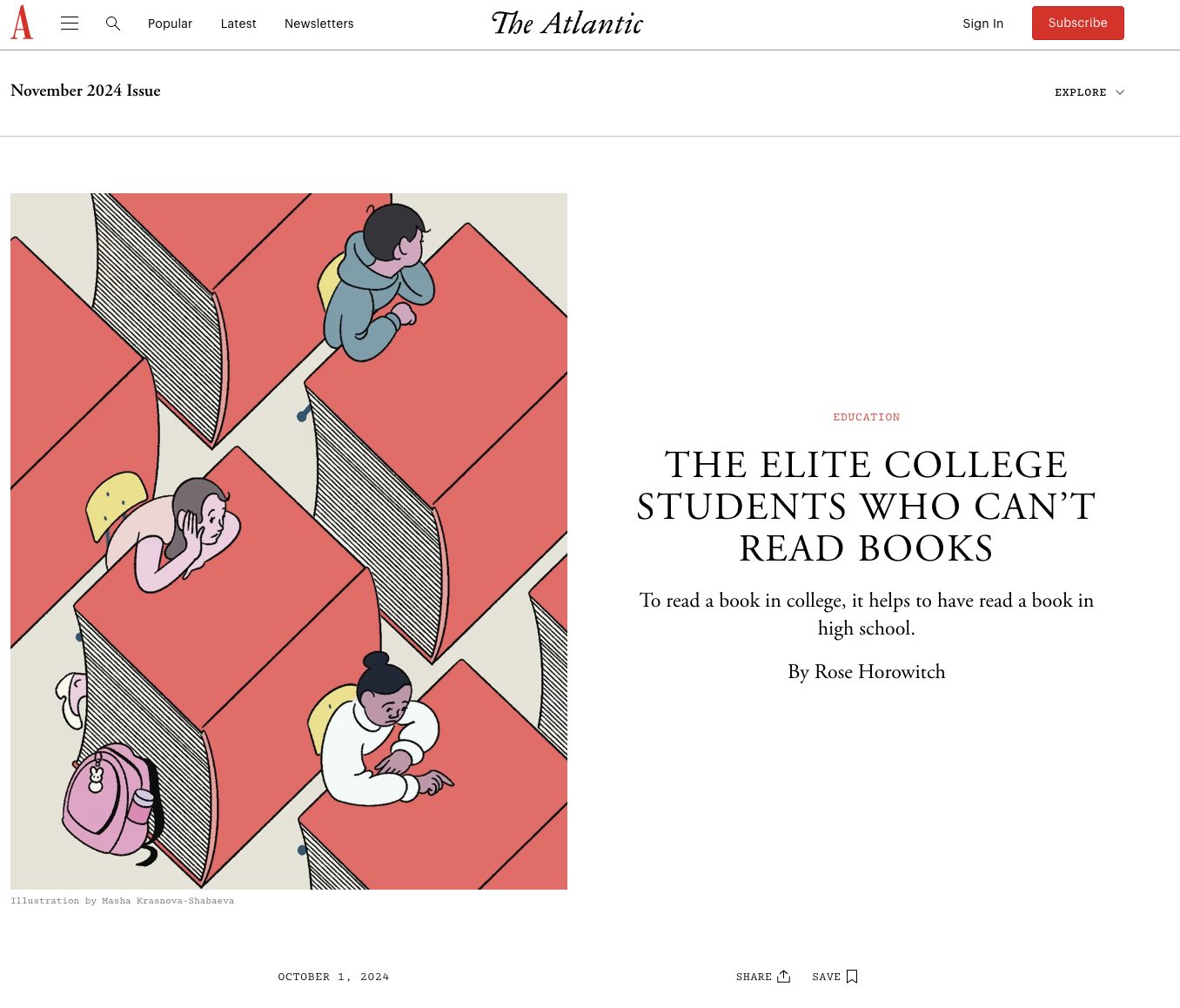
The evidence is no longer anecdotal. University libraries report historic lows in book borrowing. National literacy assessments show long-term declines in adult reading proficiency. Commentators in The Atlantic, The Chronicle of Higher Education, and The New York Times describe a generation for whom long-form reading has become almost foreign. A Victorian novel, once the ordinary fare of undergraduate study, now requires extraordinary accommodation. Even thirty pages of assigned reading can provoke anxiety, resentment, or open resistance.

It would be dishonest to ignore the role of the digital world in this transformation. Screens reward speed, fragmentation, and perpetual stimulation; sustained attention is neither required nor encouraged. But to lay the blame solely at the feet of technology is a convenient evasion. The crisis of reading within universities is not merely something that has happened to the academy. It is something the academy has, in significant measure, helped to produce.

The erosion of reading was prepared by intellectual shifts within the humanities themselves—shifts that began during the canon wars of the late twentieth century. Those battles were never only about which books should be taught. They were about whether literature possessed inherent value, whether reading required discipline, whether difficulty was formative or oppressive, and whether the humanities existed to shape students or merely to affirm them. In the decades that followed, entire traditions of reading were dismantled with remarkable confidence and astonishing speed.

The result is a moment of institutional irony. The very disciplines charged with preserving literary culture helped undermine the practices that made such culture possible. What we are witnessing now is not simply a failure of students to read, but the delayed consequence of ideas that taught generations of readers to approach texts with suspicion rather than attention, critique rather than encounter.

This essay is part of a larger project to trace that history, to explain how a war over the canon helped usher in an age in which reading itself is slipping from our grasp, and why the consequences of that war are now returning to the academy with unmistakable force.

The Canon Wars: A Short Intellectual History

To understand the present state of literary studies, one must return to the canon wars of the 1980s and 1990s — a conflict that reshaped the humanities with a speed and finality few recognised at the time. Although remembered now as a dispute about which books deserved a place on the syllabus, the canon wars were in truth a contest over the very meaning of literature and the purpose of a humanistic education.

In the decades after the Second World War, the curriculum in most Western universities still rested upon a broadly shared assumption: that certain works possessed enduring value, that they spoke across time, and that an educated person should grapple with them. This conviction, however imperfectly applied, formed the backbone of the humanities. It was also increasingly at odds with a new intellectual climate shaped by post-1968 radicalism, the rise of identity politics, and the importation of French theory.

By the early 1980s, tensions that had simmered beneath the surface erupted into public view. The most emblematic flashpoint came at Stanford University in 1987–88, when student demonstrators chanted, “Hey hey, ho ho, Western Culture’s got to go!” in protest of the university’s required course on Western civilisation. The course was soon dismantled, replaced by a broader, more ideologically framed program. What happened at Stanford quickly reverberated across the country. Departments revised reading lists, restructured curricula, and abandoned long-standing core requirements.

On one side of the debate stood defenders of the canon—figures such as Harold Bloom, Allan Bloom, E.D. Hirsch, and Roger Kimball—who argued that the great works formed a kind of civilisational inheritance. The canon, they insisted, was not a museum of privilege but a record of human striving, imagination, and achievement. On the other side were scholars like Edward Said, Toni Morrison, Henry Louis Gates Jr., Gayatri Spivak, and Homi Bhabha, who contended that the canon reflected histories of exclusion and domination, and that expanding or dismantling it was a moral imperative.

But beneath these arguments lay a deeper philosophical rift. The defenders assumed that literature possessed intrinsic value, that texts could be read for their beauty, their insight, or their power. The critics, armed with concepts drawn from Foucault, Derrida, and Barthes, argued that literature was inseparable from structures of power, that meaning was unstable, and that reading was less an act of discovery than an exposure of hidden ideological operations.

The canon wars ended not with a negotiated peace but with a decisive transformation. The traditional canon was not merely expanded; its authority was dissolved. And with it dissolved a set of shared assumptions about why we read at all.

November 7, 2025

“BookTok on its own sounds innocent enough”

Filed under: Books, Health, Media — Tags: , , , , , , — Nicholas @ 04:00

I’ve seen occasional references to BookTok on other platforms but as it seemed to be as female-coded as an online community can be, I’d never bothered to pay close attention to it. If Zoomertea is to be believed, it’s a weird and disturbing space for the unprepared to visit:

Image from “The Female Gooner Epidemic” at Zoomertea

If you’re smart enough to have never downloaded TikTok, then you’ve probably never heard of BookTok and the resulting epidemic of female gooners (a term borrowed from porn culture to describe obsessive arousal and fixation). BookTok on its own sounds innocent enough, women rediscovering the joys of reading, romanticising cozy nights in, or even joining a book club. In theory, what could be more wholesome? However, the reality is more concerning. It turns out the bookish girls have traded the likes of Pride and Prejudice for highly pornographic dark fantasy erotica, stories that make Fifty Shades of Grey seem tame.

Women have always enjoyed a flair for romance. Once it was the slow burn longing of Romeo & Juliet or Wuthering Heights – the stories weren’t explicit, yet still roused deep, passionate feelings. By the 2000s, romance had evolved into “chick lit” – breezy novels about friendship, love and self-discovery. Books like Bridget Jones and the Devil Wears Prada swapped tragic love for witty realism, capturing the struggles of modern women navigating careers, dating, and independence. It seems like in all aspects of modern culture, people have been pushing for the “reliability factor” – they wanted to see themselves in the characters and storylines. But somewhere along the way, the realism and reliability factor lost its appeal.

During the pandemic, while the virus spread and the world stayed home, TikTok spread too, surpassing 2 billion downloads by mid-2020. With endless free time, people picked up new hobbies: some tried Chloe Ting’s “Get Abs in 2 Weeks” workouts, others turned to BookTok and rediscovered their love for literature. Booktok isn’t just for explicit romantasy novels, however it’s become synonymous with women who obsessively consume dark romance. On BookTok, desire isn’t intimate anymore; it’s performed.

While Fifty Shades of Grey, a book very explicitly about sex, came almost ten years before BookTok, it wasn’t exposed to the algorithmic amplification loop we see today. Although its release did shock readers and spark feminist critiques about patriarchal relationships and sexual themes, it still felt more like a dirty secret. Its eroticism was discussed privately, even sheepishly. It was a book club secret, not a TikTok performance. Now, even the most unassuming women are flocking to BookTok and demanding books with a maximum “spice rating”, without an ounce of shame. But how did this happen?

Somewhere between the isolation and scrolling, the lines between fantasy and reality began to blur. The algorithm on TikTok can be very dangerous for enforcing unhealthy habits on its users. When a woman watches or likes just one “spicy book” video, even just out of curiosity, TikTok interprets it as interest in similar content. Without the user’s knowledge, suddenly their ForYou page is filled with similar videos, “books with a max spice rating”, “extreme taboo book recommendations” or “Top five dark romance recs”. The more they see, the more they engage, the more the algo pushes darker more extreme content. Essentially, the algorithm learns: You like desire, here’s more. Louder. Darker

October 31, 2025

Halloween Special: Doctor Jekyll and Mister Hyde

Filed under: Books, Britain, Humour, Media, Science — Tags: , , , — Nicholas @ 02:00

Overly Sarcastic Productions
Published 31 Oct 2019

Some monsters are undead creatures of the night. Some monsters are cosmic horror nightmare gods. Some monsters are existential personifications of dread and decay. But perhaps the greatest monster of all… is man.

Have a very spooky Halloween! And don’t forget the explicit moral of Jekyll and Hyde — that the greatest danger you’ll ever face comes from wealthy middle-aged white men who get away with their crimes because society refuses to believe they would ever do such horrible things. … Hm. Are we SURE this was written in 1886 …?

(Topic originally requested by patron Kyakan!)

MERCH LINKS: https://www.redbubble.com/people/OSPY…

OUR WEBSITE: https://www.OverlySarcasticProduction…

October 13, 2025

Stephen Fry’s Odyssey weighed in the balance and found wanting

Filed under: Books, Greece, History — Tags: , , , , , — Nicholas @ 03:00

Bryan Mercadente received a copy of Stephen Fry’s latest foray into Greek mythology and not only is not impressed, he writes, “Every page wasted on Fry is a page stolen from the real thing. The copy my aunt has given me for my birthday is already skimmed with disgust and thrown into the dustbin: it is too disgusting for the charity shops.”

The Iliad and Odyssey are the founding works of our civilisation. They are poems of war, loss, exile, and return. The hero of The Odyssey is a liar, a man of cunning and cruelty, but also a survivor who longs for home. The Homeric poems have come to us out of the Bronze Age. They have survived the collapse of at least two civilisations, and will survive the collapse of our own. They survive because they are already perfect. The hexameters carry an austere music. Their formulaic epithets — “ῥοδοδάκτυλος Ἠώς“, “πόδας ὠκὺς Ἀχιλλεύς“, “δῖος Ὀδυσσεύς” — are the memory-tricks of a sung tradition, but they also give the poems a dignity that no one who reads them can ever forget. Like The Iliad, The Odyssey was not written to be read in comfort with a cup of tea. It was composed to be chanted in smoky halls to men who might be dead tomorrow.

Stephen Fry knows none of this. Or if he knows it, he does not care. His Odyssey is Homer without the difficulty. It is Homer stripped of his grandeur, reduced to banter and “relatable” anecdotes. The Observer praised it for bringing “contemporary relevance” to the myths. That line is damning enough. Homer does not need contemporary relevance. A book that has spoken to audiences across three thousand years already possesses the only relevance that matters. To make Homer relevant is to make him trivial.

The Guardian called the book “relatable and full of humour“. Again, the praise condemns. Relatable? Homer is not relatable. The world he describes is harsh and alien. His heroes live by honour and die by the sword. They weep like children and sacrifice to gods who may or may not answer. That strangeness is the point. It is what makes Homer worth reading. To make him “relatable” is to gut him of meaning.

The Irish Independent calls Fry “A born storyteller“. This blurb, like the others, is the language of people who cannot read. No serious critic would praise a reteller of Homer as “a born storyteller”, as if the original poet were not the greatest storyteller of them all. These blurbs are not criticism. They are advertising slogans. And they work. The book is a bestseller.

Why, then, is Fry’s book a bestseller? Not because of merit. It sells because of Stephen Fry himself. For thirty years, he has been cultivated as a “national treasure”. He is the ideal leftist intellectual: clever enough to appear learned, shallow enough never to disturb. He quotes Wilde, sprinkles in Latin tags, and sprinkles them badly. His claque tells us that he is bipolar, gay, witty, and charming. He is on panel shows, chat shows, and literary festivals. He is always agreeable, always moderate, and always applauded.

Fry has built a career on the fact that the English middle classes like to feel cultured without effort. They want Plato without philosophy, Shakespeare without metre, Wagner without subversion, Homer without Greek. They want to be reassured that the classics are not difficult or dangerous, but fun. Fry gives them what they want. He domesticates the wild. He reduces epic to anecdote. He packages civilisation as entertainment.

It is not enough to call this dumbing down. It is worse. Dumbing down implies a reduction in complexity. What Fry does is not simplification but falsification. The Odyssey is not a sequence of funny stories about gods and monsters. It is about endurance and the fragility of human life under the indifference of the divine. To make it “funny” is to destroy it. It is as if someone rewrote the Inferno as a travel blog or recast the Iliad as a football commentary. The whole point of the work is lost.

Popularity, however, is not a defence. It is an indictment. Books that sell by the million are almost always worthless. They are consumed because they flatter the prejudices of the public. They make readers feel clever without having to be clever. They make them feel cultured without culture. They are the literary equivalent of processed food: cheap, sweet, addictive, fattening.

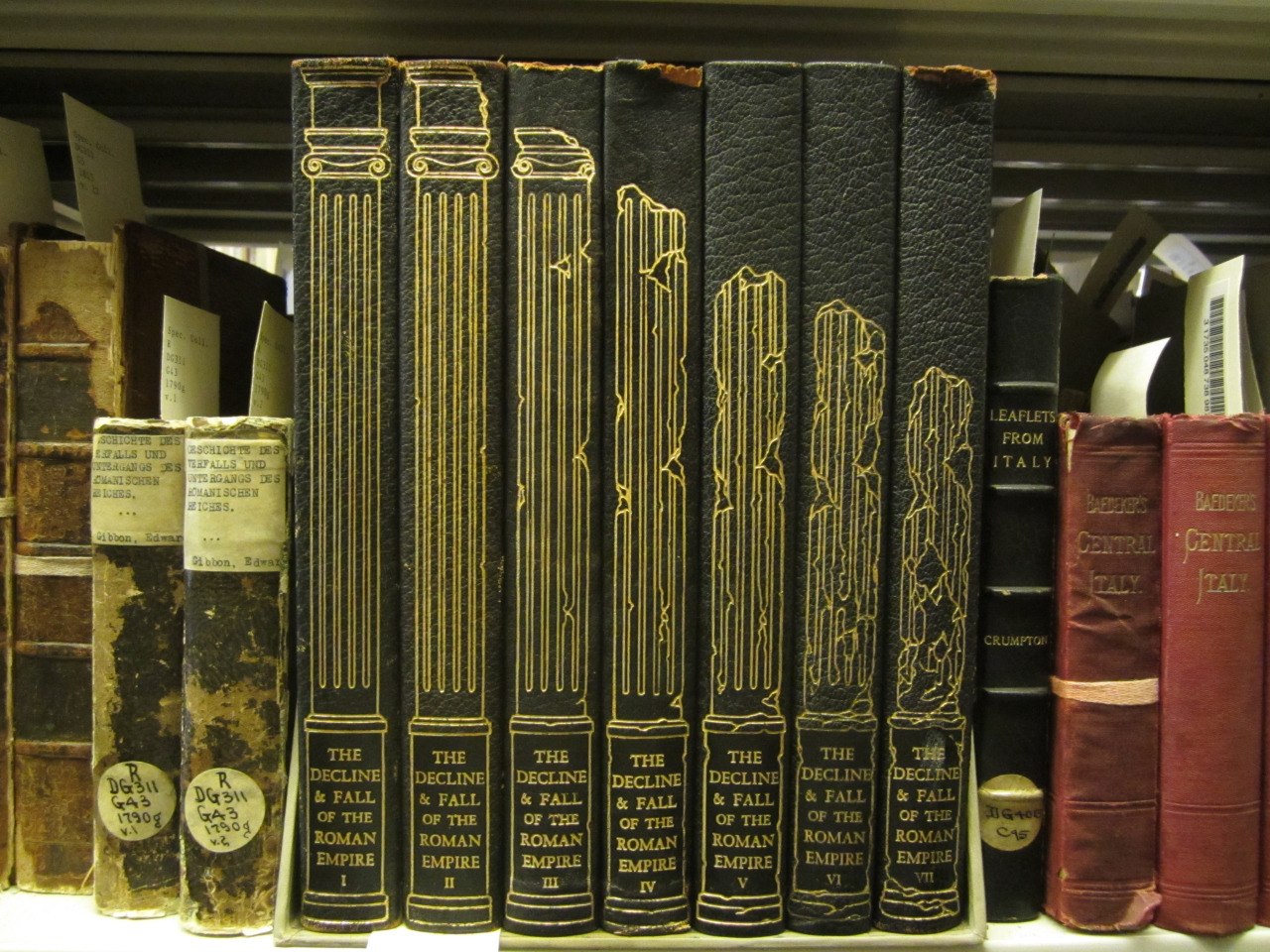
What, then, is the harm? Why not let people have their Fry and be happy? So what if his writing is as inconsequential as his suicide attempts? The harm is that time is short. Every hour spent on Stephen Fry is an hour not spent on Homer. It is an hour subtracted from Gibbon, Johnson, or Shakespeare. It is an hour less of life. The opportunity cost is everything. Bad books are not neutral. They are parasites. They feed on the hours that might have been spent on good ones.

August 25, 2025

The Sharpest Pen of the Edwardian Age | Who Was Saki?

Filed under: Britain, History, Humour, Military, Quotations, WW1 — Tags: , , , — Nicholas @ 02:00

Vault of Lost Tales
Published 5 Apr 2025

Delve into the razor-sharp world of Saki in this engaging author talk exploring his chillingly clever short story, “The Open Window”. Discover the man behind the pen name — H.H. Munro — and uncover how his biting satire, Edwardian upbringing, and darkly humorous worldview shaped this unforgettable tale. Perfect for fans of classic literature, Oscar Wilde-style wit, and unsettling plot twists, this literary deep dive offers historical context, thematic insights, and just enough spookiness to keep you on edge. Whether you’re a student, a short story lover, or just curious about the mind that created one of literature’s most deviously satisfying endings, this talk is your open invitation.

“Saki”, the wickedly sharp pen name of Hector Hugh Munro, masked a man whose wit could slice through Edwardian society like a silver butter knife through scandal.

Born in 1870 in British Burma and raised in England, Munro brought an acerbic wit to the drawing rooms of empire, crafting tales that balanced dry humor, social critique, and sudden, often shocking twists. Writing under the name “Saki”, he produced short stories that mocked the pretensions of the upper class, exposed the darkness beneath genteel facades, and made readers laugh — sometimes uncomfortably. His life, marked by loss, repressed identity, and service in World War I, ended tragically in 1916 on the battlefield, but his stories continue to delight and disturb to this day.
(more…)

August 18, 2025

QotD: Dostoevsky’s Demons can be read as “one long, savage parody of Fathers and Sons

Filed under: Books, History, Politics, Quotations, Russia — Tags: , , , , , — Nicholas @ 01:00

To understand what happens next [in Dostoevsky’s Demons], it helps to have read some Turgenev. His most famous work, Fathers and Sons, is of a piece with the most lurid boomer fantasies. The basic plot is that there are some genteel Russian liberals, good New York Times readers, people with all the right views. Their kids come back from college and are espousing all this weird stuff: stuff about white fragility and transgenderism and boycotting Israel, stuff that makes their nice liberal parents extremely uncomfortable. But it’s okay, you see? The kids magnanimously realize that their parents were once cool revolutionaries too, and the parents make peace with the fact that the kids are just further out ahead than they are, and everybody feels good about themselves because if the kids have seen far, it’s only by standing on the shoulders of giants. The important thing to understand is that everything about this plot is identity validation wish-fulfillment for the boomer liberal parents (like Turgenev himself). It’s the political equivalent of that YouTube genre where Gen Z Afro-American kids rock out to Phil Collins.

The macro-structure of Demons mirrors this so closely, you can almost read the book as one long, savage parody of Fathers and Sons.1 The sunny opening section is a satire of the boomer liberals, and the big vibe shift part way in is their kids coming back from college. But that’s where things go off the rails. In this book, the next generation shares their parents’ anti-religious and anti-monarchist attitudes, but unlike in Fathers and Sons, the kids in Demons are disgusted by the hypocrisy and cowardice of their genteel liberal parents, and eager to plunge Russia into a hyper-totalitarian nightmare. The exact contours of that nightmare are something they frequently argue about and change their minds over, but they can all agree that it will need to begin with an enormous mountain of skulls, and that their town is as good a place as any to start.

Dostoevsky’s other works put individuals front and center, his stories have unbelievably rich characterization (Nietzsche once said that Dostoevsky was the greatest psychologist to ever live), because for Dostoevsky the very highest stakes, the most important questions in the world, were about the damnation or salvation of individual souls. But Demons is different: here the characters all blur together, their names are disgorged to you in a never-ending torrent, and only a few of them are distinctive in any way.2 How could Dostoevsky think these people don’t matter? It’s because they aren’t real people anymore. It’s because they’re possessed. Their brains have been scooped out and all you can see in their eyes is a writhing mass of worms. Their ideas and ideologies have hollowed them out and are wearing their skins as suits.

But what if the ideas don’t matter either? It’s easy to interpret the second half of Demons as a novel of ideas, but it really isn’t. Your first clue is that the ideas are just so goofy. There’s one guy who thinks that by killing himself he will become God (don’t ask, it’s Dostoevsky, man). Another has written a book with ten chapters, explaining how “Beginning with the principle of unlimited freedom I arrive at unlimited despotism”, and proposing a method of brainwashing for reducing ninety percent of humanity to a mindless “herd”. Yet another thinks that everything can be solved by killing one hundred million people, but laments that even with very efficient methods of execution this will take at least thirty years.3 My own favorite might be the guy who refuses to explain what his system is, but just smugly declares that since everybody is going to end up following it eventually, it’s pointless for him to explain it.

John Psmith, “REVIEW: Demons, by Fyodor Dostoevsky”, Mr. and Mrs. Psmith’s Bookshelf, 2023-07-17.


  1. Further evidence for this reading: the book contains a character, the great writer “Karmazinov”, who is a straightforward expy of Turgenev himself.
  2. That said if you do need to keep track of them, this alignment chart made by some genius on the internet is a pretty handy guide: link.
  3. This one probably seems less funny after the 20th century than it did when Dostoevsky wrote it.

August 8, 2025

The Rise and Fall of Books in Ancient Rome

Filed under: Europe, History — Tags: , , , — Nicholas @ 02:00

toldinstone
Published 21 Mar 2025

This video explores how books were published and distributed in ancient Rome.

Chapters
0:00 Introduction
0:30 Literacy and texts
1:19 Libraries
2:09 Scrolls and codices
3:13 Bookstores and booksellers
4:07 Helix
5:13 Publication
6:17 Luxury and vintage books
7:14 Bestsellers
8:10 The end of the book trade

July 23, 2025

The Most Bitter Man In All Of Ancient Rome: Meet JUVENAL

Filed under: Europe, History — Tags: , , , , , , — Nicholas @ 02:00

MoAn Inc.
Published 27 Feb 2025
(more…)

June 24, 2025

Fandom Has Always Been UNHINGED

Jill Bearup
Published 23 Jun 2025

Listen, nobody asked for a history of fanfiction but here we are regardless. From Helen of Troy fix-it fic to Holmes fans unsubscribing en masse when the detective was killed in The Final Problem, fandom has always been this chaotic, and fanfiction has always been with us. In one form or another.

00:00 Did you ask for this? Nah.
01:20 Ancient authors ripping off other ancient authors
03:06 Virgil was a Homer fanboy
04:10 Dante was a Virgil fanboy
05:18 Don Quixote and the Case of the Unauthorised Sequel
08:01 The Statute of Anne
12:35 Gulliver’s Travels NSFW fanart
14:40 Geniuses and Originality
16:51 The Berne Convention
17:20 Character Vibes are not Copyrightable
20:46 The First Modern Fandoms (were Genuinely Unhinged)

Link to Der Spiegel article on copyright and innovation: https://www.spiegel.de/international/…

May 12, 2025

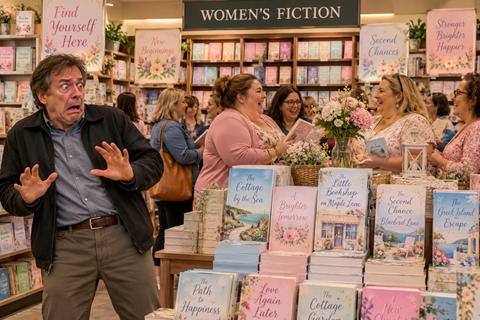
Is modern fiction in any way intended to be read by a male audience?

Filed under: Books, Business, Education, Media — Tags: , , , , — Nicholas @ 04:00

I belong to several genre-specific groups on various social media platforms, most of which appear to be disproportionally female in membership, and I read very little new fiction of any sort these days, partly for diminished interest and largely from diminished disposable income. I’ve often seen the assertion that men no longer read much fiction, but is it actually true?

You can see here some of the challenges involved in measuring reading habits. Are we talking reading books or purchasing books? Does buying correlate to reading or are women better gift givers? What about those hugely popular 20-part, 60-page-per-instalment romance series that might ratchet up purchases by women — anything like that in the fiction market for men? Should we base assumptions about readership of literary fiction on data about readership of general fiction, as many of the articles I’ve read do?

All we can safely say is that it does seem men read somewhat less fiction than women; they also read fewer books of any kind. As a person in the book industry, I wish that weren’t so, but it may not be a cultural calamity.

The most interesting article I came across in last night’s binge was published in 2009 by the University of Saskatchewan’s Virginia Wilson in Evidence Based Library and Information Practice. She undertook a small study of boys aged four through twelve, interviewing them about their reading habits. Her theoretical perspective was that if anyone was ever going to understand the reading habits of boys, they needed to recognize that the experts were the boys themselves. She quizzed forty-three of them about their book collections, what they liked and didn’t like, and their motives for reading.

Each of the boys had a personal collection of books. These ranged from eight to 398 volumes, with a median of 98. All but one of the boys had fiction in his collection. The most prominent genres were fantasy, science fiction, sports stories, and humour. The boys had no time for love stories, books about groups of girls, and such classic children’s fiction as The Adventures of Robin Hood.

Asked about their favourite books, most of the boys pointed to a non-fiction title: joke books, magic books, sports books, survival guides, science books, references, atlases, dinosaur books.

The boys also read a good deal of non-book material: comics, manga, magazines, sticker books, puzzle books, and catalogues. A number mentioned reading video game manuals, both to learn more about the games, but also to heighten their enjoyment of the narratives within the games.

The manuals were part of a bent toward pragmatic reading, something they found useful as much as pleasurable. The boys often read to support another hobby — Pokémon, for instance. They also appreciated non-linear texts and plenty of illustrations.

Interestingly, many of the boys tended to discount their own reading. They often described the informational stuff they liked—those video game manuals or computer guides or research materials for science projects—as “not really being reading”. Serious reading, in their minds, involved novels and conventional non-fiction books.

Wilson’s conclusion was that at least part of the “boys and reading problem” might come down to what counts as reading. Informational nonfiction, comic books, computer magazines, graphic novels, and role-playing game manuals were “not necessarily privileged by libraries, schools, or even by the boys themselves”.

Of course, as Wilson notes, one shouldn’t generalize too much from a small qualitative study involving forty-three boys. There’s nothing definitive to be learned here about Trump or contemporary masculinity (although I’ve read several lengthy screeds based on less).

Wilson’s paper simply reminds us that reading is complicated, and most of the available research on reading habits isn’t. Survey respondents are typically asked if they read books for leisure, or if they’ve read a book in the last year. There are many reasons to read other than for leisure. There are many things to read other than books. And not all books are equal.

I haven’t seen a study that tracks if men spend more minutes per day reading sentences than women. Or one that drills down to find who reads the most newspapers, magazines, websites, newsletters, contracts, annual reports, research papers, instruction manuals, catalogues, and cereal boxes. Each of those formats is as potentially edifying (if not as much fun) as Morning Glory Milking Farm: A Monster Bait Romance, with its 47,570 enthusiastic ratings on Goodreads.

I read so many concerns for and condemnations of contemporary males last night that it came as a surprise to learn that our most reliable measure of reading competence, the Program for the International Assessment of Adult Competencies, finds no real difference in literacy of men and women aged 16 to 64 in the US or Canada. We should all revisit that baseline before assigning responsibility for the state of civilization to whoever is or isn’t reading or buying contemporary fiction. (PIAAC did find that while Canadian literacy scores have been stable, US scores have slipped 5 percent since Trump was first elected. Make of that what you will.)

Does the men-and-fiction problem exist? I think yes, and my sense is that it’s one of both supply (what’s getting published) and demand (what men will read). I thought I’d have more than that to say. This is my kind of issue — the whole point of SHuSH is ill-considered opinion drawn from shaky evidence on a weekly timetable — but I can’t compete with what I’m reading, so I’m backing off for now.

I certainly find myself reading almost nothing that has been published recently with a few exceptions for well-researched and well-written histories and military histories. My preferred genre reading got taken over by the “jam the narrative into every story” crowd a few decades back, so I stopped buying SF and fantasy titles except those from authors I’d already read.

Older Posts »

Powered by WordPress