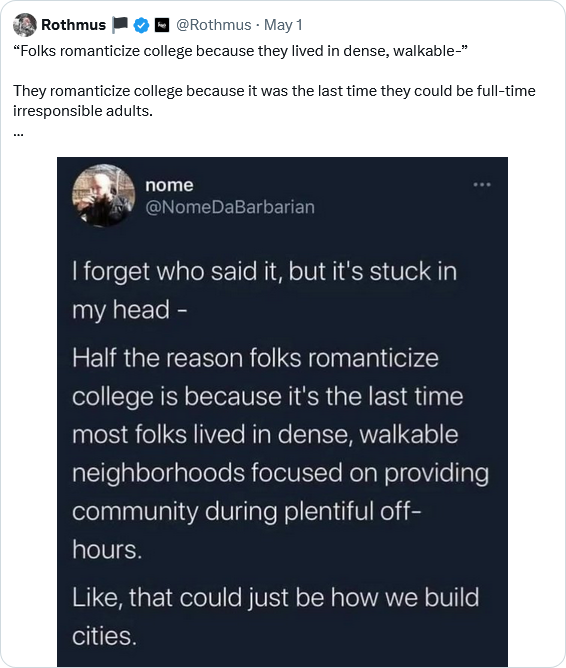
On the social media site formerly known as Twitter, Devon Eriksen responds to comments about people wanting the world to be like they remember their time at college:
People romanticize college because for four years of their lives they:
1. Had all the rights of adults but none of the responsibilities.
2. Lived in a closed community with sealed borders that kept out low IQs and anti-socials.
3. Were young, energetic, healthy, and attractive.
4. Were thrown together with a bunch of similar people who had no predefined power- or need-based relationship with them, which is how friendships form.
This last is the important one, especially as fertility rates decline.
People with children transition to making friends with other parents of children in the same age group, because events and networks centered around those children throw them together with other parents in the same way.
But childless people have few or no opportunities to make friends after college. So they are left with a slow dwindling circle of college based relationships, remembering the days when it was all easy, and they weren’t so isolated, and they didn’t have to work so hard.
Couple that with having to complete with infinity immigrants in the job market, so they can pay taxes to support infinity boomers and government bureaucrats, while being passed over for the best jobs and careers in favor of infinity DEI incompetents, who they also have to support …
Well, for a lot of people born into what was once the American middle class, college was their first and last experience of an adult life wherein they weren’t being systematically and deliberately routed into the formation of a new underclass.
A special form of underclass who are still expected to be productive enough to materially support all the non-producing people who were positioned as their social superiors despite being their intellectual inferiors.
So, yeah, they wish they could go back to college.
Is anyone surprised by this?