Brivael Le Pogam offers an apology to the west for France being so significant in the philosophical and political effluvia of 1968 for setting the conditions in which wokeness was born:
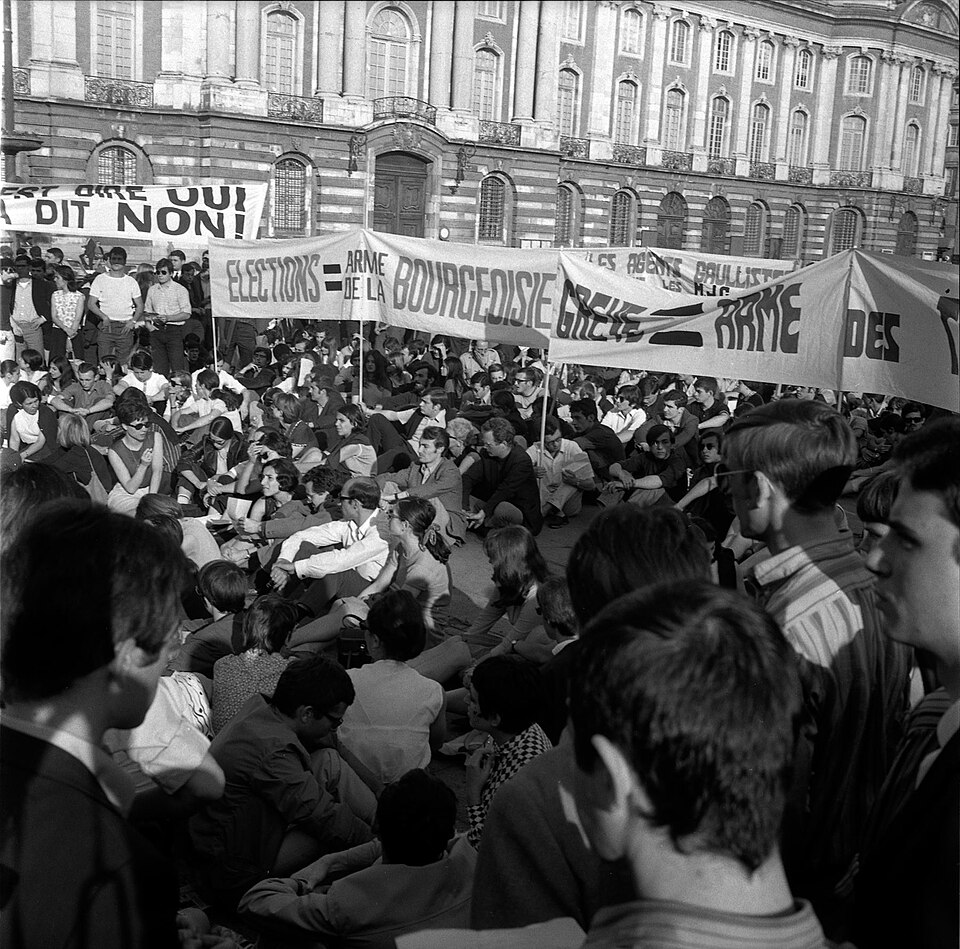
Protesters gathered in the Place du Capitole in Toulouse, 11 or 12 June, 1968.
Photo by André Cros (1926-2021) via Wikimedia Commons.
I want to offer my apologies, on behalf of the French, for giving birth to French Theory (which in turn gave birth to the worst of all ideological monstrosities: wokism).
We gave the world Descartes, Pascal, Tocqueville. And then, in the intellectual ruins of post-1968, we gave Foucault, Derrida, Deleuze. Three brilliant men who forged, in the elegance of our language, the ideological weapon that today paralyzes the West.
We must understand what they did. Foucault taught that truth does not exist, that there are only power relations disguised as knowledge. That science, reason, justice, the medical institution, the school, the prison, sexuality — everything is merely a staging of domination. Derrida taught that texts have no stable meaning, that every signifier slips away, that every reading is a betrayal, that the author is dead and the reader reigns supreme. Deleuze taught that we should prefer the rhizome to the tree, the nomad to the sedentary, desire to the law, becoming to being, difference to identity.
Taken individually, these are debatable theses. Combined, exported, and popularized, they form a system. And that system is a poison.
For here’s what happened. These texts, unreadable in France, crossed the Atlantic. The departments of Yale, Berkeley, and Columbia absorbed them in the 1980s. They found there a soil that did not exist among us: American Puritanism, its racial guilt, its obsession with identity. French Theory married this substratum, and the child of that union is called wokism.
Judith Butler reads Foucault and invents performative gender. Edward Said reads Foucault and invents academic postcolonialism. Kimberlé Crenshaw inherits the framework and invents intersectionality. At every step, the matrix is French: there is no truth, there is only power, so every hierarchy is suspect, every institution is oppressive, every norm is violence, every identity is constructed and thus negotiable, every majority is guilty.
That’s how three Parisian philosophers, who probably never imagined their practical consequences, provided the operating software to an entire generation of activists, university bureaucrats, HR managers, journalists, and legislators. That’s how we ended up with a civilization that no longer knows how to say whether a woman is a woman, whether its own history is worth defending, whether merit exists, whether truth can be distinguished from opinion.
It’s shit for one simple reason, and it must be stated calmly. A civilization stands on three pillars: the belief that there exists a truth accessible to reason, the belief that there exists a good distinct from evil, the belief that there exists a heritage to be transmitted. French Theory set out to dynamite all three. Not out of malice. Out of intellectual play, fascination with suspicion, hatred of the bourgeoisie that had nurtured them. But the result is there. An entire generation learned to deconstruct and never learned to build. An entire generation knows how to suspect and no longer knows how to admire. An entire generation sees power everywhere and beauty nowhere.
I apologize because we French bear a particular responsibility. It’s our language, our universities, our publishers, our prestige that gave this nihilism its chic packaging. Without the legitimacy of the Sorbonne and Vincennes, these ideas would never have crossed the ocean. We exported doubt the way others export weapons.
What is being built now, in Silicon Valley, in AI labs, in startups, in workshops, in all the places where people still make things instead of deconstructing them — that is the response. A civilization is rebuilt by builders, not by commentators. By those who believe that truth exists and is worth devoting oneself to. By those who embrace a hierarchy of the beautiful, the true, the good, and are not ashamed to transmit it.
So, forgive us. And back to work.
Auto-translated by the social media site formerly known as Twitter from the original French post.