Quotulatiousness

May 9, 2026

Like the Roman. The Life of Enoch Powell, by Simon Heffer

Filed under: Books, Britain, History, Media, Politics — Tags: , , , , , — Nicholas @ 05:00

I think it’s fair to say that Enoch Powell is having a moment, nearly sixty years after he shocked the establishment with his 1968 “Rivers of Blood” speech. He became a pariah even in his own party, and his political career never recovered … but his warnings have more than been fulfilled over the intervening decades. In The Critic, Jeremy Black reviews the recently reprinted 1998 biography of Enoch Powell by Simon Heffer:
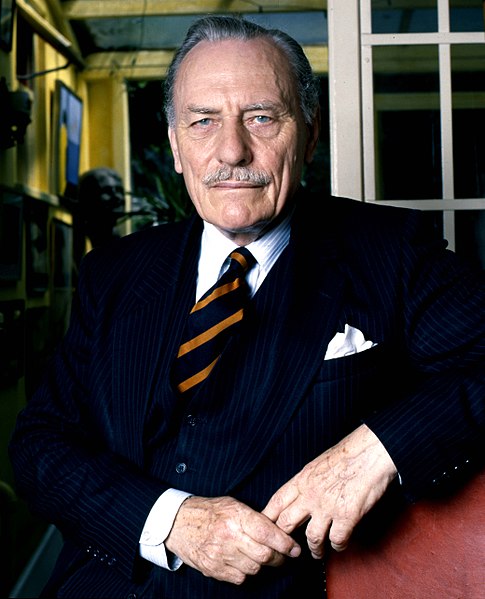
Enoch Powell in a 1987 portrait by Allan Warren.
Wikimedia Commons.

The new imprint of this important biography provides an opportunity to reread one of the most skilful works on British political history published over the last half century. As with Heffer’s other books, it is also very well written — although might I offer a plea for leaving aside sentences such as “He still saw no reason to lay off Heath”?

Before turning to the substance, it is worth considering the Foreword. Written this January, it underlines Powell’s significance to many issues, notably: “His deep scepticism about the confluence of America’s interest with those of Britain”. I am, however, dubious about the proposition that “Powell was, quite simply, one of the foremost Conservative thinkers in living memory, possibly the greatest since Burke”. Leaving aside the question of whether Burke can be described as Conservative or even, prior to the 1790s, as conservative, and, separately, the implicit dig at claims for Disraeli whom Heffer is on the record as describing as a Charlatan, I myself would make the case for Salisbury, while agreeing that Macmillan, Hailsham and MacLeod did not measure up to Powell. He returned the damage done him by Macmillan with “bilious” reviews of his Memoirs.

While I am sceptical of the claim that Powell was a great Conservative thinker in the cosmic sense, he was an impressive critic of many of the shibboleths of establishment Conservatism from the 1960s to the 1980s, including on immigration, the nuclear deterrent, the Common Market, the American alliance, Northern Ireland, and economic policy.

A significant aspect of the intellectual character of Powell was the return of this one-time atheist to the Church in the late 1940s, the subject of the “Interlude” “Powell and God” in the book. There is, as Salisbury and Cowling among others underlined, a significant link between Conservatism and the Church of England, and Powell, like Thatcher, can be profitably discussed in these terms, with Thatcher far less convincing.

The discussion of Powell’s elision from public debate is also interesting. Published by Weidenfeld and Nicolson in 1998, the biography was kept on print-on-demand until cancelled in the aftermath of the Black Lives Matter movement. Heffer compares the treatment of Powell to that of Orwell in facing difficulties in publishing Animal Farm and Nineteen Eighty-Four. For several years, Heffer found it impossible to persuade a publisher to republish the book and suggests that this was due to a craven fear of public opinion “real or perceived”, one about which Orwell had warned not least when referring to “intellectual cowardice”. The publisher he has found, it has to be said, is another instance of the very valuable work being done by non-metropolitan concerns.
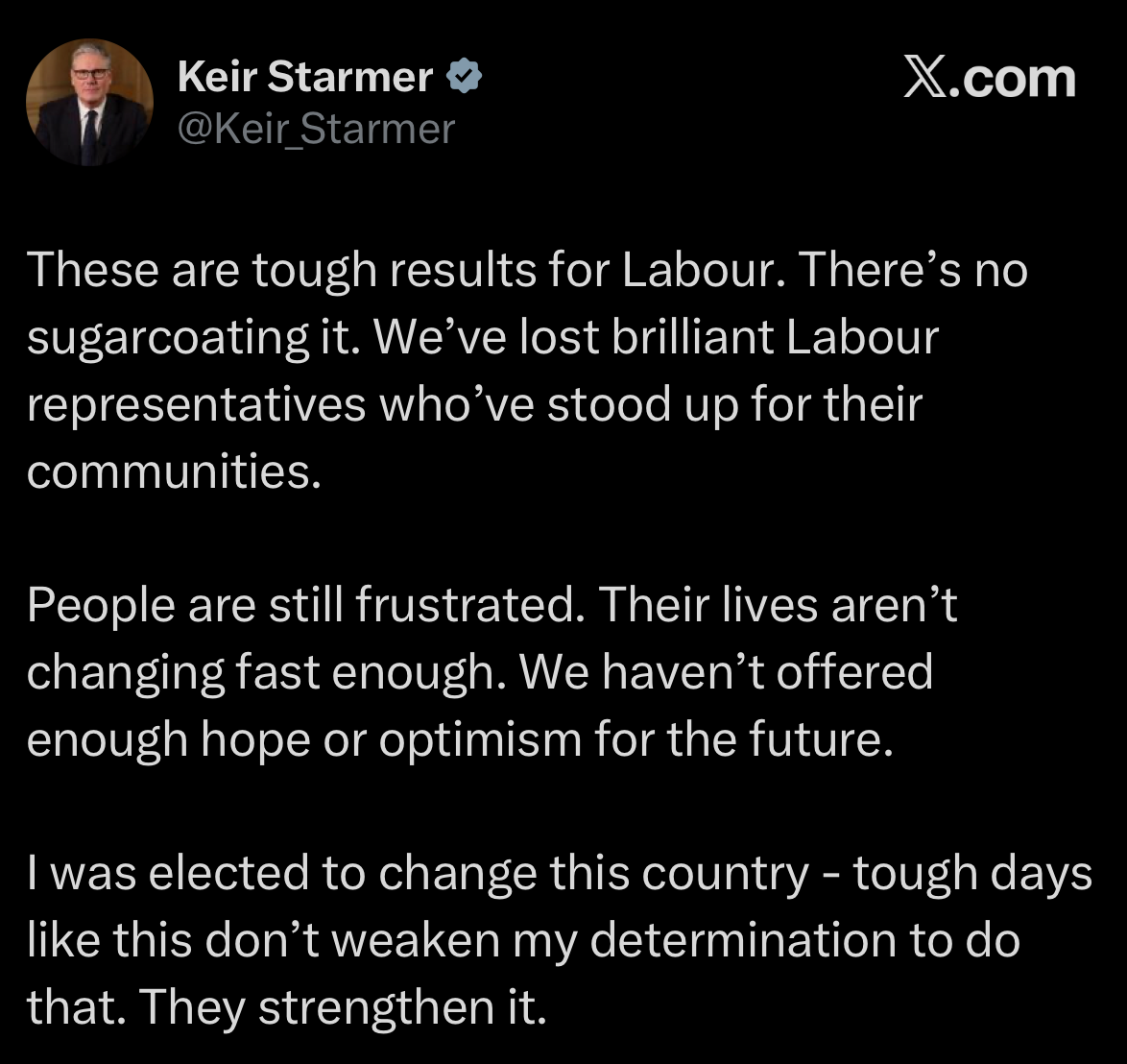

Starmer thinks local elections’ message is for Labour to move faster on their progressive agenda

Filed under: Britain, Media, Politics — Tags: , , , , , — Nicholas @ 04:00

British Prime Minister Sir Keir Starmer — who many commentators have for months been describing as a “dead man walking” — somehow manages to find an interpretation for the Labour Party’s disastrous local election results, and thinks voters just sent a message that he needs to move faster and more vigorously to implement their vision. That’s certainly a take.

Nigel Farage is certainly enjoying the outcome:

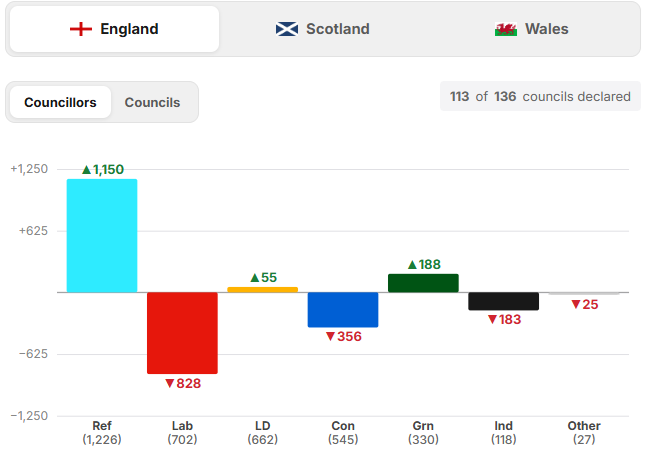
Partial council election results in England, 8 May 2026.
Graphic from the Daily Mail

Hurrah for the Tealshirts! Nigel Farage emerged from Havering Town Hall looking smug even by his standards. For years, he has been written off, denied the respect — and peerage — he feels he deserves, forced to scrape by on gifts from well-wishers, and now he was showing them all, wreaking havoc on both Labour and Conservatives.

Nothing could hold the party back, not the endless terrible comments from Reform candidates who for some reason believe Farage agrees with them, not even a huge bribery scandal involving the party leader in Wales. Today Havering, tomorrow Westminster!

Elsewhere, people were gloomier. James Cleverly explained to the BBC that winning elections isn’t the goal of politics. The Conservatives aren’t interested in here today, gone tomorrow popularity, it turns out. They just want to govern well. Which leaves a couple of questions about the last decade and a half.

David Lammy told anyone who would listen that you don’t change pilot mid-flight. Better, he didn’t add, to wait until the plane has hit the ground.

The real show of the morning was the confrontation on the BBC between Cleverly’s colleague Vicky Atkins and their former fellow Tory, Robert Jenrick. Atkins and Jenrick have a long friendship going back to the time when he was the anti-Farage candidate in Newark in 2014, through the time he was an anti-Brexit MP supporting David Cameron, his days in Theresa May’s government, his early backing of Boris Johnson, his years in the Cabinet, all the way to his realisation this year that he’d never believed any of the things he’d been telling the voters.

“Robert and I haven’t actually spoken to each other since I supported his leadership campaign,” Atkins announced, and the rest of us fastened our seatbelts for a bumpy ride. “I’m surprised that he’s so quick to can all of the work that he did when he was in government.”

Next to her, Jenrick looked like a man who has arrived at a school parents evening to discover that his ex-wife got there first and has been filling people in on the reason she cut the crotches out of all his suits. But Atkins was just getting started. “Nobody should believe the snake oil salesmen,” she said. Jenrick had accused the Tories of messing things up. “Rob was part of the team that made those mistakes.”

Jenrick made another bid to get the conversation back on track. “The question is about honesty and trustworthiness,” he said. You could have used Atkins’ expression at that moment to freeze lava.

At the time of this Daily Mail report from James Tapfield and David Wilcock, the demands from Labour MPs for Starmer to resign hadn’t quite reached the “red alert” level yet:

Partial council election results in England, 8 May 2026.
Graphic from the Daily Mail

Keir Starmer is desperately fighting to subdue a Labour revolt tonight after a local elections bloodbath saw the party routed on English councils, and destroyed in Wales and Scotland.

Loyalist ministers and MPs have been deployed in a frantic bid to prop up the PM, after a series of backbenchers broke cover to demand his resignation.

So far no Cabinet ministers have publicly joined the mutiny – a moment that many believe would be the final nail in Sir Keir’s coffin.

Rachel Reeves and David Lammy were among those backing Sir Keir – but there has been an ominous lack of vocal support from Wes Streeting, Yvette Cooper, Ed Miliband and Shabana Mahmood. London Mayor Sadiq Khan released a statement saying the results in the capital were ‘bitterly disappointing’ and the threat to the party is ‘existential’ – without mentioning the PM.

The civil war reignited this evening after Labour’s Welsh leader, Baroness Morgan, humiliatingly lost her own seat as the party’s tally of the 96 Senedd members was slashed to just nine. In a jibe at the PM, she said the Government nationally must ‘change course’.

Until yesterday Labour held nearly half the seats at the Welsh Parliament, and has never failed to top an election in the country – regarded as its birthplace.

Scottish Labour leader Anas Sarwar has also conceded defeat at Holyrood, saying they had ‘lost the argument’ and pointing the finger at Sir Keir.

Meanwhile, the Greens have dealt a hammer blow by taking the mayoralty in deep-red bastion Hackney, as well as Lewisham – signposting more misery to come in London. The Labour leader in Camden – Sir Keir’s own council – has been defeated by Zack Polanski’s candidate.

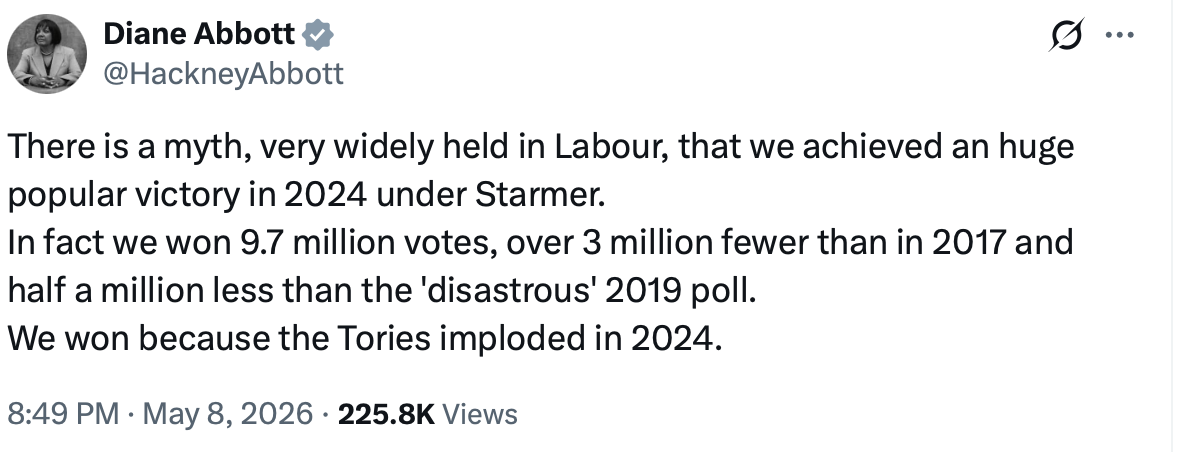
Even some Labour stalwarts are reading the tea leaves correctly:

Argentina not in the news

Filed under: Americas, Economics, Government, Media, Politics — Tags: , , , — Nicholas @ 03:00

On the social media site formerly known as Twitter, Martin Varsavsky illustrates the real situation in Argentina after Javier Milei was elected as opposed to the dystopian nightmare imagined by the western media:

“Argentine flag” by papajuan74 is licensed under CC BY 2.0 .

After more than two years of Milei, the international press still does not understand what is happening in Argentina.

The narrative abroad is “shock therapy, social pain, fragile coalition”. That frame misses the actual mechanism. Argentina did not have a budget problem. It had a printing problem. From 2003 to 2023 the central bank financed deficit after deficit until the peso lost 99 percent of its value against the dollar. Annual inflation hit 211 percent in 2023. Half the country was poor. That was the floor.

What changed is not vibes. It is arithmetic. The fiscal deficit was eliminated for the first time in 16 years. Monthly inflation fell from 25 percent to low single digits. The central bank stopped printing to fund the Treasury. Country risk dropped from over 2,500 basis points to a fraction of that. Argentine sovereign debt, which used to trade like a default option, began behaving like normal emerging market paper.

Critics say poverty rose. It did, briefly, because removing price controls and subsidies revealed the real prices of energy, transport and food that the state had been hiding with debt. Once measured honestly, poverty has been falling fast. Real wages are recovering. Mortgages in pesos are reappearing, something that had not been possible in a generation.

This matters beyond Argentina. It is the clearest live experiment in whether a developed-style economy can be rebuilt by pulling the state out of places it never belonged. Spain, Italy and France should be paying attention. A country does not get poor because it lacks resources. It gets poor because its political class learned to live off printing money and calling it social policy.

Argentina spent 80 years proving that. It is now spending two years proving the opposite.

M1E5 Experimental Paratrooper Garand

Filed under: History, Military, USA, Weapons, WW2 — Tags: , , , , — Nicholas @ 02:00

Forgotten Weapons
Published 17 Dec 2025

In January 1944 men of the 93rd Infantry Division field-modified an M1 to give it a shorter (18″) barrel, and the rifle was sent back to the US and tested by the Infantry Board. The idea was that a rifle like this might be of use to paratroopers, being more powerful than the M1A1 Carbine they were already using. The job of exploring the idea was given to John Garand at Springfield Armory, and he began work that same month.

One example was made in the spring of 1944, using an underfolding stock designed by Garand (for which he received a patent in 1949). It was 5″ shorts and 1.2 pounds lighter than a standard M1, but exhibited excessive blast and concussion. The initial design used the folding stock with a traditional grip, and this was found uncomfortable (no surprise there). The rifle was refitted with a rather odd steel pistol grip, but this was also not a great solution. By this time testing found the whole thing undesirable and it went no farther.

Thanks to the Springfield Armory National Historic Site for giving me access to this truly unique specimen from their reference collection to film for you! Don’t miss the chance to visit the museum there if you have a day free in Springfield, Massachusetts: https://www.nps.gov/spar/index.htm
(more…)

QotD: Morality and taxation

Filed under: Bureaucracy, Government, Law, Quotations, USA — Tags: , — Nicholas @ 01:00

First off, “morality” doesn’t have jack shit to do with taxation. You pay what you legally owe. Nobody willingly pays the government more than they legally owe.

This has always been this way since America has had income taxes. There is endless court precedent. You pay what you legally owe. That’s it. If you pay less than you legally owe, then the government will fine or imprison you. If you pay more than you legal owe, the government will laugh and laugh, because you are an idiot, and you deserve to be poor.

Every single person who barks about how somebody else should be paying more? They themselves are paying the minimum they can get away with. As they should. As should you.

I remember when I was taking my first tax class back in college. This class was all accounting majors by this point. At the beginning of the semester the professor (who’d had a long career as a tax guy) gave us an imaginary family as our clients and had us do their taxes. One kid didn’t take advantage of all the obvious deductions for his clients. When the professor asked why, the kid said some mushy thing about how he didn’t think it was FAIR to keep that money from the government … Holy shit. The professor ripped this kid a new asshole. HOW DARE YOU!?! IT IS NOT THE GOVERNMENT’S MONEY! IT IS YOUR CLIENT’S MONEY. YOU OWE THEM YOUR BEST! IT IS YOUR SACRED DUTY TO SAVE THEIR MONEY! YOU DISGUST ME AND YOU SHOULD NEVER BE A CPA!

That class was one of my favorites.

Basically, you pay what you owe, no more, and anyone who claims otherwise is full of shit.

Larry Correia, “No, You Idiots. That’s Not How Taxes Work – An Accountant’s Guide To Why You Are A Gullible Moron”, Monster Hunter Nation, 2020-09-28.

Powered by WordPress