So why would we impose tariffs on an import or three? No, leave aside whether it’s a good idea or not, why would we do so? To increase the price of that item inside those tariff barriers. That’s it, that’s the point, to increase the price.
Think on it. So, those dastardly foreigners are better, or cheaper, or subsidised, or just plain swarthy johnnies who are selling to us and thereby stealing the crust from the mouths of the more expensive (or less good etc) proper British producers. So, we now impose a tax at the border. This makes those products from swarthy johnnies more expensive. So, people will buy fewer swarthy and more good and honest British.
This also enables the good British to raise their prices and so make a profit.
So, what actually happens is that the British consumer gets screwed for the benefit of British capitalists. Not quite what I’d recommend as a policy but that’s the point and the intention. Tariffs raise the domestic price of the thing, that’s the reason why.
Tim Worstall, “But Increasing Prices Is The Very Point Of Tariffs”, It’s all obvious or trivial except …, 2026-06-18.
September 25, 2026
QotD: The whole point of imposing tariffs is to raise prices
September 21, 2026
Price controls work … but not the way they’re intended to
Politicians love to intervene in markets, trying to impose their preferred solution to “problems” like high prices. But markets don’t work the way politicians think they do:
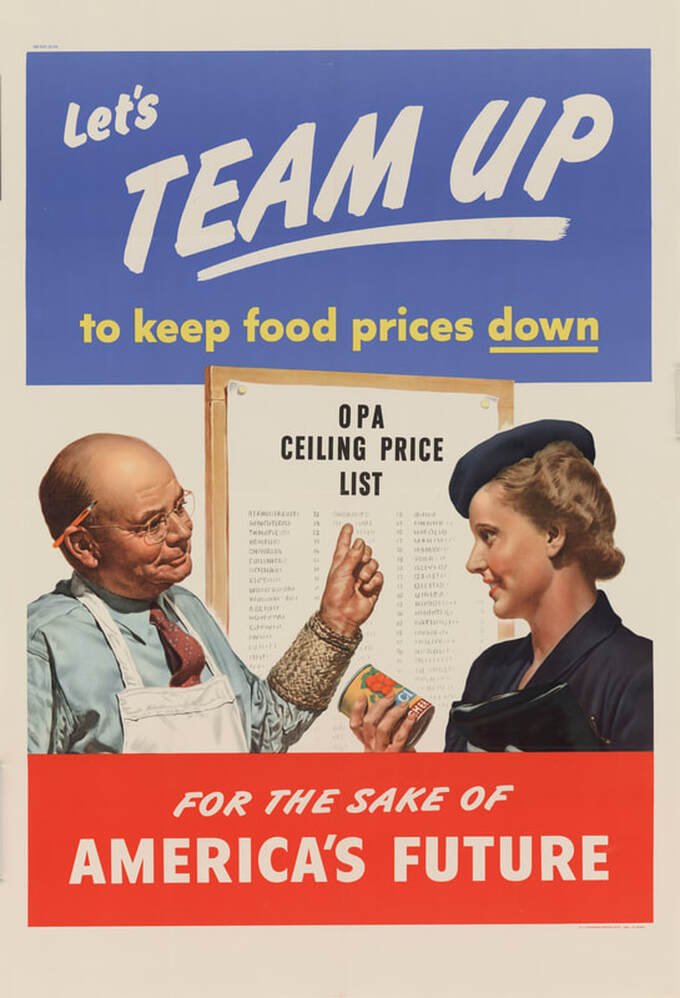
Price ceilings don’t manage markets, they destroy them. In 1946 the US meat market collapsed because of it.
The Office of Price Administration set beef ceiling prices during World War II. Ranchers and meatpackers adapted: some held cattle rather than sell at a loss, others shifted product to black markets, and slaughter volumes dropped. The OPA briefly lifted controls in mid-1946 under pressure. Beef flooded back into stores almost immediately.
Then Congress, drowning in constituent complaints about inflation, reimposed ceilings in August 1946. Slaughter collapsed within weeks. By October 1946, beef virtually disappeared from American grocery store shelves. You could walk into a butcher shop in Chicago or New York and find nothing. Scarcity was manufactured entirely by Washington bureaucrats setting prices below what producers needed to cover costs.
Mises explained the mechanism precisely: a price ceiling creates a shortage, which produces political pressure for rationing and further controls, spiraling into comprehensive economic disorganization. The OPA ran that experiment in real time on the American food supply.
President Truman ended meat controls on November 9, 1946. Beef returned within days. The supply existed the entire time. Ranchers and packers simply refused to sell at confiscatory prices, and they were correct to refuse. Coercive price suppression causes economic destruction, and 1946 proved it at the grocery counter.
September 14, 2026
Stefan Zweig’s The World of Yesterday
I’d heard a bit about Stefan Zweig but I’d never read any of his work. Ted Gioia’s review of The World of Yesterday certainly makes me a bit more likely to pick up a copy:
Photo from The Honest Broker
My most recent find is Stefan Zweig’s account of how Vienna went from nineteenth century elegance, prosperity and cultural flourishing to warmongering and hyperinflation. His book The World of Yesterday may be the single best memoir from a survivor of societal collapse from the 20th century — and deserves to be far better known.
I call Zweig a survivor, but that’s not entirely true. He somehow managed to stay alive during World War I (not an easy task for a young man in Central Europe), and the subsequent economic crisis. But World War II forced him into exile, and he committed suicide in Brazil in 1942.
He was a broken man by then — and he feared Hitler was too powerful to stop. So Zweig, one of the greatest writers and thinkers of his generation, ended it all with an overdose of pills.
Just a few years earlier, Zweig had gained renown as the most widely translated contemporary author in Europe. In Germany, his books sold 20,000 copies on the first day — even before a single advertisement had appeared. But that now changed.
“Not a single one [of my books] is available in Germany today,” he lamented at the end of his life. “Those who still possess a copy keep it carefully hidden.” And the same was true in France, Italy and other countries under fascist control.
Zweig is best known today as the inspiration behind Wes Anderson’s film The Grand Budapest Hotel. “It’s basically plagiarism”, the director has admitted. But Zweig ought to be remembered more for his writings, especially this final work from his pen.
Stefan Zweig is now remembered as the inspiration for The Grand Budapest Hotel.
His fiction is also sadly under-appreciated. And it’s very readable — Zweig was a specialist in short novels with fast-paced plots. I highly recommend 24 Hours in the Life of a Woman, and Chess as starting points. Zweig also had a knack for mini-biographies (see, for example, his stellar book on Montaigne).
The day before he died, he mailed his manuscript of The World of Yesterday to a publisher. It was released posthumously, and is now recognized as a defining document in how things go bad. Over the course of 500 pages, Zweig starts with the peace, prosperity, and cultural flourishing of the final years of the Habsburg Empire, and then shows, step by step, how a healthy, vital society self-destructed.
The entire book is well worth reading. I will only discuss a small part of it here — covering the hyperinflation following World War I. But this book is so rich in observations and telling details, I could easily devote several articles to it without coming close to exhausting its riches.
Zweig lived through the currency collapse twice — first in Austria (where he lived across the road from an odd young man named Adolf Hitler), when the crown devalued rapidly. Then he moved to Germany, where hyperinflation was even worse.
The stories he tells are so fanciful, you might think he was writing a fable in the style of Jorge Luis Borges. Consider his story of beer-swilling tourists.
The story starts when the Austrian currency collapses in value. Germans quickly learn how to take advantage of this, by crossing the border to buy up cheap merchandise — but with unforeseen consequences:
Finally, at the instigation of the German government, a border guard was appointed to prevent all consumer goods from being bought in the cheaper Salzburg instead of in the home stores … But one article remained free, which could not be confiscated: the beer that one had in the body.
And the beer-drinking Bavarians calculated from day to day on the exchange rate slip whether, as a result of the devaluation of the crown, they could drink five or six or ten liters of beer in Salzburg for the same price they had to pay at home for a single liter.
A more splendid lure could not be imagined, and so crowds of women and children moved over from neighboring Freilassing and Reichenhall to afford the luxury of swilling as much beer as their stomachs could hold. Every evening the station was a veritable pandemonium of drunken, bawling, spitting hordes of people; some who overloaded themselves had to be carried to the carriages on the trolleys usually used to transport suitcases …
Of course the happy Bavarians had no idea that they were in for a terrible revenge. For when the crown stabilized and the mark, on the other hand, plummeted in astronomical proportions, the Austrians crossed over from the same station to get cheaply drunk in their turn, and the same spectacle began a second time, but in the opposite direction.
This imbalance between currencies created other surreal scenes.
Incredible as the fact may seem, I can corroborate it as a witness that the famous luxury Hotel de l’Europe in Salzburg was for a long time rented out entirely to English unemployed people who, thanks to the abundant English unemployment benefits, lived here more cheaply than in their slums at home.

August 10, 2026
Gresham’s Law and the Thirty Years’ War
For one of the most destructive wars in European history (until the 20th century), most people know little or nothing about the Thirty Years’ War (which was a name applied later to a series of overlapping and interlocking conflicts that caused nearly 10 million deaths between 1618 and 1648). One of the many causes wasn’t so much religious or military, it was financial:
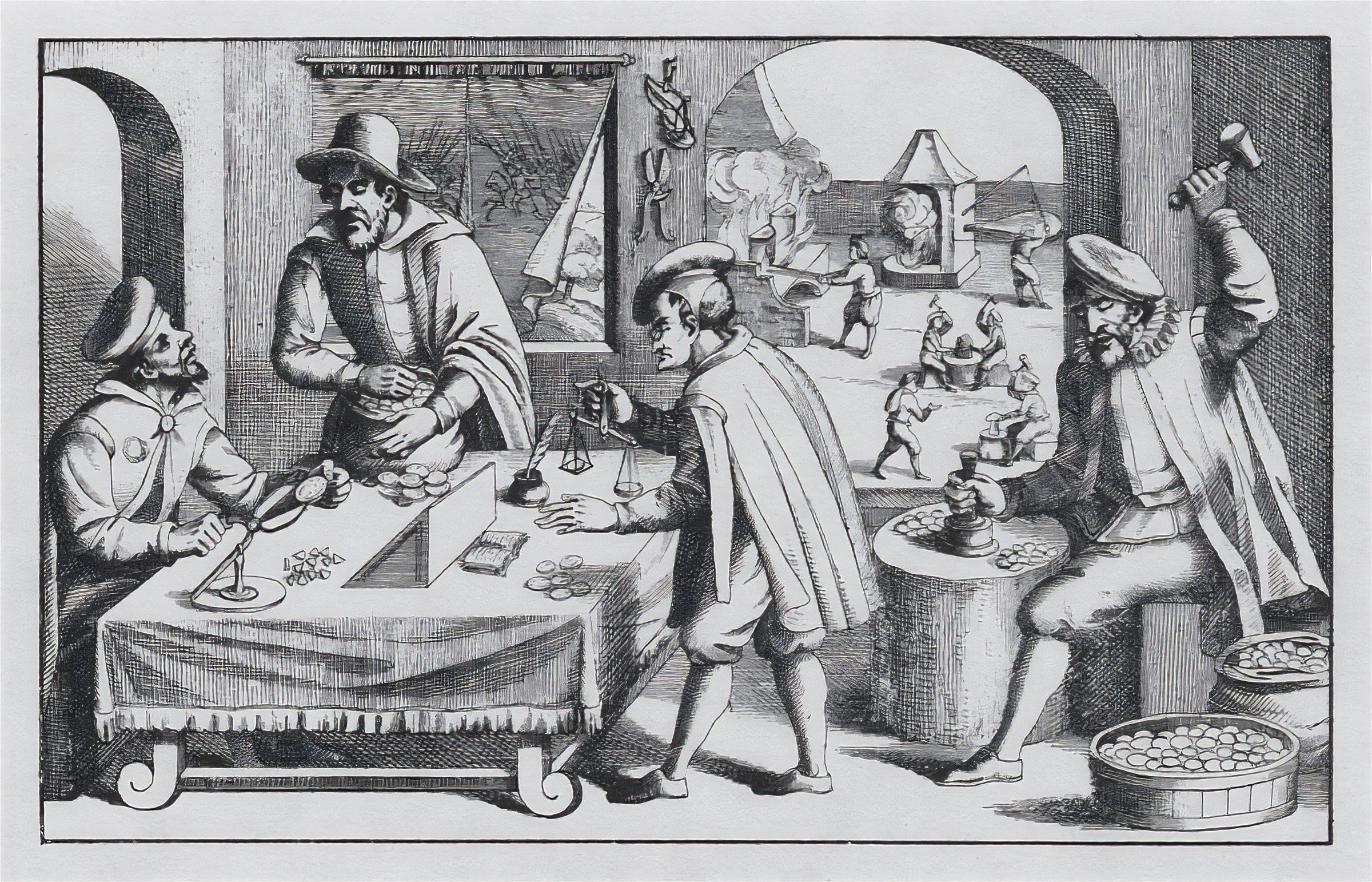
“Clipping coins in a Kipper mint”
Wikimedia Commons.
The Kipper und Wipperzeit of 1621 to 1623 [Wiki] was a direct consequence of princes and mints doing exactly what governments always do when they need money and cannot borrow it: they debased the currency.
The Thirty Years’ War started in 1618, and the Holy Roman Empire’s princes immediately faced a problem. War is expensive. Silver is finite. So the mints across the Empire began clipping, sweating, and debasing the small subsidiary coins that ordinary people used for daily transactions, flooding markets with copper-heavy pfennigs and kreutzers while hoarding the full-weight silver.
If you want to understand Gresham’s Law in its most brutal form, watch this play out. Bad money drives out good. People saved the honest silver and spent the garbage. Prices in nominal terms exploded. Contemporary accounts from Frankfurt and Augsburg document grain prices doubling and tripling between 1619 and 1623.
The real villain is the territorial mint system, which gave dozens of competing princes the legal power to set coin standards within their own borders. That fragmented monetary sovereignty created a race to the bottom. Each prince had every incentive to debase slightly more than his neighbor, because the first mover extracted real purchasing power before the market caught on.
This is currency debasement as taxation without legislation. The people who held wages and savings in subsidiary coin absorbed the loss. The princes who controlled the mints captured the seigniorage gain. No vote, no debate, no accountability.
Sound money advocates have been clear about the mechanism: when you hand governments monopoly power over coinage, they spend it. Every single time. The Kipper und Wipperzeit killed trade, wiped out savings across central Europe, and contributed to social instability that fed the war it financed. The policy destroyed the instrument it relied on.
Debasement never solves a fiscal crisis; it transfers it onto the population.
May 16, 2026
“Do not expect a quick fix or some magical solution”
On the social media site formerly known as Twitter, Eve Chipiuk points out that it’ll take more to get our governments out of the habit of kicking the can down the road than just change of faces at the top:
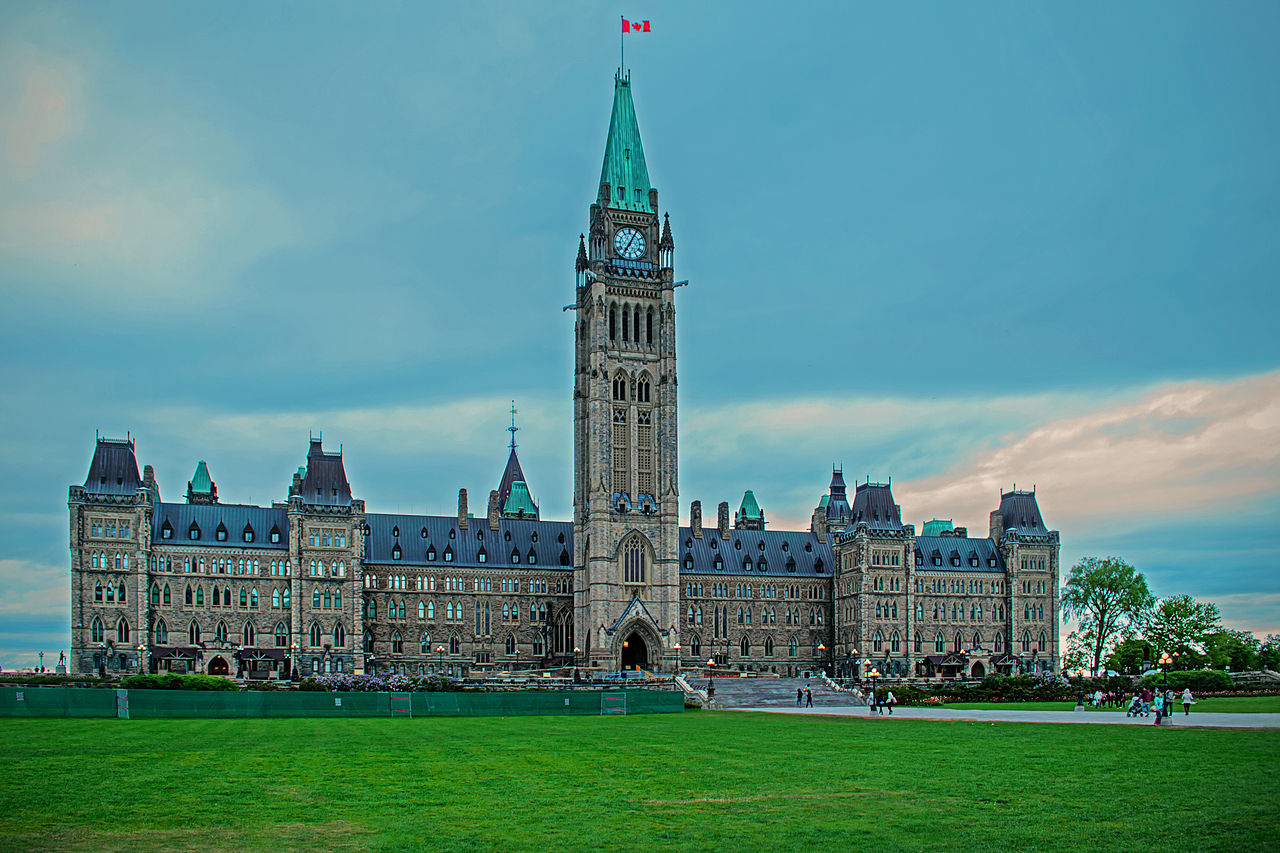
Parliament Hill in Ottawa.
Photo by S Nameirakpam via Wikimedia Commons.
No one said it would be easy. Nothing worth fighting for ever is.
Fighting powerful institutions is what I have done my entire life. It is not easy, but it is worth it because you know what is at stake.
This is also not a new problem. History has repeated this pattern before. “The first panacea for a mismanaged nation is inflation of the currency; the second is war. Both bring a temporary prosperity; both bring a permanent ruin. But both are the refuge of political and economic opportunists.” — Ernest Hemingway
Most do not want to give up an inch of their power or control because many have built their identity, influence, and livelihoods around those systems. Some have convinced the public that they know what is best for everyone else better than citizens know for themselves. Yet all you have to do is look around to see the lie. We are not better when people are divided, angry, fearful, and distracted, turning on each other instead of asking harder questions about the institutions and incentives driving the problems in the first place.
And if good people stop standing up, asking questions, and pushing back when something is wrong, those institutions only become more powerful and less accountable. That has been happening for a long time, which is exactly why many systems are so entrenched and disconnected from the people they are supposed to serve.
History repeatedly shows that when governments and institutions avoid addressing deeper structural problems, they rely on temporary measures, slogans, fear, distractions, and promises of quick fixes to maintain stability and public support. But eventually reality catches up, and and ordinary people bear the cost.
So do not expect a quick fix or some magical solution. Democracy, accountability, and freedom require informed citizens willing to stay engaged, stay principled, ask difficult questions, and do the hard work necessary to protect them.
Because in the end, what is more important to fight for than freedom, accountability, and the society we leave behind for future generations?
May 9, 2026
Argentina not in the news
On the social media site formerly known as Twitter, Martin Varsavsky illustrates the real situation in Argentina after Javier Milei was elected as opposed to the dystopian nightmare imagined by the western media:

“Argentine flag” by papajuan74 is licensed under CC BY 2.0 
 .
.
After more than two years of Milei, the international press still does not understand what is happening in Argentina.
The narrative abroad is “shock therapy, social pain, fragile coalition”. That frame misses the actual mechanism. Argentina did not have a budget problem. It had a printing problem. From 2003 to 2023 the central bank financed deficit after deficit until the peso lost 99 percent of its value against the dollar. Annual inflation hit 211 percent in 2023. Half the country was poor. That was the floor.
What changed is not vibes. It is arithmetic. The fiscal deficit was eliminated for the first time in 16 years. Monthly inflation fell from 25 percent to low single digits. The central bank stopped printing to fund the Treasury. Country risk dropped from over 2,500 basis points to a fraction of that. Argentine sovereign debt, which used to trade like a default option, began behaving like normal emerging market paper.
Critics say poverty rose. It did, briefly, because removing price controls and subsidies revealed the real prices of energy, transport and food that the state had been hiding with debt. Once measured honestly, poverty has been falling fast. Real wages are recovering. Mortgages in pesos are reappearing, something that had not been possible in a generation.
This matters beyond Argentina. It is the clearest live experiment in whether a developed-style economy can be rebuilt by pulling the state out of places it never belonged. Spain, Italy and France should be paying attention. A country does not get poor because it lacks resources. It gets poor because its political class learned to live off printing money and calling it social policy.
Argentina spent 80 years proving that. It is now spending two years proving the opposite.
March 18, 2026
The Korean War Week 91: The South Korean Economy is Dying – March 17, 1952
The Korean War by Indy Neidell
Published 17 Mar 2026There’s tension between allies as the ROK economy worsens and worsens, part of the problem being caused by all the South Korean currency printed to respond to the demand for it by the UN forces to buy “stuff”. Inflation is growing by leaps and bounds. However, at least some tension between enemies lessens, as one more point of the agenda at the Panmunjom Peace talks is settled.
00:55 Recap
01:40 The ROK Economy
06:40 Operation Mixmaster
07:39 Rotation Settled
10:31 Ridgway’s Recommendations
14:01 Overt or Covert POW Screening
15:54 Notes
16:22 Summary
16:34 Conclusionhttps://smithsonianassociates.org/tic…
(more…)
March 2, 2026
Remember this when they tell you grocery prices are high because of greedy corporations
On the social media site formerly known as Twitter, L. Wayne Mathison explains why the headline profits of grocery stores bear almost no relation to the far smaller actual profits in the grocery retail market:

“Leader IGA” by daryl_mitchell is licensed under CC BY-SA 2.0  .
.
The 32% Illusion: A Grocer’s View from Behind the Till
I used to own the IGA in Hamiota. Small town. Thin margins. Real bills. So when I hear that Loblaw Companies Limited is raking in “31–32% profit”, I don’t get angry. I get tired.
Here’s the move. Take a gross margin number. Call it profit. Add a dash of politics. Serve hot.
Gross margin is revenue minus cost of goods sold. That’s it. It doesn’t include payroll, hydro, insurance, property tax, refrigeration repairs at 2 a.m., shrink, theft, advertising, transport, interest, or the banker breathing down your neck. Net profit is what’s left after all of that. In grocery, that number floats around 2 to 3 percent in a good year. Some years less. Some years negative.
When I ran my store, payroll alone could swallow most of the gross margin. Then add freight. Then add utilities. Manitoba winters are not kind to freezers. Then add spoilage. Bananas do not care about your ideology. They rot on schedule.
People think grocers “set prices”. That’s half true at best. Suppliers raise costs. Fuel goes up. Wages rise. Carbon costs ripple through trucking and farming. You pass it on or you close. It’s arithmetic, not greed.
Now here’s the uncomfortable part. Food inflation hurts. It hurts seniors. It hurts young families. It hurts the clerk stocking shelves. But blaming a 30% “profit margin” is a shortcut. It feels good. It’s wrong.
Big chains make money on scale, pharmacy, cosmetics, financial services. Those categories carry higher margins than milk and bread. That lifts the consolidated gross margin number. It does not mean grocery aisles are printing cash.
We should argue about competition. We should argue about supply management. We should argue about taxes embedded at every step of the chain. Good. Let’s do that. But at least use the right numbers.
I spent years watching pennies. Grocers survive on volume and efficiency. A few cents per dollar is the game. Always has been.
If you want lower food prices, focus on input costs, transport, energy, regulation, and competition. Start there.
And before sharing the next viral graphic, ask one question: gross or net?
That single distinction separates outrage from reality.
November 11, 2025
How not to solve your housing affordability crisis
On the social media site formerly known as Twitter, Devon Eriksen explains why allowing fifty-year mortgages are not the solution that financial journalists seem to think they are:
Wendy O @CryptoWendyO
I don’t think a 50 year mortgage is bad.
It gives everyone more flexibility financially
You can pay a mortgage off early
Not sure how else to lower home costs in 2025Buyers: “How much will this house cost me?”
Sellers: “What’s your budget?”
Buyers: “Well, it was 500K, but with these new fifty year mortgages, I think it could stretch to million.”
Sellers: “I have an astonishing coincidence to report.”
Look, I don’t know exactly who’s retarded enough to need to hear this, but if you throw money at something, you get more of it.
Which means that if you subsidize demand, you get more demand.
And if you have the same supply, and more demand, price goes up.
This is how the federal Stafford Loan program made college a gateway to permanent debt slavery. Subsidize demand, price goes up.
The reason people don’t understand this is that most people are only smart enough to think about individuals, not populations.
They think if you have more money, you can buy more things, as if things come from the item store in a Japanese console RPG, where the store always has infinity stuff to sell you, and infinity money to buy your loot.
People who are capable of thinking about large groups quickly realize that money is just a way of distributing things.
Like, there’s a limited supply of things, and you’re just choosing who gets them. Having more money doesn’t make more things.
Except … it should, shouldn’t it?
Eventually?
Like, if apples get super expensive, because somebody invented a new kind of apple that’s so delicious that everyone wants them, then the price of those apples goes up, so more people start growing them.
So why doesn’t that work with houses and colleges?
Why don’t the super-inflated prices of those things inspire profit-minded people to make more?
It’s almost as if there were some sort of gatekeeper, whose permission you needed to make a house or a university.
But that’s impossible, because this is a totally capitalist country, so you can just do things, right?
Ian Runkle/Runkle of the Bailey chimes in:
Okay, let’s talk about 50 year mortgages.
First, let’s talk about what sets the price in a market where there’s more demand than supply. It’s set by what people can afford to pay, which means the payment/month.
What that means in practical terms is that the total price isn’t the limiter. It’s the monthly payment.
So, if X house is going for a price that has a 2500/month payment, the market is going to land total prices on a 2500/month payment.
So, increasing the mortgage terms makes things more affordable for about six months before the market adjusts. After that, it stops making it more affordable.
But “affordable” here doesn’t mean inexpensive. In fact, quite the opposite. Extending from a 30 year to a 50 year mortgage is likely to double the cost of credit.
But that’s before the prices adjust upward to “eat” the supposed affordability gains.
This doesn’t make houses more affordable, it makes them more expensive by far.
November 7, 2025
Milei – “If we don’t have [power], then the left will have it”
In Without Diminishment, Geoff Russ discusses Javier Milei’s recent podcast appearance and his demonstration that unlike a lot of theoretical libertarians, he understands the dynamics of political power:
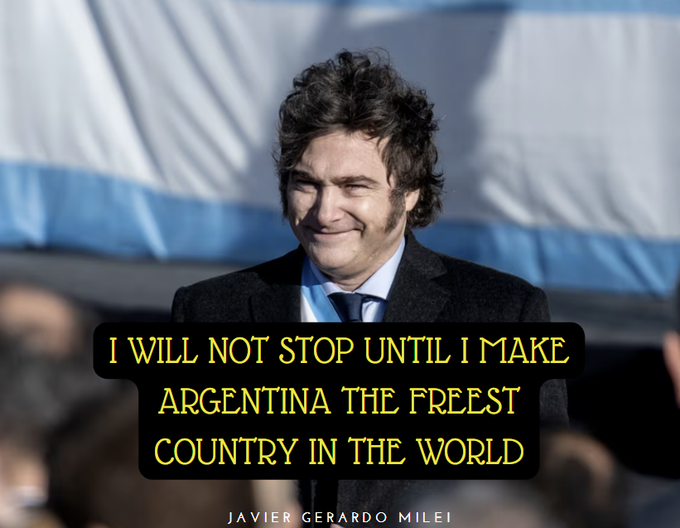
There are many liberals, libertarians and anarcho-capitalists who are really useless because all they do is criticise, let’s say, those of us who want to lead the world toward the ideas of freedom. And what they don’t realise is that power is a zero-sum game, and if we don’t have it, then the left will have it. Therefore, if you level your harshest criticism at those in your own ranks, you end up being subservient.
Have truer words ever been spoken by an English-speaking politician?
Argentine President Javier Milei’s words on the Lex Fridman podcast were a blunt reminder of something that many conservatives, particularly those in Canada, have chosen to forget.
Politics is the pursuit of political power and the chance to use it before your opponents can. Debates can be won, superb essays published, and quotes recycled from deceased politicians. Without power, however, it all amounts to nothing more than a glorified brainstorming session.
The thoughtful ideas and proposals go to waste if they lie stagnant in perpetual bickering opposition.
On October 26, Milei won a resounding victory in the legislative elections. His party, Liberty Advances, gained forty-two seats and smashed the hard-left Peronists who have dominated Argentina’s politics for more than half a century.
Milei is a fanatical believer in libertarian ideas, and has never pretended to be a moderate or incrementalist. He famously brandishes a chainsaw to represent his willingness to destroy the broken socialist status quo of Argentina.
Javier Milei at CPAC in National Harbor, Maryland 20 February, 2025.
Photo by Gage Skidmore via Wikimedia Commons.The rise of Milei has been a cultural battle for the soul of the country, and he is not shy about it. Milei leads a fresh, winning anti-Peronist coalition of forgotten and angry Argentines who want permanent, radical change.
It may be tempting to view Milei’s success as a pure affirmation of the appeal of libertarian ideology, but he is hardly Argentina’s first advocate of economic freedom. He succeeds because he is the opposite of a polite, centre-right reformer. Milei unapologetically embraces his place as a culture warrior seeking to remake the nation.
One of his targets is the institutional decadence and incompetence of the Peronist political machine. By swearing to snuff it out, Milei swept through traditional Peronist strongholds, whose voters had never considered voting for the formerly toothless Argentine opposition.
In Reason, Peter Suderman considers some of the lessons North Americans can learn from Milei’s stunning election victory:
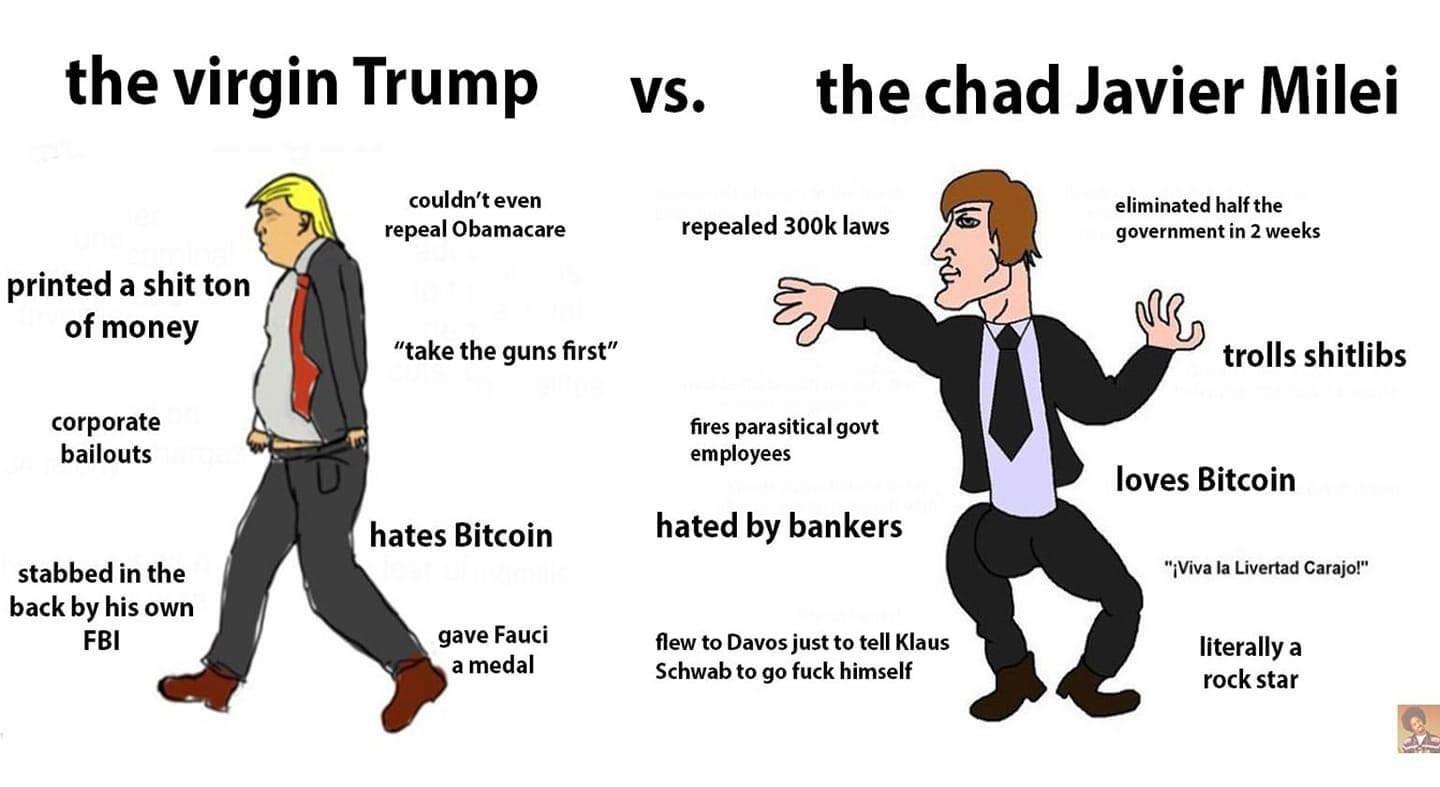
To understand why Democrats overperformed in this week’s elections, look to Argentina.
Last month, Argentinian president Javier Milei won an unexpectedly large electoral affirmation, as his party significantly outperformed expectations by more than doubling its congressional representation in what was widely seen as a referendum on his agenda.
Over the past two years, Milei, the world’s most libertarian national leader, has slashed spending, cut red tape, and made his top priority restoring economic order and prosperity to a country that has long been a socialist basket case. Critics warned that his policies would be destructive, destabilizing, and unpopular. But not only did he deliver the country’s first balanced budget in over a decade, he oversaw a radical decline in inflation — from 200 percent when he entered office down to 32 percent last month.
Despite warnings that the country would reject Milei’s brand of austerity, the country responded with a strong vindication of his policies. In a post-election analysis, The New York Times noted that Milei’s message was that only he offered a “path for a country that has undergone years of runaway inflation under high-spending populist governments”. The report pointed to Milei’s economic record to explain his party’s win: “Many Argentines had grown tired of prices swinging wildly from day to day and of a ruling class they considered to be corrupt and irresponsible”.
The same report said Milei’s outsized victory was “unexpected”. But perhaps it shouldn’t have been, because economic stability and low inflation are what voters the world over clearly want.
When voters swept President Donald Trump into office for the second time last fall, large majorities of his voters gave the economy poor marks and said their own family finances had worsened over the years. Under President Joe Biden, the American economy had been wracked by the biggest surge in inflation in forty years. American voters punished the party that was in power when that happened.
This was true all over the world. After the pandemic, inflation skyrocketed globally, and in election after election, voters rejected ruling parties.
Inflation and economic instability have long been political losers: Look at Ronald Reagan’s victory over Jimmy Carter in 1980, and his ensuing near-sweep of states in 1984 after taming a decade of out of control price hikes. The post-pandemic years have further reinforced this lesson.
Update: Undoctrination looks at Milei’s time in office so far.
Undoctrination
Published 6 Nov 2025Javier Milei just pulled off the impossible … again.
In Argentina”s 2025 “midterm” elections, Milei’s 4-year-old party, La Libertad Avanza, went from a tiny minority to the largest party in the lower house, ending socialist dominance in Congress. The election was widely viewed as a referendum on Milei’s shock therapy plan for Argentina. The results are in: Argentines want more freedom.
In this video we cover:
How Milei slashed inflation from 211% to 31.8% in just 2 years
The 34,000 government jobs cut, 10 agencies eliminated, and 672 deregulations that freed the economy during Milei’s first year in office
How the Buenos Aires rental market exploded after lifting controls
How Peronists lost their veto-proof majority — and what it means for the futureAnd we feature expert analysis from Marcos Falcone, Policy Analyst, Center for Global Liberal and Prosperity.
September 25, 2025
Streaming subscriptions rising far faster than official inflation rate
I haven’t been a regular TV watcher for a long time, but I still watch the Minnesota Vikings meaning that I need to pay for a streaming service … which has definitely been going up every year at a significantly higher-than-inflation rate. At The Honest Broker, Ted Gioia shows that this is now a very common thing indeed:
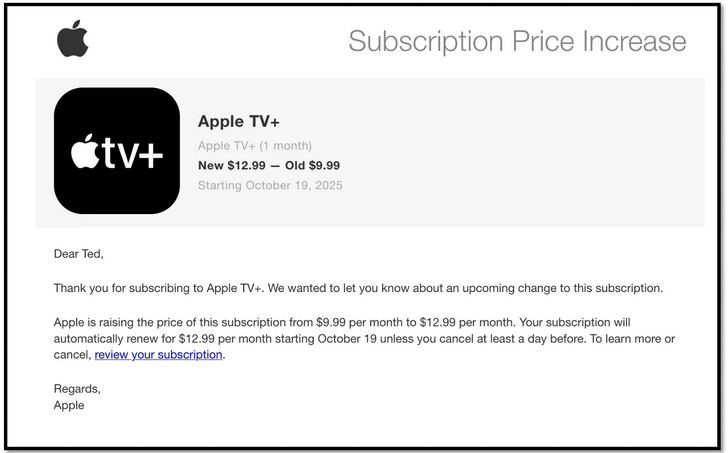
It’s not every day that I get an email from Apple. But yesterday the Cupertino leviathan reached out to me.
Can you guess why? Do they have some cool new gadget that will make my life better? Are they opening an Apple Store in my neighborhood? Does Tim Cook want to take me out to dinner?
None of the above. Apple is raising my subscription price for Apple TV by a whopping 30%.
Apple is not alone. The very next day, Disney announced a similar move.
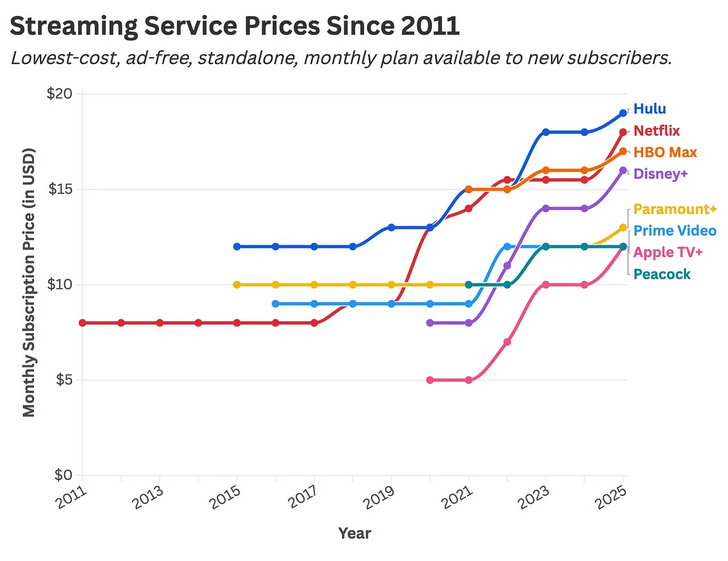
This is the fourth straight year that Disney+ has forced a price increase on viewers. The ad-free subscription price has almost tripled in just six years. During that same period, Disney’s movies have gone from bad to worse — but you pay more to stream them.
The company is truly tapping into its inner Scrooge McDuck. Inflation is just 3% now (according to official, if somewhat dubious, sources). But the ad-free subscription to Disney+ was jacked up 14% last year and is now getting another 19% boost.
Take a look at the larger picture, via this chart from Daniel Parris of Stat Significant (a friend of The Honest Broker). This stuff is reaching greed-is-good levels of abuse.
Meanwhile, the number of scripted shows commissioned by these streamers has dropped significantly. So the audience is asked to pay more for less.
July 23, 2025
Javier Milei is delivering “a man-made miracle” for Argentina
Niall Ferguson‘s thread on the social media site formerly known as Twitter, thanks to the Thread Reader App:
While the world fixates on Donald Trump’s populist cocktail of reciprocal tariffs and big, beautiful deficits, @JMilei is delivering a man-made miracle that should gladden the heart of every classical economist and quicken the pulse of all political libertarians.
@JMilei has brought monthly inflation down from 13% to 2%. The economy is now growing at an annual rate of 7%. Investors no longer shun Argentine bonds and stocks — indeed, they were among the best investments you could have made over the past two years. After a brief upward jump, the poverty rate has fallen from 42%, when Milei was elected, to 31%
These are astonishing feats. And they have ramifications that go far beyond South America. Free-market economics and political libertarianism are sometimes dismissed as a fad of the “neoliberal” 1980s, long ago superseded by the new populisms of the left and the right. Not so. The world has never seen a government more radically libertarian than @JMilei. But the amazing thing is not that it is working economically. The true miracle is that Milei’s shock therapy is working politically.
With his leather jacket and late ’60s mop top, @JMilei is part–rock star, part–mad professor, dancing, singing, and screaming his catch phrase: ¡Viva la libertad, carajo! — “Long live liberty, damn it!” It’s as if Joe Cocker had gone onstage at Woodstock and sung “I’ll Get By with a Little Help from My Friedman”. Never in the history of democracy has a tribune of the people won power this way.
July 21, 2025
Was Juan Perón a Fascist? The Cold War Origins of Peronism – W2W 037
TimeGhost History
Published 20 Jul 2025Was Juan Perón really a fascist, a socialist, or something entirely different? In this episode of War 2 War, we explore the rise of Peronism in post–World War II Argentina and how Perón tried to position his country between the superpowers of the Cold War.
Through labour reforms, nationalist rhetoric, media control, and brutal repression of dissent, Juan and Eva Perón created a powerful populist regime that borrowed ideas from both fascism and socialism, while claiming to reject both. From Argentina’s “Third Way” to its complicated ties with the US, USSR, and even Nazi fugitives, we examine the ideology, contradictions, and legacy of Peronist rule.
Was Peronism a unique form of authoritarian populism, or just another face of fascism?
Join us as we uncover the foundations of Argentina’s Cold War identity and the true political nature of Juan Perón.
(more…)
July 18, 2025
Argentina’s self-described anarcho-capitalist president
J.D. Tuccille says that Argentinian President Javier Milei may be the politician who has most successfully “defied the expectations of the chattering class” by not only winning the presidency but also by the completely unexpected turnaround of the national economy:
Drawing on official data, Reuters reports that Argentina’s “economic activity rose 7.7 per cent in April compared with the same month last year”. That was higher than expected and a welcome addition to news that the economy had grown by 5.8 per cent during the full first quarter relative to the same quarter the previous year. Early numbers put Argentina’s second-quarter growth at 7.6 per cent. By contrast, Canada’s economy grew at an annual 2.2 percent in the first quarter and the U.S. economy shrank a bit.
In equally encouraging news, Argentina’s “monthly inflation rate has fallen below two per cent for the first time in five years,” according to the Financial Times. That’s still high in North American terms, but Argentina’s governments have a history of wildly expanding the money supply to pay off debt and finance expenditures, resulting in inflation rates in the hundreds and even thousands per cent per year. Inflation slowed somewhat in recent years, but it was over 200 per cent in 2023 and Milei was elected on a promise to stabilize prices — even if it meant adopting the U.S. dollar as the country’s official currency.
Importantly, the poverty rate in Argentina has also fallen to 38.1 per cent of the population at the end of 2024 from 41.7 per cent when Milei took office. Again, that remains very high, but it’s an improvement in a country where politicians have long seemed committed to keeping people poor and dependent on the state.
This wasn’t supposed to happen. In a November 2023 open letter, over 100 economists warned that Milei’s economic “proposals, rooted in the economy of laissez-faire and which include controversial ideas such as dollarization and significant reductions in public spending, are fraught with risks that make them potentially very harmful to the Argentine economy and people”.
The economists — including such academic luminaries as Thomas Piketty and Jayati Ghosh — warned of havoc if Milei implemented his free-market plans. Voters weren’t impressed by the forecast of doom; they chose the self-described “anarcho-capitalist” economist and his upstart political coalition over the standard-bearer of the dominant Justicialist Party.
The Justicialists have been the strongest force in Argentine politics since their launch in the 1940s by Juan Peron. Peron served as a military observer in Europe and apparently combined the worst ideas he encountered into a peculiarly Argentine ideology he called “justicialism”, better known as Peronism. At its heart, the ideology drops the pretense of any practical difference between socialism and fascism and promotes a brutal mélange of statist economic schemes. This means that, while most property and business activity is in private hands, it’s subject to government dictates, distortions, and control.
July 12, 2025
Noah Smith on how surprisingly well free market policies are working in Argentina
In the headline, you should read the unstated “surprising to far too many mainstream economists and political commentators”, but full credit to Noah Smith for admitting that Milei’s radical agenda has started to make life much better for ordinary Argentinians:

Javier Milei at CPAC in National Harbor, Maryland 20 February, 2025.
Photo by Gage Skidmore via Wikimedia Commons.
So to be clear, when I say that criticism of free markets has been overdone, I’m partly talking to myself. A couple of months ago, horrified by Trump’s tariff policies, I wrote an apology to libertarians, admitting that I had failed to see the political usefulness of their project in terms of maintaining economic sanity on the Right.
But it’s not just the political benefits of free markets that have been undersold; I think the purely economic advantages are also too often ignored.
Exhibit A is Javier Milei’s track record in Argentina. A year and a half ago, when Milei was elected President of Argentina, a bunch of left-wing economists warned darkly that his radical free-market program would lead to economic devastation:
The election of the radical rightwing economist Javier Milei as president of Argentina would probably inflict further economic “devastation” and social chaos on the South American country, a group of more than 100 leading economists has warned … [S]ignatories include influential economists such as France’s Thomas Piketty, India’s Jayati Ghosh, the Serbian-American Branko Milanović and Colombia’s former finance minister José Antonio Ocampo …
The letter said Milei’s proposals – while presented as “a radical departure from traditional economic thinking” – were actually “rooted in laissez-faire economics” and “fraught with risks that make them potentially very harmful for the Argentine economy and the Argentine people” … [T]he economists warned that “a major reduction in government spending would increase already high levels of poverty and inequality, and could result in significantly increased social tensions and conflict.”
“Javier Milei’s dollarization and fiscal austerity proposals overlook the complexities of modern economies, ignore lessons from historical crises, and open the door for accentuating already severe inequalities,” they wrote.
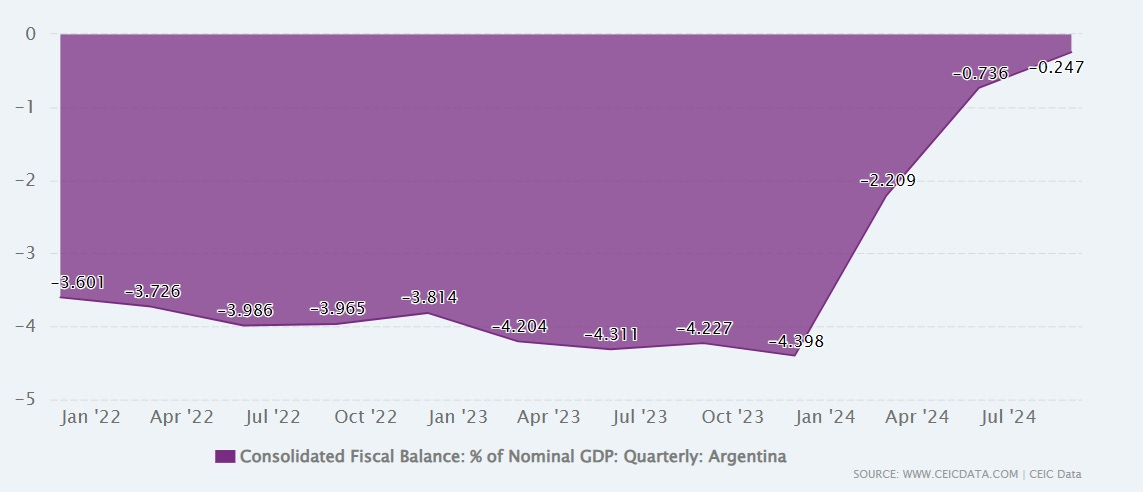
Milei won anyway. His first big policy, and the one the lefty economists fretted about the most, was deep fiscal austerity. Argentina’s long-standing economic model, created by dictator Juan Peron in the 1950s, involved a large and complex array of public works projects and subsidies for various consumer goods like energy and transportation. Milei slashed many of these, as well as cutting pensions, civil service employment, and transfers to provinces. Overall, he cut public spending by about 31%, resulting in a near-total elimination of Argentina’s chronic budget deficit:
The point of all this cutting wasn’t just to remove state intervention in the economy — it was to stop inflation. Basically, macroeconomic theory says that if deficits are high and persistent enough, then they convince everyone that the government will eventually inflate its debt away by printing money (which becomes a self-fulfilling prophecy). And most or all countries that experience hyperinflation end up escaping it only when they get their fiscal house in order. Perpetual deficits were part of Argentina’s “Peronist” system, and it’s probably a good bet that this has been responsible for the periodic bouts of hyperinflation that it experiences.
[…]
But still, Milei’s success so far should make us somewhat more confident about free-market policies — especially when we evaluate them against the new socialist ideas that have been gaining currency in the U.S. In the past, socialists and other left-leaning economic thinkers advocated central planning and nationalization of industry; in recent years, they have taken to calling for expansion of the state through fiscal policy, mixing macroeconomic justifications with micro. At all times, they call for deficit-financed expansion of social programs; when fiscal hawks want to tame the deficits, the lefties warn of the short-term macroeconomic harms of austerity.
If you’re always more terrified of austerity than you are of deficits, expansion of the state — and of the deficit — becomes a one-way ratchet. This approach is very different than Keynesianism, which advocates stimulus to overcome recessions, followed by austerity during boom times. You’ll recognize it as bearing a distinct similarity to MMT; that pseudo-theory has largely fallen out of favor, but there are plenty of more respectable progressive types whose ideas nonetheless have a lot of this “macroleftist” flavor.