… The truest reason I love The King’s Head is that William Cobbett once gave a lecture there: an event commemorated by a nice print on the wall of the man — in red jacket, white britches and black boots, all properly Georgian — and a bit of accompanying biographical text.
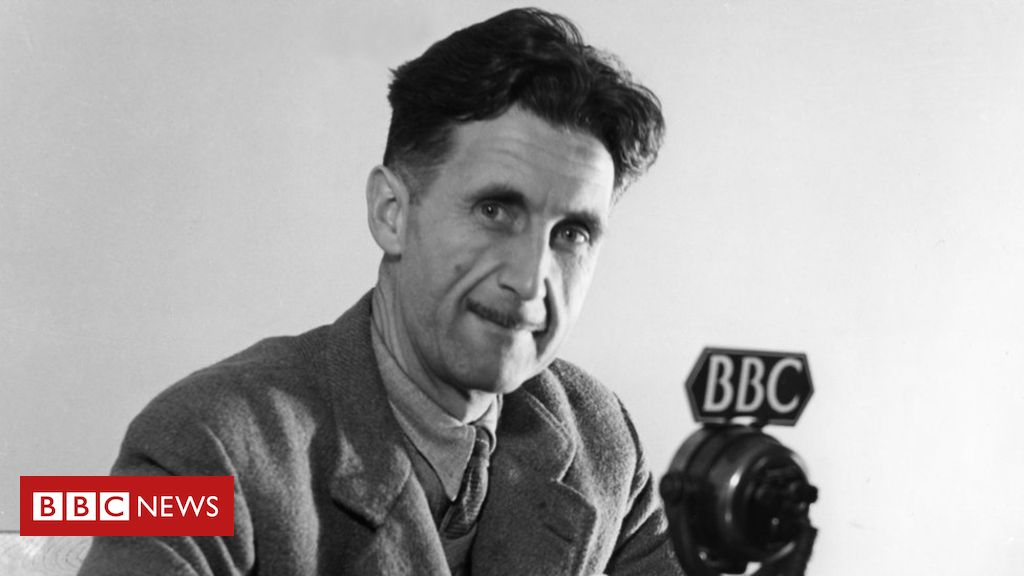
Cobbett was a scrapper on the same majestic scale as our Henry V and our Horatio, except he dished it out to Vested Interest rather than Jean-Pierre Foreigner. He is the faded star of the British Awkward Squad (Capt. Jon. Swift; Vice Capt. Geo. Orwell) and he needs a boost. He needs a blue plaque on every place he ever visited. In his long life — he was born in 1763 and died in 1835 — Cobbett was a farmer, Tory, soldier, Radical, MP, agony uncle (his books include Advice to Young Men), and the founder of Hansard.
His obituary in The Times, after categorising him as a “self-taught peasant”, declared Cobbett “by far the most voluminous writer that has ever lived for centuries”. The funniest, too: when some town council somewhere banned his anti-Malthusian play Surplus Population, he riposted with a drama entitled Bastards in High Places.
Above all, though, Cobbett was the champion of the rural poor, the village labourer and the small farmer. He was their one true tribune. He spoke at The King’s Head in 1820 because country folk were suffering a triple wham from agricultural depression, enclosure and the rise of agri-business. Or, to precis, “Hodge” (his name for the generic farm worker) was low-waged or unwaged and deprived of the bits of land he had once enjoyed under commoner’s rights.
Cobbett railed against “The Thing” (the capitalist, manufactory system) and the centrifugal, corrupting force of smoky London (“The Wen”, in Cobbettian). But he was no bloviator: he was a farm boy, and hence entirely empirical and properly pragmatic. He spent a decade travelling around the English sticks to discover the true state of affairs. His descriptions of his horseback journeys were published in 1830 as Rural Rides, the first sociological study of the English countryside.
No dry-as-dust tome by the way, the Rides: it brims with pinned-to-the-specimen-board descriptions of people and places, nature, wit. Cobbett knew beauty and, the proper Englishman that he was, he loved horses:
The finest sight in England is a stage coach ready to start. A great sheep or cattle fair is a beautiful sight; but in the stage coach you see more of what man is capable of performing. The vehicle itself, the harness, all so complete and so neatly arranged; so strong and clean and good. The beautiful horses, impatient to be off. The inside full and the outside covered, in every part with men, women, children, boxes, bags, bundles. The coachman taking his reins in hand and his whip in the other, gives a signal with his foot, and away go, at the rate of seven miles an hour.
One of these coaches coming in, after a long journey is a sight not less interesting. The horses are now all sweat and foam, the reek from their bodies ascending like a cloud. The whole equipage is covered perhaps with dust and dirt. But still, on it comes as steady as the hands on a clock.
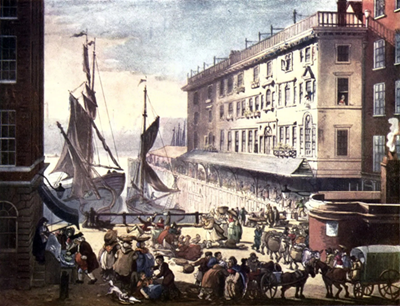
Speaking at The King’s Head coaching inn in Monmouth must have been the dream gig for Cobbett the horseman.
John Lewis-Stempel, “Why Britain needs a peasants’ revolt”, UnHerd, 2020-08-06.
April 10, 2026
QotD: William Cobbett
March 13, 2026
Argentina shedding decades of mal-investment in uncompetitive industries
Argentine President Javier Milei didn’t promise an economic revival for all of Argentina, because significant chunks of the Argentine economy were invested in low-profit or even loss-making industries as the country followed “traditional” South American economic advice. Tim Worstall celebrates some of the belated losses in those deadweight areas of the economy:
Argentina has, for decades now, been making itself poorer by following — effectively — fascist economic policy. That whole process of trying to make everything at home, not importing, being self-reliant in manufactures and so on. The effect being that everything is made by companies of sub-optimal size and therefore consumers can only gain access to expensive shite.
So along comes a liberal — Milei — who lets consumers buy what they wish to buy from whoever, whereever. The result is that those inefficient, expensive, manufacturing firms close down as people buy the better, cheaper, stuff from abroad. The people are better off because they get better, cheaper, stuff. Not that expensive shite from the domestic producers.
Now, true, those jobs go. But those workers can go and do something else. Which they will too. In fact, they are — the unemployment rate is falling.
So, who loses out here? Obviously, the domestic capitalists, the people who own the now bust factories. Which, well, the correct reaction is probably Har Har. If your wealth is based upon producing expensive shite your customers are forced to buy then why shouldn’t we celebrate when you lose the lot?
We can — and should — take our analysis that one step further too. If the absence of the trade restrictions harms the domestic capitalists then who benefitted from the trade restrictions? The domestic capitalists, obviously. Which is how that infant industry protection, that insistence upon self-reliance, how fascist economics always does work out — the people who benefit are the domestic capitalists. And why in buggery would we want to protect them from the effects of free trade?
February 21, 2026
QotD: Warren G. Harding’s successful depression-breaking policies
One is viewed as among America’s greatest presidents; the other perhaps the worst of all. One is hailed as a savior; the other as a failure. One is given memorials to enshrine his name for all time; the other is pushed into the sea of forgetfulness.
Driven by academia, this is where American history has placed Franklin Delano Roosevelt (in office 1933-1945) and Warren Gamaliel Harding (in office 1921-1923). It is impossible to see FDR absent a “great presidents” ranking; it is likewise impossible to see Harding absent the lowest rungs.
Both men came into office with an economy in tatters and both men instituted ambitious agendas to correct the respective downturns. Yet their policies were the polar opposite of one another and, as a result, had the opposite effect. In short, Harding used laissez faire-style capitalism and the economy boomed; FDR intervened and things went from bad to worse.
Despite these clear facts, in C-SPAN’s latest poll ranking US presidents, FDR finished third in the rankings, while Harding finished 37th. Surveying how both handled the economy, scholars ranked FDR third in that category, while Harding came in at 32. This is a tragedy of history.
America in 1920, the year Harding was elected, fell into a serious economic slide called by some “the forgotten depression“. Coming out of World War I and the upheavals of 1919, the economy struggled to adjust to peacetime realities, falling into a serious slump.
The depression lasted about 18 months, from January 1920 to July 1921. During that time, the conditions for average Americans steadily deteriorated. Industrial production fell by a third, stocks dropped nearly 50 percent, corporate profits were down more than 90 percent. Unemployment rose from 4 percent to 12, putting nearly 5 million Americans out of work. Small businesses were devastated, including a Kansas City haberdashery owned by Edward Jacobson and future president Harry S. Truman.
The nation’s finances were also in shambles. America had spent $50 billion on the Great War, more than half the nation’s GNP (gross national product). The national debt jumped from $1.2 billion in 1916 to $26 billion in 1919, while the Allied Powers owed the US Treasury $10 billion. Annual government spending soared more than twenty-five times, from around $700 million in 1916 to nearly $19 billion in 1919.
Harding campaigned on exactly what he wanted to do for the economy – retrenchment. He would slash taxes, cut government spending, and roll back the progressive tide. He would return the country to fiscal sanity and economic normalcy.
“We need a rigid and yet sane economy, combined with fiscal justice,” he said in his inaugural address, “and it must be attended by individual prudence and thrift, which are so essential to this trying hour and reassuring for our future”.
The business community expressed excitement about the new administration. The Wall Street Journal headlined on Election Day, “Wall Street sees better times after election”. The Los Angeles Times headlined the following day, “Eight years of Democratic incompetency and waste are drawing rapidly to a close”. Others read “Harding’s Advent Means New Prosperity” and “Inauguration ‘Let’s Go!’ Signal to Business”.
The day after Harding’s inauguration, the Times editors predicted “good times ahead”, writing, “The inauguration yesterday of President Harding and the advent of an era of Republicanism after years of business harassment and uncertainty under the Democratic regime were hailed” by the nation’s business leaders. I. H. Rice, the president of the Merchants and Manufacturers Association, told the press, “Good times are now ahead of us. Prosperity is at our door. We are headed toward pre-war conditions … Business men are well pleased with President Harding’s selections for his Cabinet and by the caliber of men he has chosen we know that he means business”.
Under Harding and his successor, Calvin Coolidge, and with the leadership of Andrew Mellon at Treasury, taxes were slashed from more than 70 percent to 25 percent. Government spending was cut in half. Regulations were reduced. The result was an economic boom. Growth averaged 7 percent per year, unemployment fell to less than 2 percent, and revenue to the government increased, generating a budget surplus every year, enough to reduce the national debt by a third. Wages rose for every class of American worker. It was unparalleled prosperity.
Ryan S. Walters, “The Two Presidents Whose Economic Policies Are Most Misunderstood by Historians”, Foundation for Economic Education, 2022-03-05.
January 5, 2026
Friedman on Orwell
On his Substack, David Friedman considers some of the things that George Orwell was mistaken about in his non-fiction writings:
It cannot be said too often – at any rate, it is not being said nearly often enough – that collectivism is not inherently democratic, but, on the contrary, gives to a tyrannical minority such powers as the Spanish Inquisitors never dreamed of. (George Orwell, The Observer, April 9, 1944)
George Orwell got some things right; unlike most political partisans, he saw the problems with the position he supported. He also got quite a lot of things wrong. The quote is from Orwell’s review of two books, The Road to Serfdom by Friedrich Hayek and The Mirror of the Past by K. Zilliacus, a left-wing writer and politician. The conclusion of the review is that Hayek is right about what is wrong with socialism, Zilliacus is right about what is wrong with capitalism, hence that “the combined effect of their books is a depressing one”.
But Zilliacus was wrong about capitalism, as was Orwell, who wrote:
But he [Hayek] does not see, or will not admit, that a return to “free” competition means for the great mass of people a tyranny probably worse, because more irresponsible, than that of the State. The trouble with competitions is that somebody wins them. Professor Hayek denies that free capitalism necessarily leads to monopoly, but in practice that is where it has led, and since the vast majority of people would far rather have State regimentation than slumps and unemployment, the drift towards collectivism is bound to continue if popular opinion has any say in the matter. (“As I Please”, pp.117-119)1
The problem is that Orwell, like many of his contemporaries (and ours), did not understand economics and thought he did. Since he wrote we have had extensive experience with free competition, if not as free as Hayek would have wanted, and the result has not been the nightmare that Orwell expected. “The trouble with competitions is that somebody wins them” sounds right only if you don’t actually understand the logic of a competitive market. In most industries organizational diseconomies of scale, the effect of more layers between the head office and the factory floor, limit the size of the firm to something considerably below the size of the market for what the firm produces. In some fields, such as restaurants or barber shops, the result is an industry with thousands of firms, in some five or ten, in only the rare case of a natural monopoly can one large firm outcompete all of its smaller competitors.
The effect of free competition is not the only thing that Orwell got wrong. Consider his essay on Kipling.2 He gets some things right, realizes that Kipling is not a fascist, indeed less of one than most moderns, and recognizes his talent:
During five literary generations every enlightened person has despised him, and at the end of that time nine-tenths of those enlightened persons are forgotten and Kipling is in some sense still there.
But he gets quite a lot wrong. In arguing that Kipling misunderstood the economics of imperialism, Orwell writes:
He could not understand what was happening, because he had never had any grasp of the economic forces underlying imperial expansion. It is notable that Kipling does not seem to realize, any more than the average soldier or colonial administrator, that an empire is primarily a money-making concern.
In explaining his own view of the logic of empire, what he thought Kipling was missing, Orwell writes:
We all live by robbing Asiatic coolies, and those of us who are “enlightened” all maintain that those coolies ought to be set free; but our standard of living, and hence our “enlightenment”, demands that the robbery shall continue.3
Britain let go of its empire, starting with India. British standards of living did not collapse; by the time all of the colonies were independent, the average real wage in the UK was 50% higher than when Orwell wrote. He could not know the future but he could observe that Switzerland, before the war, was richer than England, Denmark, with no significant colonies, almost as rich, Portugal, with an enormous African empire, much poorer. Whether Britain ran its empire at a net profit or a net loss is, I think, still an open question, but Orwell’s view of colonialism is strikingly inconsistent with the observed effects of decolonization.
Economics is not all that Orwell got wrong about Kipling; he badly underestimated the quality of Kipling’s work, due to having read very little of it. The clearest evidence is Orwell’s description of The Light that Failed as Kipling’s “solitary novel”. Kipling wrote three novels, of which that is by a good margin the worst. Orwell not only had not read Kim, Kipling’s one world class novel, he did not know it existed. In a recent post I listed eighteen works by Kipling that I liked. Orwell mentions only one of them.
- That free capitalism would ultimately fail was still Orwell’s view in 1947:
In North America the masses are contented with capitalism, and one cannot tell what turn they will take when capitalism begins to collapse (“Toward European Unity“)
- Discussed in more detail in an earlier post.
- As late as 1947, Orwell wrote:
The European peoples, and especially the British, have long owed their high standard of life to direct or indirect exploitation of the coloured peoples. (“Toward European Unity“)
December 13, 2025
Misunderstanding the causes of wealth
As most economists could point out, there’s no point asking what are the causes of poverty, because poverty is the default condition. Getting people out of poverty, that is a much more interesting discussion. Tim Worstall responds to a recent video from someone who clearly doesn’t understand where wealth comes from:
From this video here. Given that Grace [Blakeley] herself posts it she must approve the content.
Because the way that capitalism generates prosperity for some is by generating misery for others. You cannot have universal prosperity in a capitalist system. Just think about, like, this phone. What has happened for me to be able to hold this phone in my hands right now? A bunch of kids in the Democratic Republic of the Congo, at gunpoint, have been sent to scratch coltan out of the ground …
So, first thought. If the world, the economy, is a zero sum game then yes, we can only have some prosperous if others are not — some can only have more pie if others have less. On the other hand if we know how to bake the pie bigger then all can have more at the same time.
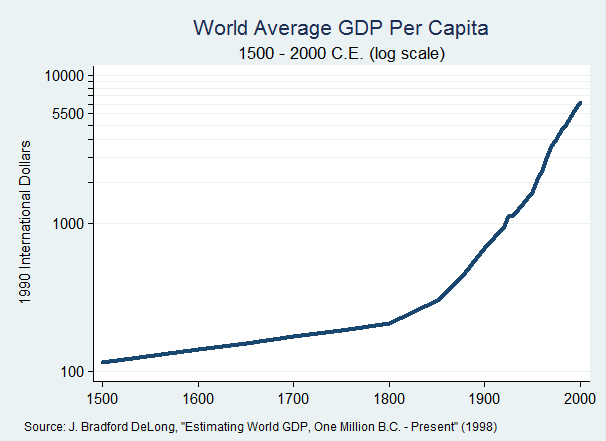
So, do we know how to make the pie bigger?
That source of Brad DeLong means yes, this is correct. Where’s that inflexion point, that bend in the curve? About where we start doing capitalism with free markets. As Marx, K himself pointed out capitalism is really very productive.
OK, so we know how to increase the size of the pie, it is possible for all to gain. It is not necessary for some to get less in order for others to gain more. The central contention is wrong. Provably, obviously, wrong.
Oh, sure, sure, it could work out that we take stuff off others in order to feed some. You know, say taxing child carers in order to pay train drivers massive salaries, as we do. But it’s not in fact necessary.
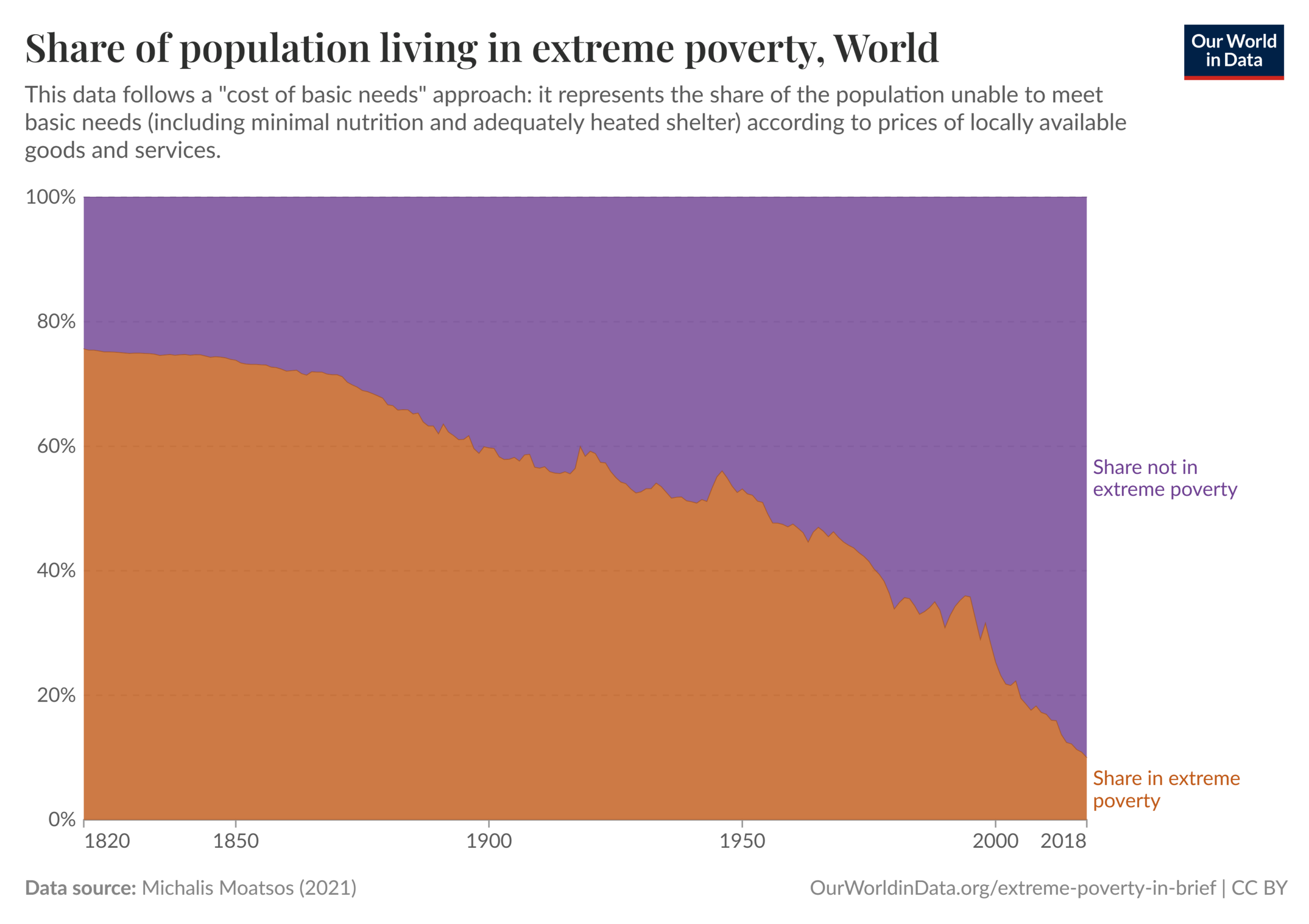
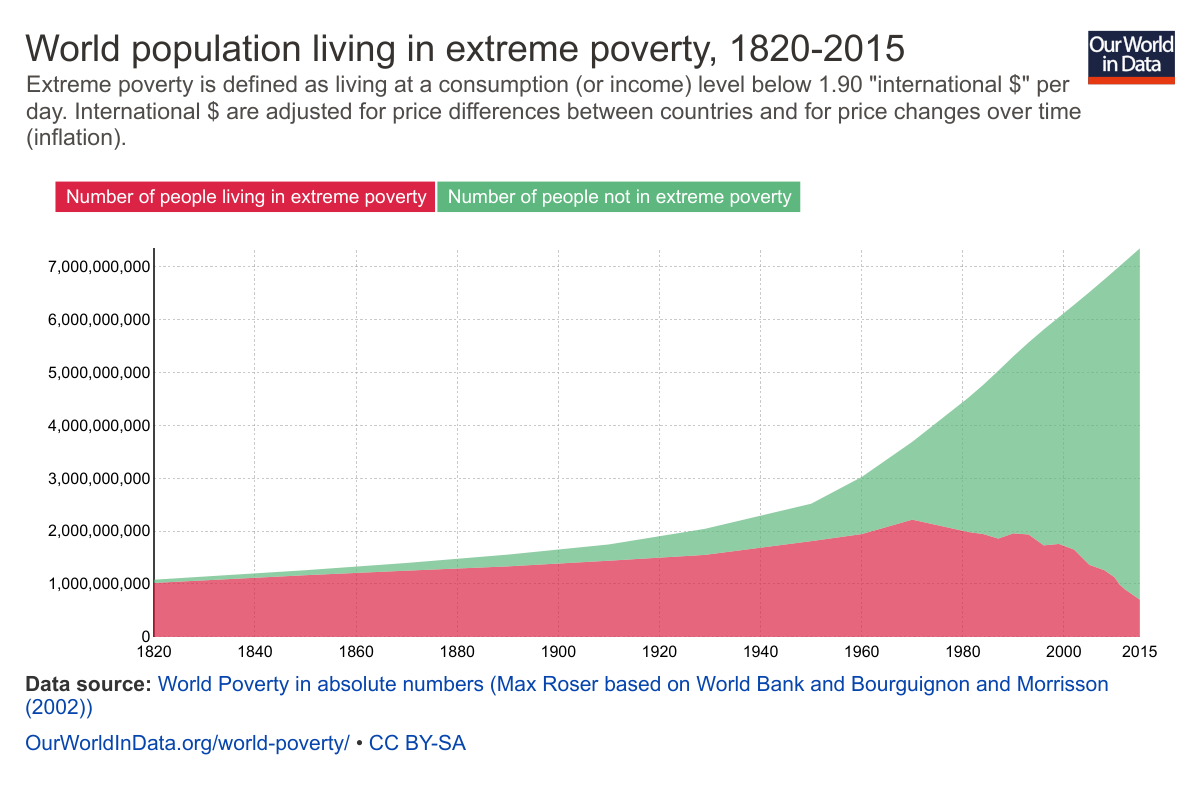
We can also check this another way:
So, lots and lots have become better off in this period of capitalism. Sure, sure, we should do better as a civilisation, we want all to do so. But while so many have got better off no, it is not possible to say that this has been done at the expense of those in extreme poverty. Because extreme poverty itself is set at the subsistence level. If you take stuff off the extreme poor then they die — that’s what subsistence level means. So that majority of humanity has not got rich by nicking it off the extreme poor. Because if they had there would be no extreme poor as they’d all be dead.
So, the overall claim is simply wrong. But it’s also wrong in specifics.
September 25, 2025
David Friedman on markets, governments and whether we need either?
Adam Smith Institute
Published 16 May 2025When markets go awry, who is to blame? Some blame greedy profiteers, whilst others blame governments for tinkering with incentives and supply chains. Where does the truth lie? And what role should the government play when markets go wrong?
Professor David Friedman is a physicist, leading free-market economist and Professor Emeritus of law at Santa Clara University. The son of Nobel Prize-winning economist Milton Friedman, David has authored many textbooks on free-market and libertarian theory. In 1973, he published The Machinery of Freedom, which has been ranked by Liberty magazine as one of the “Top Ten Best Libertarian Books” of all time.
TIMESTAMPS
0:00 – Intro
1:00 – What is a market failure?
2:44 – Restaurant analogy
4:15 – Negative externalities
5:00 – Positive externalities
5:50 – Malls
6:55 – Radio
7:40 – Price System
8:48 – Why most economists aren’t libertarians?
9:26 – Government action is a political market
12:30 – Secure property rights for future benefits
15:27 – Stalin
16:15 – Military examples
18:20 – Teaching
19:47 – Desert example
20:55 – Conclusion
22:19 – End
July 12, 2025
Noah Smith on how surprisingly well free market policies are working in Argentina
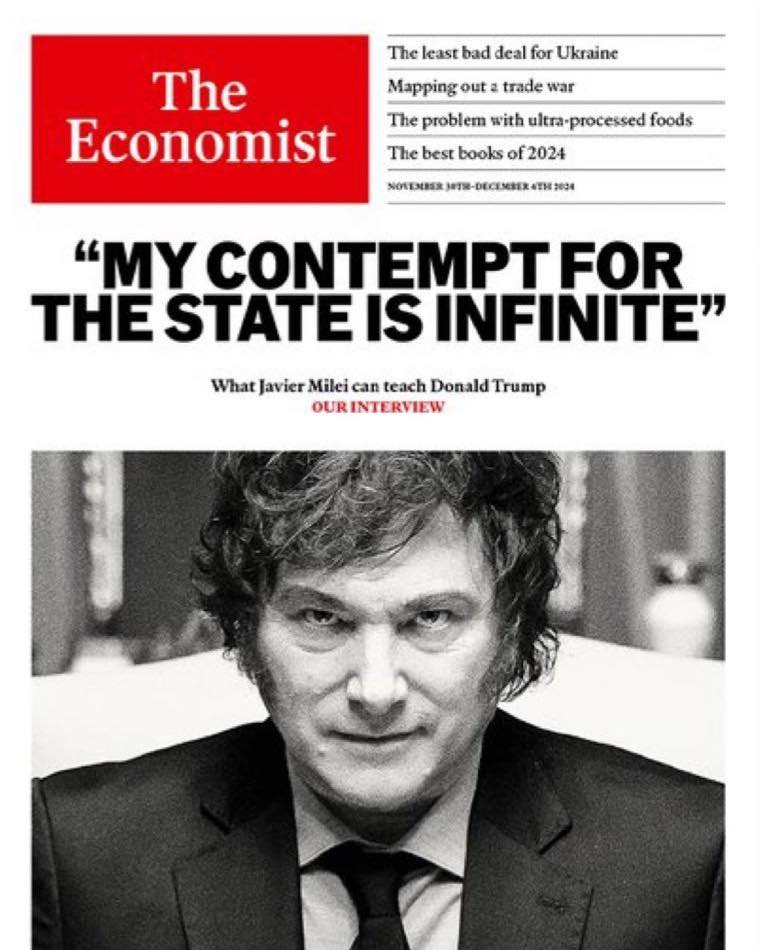
In the headline, you should read the unstated “surprising to far too many mainstream economists and political commentators”, but full credit to Noah Smith for admitting that Milei’s radical agenda has started to make life much better for ordinary Argentinians:

Javier Milei at CPAC in National Harbor, Maryland 20 February, 2025.
Photo by Gage Skidmore via Wikimedia Commons.
So to be clear, when I say that criticism of free markets has been overdone, I’m partly talking to myself. A couple of months ago, horrified by Trump’s tariff policies, I wrote an apology to libertarians, admitting that I had failed to see the political usefulness of their project in terms of maintaining economic sanity on the Right.
But it’s not just the political benefits of free markets that have been undersold; I think the purely economic advantages are also too often ignored.
Exhibit A is Javier Milei’s track record in Argentina. A year and a half ago, when Milei was elected President of Argentina, a bunch of left-wing economists warned darkly that his radical free-market program would lead to economic devastation:
The election of the radical rightwing economist Javier Milei as president of Argentina would probably inflict further economic “devastation” and social chaos on the South American country, a group of more than 100 leading economists has warned … [S]ignatories include influential economists such as France’s Thomas Piketty, India’s Jayati Ghosh, the Serbian-American Branko Milanović and Colombia’s former finance minister José Antonio Ocampo …
The letter said Milei’s proposals – while presented as “a radical departure from traditional economic thinking” – were actually “rooted in laissez-faire economics” and “fraught with risks that make them potentially very harmful for the Argentine economy and the Argentine people” … [T]he economists warned that “a major reduction in government spending would increase already high levels of poverty and inequality, and could result in significantly increased social tensions and conflict.”
“Javier Milei’s dollarization and fiscal austerity proposals overlook the complexities of modern economies, ignore lessons from historical crises, and open the door for accentuating already severe inequalities,” they wrote.
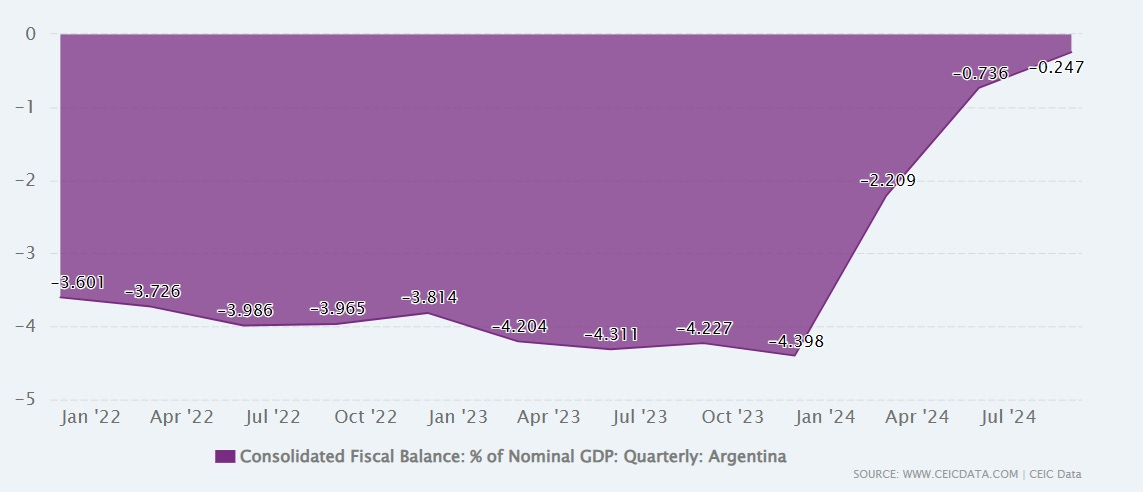
Milei won anyway. His first big policy, and the one the lefty economists fretted about the most, was deep fiscal austerity. Argentina’s long-standing economic model, created by dictator Juan Peron in the 1950s, involved a large and complex array of public works projects and subsidies for various consumer goods like energy and transportation. Milei slashed many of these, as well as cutting pensions, civil service employment, and transfers to provinces. Overall, he cut public spending by about 31%, resulting in a near-total elimination of Argentina’s chronic budget deficit:
The point of all this cutting wasn’t just to remove state intervention in the economy — it was to stop inflation. Basically, macroeconomic theory says that if deficits are high and persistent enough, then they convince everyone that the government will eventually inflate its debt away by printing money (which becomes a self-fulfilling prophecy). And most or all countries that experience hyperinflation end up escaping it only when they get their fiscal house in order. Perpetual deficits were part of Argentina’s “Peronist” system, and it’s probably a good bet that this has been responsible for the periodic bouts of hyperinflation that it experiences.
[…]
But still, Milei’s success so far should make us somewhat more confident about free-market policies — especially when we evaluate them against the new socialist ideas that have been gaining currency in the U.S. In the past, socialists and other left-leaning economic thinkers advocated central planning and nationalization of industry; in recent years, they have taken to calling for expansion of the state through fiscal policy, mixing macroeconomic justifications with micro. At all times, they call for deficit-financed expansion of social programs; when fiscal hawks want to tame the deficits, the lefties warn of the short-term macroeconomic harms of austerity.
If you’re always more terrified of austerity than you are of deficits, expansion of the state — and of the deficit — becomes a one-way ratchet. This approach is very different than Keynesianism, which advocates stimulus to overcome recessions, followed by austerity during boom times. You’ll recognize it as bearing a distinct similarity to MMT; that pseudo-theory has largely fallen out of favor, but there are plenty of more respectable progressive types whose ideas nonetheless have a lot of this “macroleftist” flavor.
December 17, 2024
QotD: Capitalism is a combination of laziness, stupidity, and greed
… But we can approach this the other way too, looking at capitalism rather than engineering. As Adam Smith didn’t quite say (but as I do, often) capitalists are lazy, stupid and greedy. Finding that new way to make money is really difficult. So, very few try. Once someone does try and find then all the lazy — and greedy, did I mention that? — capitalist bastards copy what is being done. This hauls vast amounts of capital into that area, competition erodes the profits being made by the pioneer and the end result is that it’s consumers who make out like bandits. The result (here) is that the entrepreneur makes 3% or so of the money and the consumers near all the rest. This is the very thing that makes this capitalist and free market thing work.
Tim Worstall, “Folks Are Copying SpaceX – That’s How Capitalism Works”, It’s all obvious or trivial except …, 2024-09-16.
September 17, 2024
Unbearable anti-humanism
Tim Worstall responds to a recent dispatch-from-dystopia from Christopher Ketcham, decrying the “Unbearable Anthropocentrism” he sees in the world:
No idea who Ketcham is built then he doesn’t know who I am so we’re equal there. His complaint is that Our World in Data tends to show that the world is becoming a better place. Poverty is decreasing, infant mortality rates are falling, more folk have at least a square and ever increasing numbers are getting three and so on.
This is, as the cool kids say, problematic. Because if the thing to be opposed — capitalism and markets — is making the world a better place then where will we get the revolutionary fortitude to get rid of what is making the world a better place?
Something must be wrong here, right? Well, yes, it is:
For obvious reasons, Roser’s cheerful view of capitalist business-as-usual – and the data that would seem to support it – has made him a darling of libertarian market fundamentalists, who have lavished praise on his work.
See, this is problematic. So, what?
Given the support that Roser enjoys from billionaire oligarchs at the pinnacle of the capitalist system, one wonders if it is a coincidence that so much of the data he headlines for public consumption happens to valorize that system.
Oooooh, no, the claim isn’t that he’s writing lies. It’s just a question that is being asked. Could it, you know, I wonder if …
To which the correct answer is that Ketcham is a tosser. For it really is true that these last 40 years of global neoliberalism have coincided — at the very least coincided with — the greatest reduction in abject poverty in the entire history of our species.
But because capitalism, markets, the ghastly little tosser has to spread shade on someone reporting — honestly reporting — this truth. Hey, sure, we can have lots of lovely arguments about causation and so on. But reporting facts is wrong if they’re politically inconvenient? Someone will only report facts if they’re being paid — bribed — to do so?
Fuck off laddie, go die in a ditch.
Like, you know, far too many of us all did before this capitalism, markets, shit.
Fuck off.
June 21, 2024
“Neoliberal ideology is antidemocratic at its very core. Its aim is to give free-reign over our societies to corporations, not citizens”
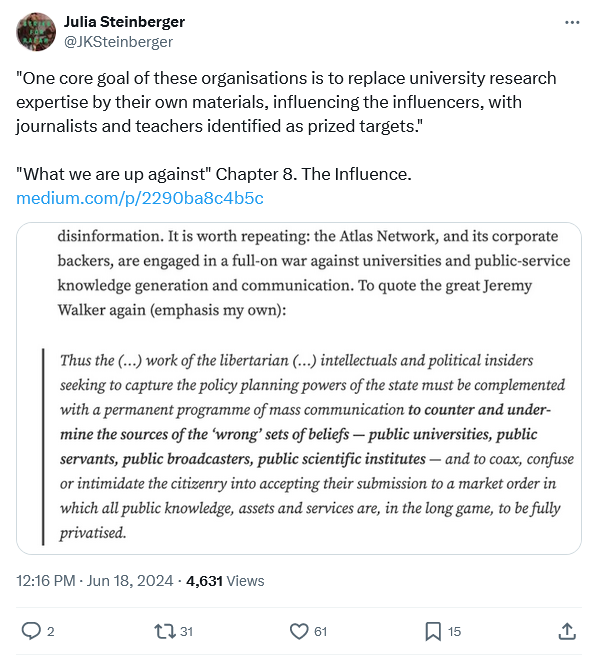
Tim Worstall responds to a recent Medium essay by Julia Steinberger which illustrates that “neoliberal” has joined “fascist” as a generic term to indicate strong disapproval of a person, organization, or idea:
The idea that an adult woman can believe these things is just amazeballs. But here we are. A tweet from Julia Steinberger leads to her Medium essay about what’s wrong with the world.
An upheaval in 10 chapters:
1. The cause. We know the climate crisis is brought to us by highly unequal and undemocratic economic systems.
Err, no? Emissions are emissions. 100 people emitting one tonne each is exactly the same as 1 person emitting 100 tonnes. Sure, it’s true that a more unequal society will have more people emitting those 100 tonne personal amounts. But a more equal society will have more people able to emit another 1 tonne each. For, more equality is by definition the movement of some of those assets of the richer to those poorer — the economic assets which either allow or do the emitting. Sure, Jim Ratcliffe’s £50,000 private jet flight emits more than my £100 Easyjet one. But if we take the £50k off Jim and give it to 500 folk like me then all 500 of us might spend the marginal income on an Easyjet flight each — which would be more emissions than Jim’s spending of the money.
It simply is not true that economic inequality is the heart, the core or the cause of climate change. It’s idiocy to think it is too.
Of course, we know what’s happening here. Climate Change is Bad, M’Kay? Which it is, obviously. Economic inequality is Bad, M’Kay? Well, there the evidence is a great deal more mixed but whatever. But in the minds of the stupid all bad things have the same cause. So, if inequality is bad, climate change is bad, then they must be the same thing because they’re Bad, M’Kay?
2. The rise. The recent history of these economic systems, in the Americas and Eurasia, is dominated by the ascendance of neoliberal ideology.
Oh, that is good. Given that I am a neoliberal — a fully paid up one, Senior Fellow at the Adam Smith Institute and all — that’s very good. Given HS2, looming wealth taxation, the increased bite of idiot regulation and all that I can’t say that I see neoliberalism as winning right now but that might depend upon your starting point. If you’re a socialist — or an idiot but I repeat myself — you might well regard the plenitude of bananas in the supermarket as neoliberal. After all, that is something that socialism never did achieve.
3. The threat. Neoliberal ideology is antidemocratic at its very core. Its aim is to give free-reign over our societies to corporations, not citizens.
And, well, you know, bollocks. The very beating heart of neoliberalism is that corporations need to be controlled and they’re best controlled by the citizens. In the form of free markets rather than voting on which bureaucrats get the gold plated pension, true. But neoliberals are between indifferent and actually against capitalist power. The whole nub of the idea is that markets do the job of controlling capitalists better than bureaucrats, politicians or, obviously, capitalists.
There’s not really any way for her thesis to survive after getting so much of the basics wrong, is there?
But just one more tidbit:
Hayek and his neoliberal colleagues now needed another, antidemocratic way, to organise society. They didn’t want democracy, but they wanted some kind of self-maintaining organisation — by which they meant hierarchy. Organisation was supposed to be supplied by the market, and hierarchy by competition within markets. (It’s worth noting that neoliberals in the 1950s did not, although they should have, predict that unfettered markets lead to concentrations in monopolies or cartels. They would arguably disapprove of the vast corporations running our current economies, even though their market-above-democracy policies predictably brought them into being.)
Well, that wasn’t actually the last tidbit. But the idea that Friedman, Mises, Menger, Hayek and the rest didn’t worry about monopolies? Jesu C is really bouncin’ on that pogo stick right now. And then the idea that democracy will be better bulwark against monopolies than markets? Can you actually do backflips on a pogo stick?
June 4, 2024
QotD: “Let the market handle it”
The argument is quite common. It’s also wrong. Its error is that it incorrectly identifies the set of choices for dealing with problems (and with “problems”).
Rodrik’s argument appears to be the height of reasonableness. “It is dogmatic and dangerous,” the argument’s champions rightly note, “to assume that one solution or one approach is the answer to every problem. Some problems call for the use of screwdrivers, others call for the use of hammers. Only a benighted fool insists on using a screwdriver to hammer in nails and on using a hammer to insert screws. The wise, non-ideological, enlightened, open-minded, reasonable, and scientifically aware person sometimes uses a screwdriver and other times uses a hammer. What could be more reasonable?!”
The error in this formulation is that markets are many tools. Markets are a toolkit with far more tools in it than government has access to. While government has only a few tools – mostly hammers (some sledge), saws, and clamps – the market is filled with many, almost countless, tools. And the market’s tools are much more varied, nuanced, specialized, and creative than are the government’s simple set of tools.
Put differently, to say “Let the market handle it” is just a shorthand way of saying “Let whoever is most willing, most able, most experienced, most knowledgeable, and best equipped be free to try his or her hand at dealing with each specific problem.” And to say “Let the market always handle it” is not – contrary to what Rodrik’s argument suggests – to propose a single, simple fix for all problems; it is to propose that the field be left open for as many fixes as are feasible to be tried. To say “Let the market always handle it” is to warn that using government as a fix crowds out – prevents – experimentation with many other possible fixes.
In short, the choice is not between only two alternative possible fixes: the market or the government. Instead, the choice is between a gigantically large and varied set of possible fixes (the market, with its many detailed specialized carpenters and master builders) or a tiny set featuring one possible fix (the government, with its hammering, sawing, and clamping officials, none of whom – unlike the case with market participants – can be reasonably presumed to know enough of the finer details of any of the problems that they are called upon to “fix”).
The truly reasonable person – the one who understands the benefits of having access to as many “solutions” to problems as possible – supports the market because he or she knows that to turn to government solutions is to drastically reduce the number of “solutions” that will be tried.
Don Boudreaux, “Very Bad Framing, or In Defense of ‘Let the Market Handle It'”, Café Hayek, 2016-08-12.
November 23, 2023
QotD: The Austrian and Chicago schools of economics
[Bureaucracies will always expand far beyond the “problem” they were instituted to address] was, anyway, the view of that “Austrian school economist”, Ludwig von Mises, proponent like the rest in that school of “classical liberalism”. His hatred of bureaucracy was a wonderful, animated thing. In his great book, Human Action, and many others, he could become almost boring on the topic. What distinguishes the Austrian school from, say, the famous Chicago school of Milton Friedman and his ilk, was its European origin. (They were, however, consciously allied.) The “Austrians” go back, to Catholic antecedents, and their interests are not reducible to “pure economics” (scare quotes because there is no such thing). Over time it extended to broad social questions, and through a constant interest in the history of ideas. These were multilingual and multicultural, in the manner of the old Habsburg empire; where our American classical liberalism has been almost unilingually English, provincially distrustful of foreign thinkers, and buzzing with statistics. (You’ll need a degree in math.)
War propelled the “Austrian” thinkers westward, and the fall of the Berlin wall propelled the “Chicago” school east. The terms no longer have geographical significance.
What all classical liberals have in common is the passionate vindication and defence of human freedom. That is what makes them, unlike progressives, readable in subsequent generations. Their subject matter cannot become dated. The “Austrians” are also necessary to understand modern history, positively as well as negatively, in the evolution of, for instance, the Christian Democratic movement that conceived a peaceful post-war Europe, in defiance of secularizing bureaucratic trends and mass-man “ideals”. Alas, this was overall defeated by the Eurocratic trend-setters, determined to build a magnificent autocratic monument to themselves.
I have the most enchanting memory of opening the box that contained an American reprint of Human Action (big thick book), which I had ordered at the age of fifteen. I no longer own a copy, but gather it still stands as a monument to the resistance — a study of “praxeology”, or purposeful human choices, stretching so wide that even religion and morality could be touched. (Conventional economics has no time for either.) A half-century later, I can even remember the construction of an earnest reading list, that was soon abandoned when I went on the road.
One may see the great division in Western thought and politics, which the Austrian-school Friedrich Hayek traced back to Bacon and Descartes, and can be traced farther to the Nominalists of the later Middle Ages. Humans live in freedom and make choices, to be restrained only by the plainest moral codes. Or, by the alternative thesis, we are components of a machine, which the man with Power can monkey with, by implanting stimuli here and there.
We are creatures of God, or — we are replaceable parts in a bureaucracy.
David Warren, “Austrian schoolboy”, Essays in Idleness, 2019-09-17.
November 4, 2023
October 5, 2021
QotD: Entrepreneurship
If entrepreneurs see value in the […] economic landscape, and perceive there are rich profits to be made in turning around businesses and then flogging them off, it is very good news indeed for the country’s economy. By releasing capital from uneconomic areas and focussing it on lucrative new bits, the overall pie gets bigger, jobs get created, and productivity is also increased.
In fact, one could almost create a new economic law: the amount of abuse raining down on entrepreneurs is directly proportional to the good they do. I haven’t seen much reason to doubt this law yet.
Johnathan Pearce, “Gordon Gekko goes to Germany”, Samizdata.net, 2005-05-05.
November 27, 2019
QotD: The evolution of markets
It is a settled assumption among most libertarians, classical liberals and English-speaking conservatives that market behaviour is part of human nature. Whether or not we care to make a point of it, we stand with John Locke and, through him, with the men of the Middle Ages and with the Greeks and Romans, in trying to derive what is right from what is natural.
We believe that there is a natural inclination to promote our own welfare and that of our loved ones. We further believe that, given reasonable security of life and property, this inclination will lead to the emergence of a system of voluntary exchange. That is, we will seek to trade the things we have or can create for other things that we regard as of greater value to ourselves.
In doing so, ratios of exchange that we call prices will be revealed. These prices, in turn, will provide general information about what should be produced, in what ways and in what quantities. Furthermore, changes in price will provide information about changes in preferences or in abilities to produce. Custom will set aside one or more goods to serve as money. Institutions will emerge that channel savings into productive investment, that spread risk, and that moderate expected fluctuations in price. Laws will develop to police the transfer of property and performance of contracts.
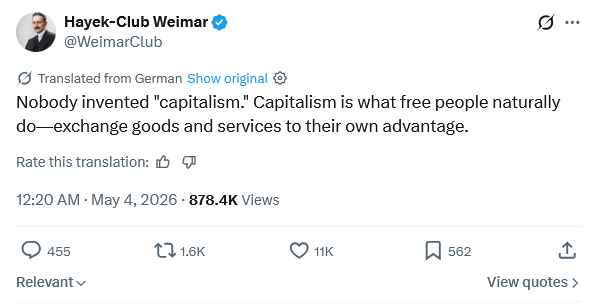
We believe that market economies emerge spontaneously and are self-regulating and self-sustaining. This is not to say that all market societies will be the same. Their exact shape will depend on the intellectual and moral qualities of the individuals who comprise them. They will reflect pre-existing patterns of trust and honesty and the general cultural and religious values of a people. They will also be more or less distorted by government intervention. But we do say that market behaviour is natural — that, in the absence of extreme government coercion, or extreme disorder, buying and selling to increase our own welfare is what we naturally do.
Sean Gabb, “Market Behaviour in the Ancient World: An Overview of the Debate”, 2008-05.