Quotulatiousness

May 5, 2026

Orwell: “It would probably not be beyond human ingenuity to write books by machinery”

Filed under: Books, Media, Technology — Tags: , , — Nicholas @ 04:00

In the portion above the paywall, Matt Johnson discusses Orwell’s career as we face an unending deluge of writing “assisted” by AI or even entirely created by AI:

In the introduction to his 1991 book Orwell: The Authorised Biography, Michael Shelden distinguishes his approach from that of Bernard Crick’s George Orwell: A Life, published a decade earlier. While Crick’s volume offered the most complete portrait of Orwell available at that point, Shelden argues that it’s too dull and impersonal — a flood of facts that bury Orwell’s singular, idiosyncratic personality. Shelden observes that Crick “relies heavily on the notion that facts speak for themselves if presented in enough detail”. So he attempts to provide a more intimate account of Orwell’s life: “A writer’s character and personal history influence what he writes and how he writes it. And the more we know about him, the better we are able to appreciate his work.” After all, “Books are not written by machines in sealed compartments”.

But we have now entered an era in which books can, in fact, be written by machines in sealed compartments. Large language models (LLMs) generate billions of words a day and are increasingly capable of producing long, structured, and sophisticated texts. While Orwell could not have foreseen the AI revolution, he predicted that synthetic text could someday replace human writing. In his 1946 essay “The Prevention of Literature”, he observes: “It would probably not be beyond human ingenuity to write books by machinery”. Although he doesn’t linger on this possibility, he laments the depersonalisation and mass production of writing already underway in the 1940s, and these arguments are just as applicable to AI-generated writing today.

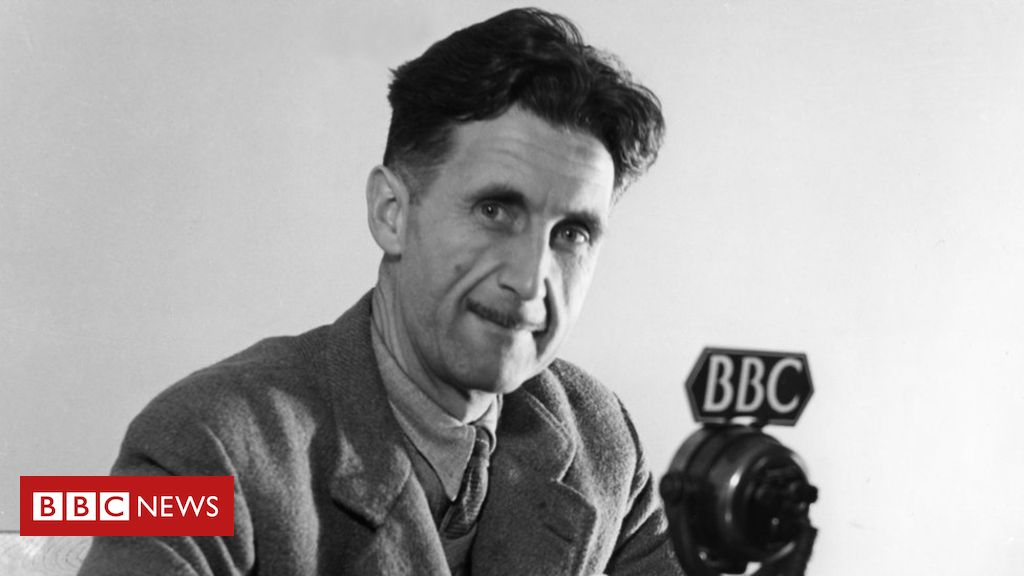
Orwell expressed an almost eerie sensitivity to the ways in which literary ability — and even the quality of thought — can decline alongside a growing reliance on automated writing processes. For example, he cites radio features “commonly written by tired hacks to whom the subject and the manner of treatment are dictated beforehand”. The writing itself was “merely a kind of raw material to be chopped into shape by producers and censors”. His experience dealing with the pressures of working in a strictly controlled corporate environment at the BBC during wartime undoubtedly left him with this impression. He also cites “innumerable books and pamphlets commissioned by government departments” created in the same industrial manner.

Orwell’s scrutiny of the “machine-like” creation of “short stories, serials, and poems for the very cheap magazines” holds up particularly well today. In an uncanny anticipation of the process by which millions of users now produce creative content with AI, he writes:

    Papers such as the Writer abound with advertisements of Literary Schools, all of them offering you readymade plots at a few shillings a time. Some, together with the plot, supply the opening and closing sentences of each chapter. Others furnish you with a sort of algebraical formula by the use of which you can construct your plots for yourself. Others offer packs of cards marked with characters and situations, which have only to be shuffled and dealt in order to produce ingenious stories automatically.

“The Prevention of Literature” was published around the time Orwell began work on Nineteen Eighty-Four, and it shows. Winston Smith’s job in the Ministry of Truth is to rewrite historical documents to match Party propaganda. He deletes “unpersons” from old news stories and ensures that recorded events always line up with the latest party line, all with the help of his speakwrite dictation machine. He dumps original documents into the Memory Hole for incineration. In the essay, Orwell moves from a discussion of increasingly robotic forms of literary production to the role this shift could play in a totalitarian state:

    It is probably in some such way that the literature of a totalitarian society would be produced, if literature were still felt to be necessary. Imagination — even consciousness, so far as possible — would be eliminated from the process of writing. Books would be planned in their broad lines by bureaucrats, and would pass through so many hands that when finished they would be no more an individual product than a Ford car at the end of the assembly line.

In some ways, Orwell’s bleak prophecies would turn out to be more accurate than he could have imagined. The idea that human thought would be replaced by an “algebraical formula” and that consciousness would be eliminated from the writing process is now a reality on a vast scale (though the question of whether consciousness will emerge from AI systems remains open). But Orwell filtered his predictions about the future of writing through his fixation on state power and the possible emergence of a “rigidly totalitarian society”, and this led him astray. In such a society, Orwell assumed that “novels and stories will be completely superseded by film and radio productions”. To the extent that people would want to keep reading, “perhaps some kind of low-grade sensational fiction will survive, produced by a sort of conveyor-belt process that reduces human initiative to the minimum”. He concluded: “It goes without saying that anything so produced would be rubbish”.

May 3, 2026

QotD: Communism, nationalism and literature

Filed under: History, Politics, Quotations, Russia — Tags: , , , , , — Nicholas @ 01:00

“Literature as we know it”, Orwell wrote in “Inside the Whale”, “is an individual thing, demanding mental honesty and a minimum of censorship”. It’s the “product of the free mind, of the autonomous individual”. This is why Orwell argued that “a writer does well to keep out of politics. For any writer who accepts or partially accepts the discipline of a political party is sooner or later faced with the alternative: toe the line, or shut up.”

According to Orwell, “As early as 1934 or 1935 it was considered eccentric in literary circles not to be more or less ‘left’, and in another year or two there had grown up a left-wing orthodoxy that made a certain set of opinions absolutely de rigueur on certain subjects”. In other words, many writers became communists, which meant they constantly had to decide whether to toe the line or shut up, depending on the circumstances: “Every time Stalin swaps partners”, Orwell wrote, “‘Marxism’ has to be hammered into a new shape … Every Communist is in fact liable at any moment to have to alter his most fundamental convictions, or leave the party. The unquestionable dogma of Monday may become the damnable heresy of Tuesday, and so on.”

Orwell also explained how communism replaced the patriotic and religious feelings that members of the English intelligentsia believed they had transcended: “All the loyalties and superstitions that the intellect had seemingly banished could come rushing back under the thinnest of disguises. Patriotism, religion, empire, military glory — all in one word, Russia. Father, king, leader, hero, savior — all in one word, Stalin”. Is it any wonder that Orwell, witnessing these endless intellectual and moral contortions, the shameless propaganda, and the constant stream of wartime lies and distortions, was drawn to a writer who didn’t regurgitate any orthodoxies or toe any lines? Miller gave his readers “no sermons, merely the subjective truth”.

Matt Johnson, “George Orwell, Henry Miller, and the ‘Dirty-Handkerchief Side of Life'”, Quillette, 2020-10-05.

May 1, 2026

We are much more Brave New World than 1984

Filed under: Books, Education, Media, Politics — Tags: , , , , — Nicholas @ 04:00

Culturally, we had lots of warning from George Orwell and Aldous Huxley about their future — our present — and while we have had some success avoiding what Orwell feared for us, we’ve had much less success avoiding a Brave New World culture:

As the curtain of totalitarianism descended across much of the globe, in the mid-twentieth century, the Western intellectual class pointed to George Orwell’s 1984 as a blueprint for societal ruin.

I’m sure many of you are familiar with Orwell’s magnum opus, but for those who don’t know the gist: Orwell envisioned a dystopian future governed by a panoptic state, where an externally imposed oppression would ruthlessly strip humanity of its autonomy, its history, and its capacity for critical thought.

It is a great novel and many believe it was prophetic (I certainly believe parts of it ring true), but, as the cultural critic Neil Postman astutely observed in his foreword to Amusing Ourselves to Death, it was not Orwell but Aldous Huxley, author of Brave New World, who accurately mapped the specific destiny of the modern collapse.

Huxley recognised a far more insidious threat:

    What Orwell feared were those who would ban books. What Huxley feared was that there would be no reason to ban a book because there would be no one who wanted to read one.

No “Big Brother” is required to deprive a populace of its cognitive liberty. He foresaw a society that would come to adore the very technologies that undid its capacity to think.

Where Orwell feared those who would ban books, Huxley feared there would eventually be no reason to ban a book, for there would be no one left who wanted to read one. Where Orwell feared the truth would be actively concealed, Huxley feared it would be drowned in an endless sea of irrelevance. Ultimately, Orwell feared that what we hate will ruin us, while Huxley feared that what we love will ruin us.

[…]

The Collapse of Literacy in the Intellectual Elite

The symptoms of this cognitive counter-revolution are visible not only in the general populace but at the very apex of the educational system, signalling a crisis that threatens the reproduction of the intellectual class itself. Over the past decade, professors at elite academic institutions have sounded the alarm regarding a precipitous and bewildering decline in student literacy. In a widely discussed exposition in The Atlantic, Nicholas Dames, a professor of Columbia University’s required Literature Humanities course since 1998, noted that his undergraduate students, the supposed academic elite of the nation are now “bewildered by the thought of finishing multiple books a semester“.1

Two decades ago, Dames’s classes effortlessly engaged in sophisticated, week-to-week analyses of lengthy texts like Jane Austen’s Pride and Prejudice and Fyodor Dostoevsky’s Crime and Punishment. Today, the landscape is unrecognisable. In 2022, a first-year student confessed to Dames that during her entire tenure at a public high school, she had never been required to read a single book cover-to-cover.2 Instead, her education consisted of excerpts, isolated poems, and fragmented news articles. This is a systemic failure; middle and high schools have largely ceased assigning whole books, breaking them down into easily digestible, context-free fragments to accommodate dwindling attention spans. High-achieving students can still decode words, but they struggle to muster the sustained attention or cognitive ambition required to immerse themselves in substantial texts. As technology provides instant gratification, the sustained labor of reading feels deeply unnatural to a generation raised on screens.

This anecdotal evidence from the highest echelons of the academy is overwhelmingly corroborated by a mountain of empirical data. The decline in sustained reading and linguistic proficiency is measurable and accelerating.


  1. https://www.theatlantic.com/magazine/archive/2024/11/the-elite-college-students-who-cant-read-books/679945/
  2. Ibid

March 26, 2026

QotD: “Instead of the unsinkable battleship we have the unsinkable Military Expert …”

Filed under: Britain, History, Military, Quotations, WW2 — Tags: , , , — Nicholas @ 01:00

One way of feeling infallible is not to keep a diary. Looking back through the diary I kept in 1940 and 1941 I find that I was usually wrong when it was possible to be wrong. Yet I was not so wrong as the Military Experts. Experts of various schools were telling us in 1939 that the Maginot Line was impregnable, and that the Russo-German Pact had put an end to Hitler’s eastwards expansion; in early 1940 they were telling us that the days of tank warfare were over; in mid 1940 they were telling us that the Germans would invade Britain forthwith; in mid 1941 that the Red army would fold up in six weeks; in December 1941, that Japan would collapse after ninety days; in July 1942, that Egypt was lost and so on, more or less indefinitely.

Where now are the men who told us those things? Still on the job, drawing fat salaries. Instead of the unsinkable battleship we have the unsinkable Military Expert …

George Orwell, “As I Please”, Tribune, 1943-12-17.

Update, 27 March: Welcome, Instapundit readers! Have a look around at some of my other posts you may find of interest. I send out a daily summary of posts here through my Substackhttps://substack.com/@nicholasrusson that you can subscribe to if you’d like to be informed of new posts in the future.

January 5, 2026

Friedman on Orwell

On his Substack, David Friedman considers some of the things that George Orwell was mistaken about in his non-fiction writings:

    It cannot be said too often – at any rate, it is not being said nearly often enough – that collectivism is not inherently democratic, but, on the contrary, gives to a tyrannical minority such powers as the Spanish Inquisitors never dreamed of. (George Orwell, The Observer, April 9, 1944)

George Orwell got some things right; unlike most political partisans, he saw the problems with the position he supported. He also got quite a lot of things wrong. The quote is from Orwell’s review of two books, The Road to Serfdom by Friedrich Hayek and The Mirror of the Past by K. Zilliacus, a left-wing writer and politician. The conclusion of the review is that Hayek is right about what is wrong with socialism, Zilliacus is right about what is wrong with capitalism, hence that “the combined effect of their books is a depressing one”.

But Zilliacus was wrong about capitalism, as was Orwell, who wrote:

    But he [Hayek] does not see, or will not admit, that a return to “free” competition means for the great mass of people a tyranny probably worse, because more irresponsible, than that of the State. The trouble with competitions is that somebody wins them. Professor Hayek denies that free capitalism necessarily leads to monopoly, but in practice that is where it has led, and since the vast majority of people would far rather have State regimentation than slumps and unemployment, the drift towards collectivism is bound to continue if popular opinion has any say in the matter. (“As I Please”, pp.117-119)1

The problem is that Orwell, like many of his contemporaries (and ours), did not understand economics and thought he did. Since he wrote we have had extensive experience with free competition, if not as free as Hayek would have wanted, and the result has not been the nightmare that Orwell expected. “The trouble with competitions is that somebody wins them” sounds right only if you don’t actually understand the logic of a competitive market. In most industries organizational diseconomies of scale, the effect of more layers between the head office and the factory floor, limit the size of the firm to something considerably below the size of the market for what the firm produces. In some fields, such as restaurants or barber shops, the result is an industry with thousands of firms, in some five or ten, in only the rare case of a natural monopoly can one large firm outcompete all of its smaller competitors.

The effect of free competition is not the only thing that Orwell got wrong. Consider his essay on Kipling.2 He gets some things right, realizes that Kipling is not a fascist, indeed less of one than most moderns, and recognizes his talent:

    During five literary generations every enlightened person has despised him, and at the end of that time nine-tenths of those enlightened persons are forgotten and Kipling is in some sense still there.

But he gets quite a lot wrong. In arguing that Kipling misunderstood the economics of imperialism, Orwell writes:

    He could not understand what was happening, because he had never had any grasp of the economic forces underlying imperial expansion. It is notable that Kipling does not seem to realize, any more than the average soldier or colonial administrator, that an empire is primarily a money-making concern.

In explaining his own view of the logic of empire, what he thought Kipling was missing, Orwell writes:

    We all live by robbing Asiatic coolies, and those of us who are “enlightened” all maintain that those coolies ought to be set free; but our standard of living, and hence our “enlightenment”, demands that the robbery shall continue.3

Britain let go of its empire, starting with India. British standards of living did not collapse; by the time all of the colonies were independent, the average real wage in the UK was 50% higher than when Orwell wrote. He could not know the future but he could observe that Switzerland, before the war, was richer than England, Denmark, with no significant colonies, almost as rich, Portugal, with an enormous African empire, much poorer. Whether Britain ran its empire at a net profit or a net loss is, I think, still an open question, but Orwell’s view of colonialism is strikingly inconsistent with the observed effects of decolonization.

Economics is not all that Orwell got wrong about Kipling; he badly underestimated the quality of Kipling’s work, due to having read very little of it. The clearest evidence is Orwell’s description of The Light that Failed as Kipling’s “solitary novel”. Kipling wrote three novels, of which that is by a good margin the worst. Orwell not only had not read Kim, Kipling’s one world class novel, he did not know it existed. In a recent post I listed eighteen works by Kipling that I liked. Orwell mentions only one of them.


  1. That free capitalism would ultimately fail was still Orwell’s view in 1947:
  2. In North America the masses are contented with capitalism, and one cannot tell what turn they will take when capitalism begins to collapse (“Toward European Unity“)

  3. Discussed in more detail in an earlier post.
  4. As late as 1947, Orwell wrote:
  5. The European peoples, and especially the British, have long owed their high standard of life to direct or indirect exploitation of the coloured peoples. (“Toward European Unity“)

December 28, 2025

It may seem petty to deny entry to EUrocrats, but it’s all they will understand

At first, I thought it was just another bout of Trump being deliberately petty over trivial stuff, but on reflection, it’s actually a neat way to bring home the message to the EU bureaucrats personally that they will be held responsible for their actions:

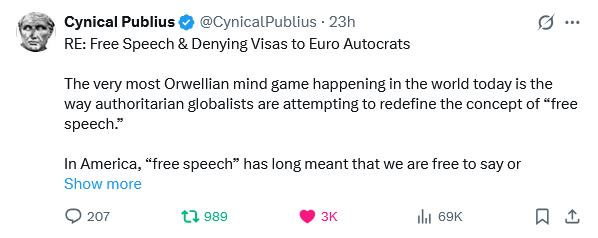
RE: Free Speech & Denying Visas to Euro Autocrats

The very most Orwellian mind game happening in the world today is the way authoritarian globalists are attempting to redefine the concept of “free speech”.

In America, “free speech” has long meant that we are free to say or write virtually anything without fear of government intervention or suppression. It is this ability to express whatever we want that makes it “free”.

The authoritarian globalists, however, have stood this on its head. They have decided that in order for their citizens to be “free”, they must be free of ever hearing or reading any speech that might offend someone or sow doubt as to government policies. To these fascists, “free speech” means GOVERNMENT MODERATED speech which somehow — through its moderation — sets people “free” from ever hearing conflicting views. As I said — straight out of Orwell.

Europe is, of course, the hotbed of this fascist redefinition of what free speech means, but we in America have only narrowly escaped this plague by electing Trump. Remember, Biden and his team were reliant on institutionally stamping out so-called “disinformation” as a means of control over the populace. We must be ever vigilant here in the USA that such thuggish government criminality never again be allowed to prosper.

I think it is very important that every citizen of the USA and the world understand the depths of depravity these people will sink to in order to control ordinary people. This is about mind control, and nothing else.

Ultimately, the value of true free speech is that it embraces the idea that we all have agency over ourselves; that we are free individuals who can and should hear conflicting views, and decide for ourselves what is true and just, and what is untrue and unjust. This is sovereignty over the self, and unfortunately Europe has never let go of the concept of serfdom, so self-sovereignty is a threat that must be stamped out.

The Trump Administration has been prescient, bold and effective in denying visas to the Eurotrash autocrats who would see free speech reduced to whatever speech unelected bureaucrats deem acceptable. I cannot commend Trump enough for the thoughtfulness and importance of that action.

In a world where almost all humans are linked by essentially the same communications platform, only one world leader is truly standing for free speech: Donald Trump. And I thank him for it. We all should — even the TDS sufferers.

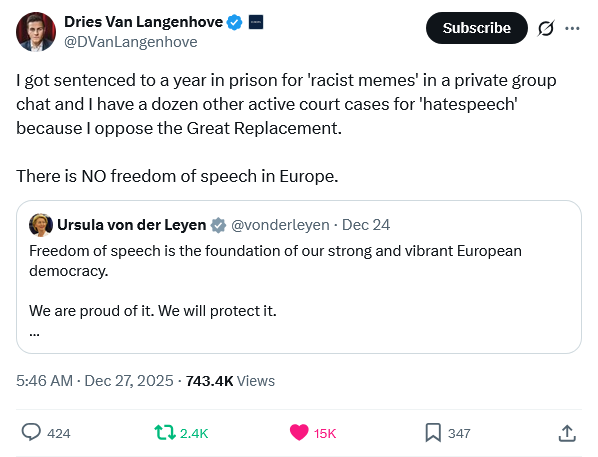
For a relevant example, Dries Van Langenhove:

Update, 29 December: Welcome, Instapundit readers! Please do have a look around at some of my other posts you may find of interest. I send out a daily summary of posts here through my Substackhttps://substack.com/@nicholasrusson that you can subscribe to if you’d like to be informed of new posts in the future.

December 25, 2025

QotD: Christmas dinner

Filed under: Britain, Food, Humour, Quotations — Tags: , , — Nicholas @ 01:00

An advertisement in my Sunday paper sets forth in the form of a picture the four things that are needed for a successful Christmas. At the top of the picture is a roast turkey; below that, a Christmas pudding; below that, a dish of mince pies; and below that, a tin of —’s Liver Salt.

It is a simple recipe for happiness. First the meal, then the antidote, then another meal. The ancient Romans were the great masters of this technique. However, having just looked up the word vomitorium in the Latin dictionary, I find that after all it does not mean a place where you went to be sick after dinner. So perhaps this was not a normal feature of every Roman home, as is commonly believed.

Implied in the above-mentioned advertisement is the notion that a good meal means a meal at which you overeat yourself. In principle I agree. I only add in passing that when we gorge ourselves this Christmas, if we do get the chance to gorge ourselves, it is worth giving a thought to the thousand million human beings, or thereabouts, who will be doing no such thing. For in the long run our Christmas dinners would be safer if we could make sure that everyone else had a Christmas dinner as well. But I will come back to that presently.

The only reasonable motive for not overeating at Christmas would be that somebody else needs the food more than you do. A deliberately austere Christmas would be an absurdity. The whole point of Christmas is that it is a debauch — as it was probably long before the birth of Christ was arbitrarily fixed at that date. Children know this very well. From their point of view Christmas is not a day of temperate enjoyment, but of fierce pleasures which they are quite willing to pay for with a certain amount of pain. The awakening at about 4 a.m. to inspect your stockings; the quarrels over toys all through the morning, and the exciting whiffs of mincemeat and sage-and-onions escaping from the kitchen door; the battle with enormous platefuls of turkey, and the pulling of the wishbone; the darkening of the windows and the entry of the flaming plum pudding; the hurry to make sure that everyone has a piece on his plate while the brandy is still alight; the momentary panic when it is rumoured that Baby has swallowed the threepenny bit; the stupor all through the afternoon; the Christmas cake with almond icing an inch thick; the peevishness next morning and the castor oil on December 27th — it is an up-and-down business, by no means all pleasant, but well worth while for the sake of its more dramatic moments.

Teetotallers and vegetarians are always scandalized by this attitude. As they see it, the only rational objective is to avoid pain and to stay alive as long as possible. If you refrain from drinking alcohol, or eating meat, or whatever it is, you may expect to live an extra five years, while if you overeat or overdrink you will pay for it in acute physical pain on the following day. Surely it follows that all excesses, even a one-a-year outbreak such as Christmas, should be avoided as a matter of course?

Actually it doesn’t follow at all. One may decide, with full knowledge of what one is doing, that an occasional good time is worth the damage it inflicts on one’s liver. For health is not the only thing that matters: friendship, hospitality, and the heightened spirits and change of outlook that one gets by eating and drinking in good company are also valuable. I doubt whether, on balance, even outright drunkenness does harm, provided it is infrequent — twice a year, say. The whole experience, including the repentance afterwards, makes a sort of break in one’s mental routine, comparable to a week-end in a foreign country, which is probably beneficial.

George Orwell, “In praise of Christmas”, Tribune, 1946-12-20.

November 25, 2025

QotD: British Socialism in the 1930s

Filed under: Britain, History, Politics, Quotations — Tags: , , , — Nicholas @ 01:00

As with the Christian religion, the worst advertisement for Socialism is its adherents. The first thing that must strike any outside observer is that Socialism, in its developed form, is a theory confined entirely to the middle classes. The typical Socialist is not, as tremulous old ladies imagine, a ferocious-looking working man with greasy overalls and a raucous voice. He is either a youthful snob-Bolshevik who in five years time will quite probably have made a wealthy marriage and been converted to Roman Catholicism; or, still more typically, a prim little man with a white-collar job, usually a secret teetotaller and often with vegetarian leanings, with a history of Nonconformity behind him, and, above all, with a social position which he has no intention of forfeiting. This last type is surprisingly common in Socialist parties of every shade; it has perhaps been taken over en bloc from. the old Liberal Party. In addition to this there is the horrible — the really disquieting — prevalence of cranks wherever Socialists are gathered together. One sometimes gets the impression that the mere words “Socialism” and “Communism” draw towards them with magnetic force every fruit-juice drinker, nudist, sandal-wearer, sex-maniac, Quaker, “Nature Cure” quack, pacifist, and feminist in England … To this you have got to add the ugly fact that most middle-class Socialists, while theoretically pining for a class-less society, cling like glue to their miserable fragments of social prestige.

George Orwell, The Road to Wigan Pier (1937)

November 19, 2025

Julia: A Feminist Retelling of 1984?

Filed under: Books, Britain, Media, Politics — Tags: , , , , — Nicholas @ 02:00

Feral Historian
Published 11 Jul 2025

Julia, a 2023 novel by Sandra Newman, does more than just retell Orwell’s 1984 through Julia’s eyes. That perspective switch presents an Oceania that is both more mundane and more familiar. It’s certainly a companion piece more than a stand-alone work, but it does have something to offer both in how it examines Orwell and a few times, how it contradicts him.

00:00 Intro
02:18 a Different Perspective
09:30 Caught in a Trap
12:45 Backstory
15:40 Departures
20:18 Endings and Beginnings
(more…)

August 25, 2025

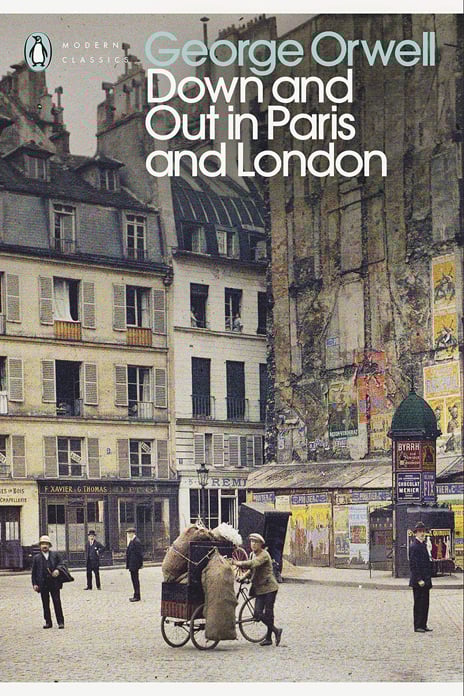
George Orwell’s Down and Out in Paris and London

Filed under: Books, Britain, France — Tags: , , , , , , — Nicholas @ 05:00

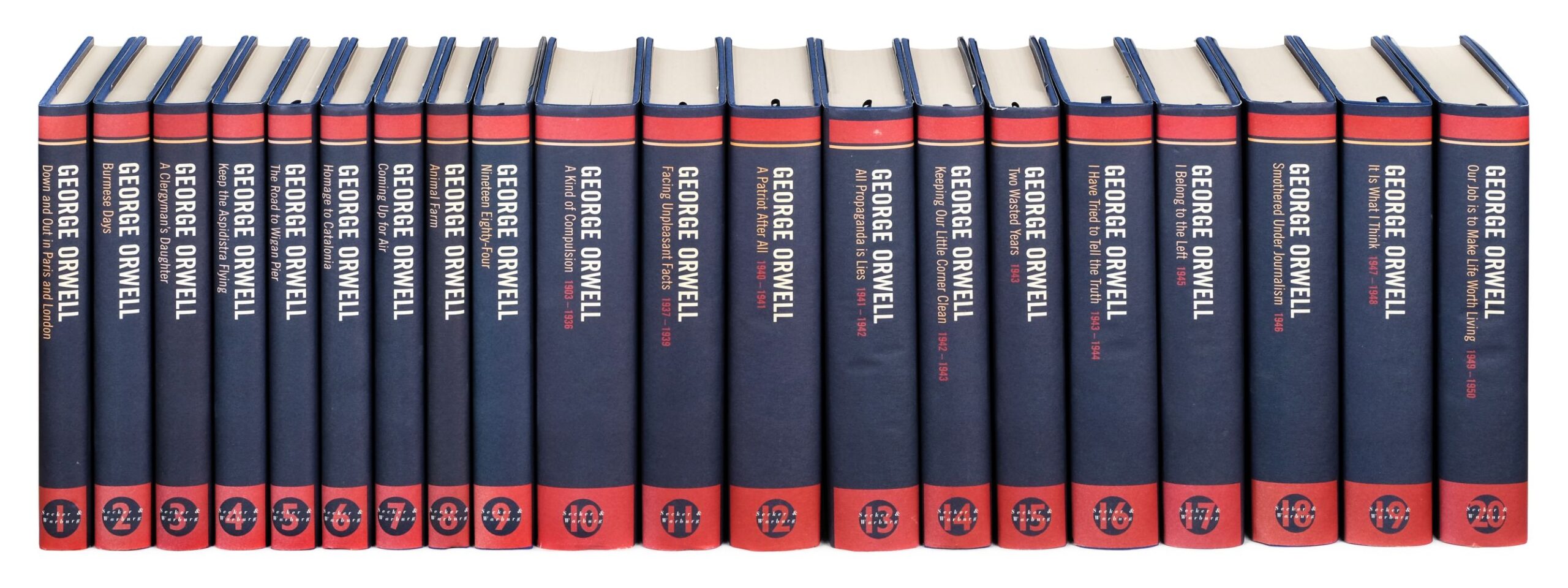
Down and Out was one of the first Orwell works I read as an adult, having encountered Animal Farm and Nineteen Eighty-Four as school texts. I would not say that I enjoyed the book so much as it gave me a very different view of both cities between the wars and encouraged me to seek out more of Orwell’s work. On his Substack, Rob Henderson considers the book and its author:

I was in high school the first time I read Down and Out in Paris and London (1933) by George Orwell. A memoir about his time in the slums of France and England.1 Orwell, while in Paris, worked as a plongeur — a person employed to wash dishes and carry out other menial tasks in a restaurant or hotel. Plongeur sounds much better than “bus boy”.

Because, at the time, I was also working as a busboy and dishwasher, I enjoyed Orwell’s description of employment in a busy restaurant. He wrote that the work itself was simple, like sorting a deck of cards, but when done against the clock it became exhausting. That captured exactly how I felt on my Friday and Saturday evening shifts.

Later I was disappointed to learn that Orwell had come from privilege. The guy went to Eton, a prestigious all-boys school. The book recounted his experiences with slum tourism. When he was penniless during the periods described in Down and Out, particularly during his return to London, his well-to-do family could and did take him back in for temporary periods so he could eat well and shower. At first this made the story feel less authentic.

Over time, though, I came to see it differently. It took someone like Orwell to write about life in the slums in a way that other educated people would pay attention to. I had to go through something similar. Only after spending time around the upper middle class did I understand how to describe my life in a way that would actually make them pay attention.

[…]

In the second half of Down and Out in Paris and London, Orwell describes living rough in London’s East End, staying in lodging houses and casual wards. He worked alongside the city’s laborers to understand poverty from the inside.

Down and Out in Paris and London was Orwell’s first published book, written when he was in his mid-twenties. It is striking is how little he romanticized the idea of being an impoverished bohemian in world-class cities, the way so many others of his background might have done. Instead, he treated his immersion in the Parisian and London underworlds as an attempt to strip away the prejudices he had inherited as an upper-middle-class Etonian.

The book is restrained in its politics. Orwell rarely pauses for commentary, preferring to tell the story as it happened and saving his more general conclusions for a couple of chapters at the end. This is more or less the same approach I took with Troubled; describe the world as it was, or at least as I remember it, and let the meaning emerge on its own.

One of the strongest features of Down and Out is its focus on the psychological effects of petty humiliations. Orwell describes kitchens where people from every corner of Europe are screaming at each other in different languages, frantically trying to keep pace with the chaos. If you have ever watched one of those Gordon Ramsay shows, you have some idea. He admired the strange order that somehow emerged from the chaos.

This voyeuristic quality is part of the book’s appeal. We all go to restaurants and see only the polished surface, knowing almost nothing about what happens behind the doors. Likewise, we all encounter homeless people in daily life and know little about how they live. Back in the 1930s, you didn’t have to make many mistakes to find yourself in a tough spot. My guess is that because society today is wealthier, there are more social services available, and powerful recreational drugs more accessible, the typical homeless person (he uses the word “tramp”, which was a prevailing term at the time) Orwell encountered nearly a century ago is very different from those we see today.

During his year and a half working menial jobs in Paris, Orwell wrote a few books, all rejected by publishers in London. None of this appears in Down and Out. He never dwells on his literary ambitions or his many failures. He does not even treat “writing” as a subject worth mentioning. For him, sleeping on a bench along the Embankment was a detail that mattered more than discussing proofs with an editor. Struggle is more interesting to read about than success. Sometimes people ask me if I’ll write a follow up to Troubled. No way. No one wants to read a whole book about a guy who went to elite universities and then blathers on about his subsequent prosperity. The thought of it induces a feeling in me of both amusement and nausea. Even if I focused on the unexpected struggles and costs of upward mobility, the stakes are so low that I can’t bring myself to take it seriously.


  1. It just occurred to me that this was in 2005. Around once a week I’d stop by my high school library after class and browse the shelves. By 2006 and 2007, I noticed fewer and fewer students actually reading in the library and more and more of them on the desktop computers, watching videos on a new website called “YouTube”. Can’t help but wonder how much streaming videos have reduced interest in reading among young people.

August 20, 2025

QotD: Most “mass movements” really do need that “vanguard” to start moving

Filed under: History, Politics, Quotations — Tags: , , , , , , — Nicholas @ 01:00

Let us stipulate that Socialism’s appeal to the proles is “I offer you a good time”. Orwell takes this as read, but it also follows from the premises laid out earlier in the essay. Orwell equates “ease, security and avoidance of pain” with “comfort, safety, short working-hours, hygiene, birth-control and, in general, common sense”. The Commies explicitly promise the proles those things; he could’ve lifted that phrase straight from the Webbs’ most doe-eyed propaganda leaflet.

And yet, as Orwell knows better than anyone, the proles can’t do it on their own. You really do need a vanguard of the proletariat. As Orwell himself notes, Hitler was backed by the big industrialists, and if you really want to needle the eggheads in your life, point out how quickly and thoroughly the German professors knuckled under […] They couldn’t wait to lick his jackboots, any more than his British and American colleagues could wait to kiss Stalin’s ass. They called themselves a “workers’ party”, but in the early days [German fascists] were almost exclusively found among the dueling fraternities – and professors! — of the German university system.

In other words, maybe the proles don’t need nothin’ but a good time, like the old song says, but though the proles are the “mass” of “mass movement”, the “movement” part gets started considerably higher up the social ladder … that is, with guys like Orwell. Guys who know, deep in their bones, that there’s more to life than hygiene, short working hours, birth control, etc. Because he’s one of the great prose stylists, it’s not as apparent in Orwell, but in lesser hands than his you can smell the contempt dripping off every sentence an egghead writes about the proles …

It’s not that the proles want hygiene, birth control, etc. It’s what they need. What they deserve, when you come right down to it, because that’s what you do with livestock — keep ’em clean and well fed, and of course control their breeding. You could take the most purple passage of “animal rights” eco-lunacy and set it side by side with the Webbs’ Soviet Communism: A New Civilization, and see no difference at all. Sure, every aspect of our lives is managed for us by Our Betters, but at least we’re free range!

Severian, “Bonfire of the Vanities II”, Founding Questions, 2021-12-29.

July 14, 2025

QotD: The inevitable endgame of power-for-power’s-sake

Filed under: Books, Government, Liberty, Quotations — Tags: , , , — Nicholas @ 01:00

One reason Hobbes’s “state of nature” thought experiment is so seductive is because, though the premise is glaringly false, the conclusions are true. Every Dissident should memorize this, it’s the most important passage in modern philosophy (if not the whole of philosophy, from Socrates on):

    I put for a general inclination of all mankind a perpetual and restless desire of Power after power, that ceaseth only in Death. And the cause of this is not always that a man hopes for a more intensive delight than he has already attained to, or that he cannot be content with a moderate power: but because he cannot assure the power and means to live well, which he hath present, without the acquisition of more.

Or, if you prefer it in slightly more modern English:

    Now I will tell you the answer to my question. It is this. The Party seeks power entirely for its own sake. We are not interested in the good of others; we are interested solely in power. Not wealth or luxury or long life or happiness: only power, pure power … Power is not a means, it is an end. One does not establish a dictatorship in order to safeguard a revolution; one makes the revolution in order to establish the dictatorship. The object of persecution is persecution. The object of torture is torture. The object of power is power. Now do you begin to understand me?

That’s the bedrock of human existence, right there: Power. Everything that isn’t Power is nothing, until Power requires it; when it’s no longer useful to Power, it becomes nothing again. Nietzsche would’ve understood O’Brien perfectly.

But please note: Human existence.

Human — animals aren’t like that. They can’t be. They’re not mere automata, as Descartes would have it, but they’re obviously not self-conscious, either. All that Green hooey about animals living in harmony with their environment is, nonetheless, true. They can’t do any other, because they’re animals. Only humans can see that extra step ahead, all the potential dangers that will never let him rest content with the power he has.

And existence – not life, existence. The world Hobbes and O’Brien describe with such terrifying eloquence isn’t life, it’s mere existence. O’Brien couldn’t see where his philosophy led, but Hobbes could:

    Whatsoever therefore is consequent to a time of War, where every man is Enemy to every man; the same is consequent to the time, wherein men live without other security, than what their own strength, and their own invention shall furnish them withal. In such condition, there is no place for Industry; because the fruit thereof is uncertain; and consequently no Culture of the Earth; no Navigation, nor use of the commodities that may be imported by Sea; no commodious Building; no Instruments of moving, and removing such things as require much force; no Knowledge of the face of the Earth; no account of Time; no Arts; no Letters; no Society; and which is worst of all, continual fear, and danger of violent death; And the life of man, solitary, poor, nasty, brutish, and short.

This is the end of power-for-power’s-sake. O’Brien was wrong about that boot stomping on a human face, forever. The “state of nature” doesn’t actually exist IN nature, but Big Brother’s Party created it artificially.

But for such a creation to continue, as O’Brien shows, it must be completely static … and that’s impossible. The opposite of Power is Entropy, and Entropy always wins in the end.

Severian, “Salute the Hat”, Founding Questions, 2021-12-07.

June 16, 2025

Why Orwell’s choristers wouldn’t solve the CBC problem

Filed under: Britain, Bureaucracy, Cancon, Government — Tags: , , — Nicholas @ 03:00

Peter Stockland was looking for a George Orwell quote in the four-volume Essays, Journalism and Letters collection, but instead he found something that painfully briefly gave him hope on how to resolve the eternal CBC problem:

Orwell had been employed by the BBC for about nine months at the time. He writes of the Beeb’s “atmosphere (being) somewhere halfway between a girls’ school and a lunatic asylum (where) all we are doing is useless, or slightly worse than useless”. But that didn’t prevent him observing the following and writing it down for potential reference:

    The only time one hears people singing in the BBC is in the early morning, between 6 and 8. That is the time when the charwomen are at work. A huge army of them arrives all at the same time. They sit in the reception hall waiting for their brooms to be issued to them and making as much noise as a parrot house, and then they have wonderful choruses, all singing together as they sweep the passages. The place has quite a different atmosphere at this time from what it has later in the day.

There’s no overt opining. No proselytizing. No being a loud mouthed schnook. No. Instead, there’s quiet observing. Passerby paying attention. After the fact drafting of an attempt at understanding. All of it brings us journalistically face to face with the vitality – the potential for beauty – of ordinary, practical work using the tools available. It stands in stark contrast to the “useless or slightly worse than useless” abstractionism going on among the great, the good, and the self-important in the BBC bureaucracy.

When I first read the diary entry, it stirred me with eureka-like enthusiasm. That’s it! That’s the solution! We can finally let go of the never-never-land fantasy of abolishing the CBC/Radio Canada. Parliament can instead issue an immediate edict for Mother Corp to hire a “huge army” of cleaning persons, issue them brooms, and unleash them to sing their hearts out. They would soon sweep away the journalistic detritus and parrot droppings in the Corpse’s downtown Toronto and Montreal buildings. A little bit of hallway husbandry married to some glorious working class song: That would fix the GD CBC.

Alas, I was quickly shaken by remembering: This is Canada. Bureaucratism is the irreversible necrosis of the national spirit.

Within months – weeks? – there would be a follow up Clean Canada Choristers Control Act. A federal agency with a $50 million annual starter budget would police against misinformation being sung by the cleaners. It would deploy a gender equitable intersectional analysis to prevent settler colonial bias affecting distribution of bass, tenor, alto and soprano voices. Above all, it would regulate the size and status of the brooms to prevent any unionized chorister feeling unsafe or excluded.

I exaggerate? Not so much. Consider this week’s confirmation that Prime Minister Mark Carney’s urgency to “fast track” projects deemed of “national interest” is about to spawn its own Major Federal Projects Office – a bureaucracy to reduce the bureaucracy of getting down to work and building Canadian things that Canadians need.

You might think some journalist somewhere might ask, like, you know, “Why can’t they just reduce the bureaucracy instead of, like, you know, creating another one with more bureaucrats? Kind of, you know, play DOGE Ball North: ‘You! Bureaucrats! You’ve been tagged! You’re out!!'”

But no. Remember, as I was obliged to, this is Canada. Those kinds of questions aren’t asked even by journalists who should be asking them because … those kinds of thoughts are no longer thunk here. (I don’t think they’re actually illegal. Yet.)

June 9, 2025

QotD: “Defending” democracy with totalitarian methods

Filed under: Britain, History, Liberty, Quotations, Russia, WW2 — Tags: , , , , — Nicholas @ 01:00

One of the peculiar phenomena of our time is the renegade Liberal. Over and above the familiar Marxist claim that “bourgeois liberty” is an illusion, there is now a widespread tendency to argue that one can defend democracy only by totalitarian methods. If one loves democracy, the argument runs, one must crush its enemies by no matter what means. And who are its enemies? It always appears that they are not only those who attack it openly and consciously, but those who “objectively” endanger it by spreading mistaken doctrines. In other words, defending democracy involves destroying all independence of thought. This argument was used, for instance, to justify the Russian purges. The most ardent Russophile hardly believed that all of the victims were guilty of all the things they were accused of: but by holding heretical opinions they “objectively” harmed the regime, and therefore it was quite right not only to massacre them but to discredit them by false accusations. The same argument was used to justify the quite conscious lying that went on in the leftwing press about the Trotskyists and other Republican minorities in the Spanish civil war. And it was used again as a reason for yelping against habeas corpus when Mosley was released in 1943.

These people don’t see that if you encourage totalitarian methods, the time may come when they will be used against you instead of for you. Make a habit of imprisoning Fascists without trial, and perhaps the process won’t stop at Fascists. Soon after the suppressed Daily Worker had been reinstated, I was lecturing to a working men’s college in South London. The audience were working‐class and lower‐middle‐class intellectuals — the same sort of audience that one used to meet at Left Book Club branches. The lecture had touched on the freedom of the press, and at the end, to my astonishment, several questioners stood up and asked me: Did I not think that the lifting of the ban on the Daily Worker was a great mistake? When asked why, they said that it was a paper of doubtful loyalty and ought not to he tolerated in war time. I found myself defending the Daily Worker, which has gone out of its way to libel me more than once. But where had these people learned this essentially totalitarian outlook? Pretty certainly they had learned it from the Communists themselves!

Tolerance and decency are deeply rooted in England, but they are not indestructible, and they have to be kept alive partly by conscious effort. The result of preaching totalitarian doctrines is to weaken the instinct by means of which free peoples know what is or is not dangerous. The case of Mosley illustrates this. In 1940, it was perfectly right to intern Mosley, whether or not he had committed any technical crime. We were fighting for our lives and could not allow a possible Quisling to go free. To keep him shut up, without trial, in 1943 was an outrage. The general failure to see this was a bad symptom, though it is true that the agitation against Mosley’s release was partly factitious and partly a rationalization of other discontents. But how much of the present slide to ward Fascist ways of thought is traceable to the “anti‐Fascism” of the past ten years, and the unscrupulousness it has entailed?

George Orwell, “The Freedom of the Press“, 1945 (written as the introduction to Animal Farm, but not published in Orwell’s lifetime).

June 8, 2025

Managerialism – threat or menace?

Filed under: Bureaucracy, Business, Government, USA — Tags: , , , , — Nicholas @ 05:00

In the New York Times (don’t worry … link is to an archived version), Nathan Levine explains to NYT readers why there is such a push back against the over-mighty technocratic organizations that have been running more and more of our fading civilization:

It is the culmination of a once marginalized, now transformative strand of political thought about who really holds power in the modern American system. Namely, that our democracy has been usurped by a permanent ruling class of wholly unaccountable managers and bureaucrats.

Anti-managerialism is back. Well positioned to answer decades of frustration with mainstream conservatives’ failure to deliver results, this old idea has become the central principle of the new right.

In fact, much of what is commonly called “populist” politics can be more accurately described as part of an anti-managerial revolution attempting to roll back the expansion of overbearing bureaucratic control into more and more areas of life.

Though it has so far met with limited success amid stiff resistance, grasping the nature of this anti-managerialism is essential to understanding the Trump administration’s effort to transform America’s institutional landscape, from government to universities and major corporations.

The idea’s intellectual history begins with the political philosopher James Burnham, who argued in his seminal 1941 book, The Managerial Revolution, that the aristocratic capitalist class was in the process of being overthrown by a revolution — just not, as the Marxists predicted, by the working class.

Instead, the exponential growth of mass and scale produced by the Industrial Revolution meant that in both corporation and state it was now those people cleverest at applying techniques of mass organization, procedure and propaganda — what he called the managerial class — who effectively controlled the means of production and would increasingly come to dominate society as a new technocratic oligarchy.

The book made an especially significant impression on George Orwell, who remarked that a managerial class consisting of “scientists, technicians, teachers, journalists, broadcasters, bureaucrats, professional politicians: in general, middling people”, hungry for “more power and more prestige”, would seek to entrench “a system which eliminates the upper class, keeps the working class in its place, and hands unlimited power to people very similar to themselves”.

Orwell was particularly struck by Burnham’s observation that the major political systems of the day — fascism, Communism and New Deal-era social democracy — were fundamentally similar in their turn toward the bureaucratic management of society. He observed that everywhere “laissez-faire capitalism gives way to planning and state interference” and “the mere owner loses power as against the technician and the bureaucrat”. Believing that accelerating managerial control risked dragging every society inexorably into totalitarianism, Orwell made Burnham’s ideas the basis of his novel 1984.

While the Cold War persisted, the view that America’s government might share some traits with the Soviet Union unsurprisingly proved unpopular, especially among Washington’s conservative establishment.

Nonetheless, the managerial class continued to grow, regardless of which political party controlled the government. Cold War defense budgets drove a relentless expansion of security state bureaucracy and the military-industrial complex. The advent of Great Society welfare programs and the Civil Rights Act demanded a re-engineering of social relations, prompting a dramatic proliferation of lawyers, regulatory bureaucrats and corporate compliance officers throughout much of public and private life. An ever-greater proportion of Americans began funneling through the credentialing machinery of higher education, inflating demand for yet more upper-middle-class managerial jobs.

Older Posts »

Powered by WordPress