Quotulatiousness

April 19, 2026

AI’s missing economic impact

Filed under: Business, Economics, Technology — Tags: , , — Nicholas @ 03:00

On the social media site formerly known as Twitter, Rational Aussie explains at least part of why the expected economic benefits of widespread adoption of artificial intelligence agents are … missing:

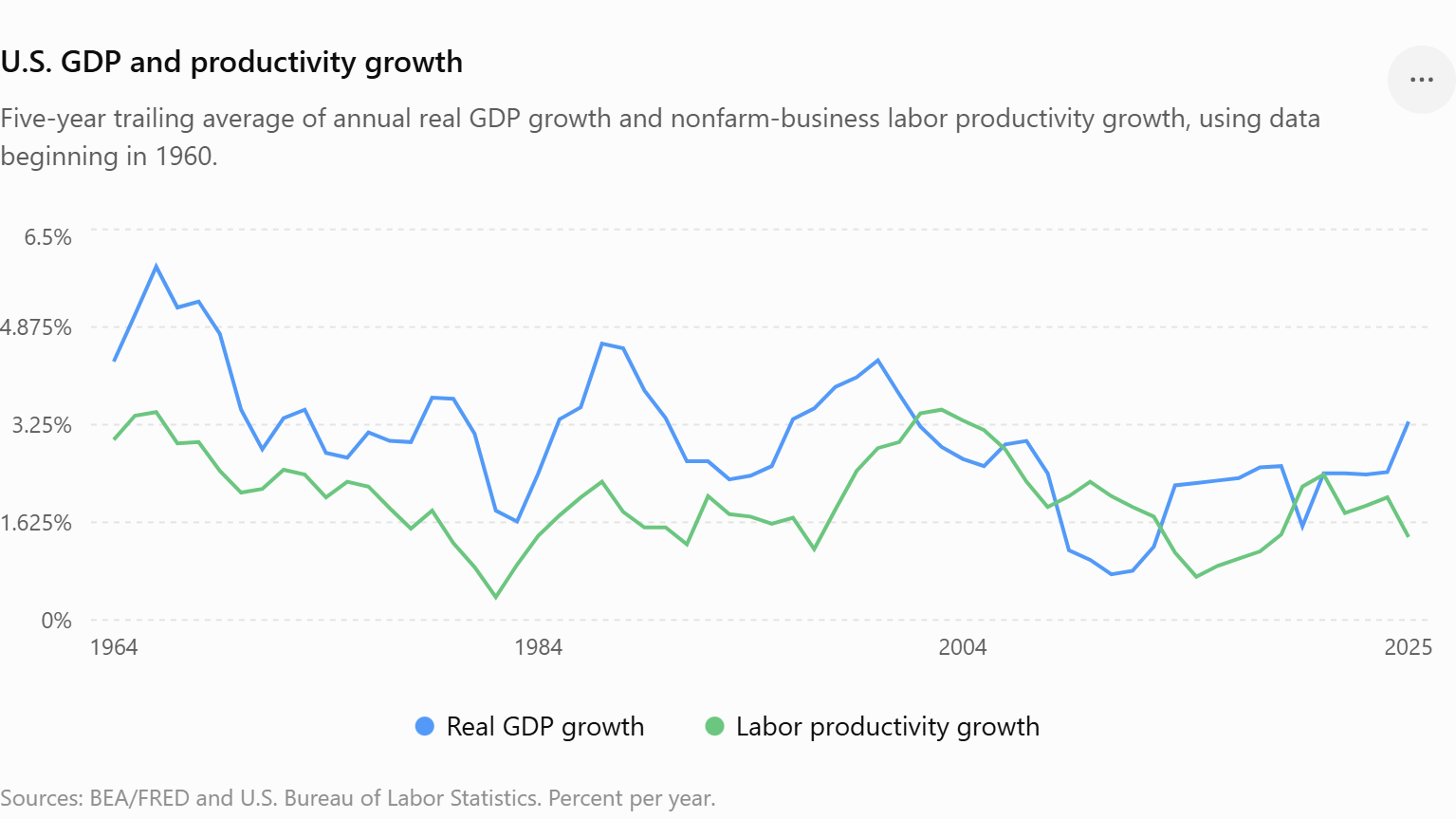
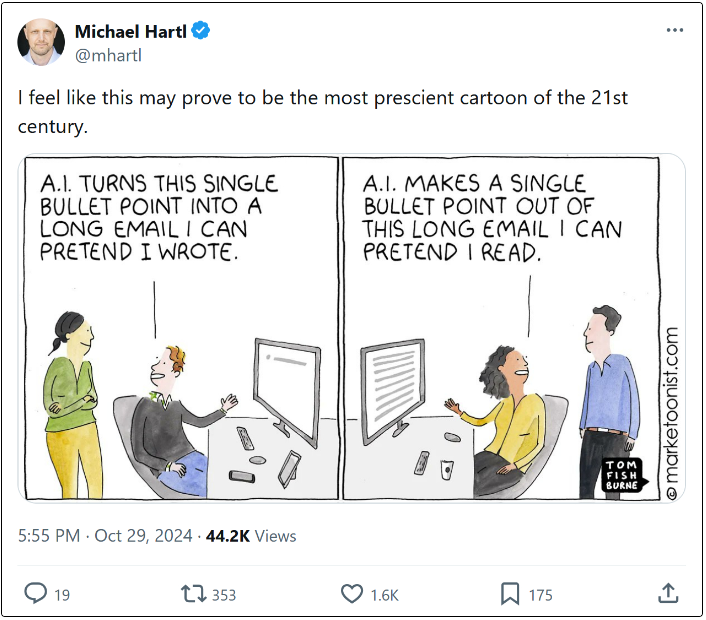
It’s funny how AI has made white collar work 10x faster already but there’s been basically no economic impact from it.

The reason is quite simple:

1. Most white collar work is bullshit, so speeding it up by 10x still equals a pile of bullshit at the end

2. Most white collar employees are using AI to do all their work for the week in 4 hours instead of 40, whilst telling their manager the deadline is still 40 hours away

We have been living in a fake economy for the better part of two decades. It is all a fugazi.

People who do real jobs in the real world get paid comparatively crap, and people who do fake jobs in the fiat Ponzi world get paid just enough fiat currency to pretend they are important. None of it amounts to anything productive nor valuable for the world though.

An entire generation doing fake email jobs, slide decks and excel sheets for corporations who ultimately produce nothing.

April 6, 2026

QotD: Taylorism

Filed under: Books, Business, Quotations — Tags: , , , , , — Nicholas @ 01:00

In the world of management, the ideology of generic, domain-agnostic expertise first made its appearance in the late 19th century under the name of “scientific management”, or “Taylorism” after its godfather Frederick Winslow Taylor. Taylor’s insight was that the same engineering principles used to design a more economical or efficient product could just as well be applied to the shop floor itself. In his view, the workers, overseers, and production processes of a factory all combined to form a great living machine, and that machine could be optimized and made more efficient by an application of scientific attitudes.

Taylor was unpopular in his own day and is even less popular today, because his particular brand of optimization of the great living machine was all about stripping autonomy (or as Marx would say, “control and conscious direction“) from workers. But the particular kind of optimization he advocated is less important than the conceptual breakthrough that while a nail factory and a car factory might look very different on the surface, they are both governed by the same set of abstract laws: laws of time and motion, concurrency, bottlenecks, worker motivation and so on. A master of those laws could optimize a nail factory, and then go on to optimize a car factory, and could do both without knowing very much at all about nails or cars.

Who could have a problem with that? Even I don’t think it’s entirely wrong — I may have misgivings about the sheer volume of people going into fields like management consulting, but I’ll admit that there remains alpha in asking a smart and incisive outsider to take a look at your operation and tell you what seems crazy. The trouble comes with confusing that sporadic, occasional sanity-check with the actual business of leading a team of people who are working together to achieve an objective. Because, get this, it’s impossible to lead such a team without a deep understanding of the details of every person’s tasks.

It’s surreal to me that this point has to be made, yet somehow it does. If the team you lead makes nails, you need to know everything there is to know about making nails. If the team you lead operates a restaurant, you need to be an expert, not in “management”, but in restaurants. If the team you lead sells mortgage-backed derivatives, you better know a heck of a lot about finance in general, mortgages in particular, the art of sales, and the specific world of selling financial instruments. There are a thousand reasons why this is true, but consider just one: a subordinate is failing at a task, and tells you that it isn’t because he’s lazy or unqualified but because the task is unexpectedly difficult. How on earth can a manager evaluate this claim without being able to do the job himself?

There’s another, very different reason managers need to be experts in whatever it is their team is doing, and it has to do with morale. A subordinate in any sort of hierarchical organization needs to see that his superior can do his own job as well or better than he can. Almost everybody gets this. In a high-pressure commercial kitchen, if a chef or sous-chef doesn’t like the performance of one of their line cooks, they will often leap in, take over that cook’s station, and begin “expediting.” This has a dual purpose: it both relieves a genuine production bottleneck, and also acts as a showy demonstration of prowess, reminding everybody that they got to be the boss through excellence. At the better tech companies, those managing software engineers are always former engineers themselves, and often the very best of the lot. Just like a chef would do, an engineering manager needs to be able to seize a computer and begin expediting under pressure, both to solve a real problem and as a dominance display. But it’s not just about keeping the troops in line, it’s about inspiring them. Nothing motivates a soldier like seeing his commander leading the charge, weapon in hand.1

John Psmith, “REVIEW: Scaling People by Claire Hughes Johnson”, Mr. and Mrs. Psmith’s Bookshelf, 2023-08-28.


  1. This shows up in places you wouldn’t expect to. I was once cast in a show, and quickly came to understand that our director could (and often did) leap onto the stage, snatch a script out of somebody’s hand, and play their part better than they could. For any part. Before he did this to me, I found him annoying and bossy. Afterwards, I would follow him into the Somme.

Update, 7 April: Welcome, Instapundit readers! Have a look around at some of my other posts you may find of interest. I send out a daily summary of posts here through my Substackhttps://substack.com/@nicholasrusson that you can subscribe to if you’d like to be informed of new posts in the future.

March 19, 2026

Government creates a problem – yet the solution is always “more government!”

Filed under: Bureaucracy, Cancon, Government — Tags: , , , , — Nicholas @ 03:00

On the social media site formerly known as Twitter, L. Wayne Mathison explains the vast drawbacks of asking governments to solve problems:

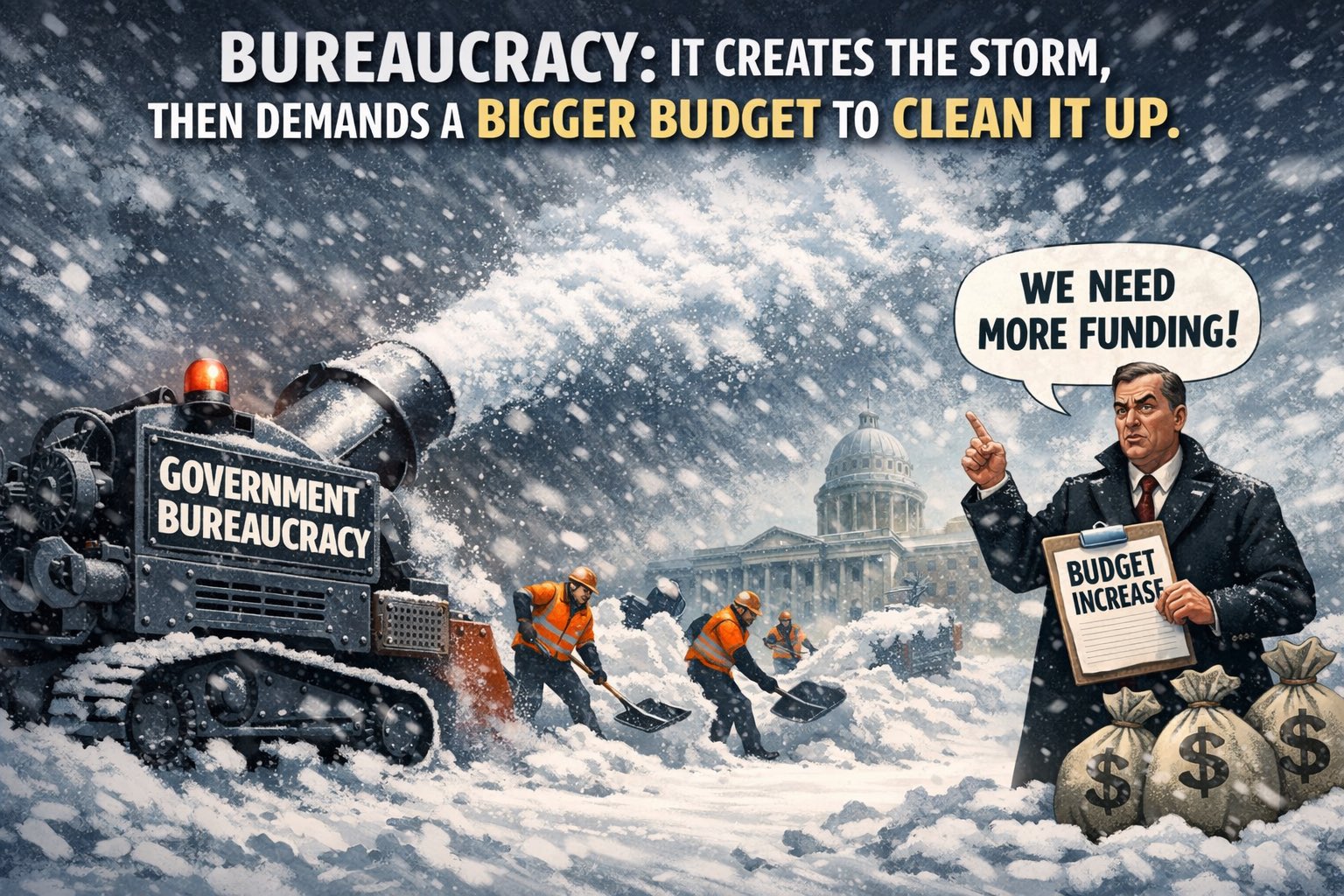
Government bureaucracy is like a snow machine that keeps blasting, then hires more people to shovel the mess it just made.

We’re told it exists to help. To protect. To serve. Nice story. But in practice, it behaves more like a self-preserving organism. It doesn’t solve problems cleanly. It multiplies them, then offers to manage the mess it helped create.

Here’s the part most people miss. Bureaucracies don’t grow because problems get bigger. They grow because complexity gets rewarded. The more tangled the system, the more valuable the people who run it. That’s not a bug. That’s the incentive structure.

William Niskanen called this decades ago. Bureaucrats maximize budgets, not results. Bigger department, bigger influence. If a problem gets solved too efficiently, the machine loses a reason to exist. So problems don’t disappear. They get “managed”.

Then comes the language game.

Confusion gets dressed up as compassion.
A program no one understands becomes “comprehensive”.
A policy that creates dependency becomes “support”.
Failure becomes “underfunding”.

It’s like hiring a mechanic who loosens parts just to bill you for tightening them later.

Now zoom in on Canada. Then zoom in tighter on Manitoba.

We don’t just have bureaucracy. We have an oversized public sector that’s crowding out the very engine that pays for it. In Manitoba especially, government employment makes up a huge slice of the workforce compared to the private sector that actually generates wealth. More administrators, fewer producers.

And here’s the quiet problem. Public sector growth doesn’t face the same discipline as the private sector. If a business bloats, it dies. If a department bloats, it asks for more funding.

So the balance drifts.

More people administering. Fewer people building, investing, risking.
More rules. Less output.
More spending. Slower growth.

It creates a kind of economic inversion. The part of society that redistributes wealth starts to outweigh the part that creates it. That’s not sustainable. It’s like living off the interest of a bank account you’ve stopped contributing to.

Politicians don’t fix this because growth is easy to sell. Cuts are not. No one gets applause for saying, “We’re going to do less”. So the system expands in one direction only.

Forward. Always forward. Never back.

Meanwhile, taxpayers are handed the bill and told it’s the price of caring.

Here’s the hard reframe. Bureaucracy isn’t malfunctioning. It’s doing exactly what it’s rewarded to do. Expand. Protect itself. Justify its existence.

If you want a different outcome, you need different incentives.

Measure outcomes, not spending.
Reward efficiency, not headcount.
Shrink what doesn’t work, no matter how “important” it sounds.

Because if you don’t trim the machine, it doesn’t stay the same size.

It learns to eat.

March 7, 2026

QotD: Grind culture and performative working

Filed under: Britain, Business, Quotations — Tags: , — Nicholas @ 01:00

As if compelled by unseen forces — one imagines that scene in The Exorcist — my fellow traveller adjusts his AirPods, straightens his spine, and “locks in”. Before him lies the cluttered still life of Productivity™: a crumpled FT, a bottle of protein-infused kefir, and two boiled eggs sweating inside their polypropylene coffin. For several moments, he sits with priestly solemnity. Then, as the train inches forward, so does he.

And so, begins his morning recital. I would call it theatre, but theatre requires even the slightest concession to its audience. There is no risk of such grace here.

“Jenny? You still there? Jenny? Excellent.”

He repeats her name as though invoking the supernatural. Dale Carnegie once advised this rigmarole; it’s meant to build something called rapport. Unfortunately, Dale Carnegie never sat captive before a disciple who had taken his gospels quite so literally.

“Jenny (build rapport), could you run those numbers by me again? (assert authority). I’m hoping to parallel-path with you moving forward (signal tribal membership). Great! (convey enthusiasm). Jenny, let’s circle back at 1400 GMT; I want to put a pin into an area of emerging awareness.”

By this point in the sermon, I’d developed several areas of emerging resentment and the unignorable desire to drive pins into eardrums — mostly mine. His monologue, which suggested he charged by the word, stretched unabated from Reading to London Paddington, where he skulked off the platform and into the neon vomit of the city like a Roman senator descending into the Suburra.

In the false refuge of a nearby pub, the missionaries gather and gab incessantly. Chirruping clots of earnest twenty-somethings discuss REM-centric sleep regimes, dopamine stacking, and some Santeria called “sunlight dosing”. They sip protein-riddled IPAs. They recite “Huberman says …” as the devout once invoked St Augustine.

These rituals — the 21st-century Lascaux cave paintings — serve one purpose: to peacock one’s devotion to a deity known as The Grind. Like all deities, The Grind demands a daily sacrifice for a distant, mostly hypothetical reward.

We have struggled to name this social pathology. Grind culture. Hustle culture. 996. No days off. Whatever it is, it is not working. In truth, it is the inbred relation of Performative Reading — Performative Working. This theatre drips with all the fripperies of work and none of the results. Much like a Hinge premium account, or indeed the British state.

Christopher Gage, “Mourning Routine: The Cult of Performative Work”, Oxford Sour, 2025-12-03.

December 7, 2025

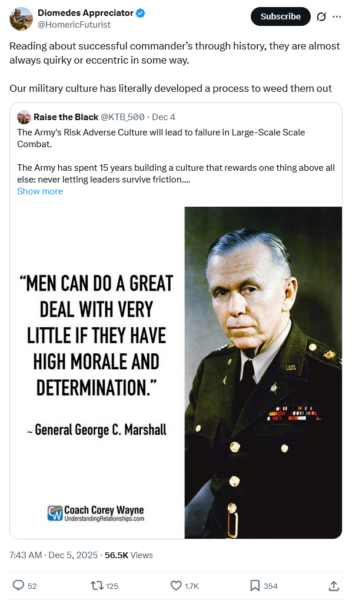
The great military leaders of the past have been … quirky

Filed under: Bureaucracy, History, Military, USA — Tags: , , , — Nicholas @ 03:00

On the social media site formerly known as Twitter, @InfantryDort considers the clear evidence that most of the greatest generals of history were, at the very least, eccentric:

Most real post I’ve seen all month.

Yes, the process weeds them out.

Until all that remains is some corporatized astroturfed version of … whatever.

Military commanders in the modern era MUST lack personal audacity to some degree. Almost without exception.

Because audacity is “dangerous”. It can be unpredictable. And this is a bad thing in a world obsessed with safety and predictability.

But a military without it, is just one on anti-depressants. You never feel the highest highs or the lowest lows.

You just … exist, in inspirational purgatory.

So you will never see a Napoleon, Patton, Allen, or Sherman ever again.

Their modern equivalents mostly got out as captains because the experience they were promised from history, is now covered in bubble wrap. Wearing a bib and a football helmet.

The modern military is devoid of both victory and defeat. A victory you aren’t allowed to win. A defeat you can explain away. Much of it is due to the American people themselves, and their disdain for violence. At least violence against what sane people classify as enemies.

We have a chance to take it back. A chance to return to glorious and sometimes unhinged leadership. But the rot is thick. And the Empire Strikes Back daily.

My infinite gratitude, and the gratitude of a fawning nation, will rest with those who display the force of will to make it happen.

And crush the corporatization of military leadership once and for all.

The world awaits. And one wonders if our country has the appetite for it all, short of an existential crisis in a war of national survival.

Update, 8 December: Welcome, Instapundit readers! Please do have a look around at some of my other posts you may find of interest. I send out a daily summary of posts here through my Substackhttps://substack.com/@nicholasrusson that you can subscribe to if you’d like to be informed of new posts in the future.

September 17, 2025

QotD: Indecision

Filed under: Government, History, Military, Politics, Quotations, USA — Tags: , , , — Nicholas @ 01:00

For those who’ve seen Band of Brothers, there’s a very telling conversation between Carville and Winters, as the sergeant complains about his platoon commander, Lt. Dyke:

    “It’s not that he makes bad decisions; it’s that he doesn’t make any decisions at all.”

Any time you see that situation in a manager, any manager, it is a flashing neon sign of incompetence.

One of the reasons why Marxists make such poor managers is that if they are presented with a situation which cannot be addressed by Party doctrine, they are largely indecisive. Even worse, if that doctrine runs counter to good management, they will use that as the underpinning for their indecisiveness. We saw this a lot under Obama, who was pathetically underqualified as a manager, having had no executive experience in his entire life before becoming POTUS. More often than not, when faced with a decision, he simply froze and allowed events to dictate the outcome, even if that outcome was inimical to the interests of the country he was supposed to be governing. (And to prove my point above, his Marxist doctrine held that the United States was a malignant force in world affairs, so allowing harm to befall the country was — to his mind — actually the proper thing to do as it “corrected” or atoned for America’s past sins.)

Kim du Toit, “Failure”, Splendid Isolation, 2020-06-04.

September 13, 2025

QotD: The Peter Principle in football, the military, and life in general

Filed under: Bureaucracy, Football, Military, Quotations, USA — Tags: , , , , , — Nicholas @ 01:00

There needs to be a word for that inflection point where the “player” and “coach” levels don’t just diverge, but actually seem to become opposites. Is that an organizational thing, a cultural thing, or what? It’s all “football”, and you probably don’t want guys who have never taken a snap to suddenly be calling plays from the sidelines, but it seems like rising to the top of one side almost by definition precludes you from doing well on the other side (for every great player who was a terrible coach, there’s a great coach who was a terrible player. I don’t think there’s any doubt that Bill Belichick is the best coach currently in the NFL, and he’s got to be a strong contender for best coach of all time, but his playing career topped out at Wesleyan University in Middletown, CT).

Is that true in other jobs where you need a combo of a certain physique, a certain IQ, and a certain attitude? The military, say, or the police? Would the average platoon sergeant be a better lieutenant than the average lieutenant? (I’m seriously asking, even though I know that the average corporal’s opinion of the average butterbar lieutenant and vice versa makes the town-gown split in college look like a friendly rivalry). What about the best NCO — would he make a good general? How about the best patrolman vs. the best detective?

And of course this is complicated by the outliers. SWAT guys generally don’t become police chiefs, Special Forces guys don’t become generals (that McChrystal bastard being an unfortunate exception), and so on, but those are extreme outliers, like quarterbacks — physical freaks with fast-firing heads; they don’t want desk jobs, I imagine.

The reason I’m rambling on about this (other than “I’m jet lagged and I have the flu”) is that our whole society seems to have fucked up its competence sorting mechanism, and that flaw seems to be structural. You don’t want a coach who never played, or a general who never fought, but at the same time there’s fuck-all relationship between “being good at playing / fighting” and “being good at coaching / strategizing” that I can see. The same applies in all bureaucracies, of course, we call it the “Peter Principle” — the guy who was good at answering phones in the call center might or might not be any good at supervising the call center, but there’s only one way to find out …

… or is there? Football is interesting in that there’s only one metric for success, and it’s easy for everyone to see. There’s absolutely zero question that So-and-So was a good player, in the same way that there’s zero question So-and-So was a good coach. You can always find nerds and lawyers to niggle around the edges — oh, So-and-So is overrated, and here’s my charts and graphs to prove it — but we all know what that’s worth. Figuring out a better way to sort talent in a binary system like football would go a long way to help us figure out how to fix our society’s fucked-up competence sorting mechanism.

Severian, “Friday Etc.”, Founding Questions, 2022-02-04.

August 27, 2025

QotD: A critical bureaucratic talent

Filed under: Bureaucracy, Humour, Quotations — Tags: , , — Nicholas @ 01:00

“Gentlemen! Gentlemen!” The Patrician raised his hands in a conciliatory fashion. “It seems to me,” he went on, taking advantage of the brief pause, “that what we have here is a strictly magical phenomenon. I would like to hear from our learned friend on this point. Hmm?”

Someone nudged the Archchancellor of Unseen University, who had nodded off.

“Eh? What?” said the wizard, startled into wakefulness.

“We were wondering,” said the Patrician loudly, “what you were intending to do about this dragon of yours?”

The Archchancellor was old, but a lifetime of survival in the world of competitive wizardry and the byzantine politics of Unseen University meant that he could whip up a defensive argument in a split second. You didn’t remain Archchancellor for long if you let that sort of ingenuous remark whizz past your ear.

“My dragon?” he said.

“It’s well known that the great dragons are extinct,” said the Patrician brusquely. “And, besides, their natural habitat was definitely rural. So it seems to me that this one must be mag—”

“With respect, Lord Vetinari,” said the Archchancellor, “it has often been claimed that dragons are extinct, but the current evidence, if I may make so bold, tends to cast a certain doubt on the theory. As to habitat, what we are seeing here is simply a change of behavior pattern, occasioned by the spread of urban areas into the countryside which has led many hitherto rural creatures to adopt, nay in many cases to positively embrace, a more municipal mode of existence, and many of them thrive on the new opportunities thereby opened to them. For example, foxes are always knocking over my dustbins.”

He beamed. He’d managed to get all the way through it without actually needing to engage his brain.

Terry Pratchett, Guards! Guards!, 1989.

August 26, 2025

QotD: Problem-solving in large organizations

Filed under: Bureaucracy, Business, Quotations — Tags: , , — Nicholas @ 01:00

… but it’s the nature of bureaucracy itself that’s most to blame. Everyone who has ever worked for even a midsize company has had this kind of experience: You’re in Customer Service, and some hotshot from Sales calls you up. He’s promised a big new potential client the earth and stars, and now he needs you to deliver. Alas, you tell him, you can’t do it. Not won’t, can’t — you’re not set up for that kind of thing. So you call your Department Supervisor over, and he comes up with what looks like a workaround …

… except no, now Accounting chimes in, that looks like it might be a violation of some codicil to some sub-paragraph of an addendum to a regulation, better check with Compliance. But before you can do that, the Division Managers get into it, because hotshot has called his Department Supervisor over and said look, Dave, I brought in seventy gorillion dollars last fiscal year, you owe me this one …

… and so forth. Everybody with me? No one is corrupt in this scenario. Nobody’s trying to pull a fast one on anybody else. Indeed, everybody’s on the same page, and everybody has every incentive to find a solution, because all our Christmas bonuses are going to look a little nicer if the firm lands this fat client. All we’re trying to do is add one task to the existing Customer Service workflow, but it’s going to take at least a Division Manager-level meeting, if not the direct input of the Big Boss himself, to get it hammered out. It’s an exponential increase in energy expenditure.

And of course it ramifies, and of course that’s true no matter what solution you come up with. Make an exception to the workflow for this one client, and pretty soon you’re going to be making exceptions for every client — every wannabe-hotshot up in Sales is going to demand the works for every little podunk potential client. Same deal if you designate one guy from Customer Service as the dedicated exception-handler. Same deal if you create a whole new sub-unit inside Customer Service (but a lot faster). And so forth.

I’m sure everyone has had that experience, too: Watching your company lose out on a potential big client because the various Departments couldn’t get on the same page for whatever reason.

And that’s just around the office! Meaning: yeah, it’d be nice if we could land that big client, maybe see an extra hundred bucks on our Christmas bonus, but nobody’s losing any sleep over it. Well, ok, Hotshot up in Sales probably is, but even the best salesman loses far more often than he wins. He’ll get over it in a day or two, or he won’t be a salesman much longer.

But the same thing happens when it comes to stuff that matters, which is why complex societies collapse.

Severian, “Collapse II”, Founding Questions, 2021-12-09.

July 28, 2025

QotD: The technology ecosystem

Filed under: Books, Business, Quotations, Technology, USA — Tags: , , , — Nicholas @ 01:00

A lot of thinkfluencers will describe technology as an “ecosystem” without grappling with the full implications of that term. Most often when they say it they’re referring to a cluster of consumer-facing businesses that rent space or other capabilities from a “platform” provider, like apps on an App Store. But that isn’t an ecosystem, that’s a shopping mall. Real ecosystems have energy and nutrient flow both up and down the food chain, as well as laterally; they have vast swarms of bottom feeders, fungi, and other detritivores that recycle matter through decomposition and make its constituents bioavailable once more; they also have a constant source of energy input (usually the sun) to make up for the constant entropic drag that would otherwise grind things to a halt. One of the great discoveries of modern ecology is that apex predators, macrofauna, the plants and animals we notice and admire are perched precariously atop a vast network of invisible supports. A tiger is the temporary result of too many worms gathering in one place.

Technology is also an ecosystem, not the way bluechecks talk about it, but in this more profound sense. A Boeing or a Google is like a tiger: the highly-visible culmination of a vast subterranean drama. Turn over a spade and you’ll find them — the suppliers and subcontractors, investor networks, tooling manufacturers, feeder universities, advisors, researchers, shipping and packaging experts, friendly bankers and government officials, producers of upstream technological inputs, and a vast collection of lower-tier companies in related markets that act like an economic flywheel, absorbing and releasing excess labor as the economy shudders through its fits and starts.

In nature, it’s energy and nutrients that move through the food webs. Here their analogues are capital and knowledge. It’s hard to miss the money sloshing back and forth — world-changing companies are nurtured through their awkward adolescence by sophisticated and patient pools of capital, and the high-flying champions of those companies become the next generation’s venture investors after cashing out. Harder to see but even more influential is the vast economic dark matter made up of professionals who struck it rich enough to live comfortably but not rich enough to fly private. These unobtrusive capitalists are the first to hear through professional whispernets that so-and-so has quit his job to work on such-and-such. Since they’re still in the rat-race, they can have an informed opinion on the caliber both of the idea and of the team around it, and are usually the early champions of the most unusual and speculative ventures. And finally, money sloshes around between the companies themselves through a complicated network of deals, joint ventures, and strategic investments.

The money is more visible, but the way knowledge moves is more important. Part of it is academic, propositional knowledge or technical data whose discovery is accelerated when a dozen different teams are on its scent, sometimes racing each other to the prize, sometimes egging each other on and celebrating each others’ victories. But the bulk of what makes this ecosystem hum, the true currency that drives nearly every barter or exchange, is practical, process knowledge of the sort that 莊子 first described and Michael Oakeshott later re-popularized for our benighted and ignorant age. What makes process knowledge unusual is that by its very nature it cannot be separated from people, cannot be digitized or divorced or attached to an email. It is at once the nous of a technological ecosystem and the thing that makes it fundamentally illegible — an immaterial, intangible essence that inheres only in individuals, like a mind or a soul.

John Psmith, “REVIEW: Flying Blind by Peter Robison”, Mr. and Mrs. Psmith’s Bookshelf, 2023-02-06.

July 20, 2025

“[T]he job of a manager [is] to get all C Northcote on bureaucracy”

Filed under: Bureaucracy, Government, USA — Tags: , , , — Nicholas @ 03:00

Tim Worstall discusses the recent announcements about the US State Department significantly reducing their staff levels — a “Reduction In Force” or RIF — that is being lamented by the Washington bureaus of all the surviving mainstream media as a world tragedy:

The Guru here, the epitome of the management science, is C Northcote Parkinson. Best remembered for Parkinson’s Law — work expands to fill the time available for its completion. But a deeper thinker than that aphorism.

The essential point being that the output of a bureaucracy is bureaucracy. There is nothing measurable that is being done, no financial value being put upon the work. Sure, sure, it might even be that what is being done is of value — we’ve not got a simple measure of it though.

Therefore a bureaucracy measures itself by the budget and staff count. The success of a bureaucracy — a bureau perhaps — is measured by increases in either or better both. Which really does mean that the output of having a bureaucracy is more bureaucracy.

In the private sector this occurs as well. That’s how the power skirts get to take over large corporations. Of course, at some point in that process the company runs out of money and goes bust — the land is cleared for the next attempt to actually add value.

With government that doesn’t happen. Which leads to one of my favourite little thoughts — every civilisation survives until it is parasitised, eaten from within, by its own bureaucracy. We’d probably prefer that this didn’t happen. Yes, anarchy is all very well in theory but no one does like it when the bins aren’t emptied and there’s no state left to keep the French at bay.

The result of this is that the state bureaucracy needs to be pruned. Always. The actual job of a minister is — should be at least — to muse on what shouldn’t be done any longer and who can we fire? As should be the waking thought of any CEO of course.

My preference — because I’m extremist, obviously — is that we just fire them all. Then hire back the 2% we actually do require in order to have a civilisation. Remember, the Empire ran India with 1,000 men. And, well, it’s not wholly obvious that it’s been run any better than that since then.

That’s therefore the job of a manager. To get all C Northcote on bureaucracy. Always and everywhere. If you prefer your phrasing a little more red blooded the answer to bureaucrats is the Carthaginian Solution. Not that anyone would buy them as slaves, not productive enough, but we can try, right?

What do you call 22,000 fewer civil servants in Washington? A good start:

Update: Fixed missing URL.

July 16, 2025

Matt Gurney’s “Hollywood Thesis”

I almost skipped reading this one, as Matt and Jen usually keep their own columns behind the paywall, but this one is free to non-paying cheapskates like me:

… I actually think there is one way that Hollywood — and probably mass entertainment writ large — has kind of warped our society. It’s not that it has promoted degeneracy or loose morals or shameless enjoyment of vice. It’s more insidious. And probably more dangerous.

I think Hollywood has tricked us into thinking that, in an emergency, our governments will prove to be a lot more competent than they will be. And usually are.

This is something I’ve been thinking about for a while. I’ve mentioned it to my Line colleagues before, and I call it my Hollywood Thesis. As I see it, the broader public has fairly accurate expectations about the level of service they can expect from their government. Sometimes it’s good, sometimes it’s bad, but it’s mostly realistic. We basically know what we’re getting into when we, for example, drag the trash bin to the curb, or turn on a tap in the morning, or go to an emergency room because you need to get stitched up after a minor mishap.

But I’ve observed over the years an interesting exception. When the public is confronted with any kind of new or unexpected threat, people, for some reason, believe their government will have some secret ability or unexpected expertise in dealing with it. Maybe it’s a quirky scientist working in the bowels of some ministry or department. Maybe it’s an elite team of experts. Or some hidden base loaded with commandos and advanced weaponry.

Wrong. And I’ve been thinking about this. Why do we assume the same government that is, for instance, struggling to fill potholes in my city, or hire enough nurses in my province, or fix a federal payroll system, is going to be more competent when presented with something totally out of the blue? This flies in the face of all of our lived experiences with government. It’s a generous assumption of state capacity that is, to put it charitably, unearned.

So why? What explains this?

It’s Hollywood. It has to be.

Lots of smart, competent people have government jobs. One of the great joys of my career has been the opportunity to speak with many. There are shining lights of unusual competency in every department, and at every order of government, really — my colleague Jen Gerson recently told our podcast listeners about how one of these hidden gems helped her cut through a confusing and dysfunctional process so she could get a permit. And I will never get tired of saying good things about the men and women of the Canadian Armed Forces — true miracle workers we do not support enough.

But there aren’t hidden capabilities. There aren’t secret teams. The same people trying to prevent Canada Post from going on strike will be the same people handling the next pandemic — or who would be responsible for opening a dialogue if aliens decided to land their mothership in the middle of a Saskatchewan farm.

It’s within the range of possibilities that, presented with a unique challenge, government leaders could rise to meet it … as long as it’s a completely unexpected situation with no pre-existing rules or regulations or bureaucratic processes in place. I admit it’s not the way the smart money would bet, but it’s technically a possibility.

July 5, 2025

“This is what happens when a major label morphs into a copyright and IP management business”

Filed under: Business, History, Media, USA — Tags: , , , — Nicholas @ 04:00

Ted Gioia reads the tea leaves of the big music labels and says that the future does not look good. At all:

I follow music industry news the way other people read obituaries.

Those two kinds of articles have a lot in common — both death notices and music biz news deal mostly with the past. The only new thing in the story is that something was living, and now it ain’t.

Here’s an example from yesterday:

This sounds like a happy story, no? These smart people are investing in music.

But it isn’t a happy story. They are investing in the rights to old music. They won’t spend any of that money on new music.

If you have any doubts about Warner’s priorities, here’s another headline — also from yesterday.

If you’re looking for a clear signal from a major record label, it won’t get any clearer than this.

This is exactly what a record label does when it no longer views music as a vital creative force in the current day. This is what happens when a major label morphs into a copyright and IP management business — which can be run by a small team of lawyers and accountants.

Yes, you can make money living off the past — but not for long.

I keep waiting to read a news story about a major label investing a billion dollars in developing new artists. But I never see that story.

I’ve written in the past about fans who prefer old music. But big record labels are even more obsessed with vintage and retro songs.

And it’s not just Warner Music. Universal Music is doing the same thing. So is Sony and Concord and other big labels.

That’s disturbing.

These are the same companies who should be creating the future of music. They should be convincing the public to listen to new songs and new artists. After all, if record labels don’t invest in the future of music, who will?

Maybe nobody.

A few years ago, investment firms started viewing old songs as investments. That didn’t work out very well. The most prominent song investment fund crashed and burned — as I predicted long in advance.

At that point, the smart money headed for the exits.

In the aftermath, the only enthusiastic buyers of old songs were the big record labels. They are the buyers of last resort.

June 8, 2025

Managerialism – threat or menace?

Filed under: Bureaucracy, Business, Government, USA — Tags: , , , , — Nicholas @ 05:00

In the New York Times (don’t worry … link is to an archived version), Nathan Levine explains to NYT readers why there is such a push back against the over-mighty technocratic organizations that have been running more and more of our fading civilization:

It is the culmination of a once marginalized, now transformative strand of political thought about who really holds power in the modern American system. Namely, that our democracy has been usurped by a permanent ruling class of wholly unaccountable managers and bureaucrats.

Anti-managerialism is back. Well positioned to answer decades of frustration with mainstream conservatives’ failure to deliver results, this old idea has become the central principle of the new right.

In fact, much of what is commonly called “populist” politics can be more accurately described as part of an anti-managerial revolution attempting to roll back the expansion of overbearing bureaucratic control into more and more areas of life.

Though it has so far met with limited success amid stiff resistance, grasping the nature of this anti-managerialism is essential to understanding the Trump administration’s effort to transform America’s institutional landscape, from government to universities and major corporations.

The idea’s intellectual history begins with the political philosopher James Burnham, who argued in his seminal 1941 book, The Managerial Revolution, that the aristocratic capitalist class was in the process of being overthrown by a revolution — just not, as the Marxists predicted, by the working class.

Instead, the exponential growth of mass and scale produced by the Industrial Revolution meant that in both corporation and state it was now those people cleverest at applying techniques of mass organization, procedure and propaganda — what he called the managerial class — who effectively controlled the means of production and would increasingly come to dominate society as a new technocratic oligarchy.

The book made an especially significant impression on George Orwell, who remarked that a managerial class consisting of “scientists, technicians, teachers, journalists, broadcasters, bureaucrats, professional politicians: in general, middling people”, hungry for “more power and more prestige”, would seek to entrench “a system which eliminates the upper class, keeps the working class in its place, and hands unlimited power to people very similar to themselves”.

Orwell was particularly struck by Burnham’s observation that the major political systems of the day — fascism, Communism and New Deal-era social democracy — were fundamentally similar in their turn toward the bureaucratic management of society. He observed that everywhere “laissez-faire capitalism gives way to planning and state interference” and “the mere owner loses power as against the technician and the bureaucrat”. Believing that accelerating managerial control risked dragging every society inexorably into totalitarianism, Orwell made Burnham’s ideas the basis of his novel 1984.

While the Cold War persisted, the view that America’s government might share some traits with the Soviet Union unsurprisingly proved unpopular, especially among Washington’s conservative establishment.

Nonetheless, the managerial class continued to grow, regardless of which political party controlled the government. Cold War defense budgets drove a relentless expansion of security state bureaucracy and the military-industrial complex. The advent of Great Society welfare programs and the Civil Rights Act demanded a re-engineering of social relations, prompting a dramatic proliferation of lawyers, regulatory bureaucrats and corporate compliance officers throughout much of public and private life. An ever-greater proportion of Americans began funneling through the credentialing machinery of higher education, inflating demand for yet more upper-middle-class managerial jobs.

QotD: The ratchet effect

It’s well known that the people at the tippy top are raging SJWs, of course, but as anyone who has ever even tangentially worked for a GloboHomoCorp knows, the Big Bosses don’t know jack shit about even very high level stuff going on in their own companies. Big Boss, and several layers of management below Big Boss, are mainly concerned with greasing politicians and other CEOs. They have absolutely no idea what’s even going on with the North American Branch of the Customer Service Division, let alone what any individual person is up to … so those flunkies and fart catchers and butt boys way down the chain have to kiss ass on their own.

What ends up happening is a kind of “ratchet effect” on steroids. The “ratchet effect”, you’ll recall, was Margaret Thatcher’s explanation for how the Left kept winning on policy even though the Right kept winning at the polls (ah, God love ya, Maggie, and give you peace). When the Left is in power, they get whatever they want. When the Right is in power, they consolidate the Left’s gains, as this is now “the new normal”. Since The Right exists only to twiddle the knobs and levers of the Leviathan State in a more efficient, cost-effective, low-tax way, the “right-wing” “reformers” find jury-rigged quasi-solutions to the problems the Left’s insanity creates.

In a very real way, then, the “ratchet effect” means the so-called “Right” ends up doing the Left’s job for them, much better than they themselves could’ve.

Same deal inside the divisions of GloboHomoCorp. Same deal inside the Third Reich, which is why “working towards the Führer” turned so murderous, so fast. Since the only way to get noticed by the next higher-up level of “management” was to be more obnoxiously ruthless than everybody else at doing what the Führer seemed to be hinting that he wanted …

In the corporate world, then, I theorize, super-aggressive, ultra-obnoxious SJW-ism is a ground-up phenomenon. Does the Big Boss really want mandatory anti-Whiteness training across all divisions? Maybe … but maybe not. And though it’s tempting to say “He’s the Big Boss, he must know at least broadly what the big divisions are up to”, do I even have to ask if you’ve ever been in a situation where that’s true? Big Bosses the world over, in any field, be they CEOs or Generals or Chief Medical Officers or what have you, don’t have the slightest clue what’s happening structurally inside their commands.

All they know is what the next-lower level of management tells them is happening.

Severian, “On Selling Out”, Founding Questions, 2021-11-26.

Older Posts »

Powered by WordPress