
A lot of thinkfluencers will describe technology as an “ecosystem” without grappling with the full implications of that term. Most often when they say it they’re referring to a cluster of consumer-facing businesses that rent space or other capabilities from a “platform” provider, like apps on an App Store. But that isn’t an ecosystem, that’s a shopping mall. Real ecosystems have energy and nutrient flow both up and down the food chain, as well as laterally; they have vast swarms of bottom feeders, fungi, and other detritivores that recycle matter through decomposition and make its constituents bioavailable once more; they also have a constant source of energy input (usually the sun) to make up for the constant entropic drag that would otherwise grind things to a halt. One of the great discoveries of modern ecology is that apex predators, macrofauna, the plants and animals we notice and admire are perched precariously atop a vast network of invisible supports. A tiger is the temporary result of too many worms gathering in one place.
Technology is also an ecosystem, not the way bluechecks talk about it, but in this more profound sense. A Boeing or a Google is like a tiger: the highly-visible culmination of a vast subterranean drama. Turn over a spade and you’ll find them — the suppliers and subcontractors, investor networks, tooling manufacturers, feeder universities, advisors, researchers, shipping and packaging experts, friendly bankers and government officials, producers of upstream technological inputs, and a vast collection of lower-tier companies in related markets that act like an economic flywheel, absorbing and releasing excess labor as the economy shudders through its fits and starts.
In nature, it’s energy and nutrients that move through the food webs. Here their analogues are capital and knowledge. It’s hard to miss the money sloshing back and forth — world-changing companies are nurtured through their awkward adolescence by sophisticated and patient pools of capital, and the high-flying champions of those companies become the next generation’s venture investors after cashing out. Harder to see but even more influential is the vast economic dark matter made up of professionals who struck it rich enough to live comfortably but not rich enough to fly private. These unobtrusive capitalists are the first to hear through professional whispernets that so-and-so has quit his job to work on such-and-such. Since they’re still in the rat-race, they can have an informed opinion on the caliber both of the idea and of the team around it, and are usually the early champions of the most unusual and speculative ventures. And finally, money sloshes around between the companies themselves through a complicated network of deals, joint ventures, and strategic investments.
The money is more visible, but the way knowledge moves is more important. Part of it is academic, propositional knowledge or technical data whose discovery is accelerated when a dozen different teams are on its scent, sometimes racing each other to the prize, sometimes egging each other on and celebrating each others’ victories. But the bulk of what makes this ecosystem hum, the true currency that drives nearly every barter or exchange, is practical, process knowledge of the sort that 莊子 first described and Michael Oakeshott later re-popularized for our benighted and ignorant age. What makes process knowledge unusual is that by its very nature it cannot be separated from people, cannot be digitized or divorced or attached to an email. It is at once the nous of a technological ecosystem and the thing that makes it fundamentally illegible — an immaterial, intangible essence that inheres only in individuals, like a mind or a soul.
John Psmith, “REVIEW: Flying Blind by Peter Robison”, Mr. and Mrs. Psmith’s Bookshelf, 2023-02-06.
July 28, 2025
QotD: The technology ecosystem
July 20, 2025
“[T]he job of a manager [is] to get all C Northcote on bureaucracy”
Tim Worstall discusses the recent announcements about the US State Department significantly reducing their staff levels — a “Reduction In Force” or RIF — that is being lamented by the Washington bureaus of all the surviving mainstream media as a world tragedy:
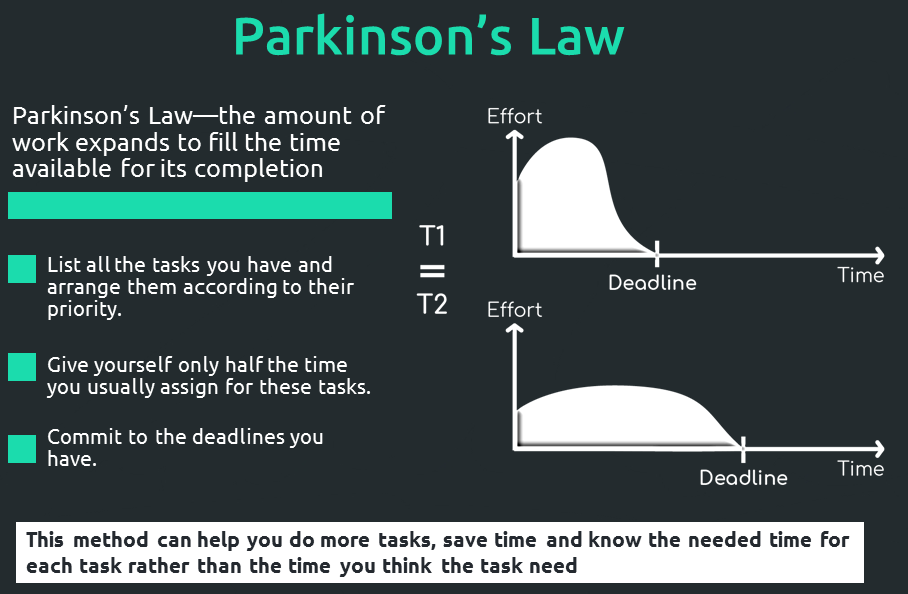
The Guru here, the epitome of the management science, is C Northcote Parkinson. Best remembered for Parkinson’s Law — work expands to fill the time available for its completion. But a deeper thinker than that aphorism.
The essential point being that the output of a bureaucracy is bureaucracy. There is nothing measurable that is being done, no financial value being put upon the work. Sure, sure, it might even be that what is being done is of value — we’ve not got a simple measure of it though.
Therefore a bureaucracy measures itself by the budget and staff count. The success of a bureaucracy — a bureau perhaps — is measured by increases in either or better both. Which really does mean that the output of having a bureaucracy is more bureaucracy.
In the private sector this occurs as well. That’s how the power skirts get to take over large corporations. Of course, at some point in that process the company runs out of money and goes bust — the land is cleared for the next attempt to actually add value.
With government that doesn’t happen. Which leads to one of my favourite little thoughts — every civilisation survives until it is parasitised, eaten from within, by its own bureaucracy. We’d probably prefer that this didn’t happen. Yes, anarchy is all very well in theory but no one does like it when the bins aren’t emptied and there’s no state left to keep the French at bay.
The result of this is that the state bureaucracy needs to be pruned. Always. The actual job of a minister is — should be at least — to muse on what shouldn’t be done any longer and who can we fire? As should be the waking thought of any CEO of course.
My preference — because I’m extremist, obviously — is that we just fire them all. Then hire back the 2% we actually do require in order to have a civilisation. Remember, the Empire ran India with 1,000 men. And, well, it’s not wholly obvious that it’s been run any better than that since then.
That’s therefore the job of a manager. To get all C Northcote on bureaucracy. Always and everywhere. If you prefer your phrasing a little more red blooded the answer to bureaucrats is the Carthaginian Solution. Not that anyone would buy them as slaves, not productive enough, but we can try, right?
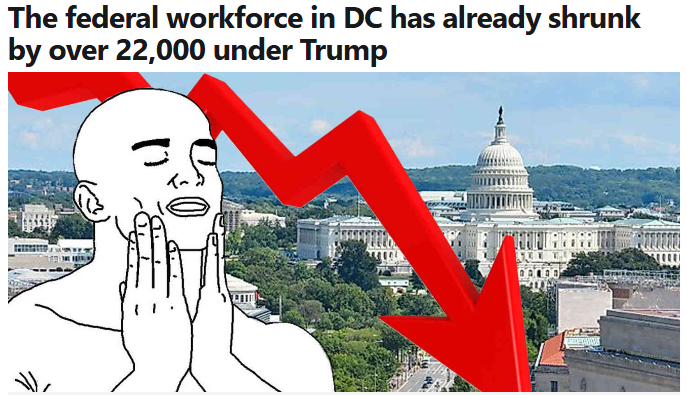
What do you call 22,000 fewer civil servants in Washington? A good start:
Update: Fixed missing URL.
July 16, 2025
Matt Gurney’s “Hollywood Thesis”
I almost skipped reading this one, as Matt and Jen usually keep their own columns behind the paywall, but this one is free to non-paying cheapskates like me:

… I actually think there is one way that Hollywood — and probably mass entertainment writ large — has kind of warped our society. It’s not that it has promoted degeneracy or loose morals or shameless enjoyment of vice. It’s more insidious. And probably more dangerous.
I think Hollywood has tricked us into thinking that, in an emergency, our governments will prove to be a lot more competent than they will be. And usually are.
This is something I’ve been thinking about for a while. I’ve mentioned it to my Line colleagues before, and I call it my Hollywood Thesis. As I see it, the broader public has fairly accurate expectations about the level of service they can expect from their government. Sometimes it’s good, sometimes it’s bad, but it’s mostly realistic. We basically know what we’re getting into when we, for example, drag the trash bin to the curb, or turn on a tap in the morning, or go to an emergency room because you need to get stitched up after a minor mishap.
But I’ve observed over the years an interesting exception. When the public is confronted with any kind of new or unexpected threat, people, for some reason, believe their government will have some secret ability or unexpected expertise in dealing with it. Maybe it’s a quirky scientist working in the bowels of some ministry or department. Maybe it’s an elite team of experts. Or some hidden base loaded with commandos and advanced weaponry.
Wrong. And I’ve been thinking about this. Why do we assume the same government that is, for instance, struggling to fill potholes in my city, or hire enough nurses in my province, or fix a federal payroll system, is going to be more competent when presented with something totally out of the blue? This flies in the face of all of our lived experiences with government. It’s a generous assumption of state capacity that is, to put it charitably, unearned.
So why? What explains this?
It’s Hollywood. It has to be.
Lots of smart, competent people have government jobs. One of the great joys of my career has been the opportunity to speak with many. There are shining lights of unusual competency in every department, and at every order of government, really — my colleague Jen Gerson recently told our podcast listeners about how one of these hidden gems helped her cut through a confusing and dysfunctional process so she could get a permit. And I will never get tired of saying good things about the men and women of the Canadian Armed Forces — true miracle workers we do not support enough.
But there aren’t hidden capabilities. There aren’t secret teams. The same people trying to prevent Canada Post from going on strike will be the same people handling the next pandemic — or who would be responsible for opening a dialogue if aliens decided to land their mothership in the middle of a Saskatchewan farm.
It’s within the range of possibilities that, presented with a unique challenge, government leaders could rise to meet it … as long as it’s a completely unexpected situation with no pre-existing rules or regulations or bureaucratic processes in place. I admit it’s not the way the smart money would bet, but it’s technically a possibility.
July 5, 2025
“This is what happens when a major label morphs into a copyright and IP management business”
Ted Gioia reads the tea leaves of the big music labels and says that the future does not look good. At all:
I follow music industry news the way other people read obituaries.
Those two kinds of articles have a lot in common — both death notices and music biz news deal mostly with the past. The only new thing in the story is that something was living, and now it ain’t.
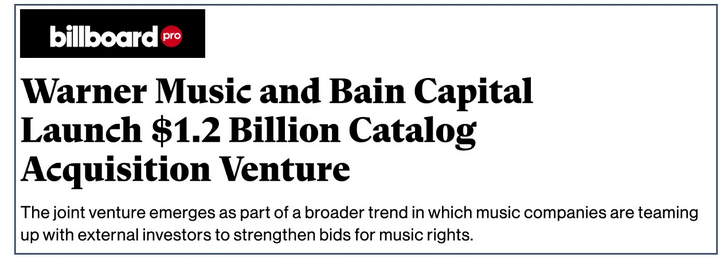
Here’s an example from yesterday:
This sounds like a happy story, no? These smart people are investing in music.
But it isn’t a happy story. They are investing in the rights to old music. They won’t spend any of that money on new music.
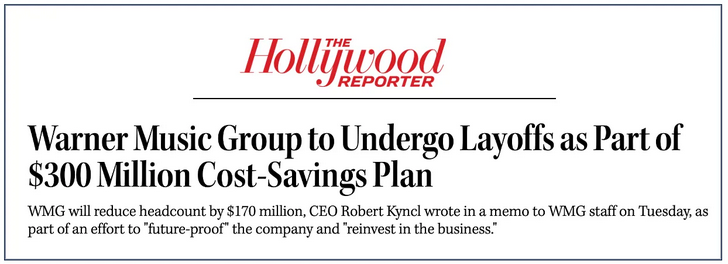
If you have any doubts about Warner’s priorities, here’s another headline — also from yesterday.
If you’re looking for a clear signal from a major record label, it won’t get any clearer than this.
This is exactly what a record label does when it no longer views music as a vital creative force in the current day. This is what happens when a major label morphs into a copyright and IP management business — which can be run by a small team of lawyers and accountants.
Yes, you can make money living off the past — but not for long.
I keep waiting to read a news story about a major label investing a billion dollars in developing new artists. But I never see that story.
I’ve written in the past about fans who prefer old music. But big record labels are even more obsessed with vintage and retro songs.
And it’s not just Warner Music. Universal Music is doing the same thing. So is Sony and Concord and other big labels.
That’s disturbing.
These are the same companies who should be creating the future of music. They should be convincing the public to listen to new songs and new artists. After all, if record labels don’t invest in the future of music, who will?
Maybe nobody.
A few years ago, investment firms started viewing old songs as investments. That didn’t work out very well. The most prominent song investment fund crashed and burned — as I predicted long in advance.
At that point, the smart money headed for the exits.
In the aftermath, the only enthusiastic buyers of old songs were the big record labels. They are the buyers of last resort.
June 8, 2025
Managerialism – threat or menace?
In the New York Times (don’t worry … link is to an archived version), Nathan Levine explains to NYT readers why there is such a push back against the over-mighty technocratic organizations that have been running more and more of our fading civilization:
It is the culmination of a once marginalized, now transformative strand of political thought about who really holds power in the modern American system. Namely, that our democracy has been usurped by a permanent ruling class of wholly unaccountable managers and bureaucrats.
Anti-managerialism is back. Well positioned to answer decades of frustration with mainstream conservatives’ failure to deliver results, this old idea has become the central principle of the new right.
In fact, much of what is commonly called “populist” politics can be more accurately described as part of an anti-managerial revolution attempting to roll back the expansion of overbearing bureaucratic control into more and more areas of life.
Though it has so far met with limited success amid stiff resistance, grasping the nature of this anti-managerialism is essential to understanding the Trump administration’s effort to transform America’s institutional landscape, from government to universities and major corporations.
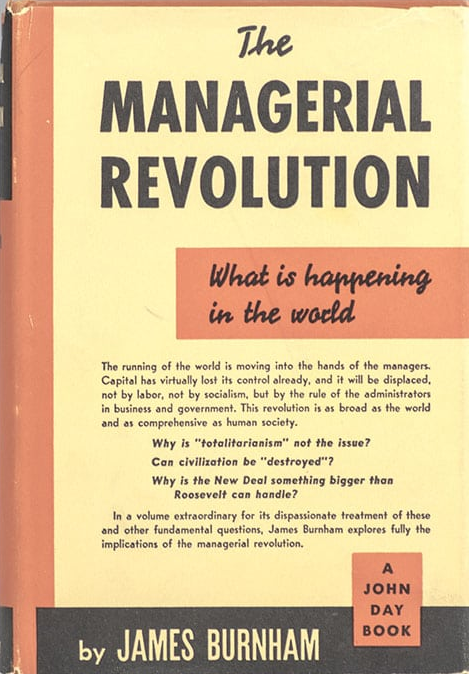
The idea’s intellectual history begins with the political philosopher James Burnham, who argued in his seminal 1941 book, The Managerial Revolution, that the aristocratic capitalist class was in the process of being overthrown by a revolution — just not, as the Marxists predicted, by the working class.
Instead, the exponential growth of mass and scale produced by the Industrial Revolution meant that in both corporation and state it was now those people cleverest at applying techniques of mass organization, procedure and propaganda — what he called the managerial class — who effectively controlled the means of production and would increasingly come to dominate society as a new technocratic oligarchy.
The book made an especially significant impression on George Orwell, who remarked that a managerial class consisting of “scientists, technicians, teachers, journalists, broadcasters, bureaucrats, professional politicians: in general, middling people”, hungry for “more power and more prestige”, would seek to entrench “a system which eliminates the upper class, keeps the working class in its place, and hands unlimited power to people very similar to themselves”.
Orwell was particularly struck by Burnham’s observation that the major political systems of the day — fascism, Communism and New Deal-era social democracy — were fundamentally similar in their turn toward the bureaucratic management of society. He observed that everywhere “laissez-faire capitalism gives way to planning and state interference” and “the mere owner loses power as against the technician and the bureaucrat”. Believing that accelerating managerial control risked dragging every society inexorably into totalitarianism, Orwell made Burnham’s ideas the basis of his novel 1984.
While the Cold War persisted, the view that America’s government might share some traits with the Soviet Union unsurprisingly proved unpopular, especially among Washington’s conservative establishment.
Nonetheless, the managerial class continued to grow, regardless of which political party controlled the government. Cold War defense budgets drove a relentless expansion of security state bureaucracy and the military-industrial complex. The advent of Great Society welfare programs and the Civil Rights Act demanded a re-engineering of social relations, prompting a dramatic proliferation of lawyers, regulatory bureaucrats and corporate compliance officers throughout much of public and private life. An ever-greater proportion of Americans began funneling through the credentialing machinery of higher education, inflating demand for yet more upper-middle-class managerial jobs.
QotD: The ratchet effect
What ends up happening is a kind of “ratchet effect” on steroids. The “ratchet effect”, you’ll recall, was Margaret Thatcher’s explanation for how the Left kept winning on policy even though the Right kept winning at the polls (ah, God love ya, Maggie, and give you peace). When the Left is in power, they get whatever they want. When the Right is in power, they consolidate the Left’s gains, as this is now “the new normal”. Since The Right exists only to twiddle the knobs and levers of the Leviathan State in a more efficient, cost-effective, low-tax way, the “right-wing” “reformers” find jury-rigged quasi-solutions to the problems the Left’s insanity creates.
In a very real way, then, the “ratchet effect” means the so-called “Right” ends up doing the Left’s job for them, much better than they themselves could’ve.
Same deal inside the divisions of GloboHomoCorp. Same deal inside the Third Reich, which is why “working towards the Führer” turned so murderous, so fast. Since the only way to get noticed by the next higher-up level of “management” was to be more obnoxiously ruthless than everybody else at doing what the Führer seemed to be hinting that he wanted …
In the corporate world, then, I theorize, super-aggressive, ultra-obnoxious SJW-ism is a ground-up phenomenon. Does the Big Boss really want mandatory anti-Whiteness training across all divisions? Maybe … but maybe not. And though it’s tempting to say “He’s the Big Boss, he must know at least broadly what the big divisions are up to”, do I even have to ask if you’ve ever been in a situation where that’s true? Big Bosses the world over, in any field, be they CEOs or Generals or Chief Medical Officers or what have you, don’t have the slightest clue what’s happening structurally inside their commands.
All they know is what the next-lower level of management tells them is happening.
Severian, “On Selling Out”, Founding Questions, 2021-11-26.
May 3, 2025
QotD: When the Cursus Honorum failed, so did the Roman Republic
The Old Republic was full of men like Caesar, because people are what they are; there are always potential Caesars running around. But the names of the Old Republic’s Caesars don’t appear in the history books, because back then they still maintained the distinction between process and outcome. If there’s a conflict between them, process must yield, and so even though a potential Caesar did a competent job as quaestor and was ready to stand for curule aedile, he’d be taken aside by an old man (“senate” comes from senex, “old man”) for a stern talking-to … or more than a stern talking-to, if it came to that.
By Julius Caesar‘s day, though, process had completely eclipsed outcome. Again, the “real” Caesar is much debated by historians, but what’s not in dispute is his naked ambition. Everybody knew what Caesar was about, right from the get-go. But since there was no way to stop his climb up the cursus honorum spelled out in the Policies and Procedures Manual, nobody did.
Indeed, by Caesar’s time, the rot was so deep that most (I’d argue all, but I’m not a Classicist) of the offices on the CH were eyewash, just lines on a CV. The curule aediles weren’t managing the grain supply; they had battalions of freedmen running that. They were still putting on games, of course, but they weren’t personally putting them on; again, battalions of clever freedmen did that. The only thing the aedile did for “his” games was pay for them … on credit, and only in order to take the next step up the ladder.
And the rot was, of course, recursive. Caesar at least had clarity: He wanted to be quaestor so he could be aedile; to be aedile so he could be praetor; to be praetor so he could be governor; to be governor so he could be general; to be general so he could be … well, whatever, that’s part of the great debate surrounding Caesar, but it doesn’t matter for our purposes. For us, what matters is that everyone else was doing the same thing, and because all the real work was being done by those battalions of clever freedmen, the quality of Republican leadership dropped off dramatically. How can a praetor-in-name-only accurately judge the competence of an aedile-in-name-only? Yeah, he technically held the office for a year, but he left it as ignorant of its duties as when he entered.
Severian, “Cursus Honorum”, Founding Questions, 2021-12-27.
[NR: Links to the Roman Glossary added.]
March 21, 2025
Star Trek: Jobs, Money, and Replicators
Feral Historian
Published 14 Jun 2024So the Federation doesn’t use money and magic walls give you anything you ask for. What kind of economy are we really looking at here, and is some approximation of this possible without first having those replicators?
First we have to talk about what money is, what a job is (vs just being employed) and a little historical detour into modern efforts at Universal Basic Income. All of which lead to a very hypothetical look at how we might be able to build a rough approximation of a Star Trek economy in the near-term future.
This is all analysis and thought-experiment. I’m not necessarily endorsing any of these ideas, just bouncing things around for consideration.
00:00 Intro
01:00 Qualitatively Distinct Model
02:27 The Triple Revolution
05:00 Jobs ≠ Employment
06:32 Universal Basic Income
11:35 Federation Credit
13:45 Impacts of Currency
15:16 Can We Really Do This?
(more…)
March 9, 2025
QotD: HR metastasized
The Peter Principle tells us that everyone gets promoted to their own level of incompetence. So, that explains why the people actually running HR departments are incompetent. The second is Parkinson’s Law, which everyone usually takes to be about work expanding to fill the time available etc. In reality the book as a whole is about how bureaucracy will eat an organisation from the inside. Like one of those parasitic wasps where the pupae eat the spider from the inside out. The lesson of this is that proper management of any organisation is a constant battle against the growth of the bureaucracy. Proper managers should — must — spend significant amounts of their time turning a blowtorch on that internal bureaucracy. Real slash and burn, proper Carthaginian Solution on their arses.
The third has the most direct and exact relevance here. Up the Organisation. In which we are told that the personnel department (what we had before Human Resources) should be the secretary of the line manager. Someone wants to hire someone? Sure. The person who decides who to hire is the person doing the hiring. He needs an assistant only in so far as someone should phone up the local rag to put the job ad in.
Now, it is necessary to have someone making sure the details for the paycheque are right, that they enrolled in the company equity scheme, health care is sorted. But that’s some beancounter preferably hundreds of miles away from any actual influence upon anything.
All of which — from that distillation of the finest ponderings upon corporate management civilisation has so far achieved — tells us what to do with Human Resources.
Turn the blowtorches on the power skirts. Possibly even the full Carthaginian. Tho’ who we’ll find to buy as drabs and doxies the usual inhabitants of HR is another matter. Dunno, might be worth ploughing them into the fields and selling the salt instead.
Tim Worstall, “The Invasion Of The Power Skirts”, It’s all obvious or trivial except …, 2024-12-06.
March 7, 2025
Trump marks the overdue end of the Long Twentieth Century, part 2
In The Conservative Woman, N.S. Lyons continues his essay contending that the arrival of Donald Trump, version 2.0, may finally end the era we’ve been living in since immediately after the end of WW2:

The Long Twentieth Century has been characterized by these three interlinked post-war projects: the progressive opening of societies through the deconstruction of norms and borders, the consolidation of the managerial state, and the hegemony of the liberal international order. The hope was that together they could form the foundation for a world that would finally achieve peace on earth and goodwill between all mankind. That this would be a weak, passionless, undemocratic, intricately micromanaged world of technocratic rationalism was a sacrifice the post-war consensus was willing to make.
That dream didn’t work out, though, because the “strong gods” refused to die.
Mary Harrington recently observed that the Trumpian revolution seems as much archetypal as political, noting that the generally “exultant male response to recent work by Elon Musk and his ‘warband’ of young tech-bros” in dismantling the entrenched bureaucracy is a reflection of what can be “understood archetypally as [their] doing battle against a vast, miasmic foe whose aim is the destruction of masculine heroism as such”. This masculine-inflected spirit was suppressed throughout the Long Twentieth Century, but now it’s back. And it wasn’t, she notes, “as though a proceduralist, managerial civilization affords no scope for horrors of its own”. Thus now “we’re watching in real time as figures such as the hero, the king, the warrior, and the pirate; or indeed various types of antihero, all make their return to the public sphere”.
Instead of producing a utopian world of peace and progress, the open society consensus and its soft, weak gods led to civilizational dissolution and despair. As intended, the strong gods of history were banished, religious traditions and moral norms debunked, communal bonds and loyalties weakened, distinctions and borders torn down, and the disciplines of self-governance surrendered to top-down technocratic management. Unsurprisingly, this led to nation-states and a broader civilization that lack the strength to hold themselves together, let alone defend against external threats from non-open, non-delusional societies. In short, the campaign of radical self-negation pursued by the post-war open society consensus functionally became a collective suicide pact by the liberal democracies of the Western world.
But, as reality began to intrude over the past two decades, the share of people still convinced by the hazy promises of the open society steadily diminished. A reaction began to brew, especially among those most divorced from and harmed by its aging obsessions: the young and the working class. The “populism” that is now sweeping the West is best understood as a democratic insistence on the restoration and reintegration of respect for those strong gods capable of grounding, uniting and sustaining societies, including coherent national identities, cohesive natural loyalties, and the recognition of objective and transcendent truths.
Today’s populism is more than just a reaction against decades of elite betrayal and terrible governance (though it is that too); it is a deep, suppressed desire for long-delayed action, to break free from the smothering lethargy imposed by proceduralist managerialism and fight passionately for collective survival and self-interest. It is the return of the political to politics. This demands a restoration of old virtues, including a vital sense of national and civilizational self-worth. And that in turn requires a rejection of the pathological “tyranny of guilt” (as the French philosopher Pascal Bruckner dubbed it) that has gripped the Western mind since 1945. As the power of endless hysterical accusations of “fascism” has gradually faded, we have – for better and worse – begun to witness the end of the Age of Hitler.
January 27, 2025
QotD: The bureaucratization of university administration
The character of the college as a micro-community of academics is being doubly subverted: from within, by the rapid growth of bureaucratic roles taken up by professional administrators, and from without, by a university seeking to centralise control and elide differences among the colleges. The more uniform the overall environment becomes, the more rapidly it will suffer from the bad decisions inevitably yet to be made.
On the metastasis of overpaid, officious administrators:
“The content of this letter is extremely important, so please read it carefully.” It isn’t often that the university speaks to its employees in this way. This was a follow-up email from the former pro-vice-chancellor for strategy and planning, David Cardwell. He wanted academics to complete his Time Allocation Survey by tabulating how many hours were spent across a vast suite of possible activities. It is characteristic of contemporary Cambridge that the strongest rhetoric it can muster is directed toward this self-serving bureaucratic exercise. Cardwell rubbed shoulders with four other pro-vice-chancellors, all enjoying a salary that is several multiples of the typical university academic, and surpasses the Prime Minister’s.
This administrative overgrowth is, by the way, a historical novelty:
All of this is new: until 1992, the role of vice-chancellor was covered in short stints by the Heads of House, who paused their college governance while the rest of Cambridge got on with what they were here to do. Now we have not only career administrators at the helm, but their five deputies, for an annual cost of around £1.5 million. All the while, the university fails to find the money to keep important subjects alive, such as the centuries-old study of millennia-old Sanskrit.
I’ve been pointing this out for years. Until very recently, administrative functions in universities were largely filled by senior academics: you got bullied into shouldering the unwelcome burden because somebody had to do it, and you drew the short straw. There is nothing that a serious person despises more than paperwork, especially a scholar, who would much rather be happily buried in whatever esoterica he has made his field of study. Forcing academics into administrative roles ensured that the people filling those offices were incentivized to keep the paperwork to an absolute minimum; the last thing they wanted was to create more of the hateful stuff.
Enter, some decades ago, the professional administrators. Initially, these usually had some sort of academic qualification, and still largely do – albeit typically in fake non-disciplines, “public administration” or what have you – but they were not in any sense scholars. They were managers. Give us your burden, they said; we’ll do all the annoying paperwork for you, and you can concentrate on your very important research, you very important scholars, you. Thus the professoriate, like gullible fools, handed over the keys to the kingdom.
Unlike professors, managers are incentivized to create as much administrative complexity as they can: the more administration there is to perform, the more administrators the institution needs, and the larger the fiefdoms senior administrators can command. Since admin typically has control of the budget, they were easily able to appropriate the necessary funds. The result has been the explosive proliferation of useless eaters with lavish salaries and ridiculous titles like Senior Vice Assistant Dean for Excellence or Junior Associate Student Life Provost. At many universities, administrators now exist in a 1:1 ratio with the student body.
Admin have sucked shrinking university budgets dry, with real intellectual consequences: they aren’t going to fire themselves, and they sure aren’t taking a salary cut, so to make up budget shortfalls academic programs with low enrolment get the axe. Butterfield’s reference to the closure of the Sanskrit program is an example of this; there are many such examples, and they are increasingly common. To brains built out of buzzwords and spreadsheets, everything is either a marketing technique or a revenue stream, and if a program isn’t popular enough to subsidize their summer vacations in Provence or social-justicey enough for them to brag to their beach friends about how progressive they are, it serves no purpose.
This ability of university administrations to close down programs illustrates something else, which is that they are the real power on campus. The academics are mere employees: they will teach whichever students the admin decides to admit, will teach those students whatever the admin says to teach them, will not teach what the admin tell them not to teach, will teach in whatever manner admin decides is best, and will evaluate the results of that instruction in whatever fashion admin mandates they be evaluated.
As members of the managerial class, university administrators are drones of the global managerial hive mind, and instinctively exert a homogenizing influence. Old, parochial practices must be jettisoned in favour of standardizing the institutions they manage.
As for our age-old titles – of lecturer, senior lecturer, reader and professor – these were replaced with American titles so as to be “more intelligible” to a global audience. … To conjure up a world of “assistant professors” and “associate professors”, who in fact have no supporting relationship to “the professors”, makes a mockery of that venerable system.
Administrators dislike horizontal social relationships amongst faculty. Peer-to-peer network architectures are hard to control; they prefer a server-terminal model, with management as the server through which all communications pass, and professors as the terminals, who can be regulated through systems of permissions. Thus, they set about dissolving those institutions that facilitate conviviality amongst the faculty:
It was telling that a few years ago the authorities silently closed down the University Combination Room, the 14th-century hall in which academics could freely convene outside their individual colleges.
Administration is also sneaky, adopting governance practices that minimize whatever legacy powers the professoriate still possesses:
Although in theory Cambridge academics are self-governing, the move to online voting, with minimal announcement, allows for many university policies to be driven through by those who want them enacted.
Butterfield understands full well that the problems are hardly unique to Cambridge:
All this I say of Cambridge. But these issues go right across the university sector … The public need to trust and respect the elite academic institutions they fund; but that respect is waning, as stories continue to reveal politicised teaching, grade inflation, authoritarian campus policies and lurid, even laughable, research grants. The ambitions of our whole education system are ultimately pegged to the achievements at the very pinnacle of academia. If Cambridge can’t resist decline, who can?
The obvious answer is: no one can resist this. Not Cambridge, not Oxford, not University College London, not Harvard, not Princeton, not MIT, and not Whittier College. The problem is too systemic; the rot too deep. Decades of administrative consolidation of power has subsumed the ivory tower into an appendage of the global asset management system. Generations of ideological infection by the mind virus of cultural Marxism, wokeism, critical social justice, gay race communism, whatever you want to call it, has poisoned the minds of too many of the faculty. Generations of steadily declining standards, an inevitable consequence of massively increased enrolment which of unavoidable necessity heavily sampled the fat middle of the IQ distribution, has thinned out the influence of the bell curve’s rarefied tail to statistical irrelevance. After all of this, the only way to save the university is to purge it, of the great mass of low-performing affirmative action students, of the diversity hire academics who substitute clumsy sermonizing for the scholarship they can neither understand nor perform, and most especially of the great tumorous mass of useless administrators.
Such a purge, to be effective, would need to be thorough. To be thorough, it would remove almost everyone in the system. This would be the same as destroying the system. To save the patient, one would have to kill the patient.
Therefore no such purge will take place.
Instead, the system will crumble, buckle under its own weight, and eventually collapse.
As, in fact, it is doing.
John Carter, “Crumbling DIEvory Towers”, Postcards From Barsoom, 2024-10-25.
December 30, 2024
Ted Gioia on 2025’s most likely trends
Peeking out from behind the paywall, the latest installment of Ted Gioia‘s arts & culture briefing includes some good news for those of us who still remember when book stores actually sold books (unlike the last time I visited an Indigo store to find that the books were even more of an afterthought than ever):

“Barnes & Noble Book Store” by JeepersMedia is licensed under CC BY 2.0 
 .
.
The Barnes & Noble turnaround is really happening — and everybody in the culture business should learn from it.
More than a year ago, I celebrated the arrival of a new boss at Barnes & Noble who actually loves books.
This led him to do all sorts of brave things. He stopped promoting new titles based on kickbacks from publishers, and instead showcased books that people might actually enjoy reading.
This was an example of stealth culture mentioned above. Shoppers had no idea that the promoted books at the front of the store were chosen on the basis of financial incentives, not quality. And new boss Jamie Daunt shook the entire publishing business by turning down the cash.
He also empowered employees in the store, giving them freedom to feature books that they loved. He told his local booksellers to remove every title from every shelf, and “weed out the rubbish”. He wanted the staff to be excited about the books they sold.
I now have a happy update to my previous report.
Barnes & Noble has more than 60 new locations opening this year, and store foot traffic is improving steadily.
In an especially inspiring move, the company recently reopened a huge retail space in DC it had abandoned in 2013. After more than a decade, it returned to the same location and opened a flagship store.
When he took over, Daunt saw that the stores were “crucifyingly boring”. But now the excitement is back. Some visitors even compare Barnes & Noble nowadays to a theme park for books.
Kendra Keeter-Gray, a BookTok content creator with over 100,000 followers, told CNN that she and her friends could spend anywhere between 30 minutes to a few hours inside a Barnes & Noble, usually in the BookTok section where they trade recommendations and flip through currently trending novels.
“When you go to Barnes, it’s like an excursion almost. I would equate it to when I was little and my parents would take me to Six Flags,” she said.
Meanwhile here’s a completely different strategy for the book business …
In Japan, writers can rent out their own shelf at a local bookstore.
The new trend in Japanese bookstores is to sublease the shelves to outsiders. The result is the exact opposite of algorithm-chosen books. Every shelf is filled with surprises.
According to the South China Morning Post:
“Here, you find books which make you wonder who on earth would buy them,” laughs Shogo Imamura, 40, who opened one such store in Tokyo’s bookstore district of Kanda Jimbocho in April.
“Regular bookstores sell books that are popular based on sales statistics while excluding books that don’t sell well,” says Imamura … “We ignore such principles”.
December 20, 2024
QotD: A’s hire A’s and B’s hire C’s
A’s hire A’s and B’s hire C’s. (and you seriously do not want to meet the people C’s hire)
that’s it. that’s all we need to extrapolate and plot it.
this pattern emerges in response to two simple drives affecting all those who lack ability to compete […]
the essence of this is simple: the highly competent (A’s) wish to be surrounded by other highly competent people. an organization of mostly A’s (or at least A’s in management) thrives and gets lots done. it innovates. it rewards achievement and ability. it’s a meritocracy. because that’s what A’s want.
and B’s hate this. they cannot get ahead and they live in fear of A’s beneath them coming for their jobs and hatred of A’s above them who prevent advancement and who make demands for performance.
they do not want their jobs taken, so they respond to this by hiring only those less competent than themselves to work under them (C’s). this is how they hold position and avoid challenge and threat.
ideally, they’d also like to clear any A’s above them out of the way so they can generate some upward mobility. they cannot do this on a meritocratic axis, so they seek another one to supplant it.
they seek to move hiring and promotion to some other quality than ability then reinforce it with doctrine.
the pretext itself is incidental to this process. it does not really matter what it is.
it just has to be “something other than competence” and you land in this self-referential recursive trap.
el gato malo, “the mediocrity downspiral”, bad cattitude, 2024-09-10.
December 10, 2024
Countering the “Managerial Revolution”
Tim Worstall discusses the rise of the managerial class — described in 1941’s Managerial Revolution by James Burnham — and how detrimental to individual enterprises and the wider economy managerialism has been:
This, rather joyously, explains a lot about the modern world. We could go back to the mid-1980s and the bloke who ran the ‘baccy company written up in Barbarians at the Gates. In which he, as CEO, had a fleet of private planes, the company paid for his 11 country club memberships and so on. His salary was decent, sure, but the corporation rented him all the trappings of a Gatsbyesque — and successful — capitalist. Until the actual capitalists — the barbarians — turned up at those gates and started demanding shareholder returns.
Or we can think of the bureaucratic classes in the UK in more recent decades. Moving effortlessly between this NGO, that quasi-governmental body and a little light sitting on the right government inquiry. All at £1500 a day and a damn good pension to follow.
Or, you know, adapt the base idea to taste. There really is a bureaucratic and managerial class that gains the incomes and power of the capitalists of the past without having to do anything quite so grubby as either risk their own money or, actually, do anything. They, umm, administer, and the entire class is wholly and absolutely convinced that everything must be administered and they’re the right people to be doing that.
You know, basically David Cameron. Met him once, when he was just down from uni. At a political meeting – drinkies for the Tory activists in a particular council ward, possibly a little wider than that. Hated him on sight which I agree has saved me much time over the decades. And I was right too. There is nothing to Cameroonism other than that the right sort of people should be administering — the managerial revolution.
Sure, sure, we used to have the aristocracy which assumed the same thing but we did used to insist that they could chop someone’s head off first — show they had the capability. Also, they didn’t complain nor demand a pension when we did that to them if they lost office.
But the bit that really strikes me. France — and thereby the European Union — seems to me to be where this Managerial Revolution has gone furthest. Get through the right training (the “enarques“) and you’re the right guy to be a Minister, run a political party, manage the oil company, sort out the railways etc. You don’t have to succeed or fail at any of them, you’re one of the gilded class that runs the place. Because, you know, everything needs to be run and one of this class should do so.
The divergence or even active conflict of interests between the owners and the non-owning managers is part of the larger Principal-Agent Problem.
September 18, 2024
QotD: Freelancing
A wage slave gets time off in lieu. A freelancer fits swing shifts between the daytime work.
You always have to keep a Plan B ready in case you need to fill gaps in your schedule. From the start of my freelancing career, I was a sub-editor SLASH writer. This evolved into journalist SLASH author SLASH print production. Then journalist SLASH trainer SLASH digital publishing. Plans C, D and E have proved most valuable.
It’s a pain in the arse. You have to get multiple business cards printed. You have to keep multiple career histories and CVs updated – something that LinkedIn, which itself accelerated the fad for wankers inventing dipshit slasher job titles, cannot handle at all.
Alistair Dabbs, “Multitasking is a myth: It means doing lots of things equally badly. Some people just like to take the p*ss”, The Register, 2019-09-27.


