
People like to point out that the political Right in America, split as it is between redneck populists and classically-liberal free marketeers, lacks the European conservatives’ emphasis on order and tradition, place and class, throne and altar and blood and soil and so forth. And, pace various European immigrants over the years and a few weirdos on the Internet, that’s true. But it’s interesting to imagine what our politics might look like today if Tidewater had remained a force on the national stage and if any substantial strain in America could say, with John Randolph of Roanoke, “I am an aristocrat. I love liberty, I hate equality.”
So there’s Tidewater, lost and forgotten except for some guys in Virginia who still put on red jackets to hunt foxes from horseback — and maybe in slightly different voting patterns. What about the nation that won, the one that’s everywhere?
I refer, of course, to Yankeedom.
“But Jane,” you say, “Yankeedom isn’t everywhere! Scroll back up to your own map — it’s in New England, sure, and, uh, northeastern Ohio and, wow, okay, the entire Upper Midwest. But that’s not everywhere.” But ignore the map for a moment: that’s Woodard’s idea, based on settlement patterns and voting behavior. What is Yankeedom, really? What are its fundamental beliefs, its vision of how life ought to be, and where do they show up today?
Of course you know the story of Yankeedom’s founding: radical Calvinists from East Anglia, settled around the Massachusetts Bay in the 1620s and 30s, funny hats? Maybe you made one of those hats for your construction paper turkey in first grade — or, if you’re a little younger, maybe you learned a nice poem about welcoming new immigrants for a glowing future of multiculturalism and prosperity. In fact the emphasis on “the Pilgrims” in American civic mythology — never mind the traditional Thanksgiving menu, heavy on quintessentially New England dishes like pie1 — is itself a product of Yankeedom’s cultural dominance, as is the insistence in that familiar story that they left England for religious freedom. It’s true! They did! But there’s a very important final bit that we somehow leave out of the version we teach to elementary schoolers: religious freedom for themselves.
The earliest Yankees imagined their new society as a Protestant utopia, a new Zion, in which they would work out their collective salvation. Any deviation from the straight-and-narrow could doom everyone, so enforcing moral and religious conformity — through banishing heretics or, if necessary, even executing them — was of paramount importance. Yankeedom was meant to be a “city on a hill”, a model for mankind: if only they could be good enough, pure enough, and holy enough, God would bless them abundantly — and then everyone else, seeing their manifest blessings, would naturally emulate them and become holy themselves! The important thing, then, was not merely to do right but to be seen to do right, as an example to neighbors and foreigners alike. Yankeedom also put a tremendous emphasis on education (literacy was necessary to read the Word of God), encouraged subordinating the interests of the individual to the greater good of the community, and saw government as an extension of the citizenry. Government, then, since it was run by and for the people, was naturally called to propagate God’s will in a corrupt and sinful world by prohibiting or regulating immoral activities.
As Yankeedom moved west, out of the strict control of the Congregationalist ministers who dominated the New England colonies, they began to abandon their specific religious tenets. Sometimes this meant exciting new religious — the Yankee-settled western portions of New York State gave rise to such religious enthusiasms that people began to call it the “Burned-Over District“2 — but just as often it meant becoming a Methodist, Unitarian, or Baptist. Wherever they went, though, the Yankees clung to their belief that you could make earthly society resemble Heaven, or at least that there was no excuse for not trying as hard as you could. Yankees were at the heart of every push for social reform, from abolitionism and the temperance movement to Reconstruction, the minimum wage, women’s suffrage, and an end to child labor. For example, the members of New York City’s Committee of Fifteen, which militated against gambling and prostitution, were mostly Yankees or German-Jewish immigrants; none were culturally New Netherlanders.
By now this should all be sounding familiar. Heavy emphasis on education, embrace of the government regulation or prohibition of immoral behavior as the central bulwark of societal virtue, extremely visible adherence to highly specific rules and norms of behavior as proof of righteousness? Oh, look, it’s woke! It’s the ideology of the professional-managerial class, the meritocratic elite — it’s the same people with the same bumper stickers on the same Mercedes SUVs in the Whole Foods parking lot that you see in every major American city, regardless of which “nation” most of the other residents belong to.
There are two things going on here, I think: first, high-cultural capital Americans are far more mobile than they used to be. Plenty of people spend a few years in DC, then a few years in Austin, or maybe San Francisco or Boulder or Brooklyn, regardless of where they grew up. Second, and perhaps more important, is the role of education. Maintaining or improving your class position depends far more on a “good” college than it used to (witness the to-do when someone claims the distinction of Harvard on a night school degree!). The Yankee emphasis on education means that most of America’s prestigious colleges and universities are in Yankee-settled areas.3 Thus, membership in a higher stratum of society practically depends on four or eight years marinating in Yankeedom. What’s a kid from rural Nebraska to do?
Jane Psmith, “REVIEW: American Nations, by Colin Woodard”, Mr. and Mrs. Psmith’s Bookshelf, 2024-02-19.
- Harriet Beecher Stowe, in Oldtown Folks, as quoted in Albion’s Seed:
“The pie is an English institution, which, planted in American soil, forthwith ran rampant and burst forth into an untold variety of genera and species. Not merely the old mince pie, but a thousand strictly American seedlings from that main stock, evinced the power of American housewives to adapt old institutions to new uses. Pumpkin pies, cranberry pies, huckleberry pies, green-currant pies, peach, pear, and plum plies, custard pies, apple pies, Marlborough-pudding pies, — pies with top crusts, and pies without, — pies adorned with all sorts of fanciful flutings and architectural strips laid across and around, and otherwise varied, attested the boundless fertility of the feminine mind, when let loose in a given direction.”
For more on the history of distinctly American pies, including why they’re so different from the English pies you may have seen on The Great British Bake-Off, I highly recommend BraveTart: Iconic American Desserts, which is somehow both the best history of American sweets I’ve ever read and the best cookbook for them.
- Famous alumni of the Burned-Over District include the Seventh-Day Adventists, John Humphrey Noyes’s Oneida Community, and the Church of Jesus Christ of the Latter-Day Saints. (Yes, Mormons are Yankees. Obviously.) But my favorite wacky Yankee religious enthusiasm — actually in Massachusetts, where they weren’t branding people with H for heretic any more — was John Murray Spear‘s “New Motive Power”, an attempt to build an electric perpetual motion machine Jesus.
- The exceptions are generally the flagship school of a large non-Yankee region or in California, the culture of which I’ve entirely elided for reasons of brevity. Sorry. The tl;dr is that Woodard argues the “Left Coast” is a hybrid of Yankees settling the cities and Greater Appalachia in the countryside, which leads to culture fairly similar to that of Yankeedom.
October 7, 2026
QotD: The cultural dominance of “Yankeedom”
September 30, 2026
QotD: “Have you ever been surprised to learn that someone was a Leftist?”
It never happens, right? Like vegans and Harvard alums, you never have to wonder if someone is an SJW — they’ll tell you, right off the bat. Usually they don’t even have to tell you; the hair and the tats and the fishing tackle in the face do that. Like putting the “Bernie 2024” sticker on the bumper of the Prius or the Subaru Outback, actually declaring yourself an SJW is overkill. So much so that it’s a cliché — of all the budding shitlords I mentored in my years in academia, none of them “came out” to me because of anything I said or did. It was all the stuff I didn’t say or do — I didn’t spend half of each class period ranting and raving about The Current Thing, which was so unusual that they figured I must be on the other side.
The Left, I think it’s fair to say, enjoys total freedom here in AINO. Total liberty, too, and that’s a distinction we should probably make at some point, but for right now let’s hold fire on that. Whichever one you want to use, though, it’s obvious that the Left have it, with pretty much zero restraint. Nothing is too weird or gross or obnoxious that the Left won’t champion it.
But even more than that, all the traditional restraints on behavior — what we should probably call decorum — have been systematically destroyed, and that’s the heart of what I want to talk about. Since we’re discussing the Left here, let’s use one of their favorite terms: Privilege. I think we can take it as read that there has never been a more privileged person, in any sense of the word “privilege,” in all of human history, than Karen (or her JV version, the Basic College Girl). And what battleaxes they are! Constantly lecturing everyone else about their privilege while plowing through every social situation like a tsunami. Like the Clintons, Karen triumphs because you just can’t believe anyone has the sheer brass-balled audacity to pull the antisocial shit they do.
Have you no shame, madam? At last, have you no shame?
Severian, “On Liberty”, Founding Questions, 2022-10-12.
August 25, 2026
QotD: “… and called it macaroni”
I don’t know whether you need much in the way of background, but since some of you seem to enjoy the “inside baseball” stuff … History, as an academic discipline, has always suffered from a “source base” problem. We deal with artifacts; more specifically with documents. If it ain’t written down … see what I mean? This is why whoever-it-was wasn’t wrong when he said that History is just the biographies of Great Men. It’s the biographies of the best-documented men, anyway. I’m exaggerating for effect, obviously, but you see what I mean.
So when, in the Seventies, we had the “cultural turn“, a whole new series of techniques had to be developed to expand the source base. Some of those were good and necessary. Others … well, Wiki quotes Frederic Jameson, one of the most prominent early-90s obfuscators (Indie band name?):
The very sphere of culture itself has expanded, becoming coterminous with market society in such a way that the cultural is no longer limited to its earlier, traditional or experimental forms, but it is consumed throughout daily life itself, in shopping, in professional activities, in the various often televisual forms of leisure, in production for the market and in the consumption of those market products, indeed in the most secret folds and corners of the quotidian. Social space is now completely saturated with the image of culture.
Translated from the PoMo, it’s your standard, tiresome stuff about “critique”. Culture just IS Capitalism, which IS Consumerism, blah blah blah, you know the drill. It’s tedious, but it’s not entirely wrong — what people “consume” (in the egghead sense, not the biomechanical sense) can give us important clues about their world. So long as you avoid the teleological temptation (didn’t they tour with EVC?) of attributing everything to “Capitalism”, you can do good work.
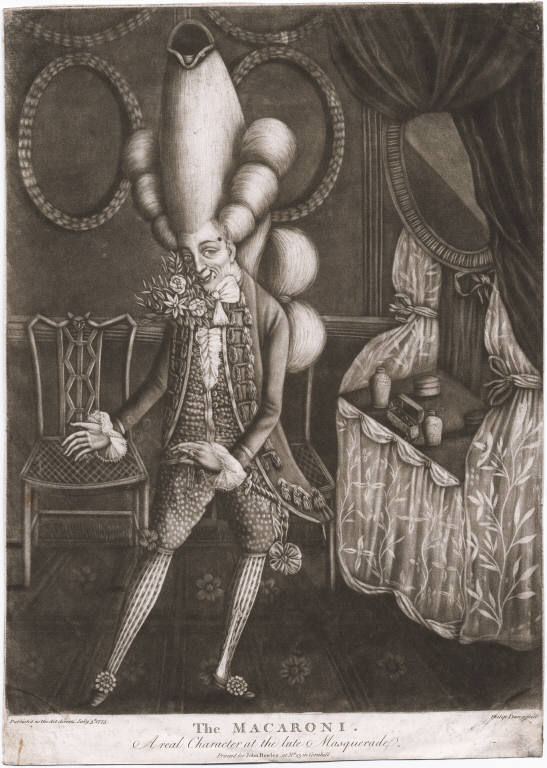
The “problem” with recent history is that the “centers of cultural production” do seem to be identifiable, and so are their motives. They are “Madison Avenue” and “to make money”, respectively, and so it’s easy — and profitable!! — to do the tiresome PoMo CultMarx thing. The further back into The Past you go, though … well, consider this:
As you can see from the caption, that style is called “macaroni” — like from the old song “Yankee Doodle,” which the Colonials appropriated in an early example of “owning the insult.” Wiki sez:
Stereotypically, men in the macaroni subculture dressed, spoke, and behaved in an unusually epicene and androgynous manner. The term “macaroni” pejoratively referred to a man who “exceeded the ordinary bounds of fashion” in terms of high-end clothing, fastidious eating, and gambling. He mixed Continental affectations with his British nature …
… The macaronis became seen in stereotyped terms in Britain, being seen as a symbol of inappropriate bourgeois excess, effeminacy, and possible homosexuality – which was then legally viewed as sodomy. At the time, homosexuality was frowned upon, and was even punishable by death. Many modern critics view the macaroni as representing a general change in 18th-century British society such as political change, class consciousness, new nationalisms, commodification, and consumer capitalism.
You see the typical “critical” blah blah blah there at the end, and it’s not wrong, just tedious, predictable, and tediously predictable. It’s also much harder to find a “purpose” for this behavior. It’s easy to do for the modern analogue of the macaroni, the hipster […] which Wiki documents extensively, because of course they do, it’s right there underneath “macaroni”. But the whole “culture industry” thing wasn’t there yet in the 18th century, so it might actually be down to an individual person. It’d be theoretically possible to find “the first macaroni” — it was the Marquis de Whatever, and he decided to dress like that because reasons, and all the best people decided to copy him, also because reasons, and that’s pretty much all your “cultural turn” can do, because that’s the only documentation we have.
Since we here are not bound by the canons of scholarship, however, we can speculate. I want to focus on this bit about macaronis:
In the 18th century, wealthy young British men traditionally took a trip around Europe upon their coming of age, known as the Grand Tour. Italy was a key destination of these tours. During their trip, many developed a taste for maccaroni, a type of pasta little known in Britain then, and so they were said to belong to the Macaroni Club, founded in 1764 by those returning from the Grand Tour. They would refer to anything that was fashionable or à la mode as “very maccaroni”.
That’s Information Velocity, preindustrial-style. They had to go there personally — or, at the very least, have access to the in-house journals of those who did:
The song “Yankee Doodle” from the time of the American Revolutionary War mentions a man who “stuck a feather in his hat and called it macaroni”. Dr. Richard Shuckburgh was a British surgeon and also the author of the song’s lyrics; the joke which he was making was that the Yankees were naive and unsophisticated enough to believe that a feather in the hat was a sufficient mark of a macaroni.
In America, only a select few persons would have access to that kind of thing, because only a few would move in those circles.
Go back a bit further, and cultural trends are far less traceable, but “centers of cultural production” are much easier to find, in one specific sense: They’re monasteries. And there you have a group which speaks a common language — extremely rare in the Middle Ages — is literate (ditto), and has something close to, if not caloric surplus, then at least “chronic caloric sufficiency”, I guess we’ll have to call it. Monks worked hard in the Middle Ages, by our standards, but not as hard as the peasantry. They were well-fed, or at least consistently fed, in a way the peasantry weren’t.
In other words, whatever Information Velocity existed in the Middle Ages, they had it. They made a virtue out of circulating books, and all those books were in a common tongue. Since they also produced books — indeed, were pretty much the only ones who did — they were also, by definition, au courant with whatever the high fashions were, because they illustrated the books that were such a crucial part of the aristocracy’s gift-giving culture.
Severian, “Monastic Vices”, Founding Questions, 2026-01-13.
August 3, 2026
“Find your Honest Broker, and your problems will be solved”
On his Substack, Ted Gioia explains how he became the “Honest Broker”:

This particular project brought me to China. I was trying to set up an operation in a remote province, far outside my comfort zone, and couldn’t seem to figure out how to maneuver among the various interests and stakeholders. My patron was one of the wealthiest men in Hong Kong, and by using his contacts, I gained access to people who normally operate behind layers of intermediaries and gatekeepers. But even these contacts led me on an endless runaround. My sources gave me conflicting advice and confusing directions. Everything felt wrong and nothing seemed quite on the level.
I knew I needed help, but had run out of options. Then I met the drunk Australian.
He wasn’t a contact on my list, and I can’t even remember his name. This was a chance encounter in a hotel bar late at night. But this hard-drinking Australian was talkative and had interesting things to say. He had spent most of his life bouncing around the capitals of Asia, and was a high-level operator in his own spheres. He bragged about his insider’s knowledge, and claimed — with some accuracy, as I came to discover — that he knew how to maneuver in China better than the clueless Westerners who were now appearing on the scene. He had traced the secret paths to power and knew all the dangerous mistakes amateurs always make.
He reeled off a list of them. “You go into a province or city and flash around some money, then expect the local officials will help you? Forget it. They’ll rob you blind, and even make you bribe them for the privilege. Same goes for the party leaders. From each according to his ability, and all that, my friend. And forget about lawyers — the legal protections here are like this” — he held up his empty glass, then flipped it over as if to emphasize the nothingness of what he was offering to the gods of Marx and Mao. “As for the bankers, you might as well call them wankers.”
The empty glass was also a sign that I needed to order another round of the local brew, and I quickly complied. My new friend fell into a meditative silence until further libations arrived. Finally, after another sip on the stomach-destroying glass of baijiu that passed for spirits at our watering hole, I asked the obvious question.
“So what do I do? Who can I trust?”
“That’s easy, mate. You need to find the Honest Broker.”
This sounded appealing enough, but I had zero idea what my new acquaintance was talking about. He might just as well have told me to go to Oz and consult with the Wizard.
“Who, exactly, is this Honest Broker?”
“There’s at least one in every city. But don’t expect their business cards to say ‘Honest Broker’ — that’s just what I call them. But that’s exactly what they are. Sometimes they don’t even have an official position. But they are the key to everything.”
He proceeded to explain how Honest Brokers play a hidden but vital role in communities without a history of legal protections and stable institutions. Their influence and power is built solely on a reputation for straight talk and trustworthy dealings. “They are true brokers, intermediaries between others. They aren’t going to participate in your deal, no matter what it is. They are go-betweens, really. But do not underestimate the power of this kind of brokerage. Whatever you need — a loan, a building permit, political influence, a place to land a private jet, whatever — they will introduce you to the right people and steer you away from the sharks.
“And they do this for a very simple reason: their prestige is enhanced by making these connections. In many cases, they don’t even want to be paid. Or let me put that differently — you repay them by becoming a trusted contact for them in future dealings. The Honest Broker may help you for free right now, but don’t be surprised if you’re asked for assistance on something completely different months or even years later. You Yanks have a hard time grasping it, and are always looking for shortcuts. But the Honest Broker plays the long-term game, mate.
“Find your Honest Broker, and your problems will be solved.”
This proved to be valuable advice, worth far more than the cost of drinks. Over the next few weeks, I changed my approach completely. I made inquiries, compared notes, and finally found my Honest Broker — who did solve my problems, just as promised. My mission accomplished, I returned back home to California and tried to forget all about it.
I put my passport out of sight. My world shrank back to manageable dimensions, and my days were spent at the two keyboards, the piano and the word processor. I was getting back into my music groove again.
A long time went by before I realized the real importance of what I had learned in China, and how it applied to the other half of my split and fractured life. I was putting energy into a new sphere now, music criticism, and trying to create a rule book for how to make it sizzle.
Yet criticism seemed such a degraded form of writing at that juncture. I had already seen the collapse in literary criticism — in fact, I had lived through it as a student at Stanford and Oxford. The whole enterprise had turned into a circus sideshow over the course of just a few years. Critics now aspired to quasi-celebrity status, and they exploited their roles as arbiters of taste to engage in the worst sort of strutting and preening. The more outlandishly they sold out their craft, opting instead for self-aggrandizement, the larger the rewards they received. This blight took root first in France but quickly spread elsewhere. And now the taint seemed to be seeping into other forms of criticism as well. Whether the subject at hand was a movie or a meal or a TV wrestling match, the critics were the real stars, and everything else subservient to their self-serving deconstruction of anything in their path.
July 30, 2026
Support for capital punishment is the opposite of a luxury belief
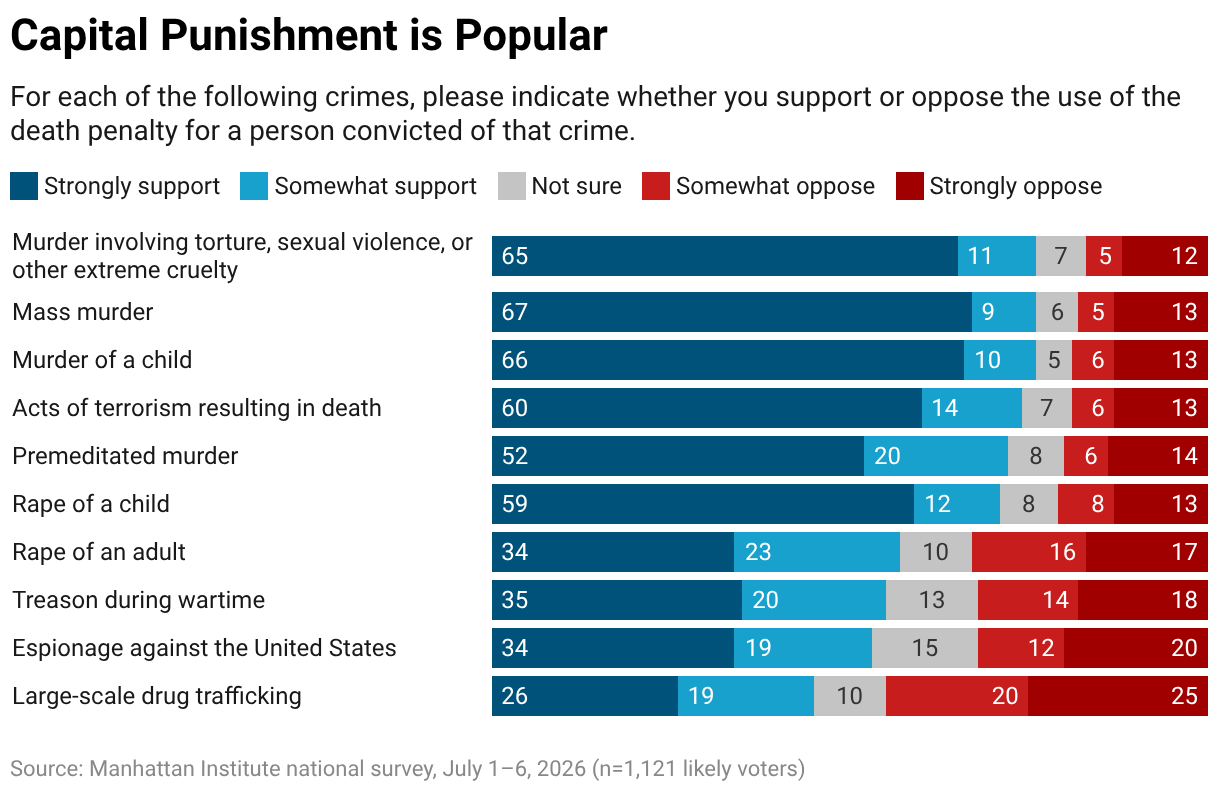
As noted in City Journal, support for capital punishment is overwhelmingly high … which is why politicians and wealthy progressives whole-heartedly oppose it. As you probably know, a “luxury belief” is one that is usually held by people who will not be in any way impacted by the downstream effects of that belief. It’s not the wealthy and privileged who suffer when murderers get out of prison, so they are generally all in favour of ever greater leniency in sentencing and easing parole conditions. Poor and middle class people are more likely to suffer when violent criminals return to their communities, which is why they generally want longer incarceration for violent crimes and favour capital punishment for certain abhorrent acts of murder. Charles Fain Lehman has more:
Those findings undermine the narrative, routinely advanced by death-penalty abolitionists, that capital punishment is on the decline because the public has turned against it. In reality, both public opinion and the current composition of the Supreme Court militate in favor of expanding the death penalty’s use — and, specifically, relaxing many of the arbitrary and undemocratic restrictions imposed on it by courts over the past several decades.
Abolitionists have based their case for declining public support on polls such as Gallup’s, which for nearly a century has asked respondents if they are “in favor of the death penalty for a person convicted of murder”. The share in favor has indeed dropped steadily since the 1990s, from a 64-point difference between support and opposition to just a 6-point split today.
That question, though, artificially reduces support by asking about all murders. Under current precedent, only certain heinous murders — those in which jury-determined aggravating factors outweigh mitigating factors — are eligible for the death penalty. There is likely far more support, for example, for executing Dylann Roof specifically than there is for executing all murderers generally.
The new MI poll illuminates this point. It asks about support for capital punishment under a variety of circumstances. The result is lopsided endorsement in the event of, for example, murder involving “extreme cruelty”, mass murder, or the murder of a child — all supported by 3-to-1 margins. Death for premeditated murder generically has 72 percent support, suggesting that even clarifying intent significantly increases support for capital punishment.
Notably, the poll also finds majority support for executing those who rape a child (71 percent) or an adult (57 percent). Yet neither offense would, absent a concurrent murder, be death-eligible. The Supreme Court ruled that applying the death penalty to non-murdering rapists violated the Eighth Amendment’s prohibition on “cruel and unusual punishment” in 1977’s Coker v. Georgia, a prohibition it extended even to child rapists in a 2008’s Kennedy v. Louisiana. With certain exceptions for crimes against the state, the Kennedy majority asserted, a crime that did not result in the taking of someone’s life was categorically ineligible for the death penalty.
Both decisions were justified by reference to the court’s “evolving standards of decency” test. First introduced in 1958’s Trop v. Dulles, the test has led the court to understand “cruel and unusual punishment” through its interpretation of “the evolving standards of decency that mark the progress of a maturing society”. That lens allowed it to reach the conclusions it did in Coker, Kennedy, and numerous other narrowings of the use of the death penalty. In combination with the aggressiveness and gamesmanship of the capital defense bar — which spends decades filing often-frivolous procedural motions to keep clearly guilty clients alive — the result has been a steady choking off of capital punishment.
Update, 31 July: Welcome, Instapundit readers! Have a look around at some of my other posts you may find of interest. I send out a daily summary of posts here through my Substack – https://substack.com/@nicholasrusson that you can subscribe to if you’d like to be informed of new posts in the future.
July 24, 2026
To Zohran Mamdani, “working class” means earning less than a million a year
Rob Henderson coined the fantastically useful phrase “luxury beliefs”, and regularly points out examples of people expressing beliefs that allow them to virtue signal at little or no cost, yet if the ideas were implemented would harm those not as privileged as the speaker:
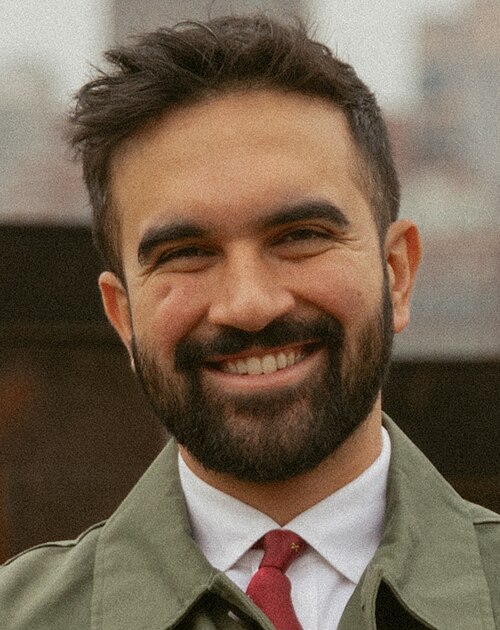
New York City mayor Zohran Mamdani, 10 February 2024.
Photo by Kara McCurdy via Wikimedia Commons.
In a recent New York Times interview, Zohran Mamdani, New York City’s socialist mayor, struggled to define “working class”.
At one point he was asked point-blank, “How do you define the working class?”
Mamdani replied, “I think if you have to work to pay your bills, I think that that is one definition of being a part of the working class”.
After some pushback from the interviewer, Mamdani said he would draw the line at “about a million dollars a year”. I have no idea how he can say that without any embarrassment, but that’s why he’s a politician and I’m not. Say what you will about him, but the man knows his base. These are the people who claim to be the champions of women yet — and please forgive what has now become a hackneyed line — can’t define what a woman is, and they claim to be the champions of the working class, yet can’t define what the working class is. Or they redefine both terms to be so expansive that they could potentially encompass just about everyone.
This is where the luxury belief class has steered us.
Anyone who isn’t a millionaire gets to be working class now. It sounds absurd but that’s where we’re at now. Remember during the primaries in 2015, Bernie Sanders said that “the millionaires and the billionaires” need to pay their fair share? At some point over the past decade, he dropped “millionaires” because he became one. Now you see the millionaires condemning only the billionaires. Mark my words, at some point in the not-too-distant future, you will see the billionaires disparaging the trillionaires. Maybe inflation will hasten that phenomenon.
Anyway, in that Mamdani interview, the focus on defining class by money is revealing.
People often conflate social class with economic class. This allows us to talk about the former while pretending we are talking about the latter.
It is easier to discuss income than educational pedigree, accent, hairstyle, clothing, taste, or zip code.
But education usually signals social class more clearly than income does.
Research has found that parental educational attainment is the most important objective indicator of social class. This is because, compared with parental income, parental education is a more powerful predictor of a child’s future lifestyle, tastes, and opinions. If your parents went to college but you didn’t, you’re still middle-class or higher. Not working class.
Education shapes habits, networks, and outlook long after the degree is earned. Higher education bestows cultural capital: patterns of speech, tastes, opinions, and expectations about life. Income may rise and fall over a lifetime. The worldview formed in selective institutions usually endures. By that standard, college graduates, regardless of earnings, are not working class.
Education also shapes political views more strongly than income does.
In 2021, Ezra Klein pointed out that “We tend to think of class as driven by income” but that “A high school dropout who owns a successful pest extermination company in the Houston exurbs might have an income that looks a lot like a software engineer’s at Google, while an adjunct professor’s will look more like an apprentice plumber’s. But in terms of class experience — who they know, what they believe, where they’ve lived, what they watch, who they marry and how they vote, act and protest — the software engineer is more like the adjunct professor.”
Plainly, a PhD who takes a job driving a taxi will tend to vote like other PhDs, not like other taxi drivers, especially if he or she also has a parent with a college degree.
It was so much easier to recognize the British classes, at least back in the 1960s that is:
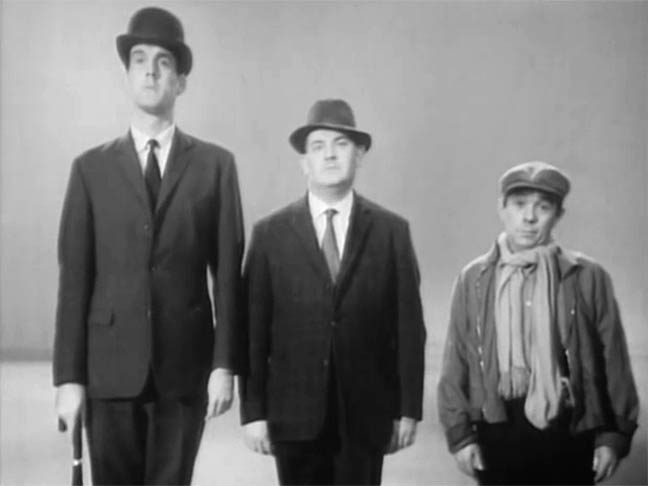
John Cleese, Ronnie Barker, and Ronnie Corbet as the avatars of the British upper, middle, and lower classes
Original version from The Frost Report, 7 April 1966.
June 22, 2026
Progressive intellectual arrogance
John Konrad tries to explain the apparently universal intellectual snobbery of progressives, which has brought pretty much every western country into the era of the expert:

Why is the left so arrogant?
Because they put their trust in a global elite. Not directly, but through the media and the universities the elite manipulate.
My dad always said it the other way around: privilege comes with responsibility. But responsibility is hard. Responsibility requires knowledge.
And in a world growing more complex and unpredictable by the year, understanding what’s happening around you takes more and more of it.
Twenty years ago you could walk through Manhattan around noon on a Sunday and watch half the city reading the Times. The thing was massive, but a fast, educated reader could come away with a decent picture of the whole world in a few hours.
Then two things happened.
Craigslist gutted newspaper revenue, and DEI mandates swapped great reporters for morally indignant j-school hacks. The quality and accuracy of information cratered.
At the same time, the internet roared to life and the world got radically more interconnected overnight.
So the elite grew less informed exactly as complexity exploded.
To cope, they borrowed a trick from NASA. There aren’t enough hours in the day to be the best rocket scientist and the best navigator and the best flight surgeon all at once. So mission control compartmentalized. The best person in each silo got a desk. Thruster problem? Everyone turns to the engine expert. Someone’s hurt? Everyone turns to the flight surgeon. The rocket guy never had to learn a thing about medicine.
The elite copied the model. They switched their brains off for anything outside their lane. Everyone specialized inside their own bubble.
But compartmentalization runs on trust. Put one bad actor in mission control, and the moment everyone turns to him, bad things happen.
To guard against that, they doubled down on credentialism. They learned to trust only the experts minted by certain colleges and blessed by certain think tanks.
And the bad actors had a field day. Fraud, disinformation, theft, all of it could happen inside a silo, unseen. And it did.
Then came a mission control director who told them not to worry. Everything was fine. They didn’t know what was going on, but he did, and he was smarter than all of them. He said so, right there in the meetings.
Everyone loves a brilliant, competent boss, especially a charismatic one who seems kind, because it means they no longer have to worry. He’s got it handled. Just trust him.
And trust Obama they did.
But he had nothing handled except his own aura. And he let Marxist actors run loose inside the silos that mattered, education and HR chief among them.
The right was skeptical, so they kept reading, kept hunting for alternative sources, kept trying to make sense of the complexity themselves. Nobody cracked it completely. But they started seeing the big red anomaly lights blinking across the dashboard.
So the smart people on the right kept building broad knowledge while the left stayed siloed. Ten years passed, and the left’s elite fell far, far behind.
They’re starting to see that Obama was a fool. But they’re stuck. You can’t cram ten years of missed homework into a few months. And they’re rich and powerful and have no interest in going back to school.
They have two options. Admit they were wrong and put in months, maybe years, of hard work to take responsibility for their actions. Or keep acting like sheep. If the rewards weren’t there, some might choose the work.
But the system is so riddled with fraud, so many hollowed-out silos kept on life support, that there’s more than enough money sloshing around the NGOs to fund their posh lives.
They have the privilege with none of the responsibility. It’s a comfortable place to sit. They don’t want to change.
But holding that position requires one thing: they have to believe their mission control director has it all under control and is smarter than anyone on the right.
The bottom line is the have to be arrogant. Or the whole house of cards comes down.
June 13, 2026
The Laurentian Elite
The people who actually rule Canada — including but not limited to Liberal Party members — don’t mind “populists” who want to “spread awareness”, because it’s about as ineffective as can be and dissipates some of the energy that might otherwise be used to oppose the Laurentian Elite’s preferred outcomes:
Homesteaders, agrarians, and populists relying on “spreading awareness”, protesting, or Americanisms like “we the people” and “the silent majority” aren’t nearly as effective or influential as people think they are.
A deeply unpopular Laurentian liberal elite minority, one that increasingly LARPs as blue-state Americans and takes its cues from them, managed to transform the country against the popular will.
Over a roughly twenty-year period between the 1940s and 1960s, they spent decades scheming behind the scenes. They changed the flag, lured French Canadians into supporting them through the Royal Commission on Biculturalism and Bilingualism by promising greater national recognition of Canada’s French heritage, then dropped the whole thing almost immediately. They pulled the rug out from under them and basically said, “SYKE, you thought. Here’s infinite immigrants instead.”
In 1971 they pushed multiculturalism and the cultural mosaic, abolished assimilation while polling showed around 80% of Canadians opposed increased immigration. They later entrenched their ideology through the Charter of Rights and Freedoms, stacked and empowered a judiciary that would future-proof it, formalized the project through the 1988 Multiculturalism Act, and gradually consolidated influence over the media, education system, and cultural institutions.
The result was a decades-long effort to indoctrinate Canadians into viewing their country as a post-national economic zone built on stolen land called Turtle Island, where Canadians don’t exist, but foreigners are just as Canadian as you and me, borders are morally questionable, and none is illegal on stolen land.
This isn’t going to be reversed through awareness campaigns, symbolic protests, or endlessly posting facts online. Political systems are ultimately shaped by elites and counter-elites. The only way this order gets replaced is if a rival elite, or a political force capable of becoming one, displaces the existing ruling class and takes its place.
That process will almost certainly involve some degree of populism, but populism by itself is not enough. You need people who can actually build institutions, wield power, and replace the current establishment rather than just complain about it or bug off into the woods, or try to balkanize the country.
June 9, 2026
“… prior opportunities for mental health evaluations were missed”
So shocking a crime, yet the reaction of the elites really does seem to boil down to “black on white violence is just something we have to put up with” or, even worse, “it’s the fault of systemic racism, homophobia, transphobia, etc., etc. …”. This was originally posted last year, but nothing significant has changed:

In the 6 weeks since the gruesome murder of Iryna Zarutska, we’ve had time to learn what politicians and the courts and the media think her death means.
And that’s this: Nobody is responsible. Brutal black-on-white violence is either a depersonalized fact of nature, like bad weather, or it’s a sort of just retribution by the oppressed against a racist society. We’re to avert our eyes, to forget the psychotic mumbling “I got that white girl! I got that white girl!” He’s just crazy. The mumbles don’t mean anything, and if they mean something it means that white people deserved it.
But it does mean something very definite. It means that white girls like Iryna can no longer trust that society will make any systematic effort to deter Black psychotics from murdering them.
An LLM, asked to summarize, says “prior opportunities for mental health evaluations were missed”. That agentless, passive language is perfect; no one did anything. No one is responsible, and no one, not even the murderer, can be held accountable.
The purpose of a system is what it does. The purpose of our justice system is to allow grisly murders to happen, as long as the victim sorts into an oppressor class and the perpetrator to sort into an oppressed one. If Iryna’s death hadn’t been caught live on video all our institutions would have colluded to make us forget it.
Institutions like the Community Relations Service. Which for 60 years until President Trump just defunded it, strongarmed white victims of racial hate crimes into keeping silent or uttering anodyne denials that race hatred could be a factor.
Blacks, 13% of the population, commit at least 60% of serious index crimes, murder and rape and felony assault. The actual percentage is probably higher, since there’s increasing evidence that Black crime is underreported by police and officials as a way of managing racial tensions downwards. In a fair system, this would predict that a solid majority of the state and federal prison population is Black. The actual percentage is about 33%
Blacks are privileged. They’re under-arrested, under-indicted, under-imprisoned, and (despite popular mythology) less likely to be killed during a police stop than a white person is.
It’s exactly by treating Blacks as a privileged class, licensed to act from racial hatred and mumble “I got that white girl!”, that we got to the point where. Iryna Zarutka bled to death on live video.
The grimmest fact about her murder other than the horrific death itself is that six weeks later, nobody is talking about black privilege.
It’s time to start having that conversation, and it’s time to start using the term “black privilege” for the combination of systematic averaion and viciousness that led to Iryna Zarutska dying, innocent and alone and abandoned by the system that should have protected her.
June 5, 2026
QotD: Modern men and the need for male spaces
Internet men believe that some kind of man-space is essential. A place for men to be men, mentor other men, and tell younger men the secret wisdom to get their lives on track. That if only we had these spaces, everything would be great for men because we’d all know the secret wisdom that doesn’t actually exist.
Internet women believe that male spaces are dens of misogyny. Places where trollish men want to gather, away from the eyes and ears of right-thinking people, so they can poison other men with hate and bigotry.
Which is silly. Men don’t hate women because other men told them to. They see women being women, and that does the trick just fine. In fact, if a man is getting hourly blowjobs from every woman whose path he crosses, then some group of troll men try to tell him women suck, he’d be confused at how uninformed these men are when women are clearly awesome.
Women’s behavior is the number-one driver of misogyny. Not men telling other men women suck.
And that’s the point of male spaces. Not secret manly-man wisdom, not chattering about woman-hate. A space where men can just be. Without women there.
Women are … a certain way.
This is especially true of middle-class and richer women, and even a little more true of white women than other kinds. But true of all women to some extent.
Women have this way about them — everything they do, say, everything about how they behave — that just subtly communicates that they do not have a lot of experience with consequences. That they are just not that used to considering consequences seriously before doing something.
I’m usually hesitant to use political buzz-words in a non-ironic way, but I think the term “privileged” is pretty perfect for this situation.
A woman’s reality — her experience — is a world where consequences just aren’t quite as big of a deal for her as they are for others. She’s never really had to consider consequences with quite the same intensity.
It’s important to note that this isn’t some kind of overt, intentional flaunting as women stride around, consequence-free, thumbing their noses at us. Women don’t even know this is a thing. They’ll deny it fiercely if you tell them. They don’t feel privileged, and their feelings are always real. They’ll even tell you that you’re the privileged one, not them. Because that feels right to them.
It’s not something they do on purpose, and it’s not even that frontal and pronounced. It’s very subtle. Just this subtle way that women are. When they talk, act, make decisions.
This makes them very irritating. Even women find each other irritating.
Archwinger, “Male spaces are because women are irritating”, Archwinger’s Substack, 2026-02-25.
April 30, 2026
Latest luxury belief just dropped: “microlooting”
Rob Henderson identifies the latest addition to the broad suite of luxury beliefs held by the over-educated, over-privileged people who will never bear the costs of their anti-civilizational thoughts:

In a 1955 essay titled “The English Aristocracy”, novelist Nancy Mitford suggested that as goods became more affordable, England’s upper classes could no longer rely on material possessions to distinguish themselves from the masses. Instead, Mitford wrote, “it is solely by their language that the upper classes nowadays are distinguished”.
Jia Tolentino and Hasan Piker proved this point last week in a conversation hosted by Nadja Spiegelman at the New York Times. It unfolded in a carefully staged loft that signaled taste and status. Ms. Spiegelman proposed a new word for shoplifting: “microlooting”. Mr. Piker later remarked that “many Americans, I think, are totally oblivious to this political language”.
“Stealing” sounds so tawdry. Microlooting is cleaner — a minor offense laundered into a boutique act of political protest. Indeed, much of upper middle class life is about rebranding disreputable behaviors to retain one’s position in the social hierarchy. The pattern is familiar. Mitford sorted vocabulary into “U” (upper class) and “non-U”. U-speakers said “vegetables” and “spectacles” and “lavatory”. Non-U speakers said “greens” and “glasses” and “toilet”.
Today, the favored words of the upper class come from a mishmash of therapy culture and human resources. Lazing off at work has become “acting your wage”. Saying no means “setting boundaries”. Infidelity is “ethical nonmonogamy”. Prostitution is “sex work”. Divorce can be called “conscious uncoupling”. Neglecting close relationships is “protecting your peace”. Listening to someone vent is “emotional labor”. Recall that in 2021 the AP Stylebook announced that a “mistress” must now be called a “companion, friend or lover”.
And shoplifting is “microlooting”.
Five years ago, I texted a high-school friend who had been released from prison. “Good news”, I told him. “You’re not an ex-felon anymore, you’re a justice-involved person.” He replied, “Okay Rob, you’re not a college graduate anymore, you’re a classroom-involved person.”
At UnHerd, Poppy Sowerby pours scorn on the well-to-do New Yorkers’ sudden discovery that “five finger discounts” are fun and socially conscious ways to strike back at “the man”:
The New Yorker columnist Jia Tolentino, the NYT‘s Nadja Spiegelman, and Hasan Piker — the midwit Marxist streamer accused of electrocuting his dog and who admitted having solicited a prostitute (not so against the free market now, ey?) — gabbed about “microlooting” — small thefts justified by the fact that, as Spiegelman puts it, “It’s so hard to live ethically in an unethical society”. Quick-fire scenarios are floated; stealing from the Louvre, Piker says, is “cool”. Stealing from supermarket chains is “not a big deal” in a “utilitarian sense”, says Tolentino. And Spiegelman wonders why she should “have to pay for organic avocados” when Jeff Bezos “has too much money” (Amazon, which he founded, acquired Whole Foods in 2017). Antisocial behaviour is justified here — explicitly or tacitly — under the lazy logic of “protest”.
Unlike microlooting, however, Tolentino finds “getting iced coffee in a plastic cup … profoundly selfish, immoral [and] collectively destructive” — presumably the bimbo-coding of that drink is unrelated. The lines of moral permissibility seem to be drawn, in other words, along the exact same lines of what these rich, educated progressives consider “cool”.
And that’s the real problem. Progressives have always found extravagant ways to reframe the ills which they personally enjoy — prostitution, pornography, choking women. Now shoplifting gets the same treatment. Tolentino is not really stealing lemons because it’s a way of flipping the bird at Bezos; she’s stealing them because she wants them. Nor are the barrier-bumpers actually trying to signal their dissatisfaction with the frequency or cleanliness of public transport — reasoning I have actually heard with my own ears, despite the fact these things can only be improved by the very funding the free riders are withholding; they are bumping barriers because they just don’t want to pay. Nicking groceries and dodging fares are age-old problems. What’s new is the towering cowardice of those who can’t admit that they, like most people, act mainly out of self-interested desire.
The appealing but deceptive idea that low-level criminality is a laudable demonstration against “the system” in fact conceals envy towards those in that “system” who, like Bezos, have known success. This resentment is particularly native to the media class, whose peers tend to out-earn them in higher-salaried fields like law and finance — conferring on writers like Spiegelman and Tolentino the faintly plausible whiff of bookish martyrdom. Nevertheless, and particularly in New York, mag luminaries can still live in $2.2 million brownstones in Clinton Hill; sticking it to the man by pilfering in the produce aisle might pass in grim artists’ squats, but five-finger discounts are harder to justify on six-figure salaries.
Update, 1 May: Welcome, Instapundit readers! Have a look around at some of my other posts you may find of interest. I send out a daily summary of posts here through my Substack – https://substack.com/@nicholasrusson that you can subscribe to if you’d like to be informed of new posts in the future.
April 26, 2026
QotD: College Town, USA
It’s not “change” in the sense we understand, and instinctively accept — it’s not “change” in the way the seasons change. It’s directed change — somebody decided to do it. And if it’s not immediately apparent who, or why, we are naturally suspicious. We are “based”, if you will, in the Permanent, so we are acutely aware of the deliberate aspects of the Impermanent.
City life gives you the opposite, indeed overwhelming, sense of Permanent Impermanence. Nothing stays the same; the only constant is change. I remember seeing it in College Town, which was not particularly large, population-wise, but had almost all the “amenities” you’d expect from a major metro. Bearing in mind, as always, that “College Town” is a composite of several different places … but they’re all basically the same, and that’s the point.
The first thing that struck me about College Town — that you see in every College Town, coast to coast — was how shabby it was. Even the brand-new apartment complexes (of which there were many, Higher Ed being a growth industry at that time) all looked dilapidated. The next thing I Noticed was the lack of institutions. College Town had every imaginable “amenity” — exotic cuisine, 24 hour everything — but no playgrounds, no ball fields, no churches. Hardly any schools, despite being pretty good size relative to the surrounding area, because why would there be? All that stuff is for people who actually live there, as opposed to the transients, or even the “permanent residents”, if you will, on the faculty (what an unconsciously telling phrase that is!).
Nobody’s from there, and nobody stays there. Not even the faculty — they always have one foot out the door, no matter if they’re Department Chairs with 30+ years’ seniority. It is crucial to their amour-propre to believe that they’re always about to get the call from Harvard, which in part explains the weird phenomenon of the “faculty ghetto”. They’ll spend a zillion dollars “restoring” a frankly tiny house in the “historic” district, by which is meant “gutting it, and making it as close to a Current Year McMansion as the physical infrastructure can bear”. Then they’ll spend a zillion more on yearly maintenance, when they could’ve gotten twice the house, with the latest and greatest everything, built to spec on the outskirts of town …
… which is five minutes away; it’s not like they’re facing some huge commute (and it’s not like they walk or even bike to campus, and God forbid they take the bus. No, they’d much rather gut or knock down another old building, just to have a garage in which to park the huge gas-guzzling SUV they drive the 45 linear feet to “work”, because how else would they show off how important they are, without parking in their designated space in the one fucking lot in the entire town?).
In other words, they don’t want to admit that they live there — they are, at most, “permanent residents”. There are no public playgrounds, because their one designer baby isn’t going to rub elbows with the children of the few greasy proles they grudgingly tolerate in the absolutely necessary service industries — you know, the mechanics and plumbers and snow plow drivers and such. There are no churches, just one or two Temples of the Current Thing, and only to the extent that a few of them have paraphilias involving clerical vestments. No ball fields, no Cub Scout packs or Elks Lodges or American Legion posts, because c’mon man. A town that size anywhere else would have a Walmart and a Minor League team and a big rivalry game between the local high schools; College Town has head shops and Egyptian-Thai fusion cuisine and DoorDash.
Permanent Impermanence, in other words. Deliberate impermanence. Nothing lasts, nothing can last, nothing should last. There are some people who find that attitude — which I would call straight-out, shit-flinging nihilism — deeply appealing, and … well … there it is.
Severian, “Transience”, Founding Questions, 2026-01-19.
February 23, 2026
“Public intellectuals”
Ted Gioia charts the rise of what we now struggle to avoid … the “public intellectual”:
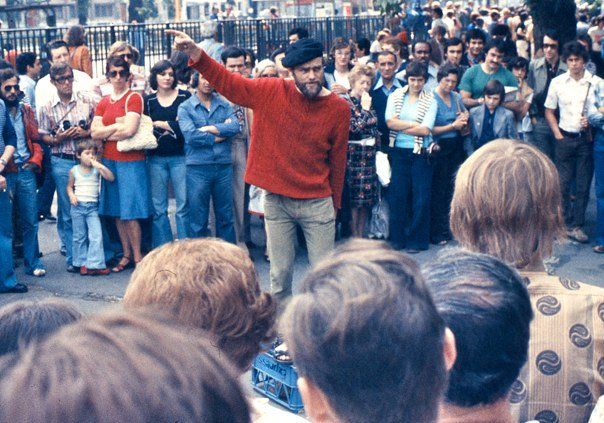
“Orator at Speakers’ Corner, London, with crowd, 1974” by GeorgeLouis is licensed under CC BY-SA 3.0 

 .
.
I see this term “public intellectual” everywhere nowadays — and it has a nice ring about it. It summons up images of speakers standing on soapboxes proclaiming the truth to passers-by.
That’s actually happened in places like London’s Hyde Park and 125th Street in Harlem. It sounds so very fair and democratic. Not every intellectual teaches at Harvard and Yale. Sometimes they really do exist out in the wild. We ought to nurture and support them.
Not long ago, these same people were often called “working class intellectuals”. I had two uncles who could be described that way — they lacked prestigious degrees and institutional affiliations. They grew up poor, but were smart and well-read and could speak articulately on almost any subject.
A few colleges specialized in educating these working class intellectuals. Consider the case of City College of New York, where the finest minds of the proletariat got book learning on the cheap. (You can find a list of CCNY alums and profs here — it includes an impressive number of Nobel laureates and Pulitzer Prize winners.)
But those days are long gone. Working-class intellectuals have vanished in recent years. Instead we have witnessed the rise of millionaire — or billionaire — intellectuals.
There have always been super-rich people, but in the past they kept a low profile. In my youth, the wealthiest person in the world was Howard Hughes, and he stayed in hiding for the last two decades of his life — you couldn’t even find a current photograph of the man.
He was doing us a favor. Hughes was rumored to have abandoned all the niceties of personal hygiene.
During the last fifteen years of his life, Hughes was described as a tall gaunt skeleton of a man with long, unwashed matted hair, a scraggly beard, and fingernails and toenails of such length that curled in upon themselves. He dressed only in a pair of dirty undershorts or went nude.
Believe it or not, Martin Scorsese cast Leonardo DiCaprio to play Hughes in the biopic. You gotta love Hollywood.
Hughes briefly emerged from seclusion on just one occasion. On January 7, 1972, he made a brief phone call from the Bahamas to seven journalists assembled in a room in a Hollywood hotel. This was necessary because a scamming author had published a fake autobiography attributed to Hughes, and the world’s richest man wanted to denounce it as a fraud.
He spoke on the phone for a few minutes, then signed off. That was the last time the media had any contact with Howard Hughes.
After Hughes’s death, the richest person in the world was Daniel Ludwig. You have probably never heard his name. But that’s no surprise — Ludwig was even more reclusive than Hughes. He lived for 95 years, and only gave one interview during that time.
Fast forward to today. Elon Musk is now the wealthiest person in the world — and he’s making proclamations every day. He even bought his own social media platform, and posts his opinions constantly. He’s the reverse of Howard Hughes. You can’t escape him. And unless he flies off to Mars, you never will.
It’s not just Musk. There are dozens of billionaires who aspire to public intellectual status. Bill Gates serves up book reviews. Peter Thiel gives a lecture series. Tom Steyer makes speeches and offers himself as a candidate for President.
We have come a long, long way from the working class intellectuals and soapbox pundits of yore. Everything now is pay-to-play.
How did this happen? When did the status of public intellectual become something you can buy, like merchandise on the shelf at a Rodeo Drive boutique?
February 13, 2026
The selective ability to override any non-criminal law is a “useful tool to have”
The Canadian government is trying to get even more power to exempt their friends and favoured companies from needing to comply with any federal laws or regulations through a provision in an omnibus bill before Parliament. It may sound like a tool to dispense privileges and favours to politically well-connected individuals and organizations, but that’s only because that’s exactly what it does:

In a little-noticed provision included in the government’s latest omnibus bill, Carney government ministers would be able to override almost any non-criminal law they wanted, and provide special treatment to any person or corporation who requested it.
When pressed about the clause in a House of Commons committee this week, Minister of Canadian Identity Marc Miller called it a “useful tool to have”.
The provision is included in C-15, the 634-page “budget implementation” bill currently before the House of Commons.
Among its hundreds of amendments and orders are new powers allowing ministers to hand out special exemptions from any “Act of Parliament” under their purview.
This means that the minister of health would be able to issue exemptions from the Canada Health Act, the Indigenous services minister could oversee exemptions from the Indian Act and the minister of finance would be able to override the Income Tax Act.
Furthermore, ministers could hand out these exemptions to any “entity” they wanted. Under federal guidelines, an “entity” can mean everything from an individual to “a corporation” to an “unincorporated organization”.
You don’t need to be a conspiracy theorist to see all kinds of ways that this provision could be abused to circumvent the normal rules everyone else is bound by. On the social media site formerly known as Twitter, Wall Street Apes reacts:

I can’t even believe this is real
Canada Minister Marc Miller is questioned about their new bill under the Liberal government led by Prime Minister Mark Carney that would EXEMPT ALL MINISTERS FROM ALL LAWS
Yes, you heard that correctly
Hidden in the omnibus budget implementation bill, section 208 or clause 12 amends the Red Tape Reduction Act to grant federal cabinet ministers broad discretionary powers
Ministers would be able to temporarily exempt any individual, company, organization, or entity from the application of almost any provision of any federal law (or regulations made under those laws) that the minister is responsible for administering or enforcing, with the sole exception of the Criminal Code
They can themselves, and deem anyone they choose exempt from ALL laws. The only exception is the criminal code
He says you can trust them because “Canadians expect us to act reasonably”
(Holy cr*p)
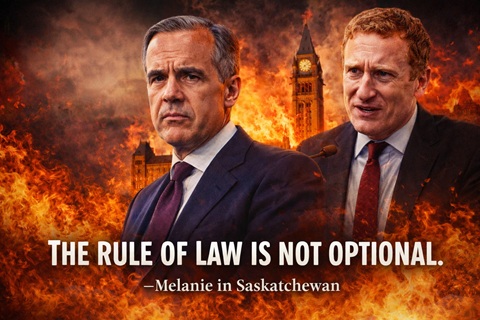
On her Substack, Melanie in Saskatchewan explains why the rule of law is not optional in Canada:
So let us play this forward. A Beijing connected firm establishes operations in Canada. It hires lobbyists. It meets with the appropriate minister. It argues that certain federal regulations are barriers to innovation or economic growth. Under Bill C 15, that minister could grant a temporary exemption. The company does not need to change Canadian law. It does not need to persuade Parliament. It only needs to persuade the right minister.
That is what should alarm Canadians.
When laws become selectively waivable by political discretion, they cease to be stable guardrails and become negotiable privileges. And power, once granted, is never granted because someone intends to leave it unused.
You tell us this is about economic growth amid trade tensions. Yet Canadians were told you were elected to steady the ship on trade and tariffs, to negotiate strength abroad, to stabilize economic uncertainty. Instead, trade tensions persist, tariffs remain contentious, and what advances efficiently is domestic policy architecture that conveniently aligns with the climate finance world you know so well.
Brookfield’s climate investment arm stands to benefit enormously from aggressive climate frameworks. You remain heavily invested. The potential for substantial personal financial gain is not speculation. It is disclosed reality.
You were not elected to refashion Canada into a climate investment thesis calibrated to suit global asset management portfolios. You were elected to manage trade pressures and protect Canadian economic interests.
This exemption clause is not a minor technical detail. It is a structural shift in how power is exercised. If it is so defensible, extract it from the omnibus bill and introduce it as standalone legislation. Let it be debated openly. Let Canadians see it clearly.
Implement a robust foreign agent registry immediately. Answer why a government that acknowledges compromised parliamentarians believes this is the moment to expand ministerial discretion over who must follow federal law.
The rule of law is not optional.
And Canadians did not vote for a system where compliance is mandatory for citizens but negotiable for the well connected.
January 22, 2026
QotD: Higher education
No; I came to the conclusion that the cause of the revolutionary guerrilla movements was the expansion of tertiary education in countries where it had not long before been the province only of the elite, largely, though never entirely, hereditary. (For the poor, gifted, and ambitious, the army was the route to social ascension.)
Tertiary education, however, was expanded with comparative suddenness. Before it was expanded, those who had it, being few, were more or less guaranteed important roles in the economy and government. They had already drawn a winning ticket in the lottery of life. Not surprisingly, a false syllogism insinuated itself into the minds of the newly educated: If the rich were educated and important, then being educated would make you rich and important. Again not surprisingly, this turned out not to be the case. If you turn out thousands of lawyers, for example, the remuneration of their work, if they find any, will be reduced and they will be disappointed in their hopes and expectations. They become angry, bitter, and disaffected, believing themselves not to be valued at their inestimable worth. They and their ilk became the middle ranks of the guerrillas (the very uppermost reaches being filled mainly by the narcissistic, spoiled sprigs of the upper classes). Only revolution would acquire for them the positions of influence and importance to which they felt that their education entitled them, and which such education had always entitled people to in the past.
Is it possible that Latin America was not so much in the rear as in the forefront of this modern social development (the case of Sendero Luminoso, the Shining Path of Peru, was a pure culture of this phenomenon)? Is it not possible that we in our societies have duped tens of millions of young people into believing that the prolongation of their formal education would lead them inexorably into the sunny uplands of power, importance, wealth, and influence, when in fact many a PhD finds himself obliged to do work that he could have done when he was 16? No one likes to think that he has been duped, however (it takes two for fraud to be committed, after all), so he looks around for some other cause of his bitter disappointment. It isn’t ignoramuses who are pulling down the statues, but ignoramuses who think that they have been educated.
Theodore Dalrymple, “Bees With Degrees”, Taki’s Magazine, 2020-07-02.
Update, 24 January: Welcome, Instapundit readers! Have a look around at some of my other posts you may find of interest. I send out a daily summary of posts here through my Substack – https://substack.com/@nicholasrusson that you can subscribe to if you’d like to be informed of new posts in the future.


